


Romans 4:17
- καθὼςkathōseven asG2531CONJConjunction
- γέγραπταιgegraptaiit has been writtenG1125V-RPI-3SVerb Perfect Passive Indicative 3rd Singular
- ὅτιhotithatG3754CONJConjunction
- πατέραpateraA fatherG3962N-ASMNoun Accusative Singular Masculine
- πολλῶνpollōnof manyG4183A-GPNAdjective Genitive Plural Neuter
- ἐθνῶνethnōnnationsG1484N-GPNNoun Genitive Plural Neuter
- τέθεικάtetheikaI have madeG5087V-RAI-1SVerb Perfect Active Indicative 1st Singular
- σεseyouG4771P-2ASPersonal pronoun Accusative 2nd Singular
- κατέναντιkatenantibeforeG2713PREPPreposition
- οὗhouwhomG3739R-GSMRelative pronoun Genitive Singular Masculine
- ἐπίστευσενepisteusenhe believedG4100V-AAI-3SVerb Aorist Active Indicative 3rd Singular
- θεοῦtheouGodG2316N-GSM-TNoun Genitive Singular Masculine Title
- τοῦtouwhoG3588T-GSMDefinite article Genitive Singular Masculine
- ζῳοποιοῦντοςzōopoiountosis giving lifeG2227V-PAP-GSMVerb Present Active Participle Genitive Singular Masculine
- τοὺςtousto theG3588T-APMDefinite article Accusative Plural Masculine
- νεκροὺςnekrousdeadG3498A-APMAdjective Accusative Plural Masculine
- καὶkaiandG2532CONJConjunction
- καλοῦντοςkalountoscallingG2564V-PAP-GSMVerb Present Active Participle Genitive Singular Masculine
- τὰtathe [things]G3588T-APNDefinite article Accusative Plural Neuter
- μὴmēnotG3361PRT-NNegative Particle Negative
- ὄνταonta[into] beingG1510V-PAP-APNVerb Present Active Participle Accusative Plural Neuter
- ὡςhōsasG5613PRTParticle or Disjunctive
- ὄντα·ontaexistingG1510V-PAP-APNVerb Present Active Participle Accusative Plural Neuter
English is a literal word-by-word gloss of the Greek, not the KJV's wording. Why?
This is the original text the KJV's translators worked from — each Greek word with its own literal English meaning in this verse, prepared by scholars at Tyndale House, Cambridge. The KJV translates whole sentences, not word by word, so its wording differs: one Greek word can become several English words, and the KJV may choose “charity” where the gloss reads “love”. Both are faithful — they answer different questions. For the KJV's own rendering, switch to the KJV text.
Details
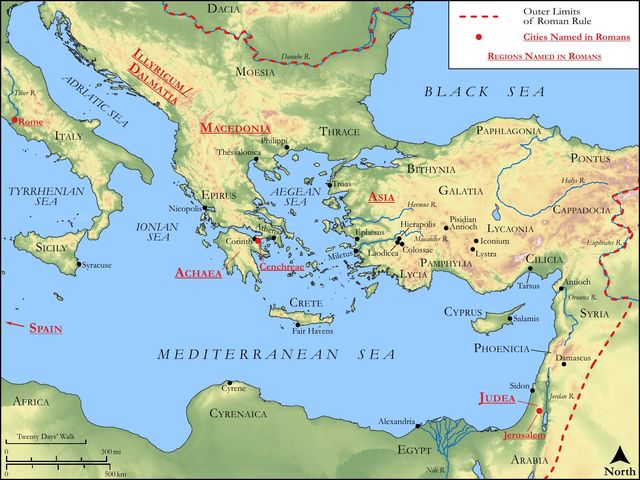
See on the biblical-era map

Study this verse
Public-domain commentary
Matthew Henry
From his Commentary on the Whole Bible. Henry comments on passages, not single verses — this entry covers Romans 4:17–22. His two-level outline is real structure in the source text, so it is rendered as structure.
Having observed when Abraham was justified by faith, and why, for the honour of Abraham and for example to us who call him father, the apostle here describes and commends the faith of Abraham, where observe,
I.Whom he believed:
God who quickeneth. It is God himself that faith fastens upon: other foundation can no man lay. Now observe what in God Abraham's faith had an eye t - o that, certainly, which would be most likely to confirm his faith concerning the things promised: - 1. God who quickeneth the dead. It was promised that he should be the father of many nations, when he and his wife were now as good as dead (Heb 11:11, Heb 11:12), and therefore he looks upon God as a God that could breathe life into dry bones. He that quickeneth the dead can do any thing, can give a child to Abraham when he is old, can bring the Gentiles, who are dead in trespasses and sins, to a divine and spiritual life, Eph 2:1. Compare Eph 1:19, Eph 1:20. 2. Who calleth things which are not as though they were; that is, creates all things by the word of his power, as in the beginning, Gen 1:3; Co2 4:6. The justification and salvation of sinners, the espousing of the Gentiles that had not been a people, were a gracious calling of things which are not as though they were, giving being to things that were not. This expresses the sovereignty of God and his absolute power and dominion, a mighty stay to faith when all other props sink and totter. It is the holy wisdom and policy of faith to fasten particularly on that in God which is accommodated to the difficulties wherewith it is to wrestle, and will most effectually answer the objections. It is faith indeed to build upon the all-sufficiency of God for the accomplishment of that which is impossible to anything but that all-sufficiency. Thus Abraham became the father of many nations before him whom he believed, that is, in the eye and account of God; or like him whom he believed; as God was a common Father, so was Abraham. It is by faith in God that we become accepted of him, and conformable to him.
II.How he believed.
He here greatly magnifies the strength of Abraham's faith, in several expressions.
1.Against hope, he believed in hope, Rom 4:18. There was a hope against him, a natural hope. All the arguments of sense, and reason, and experience, which in such cases usually beget and support hope, were against him; no second causes smiled upon him, nor in the least favoured his hope. But, against all those inducements to the contrary, he believed; for he had a hope for him: He believed in hope, which arose, as his faith did, from the consideration of God's all-sufficiency. That he might become the father of many nations. Therefore God, by his almighty grace, enabled him thus to believe against hope, that he might pass for a pattern of great and strong faith to all generations. It was fit that he who was to be the father of the faithful should have something more than ordinary in his faith - that in him faith should be set in its highest elevation, and so the endeavours of all succeeding believers be directed, raised, and quickened. Or this is mentioned as the matter of the promise that he believed; and he refers to Gen 15:5, So shall thy seed be, as the stars of heaven, so innumerable, so illustrious. This was that which he believed, when it was counted to him for righteousness, Rom 4:6. And it is observable that this particular instance of his faith was against hope, against the surmises and suggestions of his unbelief. He had just before been concluding hardly that he should go childless, that one born in his house was his heir (Rom 4:2, Rom 4:3); and this unbelief was a foil to his faith, and bespeaks it a believing against hope.
2.Being not weak in faith, he considered not his own body, Rom 4:19. Observe, His own body was now dead - become utterly unlikely to beget a child, though the new life and vigour that God gave him continued after Sarah was dead, witness his children by Keturah. When God intends some special blessing, some child of promise, for his people, he commonly puts a sentence of death upon the blessing itself, and upon all the ways that lead to it. Joseph must be enslaved and imprisoned before he be advanced. But Abraham did not consider this, su katenoēse - he did not dwell in his thoughts upon it. He said indeed, Shall a child be born to him that is a hundred years old? Gen 17:17. But that was the language of his admiration and his desire to be further satisfied, not of his doubting and distrust; his faith passed by that consideration, and thought of nothing but the faithfulness of the promise, with the contemplation whereof he was swallowed up, and this kept up his faith. Being not weak in faith, he considered not. It is mere weakness of faith that makes a man lie poring upon the difficulties and seeming impossibilities that lie in the way of a promise. Though it may seem to be the wisdom and policy of carnal reason, yet it is the weakness of faith, to look into the bottom of all the difficulties that arise against the promise.
3.He staggered not at the promise of God through unbelief (Rom 4:20), and he therefore staggered not because he considered not the frowns and discouragements of second causes; su diekrithē - he disputed not; he did not hold any self-consultation about it, did not take time to consider whether he should close with it or no, did not hesitate nor stumble at it, but by a resolute and peremptory act of his soul, with a holy boldness, ventured all upon the promise. He took it not for a point that would admit of argument or debate, but presently determined it as a ruled case, did not at all hang in suspense about it: he staggered not through unbelief. Unbelief is at the bottom of all our staggerings at God's promises. It is not the promise that fails, but our faith that fails when we stagger.
4.He was strong in faith, giving glory to God, enedunamōthē - he was strengthened in faith, his faith got ground by exercise - crescit eundo. Though weak faith shall not be rejected, the bruised reed not broken, the smoking flax not quenched, yet strong faith shall be commended and honoured. The strength of his faith appeared in the victory it won over his fears. And hereby he gave glory to God; for, as unbelief dishonours God by making him a liar (Jo1 5:10), so faith honours God by setting to its seal that he is true, Joh 3:33. Abraham's faith gave God the glory of his wisdom, power, holiness, goodness, and especially of his faithfulness, resting upon the word that he had spoken. Among men we say, "He that trusts another, gives him credit, and honours him by taking his word;" thus Abraham gave glory to God by trusting him. We never hear our Lord Jesus commending any thing so much as great faith (Mat 8:10 and Mat 15:28): therefore God gives honour to faith, great faith, because faith, great faith, gives honour to God.
5.He was fully persuaded that what God had promised he was able to perform, plērophorētheis - was carried on with the greatest confidence and assurance; it is a metaphor taken from ships that come into the harbour with full sail. Abraham saw the storms of doubts, and fears, and temptations likely to rise against the promise, upon which many a one would have shrunk back, and lain by for fairer days, and waited a smiling gale of sense and reason. But Abraham, having taken God for his pilot, and the promise for his card and compass, resolves to weather his point, and like a bold adventurer sets up all his sails, breaks through all the difficulties, regards neither winds nor clouds, but trusts to the strength of his bottom and the wisdom and faithfulness of his pilot, and bravely makes to the harbour, and comes home an unspeakable gainer. Such was his full persuasion, and it was built on the omnipotence of God: He was able. Our waverings rise mainly from our distrust of the divine power; and therefore to fix us it is requisite we believe not only that he is faithful, but that he is able, that hath promised. And therefore it was imputed to him for righteousness, Rom 4:22. Because with such a confidence he ventured his all in the divine promise, God graciously accepted him, and not only answered, but out-did, his expectation. This way of glorifying God by a firm reliance on his bare promise was so very agreeable to God's design, and so very conducive to his honour, that he graciously accepted it as a righteousness, and justified him, though there was not that in the thing itself which could merit such an acceptance. This shows why faith is chosen to be the prime condition of our justification, because it is a grace that of all others gives glory to God.
Historical interpretation
Two Centuries of Reception
7 surviving comments on this verse. Each one is dated, so this reads as a timeline rather than a list.
Select a marker to jump to its quote. Markers stagger vertically where authors wrote within a few decades of each other.
The dead here are those whose souls have sinned, for Scripture says: “The soul that sins will die.” For just as the senses perish in our mortal body so that the body can no longer hear, smell, taste or touch, so also the spiritual senses perish in the soul so that it cannot see God or hear his Word, or sense the sweet odor of Christ, or taste the good Word of God, or handle the word of life. People like that must be said to be dead. This is what we were like when Christ came, but he has given us life by his grace.
Paul confirms by quoting the law that Abraham is the father of all who believe, and so the promise is firm if they abandon the law on account of their faith, because the promise of the kingdom of heaven is given to the righteous, not to sinners. Those who are under the law are under sin because all have sinned, and it is not possible for anyone who is under the law to receive grace.In order to teach that there is one God for all, Paul tells the Gentiles that Abraham believed in God himself and was justified in his sight. The Gentiles also believe in him that they may be justified, and so there is no difference between Jew and Greek in faith, for when the circumcision and the uncircumcision are taken away they are made one in Christ.
Paul invites the Gentiles to share the faith of Abraham, who believed God while he was still uncircumcised. Now that that faith is preached in Christ, he has been raised from the dead, along with his wife. For when they were already very old they sprang back to life, so that Abraham did not doubt that he would have a son by Sarah, whom he knew to be sterile and who had long since ceased to have her menstrual period. Paul said this so that they would not worry about circumcision or uncircumcision but that they would respond eagerly because of their faith, secure in the knowledge that the one in whom they believe is no other than the one who gives life to the dead, who has the power to bring things which do not exist into being by his will.
For He had compassion on us, and mercifully saved us, observing the many errors in which we were entangled, as well as the destruction to which we were exposed, and that we had no hope of salvation except it came to us from Him. For He called us when we were not, and willed that out of nothing we should attain a real existence.
Do you observe that this was ordered by Providence from of old? What then, he means, does He say this on account of the Ishmaelites, or of the Amalekites, or of the Hagarenes? This however, as he goes on he proves more distinctly not to be said of these. But as yet he presses forward to another point, by which means he proves this very thing by defining the mode of the relationship, and establishing it with a vast reach of mind.
But his meaning is something of this sort, as God is not the God of a part, but the Father of all, so is he also. And again, as God is a father not by way of the relationship of nature, but by way of the affiance of faith, so is he also inasmuch as it is obedience that makes him father of us all. For since they thought nothing of this relationship, as clinging to that grosser one, he shows that this is the truer relationship by lifting his discourse up to God. And along with this he makes it plain that this was the reward of faith that he received. Consequently, if it were not so, and he were the father of all the dwellers upon earth, the expression before (or answering to) would be out of place, while the gift of God would be curtailed.
For if He could "quicken the dead" and bring in "those things that were not as though they were," then could He also make those who were not born of him to be his children. And this is why he does not say, bringing in the things which are not, but calling them, so showing the greater ease of it. For as it is easy to us to call the things which are by name, so to Him it is easy, yea, and much easier to give a subsistence to things that are not.
Abraham is the father of all believers, not just of the nation of Israel. “Life to the dead” is given to those who are dead for the purpose of bearing children, which is the context of the present discussion.
Everything which God did not beget of himself but made through his Word he made not out of things which already existed but out of what did not exist at all, i.e., out of nothing.
This means that faith is in the inner man, in the sight of God and not in human display, which is what the circumcision of the flesh is.
Continue studying Romans 4:17 across the web’s major study libraries — every link below opens this exact verse, chapter, or book on the destination site.
Read & Compare
 BibleGatewayThis verse in more than 200 translations and 70 languages.
 Bible.comThe YouVersion reader — hundreds of translations, reading plans, and highlights.
 ESV.orgCrossway's official English Standard Version reader.
 NET BibleThe NET translation with 60,000+ translators' notes on every rendering decision.
 STEP BibleTyndale House's free study tool — original text, vocabulary, and scholarly resources.
 BibliaLogos Bible Software's free web reader.
 USCCBThe New American Bible (Revised Edition) with the U.S. bishops' study notes.
Commentaries
 BibleHub CommentariesDozens of classic commentaries on this verse, gathered on one page.
 StudyLightMore than 100 commentary sets — the largest collection on the web.
 BibleRefPlain-English commentary on what this verse means, verse by verse.
 Enduring WordDavid Guzik's free commentary on this chapter, widely used by Bible teachers.
 Bible Study ToolsVerse commentary alongside Greek and Hebrew study aids.
Original Language & Research
- BibleHub InterlinearThe verse word by word — original language, transliteration, and English.
- BibleHub LexiconEvery word's original-language definition and Strong's entry.
 Blue Letter BibleDeep-study tools — Strong's numbers, concordance, and word studies.
 CNTR CollationThe earliest Greek manuscripts of this verse, collated letter by letter.
Sermons, Hymns & Audio


TrulyRandomVerse is not affiliated with these sites and doesn’t control their content. They’re linked because they’re genuinely useful.
Summary
Romans 4:17 serves as a profound theological anchor within Paul's discourse on justification by faith, centering on Abraham as the paradigmatic example. This verse powerfully describes the nature of the God in whom Abraham placed his trust, highlighting two extraordinary attributes: His sovereign power to bring life out of death and His creative authority to call into existence that which does not yet exist. It underscores that Abraham's faith was not in human possibility but in the limitless, life-giving, and world-creating power of God, who alone could fulfill the seemingly impossible promise of making him a "father of many nations."
Context
ShowHideLiterary Context
Romans 4 is a pivotal chapter in Paul's magnum opus, meticulously building his argument for justification by faith, not by works of the Law. Having established in Romans 3 that all, both Jew and Gentile, are under sin and can only be justified through faith in Christ, Paul turns to Abraham, the revered patriarch of Israel, to demonstrate that this principle predates the Mosaic Law. Verse 17 directly follows Paul's assertion in Romans 4:16 that the promise is "of faith, that it might be by grace." It then quotes Genesis 17:5 to underscore the magnitude of God's promise to Abraham and the radical nature of the faith required to believe it, setting the stage for the subsequent verses that detail Abraham's unwavering trust in God's power despite overwhelming odds.
Historical & Cultural Context
Abraham lived in a pre-Mosaic era, long before the giving of the Law at Sinai. His life and covenant with God thus provided a historical precedent for justification apart from legalistic observance, a crucial point for Paul to make to both Jewish and Gentile believers in Rome. The cultural understanding of lineage and inheritance was paramount in the ancient world, making the promise of "many nations" incredibly significant, yet physically impossible for an old, childless man and his barren wife. The concept of "quickening the dead" would have resonated with the Israelite understanding of God as the giver of life, who alone could open the womb of the barren or raise the dead, as seen in various Old Testament narratives. Furthermore, the idea of a God who speaks things into existence would evoke the foundational creation narrative in Genesis 1, where God's word is inherently creative and effective.
Key Themes
ShowHideThis verse powerfully contributes to several overarching themes in Romans and the broader biblical narrative. It reinforces the theme of God's Sovereignty and Omnipotence, showcasing His absolute control over life, death, and creation. It deepens the theme of Justification by Faith, illustrating that true faith is not merely intellectual assent but a radical trust in God's ability to act beyond human limitations, as seen in Abraham's example in Romans 4:3. The verse also subtly introduces the theme of Resurrection Power, anticipating the ultimate demonstration of God's power in the resurrection of Jesus Christ, which Paul will further develop as central to the believer's hope and justification in Romans 8:11. Finally, it highlights God's Creative Word, emphasizing that His declarations are not mere words but powerful decrees that bring reality into being, echoing the divine fiat in the creation account.
Exposition and Analysis
ShowHideKey Word Analysis
ShowHideReferring to G2316, this word denotes the supreme Divinity, emphasizing His unique and unparalleled nature as the one true God. In this context, it highlights that Abraham's faith was directed towards the ultimate source of power and authority, not a lesser deity or human construct. It underscores the divine nature of the one capable of performing the impossible.
Referring to G2227, this verb means "to vitalize" or "to make alive." It signifies God's power to impart life, whether physically (as in resurrection or overcoming barrenness) or spiritually. This term emphasizes God's unique prerogative over life and death, highlighting His ability to reverse the natural order and bring vitality where there is none.
Referring to G2564, this verb means "to call," often with the implication of summoning or naming. Here, it refers to God's authoritative and creative utterance. It's not merely a naming but an act of divine declaration that brings something into existence, signifying God's power to speak reality into being from non-existence.
Verse Breakdown
ShowHide"¶ (As it is written, I have made thee a father of many nations,)"
This parenthetical clause is a direct quote from Genesis 17:5, where God renames Abram to Abraham, signifying the expansion of His covenant promise. Paul uses this quote to establish the divine origin and immense scope of the promise to Abraham, which was given by God's decree, not based on Abraham's existing circumstances or human capability. The promise itself was a declaration of something that was not yet, but would be.
"before him whom he believed, [even] God,"
This phrase clarifies the object of Abraham's faith: God Himself. The preposition "before" (κατέναντι, katénanti) suggests a direct, face-to-face relationship or a faith that stands in God's presence. It emphasizes that Abraham's belief was not in the promise in isolation, but in the character and power of the God who made the promise. This God is explicitly identified as the one who possesses extraordinary, supernatural abilities.
"who quickeneth the dead,"
This clause describes the first of two divine attributes that make God uniquely capable of fulfilling His promise to Abraham. "Quickeneth the dead" refers to God's power to bring life where there is death or barrenness. In Abraham's context, this relates to his and Sarah's advanced age and Sarah's barrenness, which rendered them "as good as dead" concerning procreation (Romans 4:19). This attribute also foreshadows God's ultimate power over physical death, culminating in the resurrection of Christ.
"and calleth those things which be not as though they were."
This second attribute further elaborates on God's creative omnipotence. It speaks to God's ability to summon into existence that which has no present reality. This echoes the creation narrative where God speaks and things come into being (Genesis 1:3). For Abraham, this meant believing that God could create a vast lineage from a seemingly impossible situation, calling forth a multitude of descendants (nations) from a barren couple as if they already existed. It highlights God's sovereign word as a creative force, bringing non-existence into existence.
Literary Devices
ShowHidePaul employs several powerful literary devices in Romans 4:17 to underscore his theological points. The most prominent is Allusion, directly quoting Genesis 17:5 to ground his argument in the foundational narrative of Abraham. This serves to validate his interpretation of Abraham's faith within the Jewish tradition. Furthermore, the verse uses Personification and Anthropomorphism by attributing human-like actions to God, such as "quickeneth" and "calleth," yet these actions are described with divine power that transcends human capability. There is also a strong sense of Paradox or Antithesis in the phrases "quickeneth the dead" and "calleth those things which be not as though they were," highlighting the contrast between human limitation and divine omnipotence. This rhetorical structure emphasizes the miraculous nature of God's work and the extraordinary faith required to believe in it.
Theological and Thematic Connections
ShowHideRomans 4:17 serves as a theological cornerstone, revealing the boundless nature of God's power and the radical trust required of those who believe in Him. It establishes God as the ultimate source of life and creation, capable of transcending all natural and human limitations. This understanding of God's character is fundamental to the doctrine of justification by faith, as it explains how God can declare the ungodly righteous and fulfill seemingly impossible promises. Abraham's faith was not in his own ability or the world's circumstances, but in the God who defies impossibility, a God whose word is not just descriptive but creative. This verse thus lays the groundwork for understanding the power behind the resurrection of Christ and the spiritual new birth of believers, both of which are acts of God "quickening the dead" and "calling things that are not as though they were."
Reflection and Application
ShowHideRomans 4:17 invites believers to cultivate a faith that mirrors Abraham's, a faith not tethered to visible circumstances or human logic, but anchored in the infinite power and creative word of God. In a world that often demands tangible proof and immediate results, this verse calls us to trust in a God who operates beyond our comprehension, who can bring life into our "dead" situations—whether they be spiritual barrenness, seemingly insurmountable obstacles, or shattered dreams. It challenges us to surrender our limited perspectives and embrace the reality that God's declarations are not mere hopes but powerful, creative decrees that bring forth what He wills. What "dead" areas in your life or circumstances are you struggling to believe God can quicken? What "things which be not" is God calling into existence for you, and are you aligning your faith with His creative word?
Questions for Reflection
ShowHideFAQ
ShowHideWhat does "quickeneth the dead" mean in this context?
ShowHideIn Romans 4:17, "quickeneth the dead" primarily refers to God's power to bring life into situations that are biologically or naturally impossible, specifically Abraham and Sarah's advanced age and Sarah's barrenness, which rendered them "as good as dead" for procreation (Romans 4:19). It signifies God's ability to overcome death-like conditions and impart life. Theologically, it also foreshadows God's ultimate power over physical death, culminating in the resurrection of Jesus Christ and the future resurrection of believers.
How does "calleth those things which be not as though they were" relate to God's power?
ShowHideThis phrase highlights God's unique creative power, often referred to as creatio ex nihilo (creation out of nothing). It means that God has the sovereign authority and power to speak something into existence that previously had no reality. Just as He spoke the universe into being in Genesis 1, He declared Abraham the "father of many nations" when he had no children, and then brought that reality into being. It emphasizes that God's word is not merely descriptive but performative and creative; His declarations are inherently effective and bring about what they proclaim.
Christ-Centered Fulfillment
ShowHideRomans 4:17, though speaking of Abraham, finds its ultimate and most profound fulfillment in the person and work of Jesus Christ. The God "who quickeneth the dead" is most powerfully revealed in the resurrection of Jesus from the grave, demonstrating His absolute triumph over sin and death (Romans 4:25). Christ Himself is the "resurrection and the life" who gives spiritual life to those who are spiritually dead in sin (John 11:25; Ephesians 2:1-5). Furthermore, the God "who calleth those things which be not as though they were" is seen in Christ's redemptive work, where He calls a new creation into being from those who were "not" His people, transforming sinners into saints and making them part of His spiritual family, the church (2 Corinthians 5:17; 1 Peter 2:9-10). Abraham's faith in God's power to create and give life foreshadows the believer's faith in Christ, through whom God's promises are ultimately fulfilled and new life is granted.