


Matthew 15:28
Bible text: King James Version (1769 Blayney text) · Public domain
Bible text: King James Version with Strong's numbers · Public domain
Bible text: Berean Standard Bible · Public domain
Bible text: American Standard Version (1901) · Public domain
Bible text: World English Bible, Messianic edition · Public domain
Bible text: Geneva Bible (1599) · Public domain
Bible text: Young's Literal Translation · Public domain
- ΤότεToteThenG5119ADVAdverb
- ἀποκριθεὶςapokritheisansweringG611V-AOP-NSMVerb Aorist Passive Deponent Participle Nominative Singular Masculine
- ὁho<the>G3588T-NSMDefinite article Nominative Singular Masculine
- ἸησοῦςIēsousJesusG2424N-NSM-PNoun Nominative Singular Masculine Individual
- εἶπενeipensaidG2036V-2AAI-3SVerb 2nd Aorist Active Indicative 3rd Singular
- αὐτῇ·autēato herG846P-DSFPersonal pronoun Dative Singular Feminine
- ὦōOG5599INJInterjection
- γύναιgunaiwomanG1135N-VSFNoun Vocative Singular Feminine
- μεγάληmegalēgreat [is]G3173A-NSFAdjective Nominative Singular Feminine
- σουsouof youG4771P-2GSPersonal pronoun Genitive 2nd Singular
- ἡhētheG3588T-NSFDefinite article Nominative Singular Feminine
- πίστις·pistisfaith!G4102N-NSFNoun Nominative Singular Feminine
- γενηθήτωgenēthētōit should be [done]G1096V-AOM-3SVerb Aorist Passive Deponent Imperative 3rd Singular
- σοιsoito youG4771P-2DSPersonal pronoun Dative 2nd Singular
- ὡςhōsasG5613PRTParticle or Disjunctive
- θέλειςtheleisyou desireG2309V-PAI-2SVerb Present Active Indicative 2nd Singular
- καὶkaiAndG2532CONJConjunction
- ἰάθηiathēwas healedG2390V-API-3SVerb Aorist Passive Indicative 3rd Singular
- ἡhētheG3588T-NSFDefinite article Nominative Singular Feminine
- θυγάτηρthugatērdaughterG2364N-NSFNoun Nominative Singular Feminine
- αὐτῆςautēsof herG846P-GSFPersonal pronoun Genitive Singular Feminine
- ἀπὸapofromG575PREPPreposition
- τῆςtēstheG3588T-GSFDefinite article Genitive Singular Feminine
- ὥραςhōrashourG5610N-GSFNoun Genitive Singular Feminine
- ἐκείνηςekeinēsthatG1565D-GSFDemonstrative pronoun Genitive Singular Feminine
English is a literal word-by-word gloss of the Greek, not the KJV's wording. Why?
This is the original text the KJV's translators worked from — each Greek word with its own literal English meaning in this verse, prepared by scholars at Tyndale House, Cambridge. The KJV translates whole sentences, not word by word, so its wording differs: one Greek word can become several English words, and the KJV may choose “charity” where the gloss reads “love”. Both are faithful — they answer different questions. For the KJV's own rendering, switch to the KJV text.
Details
See on the biblical-era maps
Study this verse
Public-domain commentary
Matthew Henry
From his Commentary on the Whole Bible. Henry comments on passages, not single verses — this entry covers Matthew 15:21–28. His four-level outline is real structure in the source text, so it is rendered as structure.
We have here that famous story of Christ's casting the devil out of the woman of Canaan's daughter; it has something in it singular and very surprising, and which looks favourably upon the poor Gentiles, and is an earnest of the mercy which Christ had in store for them. Here is a gleam of that light which was to lighten the Gentiles, Luk 2:32. Christ came to his own, and his own received him not; but many of them quarrelled with him, and were offended in him; and observe what follows, Mat 15:21.
I.Jesus went thence.
Note, Justly is the light taken from those that either play by it, or rebel against it. When Christ and his disciples could not be quiet among them, he left them, and so left an example to his own rule (Mat 10:14), Shake off the dust of your feet. Though Christ endure long, he will not always endure, the contradiction of sinners against himself. He had said (Mat 15:14), Let them alone, and he did so. Note, Wilful prejudices against the gospel, and cavils at it, often provoke Christ to withdraw, and to remove the candlestick out of its place. Act 13:46, Act 13:51.
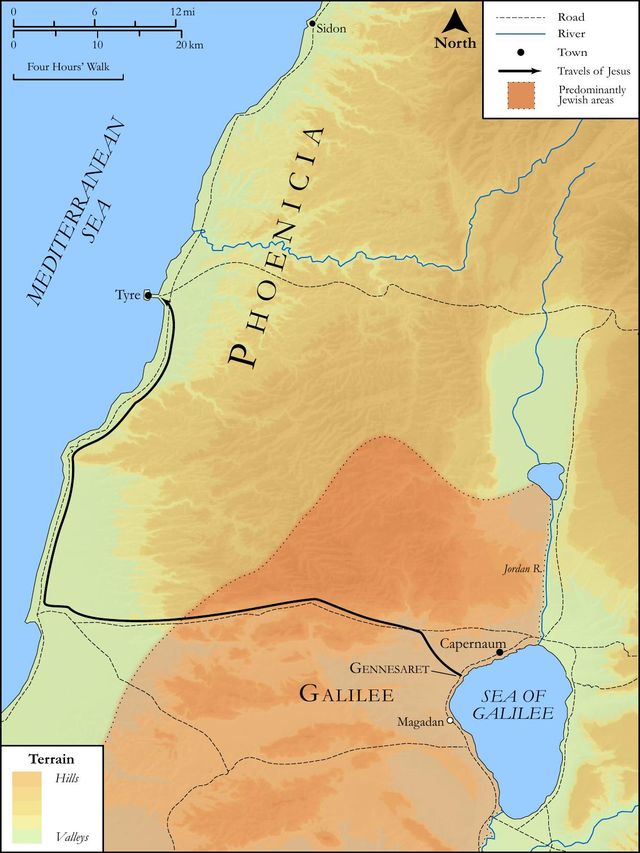
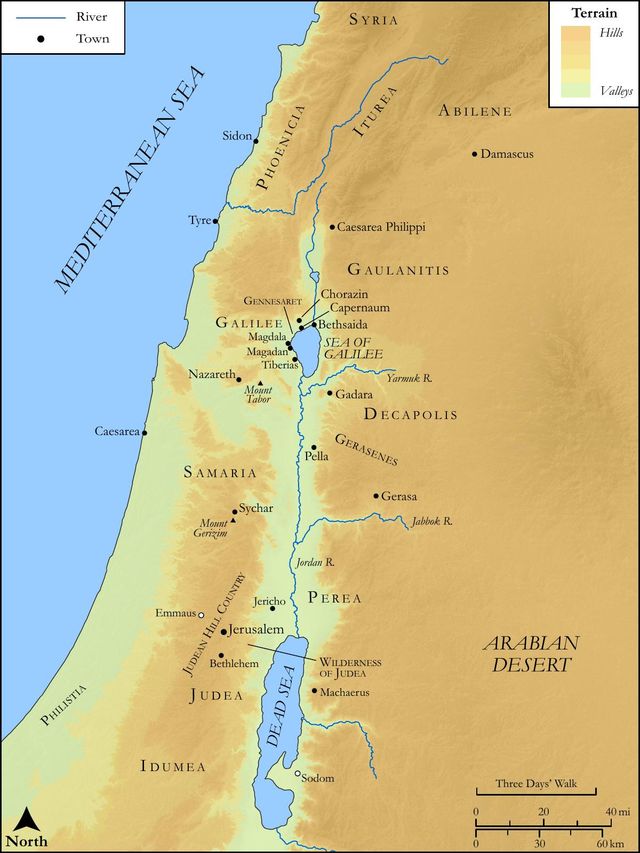
II.When he went thence, he departed into the coasts of Tyre and Sidon; not to those cities (they were excluded from any share in Christ's mighty works, Mat 11:21, Mat 11:22), but into that part of the land of Israel which lay that way: thither he went, as Elias to Sarepta, a city of Sidon (Luk 4:26); thither he went to look after this poor woman, whom he had mercy in reserve for. While he went about doing good, he was never out of his way. The dark corners of the country, which lay most remote, shall have their share of his benign influences; and as now the ends of the land, so afterward the ends of the earth, shall see his salvation, Isa 49:6. Here it was, that this miracle was wrought, in the story of which we may observe,
1.The address of the woman of Canaan to Christ, Mat 15:22. She was a Gentile, a stranger to the commonwealth of Israel; probably one of the posterity of those accursed nations that were devoted by that word, Cursed be Canaan. Note, The doom of political bodies doth not always reach every individual member of them. God will have his remnant out of all nations, chosen vessels in all coasts, even the most unlikely: she came out of the same coasts. If Christ had not now made a visit to these coasts, though the mercy was worth travelling far for, it is probable that she had never come to him. Note, It is often an excitement to a dormant faith and zeal, to have opportunities of acquaintance with Christ brought to our doors, to have the word nigh us.
Her address was very importunate, she cried to Christ, as one in earnest; cried, as being at some distance from him, not daring to approach too near, being a Canaanite, lest she should give offence. In her address,
(1.)She relates her misery; My daughter is grievously vexed with a devil, kakōs daimonizetai - She is ill-bewitched, or possessed. There were degrees of that misery, and this was the worst sort. It was common case at that time, and very calamitous. Note, The vexations of children are the trouble of parents, and nothing should be more so than their being under the power of Satan. Tender parents very sensibly feel the miseries of those that are pieces of themselves. "Though vexed with the devil, yet she is my daughter still." The greatest afflictions of our relations do not dissolve our obligations to them, and therefore ought not to alienate our affections from them. It was the distress and trouble of her family, that now brought her to Christ; she came to him, not for teaching, but for healing; yet, because she came in faith, he did not reject her. Though it is need that drives us to Christ, yet we shall not therefore be driven from him. It was the affliction o her daughter, that gave her this occasion of applying to Christ. It is good to make the afflictions of others our own, in sense and sympathy, that we may make them our own, in improvement and advantage.
(2.)She requests for mercy; Have mercy on me, O Lord, thou Son of David, she owns him to be the Messiah: that is the great thing which faith should fasten upon, and fetch comfort from. From the Lord we may expect acts of power: he can command deliverances; from the Son of David we may expect all the mercy and grace which were foretold concerning him. Though a Gentile, she owns the promise made to the fathers of the Jews, and the honour of the house of David. The Gentiles must receive Christianity, not only as an improvement of natural religion, but as the perfection of the Jewish religion, with an eye to the Old Testament.
Her petition is, Have mercy on me. She does not limit Christ to this or that particular instance of mercy, but mercy, mercy is the thing she begs: she pleads not merit, but depends upon mercy; Have mercy upon me. Mercies to the children are mercies to the parents; favours to ours are favours to us, and are so to be accounted. Note, It is the duty of parents to pray for their children, and to be earnest in prayer for them, especially for their souls; "I have a son, a daughter, grievously vexed with a proud will, an unclean devil, a malicious devil, led captive by him at his will; Lord, help them." This is a case more deplorable than that of a bodily possession. Bring them to Christ by faith and prayer, who alone is able to heal them. Parents should look upon it as a great mercy to themselves, to have Satan's power broken in the souls of their children.
2.The discouragement she met with in this address; in all the story of Christ's ministry we do not meet with the like. He was wont to countenance and encourage all that came to him, and either to answer before they called, or to hear while they were yet speaking; but here was one otherwise treated: and what could be the reason of it?
(1.)Some think that Christ showed himself backward to gratify this poor woman, because he would not give offence to the Jews, by being as free and forward in his favour to the Gentiles as to them. He had bid his disciples not go into the way of the Gentiles (Mat 10:5), and therefore would not himself seem so inclinable to them as to others, but rather more shy. Or rather,
(2.)Christ treated her thus, to try her; he knows what is in the heart, knew the strength of her faith, and how well able she was, by his grace, to break through such discouragements; he therefore met her with them, that the trial of her faith might be found unto praise, and honour, and glory, Pe1 1:6, Pe1 1:7. This was like God's tempting Abraham (Gen 22:1), like the angel's wrestling with Jacob, only to put him upon wrestling, Gen 32:24. Many of the methods of Christ's providence, and especially of his grace, in dealing with his people, which are dark and perplexing, may be explained with the key of this story, which is for that end left upon record, to teach us that there may be love in his face, and to encourage us, therefore, though he slay us, yet to trust in him.
Observe the particular discouragements given her:
[1.]When she cried after him, he answered her not a word, Mat 15:23. His ear was wont to be always open and attentive to the cries of poor supplicants, and his lips, which dropped as the honeycomb, always ready to give an answer of peace; but to this poor woman he turned a deaf ear, and she could get neither an alms nor an answer. It was a wonder that she did not fly off in a fret, and say, "Is this he that is so famed for clemency and tenderness? Have so many been heard and answered by him, as they talk, and must I be the first rejected suitor? Why so distant to me, if it be true that he hath stooped to so many?" But Christ knew what he did, and therefore did not answer, that she might be the more earnest in prayer. He heard her, and was pleased with her, and strengthened her with strength in her soul to prosecute her request (Psa 138:3; Job 23:6), though he did not immediately give her the answer she expected. By seeming to draw away the desired mercy from her, he drew her on to be so much the more importunate for it. Note, Every accepted prayer is not immediately an answered prayer. Sometimes God seems not to regard his people's prayers, like a man asleep or astonished (Psa 44:23; Jer 14:9; Psa 22:1, Psa 22:2); nay, to be angry at them (Psa 80:4; Lam 3:8, Lam 3:44); but it is to prove, and so to improve, their faith, and to make his after-appearances for them the more glorious to himself, and the more welcome to them; for the vision, at the end, shall speak, and shall not lie, Heb 2:3. See Job 35:14
[2.]When the disciples spake a good word for her, he gave a reason why he refused her, which was yet more discouraging.
First, It was some little relief, that the disciples interposed on her behalf; they said, Send her away, for she crieth after us. It is desirable to have an interest in the prayers of good people, and we should be desirous of it. But the disciples, though wishing she might have what she came for, yet therein consulted rather their own ease than the poor woman's satisfaction; "Send her away with a cure, for she cries, and is in good earnest; she cries after us, and is troublesome to us, and shames us." Continued importunity may be uneasy to men, even to good men; but Christ loves to be cried after.
Secondly, Christ's answer to the disciples quite dashed her expectations; "I am not sent, but to the lost sheep of the house of Israel; you know I am not, she is none of them, and would you have me go beyond by commission?" Importunity seldom conquers the settled reason of a wise man; and those refusals are most silencing, which are so backed. He doth not only not answer her, but he argues against her, and stops her mouth with a reason. It is true, she is a lost sheep, and hath as much need of his care as any, but she is not of the house of Israel, to whom he was first sent (Act 3:26), and therefore not immediately interested in it, and entitled to it. Christ was a Minister of the circumcision (Rom 15:8); and though he was intended for a Light to the Gentiles, yet the fulness of time for that was not now come, the veil was not yet rent, nor the partition-wall taken down. Christ's personal ministry was to be the glory of his people Israel; "If I am sent to them, what have I to do with those that are none of them." Note, It is a great trial, when we have occasion given us to question whether we be of those to whom Christ was sent. But, blessed be God, no room is left for that doubt; the distinction between Jew and Gentile is taken away; we are sure that he gave his life a ransom for many, and if for many, why not for me?
Thirdly, When she continued her importunity, he insisted upon the unfitness of the thing, and gave her not only a repulse, but a seeming reproach too (Mat 15:26); It is not meet to take the children's bread and to cast it to dogs. This seems to cut her off from all hope, and might have driven her to despair, if she had not had a very strong faith indeed. Gospel grace and miraculous cures (the appurtenances of it), were children's bread; they belonged to them to whom pertained the adoption (Rom 9:4), and lay not upon the same level with that rain from heaven, and those fruitful seasons, which God gave to the nations whom he suffered to walk in their own ways (Act 14:16, Act 14:17); no, these were peculiar favours, appropriated to the peculiar people, the garden enclosed. Christ preached to the Samaritans (Joh 4:41), but we read not of any cures he wrought among them; that salvation was of the Jews: it is not meet therefore to alienate these. The Gentiles were looked upon by the Jews with great contempt, were called and counted dogs; and, in comparison with the house of Israel, who were so dignified and privileged, Christ here seems to allow it, and therefore thinks it not meet that the Gentiles should share in the favours bestowed on the Jews. But see how the tables are turned; after the bringing of the Gentiles into the church, the Jewish zealots for the law are called dogs, Phi 3:2.
Now this Christ urgeth against this woman of Canaan; "How can she expect to eat of the children's bread, who is not of the family?" Note, 1. Those whom Christ intends most signally to honour, he first humbles and lays low in a sense of their own meanness and unworthiness. We must first see ourselves to be as dogs, less than the least of all God's mercies, before we are fit to be dignified and privileged with them. 2. Christ delights to exercise great faith with great trials, and sometimes reserves the sharpest for the last, that, being tried, we may come forth like gold. This general rule is applicable to other cases for direction, though here used only for trial. Special ordinances and church-privileges are children's bread, and must not be prostituted to the grossly ignorant and profane. Common charity must be extended to all, but spiritual dignities are appropriated to the household of faith; and therefore promiscuous admission to them, without distinction, wastes the children's bread, and is the giving of that which is holy to the dogs, Mat 7:6. Procul hinc, procul inde, profani - Off, ye profane.
3.Here is the strength of her faith and resolution, in breaking through all these discouragements. Many a one, thus tried, would either have sunk into silence, or broken out into passion. "Here is cold comfort," might she have said, "for a poor distressed creature; as good for me to have staid at home, as come hither to be taunted at and abused at this rate; not only to have a piteous case slighted, but to be called a dog!" A proud, unhumbled heart would not have borne it. The reputation of the house of Israel was not now so great in the world, but that this slight put upon the Gentiles was capable of being retorted, had the poor woman been so minded. It might have occasioned a reflection upon Christ, and might have been a blemish upon his reputation, as well as a shock to the good opinion, she had entertained of him; for we re apt to judge of persons as we ourselves find them; and think that they are what they are to us. "Is this the Son of David?" (might she have said): "Is this he that has such a reputation for kindness, tenderness, and compassion? I am sure I have no reason to give him that character, for I was never treated so roughly in my life; he might have done as much for me as for others; or, if not, he needed not to have set me with the dogs of his flock. I am not a dog, I am a woman, and an honest woman, and a woman in misery; and I am sure it is not meet to call me a dog." No, here is not a word of this. Note, A humble, believing soul, that truly loves Christ, takes every thing in good part that he saith and doeth, and puts the best construction upon it.
She breaks through all these discouragements,
(1.)With a holy earnestness of desire in prosecuting her petition. This appeared upon the former repulse (Mat 15:25); Then came she, and worshipped him, saying, Lord, help me.
[1.]She continued to pray. What Christ said, silenced the disciples; you hear no more of them; they took the answer, but the woman did not. Note, The more sensibly we feel the burthen, the more resolutely we should pray for the removal of it. And it is the will of God that we should continue instant in prayer, should always pray, and not faint.
[2.]She improved in prayer. Instead of blaming Christ, or charging him with unkindness, she seems rather to suspect herself, and lay the fault upon herself. She fears lest, in her first address, she had not been humble and reverent enough, and therefore now she came, and worshipped him, and paid him more respect than she had done; or she fears that she had not been earnest enough, and therefore now she cries, Lord, help me. Note, When the answers of prayer are deferred, God is thereby teaching us to pray more, and pray better. It is then time to enquire wherein we have come short in our former prayers, that what has been amiss may be amended for the future. Disappointments in the success of prayer, must be excitements to the duty of prayer. Christ, in his agony, prayed more earnestly.
[3.]She waives the question, whether she was of those to whom Christ was sent or no; she will not argue that with him, though perhaps she might have claimed some kindred to the house of Israel; but, "Whether an Israelite or no, I come to the Son of David for mercy, and I will not let him go, except he bless me." Many weak Christians perplex themselves with questions and doubts about their election, whether they are of the house of Israel or no; such had better mind their errand to God, and continue instant in prayer for mercy and grace; throw themselves by faith at the feet of Christ, and say, If I perish, I will perish here; and then that matter will by degrees clear itself. If we cannot reason down our unbelief, let us pray it down. A fervent, affectionate Lord, help me, will help us over many of the discouragements which are sometimes ready to bear us down and overwhelm us.
[4.]Her prayer is very short, but comprehensive and fervent, Lord, help me. Take this, First, As lamenting her case; "If the Messiah be sent only to the house of Israel, the Lord help me, what will become of me and mine," Note, It is not in vain for broken hearts to bemoan themselves; God looks upon them then, Jer 31:18. Or, Secondly, As begging grace to insist her in this hour of temptation. She found it hard to keep up her faith when it was thus frowned upon, and therefore prays, "Lord, help me; Lord, strengthen my faith now; Lord, let thy right hand uphold me, while my soul is following hard after thee," Psa 63:8. Or, Thirdly, As enforcing her original request, "Lord, help me; Lord, give me what I come for." She believed that Christ could and would help her, though she was not of the house of Israel; else she would have dropt her petition. Still she keeps up good thoughts of Christ, and will not quit her hold. Lord, help me, is a good prayer, if well put up; and it is pity that it should be turned into a byword, and that we should take God's name in vain in it.
(2.)With a holy skilfulness of faith, suggesting a very surprising plea. Christ had placed the Jews with the children, as olive-plants round about God's table, and had put the Gentiles with the dogs, under the table; and she doth not deny the aptness of the similitude. Note, There is nothing got by contradicting any word of Christ, though it bear ever so hard upon us. But this poor woman, since she cannot object against it, resolves to make the best of it (Mat 15:27); Truth, Lord, yet the dogs eat of the crumbs. Now, here,
[1.]Her acknowledgment was very humble: Truth, Lord. Note, You cannot speak so meanly and slightly of a humble believer, but he is ready to speak as meanly and slightly of himself. Some that seem to dispraise and disparage themselves, will yet take it as an affront if others do so too; but one that is humbled aright, will subscribe to the most abasing challenges, and not call them abusing ones. "Truth, Lord; I cannot deny it; I am a dog, and have no right to the children's bread." David, Thou hast done foolishly, very foolishly; Truth, Lord. Asaph, Thou hast been as a beast before God; Truth, Lord. Agur, Thou art more brutish than any man; Truth, Lord. Paul, Thou hast been the chief of sinners, art less than the least of saints, not meet to be called an apostle; Truth, Lord.
[2.]Her improvement of this into a plea was very ingenious; Yet the dogs eat of the crumbs. It was by a singular acumen, and spiritual quickness and sagacity, that she discerned matter of argument in that which looked like a slight. Note, A lively, active faith will make that to be for us, which seems to be against us; will fetch meat out of the eater, and sweetness out of the strong. Unbelief is apt to mistake recruits for enemies, and to draw dismal conclusions even from comfortable premises (Jdg 13:22, Jdg 13:23); but faith can find encouragement even in that which is discouraging, and get nearer to God by taking hold on that hand which is stretched out to push it away. So good a thing it is to be of quick understanding in the fear of the Lord, Isa 11:3.
Her plea is, Yet the dogs eat of the crumbs. It is true, the full and regular provision is intended for the children only, but the small, casual, neglected crumbs are allowed to the dogs, and are not grudged them; that is to the dogs under the table, that attend there expecting them. We poor Gentiles cannot expect the stated ministry and miracles of the Son of David, that belongs to the Jews; but they begin now to be weary of their meat, and to play with it, they find fault with it, and crumble it away; surely then some of the broken meat may fall to a poor Gentile; "I beg a cure by the by, which is but a crumb, though of the same precious bread, yet but a small inconsiderable piece, compared with the loaves which they have." Note, When we are ready to surfeit on the children's bread, we should remember how many there are, that would be glad of the crumbs. Our broken meat in spiritual privileges, would be a feast to many a soul; Act 13:42. Observe here,
First, Her humility and necessity made her glad of crumbs. Those who are conscious to themselves that they deserve nothing, will be thankful for any thing; and then we are prepared for the greatest of God's mercies, when we see ourselves less than the least of them. The least of Christ is precious to a believer, and the very crumbs of the bread of life.
Secondly, Her faith encouraged her to expect these crumbs. Why should it not be at Christ's table as at a great man's, where the dogs are fed as sure as the children? Observe, She calls it their master's table; if she were a dog, she was his dog, and it cannot be ill with us, if we stand but in the meanest relation to Christ; "Though unworthy to be called children, yet make me as one of thy hired servants: nay, rather let me be set with the dogs than turned out of the house; for in my Father's house there is not only bread enough, but to spare," Luk 15:17-19. It is good lying in God's house, though we lie at the threshold there.
4.The happy issue and success of all this. She came off with credit and comfort from this struggle; and, though a Canaanite, approved herself a true daughter of Israel, who, like a prince, had power with God, and prevailed. Hitherto Christ hid his face from her, but now gathers her with everlasting kindness, Mat 15:28. Then Jesus said, O woman, great is thy faith. This was like Joseph's making himself know to his brethren, I am Joseph; so here, in effect, I am Jesus. Now he begins to speak like himself, and to put on his own countenance. He will not contend for ever.
(1.)He commended her faith. O woman, great is thy faith. Observe,
[1.]It is her faith that he commends. There were several other graces that shone bright in her conduct of this affair - wisdom, humility, meekness, patience, perseverance in prayer; but these were the product of her faith, and therefore Christ fastens upon that as most commendable; because of all graces faith honours Christ most, therefore of all graces Christ honours faith most.
[2.]It is the greatness of her faith. Note, First, Though the faith of all the saints is alike precious, yet it is not in all alike strong; all believers are not of the same size and stature. Secondly, The greatness of faith consists much in a resolute adherence to Jesus Christ as an all-sufficient Saviour, even in the face of discouragements; to love him, and trust him, as a Friend, even then when he seems to come forth against us as an Enemy. This is great faith! Thirdly, Though weak faith, if true, shall not be rejected, yet great faith shall be commended, and shall appear greatly well-pleasing to Christ; for in them that thus believe he is most admired. Thus Christ commended the faith of the centurion, and he was a Gentile too, he had a strong faith in the power of Christ, this woman in the good-will of Christ; both were acceptable.
(2.)He cured her daughter; "Be it unto thee even as thou wilt: I can deny thee nothing, take what thou camest for." Note, Great believers may have what they will for the asking. When our will conforms to the will of Christ's precept, his will concurs with the will of our desire. Those that will deny Christ nothing, shall find that he will deny them nothing at last, though for a time he seems to hide his face from them. "Thou wouldst have thy sins pardoned, thy corruptions mortified, thy nature sanctified; be it unto thee even as thou wilt. And what canst thou desire more?" When we come, as this poor woman did, to pray against Satan and his kingdom, we concur with the intercession of Christ, and it shall be accordingly. Though Satan may sift Peter, and buffet Paul, yet, through Christ's prayer and the sufficiency of his grace, we shall be more than conquerors, Luk 22:31, Luk 22:32; Co2 12:7-9; Rom 16:20.
The event was answerable to the word of Christ; Her daughter was made whole from that very hour; from thenceforward was never vexed with the devil any more; the mother's faith prevailed for the daughter's cure. Though the patient was at a distance, that was no hindrance to the efficacy of Christ's word. He spake, and it was done.
Historical interpretation
Nine Centuries of Reception
13 surviving comments on this verse. Each one is dated, so this reads as a timeline rather than a list.
Select a marker to jump to its quote. Markers stagger vertically where authors wrote within a few decades of each other.
Or, This mother represents the proselytes, in that she leaves her own country, and forsakes the Gentiles for the name of another nation; she prays for her daughter, that is, the body of the Gentiles possessed with unclean spirits; and having learned the Lord by the Law, calls Him the Son of David.
What then saith Christ? "O woman, great is thy faith."
Yea, therefore did He put her off, that He might proclaim aloud this saying, that He might crown the woman.
"Be it unto thee even as thou wilt." Now what He saith is like this: "Thy faith indeed is able to effect even greater things than these; nevertheless, Be it unto thee even as thou wilt."
This was akin to that voice that said, "Let the Heaven be, and it was."
"And her daughter was made whole from that very hour."
Seest thou how this woman too contributed not a little to the healing of her daughter? For to this purpose neither did Christ say, "Let thy little daughter be made whole," but, "Great is thy faith, be it unto thee even as thou wilt;" to teach thee that the words were not used at random, nor were they flattering words, but great was the power of her faith.
The certain test, however, and demonstration thereof, He left to the issue of events. Her daughter accordingly was straightway healed.
But mark thou, I pray thee, how when the apostles had failed, and had not succeeded, this woman had success. So great a thing is assiduity in prayer. Yea, He had even rather be solicited by us, guilty as we are, for those who belong to us, than by others in our behalf. And yet they had more liberty to speak; but she exhibited much endurance.
And by the issue He also excused Himself to His disciples for the delay, and showed that with reason He had not assented to their request.
He said not that to eat the meats forbidden in the Law defiles not a man, that they might not have what to answer to Him again, but He concludes in that concerning which the disputation had been.
(Hom. lii.) It should be observed, that when He delivered the Jews from the observance of meats, He then also opened the door to the Gentiles, as Peter was first bidden in the vision to break this law, and was afterwards sent to Cornelius. But if any should ask, how it is that He bade His disciples go not into the way of the Gentiles, and yet now Himself walks this way; we will answer, first, that that precept which He had given His disciples was not obligatory on Him; secondly, that He went not to preach, whence Mark even says, that He purposely concealed Himself.
The Evangelist says that she was a Chananæan, to show the power of Christ's presence. For this nation, which had been driven out that they might not corrupt the Jews, now showed themselves wiser than the Jews, leaving their own borders that they might go to Christ. And when she came to Him, she asked only for mercy, as it follows, She cried unto Him, saying, Have mercy on me, Lord, thou Son of David.
(Hom. in quædam loca, xlvii.) Note the wisdom (ΦιλθσόΦιαν) of this woman, she went not to men who promised fair, she sought not useless bandages, but leaving all devilish charms, she came to the Lord. She asked not James, she did not pray John, or apply to Peter, but putting herself under the protection of penitence, she ran alone to the Lord. But, behold, a new trouble. She makes her petition, raising her voice into a shout, and God, the lover of mankind, answers not a word.
I judge that the disciples were sorry for the woman's affliction, yet dared not say 'Grant her this mercy,' but only Send her away, as we, when we would persuade any one, oftentimes say the very contrary to what we wish. He answered and said, I am not sent but to the lost sheep of the house of Israel.
But when the woman saw that the Apostles had no power, she became bold with commendable boldness; for before she had not dared to come before His sight; but, as it is said, She crieth after us. But when it seemed that she must now retire without being relieved, she came nearer, But she came and worshipped him.
And therefore she said not Ask, or Pray God for me, but Lord, help me. But the more the woman urged her petition, the more He strengthened His denial; for He calls the Jews now not sheep but sons, and the Gentiles dogs; He answered and said unto her, It is not meet to take the children's bread, and give it to dogs.
Observe this woman's prudence; she does not dare to contradict Him, nor is she vexed with the commendation of the Jews, and the evil word applied to herself; But she said, Yea, Lord, yet the dogs eat of the crumbs which fall from their masters' table. He said, It is not good; she answers, 'Yet even so, Lord;' He calls the Jews children, she calls them masters; He called her a dog, she accepts the office of a dog; as if she had said, I cannot leave the table of my Lord.
This was the cause why Christ was so backward, that He knew what she would say, and would not have her so great excellence hid; whence it follows, Then Jesus answered and said unto her, O woman, great is thy faith, be it unto thee according to thy will. Observe how the woman herself had contributed not a little to her daughter's healing and therefore Christ said not unto her, 'Let thy daughter be healed,' but, Be it unto thee according to thy will; that you may perceive that she had spoken in sincerity, and that her words were not words of flattery, but of abundant faith. And this word of Christ is like that word which said, Let there be a firmament (Gen. 1:6.) and it was made; so here, And her daughter was made whole from that hour. Observe how she obtains what the Apostles could not obtain for her; so great a thing is the earnestness of prayer. He would rather that we should pray for our own offences ourselves, than that others should pray for us.
And why did He go at all into these parts? When He had set them free from the observance of meats, then to the Gentiles also He goes on to open a door, proceeding in due course; even as Peter, having been first directed to annul this law, is sent to Cornelius.
But if any one should say, "How then, while saying to His disciples, 'Go not into the way of the Gentiles,' doth He Himself admit her?" first, this would be our reply, that what He enjoined upon His disciples, He was not Himself also tied to; secondly, that not in order to preach did He depart; which indeed Mark likewise intimating said, He even hid Himself, yet was not concealed.
For as His not hastening to them first was a part of the regular course of His proceedings, so to drive them away when coming to Him was unworthy of His love to man. For if the flying ought to be pursued, much more ought the pursuing not to be avoided.
See at any rate how worthy this woman is of every benefit. For she durst not even come to Jerusalem, fearing, and accounting herself unworthy. For were it not for this, she would have come there, as is evident both from her present earnestness, and from her coming out of her own coasts.
The evangelist speaks against the woman, that he may show forth her marvellous act, and celebrate her praise the more. For when thou hearest of a Canaanitish woman, thou shouldest call to mind those wicked nations, who overset from their foundations the very laws of nature. And being reminded of these, consider also the power of Christ's advent. For they who were cast out, that they might not pervert any Jews, these appeared so much better disposed than the Jews, as even to come out of their coasts, and approach Christ; while those were driving Him away, even on His coming unto them.
Having then come unto Him, she saith nothing else, but "Have mercy on me," and by her cry brings about them many spectators. For indeed it was a pitiful spectacle to see a woman crying aloud in so great affliction, and that woman a mother, and entreating for a daughter, and for a daughter in such evil case: she not even venturing to bring into the Master's sight her that was possessed, but leaving her to lie at home, and herself making the entreaty.
And she tells her affliction only, and adds nothing more; neither doth she drag the physician to her house, like that nobleman, saying, "Come and lay thy hand upon her," and, "Come down ere my child die."
But having described both her calamity, and the intensity of the disease, she pleads the Lord's mercy, and cries aloud; and she saith not, "Have mercy on my daughter," but, "Have mercy on me." For she indeed is insensible of her disease, but it is I that suffer her innumerable woes; my disease is with consciousness, my madness with perception of itself.
Leaving the Scribes and Pharisees and those cavillers, He passes into the parts of Tyre and Sidon; that He may heal the Tyrians and Sidonians; And Jesus went thence, and departed into the coasts of Tyre and Sidon.
Not from pharisaical pride, or the superciliousness of the Scribes, but that He might not seem to contravene His own decision, Go not into the way of the Gentiles. For He was unwilling to give occasion to their cavils, and reserved the complete salvation of the Gentiles for the season of His passion and resurrection.
The disciples, as yet ignorant of the mysteries of God or moved by compassion, beg for this Chananæan woman; or perhaps seeking to be rid of her importunity.
He says that He is not sent to the Gentiles, but that He is sent first to Israel, so that when they would not receive the Gospel, the passing over to the Gentiles might have just cause.
And He adds of the house of Israel, with this design, that we might rightly interpret by this place that other parable concerning the stray sheep.
Note how perseveringly this Chananæan woman calls Him first Son of David, then Lord, and lastly came and worshipped him, as God.
The Gentiles are called dogs because of their idolatry; who, given to the eating of blood, and dead bodies, turn to madness.
Wonderful are shown the faith, patience, and humility of this woman; faith, that she believed that her daughter could be healed; patience, that so many times overlooked, she yet perseveres in her prayers; humility, that she compares herself not to the dogs, but to the whelps. I know, she says, that I do not deserve the children's bread, and that I cannot have whole meat, nor sit at the table with the master of the house, but I am content with that which is left for the whelps, that through humble fragments I may come to the amplitude of the perfect bread.
And the daughter of this Chananæan I suppose to be the souls of believers, who were sorely vexed by a dæmon, not knowing their Creator, and bowing down to stones.
Wonderful change of things! Once Israel the son, and we the dogs; the change in faith has led to a change in the order of our names. Concerning them is that said, Many dogs hare come about me; while to us is said, as to this woman, Thy faith hath made thee whole. (Ps. 22:16.)
(Verse 27, 28.) But she said: Even so, Lord. For even the dogs eat the crumbs that fall from their masters' table. Then Jesus, answering, said to her: O woman, great is your faith: be it done to you as you wish. And her daughter was healed from that hour. I know, she said, that I am not deserving of the bread of the children, nor am I able to receive the whole food; nor to sit at the table with the father; but I am content with the crumbs of the puppies; so through the humility of the crumbs, I may obtain the greatness of the whole bread. Oh, the wonderful change of things! Israel, once a son, now dogs. Because of the diversity of faith, the order of names is changed. Concerning them, it is later said: Many dogs have surrounded me (Ps. 21:17). And: See the dogs, see the evil workers, see the mutilation (Phil. 3). We have heard with the Syrophoenician woman and the woman who had a flow of blood: Your faith is great, let it be done to you as you wish. And: Daughter, your faith has made you well.
Having seen her advocates unsuccessful, the woman then appeals for herself and does not stop but in effect says to the Lord, “Help me, I haven’t been asking this for my own sake.” Then the Savior in turn says, “It is not good to take the children’s bread and to cast it to dogs.” He uses the term dog on account of the Gentiles’ unclean lifestyle and proneness to idolatry, while he calls the Jews children on account of the fact that they appeared to be devoted to God. But he uses the word bread not only to speak of his teaching, which was through words, but also of that which nourished the faithful by means of signs. But in this case the word preceded the condemnation of the Jews, since when life in the Lord had been given to them as bread, they did not accept it. The woman does not complain, even when insulted. What does the Savior do? By his answer, he showed what he had premeditated from the outset. For it was for this reason that he postponed giving a reply: that the woman might cry aloud with this word. Thereby he would show her to be worthy of a thousand crowns. For it was not because he did not want to give her the gift that he delayed but because he sought and took care beforehand to reveal her faith. With his accolades he honors her as presenting a type of the church that is from the Gentiles. Note that he did not say, “Let your child be healed,” but “Be it done for you as you desire,”
(Quæst. Ev. i. 18.) And that to heal the Centurion's servant, and the daughter of this Chananæan woman, He does not go to their houses, signifies that the Gentiles, among whom He Himself went not, should be saved by His word. That these are healed on the prayer of their parents, we must understand of the Church, which is at once mother and children; the whole body of those who make up the Church is the mother, and each individual of that body is a son of that mother.
See, brothers, how in this woman who was a Canaanite—who came from the Gentiles and represented a type (namely, a figure of the church)—how her humility is highly praised. Indeed, the Jewish people, as castigated in the Gospel, were puffed up with pride because they were chosen to receive the law, because the patriarchs proceeded from that people, the prophets appeared and God’s servant Moses performed great miracles in Egypt, which we hear about in the Psalms. He led the people through the Red Sea with the waters receding, and he received the law, which he gave to the same people. These were the grounds for extolling the Jewish people. Because of that pride, they were unwilling to respond to Christ the author of humility, the restrainer of swellheadedness, the physician God who, because he was God, became man that as a man he might know himself as man. What great medicine! If this medicine does not cure pride, what could possibly cure it? I do not know. God became a man. He put aside his divinity. That is to say, in a certain measure he kept out of sight—he hid what was his own, while it was evident what he had taken upon himself. He became a man, even though he is God. Yet man does not yet recognize that he is a man, that he is mortal; he does not recognize that he is weak, a sinner, sick, and that being a sick person, he should seek a physician! What is even worse, he sees himself as being healthy!Because of this, that people did not draw near—that is, because of their pride. And they were called from the olive tree—that is, from that people begotten of the patriarchs—broken natural branches (namely, Jews by right, barren in the spirit of pride). And in that olive tree a wild olive shoot was grafted. This wild olive shoot represents the Gentile people. But the apostle says that the wild shoot was grafted into the olive tree but the natural branches were broken. They were broken because of pride; the wild olive shoot was grafted in because of humility. The woman manifested this humility, saying, “Yes, Lord, I am a dog. I desire crumbs.” Jesus found favor also with the centurion, who had this humility. After he asked the Lord to cure his servant, the Lord said, “I will come and cure him.” He responded, “Lord, I am not worthy that you should come under my roof; but only say the word, and my servant will be healed. I am not worthy that you should come under my roof.” He did not receive the Lord under his roof; he received him in his heart. The more humble a person is, the more receptive and full he becomes. Hills repel water; valleys are filled up. What did the Lord reply, after the centurion said, “I am not worthy that you should enter under my roof”? He said, “Truly, I say to you, not even in Israel have I found such faith”—that is, among those people to whom I have come, “I have not found such faith.” What is the meaning of the word such? So great. In what way great? To say the least, great in humility. “I have not found such faith”: like a grain of mustard seed—the smaller it is, the more potent it is. The Lord therefore grafted the wild olive shoot into the olive tree. He did this when he said, “Truly, I say to you, not even in Israel have I found such faith.”
Tyre and Sidon were Gentile towns, for Tyre was the metropolis of the Chananæans, and Sidon the boundary of the Chananæans, towards the north.
He went that He might heal them of Tyre and Sidon; or that He might deliver this woman's daughter from the dæmon, and so through her faith might condemn the wickedness of the Scribes and Pharisees. Of this woman it proceeds; And, behold, a woman, a Chananite, came out from those parts.
In this way also He was sent specially to the Jews, because He taught them by His bodily presence.
In these words is given us a pattern of catechizing and baptizing children; for the woman says not 'Heal my daughter,' or 'Help her,' but, Have mercy upon me, and help me. Thus there has come down in the Church the practice that the faithful are sponsors to God for their young children, before they have attained such age and reason that they can themselves make any pledge to God. So that as by this woman's faith her daughter was healed, so by the faith of Catholics of mature age their sins might be forgiven to infants. Allegorically; This woman figures the Holy Church gathered out of the Gentiles. The Lord leaves the Scribes and Pharisees, and comes into the parts of Tyre and Sidon, this figures His leaving the Jews and going over to the Gentiles. This woman came out of her own country, because the Holy Church departed from former errors and sins.
Those of whom the Lord speaks as children are the Patriarchs and Prophets of that time. By the table is signified the Holy Scripture, by the fragments the best precepts, or inward mysteries on which Holy Church feeds; by the crumbs the carnal precepts which the Jews keep. The fragments are said to be eaten under the table, because the Church submits itself humbly to fulfilling the Divine commands.
But the whelps eat not the crust only, but the crumbs of the children's bread, because the despised among the Gentiles on turning to the faith, seek out in Scripture not the outside of the letter, but the spiritual sense, by which they may be able to profit in good acts.
Great indeed was her faith; for the Gentiles, neither trained in the Law, nor educated by the words of the Prophets, straightway on the preaching of the Apostles obeyed with the hearing of the ear, and therefore deserved to obtain salvation.
Also whosoever has his conscience polluted with the defilement of any sin, has a daughter sorely vexed by a dæmon. Also whosoever has defiled any good that he has done by the plague of sin, has a daughter tossed by the furies of an unclean spirit, and has need to fly to prayers and tears, and to seek the intercessions and aids of the saints.
Now Jesus shows the reason why He put off healing her at the beginning. So that the faith and understanding of the woman might be made manifest, Christ did not immediately give His assent at the beginning and even drove her away. But now when her faith has been revealed she hears the words of praise, "Great is thy faith." By saying, "Be it unto thee even as thou wilt," Christ showed that if she had not had faith she would not have obtained her request. So, too, if we desire to obtain something, nothing prevents us from obtaining what we desire. Notice that even if saints should ask on our behalf, as the apostles did for the woman, still, we accomplish even more when we ask for ourselves. The Canaanite woman is also a symbol of the Church gathered from among the Gentiles. For Gentiles who first were even driven away, later were advanced to the rank of sons and were deemed worthy of the Bread, I mean, the Body of the Lord; while the Jews became dogs, thinking that they were being fed by the crumbs, that is, the minute and insignificant details of the letter of the law. "Tyre" means "besieged," "Sidon" "they who hunt," and "Canaan" "made ready by humility." Therefore the Gentiles, who were besieged by evil in that the demons were among them hunting for souls, were also made ready by humility. For the righteous were made ready for the heights of the kingdom of God.
(ap. Anselm.) The great faith of this Chananæan woman is herein shewed. She believes Him to be God, in that she calls Him Lord; and man, in that she calls Him Son of David. She claims nothing of her own desert, but craves only God's mercy. And she says not, Have mercy on my daughter, but Have mercy on me; because the affliction of the daughter is the affliction of the mother. And the more to excite His compassion, she declares to Him the whole of her grief, My daughter is sore vexed by a dœmon; thus unfolding to the Physician the wound, and the extent and nature of the disease; its extent, when she says is sore vexed; its nature, by a dæmon.
(ap. Anselm.) And by this delay in answering, He shows us the patience and perseverance of this woman. And He answered not for this reason also, that the disciples might petition for her; showing herein that the prayers of the Saints are necessary in order to obtain any thing, as it follows, And his disciples came unto him, saying, Send her away, for she crieth after us.
(ap. Anselm.) The Jews were born sons, and brought up by the Law in the worship of one God. The bread is the Gospel, its miracles and other things which pertain to our salvation. It is not then meet that these should be taken from the children and given to the Gentiles, who are dogs, till the Jews refuse them.
(non occ.) And if the Lord delays the salvation of a soul at the first tears of the supplicating Church, we ought not to despair, or to cease from our prayers, but rather continue them earnestly.
Continue studying Matthew 15:28 across the web’s major study libraries — every link below opens this exact verse, chapter, or book on the destination site.
Read & Compare
 BibleGatewayThis verse in more than 200 translations and 70 languages.
 Bible.comThe YouVersion reader — hundreds of translations, reading plans, and highlights.
 ESV.orgCrossway's official English Standard Version reader.
 NET BibleThe NET translation with 60,000+ translators' notes on every rendering decision.
 STEP BibleTyndale House's free study tool — original text, vocabulary, and scholarly resources.
 BibliaLogos Bible Software's free web reader.
 USCCBThe New American Bible (Revised Edition) with the U.S. bishops' study notes.
Commentaries
 BibleHub CommentariesDozens of classic commentaries on this verse, gathered on one page.
 StudyLightMore than 100 commentary sets — the largest collection on the web.
 BibleRefPlain-English commentary on what this verse means, verse by verse.
 Enduring WordDavid Guzik's free commentary on this chapter, widely used by Bible teachers.
 Bible Study ToolsVerse commentary alongside Greek and Hebrew study aids.
Original Language & Research
- BibleHub InterlinearThe verse word by word — original language, transliteration, and English.
- BibleHub LexiconEvery word's original-language definition and Strong's entry.
 Blue Letter BibleDeep-study tools — Strong's numbers, concordance, and word studies.
 CNTR CollationThe earliest Greek manuscripts of this verse, collated letter by letter.
Sermons, Hymns & Audio


TrulyRandomVerse is not affiliated with these sites and doesn’t control their content. They’re linked because they’re genuinely useful.
Summary
Matthew 15:28 captures the climactic moment of Jesus' encounter with the Canaanite woman, where He commends her extraordinary faith and immediately grants her fervent request. This verse stands as a profound testament to the power of persistent, humble belief, demonstrating Jesus' divine authority and His expansive compassion that transcends ethnic and societal boundaries, culminating in the instantaneous healing of the woman's demon-possessed daughter.
Context
ShowHideLiterary Context
This verse concludes an intense and pivotal interaction that begins in Matthew 15:21. Jesus has just withdrawn from Galilee to the Gentile regions of Tyre and Sidon, a strategic move following a contentious debate with the Pharisees over traditions and true defilement (Matthew 15:1-20). The Canaanite woman's desperate plea for her daughter's healing is initially met with silence, then a challenging statement about Jesus' primary mission to "the lost sheep of the house of Israel" (Matthew 15:24). Her persistent worship and humble, witty response to Jesus' "children's bread" metaphor (Matthew 15:26-27) completely transforms the dynamic, leading directly to Jesus' commendation of her "great faith" and the immediate miracle described in this narrative serves as a powerful illustration of the principles Jesus taught regarding the heart's condition over external observances.
Historical & Cultural Context
The setting in Tyre and Sidon is significant as these were predominantly Gentile territories, historically antagonistic to Israel. A "Canaanite woman" (or Syrophoenician in Mark's account) would have been viewed by many Jews as an outsider, ritually unclean, and beyond the scope of God's immediate covenant blessings. Jesus' initial responses, while seemingly harsh, reflect the prevailing Jewish understanding of the Messiah's mission being first to Israel, and they also serve to test and reveal the depth of the woman's faith. Her humility in accepting the "dog" metaphor, while re-framing it to highlight God's abundant provision, was culturally astonishing. This interaction begins to dismantle the rigid ethnic and religious barriers prevalent in first-century Judaism, foreshadowing the universal scope of the Gospel that would be fully revealed after Jesus' resurrection and the outpouring of the Spirit.
Key Themes
ShowHideThis encounter powerfully contributes to several major themes within Matthew's Gospel and the broader biblical narrative. Firstly, it highlights the theme of faith, particularly "great faith," which Jesus rarely commends, notably also seen in the Roman Centurion (Matthew 8:10). The woman's faith is characterized by persistence despite initial discouragement, humility in her response, and unwavering trust in Jesus' power. Secondly, it underscores Jesus' divine authority over sickness and demonic forces, as evidenced by the instantaneous healing. Thirdly, and profoundly, it illustrates God's inclusive compassion, demonstrating that salvation and healing are not limited by ethnic or religious background but are accessible to all who approach Him in genuine faith. This foreshadows the Gentile mission that would become central to the early church, as seen in passages like Acts 10.
Exposition and Analysis
ShowHideKey Word Analysis
ShowHideThis adjective (G3173) signifies something "big," "large," or "exceedingly" so, used in a very wide application. When Jesus describes the woman's faith as "great," it implies an extraordinary, exceptional, and profound quality, not merely its presence but its remarkable depth and resilience in the face of adversity. It suggests a faith that surpasses common expectations.
This noun (G4102) denotes "persuasion," "credence," or "moral conviction." In a religious context, it refers to reliance upon Christ for salvation and a deep trust in God's truthfulness. The woman's pístis was not just a belief in Jesus' power, but a profound trust in His willingness and ability to act, even when His words seemed to deter her. It encompasses both intellectual assent and active reliance.
This verb (G2390) means "to cure" or "to heal," whether literally or figuratively. Its use here emphasizes a complete and instantaneous restoration of health to the daughter. The passive voice ("was made whole") highlights that the healing was an action performed upon the daughter by Jesus' divine power, a direct result of His word.
Verse Breakdown
ShowHide"Then Jesus answered and said unto her,"
This phrase marks the turning point in the dialogue. After the woman's humble yet powerful retort in Matthew 15:27, Jesus responds directly, acknowledging her words and the profound faith they revealed. His "answer" is not merely a reply but a divine pronouncement.
"O woman, great [is] thy faith:"
This is Jesus' direct commendation, a rare and significant declaration. The vocative "O woman" is not a rebuke but an address of recognition and perhaps even admiration. The emphasis on "great" underscores the exceptional nature of her belief, which had persevered through silence, a seeming rejection, and a challenging metaphor. It is her faith, not her ethnicity or status, that Jesus highlights.
"be it unto thee even as thou wilt."
This is Jesus' powerful, authoritative decree. The phrase "be it unto thee" (Greek: genoito soi) is a divine fiat, meaning "let it happen to you" or "may it be done for you." It signifies Jesus' absolute power to bring about what is desired. The phrase "even as thou wilt" (Greek: hōs theleis) indicates that her desire, born of faith, aligns perfectly with God's will and Jesus' compassionate power. Her will, empowered by faith, becomes the conduit for God's action.
"And her daughter was made whole from that very hour."
This final clause confirms the immediate and complete fulfillment of Jesus' word and the woman's request. The healing was not gradual or partial but instantaneous, occurring "from that very hour" (Greek: apo ekeinēs tēs hōras). This detail emphasizes the direct correlation between Jesus' declaration and the miraculous outcome, reinforcing His divine authority and the tangible power of faith.
Literary Devices
ShowHideMatthew 15:28 employs several powerful literary devices. Commendation is central, as Jesus explicitly praises the woman's faith, a rare and highly significant act that elevates her example. The use of the adjective "great" (Greek: megas) functions as hyperbole or emphasis, highlighting the extraordinary and exceptional quality of her faith, which stood out even to Jesus. The phrase "be it unto thee even as thou wilt" serves as a divine fiat or declarative speech act, where Jesus' words themselves bring about the desired reality, demonstrating His inherent authority and power. Finally, the verse clearly illustrates cause and effect, where the woman's "great faith" is the direct catalyst for the instantaneous "making whole" of her daughter, underscoring the transformative power of belief.
Theological and Thematic Connections
ShowHideThe encounter in Matthew 15:28 resonates deeply with core biblical truths about faith, prayer, and God's expansive grace. The Canaanite woman's persistent and humble faith, which Jesus so profoundly commends, serves as a model for all believers. It demonstrates that genuine faith is not deterred by obstacles or initial silence, but presses into God with unwavering trust, believing in His power and goodness. This narrative powerfully prefigures the inclusion of Gentiles into God's covenant family, breaking down the perceived barriers between Jew and Gentile and revealing God's universal plan of salvation. It underscores that God's compassion and power are available to all who seek Him with a sincere heart, regardless of their background or previous standing.
Reflection and Application
ShowHideMatthew 15:28 offers profound encouragement and practical guidance for contemporary believers. It challenges us to examine the quality of our own faith: Is it merely intellectual assent, or is it a "great" faith that perseveres in the face of silence, apparent rejection, or daunting circumstances? The Canaanite woman's example teaches us the power of persistent, humble prayer, reminding us that God often uses trials to refine and reveal the depth of our trust in Him. This passage also serves as a powerful reminder of God's boundless compassion and universal reach. Our background, past mistakes, or perceived unworthiness do not disqualify us from approaching Christ. Instead, it is our humble, unwavering faith that draws His attention and elicits His miraculous intervention. When we bring our deepest needs to Jesus with such faith, we can trust that His will is to respond with compassion and power, often exceeding our expectations, just as He did for the Canaanite woman.
Questions for Reflection
ShowHideFAQ
ShowHideWhat makes the Canaanite woman's faith "great"?
ShowHideThe Canaanite woman's faith is deemed "great" by Jesus for several reasons. Firstly, it was persistent despite initial silence and seemingly discouraging words from Jesus, including the metaphor of the "children's bread" (Matthew 15:26). She did not give up, continuing to plead for her daughter. Secondly, it was humble; she accepted her position as an outsider ("dog") but ingeniously used the metaphor to argue for the crumbs of grace (Matthew 15:27). This humility demonstrated a profound understanding of her need and Jesus' abundant provision. Thirdly, it was unwavering; she believed in Jesus' power to heal even from a distance and despite her Gentile status. Her faith transcended societal and religious barriers, focusing solely on Jesus' ability and compassion.
Does this story suggest that Jesus initially discriminated against Gentiles?
ShowHideThis story does not suggest that Jesus discriminated against Gentiles in a negative sense, but rather that His earthly ministry had a specific, divinely ordained sequence: "I was sent only to the lost sheep of the house of Israel" (Matthew 15:24). This was in line with God's covenant promises to Israel. However, Jesus' interaction with the Canaanite woman, like His earlier encounter with the Roman Centurion (Matthew 8:5-13), demonstrates that His compassion and willingness to heal extended beyond ethnic boundaries when met with extraordinary faith. This encounter serves as a powerful foreshadowing of the universal scope of the Gospel, which would fully embrace Gentiles after His resurrection (Matthew 28:19-20). Jesus' initial responses were not rejections but tests designed to reveal and commend the woman's profound faith, ultimately demonstrating His expansive grace.
Christ-Centered Fulfillment
ShowHideMatthew 15:28 is a powerful Christ-centered narrative, revealing Jesus as the compassionate Lord who responds to genuine faith, regardless of external circumstances or societal standing. In this moment, Jesus fulfills His role as the ultimate Healer and the one who breaks down barriers. His declaration, "be it unto thee even as thou wilt," is a demonstration of His divine authority, echoing God's creative power in Genesis 1 where His word brings forth reality. This act of healing a Gentile woman's daughter foreshadows the universal reach of the Gospel, demonstrating that Jesus' redemptive work is not confined to Israel but extends to all nations, fulfilling the Abrahamic promise that "all peoples on earth will be blessed through you" (Genesis 12:3). Jesus, the Lamb of God, came to take away the sin of the world (John 1:29), and His compassionate response to the Canaanite woman illustrates that His kingdom is open to all who approach Him in humble, persistent faith, prefiguring the glorious inclusion of Gentiles into the body of Christ, the Church, as powerfully articulated by Paul in Ephesians 2:11-22. This encounter is a microcosm of God's redemptive plan, centered on Christ's power to transform lives and transcend all human divisions through faith.