


Genesis 12:3
Bible text: King James Version (1769 Blayney text) · Public domain
Bible text: Berean Standard Bible · Public domain
Bible text: American Standard Version (1901) · Public domain
Bible text: World English Bible, Messianic edition · Public domain
Bible text: Geneva Bible (1599) · Public domain
Bible text: Young's Literal Translation · Public domain
- וַאֲבָרֲכָהva·'a·va·ra·Khahso let me blessH1288Conj-w ¦ V-Piel-Imperf-1csVerb Piel Imperfect 1st Singular common genderוַsoאֲבָרֲכָהlet me bless
- מְבָרְכֶיךָme·Va·re·Khei·kha[those who] bless youH1288V-Piel-Prtcpl-mp ¦ 2msVerb Piel Participle Plural Masculine Constructמְבָרְכֶי[those who] blessךָyou
- וּמְקַלֶּלְךָu·me·ka·lel·Chaand [one who] disdains youH7043Conj-w ¦ V-Piel-Prtcpl-ms ¦ 2msVerb Piel Participle Singular Masculine Constructוּandמְקַלֶּלְ[one who] disdainsךָyou
- אָאֹר'a·'OrI will curseH779V-Qal-Imperf-1csVerb Qal Imperfect 1st Singular common gender
- וְנִבְרְכוּve·niv·re·Khuand they will be blessedH1288Conj-w ¦ V-Niphal-ConsecPerf-3cpVerb Niphal Consecutive Perfect 3rd Plural common genderוְandנִבְרְכוּthey will be blessed
- בְךָve·Khaby <the> youPrep-b ¦ 2msSuffix Personal 2nd Singular Masculineבְby <the>ךָyou
- כֹּלkolallH3605N-mscNoun Singular Masculine Construct
- מִשְׁפְּחֹתmish·pe·Chot[the] clans ofH4940N-fpcNoun Plural Feminine Construct
- הָאֲדָמָהha·'a·da·Mahthe earthH127Art ¦ N-fsNoun Singular Feminine Absoluteהָtheאֲדָמָהearth
English is a literal word-by-word gloss of the Hebrew, not the KJV's wording. Why?
This is the original text the KJV's translators worked from — each Hebrew word with its own literal English meaning in this verse, prepared by scholars at Tyndale House, Cambridge. The KJV translates whole sentences, not word by word, so its wording differs: one Hebrew word can become several English words, and the KJV may choose “the LORD” where the gloss reads “Yahweh”. Both are faithful — they answer different questions. For the KJV's own rendering, switch to the KJV text.
Details
See on the biblical-era maps


Study this verse
Public-domain commentary
Matthew Henry
From his Commentary on the Whole Bible. Henry comments on passages, not single verses — this entry covers Genesis 12:1–3. His four-level outline is real structure in the source text, so it is rendered as structure.
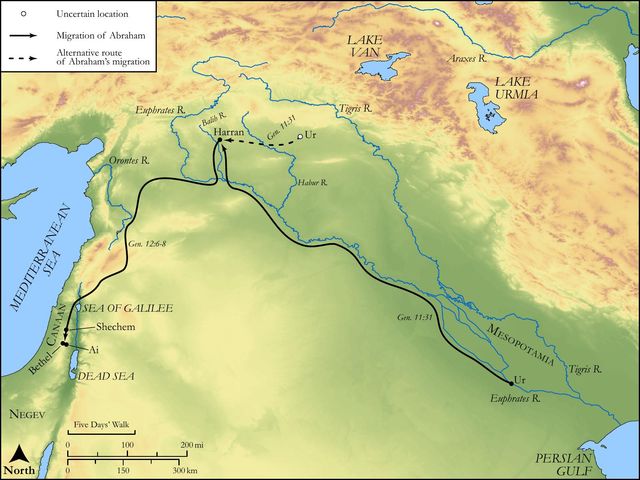
We have here the call by which Abram was removed out of the land of his nativity into the land of promise, which was designed both to try his faith and obedience and also to separate him and set him apart for God, and for special services and favours which were further designed. The circumstances of this call we may be somewhat helped to the knowledge of from Stephen's speech, Act 7:2, where we are told, 1. That the God of glory appeared to him to give him this call, appeared in such displays of his glory as left Abram no room to doubt the divine authority of this call. God spoke to him afterwards in divers manners; but this first time, when the correspondence was to be settled, he appeared to him as the God of glory, and spoke to him. 2. That this call was given him in Mesopotamia, before he dwelt in Charran; therefore we rightly read it, The Lord. had said unto Abram, namely, in Ur of the Chaldees; and, in obedience to this call, as Stephen further relates the story (Act 7:4), he came out of the land of the Chaldeans, and dwelt in Charran, or Haran, about five years, and thence, when his father was dead, by a fresh command, pursuant to the former, God removed him into the land of Canaan. some think that Haran was in Chaldea, and so was still a part of Abram's country, or that Abram, having staid there five years, began to call it his country, and to take root there, till God let him know this was not the place he was intended for. Note: If God loves us, and has mercy in store for us, he will not suffer us to take up our rest any where short of Canaan, but will graciously repeat his calls, till the good work begun be performed, and our souls repose in God only. In the call itself we have a precept and a promise.
I.A trying precept: Get thee out of thy country, Gen 12:1. Now,
1.By this precept he was tried whether he loved his native soil and dearest friends, and whether he could willingly leave all, to go along with God. His country had become idolatrous, his kindred and his father's house were a constant temptation to him, and he could not continue with them without danger of being infected by them; therefore Get thee out, yalak - Vade tibi, Get thee gone, with all speed, escape for thy life, look not behind thee, Gen 19:17. Note, Those that are in a sinful state are concerned to make all possible haste out of it. Get out for thyself (so some read it), that is, for thy own good. Note, Those who leave their sins, and turn to God, will themselves be unspeakable gainers by the change, Pro 9:12. This command which God gave to Abram is much the same with the gospel call by which all the spiritual seed of faithful Abram are brought into covenant with God. For,
(1.)Natural affection must give way to divine grace. Our country is dear to us, our kindred dearer, and our father's house dearest of all; and yet they must all be hated (Luk 14:26), that is, we must love them less than Christ, hate them in comparison with him, and, whenever any of these come in competition with him, they must be postponed, and the preference given to the will and honour of the Lord Jesus.
(2.)Sin, and all the occasions of it, must be forsaken, and particularly bad company; we must abandon all the idols of iniquity which have been set up in our hearts, and get out of the way of temptation, plucking out even a right eye that leads us to sin (Mat 5:29), willingly parting with that which is dearest to us, when we cannot keep it without hazard of our integrity. Those that resolve to keep the commandments of God must quit the society of evil doers, Psa 119:115; Act 2:40.
(3.)The world, and all our enjoyments in it, must be looked upon with a holy indifference and contempt; we must no longer look upon it as our country, or home, but as our inn, and must accordingly sit loose to it and live above it, get out of it in affection.
2.By this precept he was tried whether he could trust God further than he saw him; for he must leave his own country, to go to a land that God would show him. He does not say, "It is a land that I will give thee," but merely, "a land that I will show thee." Nor does he tell him what land it was, nor what kind of land; but he must follow God with an implicit faith, and take God's word for it, in the general, though he had no particular securities given him that he should be no loser by leaving his country, to follow God. Note, Those that will deal with God must deal upon trust; we must quit the things that are seen for things that are not seen, and submit to the sufferings of this present time in hopes of a glory that is yet to be revealed (Rom 8:18); for it doth not yet appear what we shall be (Jo1 3:2), any more than it did to Abram, when God called him to a land he would show him, so teaching him to live in a continual dependence upon his direction, and with his eye ever towards him.
II.Here is an encouraging promise, nay, it is a complication of promises, many, and exceedingly great and precious.
Note, All God's precepts are attended with promises to the obedient. When he makes himself known also as a rewarder: if we obey the command, God will not fail to perform the promise. Here are six promises: -
1.I will make of thee a great nation. When God took him from his own people, he promised to make him the head of another; he cut him off from being the branch of a wild olive, to make him the root of a good olive. This promise was,
(1.)A great relief to Abram's burden; for he had now no child. Note, God knows how to suit his favours to the wants and necessities of his children. He that has a plaster for every sore will provide one for that first which is most painful.
(2.)A great trial to Abram's faith; for his wife had been long barren, so that, if he believe, it must be against hope, and his faith must build purely upon that power which can out of stones raise up children unto Abraham, and make them a great nation. Note,
[1.]God makes nations: by him they are born at once (Isa 66:8), and he speaks to build and plant them, Jer 18:9. And,
[2.]If a nation be made great in wealth and power, it is God that makes it great.
[3.]God can raise great nations out of dry ground, and can make a little one to be a thousand.
2.I will bless thee, either particularly with the blessing of fruitfulness and increase, as he had blessed Adam and Noah, or, in general, "I will bless thee with all manner of blessings, both of the upper and the nether springs. Leave thy father's house, and I will give thee a father's blessing, better than that of they progenitors." Note, Obedient believers will be sure to inherit the blessing.
3.I will make thy name great. By deserting his country, he lost his name there. "Care not for that," says God, "but trust me, and I will make thee a greater name than ever thou couldst have had there." Having no child, he feared he should have no name; but God will make him a great nation, and so make him a great name. Note,
(1.)God is the fountain of honour, and from him promotion comes, Sa1 2:8.
(2.)The name of obedient believers shall certainly be celebrated and made great. The best report is that which the elders obtained by faith, Heb 11:2.
4.Thou shalt be a blessing; that is, (1.) "Thy happiness shall be a sample of happiness, so that those who would bless their friends shall only pray that God would make them like Abram;" as Rut 4:11. Note, God's dealings with obedient believers are so kind and gracious that we need not desire for ourselves or our friends to be any better dealt with: to have God for our friend is blessedness enough. (2.) "Thy life shall be a blessing to the places where thou shalt sojourn." Note, Good men are the blessings of their country, and it is their unspeakable honour and happiness to be made so.
5.I will bless those that bless thee and curse him that curseth thee. This made it a kind of a league, offensive and defensive, between God and Abram. Abram heartily espoused God's cause, and here God promises to interest himself in his.
(1.)He promises to be a friend to his friends, to take kindnesses shown to him as done to himself, and to recompense them accordingly. God will take care that none be losers, in the long run, by any service done for his people; even a cup of cold water shall be rewarded.
(2.)He promises to appear against his enemies. There were those that hated and cursed even Abram himself; but, while their causeless curses could not hurt Abram, God's righteous curse would certainly overtake and ruin them, Num 24:9. This is a good reason why we should bless those that curse us, because it is enough that God will curse them, Psa 38:13-15.
6.In thee shall all the families of the earth be blessed. This was the promise that crowned all the rest; for it points at the Messiah, in whom all the promises are yea and amen. Note,
(1.)Jesus Christ is the great blessing of the world, the greatest that ever the world was blessed with. He is a family blessing, by him salvation is brought to the house (Luk 19:9); when we reckon up our family blessings, let us put Christ in the imprimis - the first place, as the blessing of blessings. But how are all the families of the earth blessed in Christ, when so many are strangers to him? Answer, [1.] All that are blessed are blessed in him, Act 4:12 [2.] All that believe, of what family soever they shall be, shall be blessed in him. [3.] Some of all the families of the earth are blessed in him. [4.] There are some blessings which all the families of the earth are blessed with in Christ; for the gospel salvation is a common salvation, Jde 1:3.
(2.)It is a great honour to be related to Christ; this made Abram's name great, that the Messiah was to descend from his loins, much more than that he should be the father of many nations. It was Abram's honour to be his father by nature; it will be ours to be his brethren by grace, Mat 12:50.
Historical interpretation
Six Centuries of Reception
2 surviving comments on this verse. Each one is dated, so this reads as a timeline rather than a list.
Select a marker to jump to its quote. Markers stagger vertically where authors wrote within a few decades of each other.
Abraham, styled "the friend," [Isaiah 41:8] was found faithful, inasmuch as he rendered obedience to the words of God. He, in the exercise of obedience, went out from his own country, and from his kindred, and from his father's house, in order that, by forsaking a small territory, and a weak family, and an insignificant house, he might inherit the promises of God. For God said to him, "Get you out from your country, and from your kindred, and from your father's house, into the land which I shall show you. And I will make you a great nation, and will bless you, and make your name great, and you shall be blessed. And I will bless them that bless you, and curse them that curse you; and in you shall all the families of the earth be blessed." [Genesis 12:1-3] And again, on his departing from Lot, God said to him, "Lift up your eyes, and look from the place where you now are, northward, and southward, and eastward, and westward; for all the land which you see, to you will I give it, and to your seed forever. And I will make your seed as the dust of the earth, [so that] if a man can number the dust of the earth, then shall your seed also be numbered." [Genesis 13:14-16] And again [the Scripture] says, "God brought forth Abram, and spoke unto him, Look up now to heaven, and count the stars if you are able to number them; so shall your seed be. And Abram believed God, and it was counted to him for righteousness." [Genesis 15:5-6] On account of his faith and hospitality, a son was given him in his old age; and in the exercise of obedience, he offered him as a sacrifice to God on one of the mountains which He showed him. [Genesis 22:9]
And the Lord said to Abram, "Go out from your land, and from your kindred, and from your father's house to the land that I will show you. And I will make you into a great nation, and I will bless you, and I will make your name great, and you will be a blessing." For, speaking distinctly, the Lord mentions land, kindred, and father's house. The land of Abram must be understood as the region of the Chaldeans from which he had already departed: his kindred, the family of his brother Nahor, whom he had already left behind: the father's house, in which he was then dwelling in Haran. How then is it that he is now commanded to go out from his father's house as well as from the land and kindred from which he already seemed to have come forth? Unless perhaps it should be understood that he had left his land and his kindred with his parent with the intention, as we have previously mentioned, to return to it after reconciling with the Chaldeans in the following age: he is now commanded by the Lord to turn his mind away from the purpose of returning to Chaldea, and to take away his mind and body from the habitation of Mesopotamia as well. Leaving behind the land in which the city of pride was made, and confused by the judgment of the Lord, he was to come into the land in which he would receive the grace of the heavenly blessing and would create a new and better progeny by merit of his faith and obedience. For what he says, "And I will make you into a great nation," properly pertains to the people of Israel. For concerning the generation of other nations that were likewise to arise from him—namely the Ishmaelites, Edomites, and the peoples from Keturah, his second wife after Sarah—he says in subsequent words to him, "I will make you grow exceedingly, and I will place you among nations, and in you all the families of the earth will be blessed." This is a promise of blessing greater and far superior to the former. That one indeed is earthly, this one is heavenly: because the former signifies the propagation of carnal Israel, this one of the spiritual. The former pertains to the people who were born from him according to the flesh; this one to those who are saved in Christ from all the families of the earth, among whom are indeed those who are born from him according to the flesh and also wish to imitate his faith's piety. To all these, the Apostle Paul says, "And if you belong to Christ, then you are Abraham's seed" (Gal. 3:19). Therefore, what he says, "And in you all the families of the earth will be blessed" is as if he were saying, "And in your seed all the families of the earth will be blessed." For, to speak in the words of the Apostle, Mary was already in the loins of Abraham at that time, from whom Christ was to be born, when these things were said to him. And the wondrous disposition of heavenly severity and piety: for men gathering for a proud work deserved to be divided from one another through different languages and kinships. But leaving that province alone and willingly going into exile at the command of the Lord, he heard that all the nations divided into various provinces and languages would be gathered in him by a common blessing. Note indeed that although the world's third age is usually computed from the birth of Abraham, yet by this special oracle of the Lord to Abraham, the beginnings of the third age are consecrated according to the sufficiency of the matters themselves. For at that time, the holy seed was separated from the nations, and the Savior of all nations, who was to be born from it, was foretold. Until this time, all the faithful and righteous used to make use of that knowledge of moral life which they either knew naturally by guidance or drew originally from the doctrine of their parents. But now the knowledge also of the coming Savior in the flesh, in whom blessing and salvation were to come to all the holy ones, both those who would precede his incarnation by being born earlier and to us who believe we can be saved later by the name of the same Lord Jesus, as Peter says, in the same way as they.
Continue studying Genesis 12:3 across the web’s major study libraries — every link below opens this exact verse, chapter, or book on the destination site.
Read & Compare
 BibleGatewayThis verse in more than 200 translations and 70 languages.
 Bible.comThe YouVersion reader — hundreds of translations, reading plans, and highlights.
 ESV.orgCrossway's official English Standard Version reader.
 NET BibleThe NET translation with 60,000+ translators' notes on every rendering decision.
 STEP BibleTyndale House's free study tool — original text, vocabulary, and scholarly resources.
 BibliaLogos Bible Software's free web reader.
 USCCBThe New American Bible (Revised Edition) with the U.S. bishops' study notes.
Commentaries
 BibleHub CommentariesDozens of classic commentaries on this verse, gathered on one page.
 StudyLightMore than 100 commentary sets — the largest collection on the web.
 BibleRefPlain-English commentary on what this verse means, verse by verse.
 Enduring WordDavid Guzik's free commentary on this chapter, widely used by Bible teachers.
 Bible Study ToolsVerse commentary alongside Greek and Hebrew study aids.
Original Language & Research
- BibleHub InterlinearThe verse word by word — original language, transliteration, and English.
- BibleHub LexiconEvery word's original-language definition and Strong's entry.
 Blue Letter BibleDeep-study tools — Strong's numbers, concordance, and word studies.
 SefariaThe Hebrew text with Rashi and centuries of Jewish commentary.
Sermons, Hymns & Audio


TrulyRandomVerse is not affiliated with these sites and doesn’t control their content. They’re linked because they’re genuinely useful.
Summary
Genesis 12:3 stands as a foundational promise within the Abrahamic Covenant, articulating God's unwavering commitment to Abram, including divine favor and protective judgment. More profoundly, it serves as a prophetic declaration of God's universal redemptive plan, revealing how His relationship with one man would ultimately extend spiritual blessing and salvation to every family on the earth through his lineage.
Context
ShowHideLiterary Context
This pivotal verse is embedded within God's initial, groundbreaking call to Abram in Genesis 12. It immediately follows the divine command for Abram to leave his homeland, kindred, and father's house to journey to an unknown land that God would show him (Genesis 12:1). The promise in Genesis 12:2 outlines personal blessings for Abram—a great nation, a great name, and personal blessing—and establishes him as a source of blessing for others. Genesis 12:3 then expands on this, introducing a reciprocal principle of blessing and cursing based on how others treat Abram, before culminating in the astonishing, universal scope of the covenant: that "all families of the earth" would be blessed through him. This progression moves from personal call to national destiny, and finally to global impact, setting the stage for the entire biblical narrative of redemption.
Historical & Cultural Context
Abram's call came in a polytheistic world dominated by various local deities and tribal loyalties, for his fathers beyond the flood "served other gods." Leaving one's land and family was an act of profound cultural and religious rupture, as identity, security, and worship were intrinsically tied to one's lineage and ancestral territory. God's command to Abram was a radical summons to monotheistic faith and nomadic trust. The concept of a universal blessing was revolutionary, contrasting sharply with the ethnocentric and often hostile relations between ancient peoples. The promise of land, descendants, and blessing was a common motif in ancient covenants, but God's covenant with Abram uniquely transcended these, promising a blessing that would extend beyond national borders to encompass all humanity, a concept unparalleled in contemporary religious thought.
Key Themes
ShowHideGenesis 12:3 encapsulates several overarching themes central to the book of Genesis and the broader biblical narrative. It highlights Divine Initiative and Sovereignty, as God unilaterally initiates this covenant with Abram, demonstrating His sovereign choice and purpose. The theme of Covenant is paramount, establishing the framework for God's relationship with humanity through a chosen lineage. It introduces the profound concept of Blessing and Curse, not merely as material prosperity or misfortune, but as spiritual alignment or opposition to God's redemptive plan. Most significantly, it unveils the Universal Scope of God's Redemptive Plan, foreshadowing that God's ultimate intention was never limited to one nation but was always destined to embrace "all families of the earth." This promise lays the theological groundwork for the inclusion of Gentiles in God's salvation, a theme that finds its ultimate fulfillment in the New Testament, as seen in the Apostle Paul's exposition in Galatians 3.
Exposition and Analysis
ShowHideKey Word Analysis
ShowHideThis primitive root means "to kneel," and by implication, "to bless." When God blesses, it signifies His divine favor, empowerment, and the bestowal of benefits, leading to prosperity, fruitfulness, and well-being. When man blesses God, it is an act of adoration and praise. The repeated use of this word emphasizes the core nature of God's action in this covenant—to impart goodness and favor.
This root means "to be light," often in a negative sense, signifying to make light of, to treat lightly, to despise, or to bring into contempt. In the context of a curse, it implies a divine judgment or a pronouncement of disfavor, leading to a state of being diminished, vile, or afflicted. It stands in stark contrast to bârak, indicating a clear demarcation of divine response based on one's attitude towards Abram.
Derived from a root meaning "to spread out," this word refers to a family, a circle of relatives, or by extension, a tribe or people. Its use here, in conjunction with "earth," underscores the comprehensive and global reach of God's intended blessing. It signifies that the blessing is not limited to a specific lineage or nation but is intended for every distinct group of people on the planet.
Verse Breakdown
ShowHide"And I will bless them that bless thee,"
This clause establishes a principle of divine reciprocity. God promises to extend His favor and benefits to anyone who shows favor, kindness, or support to Abram. This highlights God's protective nature over His chosen servant and the covenant He is initiating. It implies that aligning with God's purposes for Abram will result in divine blessing.
"and curse him that curseth thee:"
This second clause introduces the inverse principle of divine judgment. God declares that He will bring disfavor, judgment, or contempt upon anyone who treats Abram lightly, despises him, or seeks to harm him. This underscores the seriousness of the covenant and God's unwavering commitment to defend and vindicate Abram, and by extension, his descendants. It serves as a warning to those who would oppose God's chosen instrument.
"and in thee shall all families of the earth be blessed."
This is the climactic and most far-reaching promise of the verse. It shifts from the immediate, reciprocal blessings and curses to a universal, future-oriented blessing. The phrase "in thee" points to Abram as the channel or instrument through whom God's blessing will flow. The scope, "all families of the earth," explicitly extends the covenant's ultimate purpose beyond Abram's immediate descendants to encompass every distinct people group across the globe, foreshadowing a spiritual blessing accessible to all humanity.
Literary Devices
ShowHideGenesis 12:3 powerfully employs Parallelism, specifically Antithetical Parallelism, in the first two clauses: "I will bless them that bless thee, and curse him that curseth thee." This structure effectively contrasts the two opposing divine responses—blessing and cursing—based on the actions of others towards Abram, emphasizing the clear and decisive nature of God's justice and favor. The phrase "all families of the earth" utilizes Hyperbole or Universalism to convey the expansive and all-encompassing nature of God's redemptive plan, ensuring that the blessing is understood to transcend any national or ethnic boundaries. The entire verse functions as a profound Prophecy and Foreshadowing, pointing forward to the ultimate fulfillment of God's global redemptive purposes through Abram's lineage, culminating in the Messiah.
Theological and Thematic Connections
ShowHideGenesis 12:3 is a theological cornerstone, revealing God's character as both just protector and universal redeemer. It establishes that God's election of Abram was not for Abram's exclusive benefit, but as a means to achieve a global purpose—to bring spiritual blessing to all humanity. This verse fundamentally shapes the biblical narrative, demonstrating that from its earliest stages, God's plan for salvation was designed to encompass all peoples, not just one chosen nation. It sets the stage for the unfolding story of redemption, highlighting the principle that divine blessing flows through obedience and alignment with God's chosen instruments, ultimately culminating in the ultimate "seed" of Abraham.
Reflection and Application
ShowHideGenesis 12:3 offers profound comfort and challenge for believers today. It assures us of God's unwavering faithfulness to His promises, reminding us that His redemptive plan, initiated millennia ago, is still unfolding and will ultimately encompass all peoples. For those who are "in Christ," we are spiritual descendants of Abraham, heirs to this promise, and recipients of the ultimate blessing. This verse calls us to embrace God's global vision, recognizing that our faith is not insular but part of a grander narrative of universal redemption. It compels us to participate actively in extending this blessing to "all families of the earth" through missions, evangelism, and acts of love and justice, aligning ourselves with God's heart for the nations. Our posture towards God's chosen people, both historically and spiritually, reflects our alignment with His covenant purposes.
Questions for Reflection
ShowHideFAQ
ShowHideDoes "in thee shall all families of the earth be blessed" mean that everyone will be saved?
ShowHideNo, this phrase does not imply universal salvation for every individual regardless of their faith or actions. Rather, it signifies that the opportunity for spiritual blessing and salvation will be made available to all families, tribes, and nations through Abram's lineage. It points to the means by which God's redemptive plan would extend globally, not that every person would automatically accept it. The blessing is ultimately received through faith in the "seed" of Abraham, Jesus Christ, as clarified in Galatians 3:8-9.
How does God "curse him that curseth thee" apply to nations today concerning Israel?
ShowHideWhile this promise was given specifically to Abram and foundational to the nation of Israel, its direct application to modern nations concerning the state of Israel is a complex theological discussion. Some interpret it as a continuing principle of divine favor and disfavor towards nations based on their treatment of the Jewish people. Others view it primarily as a covenant promise tied to the historical nation of Israel in the Old Testament, with its ultimate spiritual fulfillment in Christ and the Church. In the New Covenant, the ultimate blessing comes through faith in Jesus, making believers, both Jew and Gentile, spiritual descendants of Abraham (Galatians 3:29).
What kind of "blessing" is promised to "all families of the earth"?
ShowHideThe "blessing" promised to "all families of the earth" is primarily spiritual and redemptive. While material blessings were part of the covenant with Abram, the universal blessing points to the spiritual blessings of salvation, forgiveness of sins, righteousness by faith, and adoption into God's family. These are all made possible through Jesus Christ, the ultimate descendant of Abraham, who brings reconciliation between God and humanity (Ephesians 1:3).
Christ-Centered Fulfillment
ShowHideThe profound promise that "in thee shall all families of the earth be blessed" finds its ultimate and glorious fulfillment in the person and work of Jesus Christ. As the supreme "seed" or descendant of Abraham, Jesus is the singular channel through whom God's universal blessing is extended to all humanity, transcending ethnic and national boundaries. The Apostle Paul, in Galatians 3:8, explicitly connects this Genesis promise to the Gospel itself, declaring that "the Scripture, foreseeing that God would justify the Gentiles by faith, preached the gospel beforehand to Abraham, saying, 'In you shall all the nations be blessed.'" This demonstrates that God's redemptive plan, conceived in Abraham, was always designed to culminate in Christ, who would bring salvation to Jew and Gentile alike. Through His atoning sacrifice and resurrection, Jesus makes available the spiritual blessings of forgiveness, righteousness, adoption, and eternal life to all who believe, making them blessed with faithful Abraham. Thus, the Abrahamic Covenant, initiated in Genesis 12:3, culminates in the global reach of the Gospel through Christ, inviting every family of the earth into God's redemptive plan and forming one new humanity in Him (Ephesians 2:14-18).