


Genesis 12:4
Bible text: King James Version (1769 Blayney text) · Public domain
Bible text: King James Version with Strong's numbers · Public domain
Bible text: Berean Standard Bible · Public domain
Bible text: American Standard Version (1901) · Public domain
Bible text: World English Bible, Messianic edition · Public domain
Bible text: Geneva Bible (1599) · Public domain
Bible text: Young's Literal Translation · Public domain
- וַיֵּלֶךְvai·Ye·lekhand he wentH1980Conj-w ¦ V-Qal-ConsecImperf-3msVerb Qal Consecutive Imperfect 3rd Singular Masculineוַandיֵּלֶךְhe went
- אַבְרָם'av·RamAbramH87N-proper-mNoun Proper Masculine
- כַּאֲשֶׁרka·'a·Sherjust asH834Prep-k ¦ RelParticle Relativeכַּjustאֲשֶׁרas
- דִּבֶּרdi·Berhe had saidH1696V-Piel-Perf-3msVerb Piel Perfect 3rd Singular Masculine
- אֵלָיו'e·Lavto himH413Prep ¦ 3msPreposition Definiteאֵלָיtoוhim
- יְהוָהYah·wehYahwehH3068N-properNoun Proper Title
- וַיֵּלֶךְvai·Ye·lekhand he wentH1980Conj-w ¦ V-Qal-ConsecImperf-3msVerb Qal Consecutive Imperfect 3rd Singular Masculineוַandיֵּלֶךְhe went
- אִתּוֹ'i·Towith himH854Prep ¦ 3msPreposition Definiteאִתּwithוֹhim
- לוֹטLotLotH3876N-proper-mNoun Proper Masculine
- וְאַבְרָםve·'av·Ramand AbramH87Conj-w ¦ N-proper-mNoun Proper MasculineוְandאַבְרָםAbram
- בֶּןben[was] a son ofH1121N-mscNoun Singular Masculine Construct
- חָמֵשׁcha·MeshfiveH2568Adj-csAdjective Numerical Singular common gender Absolute
- שָׁנִיםsha·NimyearsH8141N-mpNoun Plural Masculine Absolute
- וְשִׁבְעִיםve·shiv·'Imand seventyH7657Conj-w ¦ Adj-mpAdjective Numerical Plural Masculine Absoluteוְandשִׁבְעִיםseventy
- שָׁנָהsha·Nahyear[s]H8141N-fsNoun Singular Feminine Absolute
- בְּצֵאתוֹbe·tze·Towhen he came outH3318Prep-b ¦ V-Qal-Inf ¦ 3msVerb Qal Infinitive Constructבְּwhenצֵאתcame outוֹhe
- מֵחָרָןme·cha·Ranfrom HaranH2771Prep-m ¦ N-properNoun Proper LocationמֵfromחָרָןHaran
English is a literal word-by-word gloss of the Hebrew, not the KJV's wording. Why?
This is the original text the KJV's translators worked from — each Hebrew word with its own literal English meaning in this verse, prepared by scholars at Tyndale House, Cambridge. The KJV translates whole sentences, not word by word, so its wording differs: one Hebrew word can become several English words, and the KJV may choose “the LORD” where the gloss reads “Yahweh”. Both are faithful — they answer different questions. For the KJV's own rendering, switch to the KJV text.
Details
See on the biblical-era maps


Study this verse
Public-domain commentary
Matthew Henry
From his Commentary on the Whole Bible. Henry comments on passages, not single verses — this entry covers Genesis 12:4–5. His three-level outline is real structure in the source text, so it is rendered as structure.
Here is, I. Abraham's removal out of his country, out of Ur first and afterwards out of Haran, in compliance with the call of God: So Abram departed; he was not disobedient to the heavenly vision, but did as he was bidden, not conferring with flesh and blood, Gal 1:15, Gal 1:16. His obedience was speedy and without delay, submissive and without dispute; for he went out, not knowing whither he went (Heb 11:8), but knowing whom he followed and under whose direction he went. Thus God called him to his foot, Isa 41:2.
II.His age when he removed:
he was seventy-five years old, an age when he should rather have had rest and settlement; but, if God will have him to begin the world again now in his old age, he will submit. Here is an instance of an old convert.
III.The company and cargo that he took with him.
1.He took his wife, and his nephew Lot, with him; not by force and against their wills, but by persuasion. Sarai, his wife, would be sure to go with him; God had joined them together, and nothing should put them asunder. If Abram leave all, to follow God, Sarai will leave all, to follow Abram, though neither of them knew whither. And it was a mercy to Abram to have such a companion in his travels, a help meet for him. Note, It is very comfortable when husband and wife agree to go together in the way to heaven. Lot also, his kinsman, was influenced by Abram's good example, who was perhaps his guardian after the death of his father, and he was willing to go along with him too. Note, Those that go to Canaan need not go alone, for, though few find the strait gate, blessed be God, some do; and it is our wisdom to go with those with whom God is (Zac 8:23), wherever they go.
2.They took all their effects with them - all their substance and movable goods, that they had gathered. For,
(1.)With themselves they would give up their all, to be at God's disposal, would keep back no part of the price, but venture all in one bottom, knowing it was a good bottom.
(2.)They would furnish themselves with that which was requisite, both for the service of God and the supply of their family, in the country whither they were going. To have thrown away his substance, because God had promised to bless him, would have been to tempt God, not to trust him.
(3.)They would not be under any temptation to return; therefore they leave not a hoof behind, lest that should make them mindful of the country from which they came out.
3.They took with them the souls that they had gotten, that is,
(1.)The servants they had bought, which were part of their substance, but are called souls, to remind masters that their poor servants have souls, precious souls, which they ought to take care of and provide food convenient for.
(2.)The proselytes they had made, and persuaded to attend the worship of the true God, and to go with them to Canaan: the souls which (as one of the rabbin expresses it) they had gathered under the wings of the divine Majesty. Note, Those who serve and follow God themselves should do all they can to bring others to serve and follow him too. These souls they are said to have gained. We must reckon ourselves true gainers if we can but win souls to Christ.
IV.Here is their happy arrival at their journey's end:
They went forth to go into the land of Canaan; so they did before (Gen 11:31), and then took up short, but now they held on their way, and, by the good hand of their God upon them, to the land of Canaan they came, where by a fresh revelation they were told that this was the land God promised to show them. They were not discouraged by the difficulties they met with in their way, nor diverted by the delights they met with, but pressed forward. Note,
1.Those that set out for heaven must persevere to the end, still reaching forth to those things that are before.
2.That which we undertake in obedience to God's command, and a humble attendance upon his providence, will certainly succeed, and end with comfort at last.
Historical interpretation
Three Centuries of Reception
2 surviving comments on this verse. Each one is dated, so this reads as a timeline rather than a list.
Select a marker to jump to its quote. Markers stagger vertically where authors wrote within a few decades of each other.
(Chapter 12, Verse 4) Now Abram was seventy-five years old when he departed from Haran. There arises an unsolvable question: for if Terah, the father of Abram, when he was still in the land of the Chaldeans, at seventy years old begot Abram, and afterwards died in Haran at the age of two hundred and five: how is it now mentioned that Abram, after the death of Terah, when departing from Haran, was seventy-five years old? Since from the birth of Abram until the death of his father, it is said that one hundred and thirty-five years passed. Therefore, that tradition of the Hebrews, which we mentioned above, is true: that Thara went out with his sons from the fire of the Chaldeans, and that Abram, surrounded by the Babylonian fire, was liberated by the help of God because he refused to worship it; and from that time, the days of his life, and the reckoning of his age, are considered from when he confessed the Lord, rejecting the idols of the Chaldeans. However, it is possible that because the Scripture left it uncertain, a few years ago Thara set out from Chaldea and came to Haran, where he died. Certainly, after the persecution, he came to Haran and stayed there for a longer time. Therefore, if anyone is opposed to this explanation, they will seek another solution and then rightfully reject what we have said.
So Abram departed as the Lord had directed him, and Lot went with him. Abram was seventy-five years old when he left Haran. It is clear from this number of Abraham's years that he left Haran while his father was still alive, as was explained above. There is no doubt that the number seventy-five is mystical, since in it he received the promise of divine blessing and left Isaac, the heir of the same blessing, when he was dying. To speak briefly, seventy, because it is seven times ten, represents the perfection of good actions, when we fulfill the commandments of the Decalogue through the grace of the Holy Spirit, which the prophet describes as sevenfold. To these are added five, so that in all the senses of our body, we may fulfill the same divine commandments with the help of the Spirit’s grace. Abram was seventy-five years old when he left Haran at the command or promise of the Lord and entered the Promised Land; to show that he himself, through the help of the Spirit, having anathematized the errors of Babylonian conduct, would keep God’s commandments; and this in all that he did with his body, whether living, hearing, tasting, or touching, so that there might be nothing in his body that was not enlightened and aided by the gift of the Spirit to obey the heavenly commands. And he marked that all his heirs of the promise should live in a similar manner. It is also to be imitated by all the sons of the promise, among whom we are, that he was ordered to leave his land, his kindred, and his father’s house. For we depart from our land when we renounce the pleasures of the flesh; from our kindred, when we strive to strip ourselves of all the vices with which we were born, as far as is possible for humans; from our father’s house, when we contend to leave the world itself with its prince the devil out of love for heavenly life. For we are all born into the world as sons of the devil because of the guilt of original transgression; but through the grace of regeneration, we belong to the seed of Abraham and become the sons of God, as our Father in heaven says to us, that is, to His Church: "Listen, daughter, and see, and incline your ear, forget your people and your father’s house" (Psalms 45:10). Thus it is well that Haran, from which Abraham departed, is interpreted as Wrath. Canaan, to whose land he was invited, is called the Changed or Merchant. Therefore, not only did Abraham and his brother Lot leave Haran to go to the land of Canaan, but all the elect who are born through the laver of regeneration certainly depart from Haran and come to the land of Canaan; and all the chosen, with the wrath of original sin repudiated in the state of their life and having abandoned the habit of vices, apply themselves to virtues and labor in the most blessed commerce of temporal works to attain eternal rewards; they spurn earthly riches to receive heavenly ones; they disdain the joys of human reign to deserve a share in the kingdom of God. For this is the land that the Lord promised to show His followers: because it cannot be discovered by human wisdom how to walk the way of good deeds, but His guidance must be sought in all things, as the Psalmist says: "You held my right hand, you guided me according to your will, and took me with glory" (Psalms 73:23-24).
Continue studying Genesis 12:4 across the web’s major study libraries — every link below opens this exact verse, chapter, or book on the destination site.
Read & Compare
 BibleGatewayThis verse in more than 200 translations and 70 languages.
 Bible.comThe YouVersion reader — hundreds of translations, reading plans, and highlights.
 ESV.orgCrossway's official English Standard Version reader.
 NET BibleThe NET translation with 60,000+ translators' notes on every rendering decision.
 STEP BibleTyndale House's free study tool — original text, vocabulary, and scholarly resources.
 BibliaLogos Bible Software's free web reader.
 USCCBThe New American Bible (Revised Edition) with the U.S. bishops' study notes.
Commentaries
 BibleHub CommentariesDozens of classic commentaries on this verse, gathered on one page.
 StudyLightMore than 100 commentary sets — the largest collection on the web.
 BibleRefPlain-English commentary on what this verse means, verse by verse.
 Enduring WordDavid Guzik's free commentary on this chapter, widely used by Bible teachers.
 Bible Study ToolsVerse commentary alongside Greek and Hebrew study aids.
Original Language & Research
- BibleHub InterlinearThe verse word by word — original language, transliteration, and English.
- BibleHub LexiconEvery word's original-language definition and Strong's entry.
 Blue Letter BibleDeep-study tools — Strong's numbers, concordance, and word studies.
 SefariaThe Hebrew text with Rashi and centuries of Jewish commentary.
Sermons, Hymns & Audio


TrulyRandomVerse is not affiliated with these sites and doesn’t control their content. They’re linked because they’re genuinely useful.
Summary
Genesis 12:4 records Abram's immediate and decisive departure from Haran at the age of seventy-five, accompanied by his nephew Lot. This pivotal act of obedience directly fulfills the divine command given by the LORD, marking the foundational moment for the Abrahamic covenant and initiating a new epoch in God's redemptive plan that would profoundly shape the destiny of Israel and ultimately, all nations.
Context
ShowHideLiterary Context
Genesis 12:4 serves as the immediate and faithful response to the monumental divine call issued to Abram in Genesis 12:1-3. The preceding chapter, Genesis 11, concludes with Terah, Abram's father, setting out from Ur of the Chaldeans with Abram, Nahor, and Lot, but settling in Haran, where he eventually died (Genesis 11:31-32). Thus, Abram's departure from Haran signifies a new, independent journey, distinct from his father's incomplete migration. The inclusion of Lot in this initial departure highlights the lingering familial ties, which will later be severed due to their growing possessions and the need for separate grazing lands, as detailed in Genesis 13. This verse is a crucial turning point, moving from the general history of humanity to the specific history of God's chosen people through Abram.
Historical & Cultural Context
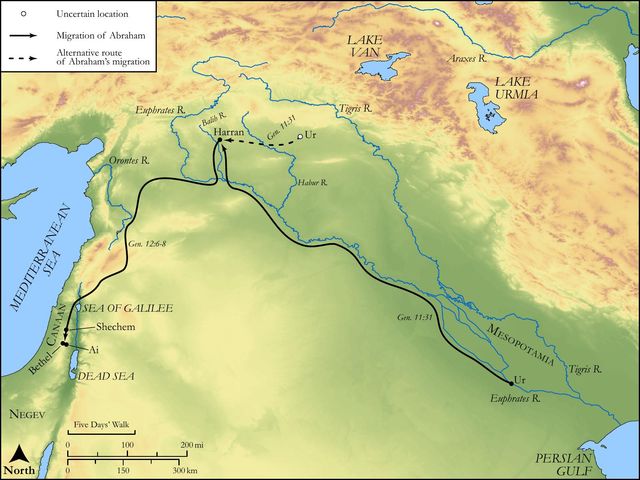
Haran was a significant city in northern Mesopotamia, a major trade hub situated on the crossroads of ancient trade routes. Leaving one's "country, kindred, and father's house" (Genesis 12:1) in the days of the patriarchs was an act of profound cultural and social disruption. Identity, security, and livelihood were inextricably linked to one's clan and ancestral land. To abandon these ties meant stepping into immense vulnerability and uncertainty, relying solely on an external promise. Abram's journey was not a mere change of residence but a radical break from the settled, idolatrous culture of Mesopotamia, demonstrating a profound commitment to the unseen God. His age of seventy-five, while advanced, was not uncommon for significant undertakings in that era, though it underscores the extraordinary nature of God's call and Abram's unwavering faith in responding to it.
Key Themes
ShowHideThis verse encapsulates several foundational themes that resonate throughout the biblical narrative. Firstly, it powerfully demonstrates obedient faith, as Abram's immediate action is a direct response to God's word, setting a precedent for his character and the nature of a covenant relationship. Secondly, it underscores divine initiative and sovereignty, emphasizing that God actively intervenes in human history, choosing and calling individuals for His purposes, as seen in God's election of Abram. Thirdly, it marks the initiation of the Abrahamic covenant, a unilateral promise from God that forms the bedrock of Israel's identity and the unfolding of God's redemptive plan for humanity, a plan that finds its ultimate expression in Christ. Finally, it highlights the theme of separation and new beginnings, where leaving the familiar and the past is a prerequisite for embracing a new identity and destiny defined by God's call, echoing principles found in passages like 2 Corinthians 5:17.
Exposition and Analysis
ShowHideKey Word Analysis
ShowHideThis primitive root signifies "to walk" or "to go," but in this context, it conveys a resolute and definitive movement. It is not a hesitant step but a purposeful setting forth, indicating Abram's immediate and complete compliance with God's command. The repetition of "departed" later in the verse (translated from H3318, yâtsâʼ, which means "to go out") further emphasizes the finality and decisiveness of his action, leaving behind his past life and environment.
This verb means "to speak," "to declare," or "to command." Its use here, "as the LORD had spoken unto him," highlights the authoritative and direct nature of God's communication. It implies not a suggestion or a vague impression, but a clear, articulate divine mandate that Abram heard and understood, prompting his immediate response. This emphasizes the divine origin and authority behind Abram's momentous journey.
While often translated as "son," bên is used here in the idiomatic expression "son of seventy and five years," which is the standard Hebrew way of indicating age. This detail is significant as it underscores that Abram was not a young man embarking on an adventure, but a seasoned individual, well past the prime of life for starting a new family or nation. This emphasizes God's sovereign timing and His ability to work through individuals regardless of their natural limitations, setting the stage for the miraculous birth of Isaac later in Abram's life.
Verse Breakdown
ShowHide"So Abram departed, as the LORD had spoken unto him"
This clause immediately establishes Abram's obedience as a direct consequence of God's command. The Hebrew phrase "as the LORD had spoken unto him" (כַּאֲשֶׁר דִּבֶּר אֵלָיו יְהוָה, ka'asher dibber elav Yahweh) is crucial, emphasizing that Abram's action was not self-initiated but a faithful response to a divine mandate. It highlights the central theme of obedience to God's revealed will as the foundation for entering into His blessings and purposes.
"and Lot went with him"
This detail indicates that while God's call was specifically to Abram, his nephew Lot, the son of his deceased brother Haran, accompanied him. This reflects the practice in the households of the patriarchs of extended family traveling together, providing mutual support and security. Lot's presence also sets the stage for future narrative developments, particularly their eventual separation due to increasing wealth and the need for more land, as recorded in Genesis 13.
"and Abram [was] seventy and five years old when he departed out of Haran"
This final clause provides a specific age for Abram at the time of his departure and pinpoints Haran as the exact location from which this transformative journey began. Abram's age emphasizes that God's call is not limited by conventional human expectations or life stages; God often initiates His greatest works through those who might seem naturally past their prime. Haran serves as the geographical and symbolic point of departure from his past, his family's settled life, and the idolatrous culture, marking the true beginning of his new life of faith.
Literary Devices
ShowHideThe narrative of Genesis 12:4 employs several effective literary devices. Narrative Economy is evident in the concise yet impactful reporting of Abram's actions. The verse wastes no words, directly stating the crucial facts: Abram's departure, his obedience to God's word, Lot's accompaniment, and Abram's age and location. This brevity lends a sense of immediacy and decisiveness to Abram's response. There is also a subtle Juxtaposition between Abram's prompt obedience and his father Terah's earlier, incomplete journey that ended in Haran (Genesis 11:31-32). While Terah stopped short, Abram fully embraces the call to move on. Furthermore, the Repetition of the idea of "departing" (implied by "went" and "departed") underscores the significance of this physical and spiritual movement away from the familiar and towards the unknown, emphasizing the profound break from his past life.
Theological and Thematic Connections
ShowHideGenesis 12:4 stands as a monumental theological statement, showcasing God's sovereign initiation of His redemptive plan and humanity's essential response of faith and obedience. Abram's immediate departure underscores that true faith is not passive assent but an active, often costly, response to God's revealed will. This pivotal act lays the groundwork for the Abrahamic covenant, a unilateral divine promise that forms the theological backbone for the nation of Israel and, ultimately, for the salvation offered to all humanity through Abram's "seed." It demonstrates that God chooses individuals not based on their inherent merit or natural ability, but according to His divine purpose and grace, calling them to step out in faith and trust in His unfailing word, even when the path ahead is unclear.
Reflection and Application
ShowHideGenesis 12:4 offers a profound and timeless lesson for believers today concerning the nature of faith and obedience. Abram's willingness to depart from everything familiar—his home, his family, his cultural security—at the age of seventy-five, simply because "the LORD had spoken unto him," challenges us to examine the depth of our own trust in God. We are often called to step out in faith, to leave behind our comfort zones, ingrained habits, or even seemingly good things, in pursuit of God's higher calling. This verse encourages us to cultivate a spirit of immediate and unwavering obedience when God's Word or His Spirit leads, even when the future is uncertain or the path seems illogical from a human perspective. It reminds us that God's timing is perfect, and readiness for His service is not limited by age, circumstances, or perceived limitations, but by a heart willing to respond with courageous faith to His divine invitation.
Questions for Reflection
ShowHideFAQ
ShowHideWhy was Abram 75 years old when he departed?
ShowHideAbram's age of seventy-five years highlights God's sovereign timing and His ability to initiate significant tasks and new beginnings for individuals regardless of their natural age or stage of life. It underscores that readiness for God's service is not limited by conventional human expectations but by a willing and obedient heart. This detail also sets the stage for the later miraculous birth of Isaac, demonstrating God's power to overcome natural limitations and fulfill His promises against all odds, reinforcing that it is never too late to respond to His divine call.
Who was Lot and why did he go with Abram?
ShowHideLot was Abram's nephew, the son of his deceased brother Haran. His inclusion in the journey reflects the strong familial ties and communal interdependence prevalent in the households of the patriarchs, where extended family often traveled together for security, support, and shared resources. While God's call was specifically directed to Abram, Lot's accompanying him initially maintained a degree of family unity. However, their paths would later diverge due to their increasing wealth and the need for separate grazing lands, as recorded in Genesis 13.
What is the significance of "as the LORD had spoken unto him"?
ShowHideThis phrase, "as the LORD had spoken unto him" (Hebrew: ka'asher dibber elav Yahweh), is profoundly significant because it directly links Abram's action to God's explicit command in Genesis 12:1-3. It emphasizes that Abram's departure was not a personal whim or a pragmatic decision, but an act of immediate and complete obedience to a divine mandate. This highlights the foundational principle of the Abrahamic covenant: God initiates through His word, and humanity responds in faithful action. It underscores God's authority and Abram's exemplary faith, setting the tone for the entire patriarchal narrative.
Christ-Centered Fulfillment
ShowHideAbram's journey of faith and obedience, initiated by a divine call to leave his home and step into the unknown, profoundly prefigures the greater journey of faith for all who believe in Christ. The covenant promised to Abram, particularly the blessing of "all the families of the earth" through his "seed" (Genesis 12:3), finds its ultimate and universal fulfillment in Jesus Christ, the true "seed" of Abraham (Galatians 3:16). Just as Abram's obedience led to the establishment of a chosen nation, Christ's perfect obedience to the Father's will, even unto death on the cross, established the new covenant, offering salvation and spiritual blessing to all peoples, Jew and Gentile alike. Abram's departure from his homeland in faith models the spiritual journey of believers who, by faith, leave behind their old lives of sin and self-reliance to follow Christ into a new, promised inheritance, seeking not an earthly city but "the city which has foundations, whose builder and maker is God" (Hebrews 11:10). His willingness to abandon the familiar for God's call echoes the call of Christ to "deny himself and take up his cross and follow Me" (Matthew 16:24), leading to a new creation in Him (2 Corinthians 5:17).