


Genesis 12:5
Bible text: King James Version (1769 Blayney text) · Public domain
Bible text: King James Version with Strong's numbers · Public domain
Bible text: Berean Standard Bible · Public domain
Bible text: American Standard Version (1901) · Public domain
Bible text: World English Bible, Messianic edition · Public domain
Bible text: Geneva Bible (1599) · Public domain
Bible text: Young's Literal Translation · Public domain
- וַיִּקַּחvai·yi·Kachand he tookH3947Conj-w ¦ V-Qal-ConsecImperf-3msVerb Qal Consecutive Imperfect 3rd Singular Masculineוַandיִּקַּחhe took
- אַבְרָם'av·RamAbramH87N-proper-mNoun Proper Masculine
- אֶת'et<obj.>H853DirObjMParticle Object Indicator
- שָׂרַיsa·RaiSaraiH8297N-proper-fNoun Proper Feminine
- אִשְׁתּוֹ'ish·Tohis wifeH802N-fsc ¦ 3msNoun Singular Feminine Constructאִשְׁתּwifeוֹhis
- וְאֶתve·'Etand <obj.>H853Conj-w ¦ DirObjMParticle Object Indicatorוְandאֶת<obj.>
- לוֹטLotLotH3876N-proper-mNoun Proper Masculine
- בֶּןben[the] son ofH1121N-mscNoun Singular Masculine Construct
- אָחִיו'a·Chivhis brotherH251N-msc ¦ 3msNoun Singular Masculine Constructאָחִיbrotherוhis
- וְאֶתve·'Etand <obj.>H853Conj-w ¦ DirObjMParticle Object Indicatorוְandאֶת<obj.>
- כָּלkolallH3605N-mscNoun Singular Masculine Construct
- רְכוּשָׁםre·khu·Shamtheir possession[s]H7399N-msc ¦ 3mpNoun Singular Masculine Constructרְכוּשָׁpossession[s]םtheir
- אֲשֶׁר'a·SherwhichH834RelParticle Relative
- רָכָשׁוּra·Kha·shuthey had accumulatedH7408V-Qal-Perf-3cpVerb Qal Perfect 3rd Plural common gender
- וְאֶתve·'Etand <obj.>H853Conj-w ¦ DirObjMParticle Object Indicatorוְandאֶת<obj.>
- הַנֶּפֶשׁha·Ne·feshthe person[s]H5315Art ¦ N-fsNoun Singular Feminine Absoluteהַtheנֶּפֶשׁperson[s]
- אֲשֶׁר'a·SherwhomH834RelParticle Relative
- עָשׂוּ'a·Suthey had acquiredH6213V-Qal-Perf-3cpVerb Qal Perfect 3rd Plural common gender
- בְחָרָןve·cha·Ranin HaranH2771Prep-b ¦ N-properNoun Proper LocationבְinחָרָןHaran
- וַיֵּצְאוּvai·ye·tze·'Uand they went outH3318Conj-w ¦ V-Qal-ConsecImperf-3mpVerb Qal Consecutive Imperfect 3rd Plural Masculineוַandיֵּצְאוּthey went out
- לָלֶכֶתla·Le·khetto goH1980Prep-l ¦ V-Qal-InfVerb Qal Infinitive Constructלָtoלֶכֶתgo
- אַרְצָה'Ar·tzah[the] land of towardsH776N-fsc ¦ SfxNoun Singular Feminine Constructאַרְצָ[the] land ofהtowards
- כְּנַעַןke·Na·'anCanaanH3667N-properNoun Proper Location
- וַיָּבֹאוּvai·ya·Vo·'uand they cameH935Conj-w ¦ V-Qal-ConsecImperf-3mpVerb Qal Consecutive Imperfect 3rd Plural Masculineוַandיָּבֹאוּthey came
- אַרְצָה'Ar·tzah[the] land of towardsH776N-fsc ¦ SfxNoun Singular Feminine Constructאַרְצָ[the] land ofהtowards
- כְּנָעַןke·Na·'anCanaanH3667N-properNoun Proper Location
English is a literal word-by-word gloss of the Hebrew, not the KJV's wording. Why?
This is the original text the KJV's translators worked from — each Hebrew word with its own literal English meaning in this verse, prepared by scholars at Tyndale House, Cambridge. The KJV translates whole sentences, not word by word, so its wording differs: one Hebrew word can become several English words, and the KJV may choose “the LORD” where the gloss reads “Yahweh”. Both are faithful — they answer different questions. For the KJV's own rendering, switch to the KJV text.
Details
See on the biblical-era maps


Study this verse
Public-domain commentary
Matthew Henry
From his Commentary on the Whole Bible. Henry comments on passages, not single verses — this entry covers Genesis 12:4–5. His three-level outline is real structure in the source text, so it is rendered as structure.
Here is, I. Abraham's removal out of his country, out of Ur first and afterwards out of Haran, in compliance with the call of God: So Abram departed; he was not disobedient to the heavenly vision, but did as he was bidden, not conferring with flesh and blood, Gal 1:15, Gal 1:16. His obedience was speedy and without delay, submissive and without dispute; for he went out, not knowing whither he went (Heb 11:8), but knowing whom he followed and under whose direction he went. Thus God called him to his foot, Isa 41:2.
II.His age when he removed:
he was seventy-five years old, an age when he should rather have had rest and settlement; but, if God will have him to begin the world again now in his old age, he will submit. Here is an instance of an old convert.
III.The company and cargo that he took with him.
1.He took his wife, and his nephew Lot, with him; not by force and against their wills, but by persuasion. Sarai, his wife, would be sure to go with him; God had joined them together, and nothing should put them asunder. If Abram leave all, to follow God, Sarai will leave all, to follow Abram, though neither of them knew whither. And it was a mercy to Abram to have such a companion in his travels, a help meet for him. Note, It is very comfortable when husband and wife agree to go together in the way to heaven. Lot also, his kinsman, was influenced by Abram's good example, who was perhaps his guardian after the death of his father, and he was willing to go along with him too. Note, Those that go to Canaan need not go alone, for, though few find the strait gate, blessed be God, some do; and it is our wisdom to go with those with whom God is (Zac 8:23), wherever they go.
2.They took all their effects with them - all their substance and movable goods, that they had gathered. For,
(1.)With themselves they would give up their all, to be at God's disposal, would keep back no part of the price, but venture all in one bottom, knowing it was a good bottom.
(2.)They would furnish themselves with that which was requisite, both for the service of God and the supply of their family, in the country whither they were going. To have thrown away his substance, because God had promised to bless him, would have been to tempt God, not to trust him.
(3.)They would not be under any temptation to return; therefore they leave not a hoof behind, lest that should make them mindful of the country from which they came out.
3.They took with them the souls that they had gotten, that is,
(1.)The servants they had bought, which were part of their substance, but are called souls, to remind masters that their poor servants have souls, precious souls, which they ought to take care of and provide food convenient for.
(2.)The proselytes they had made, and persuaded to attend the worship of the true God, and to go with them to Canaan: the souls which (as one of the rabbin expresses it) they had gathered under the wings of the divine Majesty. Note, Those who serve and follow God themselves should do all they can to bring others to serve and follow him too. These souls they are said to have gained. We must reckon ourselves true gainers if we can but win souls to Christ.
IV.Here is their happy arrival at their journey's end:
They went forth to go into the land of Canaan; so they did before (Gen 11:31), and then took up short, but now they held on their way, and, by the good hand of their God upon them, to the land of Canaan they came, where by a fresh revelation they were told that this was the land God promised to show them. They were not discouraged by the difficulties they met with in their way, nor diverted by the delights they met with, but pressed forward. Note,
1.Those that set out for heaven must persevere to the end, still reaching forth to those things that are before.
2.That which we undertake in obedience to God's command, and a humble attendance upon his providence, will certainly succeed, and end with comfort at last.
Historical interpretation
Historical reception
1 surviving comment on this verse from the historical church.
Therefore, Sarai took his wife, and Lot his brother's son, and all the substance that they had gathered, and the souls that they had made in Haran; and they went forth to go into the land of Canaan. The phrase "the souls that they had made" is used to mean the children they had begotten. For in the Scriptures, a man is sometimes indicated by the name of the soul alone, sometimes by the name of the flesh alone. By "soul," as it is said: "The soul that sinneth, it shall die" (Ezekiel 18:20); by "flesh," as in the Psalm: "Unto thee shall all flesh come" (Psalm 65:3), since neither flesh without the soul can come to God, nor can the soul sin without the flesh, but the whole man is signified by one part. Nor do those who believe that as the flesh is generated from flesh, so the soul is generated from the soul have any support from this sentiment: for by the term "soul," as we have said, the whole man is understood. However, that they made souls, that is, procreated souls in Haran, should be understood not of Abraham and Lot, but of their household and servants: for the sacred history following this testifies that the patriarchs themselves still remained without children.
Continue studying Genesis 12:5 across the web’s major study libraries — every link below opens this exact verse, chapter, or book on the destination site.
Read & Compare
 BibleGatewayThis verse in more than 200 translations and 70 languages.
 Bible.comThe YouVersion reader — hundreds of translations, reading plans, and highlights.
 ESV.orgCrossway's official English Standard Version reader.
 NET BibleThe NET translation with 60,000+ translators' notes on every rendering decision.
 STEP BibleTyndale House's free study tool — original text, vocabulary, and scholarly resources.
 BibliaLogos Bible Software's free web reader.
 USCCBThe New American Bible (Revised Edition) with the U.S. bishops' study notes.
Commentaries
 BibleHub CommentariesDozens of classic commentaries on this verse, gathered on one page.
 StudyLightMore than 100 commentary sets — the largest collection on the web.
 BibleRefPlain-English commentary on what this verse means, verse by verse.
 Enduring WordDavid Guzik's free commentary on this chapter, widely used by Bible teachers.
 Bible Study ToolsVerse commentary alongside Greek and Hebrew study aids.
Original Language & Research
- BibleHub InterlinearThe verse word by word — original language, transliteration, and English.
- BibleHub LexiconEvery word's original-language definition and Strong's entry.
 Blue Letter BibleDeep-study tools — Strong's numbers, concordance, and word studies.
 SefariaThe Hebrew text with Rashi and centuries of Jewish commentary.
Sermons, Hymns & Audio


TrulyRandomVerse is not affiliated with these sites and doesn’t control their content. They’re linked because they’re genuinely useful.
Summary
Genesis 12:5 meticulously records Abram's faithful and comprehensive departure from Haran, detailing the specific members of his household—Sarai his wife and Lot his nephew—along with their accumulated wealth and the people they had acquired. This verse marks the physical commencement of God's transformative call, illustrating Abram's tangible obedience as he journeyed towards the divinely promised land of Canaan, thereby initiating the unfolding of the Abrahamic covenant.
Context
ShowHideLiterary Context
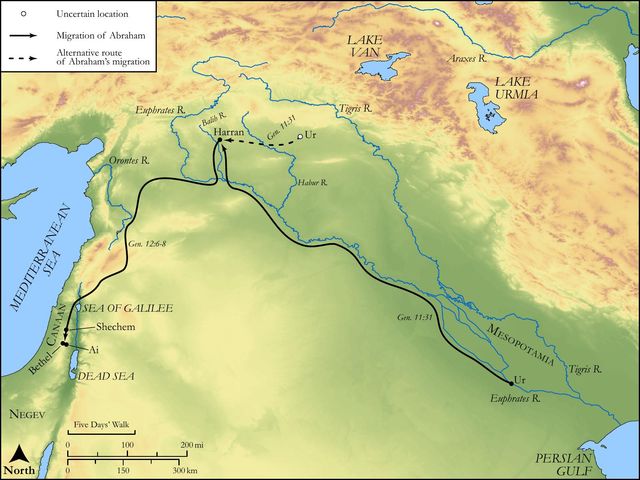
Genesis 12:5 serves as the climactic action following God's foundational call to Abram in Genesis 12:1-3. The preceding verses establish the divine command to "Go from your country, your kindred, and your father's house to the land that I will show you." Abram's journey began in Ur of the Chaldees, with a significant stop in Haran, where his father Terah died (Genesis 11:31-32). This verse, therefore, represents the decisive moment of Abram's full obedience, as he leaves the familiar territory of Haran to embark on a pilgrimage into the unknown, directly in response to God's specific instruction. It sets the stage for the subsequent narratives of Abram's life in Canaan, including his encounters with God, the challenges he faces, and the progressive revelation of the covenant promises.
Historical & Cultural Context
In the days of the patriarchs, leaving one's family, kindred, and ancestral land was an act of profound significance, often implying a loss of identity, protection, and security. Family and tribal ties were paramount, providing social, economic, and military support. Abram's journey from Haran, a significant trade hub in Mesopotamia, to Canaan involved traversing vast distances through potentially hostile territories, relying on caravans and established routes. The mention of "substance" (wealth) and "souls" (people) reflects the common practice of nomadic pastoralists who would accumulate resources and a retinue of servants or dependents, which was a sign of status and a necessity for survival and travel in that era. The land of Canaan, while geographically distinct, was a mosaic of city-states and various peoples, not a unified nation, and Abram's arrival marked his entry into a land already inhabited.
Key Themes
ShowHideGenesis 12:5 powerfully contributes to several overarching themes within Genesis and the broader biblical narrative. Firstly, it underscores the theme of Divine Sovereignty and Human Obedience, demonstrating God's initiative in calling Abram and Abram's immediate, comprehensive response. This act of obedience is a foundational example of faith, where trust in God's word leads to decisive action, even when the destination is uncertain, as highlighted later in Hebrews 11:8. Secondly, the verse introduces the theme of Covenant Initiation and Fulfillment, as Abram's arrival in Canaan is the first tangible step towards the realization of God's land promise, a cornerstone of the Abrahamic Covenant (Genesis 13:15). Thirdly, the enumeration of Abram's household and possessions speaks to the theme of Divine Provision and Blessing, indicating that God had prospered Abram even before his arrival in the promised land, equipping him for the journey and his future role. Finally, the journey itself serves as a powerful metaphor for the Pilgrimage of Faith, wherein believers are called to leave behind the familiar and comfortable to follow God's leading into unknown territories, trusting in His guidance and ultimate destination.
Exposition and Analysis
ShowHideGenesis 12:5 provides a detailed account of Abram's obedient departure, emphasizing the comprehensive nature of his response to God's call. The verse meticulously lists those accompanying him and the resources they brought, culminating in their successful arrival in the promised land.
Key Word Analysis
ShowHideThis term refers to "a breathing creature, i.e. animal of (abstractly) vitality; used very widely in a literal, accommodated or figurative sense (bodily or mental); any, appetite, beast, body, breath, creature, [idiom] dead(-ly), desire, [idiom] (dis-) contented, [idiom] fish, ghost, [phrase] greedy, he, heart(-y), (hath, [idiom] jeopardy of) life ([idiom] in jeopardy), lust, man, me, mind, mortally, one, own, person, pleasure, (her-, him-, my-, thy-) self, them (your) -selves, [phrase] slay, soul, [phrase] tablet, they, thing, ([idiom] she) will, [idiom] would have it." In this context, "souls" (נֶפֶשׁ) specifically refers to the living people—servants, retainers, or dependents—who had joined Abram's household during their stay in Haran. This indicates not only material prosperity but also an increase in human resources, possibly even individuals who had come to share Abram's faith.
This primitive root means "to do or make, in the broadest sense and widest application." While it has a vast semantic range including "accomplish," "acquire," or "produce," here it signifies that these "souls" were acquired or made part of their household through various means, such as birth, purchase, or voluntary association, during their time in Haran. It implies a deliberate action of accumulation or formation of their retinue.
This primitive root means "to go or come (in a wide variety of applications)." The use of "came" (בּוֹא) at the end of the verse emphasizes the successful completion of the journey. It signifies arrival, entrance, and the fulfillment of the initial phase of God's directive, marking their physical presence in the land God had promised to show them.
Verse Breakdown
ShowHide"And Abram took Sarai his wife, and Lot his brother's son,"
This clause identifies the primary individuals accompanying Abram. It highlights the familial core of his traveling party, emphasizing the inclusion of his wife, Sarai, and his nephew, Lot, who was now part of his immediate household after the death of Lot's father, Haran.
"and all their substance that they had gathered,"
This phrase refers to the material wealth, livestock, and possessions that Abram's household had accumulated. It indicates a period of prosperity and God's blessing even before their arrival in Canaan, equipping them for the journey and the establishment of their new life.
"and the souls that they had gotten in Haran;"
This significant phrase refers to the people—servants, dependents, or perhaps even new converts—who had become part of Abram's extended household during their stay in Haran. It demonstrates the growth of Abram's influence and retinue, suggesting a burgeoning community around him.
"and they went forth to go into the land of Canaan;"
This clause describes the active and intentional departure from Haran, emphasizing the purpose and direction of their journey. It underscores their obedience to God's command to travel towards the specific geographical destination God had indicated.
"and into the land of Canaan they came."
This concluding clause declares the successful completion of the first major leg of their journey. It is a simple yet powerful statement of arrival, signifying the initial fulfillment of God's promise regarding the land and setting the stage for the subsequent unfolding of the Abrahamic covenant.
Literary Devices
ShowHideThe verse employs several literary devices to convey its profound meaning. Enumeration is prominent, as the text meticulously lists the components of Abram's entourage: his wife, his nephew, their substance, and their acquired "souls." This detailed listing emphasizes the totality of Abram's commitment and the significant scale of his undertaking. Repetition is also used for emphasis, specifically with the phrase "into the land of Canaan" appearing twice. This repetition underscores the destination's importance and highlights the successful completion of the journey, reinforcing the idea of divine guidance and fulfillment. Furthermore, the structure of the verse, beginning with Abram's departure and concluding with his arrival, creates a sense of narrative progression and fulfillment, mirroring the journey itself and marking a clear milestone in the unfolding story of God's covenant with Abram.
Theological and Thematic Connections
ShowHideGenesis 12:5 is a pivotal verse that encapsulates the essence of faith lived out in tangible obedience. It demonstrates that genuine faith is not passive belief but an active response to God's directives, even when they demand radical change and venture into the unknown. Abram's comprehensive departure, taking his entire household and all his possessions, illustrates a complete surrender to God's will and a trust in His provision for the journey. This act initiates the physical fulfillment of the Abrahamic Covenant, particularly the promise of land, setting the stage for God's ongoing relationship with Abram and his descendants, and foreshadowing the establishment of a chosen people in a promised land.
Reflection and Application
ShowHideGenesis 12:5 serves as a timeless paradigm for the life of faith, challenging believers to respond to God's call with decisive and comprehensive obedience. Just as Abram left the familiar comforts of Haran for an uncertain future, we are often called to step out of our comfort zones, relinquish control, and trust in God's sovereign leading. This verse reminds us that true faith is demonstrated through action—a willingness to pack up our "substance" and our "souls" (our resources, relationships, and very selves) and embark on the journey God sets before us, even when the destination is not fully revealed. Embracing this posture of obedient trust cultivates a deeper reliance on God's faithfulness to provide, protect, and guide, affirming that His purposes are always greater than our own plans and that His presence is our ultimate security.
Questions for Reflection
ShowHideFAQ
ShowHideWhat does "the souls that they had gotten in Haran" mean?
ShowHideThe phrase "the souls that they had gotten in Haran" refers to the people who had become part of Abram and Sarai's household during their stay in Haran. The Hebrew word nephesh (נֶפֶשׁ), translated as "souls," broadly means living beings or persons. This would have included servants, retainers, and possibly even individuals who had been drawn to Abram's monotheistic faith and joined his retinue. It signifies the growth of Abram's influence and the expansion of his household beyond his immediate family, indicating both material prosperity and a growing community around him.
Why is Abram's departure from Haran so significant?
ShowHideAbram's departure from Haran is profoundly significant because it represents his obedient response to God's explicit call, marking the physical initiation of the Abrahamic Covenant. This act of faith, leaving his country and kindred for an unknown land, was the foundational step in God's plan to establish a chosen people through whom all nations would be blessed (Genesis 12:1-3). It demonstrates that God's promises require human cooperation and active faith, setting the stage for the unfolding narrative of redemption history and the formation of Israel. His arrival "into the land of Canaan" was the initial fulfillment of the land promise, a cornerstone of the covenant.
Christ-Centered Fulfillment
ShowHideAbram's obedient journey from Haran to Canaan, meticulously detailed in Genesis 12:5, profoundly prefigures the ultimate pilgrimage of faith embodied by Jesus Christ. While Abram left a physical land in response to a divine call, Christ, the true Son of Abraham and the ultimate obedient Son, left the unimaginable glory of His heavenly dwelling to enter the world, taking on human flesh (Philippians 2:6-8). His entire life was a journey of perfect obedience to the Father's will, culminating in His sacrificial death and triumphant resurrection, which secured a spiritual "land" of salvation and eternal life for all who believe (Hebrews 5:8-9). Just as Abram's arrival in Canaan initiated the covenant promises of land and descendants, Christ's coming inaugurated the New Covenant, fulfilling the promise that through Him, all nations would be blessed (Matthew 26:28; Galatians 3:29). He is the one who leads His people into the true promised rest, a heavenly Canaan, through His finished work (Hebrews 4:9-11).