


Genesis 11:31
Bible text: King James Version (1769 Blayney text) · Public domain
Bible text: King James Version with Strong's numbers · Public domain
Bible text: Berean Standard Bible · Public domain
Bible text: American Standard Version (1901) · Public domain
Bible text: World English Bible, Messianic edition · Public domain
Bible text: Geneva Bible (1599) · Public domain
Bible text: Young's Literal Translation · Public domain
- וַיִּקַּחvai·yi·Kachand he tookH3947Conj-w ¦ V-Qal-ConsecImperf-3msVerb Qal Consecutive Imperfect 3rd Singular Masculineוַandיִּקַּחhe took
- תֶּרַחTe·rachTerahH8646N-proper-mNoun Proper Masculine
- אֶת'et<obj.>H853DirObjMParticle Object Indicator
- אַבְרָם'av·RamAbramH87N-proper-mNoun Proper Masculine
- בְּנוֹbe·Nohis sonH1121N-msc ¦ 3msNoun Singular Masculine Constructבְּנsonוֹhis
- וְאֶתve·'Etand <obj.>H853Conj-w ¦ DirObjMParticle Object Indicatorוְandאֶת<obj.>
- לוֹטLotLotH3876N-proper-mNoun Proper Masculine
- בֶּןben[the] son ofH1121N-mscNoun Singular Masculine Construct
- הָרָןha·RanHaranH2039N-proper-mNoun Proper Masculine
- בֶּןben[the] son ofH1121N-mscNoun Singular Masculine Construct
- בְּנוֹbe·Nohis sonH1121N-msc ¦ 3msNoun Singular Masculine Constructבְּנsonוֹhis
- וְאֵתve·'Etand <obj.>H853Conj-w ¦ DirObjMParticle Object Indicatorוְandאֵת<obj.>
- שָׂרַיsa·RaiSaraiH8297N-proper-fNoun Proper Feminine
- כַּלָּתוֹka·la·Tohis daughter-in-lawH3618N-fsc ¦ 3msNoun Singular Feminine Constructכַּלָּתdaughter-in-lawוֹhis
- אֵשֶׁת'E·shet[the] wife ofH802N-fscNoun Singular Feminine Construct
- אַבְרָם'av·RamAbramH87N-proper-mNoun Proper Masculine
- בְּנוֹbe·Nohis sonH1121N-msc ¦ 3msNoun Singular Masculine Constructבְּנsonוֹhis
- וַיֵּצְאוּvai·ye·tze·'Uand they went outH3318Conj-w ¦ V-Qal-ConsecImperf-3mpVerb Qal Consecutive Imperfect 3rd Plural Masculineוַandיֵּצְאוּthey went out
- אִתָּם'i·Tamwith themH854Prep ¦ 3mpPreposition Definiteאִתָּwithםthem
- מֵאוּרme·'Urfrom UrH218Prep-m ¦ N-properNoun Proper LocationמֵfromאוּרUr
- כַּשְׂדִּיםkas·Dimof [the] ChaldeansH3778N-properNoun Proper Location
- לָלֶכֶתla·Le·khetto goH1980Prep-l ¦ V-Qal-InfVerb Qal Infinitive Constructלָtoלֶכֶתgo
- אַרְצָה'Ar·tzah[the] land of towardsH776N-fsc ¦ SfxNoun Singular Feminine Constructאַרְצָ[the] land ofהtowards
- כְּנַעַןke·Na·'anCanaanH3667N-properNoun Proper Location
- וַיָּבֹאוּvai·ya·Vo·'uand they cameH935Conj-w ¦ V-Qal-ConsecImperf-3mpVerb Qal Consecutive Imperfect 3rd Plural Masculineוַandיָּבֹאוּthey came
- עַד'adtoH5704PrepPreposition
- חָרָןcha·RanHaranH2771N-properNoun Proper Location
- וַיֵּשְׁבוּvai·Ye·she·vuand they dweltH3427Conj-w ¦ V-Qal-ConsecImperf-3mpVerb Qal Consecutive Imperfect 3rd Plural Masculineוַandיֵּשְׁבוּthey dwelt
- שָׁםShamthereH8033AdvAdverb
English is a literal word-by-word gloss of the Hebrew, not the KJV's wording. Why?
This is the original text the KJV's translators worked from — each Hebrew word with its own literal English meaning in this verse, prepared by scholars at Tyndale House, Cambridge. The KJV translates whole sentences, not word by word, so its wording differs: one Hebrew word can become several English words, and the KJV may choose “the LORD” where the gloss reads “Yahweh”. Both are faithful — they answer different questions. For the KJV's own rendering, switch to the KJV text.
Details
See on the biblical-era maps


Study this verse
Public-domain commentary
Matthew Henry
From his Commentary on the Whole Bible. Henry comments on passages, not single verses — this entry covers Genesis 11:27–32. His three-level outline is real structure in the source text, so it is rendered as structure.
Here begins the story of Abram, whose name is famous, henceforward, in both Testaments. We have here,
I.His country:
Ur of the Chaldees. This was the land of his nativity, an idolatrous country, where even the children of Eber themselves had degenerated. Note, Those who are, through grace, heirs of the land of promise, ought to remember what was the land of their nativity, what was their corrupt and sinful state by nature, the rock out of which they were hewn.
II.His relations, mentioned for his sake, and because of their interest in the following story.
1.His father was Terah, of whom it is said (Jos 24:2) that he served other gods, on the other side of the flood, so early did idolatry gain footing in the world, and so hard is it even for those that have some good principles to swim against the stream. Though it is said (Gen 11:26) that when Terah was seventy years old he begat Abram, Nahor, and Haran (which seems to tell us that Abram was the eldest son of Terah, and was born in his seventieth year), yet, by comparing Gen 11:32, which makes Terah to die in his 205th year, with Act 7:4 (where it is said that he was but seventy-five years old when he removed from Haran), it appears that he was born in the 130th year of Terah, and probably was his youngest son; for, in God's choices, the last are often first and the first last. We have,
2.Some account of his brethren.
(1.)Nahor, out of whose family both Isaac and Jacob had their wives.
(2.)Haran, the father of Lot, of whom it is here said (Gen 11:28) that he died before his father Terah. Note, Children cannot be sure that they shall survive their parents; for death does not go by seniority, taking the eldest first. The shadow of death is without any order, Job 10:22. It is likewise said that he died in Ur of the Chaldees, before the happy removal of the family out of that idolatrous country. Note, It concerns us to hasten out of our natural state, lest death surprise us in it.
3.His wife was Sarai, who some think, was the same with Iscah, the daughter of Haran. Abram himself says of her that she was the daughter of his father, but not the daughter of his mother, Gen 20:12. She was ten years younger than Abram.
III.His departure out of Ur of the Chaldees, with his father Terah, his nephew Lot, and the rest of his family, in obedience to the call of God, of which we shall read more, Gen 12:1, etc. This chapter leaves them in Haran, or Charran, a place about mid-way between Ur and Canaan, where they dwelt till Terah's head was laid, probably because the old man was unable, through the infirmities of age, to proceed in his journey. Many reach to Charran, and yet fall short of Canaan; they are not far from the kingdom of God, and yet never come thither.
Historical interpretation
Three Centuries of Reception
5 surviving comments on this verse. Each one is dated, so this reads as a timeline rather than a list.
Select a marker to jump to its quote. Markers stagger vertically where authors wrote within a few decades of each other.
Since, however, I have made mention of the patriarch, let us put before your good selves today’s reading, if you do not mind, so as to explain it and thus see the extraordinary degree of the good man’s virtue. “Thara [Thera],” the text says, “took his sons Abraham and Nachor, his son’s son Lot, and his daughter-in-law Sarah, his son Abram’s wife, and led them from the land of Chaldea to journey into the land of the Canaanites. He went as far as Charran [Haran] and settled there. Thara lived two hundred and five years in Charran, and died in Charran.” Let us attend precisely to the reading, I beseech you, so as to manage to grasp the plain sense of the writings. Note, in fact, right in the beginning there seems to be a question in the words used. This blessed author—Moses, I mean—says, “Thara took Abraham and Nachor and led them from the land of Chaldea to journey into the land of the Canaanites. He went as far as Charran and settled there.” The blessed Stephen would later use the following words in praising the Jews: “The God of glory appeared to our father Abraham when he was in Mesopotamia before he settled in Charran … and after his father died he led him there to settle.” So what does that mean? Is sacred Scripture inconsistent with itself? Not at all; rather, you need to understand from this that since the son was God-fearing, God appeared to him and called upon him to move there. His father Thara, though he happened to be a heathen, nevertheless for the affection he had for his son agreed to accompany him in his migration. He went to Charran, settled there and thus ended his life. Then it was that the patriarch moved to Canaan at God’s bidding. Of course, God did not transfer him from there until Thara passed on.
Aran [Haran] was the son of Thara [Terah], the brother of Abram and Nachor [Nahor], and he fathered two daughters, Melcha [Milcha] and Sarai who, surnamed Jesca [Iscah], had two names. Of these, Nachor took Melcha as wife, and Abram took Sarai, because marriages between uncles and brothers’ daughters had not yet been forbidden by the law. Even marriages between brothers and sisters were contracted among the first human beings.
But afterwards, when Abraham sent his servant to take a wife for his son Isaac, we find it thus written: “And the servant took ten camels of the camels of his lord, and of all the goods of his lord, with him; and arose, and went into Mesopotamia, into the city of Nahor.” This and other testimonies of this sacred history show that Nahor, Abraham’s brother, had also left the region of the Chaldeans and fixed his abode in Mesopotamia, where Abraham dwelt with his father. Why, then, did the Scripture not mention him when Terah with his family went forth out of the Chaldean nation and dwelt in Haran, since it mentions that he took with him not only Abraham his son but also Sarah his daughter-in-law and Lot his grandson? The only reason we can think of is that perhaps he had lapsed from the piety of his father and brother, and adhered to the superstition of the Chaldeans and had afterwards emigrated there, either through penitence or because he was persecuted as a suspected person.
Next it is related how Terah with his family left the region of the Chaldeans and came into Mesopotamia and dwelt in Haran. But nothing is said about one of his sons called Nahor, as if Abram had not taken him along with him. For the narrative runs thus: “And Terah took Abram his son, and Lot the son of Haran, his son’s son, and Sarah his daughter-in-law, his son Abram’s wife, and led them forth out of the region of the Chaldeans to go into the land of Canaan; and he came into Haran, and dwelt there.” Nahor and Milcah his wife are nowhere named here.
So Thare took Abram his son, and Lot the son of Haran, his son's son, and Sarai his daughter-in-law, the wife of Abram his son, and brought them out of Ur of the Chaldeans, to go into the land of Canaan. The old translation has, "he brought them out of the region of the Chaldeans," which poses no question at all. But as it is said according to the Hebrew truth, "he brought them out of Ur," that is, out of the fire or burning of the Chaldeans, it can be rightly understood that he brought them out of that region where fire was worshipped, instead of saying, "he brought them out of the idolatry of the Chaldeans." As for the statement "to go into the land of Canaan," and immediately thereafter is added "they came as far as Haran, and dwelt there, and the days of Thare were two hundred and five years, and Thare died in Haran," it shows Thare's intention, because he indeed thought, when he fled from the Chaldeans, to go into the land of Canaan: but when he reached Haran, and found in it a convenient and safe place for himself and his people from the pursuit of the Chaldeans, he refrained from further traveling to the land of Canaan, but remained in the city to which he had come until his death: so much so that even when his son Abraham and his grandson Lot went out of it at the command of the Lord, he did not care to move his foot from it. For as it is said there, that he was two hundred and five years old when he died, it is clear that it happened long after their departure. Indeed, Abraham, who was born when his father was seventy, was seventy-five years old when he left Haran, which makes one hundred and forty-five years. Therefore, at this age of the father he left Haran, namely sixty years before his death. But the Scripture, by preoccupying Thare’s death before Abraham’s departure, joined his arrival and residence in Haran, so that thereafter it might have a free space for narrating about Abraham and Lot. Now Haran is a city of Mesopotamia beyond Edessa, which is still called Charrae today, noted among the Romans for the death of consul Crassus, among us notable for the residence of the patriarchs: which also in the book of the holy Father Tobit is renowned by the hospitality of the archangel Raphael.
Continue studying Genesis 11:31 across the web’s major study libraries — every link below opens this exact verse, chapter, or book on the destination site.
Read & Compare
 BibleGatewayThis verse in more than 200 translations and 70 languages.
 Bible.comThe YouVersion reader — hundreds of translations, reading plans, and highlights.
 ESV.orgCrossway's official English Standard Version reader.
 NET BibleThe NET translation with 60,000+ translators' notes on every rendering decision.
 STEP BibleTyndale House's free study tool — original text, vocabulary, and scholarly resources.
 BibliaLogos Bible Software's free web reader.
 USCCBThe New American Bible (Revised Edition) with the U.S. bishops' study notes.
Commentaries
 BibleHub CommentariesDozens of classic commentaries on this verse, gathered on one page.
 StudyLightMore than 100 commentary sets — the largest collection on the web.
 BibleRefPlain-English commentary on what this verse means, verse by verse.
 Enduring WordDavid Guzik's free commentary on this chapter, widely used by Bible teachers.
 Bible Study ToolsVerse commentary alongside Greek and Hebrew study aids.
Original Language & Research
- BibleHub InterlinearThe verse word by word — original language, transliteration, and English.
- BibleHub LexiconEvery word's original-language definition and Strong's entry.
 Blue Letter BibleDeep-study tools — Strong's numbers, concordance, and word studies.
 SefariaThe Hebrew text with Rashi and centuries of Jewish commentary.
Sermons, Hymns & Audio


TrulyRandomVerse is not affiliated with these sites and doesn’t control their content. They’re linked because they’re genuinely useful.
Summary
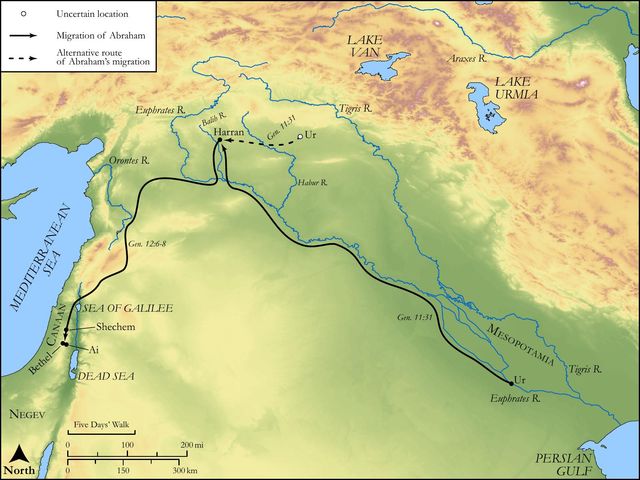
Genesis 11:31 chronicles the significant relocation of Terah, the patriarch, along with his son Abram, grandson Lot, and daughter-in-law Sarai, from their ancestral home in Ur of the Chaldees. Although their stated intention was to journey to the land of Canaan, the family ultimately settled in Haran, marking a pivotal, albeit incomplete, step in the unfolding divine narrative that would eventually lead to the establishment of the nation of Israel and the lineage through which the Messiah would come.
Context
ShowHideLiterary Context
This verse concludes the genealogical record of Shem's descendants, specifically focusing on the line leading to Abram, which began in Genesis 11:10. It immediately precedes the pivotal narrative of God's call to Abram in Genesis 12:1-3, serving as a crucial transitional passage. The detailed enumeration of family members and their journey sets the stage for the patriarchal narratives, emphasizing the specific lineage through which God's redemptive plan will begin to unfold. The abrupt halt in Haran, followed by Terah's death in Genesis 11:32, highlights the incomplete nature of this initial migration, creating a narrative tension that is resolved by God's direct intervention with Abram.
Historical & Cultural Context
Ur of the Chaldees, located in southern Mesopotamia (modern-day Iraq), was a prominent Sumerian city-state during the early second millennium BCE. It was a highly advanced urban center, known for its extensive trade networks and its worship of the moon god. Life in Ur was deeply intertwined with polytheistic worship and a complex social structure. The "Chaldees" (Kasdim) refers to the people inhabiting the region. Haran, in northern Mesopotamia (modern-day Turkey), was also a significant city and a major crossroads for trade routes, similarly dedicated to the worship of the moon god. The journey from Ur to Haran, following the fertile crescent, was a well-established trade route. For Terah's family to leave such a deeply entrenched cultural and religious environment, especially one devoted to idolatry (as implied by Joshua 24:2), signifies a momentous break, whether initiated by human conviction or divine prompting.
Key Themes
ShowHideThis verse contributes to several overarching themes within Genesis and the broader biblical narrative. Firstly, it underscores the theme of divine election and separation, as God begins to set apart a specific family from the idolatrous world to accomplish His purposes, foreshadowing the later call to Abram in Genesis 12. Secondly, it introduces the theme of pilgrimage and sojourning, as the family embarks on a journey away from their homeland towards an unknown destination, a motif that will define the lives of the patriarchs. Thirdly, the partial fulfillment of the journey (stopping in Haran instead of Canaan) highlights the theme of human inadequacy and the need for divine initiative. It subtly contrasts human intentions with God's ultimate plan, demonstrating that while humans may take steps, it is God who ultimately directs and completes the journey toward His promised land, as seen in the subsequent chapters.
Exposition and Analysis
ShowHideKey Word Analysis
ShowHideThis primitive root signifies "to take" in a wide variety of applications, including to accept, bring, buy, carry away, or seize. In Genesis 11:31, it indicates Terah's active initiative and leadership in gathering his family members for the journey. It's not a passive act, but a deliberate decision to embark on this significant migration, highlighting his patriarchal authority and responsibility for the family's direction.
This primitive root means "to go out" or "to bring out," with applications ranging from departing and escaping to appearing and proceeding. Here, it describes the physical act of leaving Ur, emphasizing the break from their previous location and lifestyle. This "going forth" is a foundational act of separation, setting the stage for a new beginning, even if its ultimate destination was not immediately reached.
This primitive root primarily means "to sit down," but by implication, "to dwell," "to remain," or "to settle." In the context of Genesis 11:31, it signifies that the family established a permanent residence in Haran, rather than merely passing through. This act of "dwelling" indicates a cessation of their journey towards Canaan, representing a significant deviation from their stated objective and a settling short of the ultimate divine purpose.
Verse Breakdown
ShowHide"And Terah took Abram his son, and Lot the son of Haran his son's son, and Sarai his daughter in law, his son Abram's wife;"
This opening clause meticulously lists the key members of the household embarking on this journey. Terah, as the patriarch, is identified as the one who "took" them, indicating his leadership and initiative. The inclusion of Abram, Lot (Abram's nephew, son of his deceased brother Haran), and Sarai (Abram's wife and Terah's daughter-in-law) emphasizes the specific lineage through which God's future covenant and promises will be channeled. The detailed enumeration underscores the importance of this family unit in the unfolding divine plan.
"and they went forth with them from Ur of the Chaldees, to go into the land of Canaan;"
This clause describes the origin and intended destination of their journey. "Ur of the Chaldees" pinpoints their starting point as a major Chaldean city, a hub of pagan worship. Their stated purpose, "to go into the land of Canaan," is highly significant, as Canaan is the very land God would later promise to Abram. This indicates either a pre-existing understanding or a divine prompting that had already begun to direct their path, even before the explicit call in Genesis 12.
"and they came unto Haran, and dwelt there."
This final clause reveals the unexpected turn in their journey. Instead of reaching Canaan, they "came unto Haran" and "dwelt there." Haran, another significant city in northern Mesopotamia, became their new home. This settling short of the intended destination is a crucial detail, highlighting a delay or incomplete obedience to what may have been a nascent divine leading, or simply a human decision to cease their journey prematurely. It sets up the narrative for God's direct intervention with Abram after Terah's death in Haran.
Literary Devices
ShowHideThe verse employs several literary devices to convey its meaning and significance. Enumeration is prominent, with the detailed listing of family members (Terah, Abram, Lot, Sarai) emphasizing the specific individuals involved in this foundational migration and highlighting the importance of lineage in the biblical narrative. There is a subtle contrast or irony between the stated intention ("to go into the land of Canaan") and the actual outcome ("they came unto Haran, and dwelt there"). This juxtaposition underscores human limitations or hesitations in fully pursuing a divine calling, creating a narrative tension that foreshadows God's direct intervention in the subsequent chapter. The journey itself serves as foreshadowing, hinting at the greater pilgrimage of faith that Abram will undertake, and the concept of leaving one's homeland for a promised land, a recurring motif throughout Scripture. The narrative also functions as a chronicle, providing a historical record of the foundational movements of the patriarchal family, bridging the genealogical accounts with the covenant narratives.
Theological and Thematic Connections
ShowHideGenesis 11:31 serves as a crucial bridge between the universal history of humanity and the particular history of God's chosen people. It demonstrates God's sovereign hand at work even before His explicit covenant with Abram. While Terah initiated the journey, the destination—Canaan—was the very land God would soon promise to Abram. This suggests a divine orchestration of events, subtly guiding human decisions towards His ultimate redemptive purposes. The departure from Ur, a center of idolatry, symbolizes a necessary separation from the world for those called into God's service, a theme that resonates throughout the Bible. The settling in Haran, however, reveals the common human tendency to stop short of God's full will, highlighting the need for continued faith and obedience, and ultimately, for God's direct intervention to complete His plan.
Reflection and Application
ShowHideThe journey of Terah's family from Ur to Haran, with the stated intention of reaching Canaan, offers profound insights for contemporary believers. It reminds us that God's providential hand is often at work in our lives even before we fully recognize His specific call. Like Terah, we may embark on journeys or make decisions that, unbeknownst to us, align with God's broader purposes. However, the narrative also serves as a cautionary tale: the danger of settling for "good enough" instead of pressing on towards God's ultimate destination. Haran, though a step in the right direction, was not Canaan. This can be a spiritual parallel for us, where we might begin a journey of faith, leave behind old ways, but then become comfortable in a "Haran"—a place of partial obedience or incomplete surrender—rather than fully embracing God's complete will and promised inheritance. True spiritual growth often requires us to leave our comfort zones, even the ones we've recently established, to pursue the fullness of God's calling.
Questions for Reflection
ShowHideFAQ
ShowHideWas it Terah or God who initiated the journey from Ur?
ShowHideThe text of Genesis 11:31 explicitly states that "Terah took Abram his son... and they went forth with them from Ur of the Chaldees." On the surface, it appears to be Terah's initiative. However, the New Testament provides further insight. In Acts 7:2-4, Stephen, in his sermon, states that "The God of glory appeared unto our father Abraham, when he was in Mesopotamia, before he dwelt in Charran [Haran]." This indicates that God's call to Abram (then Abraham) predated the family's settlement in Haran and likely prompted the departure from Ur. Therefore, while Terah was the human agent who organized and led the family's migration, the ultimate impetus was a divine revelation or leading given to Abram, which Terah then acted upon, at least in part.
Christ-Centered Fulfillment
ShowHideGenesis 11:31, though seemingly a simple genealogical transition, finds profound Christ-centered fulfillment in several ways. The journey from Ur of the Chaldees, an idolatrous pagan city, towards the promised land of Canaan, foreshadows the ultimate call of God for His people to separate from the world and journey towards a heavenly inheritance. Just as Abram was called out of his homeland, believers are called out of darkness into Christ's marvelous light, becoming "sojourners and pilgrims" on earth (1 Peter 2:11). The incomplete journey to Haran, where Terah died, highlights human limitations and the need for divine intervention. This points to Jesus Christ, who perfectly fulfilled God's will, completing the journey of redemption that humanity could not. He is the true "way" to the Father and the ultimate "land" of promise (John 14:6). Furthermore, Christ Himself is the ultimate "seed" through whom all the families of the earth would be blessed, a promise first made to Abram after he finally reached Canaan (Genesis 12:3). Thus, the initial, halting steps of Terah's family towards Canaan ultimately find their perfect and complete realization in the person and work of Jesus Christ, who brings humanity into the true rest and inheritance of God.