


Genesis 11:32
Bible text: King James Version (1769 Blayney text) · Public domain
Bible text: Berean Standard Bible · Public domain
Bible text: American Standard Version (1901) · Public domain
Bible text: World English Bible, Messianic edition · Public domain
Bible text: Geneva Bible (1599) · Public domain
Bible text: Young's Literal Translation · Public domain
- וַיִּהְיוּvai·yih·Yuand they wereH1961Conj-w ¦ V-Qal-ConsecImperf-3mpVerb Qal Consecutive Imperfect 3rd Plural Masculineוַandיִּהְיוּthey were
- יְמֵיye·mei[the] days ofH3117N-mpcNoun Plural Masculine Construct
- תֶרַחTe·rachTerahH8646N-proper-mNoun Proper Masculine
- חָמֵשׁcha·MeshfiveH2568Adj-csAdjective Numerical Singular common gender Absolute
- שָׁנִיםsha·NimyearsH8141N-mpNoun Plural Masculine Absolute
- וּמָאתַיִםu·ma·Ta·yimand two hundredH3967Conj-w ¦ Adj-fdAdjective Numerical Dual Feminine Absoluteוּandמָאתַיִםtwo hundred
- שָׁנָהsha·Nahyear[s]H8141N-fsNoun Singular Feminine Absolute
- וַיָּמָתvai·Ya·motand he diedH4191Conj-w ¦ V-Qal-ConsecImperf-3msVerb Qal Consecutive Imperfect 3rd Singular Masculineוַandיָּמָתhe died
- תֶּרַחTe·rachTerahH8646N-proper-mNoun Proper Masculine
- בְּחָרָןbe·cha·Ranin HaranH2771Prep-b ¦ N-properNoun Proper LocationבְּinחָרָןHaran
English is a literal word-by-word gloss of the Hebrew, not the KJV's wording. Why?
This is the original text the KJV's translators worked from — each Hebrew word with its own literal English meaning in this verse, prepared by scholars at Tyndale House, Cambridge. The KJV translates whole sentences, not word by word, so its wording differs: one Hebrew word can become several English words, and the KJV may choose “the LORD” where the gloss reads “Yahweh”. Both are faithful — they answer different questions. For the KJV's own rendering, switch to the KJV text.
Details
See on the biblical-era maps


Study this verse
Public-domain commentary
Matthew Henry
From his Commentary on the Whole Bible. Henry comments on passages, not single verses — this entry covers Genesis 11:27–32. His three-level outline is real structure in the source text, so it is rendered as structure.
Here begins the story of Abram, whose name is famous, henceforward, in both Testaments. We have here,
I.His country:
Ur of the Chaldees. This was the land of his nativity, an idolatrous country, where even the children of Eber themselves had degenerated. Note, Those who are, through grace, heirs of the land of promise, ought to remember what was the land of their nativity, what was their corrupt and sinful state by nature, the rock out of which they were hewn.
II.His relations, mentioned for his sake, and because of their interest in the following story.
1.His father was Terah, of whom it is said (Jos 24:2) that he served other gods, on the other side of the flood, so early did idolatry gain footing in the world, and so hard is it even for those that have some good principles to swim against the stream. Though it is said (Gen 11:26) that when Terah was seventy years old he begat Abram, Nahor, and Haran (which seems to tell us that Abram was the eldest son of Terah, and was born in his seventieth year), yet, by comparing Gen 11:32, which makes Terah to die in his 205th year, with Act 7:4 (where it is said that he was but seventy-five years old when he removed from Haran), it appears that he was born in the 130th year of Terah, and probably was his youngest son; for, in God's choices, the last are often first and the first last. We have,
2.Some account of his brethren.
(1.)Nahor, out of whose family both Isaac and Jacob had their wives.
(2.)Haran, the father of Lot, of whom it is here said (Gen 11:28) that he died before his father Terah. Note, Children cannot be sure that they shall survive their parents; for death does not go by seniority, taking the eldest first. The shadow of death is without any order, Job 10:22. It is likewise said that he died in Ur of the Chaldees, before the happy removal of the family out of that idolatrous country. Note, It concerns us to hasten out of our natural state, lest death surprise us in it.
3.His wife was Sarai, who some think, was the same with Iscah, the daughter of Haran. Abram himself says of her that she was the daughter of his father, but not the daughter of his mother, Gen 20:12. She was ten years younger than Abram.
III.His departure out of Ur of the Chaldees, with his father Terah, his nephew Lot, and the rest of his family, in obedience to the call of God, of which we shall read more, Gen 12:1, etc. This chapter leaves them in Haran, or Charran, a place about mid-way between Ur and Canaan, where they dwelt till Terah's head was laid, probably because the old man was unable, through the infirmities of age, to proceed in his journey. Many reach to Charran, and yet fall short of Canaan; they are not far from the kingdom of God, and yet never come thither.
Historical interpretation
Historical reception
1 surviving comment on this verse from the historical church.
On Terah’s death in Mesopotamia, where he is said to have lived two hundred and five years, the promises of God made to Abraham now begin to be clarified. So it is written, “And the days of Terah in Haran were two hundred and five years, and he died in Haran.” This is not to be taken as if he had spent all his days there but that he there completed the days of his life, which were two hundred and five years. Otherwise it would not be known how many years Terah lived, since it is not said in what year of his life he came into Haran. And it is absurd to suppose that in this series of generations, where it is carefully recorded how many years each one lived, his age was the only one not put on record. For although some whom the same Scripture mentions do not have their age recorded, they are not in this series, in which the reckoning of time is continuously indicated by the death of the parents and the succession of the children. For this series, which is given in order from Adam to Noah and from him down to Abraham, contains no one without the number of the years of his life.
Continue studying Genesis 11:32 across the web’s major study libraries — every link below opens this exact verse, chapter, or book on the destination site.
Read & Compare
 BibleGatewayThis verse in more than 200 translations and 70 languages.
 Bible.comThe YouVersion reader — hundreds of translations, reading plans, and highlights.
 ESV.orgCrossway's official English Standard Version reader.
 NET BibleThe NET translation with 60,000+ translators' notes on every rendering decision.
 STEP BibleTyndale House's free study tool — original text, vocabulary, and scholarly resources.
 BibliaLogos Bible Software's free web reader.
 USCCBThe New American Bible (Revised Edition) with the U.S. bishops' study notes.
Commentaries
 BibleHub CommentariesDozens of classic commentaries on this verse, gathered on one page.
 StudyLightMore than 100 commentary sets — the largest collection on the web.
 BibleRefPlain-English commentary on what this verse means, verse by verse.
 Enduring WordDavid Guzik's free commentary on this chapter, widely used by Bible teachers.
 Bible Study ToolsVerse commentary alongside Greek and Hebrew study aids.
Original Language & Research
- BibleHub InterlinearThe verse word by word — original language, transliteration, and English.
- BibleHub LexiconEvery word's original-language definition and Strong's entry.
 Blue Letter BibleDeep-study tools — Strong's numbers, concordance, and word studies.
 SefariaThe Hebrew text with Rashi and centuries of Jewish commentary.
Sermons, Hymns & Audio


TrulyRandomVerse is not affiliated with these sites and doesn’t control their content. They’re linked because they’re genuinely useful.
Summary
Genesis 11:32 succinctly concludes the life of Terah, the father of Abram, recording his lifespan of 205 years and his death in Haran. This seemingly simple genealogical entry is profoundly significant, acting as a pivotal narrative hinge that marks the cessation of one patriarchal era and immediately precedes the momentous divine calling of Abram, thereby setting the indispensable stage for the initiation of God's redemptive covenant and the unfolding of His sovereign plan for humanity.
Context
ShowHideLiterary Context
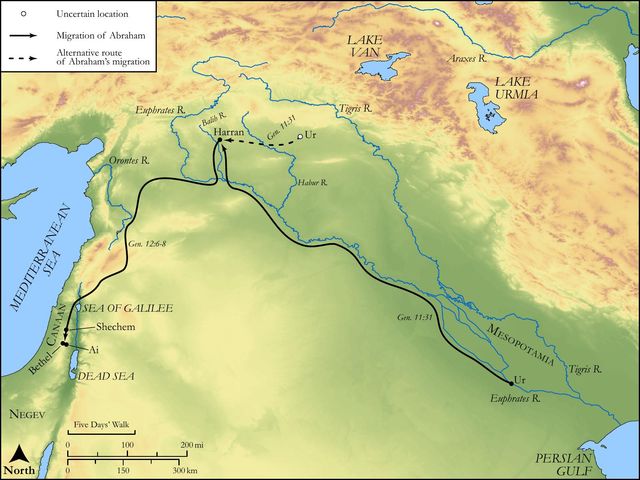
This verse is strategically positioned within the "generations of Terah" (tôledôt Terach) in Genesis 11, serving as the culmination of the post-flood genealogies that trace the lineage from Shem to Abram. It directly follows the account of Terah's departure from Ur of the Chaldees with his family, including Abram, Nahor, and Lot, with the stated intention of journeying to Canaan (Genesis 11:31). Terah's death in Haran, short of the intended destination, functions as a narrative transition, closing the chapter on his leadership and immediately preceding the foundational narrative of God's direct call to Abram in Genesis 12, which inaugurates the patriarchal history of Israel.
Historical & Cultural Context
Haran, located in northern Mesopotamia (modern-day Turkey), was a significant ancient city and a major crossroads for trade routes connecting Mesopotamia, Syria, and Anatolia. It was a prominent center of moon-god worship (Sin), similar to Ur, which may have offered a familiar cultural and religious environment for Terah's family. The journey from Ur to Haran was a substantial undertaking, likely involving a caravan of family, servants, and livestock, following the fertile crescent. The extended lifespans recorded for patriarchs like Terah (205 years) are characteristic of the early Genesis narratives, reflecting a period distinct from later human longevity and emphasizing divine blessing or a different physiological reality in the antediluvian and early post-diluvian eras.
Key Themes
ShowHideGenesis 11:32 contributes to several overarching themes within the book of Genesis. It underscores the theme of Divine Sovereignty and Timing, as Terah's death in Haran is precisely timed to clear the way for Abram's independent and unhindered obedience to God's call to leave his father's house and land (Genesis 12:1). It also highlights the theme of Incomplete Journeys vs. Full Obedience, contrasting Terah's stopping short of Canaan with Abram's subsequent complete faith-journey. Furthermore, it reinforces the theme of Generational Transition and Divine Election, demonstrating how God's redemptive plan progresses through chosen individuals across generations, with the baton of divine purpose passing from Terah to Abram, leading to the pivotal covenant promises outlined in Genesis 12:1-3.
Exposition and Analysis
ShowHideGenesis 11:32 states, "And the days of Terah were two hundred and five years: and Terah died in Haran." This verse provides a concise summary of Terah's life and its conclusion, serving as a critical narrative bridge to the subsequent events concerning Abram.
Key Word Analysis
ShowHideThis word (H3117) often refers to a literal day but can also idiomatically denote an entire lifespan or a significant period of time, as it does here. The phrase "the days of Terah" signifies the totality of his life, emphasizing its completion. Its use highlights the biblical focus on the duration and conclusion of a life, particularly for figures within the patriarchal narratives.
This primitive root (H4191) signifies the cessation of life, whether literally or figuratively. In this context, it marks the physical death of Terah, a definitive end to his earthly existence and his role as the patriarch leading the family's migration. The verb underscores the finality of his journey and the transition of leadership.
This proper noun (H2771) refers to the specific geographical location where Terah's journey ended and where he died. Its name, possibly related to "parched" or "road," ironically became the final, un-parched resting place for Terah, short of the promised land of Canaan. The specificity of the location is crucial, as it sets the scene for Abram's subsequent departure from this very place.
Verse Breakdown
ShowHide"And the days of Terah were two hundred and five years"
This clause provides the precise duration of Terah's life, emphasizing his longevity within the patriarchal lineage. The mention of his age at death is a common feature in Genesis genealogies, serving to authenticate the lineage and mark the passage of time. It signifies the completion of his earthly sojourn, a full life according to the standards of that era, and sets the stage for the narrative to move beyond his direct involvement.
"and Terah died in Haran"
This second clause specifies the location of Terah's death, which is highly significant. Haran was a major trading city, a stop on the journey from Ur to Canaan that Terah initiated. His death here, rather than in the promised land, underscores that he did not complete the divinely intended journey. This detail is crucial for understanding the subsequent narrative, as it removes the patriarchal head of the family, allowing Abram to receive and obey God's call to leave his "father's house" and continue the journey to Canaan independently, without the direct influence or potential hindrance of his father.
Literary Devices
ShowHideThe verse employs Conciseness and Narrative Economy, conveying a significant life event in a brief statement, characteristic of genealogical summaries in Genesis. It functions as a powerful Narrative Hinge or Transition Point, marking the end of one era (Terah's leadership and the family's partial migration) and immediately ushering in the next (Abram's independent call and the beginning of the covenant nation). Furthermore, Terah's death in Haran serves as a subtle Foreshadowing of the theme of incomplete obedience versus full faith, which will be contrasted with Abram's journey. The location "Haran" itself can be seen as Symbolic, representing a stopping point short of God's ultimate destination, a place of comfort and familiarity that can hinder the full pursuit of divine purpose.
Theological and Thematic Connections
ShowHideTerah's death in Haran is not merely a biographical detail but a divinely orchestrated event that precipitates a major turning point in salvation history. It highlights God's sovereign control over the timing of events, ensuring that His redemptive plan unfolds precisely according to His will, paving the way for the establishment of the Abrahamic covenant. This transition underscores the principle that God's purposes are often fulfilled through a new, decisive step of faith from the next generation, even if the previous generation initiated the journey.
Reflection and Application
ShowHideGenesis 11:32, though brief, offers profound insights for contemporary believers. It reminds us that even in seemingly ordinary events like death, God's overarching plan is meticulously at work, orchestrating circumstances to advance His purposes. Terah's passing was a crucial part of the divine setup to move Abram into the next, pivotal phase of his destiny. This teaches us to discern God's hand in life's transitions, understanding that endings often precede new beginnings, and what appears to be a natural occurrence can be a divinely appointed moment for a shift in spiritual trajectory. Furthermore, Terah's incomplete journey to Canaan serves as a gentle yet powerful reminder for us to pursue God's callings fully, not stopping short of His ultimate destination for our lives. Just as Paul exhorted believers to press toward the goal for the prize of the high calling in Christ Jesus, we are encouraged to trust God for strength and guidance to complete the path He sets before us, knowing that His purposes often unfold through the faithful continuation of one generation's efforts by the next, requiring our full commitment and obedience.
Questions for Reflection
ShowHideFAQ
ShowHideWhy did Terah stop in Haran instead of continuing to Canaan?
ShowHideThe biblical text does not explicitly state why Terah stopped in Haran. Genesis 11:31 simply records that he "dwelt there." Possible reasons could include the city's strategic location as a major trading hub, offering economic opportunities and a familiar cultural environment (like Ur, Haran was a center of moon-god worship), or perhaps Terah's advanced age and the weariness of the journey. Theologically, his stopping in Haran served God's sovereign purpose by setting the stage for Abram's independent call and complete separation from his father's household, ensuring that the covenant journey would be initiated by Abram alone, in full obedience.
Does Terah's death in Haran imply a failure of faith on his part?
ShowHideThe text does not explicitly condemn Terah for stopping in Haran, nor does it label it a "failure of faith." He did initiate the journey from Ur towards Canaan, which was a significant act of faith and obedience to a divine prompting (as indicated in Acts 7:2-4). However, his death in Haran, short of the promised land, highlights that he did not fully complete the journey. This contrasts powerfully with Abram's subsequent complete obedience in Genesis 12. While not necessarily a "failure," it underscores the idea that God's ultimate purposes often require a new, decisive step of faith and full commitment from the next generation to bring His plans to fruition.
Did Abram leave Haran before or after Terah's death?
ShowHideAccording to the chronological sequence presented in Genesis 11:32 and Genesis 12:1-4, Abram left Haran after his father Terah died. Genesis 11:32 states Terah died in Haran, and then Genesis 12:1 immediately begins with God's command to Abram to leave his country and father's house. While Stephen's speech in Acts 7:4 might seem to suggest Abram left Haran after Terah's death, it aligns with this sequence, indicating that the final departure from Haran to Canaan occurred subsequent to Terah's passing, even if God's initial call to Abram came earlier in Ur. This timing ensured Abram's complete separation and independence for his covenant journey.
Christ-Centered Fulfillment
ShowHideTerah's life and death in Genesis 11:32 serve as a crucial transitional point, not only in the lineage of Abraham but also in foreshadowing the greater redemptive plan culminating in Christ. Terah's incomplete journey to the promised land highlights humanity's inherent inability to fully achieve God's purposes through their own efforts, necessitating a divine intervention and a perfect fulfiller. The passing of the torch from Terah to Abram, leading to the covenant promises of land, seed, and blessing, points directly to the lineage through which the Messiah would come (Matthew 1:1). Christ is the ultimate "completer" of God's journey for humanity; He perfectly fulfilled the Law (Matthew 5:17), the Prophets (Luke 24:44), and the covenant promises initiated with Abram (Galatians 3:16), leading His people not to a geographical land but into the eternal rest and inheritance of God's kingdom (Hebrews 4:9-10). His perfect obedience and sacrifice accomplish what no patriarch or generation could fully achieve, bringing all of God's promises to their definitive "Yes" and "Amen" in Him (2 Corinthians 1:20), thereby establishing the true and everlasting covenant with His people.