


Matthew 1:1
“The Genealogy of Jesus Christ”Matthew 1:1–17
Bible text: King James Version (1769 Blayney text) · Public domain
Bible text: Berean Standard Bible · Public domain
Bible text: American Standard Version (1901) · Public domain
Bible text: World English Bible, Messianic edition · Public domain
Bible text: Geneva Bible (1599) · Public domain
Bible text: Young's Literal Translation · Public domain
- ΒίβλοςBiblos[The] bookG976N-NSFNoun Nominative Singular Feminine
- γενέσεωςgeneseōsof [the] genealogyG1078N-GSFNoun Genitive Singular Feminine
- ἸησοῦIēsouof JesusG2424N-GSM-PNoun Genitive Singular Masculine Individual
- ΧριστοῦChristouChristG5547N-GSM-TNoun Genitive Singular Masculine Title
- υἱοῦhuiousonG5207N-GSMNoun Genitive Singular Masculine
- ΔαυὶδDauidof DavidG1138N-GSM-PNoun Genitive Singular Masculine Individual
- υἱοῦhuiousonG5207N-GSMNoun Genitive Singular Masculine
- ἈβραάμAbraamof AbrahamG11N-GSM-PNoun Genitive Singular Masculine Individual
English is a literal word-by-word gloss of the Greek, not the KJV's wording. Why?
This is the original text the KJV's translators worked from — each Greek word with its own literal English meaning in this verse, prepared by scholars at Tyndale House, Cambridge. The KJV translates whole sentences, not word by word, so its wording differs: one Greek word can become several English words, and the KJV may choose “charity” where the gloss reads “love”. Both are faithful — they answer different questions. For the KJV's own rendering, switch to the KJV text.
Words in [ ] are added by the English.
Details
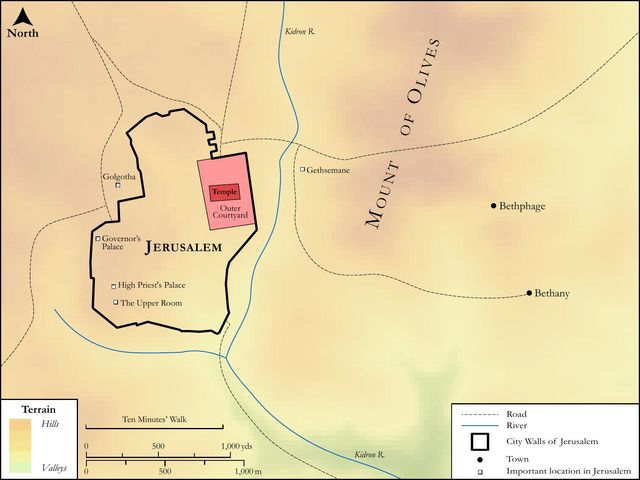
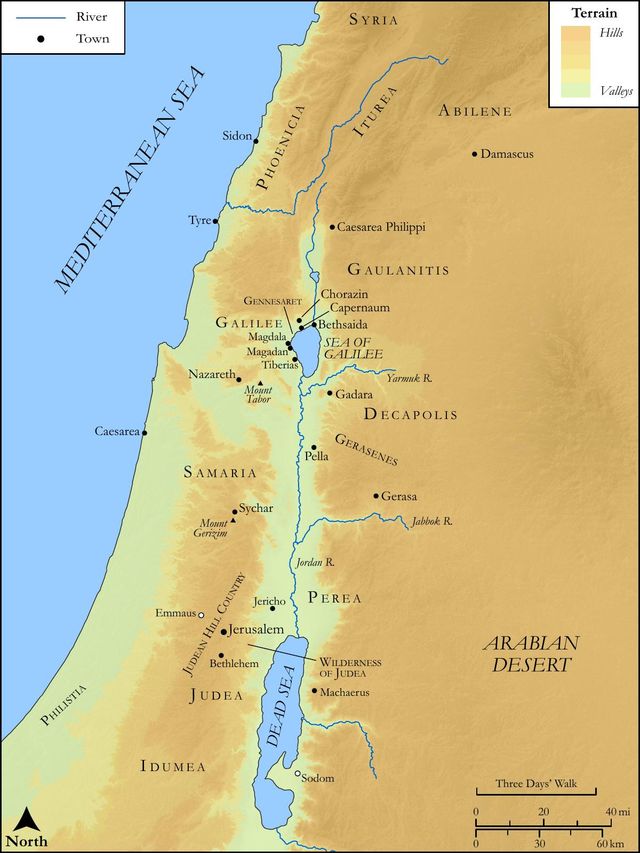
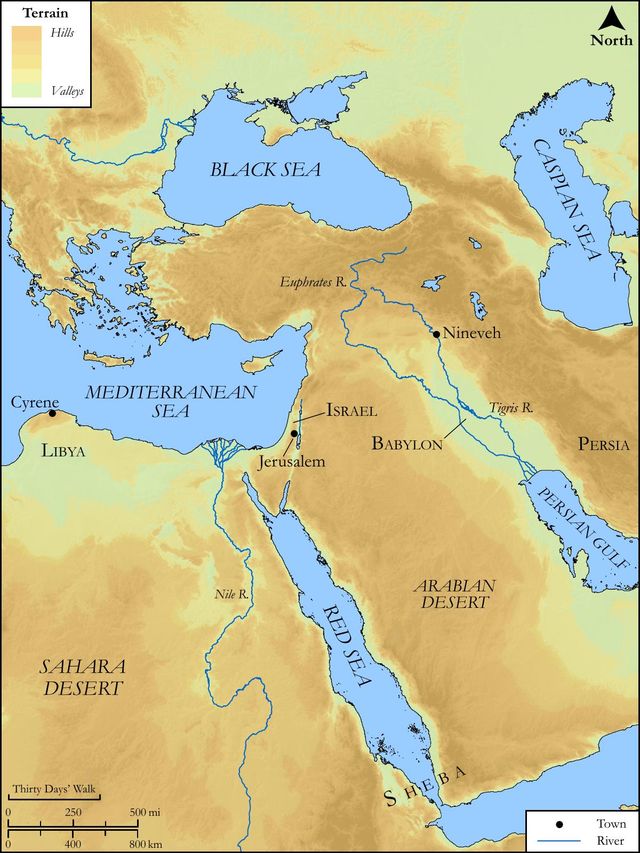
See on the biblical-era maps
Study this verse
Public-domain commentary
Matthew Henry
From his Commentary on the Whole Bible. Henry wrote on whole passages, and this entry covers Matthew 1:1–17. He set out his notes in a two-level outline, kept here as he numbered it.
Concerning this genealogy of our Saviour, observe,
I.The title of it.
It is the book (or the account, as the Hebrew word sepher, a book, sometimes signifies) of the generation of Jesus Christ, of his ancestors according to the flesh; or, It is the narrative of his birth. It is Biblos Geneseōs - a book of Genesis. The Old Testament begins with the book of the generation of the world, and it is its glory that it does so; but the glory of the New Testament herein excelleth, that it begins with the book of the generation of him that made the world. As God, his outgoings were of old, from everlasting (Micah 5:2), and none can declare that generation; but, as man, he was sent forth in the fulness of time, born of a woman, and it is that generation which is here declared.
II.The principal intention of it.
It is not an endless or needless genealogy; it is not a vain-glorious one, as those of great men commonly are. Stemmata, quid faciunt? - Of what avail are ancient pedigrees? It is like a pedigree given in evidence, to prove a title, and make out a claim; the design is to prove that our Lord Jesus is the son of David, and the son of Abraham, and therefore of that nation and family out of which the Messiah was to arise. Abraham and David were, in their day, the great trustees of the promise relating to the Messiah. The promise of the blessing was made to Abraham and his seed, of the dominion to David and his seed; and they who would have an interest in Christ, as the son of Abraham, in whom all the families of the earth are to be blessed, must be faithful, loyal subjects to him as the son of David, by whom all the families of the earth are to be ruled. It was promised to Abraham that Christ should descend from him (Genesis 12:3; Genesis 22:18), and to David that he should descend from him (2 Samuel 7:12; Psalm 89:3, etc.; Psalm 132:11); and therefore, unless it can be proved that Jesus is a son of David, and a son of Abraham, we cannot admit him to be the Messiah. Now this is here proved from the authentic records of the heralds' offices. The Jews were very exact in preserving their pedigrees, and there was a providence in it, for the clearing up of the descent of the Messiah from the fathers; and since his coming that nation is so dispersed and confounded that it is a question whether any person in the world can legally prove himself to be a son of Abraham; however, it is certain that none can prove himself to either a son of Aaron or a son of David, so that the priestly and kingly office must either be given up, as lost for ever, or be lodged in the hands of our Lord Jesus. Christ is here first called the son of David, because under that title he was commonly spoken of, and expected, among the Jews. They who owned him to be the Christ, called him the son of David, Matthew 15:22; Matthew 20:31; Matthew 21:15. Thus, therefore, the evangelist undertakes to make out, that he is not only a son of David, but that son of David on whose shoulders the government was to be; not only a son of Abraham, but that son of Abraham who was to be the father of many nations.
In calling Christ the son of David, and the son of Abraham, he shows that God is faithful to his promise, and will make good every word that he has spoken; and this. 1. Though the performance be long deferred. When God promised Abraham a son, who should be the great blessing of the world, perhaps he expected it should be his immediate son; but it proved to be one at the distance of forty-two generations, and about 2000 years: so long before can God foretel what shall be done, and so long after, sometimes, does God fulfil what has been promised. Note, Delays of promised mercies, though they exercise our patience, do not weaken God's promise. 2. Though it begin to be despaired of. This son of David, and son of Abraham, who was to be the glory of his Father's house, was born when the seed of Abraham was a despised people, recently become tributary to the Roman yoke, and when the house of David was buried in obscurity; for Christ was to be a root out of a dry ground. Note, God's time for the performance of his promises is when it labours under the greatest improbabilities.
III.The particular series of it, drawn in the direct line from Abraham downward, according to the genealogies recorded in the beginning of the books of Chronicles (as far as those go), and which here we see the use of.
Some particulars we may observe in the genealogy.
1.Among the ancestors of Christ who had brethren, generally he descended from a younger brother; such Abraham himself was, and Jacob, and Judah, and David, and Nathan, and Rhesa; to show that the pre-eminence of Christ came not, as that of earthly princes, from the primogeniture of his ancestors, but from the will of God, who, according to the method of his providence, exalteth them of low degree, and puts more abundant honour upon that part which lacked.
2.Among the sons of Jacob, besides Judah, from whom Shiloh came, notice is here taken of his brethren: Judas and his brethren. No mention is made of Ishmael the son of Abraham, or of Esau the son of Isaac, because they were shut out of the church; whereas all the children of Jacob were taken in, and, though not fathers of Christ, were yet patriarchs of the church (Acts 7:8), and therefore are mentioned in the genealogy, for the encouragement of the twelve tribes that were scattered abroad, intimating to them that they have an interest in Christ, and stand in relation to him as well as Judah.
3.Phares and Zara, the twin-sons of Judah, are likewise both named, though Phares only was Christ's ancestor, for the same reason that the brethren of Judah are taken notice of; and some think because the birth of Phares and Zara had something of an allegory in it. Zara put out his hand first, as the first-born, but, drawing it in, Phares got the birth-right. The Jewish church, like Zara, reached first at the birthright, but through unbelief, withdrawing the hand, the Gentile church, like Phares, broke forth and went away with the birthright; and thus blindness is in part happened unto Israel, till the fulness of the Gentiles become in, and then Zara shall be born - all Israel shall be saved, Romans 11:25, Romans 11:26.
4.There are four women, and but four, named in this genealogy; two of them were originally strangers to the commonwealth of Israel, Rachab a Canaanitess, and a harlot besides, and Ruth the Moabitess; for in Jesus Christ there is neither Greek, nor Jew; those that are strangers and foreigners are welcome, in Christ, to the citizenship of the saints. The other two were adulteresses, Tamar and Bathsheba; which was a further mark of humiliation put upon our Lord Jesus, that not only he descended from such, but that is decent from them is particularly remarked in his genealogy, and no veil drawn over it. He took upon him the likeness of sinful flesh (Romans 8:3), and takes even great sinners, upon their repentance, into the nearest relation to himself. Note, We ought not to upbraid people with the scandals of their ancestors; it is what they cannot help, and has been the lot of the best, even of our Master himself. David's begetting Solomon of her that had been the wife of Urias is taken notice of (says Dr. Whitby) to show that the crime of David, being repented to, was so far from hindering the promise made to him, that it pleased God by this very woman to fulfil it.
5.Though divers kings are here named, yet none is expressly called a king but David (Matthew 1:6), David the king; because with him the covenant of royalty was made, and to him the promise of the kingdom of the Messiah was given, who is therefore said to inherit the throne of his father David, Luke 1:32.
6.In the pedigree of the kings of Judah, between Joram and Ozias (Matthew 1:8), there are three left out, namely, Ahaziah, Joash, and Amaziah; and therefore when it is said, Joram begat Ozias, it is meant, according to the usage of the Hebrew tongue, that Ozias was lineally descended from him, as it is said to Hezekiah that the sons which he should beget should be carried to Babylon, whereas they were removed several generations from him. It was not through mistake or forgetfulness that these three were omitted, but, probably, they were omitted in the genealogical tables that the evangelist consulted, which yet were admitted as authentic. Some give this reason for it: - It being Matthew's design, for the sake of memory, to reduce the number of Christ's ancestors to three fourteens, it was requisite that in this period three should be left out, and none more fit than they who were the immediate progeny of cursed Athaliah, who introduced the idolatry of Ahab into the house of David, for which this brand is set upon the family and the iniquity thus visited to the third and fourth generation. Two of these three were apostates; and such God commonly sets a mark of his displeasure upon in this world: they all three had their heads brought to the grave with blood.
7.Some observe what a mixture there was of good and bad in the succession of these kings; as for instance (Matthew 1:7, Matthew 1:8), wicked Roboam begat wicked Abia; wicked Abia begat good Asa; good Asa begat good Josaphat; good Josaphat begat wicked Joram. Grace does not run in the blood, neither does reigning sin. God's grace is his own, and he gives or withholds it as he pleases.
8.The captivity of Babylon is mentioned as a remarkable period in this line, Matthew 1:11, Matthew 1:12. All things considered, it was a wonder that the Jews were not lost in that captivity, as other nations have been; but this intimates the reason why the streams of that people were kept to run pure through that dead sea, because from them, as concerning the flesh, Christ was to come. Destroy it not, for a blessing is in it, even that blessing of blessings, Christ himself, Isaiah 65:8, Isaiah 65:9. It was with an eye to him that they were restored, and the desolations of the sanctuary were looked upon with favour for the Lord's sake, Daniel 9:17.
9.Josias is said to beget Jechonias and his brethren (Matthew 1:11); by Jechonias here is meant Jehoiakim, who was the first-born of Josias; but, when it is said (Matthew 1:12) that Jechonias begat Salathiel, that Jechonias was the son of that Jehoiakim who was carried into Babylon, and there begat Salathiel (as Dr. Whitby shows), and, when Jechonias is said to have been written childless (Jeremiah 22:30), it is explained thus: No man of his seed shall prosper. Salathiel is here said to beget Zorobabel, whereas Salathiel begat Pedaiah, and he begat Zorobabel (1 Chronicles 3:19): but, as before, the grandson is often called the son; Pedaiah, it is likely, died in his father's lifetime, and so his son Zorobabel was called the son of Salathiel.
10.The line is brought down, not to Mary the mother of our Lord, but to Joseph the husband of Mary (Matthew 1:16); for the Jews always reckoned their genealogies by the males: yet Mary was of the same tribe and family with Joseph, so that, both by his mother and by his supposed father, he was of the house of David; yet his interest in that dignity is derived by Joseph, to whom really according to the flesh he had no relation, to show that the kingdom of the Messiah is not founded in a natural descent from David.
11.The centre in whom all these lines meet is Jesus, who is called Christ, Matthew 1:16. This is he that was so importunately desired, so impatiently expected, and to whom the patriarchs had an eye when they were so desirous of children, that they might have the honour of coming into the sacred line. Blessed be God, we are not now in such a dark and cloudy state of expectation as they were then in, but see clearly what these prophets and kings saw as through a glass darkly. And we may have, if it be not our own fault, a greater honour than that of which they were so ambitious: for they who do the will of God are in a more honourable relation to Christ than those who were akin to him according to the flesh, Matthew 12:50. Jesus is called Christ, that is, the Anointed, the same with the Hebrew name Messiah. He is called Messiah the Prince (Daniel 9:25), and often God's Anointed (Psalm 2:2). Under this character he was expected: Art thou the Christ - the anointed one? David, the king, was anointed (1 Samuel 16:13); so was Aaron, the priest (Leviticus 8:12), and Elisha, the prophet (1 Kings 19:16), and Isaiah, the prophet (Isaiah 61:1). Christ, being appointed to, and qualified for, all these offices, is therefore called the Anointed - anointed with the oil of gladness above his fellows; and from this name of his, which is as ointment poured forth, all his followers are called Christians, for they also have received the anointing.
Lastly. The general summary of all this genealogy we have, Matthew 1:17, where it is summed up in three fourteens, signalized by remarkable periods. In the first fourteen, we have the family of David rising, and looking forth as the morning; in the second, we have it flourishing in its meridian lustre; in the third, we have it declining and growing less and less, dwindling into the family of a poor carpenter, and then Christ shines forth out of it, the glory of his people Israel.
Historical interpretation
Ten Centuries of Reception
32 surviving comments on this verse. Each one is dated, so this reads as a timeline rather than a list.
Select a marker to jump to its quote. Markers stagger vertically where authors wrote within a few decades of each other.
So then Matthew wrote the oracles in the Hebrew language, and every one interpreted them as he was able.
They may, then, obliterate the testimony of the devils which proclaimed Jesus the son of David; but whatever unworthiness there be in this testimony, that of the apostles they will never be able to efface, There is, first of all, Matthew, that most faithful chronicler of the Gospel, because the companion of the Lord; for no other reason in the world than to show us clearly the fleshly original of Christ, he thus begins his Gospel: "The book of the generation of Jesus Christ, the son of David, the son of Abraham." With a nature issuing from such fountal sources, and an order gradually descending to the birth of Christ, what else have we here described than the very flesh of Abraham and of David conveying itself down, step after step, to the very virgin, and at last introducing Christ,-nay, producing Christ Himself of the virgin?
"The first living creature was like to a lion, and the second was like to a calf, and the third had a face like to a man, and the fourth was like to a flying eagle; and they had six wings, and round about and within they were full of eyes; and they had no rest, saying, Holy, holy, holy, Lord Omnipotent. And the four and twenty elders, failing down before the throne, adored God." The four and twenty elders arethe twenty-four books of the prophets and of the law, which give testimonies of the judgment. Moreover, also, they are the twenty-four fathers-twelve apostles and twelve patriarchs.And in that the living creatures are different in appearance, this is the reason: the living creature like to a lion designates Mark, in whom is heard the voice of the lion roaring in the desert. And in the figure of a man, Matthew strives to declareto us the genealogy of Mary, from whom Christ took flesh. Therefore, in enumerating from Abraham to David, and thence to Joseph, he spoke of Him as if of a man: therefore his announcement sets forth the image of a man. Luke, in narrating the priesthood of Zacharias as he offers a sacrifice for the people, and the angel that appears to him with respect of the priesthood, and the victim in the same description bore the likeness of a calf. John the evangelist, like to an eagle hastening on uplifted wings to greater heights, argues about the Word of God. Mark, therefore, as an evangelist thus beginning, "The beginning of the Gospel of Jesus Christ, as it is written in Isaiah the prophet; " The voice of one crying in the wilderness," -has the effigy of a lion. And Matthew, "The hook of the generation of Jesus Christ, the son of David, the son of Abraham: " this is the form of a man. But Luke said, "There was a priest, by name Zachariah, of the course of Abia, and his wife was of the daughters of Aaron: " this is the likeness of a calf. But John, when he begins, "In the beginning was the Word, and the Word was with God, and the Word was God," sets forth the likeness of a flying eagle. Moreover, not only do the evangelists express their four similitudes in their respective openings of the Gospels, but also the Word itself of God the Father Omnipotent, which is His Son our Lord Jesus Christ, bears the same likeness in the time of His advent. When He preaches to us, He is, as it were, a lion and a lion's whelp. And when for man's salvation He was made man to overcome death, and to set all men free, and that He offered Himself a victim to the Father on our behalf, He was called a calf. And that He overcame death and ascended into the heavens, extending His wings and protecting His people, He was named a flying eagle. Therefore these announcements, although they are four, yet are one, because it proceeded from one mouth. Even as the river in paradise, although it is one, was divided into four heads. Moreover, that for the announcement of the New Testament those bring creatures had eyes within and without, shows the spiritual providence which both looks into the secrets of the heart, and beholds the things which are coming after that are within and without.
(Quæst. Nov. et Vet. Test. q. 49.) What God conferred on those, who, by the anointing of oil were consecrated as kings or priests, this the Holy Spirit conferred on the Man Christ; adding moreover a purification. The Holy Spirit cleansed that which taken of the Virgin Mary was exalted into the Body of the Saviour, and this is that anointing of the Body of the Saviour's flesh whence He was called Christb. Because the impious craft of the Jews denied that Jesus was born of the seed of David, he adds, The son of David, the son of Abraham.
What Matthew publishes in order of kingly succession, Luke has set forth in order of priestly origin. While accounting for each order, both indicate the relationship of the Lord to each ancestral lineage. The order of his lineage is thus duly presented, because the association of the priestly and royal tribes that was begun through David from marriage is now confirmed out of the descent from Shealtiel to Zerubbabel. And so, while Matthew recounts his paternal origin that began in Judah, Luke teaches that his ancestry was taken from the tribe of Levi. Each in his own way demonstrates the glory of our Lord Jesus Christ, who is both the eternal king and priest, as seen even in the fleshly origin of both of his ancestries. It does not matter that the origin of Joseph instead of Mary is recounted, for indeed there is one and the same blood relationship for the whole tribe. Moreover, both Matthew and Luke provide precedents. They name fathers in order not so much by their lineage as by their clan, since the tribe began from one individual and continues under a family of one succession and origin. Indeed, Christ has to be shown as the son of David and Abraham, so Matthew began in this way: “The book of the genealogy of Jesus Christ, the son of David, the son of Abraham.” It does not matter who is placed in a given order as long as the whole family is understood to derive from a single source. Joseph and Mary belonged to the same kinship line. Joseph is shown to have sprung from the line of Abraham. It is revealed that Mary came from this line, too. This system is codified in law so that, if the oldest of a family should die without sons, the next oldest brother of the same family would take the dead man’s wife in marriage. He would consider his sons as received into the family of the one who had died, and thus the order of succession remains with the firstborn, since they are considered to be the fathers of those born after them in either name or birth.
Vigil. Tapsens. (ibid. p. 644): The audaciousness of this most insane error I will curb by the authority of the heavenly testimonies, and demonstrate the distinct personality of the proper substance of the Son. I shall not produce things which are liable to be explained away as agreeable to the assumption of human nature; but shall offer such passages as all will allow to be decisive in proof of His divine nature. In Genesis we find God saying, “Let Us make man in Our own Image.” By this plural number showing, that there was some other person to whom He spoke. Had He been one, He would have been said to have made Him in His own Image, but there is another; and He is said to have made man in the Image of that other.
(in Luc. c. iii.) He therefore names specially two authors of His birth—one who received the promise concerning the kindreds of the people, the other who obtained the oracle concerning the generation of Christ; and though he is later in order of succession is yet first named, inasmuch as it is greater to have received the promise concerning Christ than concerning the Church, which is through Christ; for greater is He who saves than that which is saved.
§ 1 The sacrament of our salvation and faith, though in all the divine scriptures, is especially contained in the evangelical preaching, in which the secret of the heavenly sanctuary is revealed to us even as the mystery of the Lord’s passion and resurrection is revealed to everyone. However, the transcribers the gospel (as it is divided into four books) are: Matthew, Mark, Luke, and John, who once had been prefigured and predestined to the duty of this divine work, as the blessed Luke reported: Inasmuch as many have undertaken to compose a narrative of the things that have been fulfilled among us. (Luke 1:1)
For Matthew is appointed by the divine authority and grace of the holy spirit to be the first to write down the gospel, then Mark and Luke, most recently of all John, after he came back, upon the death of Domitian Caesar, from Patmos, the island where he had been bound. After he had been posted on this island and written the Revelation, he was disclosed the gospel he was to write on account of the different heresies instigated by the devil that by then were beginning to spring up.
§ 2 Matthew certainly and John too belong to the number of the twelve apostles, who not only were with the Lord before the passion but also kept company with him after the resurrection for forty days. They carefully recounted everything they saw and heard according to what John testified in his epistle, saying: as we have heard and saw with our eyes and by our hand have been examined, these things we declare to you. (1 John 1:1-3)
But Mark was Peter’s disciple and interpreter. He did not see the Lord in the flesh but he wrote the gospel, filled full of heavenly grace and the holy spirit. Luke also did not see the Lord in the flesh, but, because he was very educated in the law (since he was a companion of Paul in everything), he wrote down the gospel carefully in his own name, expounding from the very beginning everything in the order of the matters as he learned with respect to the apostles, as he himself testified, saying: as those who have been there all along and those who had been ministers of the message handed down to us. (Luke 1:2)
§ 3 Therefore, the authority of these four evangelists is firm and steadfast, because they all composed by one principle. Of course, various principles are taught in their sure foundation, but they do not disagree among themselves on anything, because every one of them perceived the same thing by faith concerning the Lord’s incarnation, nativity, passion, resurrection, and also his twin advent. And because we endeavor to say some things about the gospels, the responsibility and situation of the matter advise us to test also the truth of the gospels prefigured from the law of the Old Testament, as surely the Apostle says: the law was a shadow of things to come (Heb 10:1), because neither can the new stand without the old nor could the old have any stability without the new. It is said that everything about them is more complete in their place when the message is to be from the two testaments.
§ 4 Thus, both the type and the number of the four gospels are clearly described in the law and the prophets, as in the four rivers that flow from one source in Eden, or in the four rows of stones that Aaron wore woven in the priestly garment on his chest, or in the fourfold row of twelve calves that Solomon set up under the bronze sea in the temple. In all of these, the expressedexamples of the future truth cannot be doubted. Hence also Elijah the Tishbite----not unknowing by the holy Spirit of the evangelical sacrament of the preaching to come, when he freed the people from error and turned them from idols to God----poured four jugs of water in the sacrifice he offered when he put the burnt offering on the wood and made it three times in number. And fire came down from the sky, as he openly declared even then the image of the coming hope, that is the sacrament of the cross and the number of the gospels and the grace of baptism and the faith in the Trinity, in which we are baptized and made a worthy sacrifice for God, coming upon us with fire from the sky, that is, his holy Spirit presented to us as a gift.
§ 5 But even clearer and plainer we find that through Ezekiel the prophet these gospels are depicted in the four living things whose appearance and shape are both described. Their likeness, he says, is the appearance of a human and the appearance of a lion and the appearance of a calf and the appearance of a flying eagle. (Ezek 1:10) Evident among these is certainly the form of the evangelists. Although they are depicted in different appearances for each changing principle, their preaching is nonetheless not different. In fact, the prophet, when he said that the appearances are specific to each, related that each of their four appearances is heavenly, that is, each living thing has the four appearances. The reason for this is not obscure, because it is meant that they are one, both individually and collectively. While he certainly distinguishes and separates them in connection with their appearances or number, the unity of preaching still makes them inseparable and whole, because you will find everything in each and the whole in all. But we must understand and get to know just this difference among the appearances. The appearance, he says, of a human, and the appearance of a lion and the appearance of a calf and the appearance of a flying eagle. The appearance of a human is understood as the gospel according to Matthew, a human since he began from the bodily birth of the Lord to make the introduction, saying: The book of the generation of Jesus Christ, son of David, son of Abraham, (Matt 1:1) etc. He announces his birth by this human origin. Because of that, it is thus described as the appearance of a human. Now, the appearance of a lion is understood to be the gospel according to John, because, when the other evangelists had said that Christ our God is made human according to the assumption of flesh and born of the virgin, he revealed his timeless and divine birth in just the beginning of his message, saying: In the beginning was the Word and the Word was with God and God as the Word, (John 1:1) etc. With this voice, the preacher of such divinity roared like a lion to frighten off the heresies.
§ 6 The Apocalypse also mentioned these living things, but we must carefully examine why, when the prophet had said that the first appearance was of a human, then of a lion, did the Apocalypse put the appearance of the lion earlier in reversed order, saying The appearance of a lion and the appearance of a human (Rev 4:7), because we must point out it is so, not accidentally but for a particular reason. For Matthew has thus been described first in order in with the prophet in the appearance of a human, because he was to write down the first gospel. But John is brought earlier for this reason in the Apocalypse, because he surpassed everyone in preaching the timeless and coeternal Son of the Father by the excellent beginning of his preaching. Thus, he is placed later as to time or order, but he is regarded first as to faith since he would know the secret, divine mysteries from reclining on the Lord’s bosom. But the fact that John is preferred in connection with faith does not detract from the other evangelists since they all were directed by one and the same Spirit to the complete instruction of the Church and wrote about the Lord necessarily and completely. For, because many different heresies were to come, the holy spirit so impacted the writing of each as to expound the complete and perfect sacrament of the heavenly faith through all of them, by which it confuted all enemies of the truth together. Finally, the Holy Spirit at once opposes those wretched people who deny that the Son of God was born of a virgin for our salvation, judging this as unworthy for God, through Matthew and Luke. Through them, it clearly discloses both the birth of the Lord according to the flesh and the conception and labor of the virgin. However, those who dared blaspheme the true divinity of the Son of God and the unlimited nature of his eternity, denying in particular that he was born of the Father and is true God and had always been with the Father, St. John and Mark nonetheless oppose at once, condemning the infidelity of their blasphemy, testifying in the beginning of his gospel that the only-begotten Son of God is God.
§ 7 But as we are all carefully following this along, I seem to have gone on longer than I intended to. Let us now go back to the order. Thus, St. John is described in the appearance of the lion, as best comprehended.
The gospel according to Luke, however, is recognized in the appearance of the calf, because he wrote according to the law as he began from the priesthood of Zacharias saying: In the days of Herod the king of Judea, there was a certain by the name of Zacharias from the order of Abijah and his wife of the sons of Aaron, etc.
For that reason, however, he has been represented by the person of the calf, because the law he wrote according to had decreed for a type of a future truth that, among other sacrifices, a calf be offered for the sins of the people. Hence, not undeservedly, only this evangelist made mention of this fattened calf, which was killed for the salvation and return of the lost son in the joy of the exulting father, because St. Luke so made mention as he declared that our Lord and Savior has suffered for the sins of the human race according to the preceding form of the law.
To be sure, the appearance of the flying eagle is understood as the gospel according to Mark, who began with a prophetic testimony saying: The beginning of the gospel of Jesus Christ Son of God, as is written in Isaiah: Behold I send my angel before my appearance. A voice crying in the wilderness: Prepare the ways of the Lord, make our God’s paths straight. (Mark 1:1-3)
And because the eagle is often described as the form of the holy spirit, who has been spoken in the prophets, he is thus depicted in the appearance of an eagle. For also only he reported that our Lord and Savior flew away to heaven, that is, wetn back to the Father, as David had said: He ascended above the Cherubim and flew; he flew above the feathers of the wind. (Ps 17:11 [18:10])
§ 8 Finally, as we know that the reason for such a sacrament is arranged in each of the evangelists by the Holy Spirit, the same appearances also combine in the person of our Lord and God. For, he is understood to be a human because of the flesh that he took on from the virgin, and the calf because of what he himself offered as a sacrifice worthy of God for our sins, and a lion for the power of the virtue that defeated death in triumph, allowing in himself none of the brunt of outside fears, and an eagle because, when the mystery of the passion was completed as an eagle flew to heaven, the booty of human flesh it snatched from our jaws has been taken with him.
§ 9 For the same reason in the prophet Zechariah we also read the foretold number of the evangelists, reported by the prophet like this: I saw, he said, four chariots going out of two mountains ,and these mountains, he said, were mountains of bronze. In the first chariot were red horses, and in the second chariot were black horsed, and in the third chariot were white horses, and in the fourth chariot were different and dappled horses. And I said to the angel who was speaking to me: What are these, lord? Responding he said to me: Do you not know what these are? And I said: No, lord. And he told me: These are the four winds of the sky that stand with God before the whole earth. (Zech 6:1-5) And so this is the number of the chariots.
In fact the following rationale, promulgated by prophetic reason, teaches us to perceive a type of the gospel truth: we notice that the gospels have also been clearly designated in these chariots. He declared that the four horses are described in four parts, as we best recall, because each of the gospels must be understood in the four and the four in each. Although the preaching of the evangelists would rightly seem to be in four portions, they still are undividedly of one mind for the unity of the faith. In fact, we know that the gospels were clearly prefigured in these chariots, because the prophet asked the angel speaking to him about what these were and he was told this: These are the four winds of the sky that stand with God before all the earth, which he reported by God’s command to have circled all the earth. And if we have not considered the saying about these winds (which blow through the lands and generate waves or brew up storms), it is simple enough to understand that, when they have been described in the prophets desiring only the divine and eternal heavenly things, the Lord deservedly adds more: These are the ones that circle the earth; they soften my fury (Zech 6:8). As we perceptively have recognized, the divine wrath, which was over people’s sins, cannot otherwise be appeased except through the gospel’s preaching, which runs throughout the globe and gives both the remission of sins and salvation to the human race.
§ 10 Yet the arrangement of the world rests upon the rationale for this evangelical number: for we recognize the four seasons that the year progresses through and the four corners of the earth that the four guardian angels are assigned to, referring to the Apocalypse.
§ 11 And although there are said to be four gospels because of the number of the evangelists, even though there is only gospel among them all, as the Lord said: And this gospel will be preached through the whole globe (Matt 24:14). He did not say gospels but gospel. The apostle described this too when he says: If anyone has preached to you a gospel other than what you have received, let them be accursed. (Gal 1:9) Hence, it is plain that there are certain four books of the gospels, but one gospel is counted in these four books. And for that reason one must not be prejudiced should we sometimes say “gospels” because of the number of evangelists or when we name the gospels in this way as the most important books or when we designate the number of the evangelists according to the usual custom of the majority. Indeed we both confess and believe that there is one true gospel according to the authority of the Lord or even the apostle.
§ 12 Although we have wanted to establish the number of evangelists from a painstaking study of the various testimonies of the prophets, I have extended the sermon longer than I have intended to. But we strive to investigate the order of the gospel according to Matthew, even with little insight and a mediocre sermon.
Therefore St. Matthew began writing his Gospel with an introduction of this sort, saying, “This is the book of Jesus Christ, descendant of David, descendant of Abraham. Abraham begot Isaac, Isaac begot Jacob,” and the rest that follows. Matthew, as I have said, tells of the second birth of the Lord into flesh and for this reason traces his family line from Abraham, treating separately the tribe of Judah, until he comes down to Joseph and Mary. Since the Evangelist begins from Abraham by succession of birth and recounts in order the names of all, one may wonder why he calls Christ our Lord only the descendant of David and the descendant of Abraham in saying, “This is the book of the lineage of Jesus Christ, Son of David, Son of Abraham.” At any rate, we know that the Evangelist did not say this without reason and in this order. Each of them, both Abraham and David, whether by the promise of the Lord or rank of birth, lived as a worthy predecessor in the line of Jesus Christ as to his existence in flesh. For the Lord had promised to Abraham, who by right of circumcision was the founding patriarch of the Jewish people, that from his seed all nations would be blessed. This was realized in Christ, who received his body from the line of Abraham. The apostle made an interpretation for the Galatians about this, saying, “Now the promises were made to Abraham and to his offspring. It does not say, ‘And to offsprings,’ referring to many; but, referring to one, ‘And to your offspring,’ which is Christ.” So also is David first among the tribe of Judah in the rank of king. And likewise God promised to this very tribe that the eternal king, Christ the Lord, would be born from the fruit of its womb. For David was the first king from the tribe of Judah, from which the Son of God received his flesh. Thus Matthew rightly counted Christ our Lord as the descendant of David and Abraham, because both Joseph and Mary are descended from these regal origins, the line of David, who himself descended from Abraham, who in faith lived as the father of nations and in flesh was the first of the Jewish people.
(Hom. in Matt. Hom. ii.) Or he therefore entitles it, The book of the generation, because this is the sum of the whole dispensation, the root of all its blessings; viz. that God became man; for this once effected, all other things followed of course.
And do not consider this genealogy a small thing to hear: for truly it is a marvellous thing that God should descend to be born of a woman, and to have as His ancestors David and Abraham.
But why would it not have been enough to name one of them, David alone, or Abraham alone? Because the promise had been made to both of Christ to be born of their seed. To Abraham, And in thy seed shall all the nations of the earth he blessed. (Gen. 22:18.) To David, Of the fruit of thy body will I set upon thy seat. (Ps. 132:11.) He therefore calls Christ the Son of both, to show that in Him was fulfilled the promise to both. Also because Christ was to have three dignities; King, Prophet, Priest; but Abraham was prophet and priest; priest, as God says to him in Genesis, Take an heifer; (Gen. 15:9.) Prophet, as the Lord said to Abimelech concerning him, He is a prophet, and shall pray for thee. (Gen. 20:7.) David was king and prophet, but not priest. Thus He is expressly called the son of both, that the threefold dignity of His forefathers might be recognized by hereditary right in Christ.
"But whence is it manifest that He is of David?" one may say. For if He was not sprung of a man, but from a woman only, and the Virgin hath not her genealogy traced, how shall we know that He was of David's race? Thus, there are two things inquired; both why His mother's genealogy is not recited, and wherefore it can be that Joseph is mentioned by them, who hath no part in the birth: since the latter seems to be superfluous, and the former a defect.
Of which then is it necessary to speak first? How the Virgin is of David. How then shall we know that she is of David? Hearken unto God, telling Gabriel to go unto "a virgin betrothed to a man (whose name was Joseph), of the house and lineage of David." What now wouldest thou have plainer than this, when thou hast heard that the Virgin was of the house and lineage of David?
Hence it is evident that Joseph also was of the same. Yes, for there was a law, which bade that it should not be lawful to take a wife from any other stock, but from the same tribe. And the patriarch Jacob also foretold that He should arise out of the tribe of Judah, saying on this wise: "there shall not fail a ruler out of Judah, nor a governor out of his loins, until He come for whom it is appointed, and He is the expectation of the Gentiles."
"Well; this prophecy doth indeed make it clear that He was of the tribe of Judah, but not also that He was of the family of David. Was there then in the tribe of Judah one family only, even that of David, or were there not also many others? And might it not happen for one to be of the tribe of Judah, but not also of the family of David?"
Nay, lest thou shouldest say this, the evangelist hath removed this suspicion of thine, by saying, that He was "of the house and lineage of David."
And if thou wish to learn this from another reason besides, neither shall we be at a loss for another proof. For not only was it not allowed to take a wife out of another tribe, but not even from another lineage, that is, from another kindred. So that if either we connect with the Virgin the words, "of the house and lineage of David," what hath been said stands good; or if with Joseph, by that fact this also is proved. For if Joseph was of the house and lineage of David, he would not have taken his wife from another than that whence he himself was sprung.
"What then," one may say, "if he transgressed the law?" Why, for this cause he hath by anticipation testified that Joseph was righteous, on purpose that thou mightest not say this, but having been told his virtue, mightest be sure also that he would not have transgressed the law. For he who was so benevolent, and free from passion, as not to wish, even when urged by suspicion, to attempt inflicting punishment on the Virgin, how should he have transgressed the law for lust? he that showed wisdom and self-restraint beyond the law (for to put her away, and that privily, was to act with self-restraint beyond the law), how should he have done anything contrary to the law; and this when there was no cause to urge him?
Now that the Virgin was of the race of David is indeed from these things evident; but wherefore he gave not her genealogy, but Joseph's, requires explanation. For what cause was it then? It was not the law among the Jews that the genealogy of women should be traced. In order then that he might keep the custom, and not seem to be making alterations from the beginning, and yet might make the Virgin known to us, for this cause he hath passed over her ancestors in silence, and traced the genealogy of Joseph. For if he had done this with respect to the Virgin, he would have seemed to be introducing novelties; and if he had passed over Joseph in silence, we should not have known the Virgin's forefathers. In order therefore that we might learn, touching Mary, who she was, and of what origin, and that the laws might remain undisturbed, he hath traced the genealogy of her espoused husband, and shown him to be of the house of David. For when this hath been clearly proved, that other fact is demonstrated with it, namely, that the Virgin likewise is sprung from thence, by reason that this righteous man, even as I have already said, would not have endured to take a wife from another race.
Why Joseph's genealogy is traced, who had no part in the birth. And one cause we have mentioned already; but it is necessary to mention likewise the other, that which is more mystical and secret than the first. What then is this? He would not that it should be manifest to the Jews, at the time of the birth, that Christ was born of a virgin.
Nay, be not troubled at the strangeness of the saying. For it is no statement of mine, but of our fathers, wonderful and illustrious men. For if He disguised many things from the first, calling Himself Son of Man, and hath not everywhere clearly unfolded to us even His equality with the Father; why dost thou wonder at His having for a time disguised this also, taking order as He was for a certain great and marvellous purpose?
But what kind of marvel? it may be asked. That the Virgin should be preserved, and delivered from evil suspicion. For if this had been discovered by the Jews from the beginning, they would have stoned the Virgin, making the report a handle for mischief, and would have condemned her for adultery. For if in regard to the other matters, for which they had frequent precedents likewise in the old dispensation, they were quite shameless in their obstinacy (for so, because He had cast out devils, they called Him possessed; and because He healed on the Sabbath day, they supposed Him to be an adversary of God; and yet oftentimes even before this had the Sabbath been broken), what would they not have said, if this had been told them? Especially as they had all time before this on their side, in that it never had produced any such thing. For if after so many miracles they still called Him son of Joseph, how before the miracles would they have believed that He was born of a virgin?
It is then for this reason that both Joseph has his genealogy traced, and the Virgin betrothed to him. For if even he, who was both a just and wondrous man, required many things, in order that he should receive that which had come to pass; an angel, and the vision in dreams, and the testimony from the prophets; how could the Jews, being both dull and depraved, and of so unfriendly spirit towards Him, have admitted this idea into their minds? For the strangeness and novelty thereof would be sure greatly to disturb them, and the fact that they had never so much as heard of such a thing having happened in the times of their forefathers. For as the man who was once persuaded that He is Son of God, would after that have no cause to doubt concerning this too; so he who was accounting Him to be a deceiver and an adversary of God, how could he but have been yet more offended by this, and have been led on unto the opposite notion? For this cause neither do the apostles at the first directly say this, but while of His resurrection they discourse much and often (forasmuch as of this there were examples in the times before, although not such as this); that He was born of a virgin they do not say always: nay, not even His mother herself ventured to utter this. See, for instance, what saith the Virgin even to Himself: "Behold, Thy father and I have sought Thee." For if this suspicion had been entertained, neither would He any longer have been accounted to be a Son of David, and this opinion not being held, many other evils besides would have arisen. For this cause neither do the angels say these things to all, but to Mary only, and Joseph; but when showing to the shepherds the glad tidings of that which was come to pass, they no longer added this.
Wherefore did he not say, "the Son of Abraham," and then "the Son of David?" It is not, as some suppose, that he means to proceed upward from the lower point, since then he would have done the same as Luke, but now he doth the contrary. Why then hath he made mention of David? The man was in the mouths of all, both from his distinction, and from the time, for he had not been so very long since dead, like Abraham. And though God made promises to both, yet the one, as old, was passed over in silence, while the other, as fresh and recent, was repeated of all. Themselves, for instance, say, "Doth not Christ come of the seed of David, and out of Bethlehem, the town where David was?" And no man called Him Son of Abraham, but all Son of David; and that because this last was more in the recollection of all, both on account of the time, as I have already said, and because of his royalty. On this principle again all the kings whom they had in honor after his time were named from him, both by the people themselves and by God. For both Ezekiel and other prophets besides speak of David as coming and rising again; not meaning him that was dead, but them who were emulating his virtue. And to Hezekiah He saith, "I will defend this city, for mine own sake and for my servant David's sake." And to Solomon too He said, that for David's sake He rent not the kingdom during his lifetime. For great was the glory of the man, both with God and with men.
On account of this he makes the beginning at once from him who was more known, and then runs up to his father; accounting it superfluous, as far as regards the Jews, to carry the genealogy higher up. For these were principally the persons held in admiration; the one as a prophet and a king, the other as a patriarch and a prophet.
For this reason he hath also straightway called Him by this title, naming Him Jesus. For this name, Jesus, is not Greek, but in the Hebrew language it is thus called Jesus; which is, when interpreted into the Greek tongue, "A Saviour." And He is called a Saviour, from His saving His people.
Seest thou how he hath given wings to the hearer, at once speaking things familiar, and at the same time by these indicating to us things beyond all hope? I mean that both these names were well known to the Jews. For, because the things that were to happen were beyond expectation, the types even of the names went before, in order that from the very first all the unsettling power of novelty might be taken away. Thus he is called Jesus, who after Moses brought the people into the land of promise. Hast thou seen the type? Behold the truth. That led into the land of promise, this into heaven, and to the good things in the heavens; that, after Moses was dead, this after the law had ceased; that as a leader, this as a King.
However, lest having heard the word Jesus, thou shouldest by reason of the identity of the name be perplexed, he hath added, "Jesus Christ, Son of David." But that other was not of David, but of another tribe.
Wherefore he call it a "book of the generation of Jesus Christ," while yet this book hath not the birth only, but the whole dispensation? Because this is the sum of the whole dispensation, and is made an origin and root of all our blessings. As then Moses calleth it the book of heaven and earth, although he hath not discoursed of heaven and earth only, but also of all things that are in the midst thereof; so also this man hath named his book from that which is the sum of all the great things done. For that which teems with astonishment, and is beyond hope and all expectation, is that God should become man. But this having come to pass, all afterwards follows in reasonable consequence.
"The book of the generation of Jesus Christ, Son of David, Son of Abraham."
"What sayest thou? Didst thou not promise to discourse of the Only-begotten Son of God, and dost thou make mention of David, a man born after a thousand generations, and say that he is both father and ancestor?" Stay, seek not to learn all at once, but gently and by little and little. Why, it is in the vestibule that thou art standing, by the very porch; why then dost thou hasten towards the inner shrine? As yet thou hast not well marked all without. For neither for a while do I declare unto thee that other generation: or rather not even this which cometh after, for it is unutterable, and unspeakable. And before me the Prophet Isaiah hath told thee this; where when proclaiming His passion, and His great care for the world, and admiring who He was, and what He became, and whither He descended, he cried out loud and clear, saying thus, "Who shall declare His generation?"
It is not then of that we are now to speak, but of this beneath, this which took place on earth, which was amongst ten thousand witnesses. And concerning this again we will relate in such wise as it may be possible for us, having received the grace of the Spirit. For not even this may any one set forth altogether plainly, forasmuch as this too is most awful. Think not, therefore, it is of small things thou art hearing, when thou hearest of this birth, but rouse up thy mind, and straightway tremble, being told that God hath come upon earth. For so marvellous was this, and beyond expectation, that because of these things the very angels formed a choir, and in behalf of the world offered up their praise for them, and the prophets from the first were amazed at this, that "He was seen upon earth, and conversed with men." Yea, for it is far beyond all thought to hear that God the Unspeakable, the Unutterable, the Incomprehensible, and He that is equal to the Father, hath passed through a virgin's womb, and hath vouchsafed to be born of a woman, and to have Abraham and David for forefathers. But why do I say Abraham and David? For what is even more amazing, there are those women, whom we have lately mentioned.
Hearing these things, arise, and surmise nothing low: but even because of this very thing most of all shouldest thou marvel, that being Son of the Unoriginate God, and His true Son, He suffered Himself to be called also Son of David, that He might make thee Son of God. He suffered a slave to be father to Him, that He might make the Lord Father to thee a slave.
Seest thou at once from the beginning of what nature are the Gospels? If thou doubt concerning the things that pertain to thee from what belongs to Him believe these also. For it is far more difficult, judging by human reason, for God to become man, than for a man to be declared a Son of God. When therefore thou art told that the Son of God is Son of David and of Abraham, doubt not any more that thou too, the son of Adam, shall be son of God. For not at random, nor in vain did He abase Himself so greatly, only He was minded to exalt us. Thus He was born after the flesh, that thou mightest be born after the Spirit; He was born of a woman, that thou mightest cease to be the son of a woman.
Wherefore the birth was twofold, both made like unto us, and also surpassing ours. For to be born of a woman indeed was our lot, but "to be born not of blood, nor of the will of flesh, nor of man," but of the Holy Ghost, was to proclaim beforehand the birth surpassing us, the birth to come, which He was about freely to give us of the Spirit.
Matthew, also called Levi, apostle and aforetimes publican, composed a gospel of Christ at first published in Judea in Hebrew for the sake of those of the circumcision who believed, but this was afterwards translated into Greek, though by what author is uncertain. The Hebrew itself has been preserved until the present day in the library at Cæsarea which Pamphilus so diligently gathered. I have also had the opportunity of having the volume described to me by the Nazarenes of Berœa, a city of Syria, who use it. In this it is to be noted that wherever the Evangelist, whether on his own account or in the person of our Lord the Saviour quotes the testimony of the Old Testament he does not follow the authority of the translators of the Septuagint but the Hebrew. Wherefore these two forms exist "Out of Egypt have I called my son," and "for he shall be called a Nazarene."
(Prolog. in Comm. in Matt.) 'The face of a man' (in Ezekiel's vision [Ez. 1:5]) signifies Matthew, who accordingly opens his Gospel with the human genealogy of Christ.
(Comm. in Matt. ch. 1.) We read in Isaiah, Who shall declare His generation? (Is. 53:8.) But it does not follow that the Evangelist contradicts the Prophet, or undertakes what he declares impossible; for Isaiah is speaking of the generation of the Divine nature; St. Matthew of the incarnation of the human.
The order of the names is inverted, but of necessity; for had he written Abraham first, and David afterwards, he would have to repeat Abraham again to preserve the series of the genealogy.
Some might be perplexed by the fact that Matthew enumerates one series of ancestors, descending through David to Joseph, while Luke specifies a different succession, tracing the ancestry from Joseph backwards through David. It was easy for them to perceive that Joseph was able to have two fathers, one blood father by whom he was born and another adoptive father by whom he was adopted. Indeed, this was the custom of adoption even among that people of God. In this way they could endow sonship upon those whom they had not given birth. Recall how Pharaoh’s daughter adopted Moses (and she was a foreigner). And Jacob himself adopted his own grandsons, the sons of Joseph: “And now your two sons, who were born to you in the land of Egypt, before I came to you in Egypt, are mine; Ephraim and Manasseh shall be mine, as Reuben and Simeon are. And the offspring born to you after them shall be yours.” In this way, too, it came about that there were twelve tribes of Israel, with the tribe of Levi being given the special task of tending the temple. Along with this one there were thirteen tribes, although there had been twelve sons of Jacob. In this way it is understood that Luke included Joseph’s father in his Gospel, not by whom he was begotten but by whom he was adopted. He recounted his ancestors upwards until he came to David.
(de Hær. 8, et 10.) Cerinthus then and Ebion made Jesus Christ only man; Paul of Samosata, following them, asserted Christ not to have had an existence from eternity, but to have begun to be from His birth of the Virgin Mary; he also thought Him nothing more than man. This heresy was afterwards confirmed by Photinus.
(de Hæres. 19.) The error of Nestorius was, that he taught that a man only was born of the Blessed Virgin Mary, whom the Word of God received not into Unity of person and inseparable fellowship; a doctrine which Catholic ears could not endure.
(de Hæres. 41.) Sabellius they say was a disciple of Noetus, who taught that the same Christ was one and the same Father and Holy Spirit.
(cont. Faust. ii. 1.) Faustus affirms, that "the Gospel both begins, and begins to be so called, from the preaching of Christc, in which He no where affirms Himself to have been born of men. Nay, so far is this genealogy from being part of the Gospel, that the writer does not venture so to entitle it; beginning, 'The book of the generation,' not 'The book of the Gospel.' Mark again, who cared not to write of the generation, but only of the preaching of the Son of God, which is properly The Gospel, begins thus accordingly, The Gospel of Jesus Christ the Son of God. Thus then, all that we read in Matthew before the words, Jesus began to preach the Gospel of the kingdom, (Matt. 4:17.) is a part of the genealogy, not of the Gospel. I therefore betook myself to Mark and John, with whose prefaces I had good reason to be satisfied, as they introduce neither David, nor Mary, nor Joseph." To which Augustine replies, What will he say then to the Apostle's words, Remember the resurrection of Jesus Christ of the seed of David according to my Gospel. (2 Tim. 2:8.) But the Gospel of the Apostle Paul was likewise that of the other Apostles, and of all the faithful, as he says, Whether I, or they, thus have we preached the Gospel.
(de Hær. 49.) The Arians will not have the Father, Son, and Holy Spirit, to be of one and the same substance, nature, and existence; but that the Son is a creature of the Father, and the Holy Spirit a creature of a creature, i. e. created by the Son; further, they think that Christ took the flesh without a soul.
(de Trin. i. 6.) But John declares the Son to be not only God, but even of the same substance as the Father; for when he had said, The Word was God, he added, all things were made by Him; whence it is clear that He was not made by Whom all things were made; and if not made, then not created; and therefore of one substance with the Father, for all that is not of one substance with the Father is creature.
(cont. Fel. 13.) I know not what benefit the person of the Mediator has conferred upon us, if He redeemed not our better part, but took upon Him our flesh only, which without the soul cannot have consciousness of the benefit. But if Christ came to save that which had perished, the whole man had perished, and therefore needs a Saviour; Christ then in coming saves the whole man, taking on Him both soul and body.
(Lib. 83. Quæst. q. 80.) How too do they answer innumerable objections from the Gospel Scriptures, in which the Lord speaks so many things manifestly contrary to them? as is that, My soul is sorrowful even unto death, (Matt. 26:38.) and, I have power to lay down My life; (John 10:18.) and many more things of the like kind. Should they say that He spoke thus in parables, we have at hand proofs from the Evangelists themselves, who in relating His actions, bear witness as to the reality of His body, so of His soul, by mention of passions which cannot be without a soul; as when they say, Jesus wondered, was angry, and others of like kind.
(de Hæres. 55.) The Apollinarians also as the Arians affirmed that Christ had taken the human flesh without the soul. But overthrown on this point by the weight of Scripture proof, they then said that that part which is the rational soul of man was wanting to the soul of Christ, and that its place was filled by the Word itself. But if it be so, then we must believe that the Word of God took on Him the nature of some brute with a human shape and appearance. But even concerning the nature of Christ's body, there are some who have so far swerved from the right faith, as to say, that the flesh and the Word were of one and the same substance, most perversely insisting on that expression, The Word was made flesh; which they interpret that some portion of the Word was changed into flesh, not that He took to Him flesh of the flesh of the Virgind.
(Ep. i. ad Monachos Egypti.) Saith the Apostle of the Only-begotten, Who being in the form of God, thought it no robbery to be equal with God (Phil. 2:6). Who then is this who is in the form of God? or how emptied He Himself, and humbled Himself to the likeness of man? If the above-mentioned heretics dividing Christ into two parts, i. e. the Man and the Word, affirm that it was the Man that was emptied of glory, they must first show what form and equality with the Father are understood to be, and did exist, which might suffer any manner of emptying. But there is no creature, in its own proper nature, equal with the Father; how then can any creature be said to be emptied? or from what eminence to descend to become man? Or how can he be understood to have taken upon Him, as though He had not at first, the form of a servant? But, they say, the Word being equal with the Father dwelt in Man born of a woman, and this is the emptying. I hear the Son truly saying to the Holy Apostles, If any man love Me, he will keep My saying; and My Father will lore him, and We will come unto him, and make Our abode with him. (John 14:23.) Hear how He saith that He and the Father will dwell in them that love Him. Do you then suppose that we shall grant that He is there emptied of His glory, and has taken upon Him the form of a servant, when He makes His abode in the hearts of them that love Him? Or the Holy Spirit, does He fulfil an assumption of human flesh, when He dwells in our hearts?
(Ep. ad Joan. Antioch. tom. 6. Ep. 107.) We account those persons mad who have suspected that so much as the shadow of change could take place in the nature of the Divine Word; it abides what it ever was, neither is nor can be changed.
(Epist. lib. iv. 166.) But not to mention all arguments, let us bring forward that one to which all arguments point, that, for one who was God to assume a lowly guise both has an obvious use, and is an adaptation and in nothing contradicts the course of nature. But for one who is man to speak things divine and supernatural is the highest presumption; for though a king may humble himself a common soldier may not take on him the state of an emperor. So, if He were God made man, all lowly things have place; but if mere man, high things have none.
(Epist. 59. ad Const. Id. Ep. 83. ad Palest.) We do not speak of Christ as man in such a sort as to allow that any thing was wanting to Him, which it is certain pertains to human nature, whether soul, or rational mind, or flesh, and flesh such as was taken of the Woman, not gained by a change or conversion of the Word into flesh. These three several errors, that thrice false heresy of the Apollinarists has brought forward. Eutyches also chose out this third dogma of Apollinaris, which denying the verity of the human body and soul, maintained that our Lord Jesus Christ was wholly and entirely of one nature, as though the Divine Word had changed itself into flesh and soul, and as though the conception, birth, growth, and such like, had been undergone by that Divine Essence, which was incapable of any such changes with the very and true flesh; for such as is the nature of the Only-begotten, such is the nature of the Father, and such is the nature of the Holy Ghost, both impassible and eternal. But if to avoid being driven to the conclusion that the Godhead could feel suffering and death, he departs from the corruption of Apollinaris, and should still dare to affirm the nature of the incarnate Word, that is of the Word and the flesh, to be the same, he clearly falls into the insane notions of Manichæus and Marcion, and believes that the Lord Jesus Christ did all His actions with a false appearance, that His body was not a human body, but a phantasm, which imposed on the eyes of the beholders.
(Ep. 35. ad Julian.) But what Eutyches ventured to pronounce as an episcopal decision, that in Christ before His incarnation were two natures, but after His incarnation only one, it behoved that he should have been urgently pressed to give the reason of this his belief. I suppose that in using such language he supposed the soul which the Saviour took, to have had its abode in heaven before it was born of the Virgin Marye. This Catholic hearts and ears endure not, for that the Lord when He came down from heaven showed nothing of the condition of human nature, nor did He take on Him any soul that had existed before, nor any flesh that was not taken of the flesh of His mother. Thus what was justly condemned in Origenf, must needs be rebuked in Eutyches, to wit, that our souls before they were placed in our bodies had actions not only wonderful but various.
(Vigil. Tapsens. [Athan. Ed. Ben. vol. ii. p. 646.]) The Apostle John, seeing long before by the Holy Spirit this man's madness, rouses him from his deep sleep of error by the preaching of his voice, saying, In the beginning was the Word. (John 1:1.) He therefore, who in the beginning was with God, could not in this last time take the beginning of His being from man. He says further, (let Photinus hear his words,) Father, glorify Me with that glory which I had with Thee before the world was. (John 17:5.)
(Vigil. Tapsens. [ibid. p. 644.]) The audaciousness of this most insane error I will curb by the authority of the heavenly testimonies, and demonstrate the distinct personality of the proper substance, of the Son. I shall not produce things which are liable to be, explained away as agreeable to the assumption of human; nature; but shall offer such passages as all will allow to be decisive in proof of His divine nature. In Genesis we find God saying, Let Us make man in Our own Image. By this plural number showing, that there was some other person to whom He spoke. Had He been one, He would have been said to have made Him in His own Image, but there is another; and He is said to have made man in the Image of that other.
(Homil. in Matt. Hom. i.) Matthew wrote for the Jews, and in Hebrewa; to them it was unnecessary to explain the divinity which they recognized; but necessary to unfold the mystery of the Incarnation. John wrote in Greek for the Gentiles who knew nothing of a Son of God. They required therefore to be told first, that the Son of God was God, then that this Deity was incarnate.
Another reason is that royal dignity is above natural, though Abraham was first in time, yet David in honour.
Though any affirm that the prophet (Isaiah) does speak of His human generation, we need not answer to his enquiry, Who shall declare it? "No man;" but, "Very few;" because Matthew and Luke have.
These heresies therefore the Apostles overthrow in the opening of their Gospels, as Matthew in relating how He derived His descent from the kings of the Jews proves Him to have been truly man and to have had true flesh. Likewise Luke, when he describes the priestly stock and person; Mark when he says, The beginning of the Gospel of Jesus Christ the Son of God; and John when lie says, In the beginning was the Word; both show Him to have been before all ages God, with God the Father.
One must bear in mind therefore that the Evangelists, or rather the Spirit speaking through them, took pains to ensure that their readers believed that Christ was truly God and truly human. Because of what they wrote, no one could possibly doubt that he is God by nature, beyond all variation, mutation or illusion, and that according to the ordered plan of God he was truly human. This is why John could say, on the one hand, “In the beginning was the Word, and the Word was with God, and the Word was God.” John immediately adds, “The Word was made flesh and dwelt among us.” Hence Matthew wrote appropriately, “The book of the generation of Jesus Christ, the son of David, the son of Abraham.” On the one hand he is not able to be counted simply from natural generation among families, since it is written, “Who shall declare his generation?” He is before the centuries and of one substance with the Father himself, from the standpoint of eternity. But by this genealogy he is also numbered among the families of humanity according to the flesh. For in truth, while remaining God, Christ became man without ceasing to be God, unaltered till the end of time.This is why there is also mention of the ancient patriarchs in the lineage, the narrative and observation of the times and vicissitudes that are indeed proper to human history. Through all this Matthew made it clear that Christ participates in our human generation and in our nature. Otherwise some might claim that he appeared in illusion and in imagination only, rather than by becoming genuinely human. Think of what might have been said if none of this had been written?
The Life of the Evangelist Matthew
Matthew, also known as Levi, tax collector turned apostle, was the first to compose the Gospel of Christ, in Judea in the Hebrew language for those of the circumcision who believed. It is unknown by whom it was later translated into Greek. The Hebrew text is preserved to this day in the library of Caesarea that was most diligently assembled by the Martyr Pamphilus. The Nazarenes of Berroia in Syria, who use this text, gave me permission to copy it. From this one is easily convinced that where the evangelist makes use of the testimony of the Old Testament Scriptures, either himself, or in the person of our Lord and Saviour Jesus Christ, he does not follow the authority of the Seventy (i.e. The Septuagint), but of the Hebrew text. It is from the latter that these two passages come: Out of Egypt have I called My Son (Mt 2:15) and He shall be called a Nazarene (Mt 2:23).
By this exordium he shows that it is the birth of Christ according to the flesh that he has undertaken to narrate.
Though the genealogy occupies only a small part of the volume, he yet begins thus, The book of the generation. For it is the manner of the Hebrews to name their books from that with which they open; as Genesis.
He says, The book of the generation of Jesus Christ, because he knew it was written, 'The book of the generation of Adam.' He begins thus then, that he may oppose book to book, the new Adam to the old Adam, for by the one were all things restored which had been corrupted by the other.
By saying, of Jesus Christ, he expresses both the kingly and priestly office to be in Him, for Jesus, who first bore this name, was after Moses, the first who was leader of the children of Israel; and Aaron, anointed by the mystical ointment, was the first priest under the Law.
There are four Evangelists; two of them, Matthew and John, were of the company of the twelve, and two, Mark and Luke, were of the seventy. Mark was a follower and disciple of Peter; and Luke, of Paul. Matthew, then, first wrote the Gospel, in the Hebrew language for the Jews who believed, eight years after Christ’s Ascension. Some say that John translated it from the Hebrew language into Greek. Mark wrote his Gospel ten years after the Ascension, instructed by Peter. Luke wrote his Gospel fifteen years after the Ascension, and John the most wise Theologian, thirty two years after the Ascension.
It is said that after the death of the first three Evangelists, the three Gospels were brought to John while he yet lived that he might see them and judge if they had been composed according to the truth. When John read them he fully accepted the grace of the truth in them. and whatever the other Evangelists had omitted, he completed in his Gospel, and whatever they had touched on briefly, he elaborated. This was the beginning of theology. Since the other Evangelists had not mentioned the existence of God the Word from before the ages, John himself spoke the word of God—theology—concerning this, so that no one would think that God the Word was a mere man without divinity. For Matthew speaks only of the existence of Christ in the flesh, as he was writing for the Jews for whom it sufficed to learn that Christ was begotten from Abraham and David. A believing Jew is content to know that Christ is from David.
You might ask, “Was not one Evangelist enough?” Listen, then: one was enough, but four were allowed to write so that the truth might be revealed more clearly. When you see these four Evangelists, not sitting down together in one place, but each one by himself at a different time and place writing about the same things as if with one voice, do you not marvel at the truth of the Gospel and conclude that they spoke by the Holy Spirit? Do not tell me that they are not in agreement in all points. Consider where exactly they do not agree. Does one Evangelist say that Christ was born, and another, that He was not? Or one, that He rose, and another, that He did not? Indeed not! In what is essential, they speak with one voice. Therefore, if they do not diverge in the essential points, why do you marvel if they appear to vary in minor details? It is precisely because their accounts do not agree in every detail that we can see that they present the truth. If they had agreed on every point, it would cause one to suspect that they sat down and deliberated together in writing the Gospels. Instead, what one Evangelist has omitted, another has recorded, and for this reason that they seem to be at variance on certain points.
Why did he not say "vision" or "word" as did the prophets who prefaced their writing in this manner: "The vision which Isaiah saw (Is 1:1)," and "The word which came to Isaiah (Is 2:1)." Do you wish to know why? Because the prophets were speaking to hard-hearted and disobedient people, and therefore they would say, "This is a divine vision," or "This is the word of God," so that the people would be frightened and not disdain what was said. But Matthew was addressing believers who were obedient and of a good disposition, and for this reason he did not begin in the manner of the prophets. I will also add that what the prophets saw, they saw noetically, that is, with their minds, envisioning these things by the Holy Spirit; and this is why they called them "visions." But Matthew did not see Christ noetically, nor did he envision Him in his mind, but he was with Him tangibly and listened to Him with his senses and saw Him in the flesh. Therefore he did not say, "The vision which I saw," but "The book of generation."
The name "Jesus" is not Greek but Hebrew, meaning "Saviour," for Iao is the Hebrew word for "salvation."
The Hebrew kings and priests were called "christs" [i.e. "anointed ones"], because they were anointed with the holy oil poured out from a horn held over the head. The Lord, therefore, is called Christ, both as King because He ruled over sin, and as Priest because He offered Himself as a sacrifice for us. He Himself was pre-eminently anointed with the true oil, the Holy Spirit; for who else possessed the Spirit as did the Lord? In the saints, the grace of the Holy Spirit was at work, but in Christ it was not the grace of the Spirit at work, but rather Christ being of one essence with the Spirit worked the miracles.
Since Matthew had said "Jesus," he added "the Son of David," so that you would not think he was speaking of the other Jesus [i.e. Joshua]; for there was another renowned Jesus, who became commander after Moses, but he was called "son of Nave," and not "son of David." For he preceded David by many generations and was not of the tribe of Judah, from which David was descended, but of another.
Why did he place David before Abraham? He did so because to the Jews David had greater renown, both because he was more recent than Abraham and because he was more illustrious on account of his kingdom. For of the kings, David was the first to please God, and he received the promise from God that the Christ would arise from his seed. For this reason all men called Christ "the Son of David." And indeed David was also a symbolic type of Christ; for just as David ruled after Saul, that outcast from God who was rejected, so too Christ came in the flesh to reign over us after Adam had been deprived of the kingship and the dominion which he had over all things, both animals and demons.
(Ordinaria.) The full expression would be This is the book of the generation; but this is a usual ellipse; e. g. The vision of Isaiah, for, 'This is the vision.' Generation, he says in the singular number, though there be many here given in succession, as it is for the sake of the one generation of Christ that the rest are here introduced.
But since from this title it appears that the whole book is concerning Jesus Christ, it is necessary first to know what we must think concerning Him; for so shall be better explained what this book relates of Him.
(non occ.) Others denied the reality of Christ's human nature. Valentinus said, that Christ sent from the Father, carried about a spiritual or celestial body, and took nothing of the Virgin, but passed through her as through a channel, taking nothing of her flesh. But we do not therefore believe Him to have been born of the Virgin, because by no other means He could have truly lived in the flesh, and appeared among men; but because it is so written in the Scripture, which if we believe not we cannot either be Christians, or be saved. But even a body taken of spiritual, or ethereal, or clayey substance, had He willed to change into the true and very quality of human flesh, who will deny His power to do this? The Manichæans said that the Lord Jesus Christ was a phantasm, and could not be born of the womb of a woman. But if the body of Christ was a phantasm, He was a deceiver, and if a deceiver, then He was not the truth. But Christ is the Truth; therefore His Body was not a phantasm.
(non occ.) And as the opening both of this Gospel, and of that according to Luke, manifestly proves Christ's birth of a woman, and hence His real humanity, they reject the beginning of both these Gospels.
Continue studying Matthew 1:1 across the web’s major study libraries — every link below opens this exact verse, chapter, or book on the destination site.
Read & Compare
 BibleGatewayThis verse in more than 200 translations and 70 languages.
 Bible.comThe YouVersion reader — hundreds of translations, reading plans, and highlights.
 ESV.orgCrossway's official English Standard Version reader.
 NET BibleThe NET translation with 60,000+ translators' notes on every rendering decision.
 STEP BibleTyndale House's free study tool — original text, vocabulary, and scholarly resources.
 BibliaLogos Bible Software's free web reader.
 USCCBThe New American Bible (Revised Edition) with the U.S. bishops' study notes.
Commentaries
 BibleHub CommentariesDozens of classic commentaries on this verse, gathered on one page.
 StudyLightMore than 100 commentary sets — the largest collection on the web.
 BibleRefPlain-English commentary on what this verse means, verse by verse.
 Enduring WordDavid Guzik's free commentary on this chapter, widely used by Bible teachers.
 Bible Study ToolsVerse commentary alongside Greek and Hebrew study aids.
Original Language & Research
- BibleHub InterlinearThe verse word by word — original language, transliteration, and English.
- BibleHub LexiconEvery word's original-language definition and Strong's entry.
 Blue Letter BibleDeep-study tools — Strong's numbers, concordance, and word studies.
 CNTR CollationThe earliest Greek manuscripts of this verse, collated letter by letter.
Sermons, Hymns & Audio


TrulyRandomVerse is not affiliated with these sites and doesn’t control their content. They’re linked because they’re genuinely useful.
Written with AI assistance. Always check it against Scripture.
This verse
Matthew titles his Gospel the record of the origin of Jesus Christ, and names him the heir of God’s promises to David and to Abraham.
“The book of the generation of Jesus Christ,”
The title of the whole Gospel: the written record, bíblos, of the origin, génesis, of Jesus. “Christ” is his title, the Anointed One.
“the son of David,”
The royal claim. Jesus is the descendant promised to sit on David’s throne for ever (2 Samuel 7:12–16).
“the son of Abraham.”
The wider claim. Jesus is the seed through whom all the families of the earth are blessed (Genesis 12:3).
Passage studyMatthew 1:1–17
Jesus Christ, Son of David and Son of Abraham
Summary
Matthew opens his Gospel with the family record of Jesus Christ, and in its first line he names him the son of David and the son of Abraham. The list runs from Abraham through Judah to David, down the kings of Judah to the exile in Babylon, and on through quiet generations to Joseph, the husband of Mary, of whom Jesus was born. Four women stand in it, along with faithful kings and wicked ones, and Matthew arranges the whole into three sets of fourteen generations. In these seventeen verses we see that God kept his promises to Abraham and to David across many centuries, that his grace reached into a family marked by sin and by outsiders, and that the whole history of Israel was moving toward Christ.
The son of David, the son of Abraham
The first verse is the title of Matthew’s Gospel, and it names its subject at once. “The book” is bíblos, which properly means the inner bark of the papyrus plant, and so a sheet or scroll of writing, here a written record. “Generation” is génesis, which means birth or origin, so the phrase means the account of where Jesus Christ came from. The Greek words biblos geneseos are the ones the Greek Old Testament uses for “This is the book of the generations of Adam” (Genesis 5:1). Genesis began with Adam, and Matthew begins a new account of God’s work with Jesus.
For Matthew’s first readers, most of them Jews, a genealogy was much more than a family tree. It was a legal record that settled a man’s identity, his tribe, his inheritance and his right to an office such as king or priest. Anyone said to be the Messiah had to come from David, because the prophets had said so. Matthew therefore opens his Gospel by setting out the record that shows who Jesus is.
“The son of David” was a recognised title of the Messiah, and people call Jesus by it later in this Gospel (Matthew 9:27). God had promised David a descendant whose throne he would establish for ever (2 Samuel 7:12–16, 7:16), and Isaiah foretold a child born to sit on David’s throne and rule it with justice for ever (Isaiah 9:6–7). Paul says that Jesus was made of the seed of David according to the flesh and declared to be the Son of God by the resurrection (Romans 1:3–4), and the angel told Mary that God would give her son the throne of his father David and that his kingdom would have no end (Luke 1:32–33).
“The son of Abraham” reaches further. God called Abraham and promised, “in thee shall all families of the earth be blessed” (Genesis 12:1–3, 12:3), and later, “in thy seed shall all the nations of the earth be blessed” (Genesis 22:18). Paul says that this seed is Christ (Galatians 3:16) and that in this promise the Scripture preached the gospel to Abraham beforehand (Galatians 3:8). So the King of Israel is also the one through whom the nations are blessed. In him Jew and Gentile are made one and the wall between them is broken down (Ephesians 2:14–16), and the Gospel that opens with the son of Abraham closes with the risen Christ, who has all power in heaven and earth (Matthew 28:18), sending his disciples to teach all nations (Matthew 28:19). All the promises of God in him are yea and amen (2 Corinthians 1:20).
How the record is written
The verb that carries the list is “begat”, gennáō, which means to father a child. It is properly said of the father, by extension of the mother, and figuratively it means to regenerate. It comes from a form of génos, race or stock. Matthew repeats the same form, egennēsen, “he begat”, with each name, and the little word dé, “and”, joins one clause to the next. The repetition gives the list the steady rhythm of a litany and keeps the line moving from father to son, generation after generation, toward the one at its end. That figurative sense of the verb fits him well, because the one born at the end of this line gives new birth to all who believe, and he is the only begotten Son of God (John 3:16).
Every name here belongs to real history. Jesus entered the world through a real family, with a real ancestry, and the record shows that his humanity was as real as theirs. The pattern holds unchanged until verse 16, where Matthew alters it on purpose, and the change is the key to the whole list.
Abraham, Isaac, Jacob and Judah
The record starts with Abraám, whose name means “father of a multitude”, the man with whom God began his covenant with Israel. Isaac was the son of promise, born to Sarah after she had long been barren, when a child was humanly impossible. Jacob, Isaac’s son, was renamed Israel, and his twelve sons became the fathers of the twelve tribes. Paul reminds us that the line of promise runs through the children God chose (Romans 9:6–8).
Of the twelve, Matthew names only “Judas”, Ioúdas, the Greek form of Judah, a name that means “praise”. Judah was Jacob’s fourth son, and Jacob prophesied over him, “The sceptre shall not depart from Judah ... until Shiloh come” (Genesis 49:10). The kings were to come from Judah’s tribe, and so did David. Our Lord sprang out of Judah (Hebrews 7:14), and he is the Lion of the tribe of Judah (Revelation 5:5).
“His brethren” are the other eleven sons of Jacob: Reuben, Simeon, Levi, Dan, Naphtali, Gad, Asher, Issachar, Zebulun, Joseph and Benjamin. Matthew mentions them so that the whole family of Israel stands behind the line, while his eye stays on the branch that leads to Christ.
Four women in the line of the Messiah
Genealogies in Israel were traced through the fathers, so a mother’s name stands out. Matthew names four women before Mary: Tamar, Rahab, Ruth, and “her that had been the wife of Urias”. Each is introduced with ek, “of”, which means from or out of and marks the mother from whom the child was born. Their stories are unusual, some are scandalous, and several involve people from outside Israel. Matthew put them in on purpose.
Tamar
“Judas begat Phares and Zara of Thamar” recalls the account in Genesis 38. Judah withheld from his widowed daughter-in-law Tamar what she was owed, and she took her place in his family by deception. The twins Perez and Zerah were born of that union (Genesis 38:29), and God carried the line of the Messiah forward through Perez.
Rahab
Rhacháb is the Greek spelling of Rahab, the Canaanite harlot of Jericho who hid Israel’s spies (Joshua 2:1–21). The Canaanites were Israel’s enemies, yet Rahab is remembered for her faith (Hebrews 11:31) and became the mother of Boaz.
Ruth
Ruth was a Moabitess, from a people barred from the congregation of the LORD (Deuteronomy 23:3). She clung to her mother-in-law Naomi and to Naomi’s God, married Boaz, and bore Obed, the grandfather of David (Ruth 4:13–17).
The wife of Uriah
Matthew names Solomon’s mother by her first husband. The words “of her” stand for the Greek ek tēs, “out of the one”, and the KJV supplies “that had been the wife”. Ourías is the Greek form of Uriah, a name that means “the LORD is my light”. Uriah was a Hittite and one of David’s loyal soldiers. Calling Bathsheba his wife brings back at once the whole account of 2 Samuel 11: David’s adultery with her and his murder of her husband. After the child of that sin died, God gave David and Bathsheba Solomon (2 Samuel 12:24), and through him the royal line went on.
Why Matthew includes them
These women show from the first page of the Gospel what kind of Saviour this is. God kept his promise through a deceived father-in-law, a Canaanite harlot, a woman of Moab and a king’s adultery, and his grace was greater than all of it. “Where sin abounded, grace did much more abound” (Romans 5:20). Rahab and Ruth, and Uriah the Hittite behind Bathsheba, also show that Gentiles had a place in the Messiah’s family long before the gospel went out to them. In Christ there is neither Jew nor Greek (Galatians 3:28), and he has redeemed people out of every kindred, tongue, people and nation (Revelation 5:9–10).
Jesus took his place in a family marked by human frailty, and he himself was “in all points tempted like as we are, yet without sin” (Hebrews 4:15). The list ends with a fifth woman, Mary, through whom salvation came to all.
From Judah to David
Verses 3 to 6 follow the same line that closes the book of Ruth, from Perez to David (Ruth 4:18–22), and that Chronicles records (1 Chronicles 2:9–10). Luke’s list passes through the same names (Luke 3:33). The line goes through Perez, and Zerah is left aside. Esrom is Hezron, and Aram is Ram.
Little is told of Aminadab beyond his place here, but his son Naasson, the Nahshon of the Old Testament, was the prince of the tribe of Judah in the wilderness (Numbers 1:7). When the tabernacle was dedicated, he was the first of the princes to bring his offering (Numbers 7:12). Salmon, his son, married Rahab and was the father of Boaz.
Boaz, “Booz” in the KJV, is the man of integrity in the book of Ruth who acted as kinsman-redeemer for Ruth and Naomi. In this he points to Christ, the greater Redeemer, who came for the lost sheep of Israel and for every nation. Boaz, Ruth, Obed and Jesse all belonged to Bethlehem, the town where the prophet said the ruler of Israel would be born (Micah 5:2).
Jesse is remembered as the father of David, the son whom God chose and Samuel anointed (1 Samuel 16:1–13). Isaiah foretold a rod coming out of the stem of Jesse (Isaiah 11:1). In verse 6 David is twice called “the king”, basileús, the word for a sovereign ruler. He alone in the list bears the title, because he was the king to whom God made the covenant of an everlasting throne. The first part of the list ends with him and the second begins with him.
The kings of Judah, faithful and wicked
From Solomon to Josiah the list is a roll of the kings of Judah, and Matthew gives them all the same plain words. Their reigns are told in Kings and Chronicles, among them the four kings of verse 9 (2 Kings 15, 2 Chronicles 26).
The kings of verses 9 and 10 ruled mostly in the eighth century before Christ and after, when Assyria and then Babylon pressed on Judah. Matthew lists the good and the bad side by side, and the list shows that God’s promise to David rested on God himself. He had sworn, “Thy seed will I establish for ever, and build up thy throne to all generations” (Psalm 89:3–4), and he kept that oath through wise kings and foolish ones, through reform and apostasy. To Israel belong the covenants and the promises (Romans 9:4), and of them, as concerning the flesh, Christ came (Romans 9:5). Joseph was of the house and lineage of David (Luke 2:4), and Jesus calls himself the root and the offspring of David (Revelation 22:16).
The list also shows how much Israel needed a better King. Hezekiah and Josiah brought reforms that lasted only a while and could save their people from judgment for only a time. Jesus reigns in perfect righteousness and goes further than any reformer, for he is “the Lamb of God, which taketh away the sin of the world” (John 1:29). God commends his love to us in that, while we were yet sinners, Christ died for us (Romans 5:8).
Why three kings are missing after Joram
Verse 8 says “Joram begat Ozias”, but Chronicles lists three kings between them, Ahaziah, Joash and Amaziah (1 Chronicles 3:11–12). Matthew left them out deliberately. Genealogies of his day were often shortened or arranged by number, to help memory or to make a point, and Matthew condenses this part of the line to fit his pattern of three fourteens, which he states in verse 17. Some have also suggested a judgment in the choice, since these three came after Joram’s marriage to Athaliah joined the royal line to the house of Ahab. Either way, the record stays true to its purpose, which is to show the line from David to Christ.
Carried away to Babylon
Verse 11 marks the great turning point of the list. “Carried away” is metoikesía, a change of abode, which here means deportation, a people removed from their home by force. Babylon, Babylṓn, the capital of Chaldea, besieged Jerusalem under Nebuchadnezzar. The temple was destroyed in 586 BC, and the royal family, the leading men and the skilled workers were taken away. Jeremiah had warned that this would come as judgment for Judah’s long idolatry (Jeremiah 25, 25:8–11, 25:11–12), and Isaiah had warned Hezekiah of Babylon (Isaiah 39). In Scripture Babylon becomes a picture of worldly power set against God’s people.
The exile looked like the end of God’s promise of an everlasting throne. It closed the line of kings reigning in Jerusalem, yet the line of David went on. “Jechonias and his brethren” are Jechoniah, also called Jehoiachin or Coniah, and his brothers, adelphós, members of the royal house who shared the exile. Genealogies usually follow one son, so naming the brothers shows that the whole house of David went into captivity together. Jechoniah reigned only briefly and was carried away to Babylon (2 Kings 24:10–16).
Jechoniah and Jeremiah’s word against him
Jeremiah said of Coniah, “no man of his seed shall prosper, sitting upon the throne of David, and ruling any more in Judah” (Jeremiah 22:30), and yet Matthew carries the line through him. That word concerned sitting and ruling on the throne in Jerusalem, and the line itself went on, kept for the Messiah. The gifts and calling of God are without repentance (Romans 11:29), and through Jeremiah God also promised to raise up to David a righteous Branch (Jeremiah 23:5, 33:14–17).
Shealtiel and Zerubbabel
Verse 12 begins the third part of the list. Salathiel, Shealtiel, was born after the deportation. His son Zorobabel, Zorobábel, the Zerubbabel of the Old Testament, led exiles home to Jerusalem after the decree of Cyrus and began the rebuilding of the temple (Ezra 3, Ezra 3:8). Haggai’s prophecies are addressed to him (Haggai 1:1), and he and the people obeyed the voice of the LORD (Haggai 1:12). Zerubbabel’s work points to Jesus, who spoke of the temple of his body (John 2:19–21) and restores God’s people more fully than any return from Babylon.
The exile pictures a deeper captivity. Jesus came to set his people free from sin and death, for the wages of sin is death, and the gift of God is eternal life (Romans 6:23). God was in Christ reconciling the world to himself (2 Corinthians 5:19), and he has delivered us from the power of darkness into the kingdom of his dear Son (Colossians 1:13–14). His kingdom is of another order than the thrones of Judah: “My kingdom is not of this world” (John 18:36).
The quiet generations after the exile
After Zerubbabel come Abiud, Eliakim, Azor, Sadoc, Achim, Eliud, Eleazar, Matthan and Jacob. Abiud is mentioned nowhere else in Scripture, and the rest are known to us almost only from this record. They lived after the return, when the Jews were under foreign rule and longed for their kingdom to be restored and for the Messiah to come. Their names carry quiet testimony. Eliud, Elioúd, means “God of majesty” or “God of praise”, Eleazar means “God has helped”, and Matthan means “gift”. Luke’s list also passes through Zerubbabel (Luke 3:27–28).
The last of them is Jacob, Iakṓb, a name that means “supplanter” or “heel-grabber”. This Jacob is a different man from the patriarch of verse 2. He was the father of Joseph.
These generations show that God’s work goes forward through ordinary lives as surely as through kings and prophets. Nothing in their time looked remarkable, yet God was bringing his promise near, until “when the fulness of the time was come, God sent forth his Son, made of a woman, made under the law” (Galatians 4:4).
Joseph the husband of Mary, of whom was born Jesus
Verse 16 begins in the usual way, “Jacob begat Joseph”, and then the pattern changes. Matthew calls Joseph “the husband of Mary”, using anḗr, the word for a man or husband, and then writes “of whom was born Jesus”. In Greek this is ex hēs egennēthē Iēsous. The word for “of whom” is feminine, so it refers to Mary alone, and the verb “was born” is the same gennáō, now in the passive. Every name before Joseph is said to have begotten the next, and here Matthew carefully avoids saying that Joseph begat Jesus. He prepares us for what he tells next, that Mary was found with child of the Holy Ghost (Matthew 1:18–25, 1:18–20). Isaiah had said, “Behold, a virgin shall conceive, and bear a son, and shall call his name Immanuel” (Isaiah 7:14), and Gabriel told Mary that the Holy Ghost would come upon her and that her child would be called the Son of God (Luke 1:34–35).
Joseph still matters to the record. By Jewish custom the husband of the mother was the legal father of her child, so Jesus received through Joseph the legal right of David’s house. Through Mary he is truly human, and by his conception of the Holy Ghost he is the Son of God. The Word was made flesh and dwelt among us (John 1:14).
“Who is called Christ” gives his office. Christós comes from chriō, to anoint, and means “anointed”, the Greek equivalent of the Hebrew mashiach, Messiah. In Israel kings and priests, and sometimes prophets, were anointed as a sign that God had appointed them. Christ is a title declaring that Jesus is the King and Deliverer the prophets promised, and the whole Gospel of Matthew unfolds from it.
Does the genealogy prove that Jesus is God?
The genealogy itself establishes his human descent and his right as the Messiah of Abraham’s and David’s line. It shows God’s hand in bringing him at the right time, and it hints at a greater power at work in births such as Isaac’s. The full witness to his divinity comes in the rest of Matthew’s Gospel: his conception by the Holy Ghost (Matthew 1:18), his teaching and miracles, his resurrection, and his claim to all power in heaven and in earth (Matthew 28:18–20).
Why Luke’s list is different
Luke also gives Jesus’ genealogy, tracing it back to Adam (Luke 3:23–38), and many of its names differ from Matthew’s after David. Believers differ on how the two fit together. Many hold that Luke gives Mary’s line while Matthew gives Joseph’s legal line, and so Luke shows Jesus’ connection to all mankind. Others hold that Luke too follows Joseph, tracing another line of legal succession. Both views agree that Jesus is truly the son of David and the heir of God’s promises.
Why Matthew counts three sets of fourteen
Verse 17 sums up the record. “Generations” is geneá, a generation, a line of descent, or a period of time. Matthew divides the history into three spans of fourteen generations, from Abraham to David, from David to the carrying away into Babylon, and from the carrying away, metoikesía again, to Christ. The first span runs from the promise to the kingdom, the second from the height of David’s throne down through decline to judgment, and the third through the long years of waiting after the exile. Each ends at a great turning point, and the last ends in Christ.
The count is arranged on purpose. As verse 8 shows, Matthew passed over some names, and his list is shorter than the records in Chronicles (1 Chronicles 3). Ancient genealogies were written to establish a line and make a point, and Matthew’s shape tells us that God ordered this history and brought his Son at the time he had set.
Many see a reason for the number fourteen in David’s name. Hebrew letters also served as numbers, and the three letters of David’s name, D-V-D (dalet, vav, dalet), add up to 4 + 6 + 4 = 14. On this reading the very shape of the list says “David” three times over, and points to Jesus as the son of David and heir of his throne.
The God who kept this family line
This list of names teaches us to trust God’s timing. He made promises to Abraham and to David and kept them through centuries of faithfulness and failure, captivity and silence, until Christ was born. He is just as faithful to the promises he has made to us, and he works all things together for good to them that love him (Romans 8:28). In Christ all things hold together (Colossians 1:17), and God’s purpose is to gather together in one all things in him (Ephesians 1:10).
The record also shows the reach of God’s grace. Tamar, Rahab, Ruth, Bathsheba, David and Manasseh are all here, and Jesus was glad to be known as their descendant. Your past and your family history lie open before the same grace that wrote these names into the line of the Saviour, and Rahab the Canaanite and Ruth of Moab are a welcome to every nation.
And the quiet names matter. Abiud, Azor and Achim lived and died with nothing recorded of them beyond their place in this list, and God counted each one as he carried his promise forward. A life of faithful obedience in an ordinary generation, handing on the faith to those who come after, has its place in the same story.
Matthew 1:1 This verse
“The book of the generation of Jesus Christ,”
The title of the whole Gospel: the written record, bíblos, of the origin, génesis, of Jesus. “Christ” is his title, the Anointed One.
“the son of David,”
The royal claim. Jesus is the descendant promised to sit on David’s throne for ever (2 Samuel 7:12–16).
“the son of Abraham.”
The wider claim. Jesus is the seed through whom all the families of the earth are blessed (Genesis 12:3).
Matthew 1:2
“Abraham begat Isaac;”
The first “begat”, gennáō. The line begins with the father of the covenant, and Isaac was the son of promise.
“and Isaac begat Jacob;”
Jacob, renamed Israel, whose twelve sons became the twelve tribes.
“and Jacob begat Judas and his brethren;”
Judah is named because the sceptre was promised to his tribe (Genesis 49:10), and his eleven brothers are included with him.
Matthew 1:3
“And Judas begat Phares and Zara of Thamar;”
The first mother in the list, introduced with ek, “of”. Perez and Zerah were twins, born of Judah and Tamar (Genesis 38).
“and Phares begat Esrom;”
The line goes through Perez, as the Old Testament records do. Esrom is Hezron.
“and Esrom begat Aram;”
Aram is Ram, as in Ruth 4:18–22.
Matthew 1:4
“And Aram begat Aminadab;”
Amminadab is known chiefly as a link in this line and as the father of Nahshon.
“and Aminadab begat Naasson;”
Nahshon was prince of Judah in the wilderness and the first to bring his offering when the tabernacle was dedicated (Numbers 7:12).
“and Naasson begat Salmon;”
Salmon became the husband of Rahab and the father of Boaz.
Matthew 1:5
“And Salmon begat Booz of Rachab;”
Rahab, Rhacháb, the Canaanite of Jericho who sheltered the spies and is honoured for her faith (Hebrews 11:31).
“and Booz begat Obed of Ruth;”
Boaz, the kinsman-redeemer, and Ruth the Moabitess, a woman from a people barred from Israel’s assembly, welcomed into David’s family.
“and Obed begat Jesse;”
Jesse of Bethlehem, the father of David, which brings the line to the royal house.
Matthew 1:6
“And Jesse begat David the king;”
Only David is called king, basileús. The first fourteen generations end with him.
“and David the king begat Solomon”
Solomon, the heir to David’s throne and builder of the temple.
“of her that had been the wife of Urias;”
Bathsheba, named by her husband Uriah, Ourías, the Hittite whom David had killed (2 Samuel 11). God gave Solomon after the first child died (2 Samuel 12:24).
Matthew 1:7
“And Solomon begat Roboam;”
Solomon’s later idolatry and Rehoboam’s folly led to the division of the kingdom (1 Kings 12).
“and Roboam begat Abia;”
Abijah, also called Abijam, reigned briefly, at war with the northern kingdom.
“and Abia begat Asa;”
Asa, a reforming king who sought to restore true worship, a sign that God also raised up faithful men in the royal line.
Matthew 1:8
“And Asa begat Josaphat;”
Jehoshaphat followed his father’s reforms and had the people taught the Law.
“and Josaphat begat Joram;”
Joram, Iōrám, turned to wickedness, led astray through his marriage to Athaliah of Ahab’s house (2 Kings 8:16–24).
“and Joram begat Ozias;”
Three kings stand between Joram and Uzziah in 1 Chronicles 3:11–12. Matthew passes over them to keep his count of fourteen.
Matthew 1:9
“And Ozias begat Joatham;”
Uzziah’s reign began in prosperity and ended in leprosy because of his pride (2 Chronicles 26:16–21).
“and Joatham begat Achaz;”
Jotham, a faithful king, was the father of Ahaz, one of the worst kings of Judah (2 Kings 16:3–4).
“and Achaz begat Ezekias;”
From wicked Ahaz came Hezekiah, Ezekías, who trusted the LORD under the Assyrian siege.
Matthew 1:10
“And Ezekias begat Manasses;”
The godly father had the most wicked son, and yet Manasseh at last repented (2 Chronicles 33:12–13).
“and Manasses begat Amon;”
Amon followed his father’s sins and took no part in his repentance.
“and Amon begat Josias;”
Josiah, Iōsías, the king of the great return to the Law before the exile.
Matthew 1:11
“And Josias begat Jechonias and his brethren,”
Jechoniah, also called Jehoiachin or Coniah. His brothers, adelphós, are named because the whole royal house shared the exile.
“about the time they were carried away to Babylon:”
The deportation, metoikesía, ends the second fourteen generations. It was the judgment Jeremiah had foretold (Jeremiah 25:11–12).
Matthew 1:12
“And after they were brought to Babylon,”
The third set of generations begins in exile, with Judah’s people taken from their land by force to Babylṓn.
“Jechonias begat Salathiel;”
The line goes on through the king of whom Jeremiah said none of his seed would prosper on David’s throne (Jeremiah 22:30).
“and Salathiel begat Zorobabel;”
Zerubbabel, Zorobábel, led the return and the rebuilding of the temple (Ezra 3:8).
Matthew 1:13
“And Zorobabel begat Abiud;”
The generation after the return from Babylon. Abiud appears nowhere else in Scripture.
“and Abiud begat Eliakim;”
Eliakim is known only as a link in this line.
“and Eliakim begat Azor;”
Azor too, and each is joined to the next by the same dé, “and”.
Matthew 1:14
“And Azor begat Sadoc;”
Sadoc is Zadok, a descendant of David in the years of foreign rule.
“and Sadoc begat Achim;”
Another quiet link in the waiting years.
“and Achim begat Eliud;”
Eliud, Elioúd, means “God of majesty” or “God of praise”.
Matthew 1:15
“And Eliud begat Eleazar;”
Eleazar means “God has helped”.
“and Eleazar begat Matthan;”
Matthan means “gift”.
“and Matthan begat Jacob;”
This Jacob, Iakṓb, is the father of Joseph, a different man from the patriarch of verse 2.
Matthew 1:16
“And Jacob begat Joseph”
The last “begat” of the list.
“the husband of Mary,”
Joseph, her husband, anḗr, and Jesus’ legal father, through whom he holds David’s right.
“of whom was born Jesus,”
“Of whom” is feminine in Greek and refers to Mary, and “was born” is passive. Matthew avoids saying that Joseph begat Jesus, which points to the virgin birth that follows (Matthew 1:18–25).
“who is called Christ.”
Christós, the Anointed One, the Messiah.
Matthew 1:17
“So all the generations from Abraham to David are fourteen generations;”
The first span, geneá, runs from the promise to the king.
“and from David until the carrying away into Babylon are fourteen generations;”
The second runs from the height of the kingdom down to its judgment.
“and from the carrying away into Babylon unto Christ are fourteen generations.”
The third runs through the long wait to Christ, the goal of the whole record.
Last revised