


Matthew 1:11
Bible text: King James Version (1769 Blayney text) · Public domain
Bible text: Berean Standard Bible · Public domain
Bible text: American Standard Version (1901) · Public domain
Bible text: World English Bible, Messianic edition · Public domain
Bible text: Geneva Bible (1599) · Public domain
Bible text: Young's Literal Translation · Public domain
- ἸωσίαςIōsiasJosiahG2502N-NSM-PNoun Nominative Singular Masculine Individual
- δὲdethenG1161CONJConjunction
- ἐγέννησενegennēsenbegatG1080V-AAI-3SVerb Aorist Active Indicative 3rd Singular
- τὸνton<the>G3588T-ASMDefinite article Accusative Singular Masculine
- ἸεχονίανIechonianJeconiahG2423N-ASM-PNoun Accusative Singular Masculine Individual
- καὶkaiandG2532CONJConjunction
- τοὺςtoustheG3588T-APMDefinite article Accusative Plural Masculine
- ἀδελφοὺςadelphousbrothersG80N-APMNoun Accusative Plural Masculine
- αὐτοῦautouof himG846P-GSMPersonal pronoun Genitive Singular Masculine
- ἐπὶepiat [the time]G1909PREPPreposition
- τῆςtēsof theG3588T-GSFDefinite article Genitive Singular Feminine
- μετοικεσίαςmetoikesiascarrying awayG3350N-GSFNoun Genitive Singular Feminine
- ΒαβυλῶνοςBabulōnosto BabylonG897N-GSF-LNoun Genitive Singular Feminine Location
English is a literal word-by-word gloss of the Greek, not the KJV's wording. Why?
This is the original text the KJV's translators worked from — each Greek word with its own literal English meaning in this verse, prepared by scholars at Tyndale House, Cambridge. The KJV translates whole sentences, not word by word, so its wording differs: one Greek word can become several English words, and the KJV may choose “charity” where the gloss reads “love”. Both are faithful — they answer different questions. For the KJV's own rendering, switch to the KJV text.
Details
See on the biblical-era maps

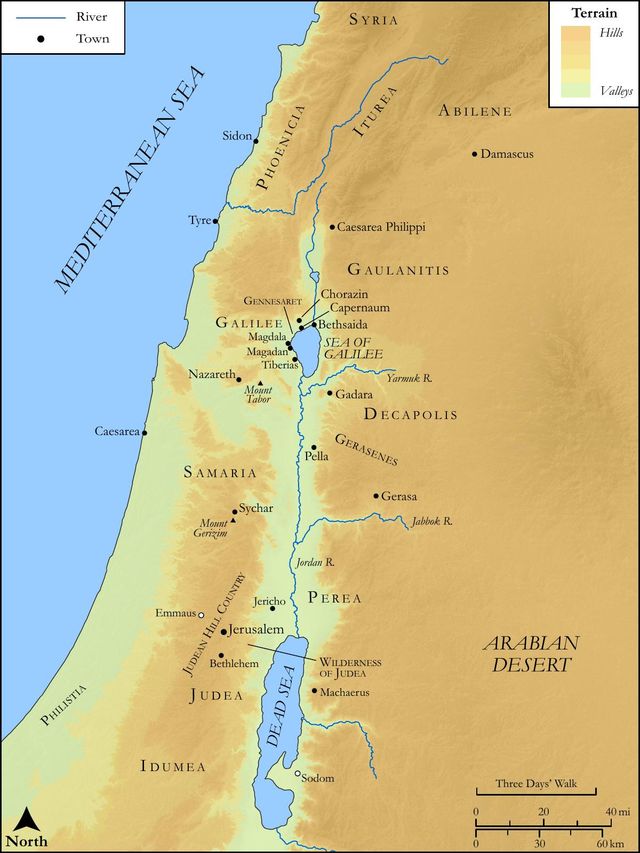
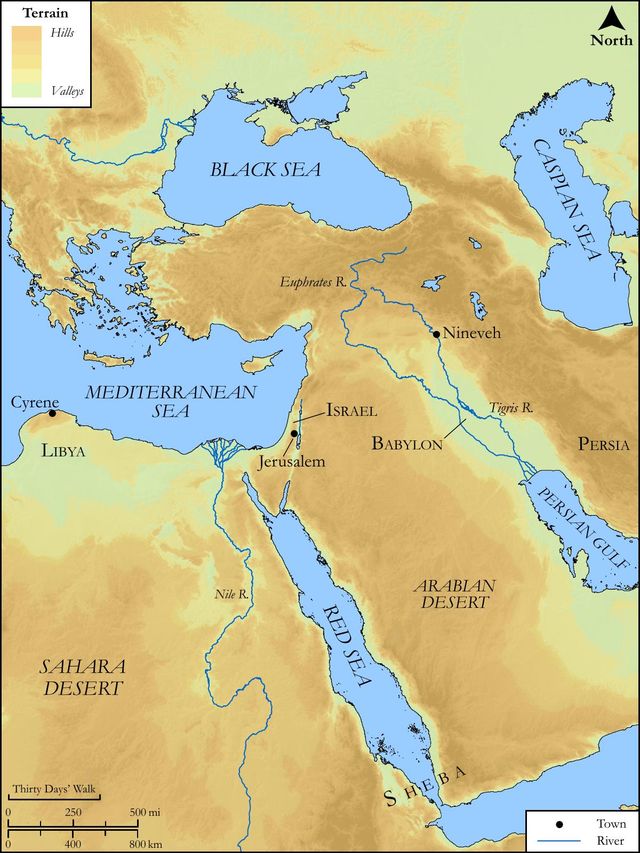
Study this verse
Public-domain commentary
Matthew Henry
From his Commentary on the Whole Bible. Henry comments on passages, not single verses — this entry covers Matthew 1:1–17. His two-level outline is real structure in the source text, so it is rendered as structure.
Concerning this genealogy of our Saviour, observe,
I.The title of it.
It is the book (or the account, as the Hebrew word sepher, a book, sometimes signifies) of the generation of Jesus Christ, of his ancestors according to the flesh; or, It is the narrative of his birth. It is Biblos Geneseōs - a book of Genesis. The Old Testament begins with the book of the generation of the world, and it is its glory that it does so; but the glory of the New Testament herein excelleth, that it begins with the book of the generation of him that made the world. As God, his outgoings were of old, from everlasting (Mic 5:2), and none can declare that generation; but, as man, he was sent forth in the fulness of time, born of a woman, and it is that generation which is here declared.
II.The principal intention of it.
It is not an endless or needless genealogy; it is not a vain-glorious one, as those of great men commonly are. Stemmata, quid faciunt? - Of what avail are ancient pedigrees? It is like a pedigree given in evidence, to prove a title, and make out a claim; the design is to prove that our Lord Jesus is the son of David, and the son of Abraham, and therefore of that nation and family out of which the Messiah was to arise. Abraham and David were, in their day, the great trustees of the promise relating to the Messiah. The promise of the blessing was made to Abraham and his seed, of the dominion to David and his seed; and they who would have an interest in Christ, as the son of Abraham, in whom all the families of the earth are to be blessed, must be faithful, loyal subjects to him as the son of David, by whom all the families of the earth are to be ruled. It was promised to Abraham that Christ should descend from him (Gen 12:3; Gen 22:18), and to David that he should descend from him (Sa2 7:12; Psa 89:3, etc.; Psa 132:11); and therefore, unless it can be proved that Jesus is a son of David, and a son of Abraham, we cannot admit him to be the Messiah. Now this is here proved from the authentic records of the heralds' offices. The Jews were very exact in preserving their pedigrees, and there was a providence in it, for the clearing up of the descent of the Messiah from the fathers; and since his coming that nation is so dispersed and confounded that it is a question whether any person in the world can legally prove himself to be a son of Abraham; however, it is certain that none can prove himself to either a son of Aaron or a son of David, so that the priestly and kingly office must either be given up, as lost for ever, or be lodged in the hands of our Lord Jesus. Christ is here first called the son of David, because under that title he was commonly spoken of, and expected, among the Jews. They who owned him to be the Christ, called him the son of David, Mat 15:22; Mat 20:31; Mat 21:15. Thus, therefore, the evangelist undertakes to make out, that he is not only a son of David, but that son of David on whose shoulders the government was to be; not only a son of Abraham, but that son of Abraham who was to be the father of many nations.
In calling Christ the son of David, and the son of Abraham, he shows that God is faithful to his promise, and will make good every word that he has spoken; and this. 1. Though the performance be long deferred. When God promised Abraham a son, who should be the great blessing of the world, perhaps he expected it should be his immediate son; but it proved to be one at the distance of forty-two generations, and about 2000 years: so long before can God foretel what shall be done, and so long after, sometimes, does God fulfil what has been promised. Note, Delays of promised mercies, though they exercise our patience, do not weaken God's promise. 2. Though it begin to be despaired of. This son of David, and son of Abraham, who was to be the glory of his Father's house, was born when the seed of Abraham was a despised people, recently become tributary to the Roman yoke, and when the house of David was buried in obscurity; for Christ was to be a root out of a dry ground. Note, God's time for the performance of his promises is when it labours under the greatest improbabilities.
III.The particular series of it, drawn in the direct line from Abraham downward, according to the genealogies recorded in the beginning of the books of Chronicles (as far as those go), and which here we see the use of.
Some particulars we may observe in the genealogy.
1.Among the ancestors of Christ who had brethren, generally he descended from a younger brother; such Abraham himself was, and Jacob, and Judah, and David, and Nathan, and Rhesa; to show that the pre-eminence of Christ came not, as that of earthly princes, from the primogeniture of his ancestors, but from the will of God, who, according to the method of his providence, exalteth them of low degree, and puts more abundant honour upon that part which lacked.
2.Among the sons of Jacob, besides Judah, from whom Shiloh came, notice is here taken of his brethren: Judas and his brethren. No mention is made of Ishmael the son of Abraham, or of Esau the son of Isaac, because they were shut out of the church; whereas all the children of Jacob were taken in, and, though not fathers of Christ, were yet patriarchs of the church (Act 7:8), and therefore are mentioned in the genealogy, for the encouragement of the twelve tribes that were scattered abroad, intimating to them that they have an interest in Christ, and stand in relation to him as well as Judah.
3.Phares and Zara, the twin-sons of Judah, are likewise both named, though Phares only was Christ's ancestor, for the same reason that the brethren of Judah are taken notice of; and some think because the birth of Phares and Zara had something of an allegory in it. Zara put out his hand first, as the first-born, but, drawing it in, Phares got the birth-right. The Jewish church, like Zara, reached first at the birthright, but through unbelief, withdrawing the hand, the Gentile church, like Phares, broke forth and went away with the birthright; and thus blindness is in part happened unto Israel, till the fulness of the Gentiles become in, and then Zara shall be born - all Israel shall be saved, Rom 11:25, Rom 11:26.
4.There are four women, and but four, named in this genealogy; two of them were originally strangers to the commonwealth of Israel, Rachab a Canaanitess, and a harlot besides, and Ruth the Moabitess; for in Jesus Christ there is neither Greek, nor Jew; those that are strangers and foreigners are welcome, in Christ, to the citizenship of the saints. The other two were adulteresses, Tamar and Bathsheba; which was a further mark of humiliation put upon our Lord Jesus, that not only he descended from such, but that is decent from them is particularly remarked in his genealogy, and no veil drawn over it. He took upon him the likeness of sinful flesh (Rom 8:3), and takes even great sinners, upon their repentance, into the nearest relation to himself. Note, We ought not to upbraid people with the scandals of their ancestors; it is what they cannot help, and has been the lot of the best, even of our Master himself. David's begetting Solomon of her that had been the wife of Urias is taken notice of (says Dr. Whitby) to show that the crime of David, being repented to, was so far from hindering the promise made to him, that it pleased God by this very woman to fulfil it.
5.Though divers kings are here named, yet none is expressly called a king but David (Mat 1:6), David the king; because with him the covenant of royalty was made, and to him the promise of the kingdom of the Messiah was given, who is therefore said to inherit the throne of his father David, Luk 1:32.
6.In the pedigree of the kings of Judah, between Joram and Ozias (Mat 1:8), there are three left out, namely, Ahaziah, Joash, and Amaziah; and therefore when it is said, Joram begat Ozias, it is meant, according to the usage of the Hebrew tongue, that Ozias was lineally descended from him, as it is said to Hezekiah that the sons which he should beget should be carried to Babylon, whereas they were removed several generations from him. It was not through mistake or forgetfulness that these three were omitted, but, probably, they were omitted in the genealogical tables that the evangelist consulted, which yet were admitted as authentic. Some give this reason for it: - It being Matthew's design, for the sake of memory, to reduce the number of Christ's ancestors to three fourteens, it was requisite that in this period three should be left out, and none more fit than they who were the immediate progeny of cursed Athaliah, who introduced the idolatry of Ahab into the house of David, for which this brand is set upon the family and the iniquity thus visited to the third and fourth generation. Two of these three were apostates; and such God commonly sets a mark of his displeasure upon in this world: they all three had their heads brought to the grave with blood.
7.Some observe what a mixture there was of good and bad in the succession of these kings; as for instance (Mat 1:7, Mat 1:8), wicked Roboam begat wicked Abia; wicked Abia begat good Asa; good Asa begat good Josaphat; good Josaphat begat wicked Joram. Grace does not run in the blood, neither does reigning sin. God's grace is his own, and he gives or withholds it as he pleases.
8.The captivity of Babylon is mentioned as a remarkable period in this line, Mat 1:11, Mat 1:12. All things considered, it was a wonder that the Jews were not lost in that captivity, as other nations have been; but this intimates the reason why the streams of that people were kept to run pure through that dead sea, because from them, as concerning the flesh, Christ was to come. Destroy it not, for a blessing is in it, even that blessing of blessings, Christ himself, Isa 65:8, Isa 65:9. It was with an eye to him that they were restored, and the desolations of the sanctuary were looked upon with favour for the Lord's sake, Dan 9:17.
9.Josias is said to beget Jechonias and his brethren (Mat 1:11); by Jechonias here is meant Jehoiakim, who was the first-born of Josias; but, when it is said (Mat 1:12) that Jechonias begat Salathiel, that Jechonias was the son of that Jehoiakim who was carried into Babylon, and there begat Salathiel (as Dr. Whitby shows), and, when Jechonias is said to have been written childless (Jer 22:30), it is explained thus: No man of his seed shall prosper. Salathiel is here said to beget Zorobabel, whereas Salathiel begat Pedaiah, and he begat Zorobabel (Ch1 3:19): but, as before, the grandson is often called the son; Pedaiah, it is likely, died in his father's lifetime, and so his son Zorobabel was called the son of Salathiel.
10.The line is brought down, not to Mary the mother of our Lord, but to Joseph the husband of Mary (Mat 1:16); for the Jews always reckoned their genealogies by the males: yet Mary was of the same tribe and family with Joseph, so that, both by his mother and by his supposed father, he was of the house of David; yet his interest in that dignity is derived by Joseph, to whom really according to the flesh he had no relation, to show that the kingdom of the Messiah is not founded in a natural descent from David.
11.The centre in whom all these lines meet is Jesus, who is called Christ, Mat 1:16. This is he that was so importunately desired, so impatiently expected, and to whom the patriarchs had an eye when they were so desirous of children, that they might have the honour of coming into the sacred line. Blessed be God, we are not now in such a dark and cloudy state of expectation as they were then in, but see clearly what these prophets and kings saw as through a glass darkly. And we may have, if it be not our own fault, a greater honour than that of which they were so ambitious: for they who do the will of God are in a more honourable relation to Christ than those who were akin to him according to the flesh, Mat 12:50. Jesus is called Christ, that is, the Anointed, the same with the Hebrew name Messiah. He is called Messiah the Prince (Dan 9:25), and often God's Anointed (Psa 2:2). Under this character he was expected: Art thou the Christ - the anointed one? David, the king, was anointed (Sa1 16:13); so was Aaron, the priest (Lev 8:12), and Elisha, the prophet (Kg1 19:16), and Isaiah, the prophet (Isa 61:1). Christ, being appointed to, and qualified for, all these offices, is therefore called the Anointed - anointed with the oil of gladness above his fellows; and from this name of his, which is as ointment poured forth, all his followers are called Christians, for they also have received the anointing.
Lastly. The general summary of all this genealogy we have, Mat 1:17, where it is summed up in three fourteens, signalized by remarkable periods. In the first fourteen, we have the family of David rising, and looking forth as the morning; in the second, we have it flourishing in its meridian lustre; in the third, we have it declining and growing less and less, dwindling into the family of a poor carpenter, and then Christ shines forth out of it, the glory of his people Israel.
Historical interpretation
Nine Centuries of Reception
10 surviving comments on this verse. Each one is dated, so this reads as a timeline rather than a list.
Select a marker to jump to its quote. Markers stagger vertically where authors wrote within a few decades of each other.
Thus the stain of the Gentile alliance being purged, the royal race is again taken up in the fourth following generation.
(In Luc. cap. 2.) That there were two kings of the name of Joakim, is clear from the Book of Kings. And Joakim slept with his fathers, and Joachin his son reigned, in his stead. (2 Kings 24:6.) This son is the same whom Jeremiah calls Jeconias. And rightly did St. Matthew purpose to differ from the Prophet, because he sought to show therein the great abundance of the Lord's mercies. For the Lord did not seek among men nobility of race, but suitably chose to be born of captives and of sinners, as He came to preach remission of sin to the captives. The Evangelist therefore did not conceal either of these; but rather showed them both, inasmuch as both were called Jeconias.
Verse 1. "In the third year of the reign of Joacim (Jehoiakim) king of Judah, Nebuchadnezzar king of Babylon came to Jerusalem and besieged it." Jehoiakim, son of the Josiah in whose thirteenth regnal year Jeremiah began to prophesy, and under whom the woman Hulda prophesied, was the same man as was called by the other name of Eliakim, and reigned over the tribes of Judah and Jerusalem eleven years. His son Jehoiachin surnamed Jeconiah, followed him in the kingship, and on the tenth day of the third month of his reign he was taken captive by Nebuchadnezzar's generals and brought to Babylon. In his place his paternal uncle Zedekiah, a son of Josiah, was appointed king, and in his eleventh year Jerusalem was captured and destroyed. Let no one therefore imagine that the Jehoiakim in the beginning of Daniel is the same person as the one who is spelled Jehoiachin in the commencement of Ezekiel. For the latter has "-chin" as its final syllable, whereas the former has "-kim." And it is for this reason that in the Gospel according to Matthew there seems to be a generation missing, because the second group of fourteen, extending to the time of Jehoiakim, ends with a son of Josiah, and the third group begins with Jehoiachin, son of Jehoiakim. Being ignorant of this factor, Porphyry formulated a slander against the Church which only revealed his own ignorance, as he tried to prove the evangelist Matthew guilty of error.
(Vers. 4 seqq.) Naasson, however, fathered Salmon. Salmon, however, fathered Boaz by Rahab. Boaz, however, fathered Obed by Ruth. Obed, however, fathered Jesse. Jesse, however, fathered King David. David, however, king, fathered Solomon by her who had been Uriah's. Solomon, however, fathered Rehoboam. Rehoboam, however, fathered Abijah. Abijah, however, fathered Asa. Asa, however, fathered Jehoshaphat. Jehoshaphat, however, fathered Joram. This is Naasson, the prince of the tribe of Judah, as we read in Numbers (Num. I and II).
Joram, however, begot Oziam. Ozias, however, begot Joathan. Joathan, however, begot Achaz. Achaz, however, begot Ezechiam. Ezechias, however, begot Manassen. Manasses, however, begot Amon. Amon, however, begot Josiam. Josias, however, begot Jechoniam and his brothers in the Babylonian exile. In the fourth book of Kings (Ch. III, VIII and following), we read that Joram was begotten by Ochoziam, and after his death, Josabeth, daughter of King Joram and sister of Ochozia, took Joas, the son of her brother, and rescued him from the slaughter that was being carried out by Athalia (or Atholia). His son Amasias succeeded him to the kingdom, and after him his son Azarias, who is also called Ozias (or Ochozias). His son Joathan succeeded him. Therefore, you can see that according to the history, there were three kings in the middle whom the Evangelist omitted: for Joram did not beget Ozias, but Ochozias, and the others we mentioned. However, because it was the intent of the Evangelist to list three sets of fourteen generations in different periods of time, and Joram had married the most wicked Jezabel, his memory is removed up to the third generation, so as not to be included in the order of the holy birth.
In the fourth book of Kings we read, that Ochozias was the son of Joram. On his death, Josabeth, sister of Ochozias and daughter of Joram, took Joash, her brother's son, and preserved him from the slaughter of the royal seed by Athalias. To Joash succeeded his son Amasias; after him his son Azarias, who is called Ozias; after him his son Joatham. Thus you see according to historical truth there were three intervening kings, who are omitted by the Evangelist. Joram, moreover, begot not Ozias, but Ochozias, and the rest as we have related. But because it was the purpose of the Evangelist to make each of the three periods consist of fourteen generations, and because Joram had connected himself with Jezebel's most impious race, therefore his posterity to the third generation is omitted in tracing the lineage of the holy birth.
Otherwise, we may consider the first Jeconias to be the same as Joakim, and the second to be the son not the father, the one being spelt with k and m, the second by ch and n. This distinction has been confounded both by Greeks and Latins, by the fault of writers and the lapse of time.
Solomon is interpreted 'peacemaker,' because having subdued all the nations round about, and made them tributary, he had a peaceful reign. Roboam is interpreted 'by a multitude of people,' for multitude is the mother of sedition; for where many are joined in a crime, that is commonly unpunishable. But a limit in numbers is the mistress of good order.
8-11. And Josaphat begat Joram; and Joram begat Ozias; and Ozias begat Joatham; and Joatham begat Achaz; and Achaz begat Ezekias; and Ezekias begat Manasses; and Manasses begat Amon; and Amon begat Josias; and Josias begat Jechonias and his brethren, about the time they were carried away to Babylon.
What the Holy Spirit testified through the Prophet, saying, that He would cut off every male from the house of Ahab, and Jezebel, that Jehu the son of Nausi fulfilled, and received the promise that his children to the fourth generation should sit on the throne of Israel. As great a blessing then as was given upon the house of Ahab, so great a curse was given on the house of Joram, because of the wicked daughter of Ahab and Jezebel, that his sons to the fourth generation should be cut out of the number of the Kings. Thus his sin descended on his posterity as it had been written, I will visit the sins of the fathers upon the children unto the third and fourth generation. (Exod. 20:5.) Thus see how dangerous it is to marry with the seed of the ungodly.
But the order in the Book of Kings (2 Kings 23.) is different, thus namely; Josias begot Eliakim, afterwards called Joakim; Joakim begot Jechonias. But Joakim is not reckoned among the Kings in the genealogy, because God's people had not set him on the throne, but Pharaoh by his might. For if it were just that only for their intermixture with the race of Ahab, three kings should be shut out of the number in the genealogy, was it not just that Joakim should be likewise shut out, whom Pharaoh had set up as king by hostile force? And thus Jechonias, who is the son of Joakim, and the grandson of Josiah, is reckoned among the kings as the son of Josiah, in place of his father who is omitted.
But it may be asked, why the Evangelist says they were born in the carrying away, when they were born before the carrying away. He says this because they were born for this purpose, that they should be led captive, from the dominion of the whole nation, for their own and others' sins. And because God foreknew that they were to be carried away captive, therefore he says, they were born in the carrying away to Babylon. But of those whom the holy Evangelist places together in the Lord's genealogy, it should be known, that they were alike in good or ill fame. Judas and his brethren were notable for good, in like manner Phares and Zara, Jechonias and his brethren, were notable for evil.
Bersabee is interpreted 'the seventh well,' or 'the well of the oathc;' by which is signified the grant of baptism, in which is given the gift of the sevenfold Spirit, and the oath against the Devil is made. Christ is also Solomon, i. e. the peaceful, according to that of the Apostle, He is our peace. (Eph. 2:14.) Roboamd is, 'the breadth of the people,' according to that, Many shall come from the East and from the West.
He is also Abias, that is, 'the Lord Father,' according to that, One is your Father who is in heaven. (Mat. 23:9.) And again, Ye call me Master and Lord. (John 13:13.) He is also Asae, that is, 'lifting up,' according to that, Who taketh away the sins of the world. (John 1:29.) He is also Josaphat, that is, 'judging,' for, The Father hath committed all judgment unto the Son. (John 5:22.) He is also Joram, that is, 'lofty,' according to that, No man hath ascended up to heaven, but He that came down from heaven. (John 3:13.) He is also Ozias, that is, 'the Lord's strength,' for The Lord is my strength and my praise. (Ps. 118:14.) He is also Jothamf, that is, 'completed,' or 'perfected,' for Christ is the end of the Law. (Rom. 10:4.) He is also Ahazg, that is, 'turning,' according to that, Be ye turned to Me. (Zech. 1:3.)
He is also Ezekias, that is, 'the strong Lord,' or, 'the Lord shall comfort;' according to that, Be of good cheer, I have overcome the world. (John 16:33.) He is also Manasses, that is, 'forgetful,' or, 'forgotten,' according to that, I will not remember your sins any more. (Ezek. 28.) He is also Aaronh, that is,' faithful,' according to that, The Lord is faithful in all His words. (Ps. 145:17.) He is also Josias, that is, 'the incense of the Lordi,' as, And being in an agony, He prayed more earnestly. (Luke 22:44.)
He is Jechoniask, that is, 'preparing,' or 'the Lord's preparation,' according to that, If I shall depart, I will also prepare a place for you. (John 14:3.)
Or; 'the might of the people,' because he quickly converts the people to the faith.
Or, 'embracing,' because None knoweth the Father but the Son. (Matt. 11:27.)
And that incense signifies prayer, the Psalmist witnesses, saying, Let my prayer come up as incense before Thee. (Ps. 141:2.) Or, 'The salvation of the Lord,' according to that, My salvation is for ever. (Is. 55.)
The "deportation to Babylon" means the captivity which they later endured when they were all led away into Babylon. For the Babylonians campaigned against them on another occasion, causing less affliction. But on this occasion, the Babylonians carried them all away from their homeland.
This Ezekias was he to whom, when he had no children, it was said, Set thy house in order, for thou shalt die. (Is. 38:1.) He wept, not from desire of longer life, for he knew that Solomon had thereby pleased God, that he had not asked length of days; but he wept, for he feared that God's promise should not be fulfilled, when himself, being in the line of David of whom Christ should come, was without children. And Ezekias begat Manasses; and Manasses begat Amon; and Amon begat Josias.
Mystically, David is Christ, who overcame Golias, that is, the Devil. Urias, i. e. God is my light, is the Devil who says, I will be like the Highest. (Is. 14:14.) To Him the Church was married, when Christ on the Throne of the majesty of His Father loved her, and having made her beautiful, united her to Himself in wedlock. Or Urias is the Jewish nation who through the Law boasted of their light. From them Christ took away the Law, having taught it to speak of Himself. Bersabee is 'the well of satiety,' that is, the abundance of spiritual grace.
Morally; After David follows Solomon, which is interpreted, 'peaceful.' For one then becomes peaceful, when unlawful motions being composed, and being as it were already set in the everlasting rest, he serves God, and turns others to Him. Then follows Roboam, that is 'the breadth of the people.' For when there is no longer any thing to overcome within himself, it behoves a man to look abroad to others, and to draw with him the people of God to heavenly things. Next is Abias, that is, 'the Lord Father,' for these things premised, He may proclaim Himself the Son of God, and then He will be Asa, that is, 'raising up,' and will ascend to His Father from virtue to virtue: and He will become Josaphat, that is, 'judging,' for He will judge others, and will be judged of none. Thus he becomes Joram, that is, 'lofty,' as it were dwelling on high; and is made Oziah, that is, 'the strong One of the Lord,' as attributing all his strength to God, and persevering in his path. Then follows Jotham, that is, 'perfect,' for he groweth daily to greater perfection. And thus he becomes Ahaz, that is, 'embracing,' for by obedience knowledge is increased according to that, They have proclaimed the worship of the Lord, and have understood His doings. Then follows Ezekias, that is, 'the Lord is strong,' because he understands that God is strong, and so turning to His love, he becomes Manasses, 'forgetful,' because he gives up as forgotten all worldly things; and is made thereby Amon, that is, 'faithful,' for whoso despises all temporal things, defrauds no man of his goods. Thus he is made Josias, that is, 'in certain hope of the Lord's salvation;' for Josias is interpreted 'the salvation of the Lord.'
Continue studying Matthew 1:11 across the web’s major study libraries — every link below opens this exact verse, chapter, or book on the destination site.
Read & Compare
 BibleGatewayThis verse in more than 200 translations and 70 languages.
 Bible.comThe YouVersion reader — hundreds of translations, reading plans, and highlights.
 ESV.orgCrossway's official English Standard Version reader.
 NET BibleThe NET translation with 60,000+ translators' notes on every rendering decision.
 STEP BibleTyndale House's free study tool — original text, vocabulary, and scholarly resources.
 BibliaLogos Bible Software's free web reader.
 USCCBThe New American Bible (Revised Edition) with the U.S. bishops' study notes.
Commentaries
 BibleHub CommentariesDozens of classic commentaries on this verse, gathered on one page.
 StudyLightMore than 100 commentary sets — the largest collection on the web.
 BibleRefPlain-English commentary on what this verse means, verse by verse.
 Enduring WordDavid Guzik's free commentary on this chapter, widely used by Bible teachers.
 Bible Study ToolsVerse commentary alongside Greek and Hebrew study aids.
Original Language & Research
- BibleHub InterlinearThe verse word by word — original language, transliteration, and English.
- BibleHub LexiconEvery word's original-language definition and Strong's entry.
 Blue Letter BibleDeep-study tools — Strong's numbers, concordance, and word studies.
 CNTR CollationThe earliest Greek manuscripts of this verse, collated letter by letter.
Sermons, Hymns & Audio


TrulyRandomVerse is not affiliated with these sites and doesn’t control their content. They’re linked because they’re genuinely useful.
Summary
Matthew 1:11 serves as a pivotal point within the genealogy of Jesus Christ, meticulously tracing the lineage from King Josiah to Jeconiah (also known as Jehoiachin or Coniah) and his brothers. This verse not only continues the royal line but also critically marks the historical epoch of the Babylonian exile, a period of profound national judgment and displacement for the people of Judah, yet one through which God's sovereign plan for the Messiah's coming continued to unfold.
Context
ShowHideLiterary Context
This verse is situated within the opening chapter of Matthew's Gospel, which begins with a meticulously constructed genealogy of Jesus Christ, tracing His ancestry from Abraham through David and down to Joseph, Jesus' legal father. Matthew's genealogy is highly structured, intentionally divided into three sections of fourteen generations each, as explicitly stated in Matthew 1:17. Verse 11 specifically concludes the second set of fourteen generations (from David to the Babylonian captivity) and initiates the third (from the captivity to Christ). Its placement is strategic, highlighting the Babylonian exile as a major historical and theological watershed moment, emphasizing both the continuity of God's covenant promises despite national failure and the profound disruption that necessitated a new era culminating in the Messiah.
Historical & Cultural Context
The period referenced in Matthew 1:11 centers on the Babylonian Captivity, a catastrophic event for the Kingdom of Judah. Following a series of unfaithful kings and widespread idolatry, God allowed the Babylonian Empire, under King Nebuchadnezzar, to conquer Judah. Jerusalem was besieged, the Temple was destroyed in 586 BC, and the Judean elite, including the royal family and skilled craftsmen, were forcibly deported to Babylon. This was not merely a political defeat but a profound theological crisis, as it appeared to contradict God's promises of an eternal Davidic dynasty and a perpetual dwelling place in Jerusalem. Culturally, the exile forced a reevaluation of national identity, the role of the Temple, and the nature of God's covenant. It was a time of immense suffering and spiritual introspection, yet it also fostered the development of synagogue worship and a deeper commitment to the Law among the exiles.
Key Themes
ShowHideMatthew 1:11 contributes significantly to several overarching themes in Matthew and the broader biblical narrative. Firstly, it underscores God's unwavering sovereignty over history, demonstrating that even in moments of national disaster and divine judgment, God remains in control, guiding events towards His ultimate redemptive purposes. The exile, though a consequence of human sin, was not an interruption but a divinely ordained phase in God's plan, fulfilling prophetic warnings found in books like Jeremiah and Isaiah. Secondly, the verse highlights the continuity of the Davidic line despite the apparent end of the monarchy. Jeconiah, though a captive king, maintained the royal lineage, ensuring that the future Messiah would indeed descend from the house and lineage of David. This reinforces the theme of God's faithfulness to His covenant promises, even when human faithfulness falters. Finally, the inclusion of the exile emphasizes the theme of judgment and restoration, setting the stage for the ultimate restoration brought by Jesus Christ.
Exposition and Analysis
ShowHideKey Word Analysis
ShowHideFrom the verb meaning "to procreate" or "to become the father of," this term consistently emphasizes direct lineal descent throughout Matthew's genealogy. In this context, it affirms the biological and legal connection of Jeconiah to Josiah, maintaining the unbroken chain of the Davidic lineage despite the political upheaval. It underscores the divine orchestration of human generations to fulfill God's redemptive plan.
This noun specifically refers to "a change of abode" or, more precisely, "expatriation" and "deportation." It vividly describes the forced removal of the Judean population from their homeland to Babylon. Its inclusion here is not merely a historical note but a theological marker, signifying the profound judgment and displacement that marked a major turning point in Israel's history, fulfilling prophecies of exile due to their persistent disobedience.
Meaning "brother" (literally or figuratively), this term in the context of Jeconiah likely refers to other sons of King Josiah or prominent members of the royal family who were also part of the deportation. Its presence emphasizes the collective nature of the exile, indicating that the entire royal house and a significant portion of the Judean elite were affected by this national catastrophe, underscoring the widespread impact of the judgment.
Verse Breakdown
ShowHide"And Josias begat Jechonias and his brethren,"
This clause continues the genealogical sequence, identifying Josiah as the father of Jeconiah. The inclusion of "and his brethren" is notable, as genealogies typically focus on the direct line. This phrase may serve several purposes: to acknowledge Jeconiah's siblings who were also part of the royal lineage and likely shared in the exile, to highlight the broader impact of the coming judgment on the entire royal family, or to subtly indicate a disruption in the direct kingly succession, as Jeconiah's reign was brief and tumultuous, and the kingship effectively ended with him in Judah.
"about the time they were carried away to Babylon:"
This concluding phrase provides crucial historical context, dating the transition from Josiah's line to Jeconiah's at the precise moment of the Babylonian exile. It transforms a simple genealogical entry into a significant historical marker, signaling the end of the independent Davidic monarchy in Judah and the beginning of a period of foreign domination and national dispersion. This phrase is key to Matthew's structuring of the genealogy, marking the end of the second major period and the beginning of the third, leading directly to Christ.
Literary Devices
ShowHideMatthew 1:11 employs several significant literary devices. The most prominent is Historical Marker, as the phrase "about the time they were carried away to Babylon" serves as a precise chronological and theological pivot point within the genealogy. It is not merely a date but a shorthand for a complex period of national crisis and divine judgment. This verse also utilizes Conciseness, characteristic of genealogical lists, compressing centuries of history and profound events into a single, impactful statement. Furthermore, there is an element of Theological Symbolism in the mention of "Babylon" itself, which throughout biblical literature often symbolizes oppressive worldly power and judgment against God's people. Its inclusion here reminds the reader of the consequences of Israel's unfaithfulness and sets the stage for a new era of anticipation for the Messiah who would bring true liberation.
Theological and Thematic Connections
ShowHideMatthew 1:11 profoundly connects to the broader biblical narrative by illustrating God's unwavering sovereignty and faithfulness, even amidst human failure and national catastrophe. The Babylonian exile, though a severe judgment for Israel's persistent sin and idolatry, was simultaneously a fulfillment of prophecy and a demonstration that God's covenant promises, particularly the Davidic covenant, remained intact. The lineage of the Messiah continued through Jeconiah, a king who reigned during the exile, underscoring that God's ultimate plan of redemption was not derailed but rather progressed through and even by means of these challenging circumstances. This highlights a recurring biblical theme: God uses both blessing and judgment to achieve His redemptive purposes, always working towards the ultimate revelation of His Son.
Reflection and Application
ShowHideMatthew 1:11 offers profound lessons for contemporary believers. It reminds us that God's sovereign hand is at work even in the most challenging and seemingly chaotic periods of history, including our personal lives. The Babylonian exile was a dark chapter for Israel, a consequence of their disobedience, yet it was precisely through this period of judgment and displacement that God preserved the lineage leading to the Messiah. This verse encourages us to trust in God's faithfulness and His overarching plan, even when circumstances appear bleak or when we face personal "exiles" or setbacks. It teaches us that God can redeem even our failures and redirect our paths to serve His greater purposes. Our hope is anchored not in the stability of human institutions or circumstances, but in the unshakeable faithfulness of God, who is always working towards the ultimate fulfillment of His redemptive promises.
Questions for Reflection
ShowHideFAQ
ShowHideWhy does Matthew include "and his brethren" when genealogies typically focus on the direct line?
ShowHideThe inclusion of "and his brethren" (Greek, adelphós) in Matthew 1:11 is a unique feature in this genealogy. While it might simply acknowledge other sons of Josiah who were also part of the royal family, its primary significance is likely to emphasize the collective nature of the Babylonian exile. It underscores that the entire royal house and a significant portion of the Judean elite were affected by this national catastrophe, highlighting the widespread impact of God's judgment and the profound disruption to the Davidic monarchy. It also subtly prepares the reader for the fact that the direct kingly succession was broken, and the future Messiah would come from a line that had endured significant humbling.
What is the significance of the Babylonian Captivity being highlighted in Jesus' genealogy?
ShowHideThe Babylonian Captivity, marked in Matthew 1:11, is a pivotal historical and theological event. Matthew's inclusion of it serves several key purposes. Firstly, it acts as a major dividing point in his structured genealogy, marking the end of the second period of fourteen generations and the beginning of the third, leading to Christ Matthew 1:17. Secondly, it underscores God's sovereignty, showing that even a devastating national judgment was part of His divine plan, fulfilling prophecies of exile due to Israel's disobedience. Thirdly, it highlights the profound spiritual and national low point Israel reached, thereby emphasizing the desperate need for a Messiah who would bring true liberation and restoration, far greater than any physical return from exile.
Christ-Centered Fulfillment
ShowHideMatthew 1:11, with its stark reference to the Babylonian exile, powerfully sets the stage for the Christ-centered fulfillment found in Jesus. The exile represented the nadir of Israel's national life, a period of judgment where the Davidic monarchy ceased and the people were scattered. Yet, it is precisely through this broken and humbled lineage that Jesus, the Messiah, emerges. He is the true Son of David, not merely inheriting a throne, but establishing an eternal kingdom that transcends earthly political structures, as prophesied in Isaiah 9:6-7. Unlike Jeconiah, who was "carried away" into physical bondage, Jesus comes to deliver His people from a far greater captivity: the bondage of sin and death Romans 6:23. His birth marks the end of the "exile" of humanity from God's presence, bringing about the ultimate return and reconciliation through His atoning sacrifice 2 Corinthians 5:19. Thus, the historical low point of the exile in Matthew 1:11 foreshadows the spiritual redemption and restoration inaugurated by Christ, who is the ultimate fulfillment of God's promises, bringing true freedom and an everlasting kingdom.