


Jeremiah 27:20
Bible text: King James Version (1769 Blayney text) · Public domain
Bible text: King James Version with Strong's numbers · Public domain
Bible text: Berean Standard Bible · Public domain
Bible text: American Standard Version (1901) · Public domain
Bible text: World English Bible, Messianic edition · Public domain
Bible text: Geneva Bible (1599) · Public domain
Bible text: Young's Literal Translation · Public domain
- אֲשֶׁר'a·SherwhichH834RelParticle Relative
- לֹאlo'notH3808NegParticle Negative
- לְקָחָםle·ka·Chamhe took themH3947V-Qal-Perf-3ms ¦ 3mpVerb Qal Perfect 3rd Singular Masculineלְקָחָhe tookםthem
- נְבוּכַדְנֶאצַּרne·vu·khad·ne·TzarNebuchadnezzarH5019N-proper-mNoun Proper Masculine
- מֶלֶךְMe·lekh[the] king ofH4428N-mscNoun Singular Masculine Construct
- בָּבֶלba·VelBabylonH894N-properNoun Proper Location
- בַּגְלוֹתוֹbag·lo·towhen he took into exileH1540Prep-b ¦ V-Hiphil-Inf ¦ 3msVerb Hiphil Infinitive Constructבַּwhenגְלוֹתtook into exileוֹhe
- אֶת'et<obj.>H853DirObjMParticle Object Indicator
- יְכֹנְיָהye·kha·ne·YahJeconiahH3204N-proper-mNoun Proper Masculine
- בֶןven[the] son ofH1121N-mscNoun Singular Masculine Construct
- יְהוֹיָקִיםye·ho·ya·KimJehoiakimH3079N-proper-mNoun Proper Masculine
- מֶלֶךְMe·lekh[the] king ofH4428N-mscNoun Singular Masculine Construct
- יְהוּדָהye·hu·DahJudahH3063N-properNoun Proper Location
- מִירוּשָׁלִַםmi·ru·sha·Limfrom JerusalemH3389Prep-m ¦ N-properNoun Proper LocationמִfromירוּשָׁלִַםJerusalem
- בָּבֶלָהba·Ve·lahBabylon towardsH894N-proper ¦ SfxNoun Proper LocationבָּבֶלָBabylonהtowards
- וְאֵתve·'Etand <obj.>H853Conj-w ¦ DirObjMParticle Object Indicatorוְandאֵת<obj.>
- כָּלkolallH3605N-mscNoun Singular Masculine Construct
- חֹרֵיcho·Rei[the] nobles ofH2715N-mpcNoun Plural Masculine Construct
- יְהוּדָהye·hu·DahJudahH3063N-properNoun Proper Location
- וִירוּשָׁלִָםvi·ru·sha·Limand JerusalemH3389Conj-w ¦ N-properNoun Proper LocationוִandירוּשָׁלִָםJerusalem
English is a literal word-by-word gloss of the Hebrew, not the KJV's wording. Why?
This is the original text the KJV's translators worked from — each Hebrew word with its own literal English meaning in this verse, prepared by scholars at Tyndale House, Cambridge. The KJV translates whole sentences, not word by word, so its wording differs: one Hebrew word can become several English words, and the KJV may choose “the LORD” where the gloss reads “Yahweh”. Both are faithful — they answer different questions. For the KJV's own rendering, switch to the KJV text.
Details
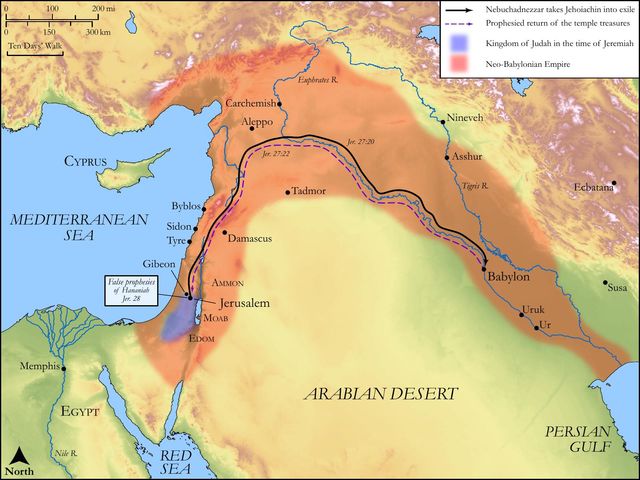
See on the biblical-era map
Study this verse
Public-domain commentary
Matthew Henry
From his Commentary on the Whole Bible. Henry comments on passages, not single verses — this entry covers Jeremiah 27:12–22.
What was said to all the nations is here with a particular tenderness applied to the nation of the Jews, for whom Jeremiah was sensibly concerned. The case at present stood thus: Judah and Jerusalem had often contested with the king of Babylon, and still were worsted; many both of their valuable persons and their valuable goods were carried to Babylon already, and some of the vessels of the Lord's house particularly. Now how this struggle would issue was the question. They had those among them at Jerusalem who pretended to be prophets, who bade them hold out and they should, in a little time, be too hard for the king of Babylon and recover all that they had lost. Now Jeremiah is sent to bid them yield and knock under, for that, instead of recovering what they had lost, they should otherwise lose all that remained; and to press them to this is the scope of these verses.
I.Jeremiah humbly addresses the king of Judah, to persuade him to surrender to the king of Babylon.
His act would be the people's and would determine them, and therefore he speaks to him as to them all (Jer 27:12): Bring your necks under the yoke of the king of Babylon and live. Is it their wisdom to submit to the heavy iron yoke of a cruel tyrant, that they may secure the lives of their bodies? And is it not much more our wisdom to submit to the sweet and easy yoke of our rightful Lord and Master Jesus Christ, that we may secure the lives of our souls? Bring down your spirits to repentance and faith, and that is the way to bring up your spirits to heaven and glory. And with much more cogency and compassion may we expostulate with perishing souls than Jeremiah here expostulates with a perishing people: "Why will you die by the sword and the famine - miserable deaths, which you inevitably run yourselves upon, under pretence of avoiding miserable lives?" What God had spoken, in general, of all those that would not submit to the king of Babylon, he would have them to apply to themselves and be afraid of. It were well if sinners would, in like manner, be afraid of the destruction threatened against all those that will not have Christ to reign over them, and reason thus with themselves, "Why should we die the second death, which is a thousand times worse than that by sword and famine, when we might submit and live?"
II.He addresses himself likewise to the priests and the people (Jer 27:16), to persuade them to serve the king of Babylon, that they might live, and might prevent the desolation of the city (Jer 27:17): "Wherefore should it be laid waste, as certainly it will be if you stand it out?" The priests had been Jeremiah's enemies, and had sought his life to destroy it, yet he approves himself their friend, and seeks their lives, to preserve and secure them, which is an example to us to render good for evil. When the blood-thirsty hate the upright, yet the just seek his soul, and the welfare of it, Pro 29:10. The matter was far gone here; they were upon the brink of ruin, which they would not have been brought to if they would have taken Jeremiah's counsel; yet he continues his friendly admonitions to them, to save the last stake and manage that wisely, and now at length in this their day to understand the things that belong to their peace, when they had but one day to turn them in.
III.In both these addresses he warns them against giving credit to the false prophets that rocked them asleep in their security, because they saw that they loved to slumber: "Hearken not to the words of the prophets (Jer 27:14), your prophets, Jer 27:16. They are not God's prophets; he never sent them; they do not serve him, nor seek to please him; they are yours, for they say what you would have them say, and aim at nothing but to please you." Two things their prophets flattered them into the belief of: - 1. That the power which the king of Babylon had gained over them should now shortly be broken. They said (Jer 27:14), "You shall not serve the king of Babylon; you need not submit voluntarily, for you shall not be compelled to submit." This they prophesied in the name of the Lord (Jer 27:15), as if God had sent them to the people on this errand, in kindness to them, that they might not disparage themselves by an inglorious surrender. But it was a lie. They said that God sent them; but that was false; he disowns it: I have not sent them, saith the Lord. They said that they should never be brought into subjection to the king of Babylon; but that was false too, the event proved it so. They said that to hold out to the last would be the way to secure themselves and their city; but that was false, for it would certainly end in their being driven out and perishing. So that it was all a lie, from first to last; and the prophets that deceived the people with these lies did, in the issue, but deceive themselves; the blind leaders and the blind followers fell together into the ditch: That you might perish, you, and the prophets that prophesy unto you, who will be so far from warranting your security that they cannot secure themselves. Note, Those that encourage sinners to go on in their sinful ways will in the end perish with them. 2. They prophesied that the vessels of the temple, which the king of Babylon had already carried away, should now shortly be brought back (Jer 27:16); this they fed the priests with the hopes of, knowing how acceptable it would be to them, who loved the gold of the temple better than the temple that sanctified the gold. These vessels were taken away when Jeconiah was carried captive into Babylon, Jer 27:20. We have the story, and it is a melancholy one, Kg2 24:13, Kg2 24:15; Ch2 36:10. All the goodly vessels (that is, all the vessels of gold that were in the house of the Lord), with all the treasures, were taken as prey, and brought to Babylon. This was grievous to them above any thing; for the temple was their pride and confidence, and the stripping of that was too plain an indication of that which the true prophet told them, that their God had departed from them. Their false prophets therefore had no other way to make them easy than by telling them that the king of Babylon should be forced to restore them in a little while. Now here, (1.) Jeremiah bids them think of preserving the vessels that remained by their prayers, rather than of bringing back those that were gone by their prophecies (Jer 27:18): If they be prophets, as they pretend, and if the word of the Lord be with them - if they have any intercourse with heaven and any interest there, let them improve it for the stopping of the progress of the judgment; let them step into the gap, and stand with their censer between the living and the dead, between that which is carried away and that which remains, that the plague may be stayed; let them make intercession with the Lord of hosts, that the vessels which are left go not after the rest. [1.] Instead of prophesying, let them pray. Note, Prophets must be praying men; by being much in prayer they must make it to appear that they keep up a correspondence with heaven. We cannot think that those do, as prophets, ever hear thence, who do not frequently by prayer send thither. By praying for the safety and prosperity of the sanctuary they must make it to appear that, as becomes prophets, they are of a public spirit; and by the success of their prayers it will appear that God favours them. [2.] Instead of being concerned for the retrieving of what they had lost, they must bestir themselves for the securing of what was left, and take it as a great favour if they can gain that point. When God's judgments are abroad we must not seek great things, but be thankful for a little. (2.) He assures them that even this point should not be gained, but the brazen vessels should go after the golden ones, Jer 27:19, Jer 27:22. Nebuchadnezzar had found so good a booty once that he would be sure to come again and take all he could find, not only in the house of the Lord, but in the king's house. They shall all be carried to Babylon in triumph, and there shall they be. But he concludes with a gracious promise that the time should come when they should all be returned: Until the day that I visit them in mercy, according to appointment, and then I will bring those vessels up again, and restore them to this place, to their place. Surely they were under the protection of a special Providence, else they would have been melted down and put to some other use; but there was to be a second temple, for which they were to be reserved. We read particularly of the return of them, Ezr 1:8. Note, Though the return of the church's prosperity do not come in our time, we must not therefore despair of it, for it will come in God's time. Though those who said, The vessels of the Lord's house shall shortly be brought again, prophesied a lie (Jer 27:16), yet he that said, They shall at length be brought again, prophesied the truth. We are apt to set our clock before God's dial, and then to quarrel because they do not agree; but the Lord is a God of judgment, and it is fit that we should wait for him.
Historical interpretation
Historical reception
1 surviving comment on this verse from the historical church.
(Verse 19 onwards) O Lord of hosts, let the vessels that were left behind in the house of the Lord, and in the house of the king of Judah, and in Jerusalem, and in Babylon, not come back. For thus says the Lord of hosts concerning the pillars, and concerning the sea, and concerning the bases (which are written as Mechonoth in Hebrew) and concerning the remaining vessels that are in this city, which Nebuchadnezzar, the king of Babylon, did not take when he took Jeconiah, the son of Jehoiakim, the king of Judah, from Jerusalem to Babylon, along with all the nobles of Judah and Jerusalem. Because this is what the Lord of hosts, the God of Israel, says about the vessels that have been left behind in the house of the Lord, and in the house of the king of Judah and Jerusalem: They will be carried to Babylon and there they will remain until the day of their visitation, says the Lord. And I will bring them back and restore them to this place. These things, as we have said, are not found in the Septuagint, but have been translated from the Hebrew truth: for they have added something that was not written, saying, 'Thus says the Lord to me: And the rest of the vessels that the king of Babylon did not take when he carried Jeconiah from Jerusalem to Babylon, they will enter, says the Lord,' putting more emphasis on the meaning than on the words, perhaps thinking it irrational that God would speak to columns and to the sea, and to the bases, and to the remaining vessels in Jerusalem, as if we did not read that the Lord rebuked the morning worm and spoke to the sea, saying, 'Be silent and be still.' (Jonah 4). And he says: Let them come to me, whether it be the Lord of armies (Mark 4:39), this shows that a true Prophet can resist the Lord with prayers, just as Moses stood in opposition to the Lord, in order to turn away the anger of his fury. Samuel also did the same (1 Samuel 8). And the Lord said to Moses: Let me alone, he said, that I may strike this people (Exodus 32:10). But when he says, Let me alone, he shows that he can be held back by the prayers of the saints. The prophets, he says, and whatever they predict, should demonstrate their fulfillment through their actions; and then the prophecy will be confirmed by truth. However, we read about the pillars, sea, bases, and other vessels in the book of Malachi and in the final volume of this prophet (2 Kings, chapter 25). And the vessels that were carried away to Babylon are listed, when Zedekiah was captured, the city was burned, and the temple was destroyed.
Continue studying Jeremiah 27:20 across the web’s major study libraries — every link below opens this exact verse, chapter, or book on the destination site.
Read & Compare
 BibleGatewayThis verse in more than 200 translations and 70 languages.
 Bible.comThe YouVersion reader — hundreds of translations, reading plans, and highlights.
 ESV.orgCrossway's official English Standard Version reader.
 NET BibleThe NET translation with 60,000+ translators' notes on every rendering decision.
 STEP BibleTyndale House's free study tool — original text, vocabulary, and scholarly resources.
 BibliaLogos Bible Software's free web reader.
 USCCBThe New American Bible (Revised Edition) with the U.S. bishops' study notes.
Commentaries
 BibleHub CommentariesDozens of classic commentaries on this verse, gathered on one page.
 StudyLightMore than 100 commentary sets — the largest collection on the web.
 BibleRefPlain-English commentary on what this verse means, verse by verse.
 Enduring WordDavid Guzik's free commentary on this chapter, widely used by Bible teachers.
 Bible Study ToolsVerse commentary alongside Greek and Hebrew study aids.
Original Language & Research
- BibleHub InterlinearThe verse word by word — original language, transliteration, and English.
- BibleHub LexiconEvery word's original-language definition and Strong's entry.
 Blue Letter BibleDeep-study tools — Strong's numbers, concordance, and word studies.
 SefariaThe Hebrew text with Rashi and centuries of Jewish commentary.
Sermons, Hymns & Audio


TrulyRandomVerse is not affiliated with these sites and doesn’t control their content. They’re linked because they’re genuinely useful.
Summary
Jeremiah 27:20 provides a precise historical detail within Jeremiah's broader prophetic message concerning Judah's impending submission to Babylonian rule. It specifically recounts what King Nebuchadnezzar of Babylon did not seize during the second major deportation of Judah's people and treasures, which occurred when King Jeconiah, son of Jehoiakim, along with the nobles of Judah and Jerusalem, were taken captive to Babylon. This verse serves as a critical historical anchor, highlighting the partial nature of this particular judgment and implicitly foreshadowing the more complete despoliation of Jerusalem and its temple that would follow.
Context
ShowHideLiterary Context
This verse is intricately woven into Jeremiah's prophetic discourse in Jeremiah 27. The chapter commences with the prophet Jeremiah dramatically wearing a wooden yoke, a powerful visual metaphor symbolizing the inescapable servitude to Nebuchadnezzar that God had ordained for Judah and surrounding nations. Jeremiah's message was profoundly counter-cultural and unpopular, urging submission to Babylon rather than resistance, as resistance would mean opposing God's sovereign will. Verse 20 functions as a crucial historical interjection, providing concrete evidence of the unfolding judgment and setting the stage for the subsequent prophecy regarding the remaining temple vessels. The preceding verses (Jeremiah 27:18-19) speak of the future fate of the articles left in the temple, directly connecting to what Nebuchadnezzar "took not" in this verse, while the following verses (Jeremiah 27:21-22) explicitly state that these remaining items will eventually be carried to Babylon and then, by God's decree, returned.
Historical & Cultural Context
Jeremiah 27:20 refers to the second of three major deportations of the people of Judah to Babylon. This significant event, occurring around 597 BC, followed an initial skirmish and a subsequent siege of Jerusalem by Nebuchadnezzar. King Jeconiah (also known as Jehoiachin or Coniah), who had reigned for only three months and ten days, surrendered to Nebuchadnezzar and was taken captive. This deportation was not merely about taking people; it was a calculated strategic move by Babylon to neutralize potential rebellion by removing the leadership, skilled artisans, and influential figures from Jerusalem, thereby weakening the city's capacity for resistance. The "nobles of Judah and Jerusalem" mentioned in the verse represent this vital segment of society. This historical event is corroborated by extra-biblical sources and detailed in parallel biblical accounts such as 2 Kings 24:10-17 and 2 Chronicles 36:9-10. The act of carrying away captives to the conquering nation was a common and brutal practice in the warfare of that day, serving as a display of power, a means of control, and a source of labor and tribute.
Key Themes
ShowHideThe verse profoundly underscores God's Divine Sovereignty in Judgment, illustrating that even the actions of a powerful pagan king like Nebuchadnezzar were meticulously orchestrated instruments in God's hand to execute His judgment upon Judah for their persistent idolatry and covenant unfaithfulness. This demonstrates that God is not merely reactive but actively directs historical events to achieve His purposes, as seen in Isaiah 46:10. Furthermore, the precise historical details mentioned in the verse contribute to the theme of Prophetic Accuracy, as Jeremiah's unpopular prophecies, which foretold these very events, were proven true through their tangible fulfillment. The successive deportations, including the one described here, serve as a stark reminder of the Consequences of Disobedience, highlighting that Judah's repeated rejection of God's warnings through His prophets led directly to the traumatic experience of exile. Finally, by noting what Nebuchadnezzar "took not," the verse implicitly introduces the theme of Partial Fulfillment and Future Judgment, pointing to a more complete despoliation of Jerusalem and its temple that would occur with the city's final destruction in 586 BC, thereby demonstrating God's judgment unfolding in stages.
Exposition and Analysis
ShowHideKey Word Analysis
ShowHideFrom a primitive root meaning "to denude (especially in a disgraceful sense); by implication, to exile (captives being usually stripped); figuratively, to reveal." This word vividly describes the act of forced removal and the stripping away of a people's dignity, land, and freedom. In the context of Jeremiah 27:20, it emphasizes the traumatic experience of the Judeans being uprooted from their homeland and transported to a foreign land, a direct consequence of their disobedience to God. The nuance of "disgraceful sense" highlights the humiliation inherent in such a forced relocation.
Or (fully) חוֹר; from חָרַר; (compare חֹרִי); properly, "white or pure (from the cleansing or shining power of fire; hence (figuratively) noble (in rank)." This term refers to the elite, the prominent, and the influential members of society. Their deportation was a strategic move by Babylon to decapitate Judah's leadership and intellectual class, ensuring that any future rebellion would be difficult to organize. The removal of the "nobles" signified a profound loss of national strength, wisdom, and identity, leaving the remaining populace vulnerable and demoralized.
A primitive root meaning "to take (in the widest variety of applications); accept, bring, buy, carry away, drawn, fetch, get, infold, [idiom] many, mingle, place, receive(-ing), reserve, seize, send for, take (away, -ing, up), use, win." In this verse, the negative "took not" is crucial. While Nebuchadnezzar was known for his extensive plundering and deportation, this specific verb, when negated, highlights the items or individuals he left behind during this particular deportation. This deliberate omission sets up the prophetic declaration in the subsequent verses about the ultimate fate of the remaining temple articles, indicating a controlled and staged execution of divine judgment rather than a single, complete act of destruction.
Verse Breakdown
ShowHide"Which Nebuchadnezzar king of Babylon took not,"
This opening clause immediately focuses on an act of omission by the powerful Babylonian king. It implies that while Nebuchadnezzar was known for his conquests and plundering, there were specific items or people he did not take during this particular campaign. This sets up a contrast with what he did take, drawing attention to the selective nature of this phase of the judgment and creating anticipation for what was left behind, specifically the remaining temple vessels mentioned in the broader context of Jeremiah 27.
"when he carried away captive Jeconiah the son of Jehoiakim king of Judah from Jerusalem to Babylon,"
This clause specifies the precise historical event and the key figures involved. It refers to the second major deportation of Judah, which occurred around 597 BC. Jeconiah (also known as Jehoiachin or Coniah) was a short-reigning king of Judah, and his capture and exile to Babylon marked a significant turning point in Judah's decline, effectively ending the Davidic line's direct rule in Jerusalem. This detail anchors the prophecy in verifiable historical reality, demonstrating the accuracy and reliability of Jeremiah's message.
"and all the nobles of Judah and Jerusalem;"
This final clause identifies another significant group that was deported alongside King Jeconiah. The "nobles" represent the elite, the influential, and likely the skilled individuals of Judahite society—including craftsmen, warriors, and administrators. Their removal was a strategic move by Nebuchadnezzar to cripple Judah's leadership and intellectual capacity, ensuring that any future resistance would be severely hampered. The inclusion of "Judah and Jerusalem" emphasizes that the impact of this deportation extended beyond the capital city to the broader kingdom, signifying a comprehensive stripping away of national strength.
Literary Devices
ShowHideThe verse employs several significant Literary Devices. Historical Allusion is paramount, as the text directly references specific, verifiable historical events—the reign of Nebuchadnezzar, the capture of King Jeconiah, and the deportation of Judah's elite. This grounds the prophecy in reality, lending credibility and authority to Jeremiah's divine message for his contemporary audience, demonstrating that God's word is not abstract but concretely intersects with human history. The use of Synecdoche is also evident in "all the nobles of Judah and Jerusalem," where a part (the nobles) represents a significant portion of the whole (the influential and capable population, including the skilled and educated). This highlights the strategic nature of the Babylonian deportation, aiming to dismantle the nation's leadership and intellectual backbone. Furthermore, the phrasing "took not" creates a subtle Anticipation or Foreshadowing. By explicitly stating what was not taken, the text implicitly points to a future, more complete taking, thereby preparing the audience for the ultimate destruction of Jerusalem and the temple, which is prophesied later in the chapter and eventually fulfilled. This deliberate omission serves to heighten the dramatic tension and underscore the unfolding, staged nature of divine judgment.
Theological and Thematic Connections
ShowHideJeremiah 27:20 is a powerful testament to God's meticulous sovereignty over human history, even in its most tumultuous moments. It demonstrates that the rise and fall of nations, and the actions of powerful rulers like Nebuchadnezzar, are not random occurrences but are orchestrated by God to fulfill His divine purposes, particularly in executing judgment upon a disobedient people. This verse, by detailing what was not taken during this specific deportation, also subtly introduces the theme of God's patient, staged judgment, which unfolds in phases rather than a single, immediate cataclysm. It underscores that even in judgment, there is a controlled, deliberate process, allowing for continued prophetic warning and a final, complete fulfillment of divine decrees. This divine control ensures that God's ultimate plan for His people, including their eventual restoration, remains firmly on course.
Reflection and Application
ShowHideJeremiah 27:20, though a specific historical detail, offers profound insights for contemporary believers. It compels us to recognize God's unwavering sovereignty, even when circumstances appear chaotic, unjust, or beyond human control. Just as God used Nebuchadnezzar as an instrument of His will, He continues to work through various means—sometimes through difficult situations, unexpected leaders, or seemingly random events—to accomplish His purposes in the world and in our individual lives. This verse reminds us that true security and hope are found not in political alliances, material possessions, or human strength, but in trusting the One who holds all history in His hands. It calls us to examine our own lives for areas of disobedience, urging us to heed God's warnings and align our wills with His, recognizing that there are profound consequences for persistent rebellion against divine truth. Ultimately, it encourages a posture of humility and dependence, knowing that God's plan will prevail, whether through judgment that refines or through His ultimate promise of restoration and redemption.
Questions for Reflection
ShowHideFAQ
ShowHideWhat is the significance of Nebuchadnezzar "took not" certain items?
ShowHideThe phrase "took not" is highly significant because it highlights that during the second deportation (597 BC), while King Jeconiah and many nobles were taken, certain valuable items, particularly the remaining vessels from the temple, were left behind. This deliberate omission sets the stage for Jeremiah's subsequent prophecy in Jeremiah 27:21-22, which declares that these remaining items would eventually be carried to Babylon in the final, devastating destruction of Jerusalem (586 BC). It underscores the staged and deliberate nature of God's judgment, demonstrating His meticulous control over historical events and the precise accuracy of Jeremiah's detailed prophecies.
Who was Jeconiah, and why is his capture important?
ShowHideJeconiah (also known as Jehoiachin or Coniah, H3204) was the son of Jehoiakim (H3079) and briefly reigned as king of Judah for only three months and ten days before surrendering to Nebuchadnezzar. His capture and deportation to Babylon in 597 BC, along with many of Judah's elite (H2715), was a pivotal moment in the unfolding judgment upon Judah (H3063) and Jerusalem (H3389). It marked a significant blow to Judah's sovereignty, effectively ending the direct Davidic line's rule in Jerusalem for a time, and was a clear fulfillment of Jeremiah's prophecies of impending judgment. This event is well-documented in 2 Kings 24:10-17 and 2 Chronicles 36:9-10, solidifying the historical accuracy of Jeremiah's account.
Christ-Centered Fulfillment
ShowHideWhile Jeremiah 27:20 describes a historical act of judgment and partial despoliation, its ultimate Christ-centered fulfillment lies in the profound contrast between earthly kings and the eternal King, Jesus Christ. Nebuchadnezzar, despite his immense power, could only take and destroy, leaving behind some things for a later, more complete destruction. His power was limited and temporary. In stark contrast, Jesus, the true King of kings and Lord of lords, did not come to take or destroy, but to give His life as a ransom for many (Mark 10:45). He did not merely leave some things behind; He fully and completely conquered sin, death, and the grave through His sacrifice on the cross and His glorious resurrection (Colossians 2:15). The exile of Jeconiah and the nobles foreshadows the spiritual captivity of humanity under the dominion of sin, from which only Christ could deliver us. Unlike the earthly treasures that were eventually plundered and the temporary nature of human kingdoms, the spiritual treasures and eternal inheritance offered in Christ are imperishable, undefiled, and unfading, reserved in heaven for believers, and can never be taken away (1 Peter 1:4). Thus, Jeremiah 27:20, in its depiction of a limited, earthly judgment and the transient nature of human power, points forward to the comprehensive and redemptive work of Christ, who fully accomplishes what no earthly king could, bringing ultimate freedom and eternal restoration to His people (John 8:36).