


1 Peter 1:4
Bible text: King James Version (1769 Blayney text) · Public domain
Bible text: Berean Standard Bible · Public domain
Bible text: American Standard Version (1901) · Public domain
Bible text: World English Bible, Messianic edition · Public domain
Bible text: Geneva Bible (1599) · Public domain
Bible text: Young's Literal Translation · Public domain
- εἰςeistoG1519PREPPreposition
- κληρονομίανklēronomianan inheritanceG2817N-ASFNoun Accusative Singular Feminine
- ἄφθαρτονaphthartonimperishableG862A-ASFAdjective Accusative Singular Feminine
- καὶkaiandG2532CONJConjunction
- ἀμίαντονamiantonundefiledG283A-ASFAdjective Accusative Singular Feminine
- καὶkaiandG2532CONJConjunction
- ἀμάραντονamarantonunfadingG263A-ASFAdjective Accusative Singular Feminine
- τετηρημένηνtetērēmenēnreservedG5083V-RPP-ASFVerb Perfect Passive Participle Accusative Singular Feminine
- ἐνeninG1722PREPPreposition
- οὐρανοῖςouranois[the] heavensG3772N-DPMNoun Dative Plural Masculine
- εἰςeisforG1519PREPPreposition
- ὑμᾶςhumasyouG4771P-2APPersonal pronoun Accusative 2nd Plural
English is a literal word-by-word gloss of the Greek, not the KJV's wording. Why?
This is the original text the KJV's translators worked from — each Greek word with its own literal English meaning in this verse, prepared by scholars at Tyndale House, Cambridge. The KJV translates whole sentences, not word by word, so its wording differs: one Greek word can become several English words, and the KJV may choose “charity” where the gloss reads “love”. Both are faithful — they answer different questions. For the KJV's own rendering, switch to the KJV text.
Details
See on the biblical-era maps

Study this verse
Public-domain commentary
Matthew Henry
From his Commentary on the Whole Bible. Henry comments on passages, not single verses — this entry covers 1 Peter 1:3–5. His three-level outline is real structure in the source text, so it is rendered as structure.
We come now to the body of the epistle, which begins with,
I.A congratulation of the dignity and happiness of the state of these believers, brought in under the form of a thanksgiving to God. Other epistles begin in like manner, Co2 1:3; Eph 1:3. Here we have,
1.The duty performed, which is blessing God. A man blesses God by a just acknowledgment of his excellency and blessedness.
2.The object of this blessing described by his relation to Jesus Christ: The God and Father of our Lord Jesus Christ. Here are three names of one person, denoting his threefold office.
(1.)He is Lord, a universal king or sovereign.
(2.)Jesus, a priest or Saviour.
(3.)Christ, a prophet, anointed with the Spirit and furnished with all gifts necessary for the instruction, guidance, and salvation of his church. This God, so blessed, is the God of Christ according to his human nature, and his Father according to his divine nature.
3.The reasons that oblige us to this duty of blessing God, which are comprised in his abundant mercy. All our blessings are owing to God's mercy, not to man's merit, particularly regeneration. He hath begotten us again, and this deserves our thanksgiving to God, especially if we consider the fruit it produces in us, which is that excellent grace of hope, and that not such a vain, dead, perishing hope as that of worldlings and hypocrites, but a lively hope, a living, strong, quickening, and durable hope, as that hope must needs be that has such a solid foundation as the resurrection of Jesus Christ from the dead. Learn,
(1.)A good Christian's condition is never so bad but he has great reason still to bless God. As a sinner has always reason to mourn, notwithstanding his present prosperity, so good people, in the midst of their manifold difficulties, have reason still to rejoice and bless God.
(2.)In our prayers and praises we should address God as the Father of our Lord Jesus Christ; it is only through him that we and our services are accepted.
(3.)The best of men owe their best blessings to the abundant mercy of God. All the evil in the world is from man's sin, but all the good in it is from God's mercy. Regeneration is expressly ascribed to the abundant mercy of God, and so are all the rest; we subsist entirely upon divine mercy. Of the nature of regeneration, see on Joh 3:3.
(4.)Regeneration produces a lively hope of eternal life. Every unconverted person is a hopeless creature; whatever he pretends to of that kind is all confidence and presumption. The right Christian hope is what a man is begotten again unto by the Spirit of God; it is not from nature, but free grace. Those who are begotten to a new and spiritual life are begotten to a new and spiritual hope.
(5.)The hope of a Christian has this excellency, it is a living hope. The hope of eternal life in a true Christian is a hope that keeps him alive, quickens him, supports him, and conducts him to heaven. Hope invigorates and spirits up the soul to action, to patience, to fortitude, and perseverance to the end. The delusive hopes of the unregenerate are vain and perishing; the hypocrite and his hope expire and die both together, Job 27:8.
(6.)The resurrection of Jesus Christ from the dead is the ground or foundation of a Christian's hope. The resurrection of Christ is the act of the Father as a Judge, of the Son as a conqueror. His resurrection demonstrates that the Father accepts his death in full discharge for our ransom, that he is victorious over death, the grave, and all our spiritual enemies; and it is also an assurance of our own resurrection. There being an inseparable union between Christ and his flock, they rise by virtue of his resurrection as a head, rather than by virtue of his power as a Judge. We have risen with Christ, Col 3:1. From all this taken together, Christians have two firm and solid foundations whereon to build their hope of eternal life.
II.Having congratulated these people on their new birth, and the hope of everlasting life, the apostle goes on to describe that life under the notion of an inheritance, a most proper way of speaking to these people; for they were poor and persecuted, perhaps turned out of their inheritances to which they were born; to allay this grievance, he tells them they were new-born to a new inheritance, infinitely better than what they had lost. Besides, they were most of them Jews, and so had a great affection to the land of Canaan, as the land of their inheritance, settled upon them by God himself; and to be driven out from abiding in the inheritance of the Lord was looked upon as a sore judgment, Sa1 26:19. To comfort them under this they are put in mind of a noble inheritance reserved in heaven for them, such a one that the land of Canaan was but a mere shadow in comparison with it. Here note,
1.Heaven is the undoubted inheritance of all the children of God; all that are born again are born to an inheritance, as a man makes his child his heir; the apostle argues, If children, then heirs, Rom 8:17. God giveth his gifts unto all, but the inheritance to none but his children; those that are his sons and daughters by regeneration and adoption receive the promise of eternal inheritance, Heb 9:15. This inheritance is not our purchase, but our Father's gift; not wages that we merit, but the effect of grace, which first makes us children and then settles this inheritance upon us by a firm unalterable covenant.
2.The incomparable excellencies of this inheritance, which are four: - (1.) It is incorruptible, in which respect it is like its Maker, who is called the incorruptible God, Rom 1:23. All corruption is a change from better to worse, but heaven is without change and without end; the house is eternal in the heavens, and the possessors must subsist for ever, for their corruptible must put on incorruption, Co1 15:53. (2.) This inheritance is undefiled, like the great high priest that is now in possession of it, who is holy, harmless, and undefiled, Heb 7:26. Sin and misery, the two grand defilements that spoil this world, and mar its beauty, have no place there. (3.) It fadeth not away, but always retains its vigour and beauty, and remains immarcescible, ever entertaining and pleasing the saints who possess it, without the least weariness or distaste. (4.) "Reserved in heaven for you," which expression teaches us, [1.] That it is a glorious inheritance, for it is in heaven, and all that is there is glorious, Eph 1:18. [2.] It is certain, a reversion in another world, safely kept and preserved till we come to the possession of it. [3.] The persons for whom it is reserved are described, not by their names, but by their character: for you, or us, or every one that is begotten again to a lively hope. This inheritance is preserved for them, and none but them; all the rest will be shut out for ever.
III.This inheritance being described as future, and distant both in time and place, the apostle supposes some doubt or uneasiness yet to remain upon the minds of these people, whether they might not possibly fall short by the way. "Though the happiness be safe in heaven, yet we are still upon earth, liable to abundance of temptations, miseries, and infirmities. Are we in such a safe state that we shall certainly come thither?" To this he answers that they should be safely guarded and conducted thither; they should be kept and preserved from all such destructive temptations and injuries as would prevent their safe arrival at eternal life. The heir to an earthly estate has no assurance that he shall live to enjoy it, but the heirs of heaven shall certainly be conducted safely to the possession of it. The blessing here promised is preservation: You are kept; the author of it is God; the means in us made use of for that end are our own faith and care; the end to which we are preserved is salvation; and the time when we shall see the safe end and issue of all is the last time. Note,
1.Such is the tender care of God over his people that he not only gives them grace, but preserves them unto glory. Their being kept implies both danger and deliverance; they may be attacked, but shall not be overcome.
2.The preservation of the regenerate to eternal life is the effect of God's power. The greatness of the work, the number of enemies, and our own infirmities, are such that no power but what is almighty can preserve the soul through all unto salvation; therefore the scripture often represents man's salvation as the effect of divine power, Co2 12:9; Rom 14:4.
3.Preservation by God's power does not supersede man's endeavour and care for his own salvation; here are God's power and man's faith, which implies an earnest desire of salvation, a reliance upon Christ according to his invitations and promises, a vigilant care to do every thing pleasing to God and avoid whatever is offensive, an abhorrence of temptations, a respect to the recompence of reward, and persevering diligence in prayer. By such a patient, operating, conquering faith, we are kept under the assistance of divine grace, unto salvation; faith is a sovereign preservative of the soul through a state of grace unto a state of glory.
4.This salvation is ready to be revealed in the last time. Here are three things asserted about the salvation of the saints: - (1.) That it is now prepared, and made ready, and reserved in heaven for them. (2.) Though it be made ready now, yet it is in a great measure hidden and unrevealed at present, not only to the ignorant, blind world, that never enquire after it, but even to the heirs of salvation themselves. It does not yet appear what we shall be, Jo1 3:2. (3.) That it shall be fully and completely revealed in the last time, or at the last day of judgment. Life and immortality are now brought to light by the gospel, but this life will be revealed more gloriously at death, when the soul shall be admitted into the presence of Christ, and behold his glory; and even beyond this there will be a further and a final revelation of the amplitude and transcendency of the saints' felicity at the last day, when their bodies shall be raised and re-united to their souls, and judgment shall pass upon angels and men, and Christ shall publicly honour and applaud his servants in the face of all the world.
Historical interpretation
Eight Centuries of Reception
8 surviving comments on this verse. Each one is dated, so this reads as a timeline rather than a list.
Select a marker to jump to its quote. Markers stagger vertically where authors wrote within a few decades of each other.
The Father of immortality sent the immortal Son and Word into the world, who came to man in order to wash him with water and the Spirit; and He, begetting us again to in corruption of soul and body, breathed into us the breath (spirit) of life, and endued us with an incorruptible panoply. If, therefore, man has become immortal, he will also be God.
For God foresaw that the faith and behavior of people would be put right by the teaching of the gospel, and so he chose them in Christ before the foundation of the world, predestinating them to be his children by partaking of the Spirit of sonship. For foreknowledge means no more than seeing what is inside a person. It is now no longer foreknowledge in effect but knowledge of something real which has been foreseen. Those to whom Peter is writing were chosen according to foreknowledge, but the calling does not come to people who are hidden from view, for their innate awareness removes any doubt about their true nature.
In order to show how the inheritance of the blessed will continue forever, Peter calls it incorruptible and unfading, demonstrating by this that it is a pure and divine inheritance which will remain uncontaminated in the eyes of those who care nothing for their present wealth, knowing that they have something better and eternal waiting for them.
An incorruptible inheritance must be an infinite one, since everything finite is corruptible. The inheritance of the first Adam was corrupted by sin, but the inheritance of the second Adam can never be touched by the stain of sin.
God has revealed the doctrine of truth, enjoined the path of good work and both promised and delivered the blessing of an inheritance that is always unfading and uncorrupted.
To an inheritance incorruptible, etc. Incorruptible, he says, because of the heavenly life, which is touched neither by age, nor disease, nor death, nor any sadness. Undefiled, because no impure person can enter into it. Unfading, because that heavenly life and conversation never come to seem worthless to the minds of the blessed, as the luxuries and delights of the present age often turn into disgust from prolonged custom and use.
Kept in heaven for you. Kept in you he says, instead of saying, kept for you, that is, kept now for this purpose, that it might be bestowed on you in heaven at the appointed time. Or certainly kept in heaven in you, because He who gave believers the power to become children of God (John 1), gave them the power to receive that inheritance in heaven, by persevering until the end to be saved. And therefore he says the inheritance is kept within those whom, with the Lord’s help, he knows must arrive at it by their merits, because those who do not keep the discipline of the Father do not deserve to receive the inheritance from Him.
In an incorruptible and undefiled inheritance, and that does not fade away, reserved in heaven for you who are kept by the power of God through faith for salvation, ready to be revealed in the last time. In which you greatly rejoice, though now for a little while, if necessary, you have been grieved by various trials, that the genuineness of your faith, being much more precious than gold that perishes, though it is tested by fire, may be found in praise, honor, and glory at the revelation of Jesus Christ, whom having not seen, you love. Though now you do not see Him, yet believing, you rejoice with joy, inexpressible and full of glory, receiving the end of your faith, the salvation of your souls.
If there is an inheritance in heaven, the restoration of things is magnificent in a thousand years.
"In which you greatly rejoice, though now for a little while, if necessary." This is the order: affected by sorrow now, if necessary, that is, if this also should be (for not all saints are afflicted) at the end of time you will rejoice, for the present is accepted for the future. Or even through the present, as is declared in the following.
"In praise, honor." It signifies the reason why the righteous are afflicted through these things, while also comforting them, because through afflictions they become more manifest: and making them more diligent by adding:
at the revelation of Jesus Christ, at that time, through the demonstration of sufferings, a great nobility will be added to those who have competed. Moreover, he adds another thing that attracts to the endurance of afflictions. What is that?
"whom having not seen, you love." For if, when you do not see him with bodily eyes, you love him solely by hearing, he says, consider how great a love you will show when you see him, and that when he is manifested in glory: for if his passion has so attracted you, how much will his manifestation affect you with incredible splendor, when he will even grant you the salvation of souls as a reward? Therefore, in order that you may be known in such a way, also receiving such glory, show the briefest endurance in time, and you will have the highest goal of your purpose.
Continue studying 1 Peter 1:4 across the web’s major study libraries — every link below opens this exact verse, chapter, or book on the destination site.
Read & Compare
 BibleGatewayThis verse in more than 200 translations and 70 languages.
 Bible.comThe YouVersion reader — hundreds of translations, reading plans, and highlights.
 ESV.orgCrossway's official English Standard Version reader.
 NET BibleThe NET translation with 60,000+ translators' notes on every rendering decision.
 STEP BibleTyndale House's free study tool — original text, vocabulary, and scholarly resources.
 BibliaLogos Bible Software's free web reader.
 USCCBThe New American Bible (Revised Edition) with the U.S. bishops' study notes.
Commentaries
 BibleHub CommentariesDozens of classic commentaries on this verse, gathered on one page.
 StudyLightMore than 100 commentary sets — the largest collection on the web.
 BibleRefPlain-English commentary on what this verse means, verse by verse.
 Enduring WordDavid Guzik's free commentary on this chapter, widely used by Bible teachers.
 Bible Study ToolsVerse commentary alongside Greek and Hebrew study aids.
Original Language & Research
- BibleHub InterlinearThe verse word by word — original language, transliteration, and English.
- BibleHub LexiconEvery word's original-language definition and Strong's entry.
 Blue Letter BibleDeep-study tools — Strong's numbers, concordance, and word studies.
 CNTR CollationThe earliest Greek manuscripts of this verse, collated letter by letter.
Sermons, Hymns & Audio


TrulyRandomVerse is not affiliated with these sites and doesn’t control their content. They’re linked because they’re genuinely useful.
Summary
The Apostle Peter, writing to believers scattered and facing intense persecution, immediately directs their gaze from present suffering to the glorious, secure, and eternal future God has prepared for them. This passage describes the magnificent nature of the inheritance awaiting all who are born again, building directly upon the "lively hope" introduced in the preceding verse. This passage offers profound comfort and unwavering assurance, highlighting the divine permanence, absolute purity, and unfading glory of God's promises to His children.
Context
ShowHideLiterary Context
1 Peter 1:4 flows directly from 1 Peter 1:3, which speaks of God's abundant mercy in giving believers a "lively hope" through the resurrection of Jesus Christ from the dead and a "new birth" into this hope. Verse 4 then elaborates on the object of this hope: a divinely secured inheritance. Peter's letter is addressed to "elect exiles of the Dispersion" (1 Peter 1:1), emphasizing their temporary status on earth and pointing them toward their ultimate, heavenly home. The subsequent verses in 1 Peter 1 continue to develop themes of salvation, faith, and the purification that comes through trials, all anchored by the certainty of this future inheritance.
Historical & Cultural Context
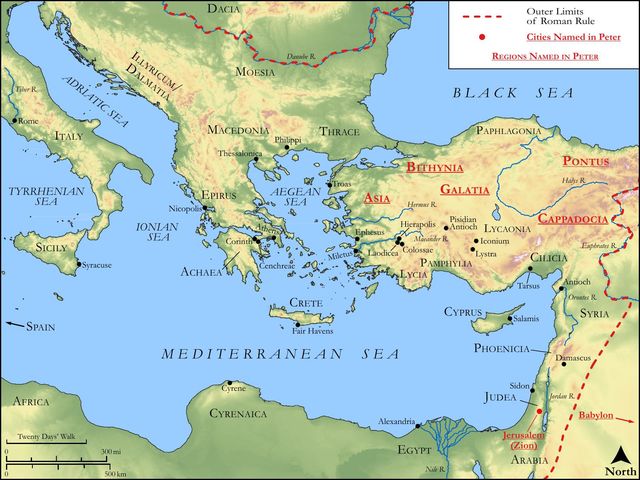
Peter's audience consisted of Christians living in various Roman provinces of Asia Minor (modern-day Turkey), likely facing social ostracism, economic hardship, and escalating persecution under Roman rule. In the Roman world, an inheritance was a significant legal and social concept, often involving land, property, or status passed down through family lines. However, such inheritances were vulnerable to political upheaval, confiscation, legal disputes, decay, and natural disasters. By contrasting these earthly uncertainties with a heavenly inheritance, Peter provides a powerful counter-cultural message of security and hope that would have resonated deeply with those experiencing instability and loss. The concept of "exiles" or "sojourners" (Greek: paroikoi) was also culturally significant, describing those living outside their homeland, a status that perfectly encapsulated the early Christians' identity as citizens of heaven living temporarily on earth.
Key Themes
ShowHideThis verse contributes significantly to several major theological themes within 1 Peter. Foremost is the theme of "living hope," which is not a mere wish but a confident expectation rooted in God's power and Christ's resurrection. It also highlights "divine preservation"—God's active role in safeguarding the believer's future. The verse establishes a stark "contrast between temporal and eternal," urging believers to fix their gaze on heavenly realities rather than fleeting earthly possessions, a theme echoed in Matthew 6:19-21. Furthermore, it underscores the "security of salvation," emphasizing that what God has promised, He will surely deliver, providing immense comfort to those undergoing trials, as Peter discusses in 1 Peter 1:6-7.
Exposition and Analysis
ShowHideKey Word Analysis
ShowHideThis term refers to heirship, a patrimony, or a possession received by lot or by right of succession. In biblical terms, it often signifies not just material wealth but a spiritual legacy, a share in God's promises and blessings. Here, it is the ultimate fulfillment of God's covenant promises to His people, a spiritual possession that far surpasses any earthly legacy.
Derived from a negative particle ("a-") and a word meaning "to decay" or "to perish," this adjective describes something that is undecaying, imperishable, and immune to destruction or moral corruption. Unlike all earthly things that are subject to decay, rust, or moth (Matthew 6:19), this inheritance possesses an inherent, eternal quality that ensures its lasting perfection.
This verb means "to guard," "to keep," "to watch over," or "to preserve." It implies active, careful custody, ensuring that something is held safe from loss or injury. The use of this word here emphasizes God's sovereign power and faithfulness in actively protecting and maintaining this inheritance, guaranteeing its availability for those for whom it is intended. It is not merely set aside but divinely kept.
Verse Breakdown
ShowHide"To an inheritance incorruptible,"
This phrase introduces the nature of the believer's future portion. It is not a fleeting, earthly legacy, but a spiritual inheritance that is fundamentally immune to decay, destruction, or the passage of time. Its imperishability guarantees its eternal value and existence.
"and undefiled,"
Adding to its perfect nature, this inheritance is absolutely pure, untainted by any moral blemish, sin, or human imperfection. It is spotless and unpolluted, reflecting the holiness of God who bestows it and the purity of the heavenly realm where it is kept. There is no stain upon it, ensuring its pristine condition forever.
"and that fadeth not away,"
This third adjective emphasizes the eternal freshness, beauty, and vibrancy of the inheritance. It will never wither, lose its luster, or diminish in glory. Unlike earthly flowers or treasures that fade and lose their appeal, this inheritance retains its full splendor and value perpetually, remaining ever-new and glorious.
"reserved in heaven for you,"
This final clause highlights the ultimate security and personal nature of this inheritance. It is not held in an earthly bank susceptible to theft or economic downturns, but is securely kept in God's perfect dwelling place, beyond the reach of any earthly power or corruption. The phrase "for you" underscores God's specific, personal provision and guarantee for each individual believer, assuring them of their rightful claim.
Literary Devices
ShowHidePeter masterfully employs several literary devices to convey the profound truth and comfort of the believer's inheritance. The most prominent is Tricolon, the use of three parallel clauses or phrases, seen in "incorruptible, and undefiled, and that fadeth not away." This creates a cumulative effect, powerfully emphasizing the comprehensive and unparalleled perfection of the inheritance. The repeated use of "and" (a form of Polysyndeton) further stresses each distinct quality, allowing the reader to ponder each aspect of its divine nature. Furthermore, the verse employs Contrast by implicitly setting this heavenly inheritance against any earthly counterpart. While earthly inheritances are susceptible to decay, defilement, and fading, the believer's inheritance is divinely secured against all such vulnerabilities, highlighting its superior and eternal nature. The phrase "reserved in heaven for you" also functions as Symbolism, with "heaven" representing not just a physical location but a realm of divine perfection, security, and God's presence, where the inheritance is perfectly guarded.
Theological and Thematic Connections
ShowHideThe concept of an "inheritance" is deeply rooted in biblical theology, tracing back to God's promise of a land to Abraham and his descendants, and later expanding to encompass spiritual blessings and eternal life. 1 Peter 1:4 elevates this concept to its ultimate spiritual fulfillment, portraying it as the eschatological reality for all believers. This inheritance is not earned but freely given by God's mercy, a direct result of the new birth and the living hope found in Christ. Its incorruptible, undefiled, and unfading nature underscores God's faithfulness and the absolute security of His promises, providing a steadfast anchor for believers amidst the transient and often turbulent realities of earthly life. It speaks to the believer's true citizenship being in heaven and their ultimate destiny being with God, a truth that transforms their perspective on suffering and motivates them to live lives worthy of their divine calling.
Reflection and Application
ShowHide1 Peter 1:4 offers profound encouragement and a vital shift in perspective for believers today, particularly in a world marked by uncertainty, loss, and decay. Knowing that an incorruptible, undefiled, and unfading inheritance awaits provides an unshakeable foundation for hope and perseverance amidst life's inevitable trials and tribulations. Our ultimate destiny is divinely secured, regardless of present circumstances, empowering us to face adversity with courage and joy. This verse encourages us to live with an eternal mindset, valuing spiritual realities and heavenly treasures over temporary earthly gains, which are inherently subject to corruption and loss. Furthermore, the pure and undefiled nature of our future inheritance should serve as a powerful motivation for pursuing holiness and living lives that reflect the purity of our future dwelling and the character of the God who has called us. It reminds us that our identity is not defined by our earthly possessions or status, but by our divine heirship and the glorious future that is guaranteed by God's faithfulness.
Questions for Reflection
ShowHideFAQ
ShowHideWhat does 'incorruptible, undefiled, and unfading' truly mean for me?
ShowHideThese three terms describe the absolute perfection and permanence of the inheritance God has prepared for believers. "Incorruptible" means it cannot decay, perish, or be destroyed by any force, internal or external. Unlike earthly treasures that rust or rot, your heavenly inheritance is eternally preserved. "Undefiled" means it is absolutely pure, untainted by sin, evil, or human imperfection. There is no stain, blemish, or moral impurity upon it, reflecting the holiness of God Himself. "Fadeth not away" (Greek: amarantos) means it will never lose its beauty, value, or vibrancy; it will remain perpetually fresh and glorious, never diminishing or becoming obsolete. For you, this means complete security, perfect purity, and unending joy in your future with God, a stark contrast to the fleeting and flawed nature of all earthly things, as Jesus taught in Matthew 6:19-21.
How can I be sure this inheritance is 'reserved in heaven for me'?
ShowHideThe phrase "reserved in heaven for you" provides the ultimate assurance of its security. It signifies that this inheritance is not held in an earthly bank, susceptible to theft, economic downturns, or human error, but is securely kept in God's perfect dwelling place. God Himself is the guarantor and guardian of this inheritance. His power is infinite, His faithfulness is unwavering, and His promises are unbreakable. The resurrection of Jesus Christ is the down payment and guarantee of this future reality, demonstrating God's power to overcome death and secure eternal life for His children. Furthermore, believers are "sealed with the promised Holy Spirit, who is the guarantee of our inheritance" (Ephesians 1:13-14). Your inheritance is not dependent on your ability to keep it, but on God's perfect ability to preserve it for you.
Christ-Centered Fulfillment
ShowHideThe glorious inheritance described in 1 Peter 1:4 is not merely a future promise but is utterly rooted in and fulfilled through the person and work of Jesus Christ. It is through His "lively hope" (1 Peter 1:3), established by His resurrection from the dead, that believers are born again into this secure future. Christ Himself is the ultimate Heir of all things, as declared in Hebrews 1:2, and it is by grace through faith in Him that we become "heirs of God and co-heirs with Christ" (Romans 8:17). Our inheritance is incorruptible because Christ, who conquered death and corruption, guarantees it. It is undefiled because His sacrifice on the cross purifies us and makes us worthy to receive it, presenting us blameless before God (Colossians 1:22). It is unfading because Christ's glory is eternal and His kingdom is everlasting (2 Peter 1:11). The fact that this inheritance is "reserved in heaven for you" speaks to Christ's promise to prepare a place for His followers (John 14:1-3), ensuring that our future is not only secure but is intimately connected to His presence and reign. Thus, the believer's inheritance is not just a gift from God, but a participation in the very life and triumph of Christ Himself.