


1 Peter 1:3
Bible text: King James Version (1769 Blayney text) · Public domain
Bible text: King James Version with Strong's numbers · Public domain
Bible text: Berean Standard Bible · Public domain
Bible text: American Standard Version (1901) · Public domain
Bible text: World English Bible, Messianic edition · Public domain
Bible text: Geneva Bible (1599) · Public domain
Bible text: Young's Literal Translation · Public domain
- ΕὐλογητὸςEulogētosBlessed [be]G2128A-NSMAdjective Nominative Singular Masculine
- ὁhotheG3588T-NSMDefinite article Nominative Singular Masculine
- θεὸςtheosGodG2316N-NSM-TNoun Nominative Singular Masculine Title
- καὶkaiandG2532CONJConjunction
- πατὴρpatērFatherG3962N-NSM-TNoun Nominative Singular Masculine Title
- τοῦtouof theG3588T-GSMDefinite article Genitive Singular Masculine
- κυρίουkuriouLordG2962N-GSM-TNoun Genitive Singular Masculine Title
- ἡμῶνhēmōnof usG3165P-1GPPersonal pronoun Genitive 1st Plural
- ἸησοῦIēsouJesusG2424N-GSM-PNoun Genitive Singular Masculine Individual
- ΧριστοῦChristouChristG5547N-GSM-TNoun Genitive Singular Masculine Title
- ὁhothe [One]G3588T-NSMDefinite article Nominative Singular Masculine
- κατὰkataaccording toG2596PREPPreposition
- τὸtotheG3588T-ASNDefinite article Accusative Singular Neuter
- πολὺpolugreatG4183A-ASNAdjective Accusative Singular Neuter
- αὐτοῦautouof HimG846P-GSMPersonal pronoun Genitive Singular Masculine
- ἔλεοςeleosmercyG1656N-ASNNoun Accusative Singular Neuter
- ἀναγεννήσαςanagennēsashaving begotten againG313V-AAP-NSMVerb Aorist Active Participle Nominative Singular Masculine
- ἡμᾶςhēmasusG3165P-1APPersonal pronoun Accusative 1st Plural
- εἰςeistoG1519PREPPreposition
- ἐλπίδαelpidaa hopeG1680N-ASFNoun Accusative Singular Feminine
- ζῶσανzōsanlivingG2198V-PAP-ASFVerb Present Active Participle Accusative Singular Feminine
- δι᾽di᾽throughG1223PREPPreposition
- ἀναστάσεωςanastaseōs[the] resurrectionG386N-GSFNoun Genitive Singular Feminine
- ἸησοῦIēsouof JesusG2424N-GSM-PNoun Genitive Singular Masculine Individual
- ΧριστοῦChristouChristG5547N-GSM-TNoun Genitive Singular Masculine Title
- ἐκekout fromG1537PREPPreposition
- νεκρῶνnekrōn[the] deadG3498A-GPMAdjective Genitive Plural Masculine
English is a literal word-by-word gloss of the Greek, not the KJV's wording. Why?
This is the original text the KJV's translators worked from — each Greek word with its own literal English meaning in this verse, prepared by scholars at Tyndale House, Cambridge. The KJV translates whole sentences, not word by word, so its wording differs: one Greek word can become several English words, and the KJV may choose “charity” where the gloss reads “love”. Both are faithful — they answer different questions. For the KJV's own rendering, switch to the KJV text.
Details
See on the biblical-era maps

Study this verse
Public-domain commentary
Matthew Henry
From his Commentary on the Whole Bible. Henry comments on passages, not single verses — this entry covers 1 Peter 1:3–5. His three-level outline is real structure in the source text, so it is rendered as structure.
We come now to the body of the epistle, which begins with,
I.A congratulation of the dignity and happiness of the state of these believers, brought in under the form of a thanksgiving to God. Other epistles begin in like manner, Co2 1:3; Eph 1:3. Here we have,
1.The duty performed, which is blessing God. A man blesses God by a just acknowledgment of his excellency and blessedness.
2.The object of this blessing described by his relation to Jesus Christ: The God and Father of our Lord Jesus Christ. Here are three names of one person, denoting his threefold office.
(1.)He is Lord, a universal king or sovereign.
(2.)Jesus, a priest or Saviour.
(3.)Christ, a prophet, anointed with the Spirit and furnished with all gifts necessary for the instruction, guidance, and salvation of his church. This God, so blessed, is the God of Christ according to his human nature, and his Father according to his divine nature.
3.The reasons that oblige us to this duty of blessing God, which are comprised in his abundant mercy. All our blessings are owing to God's mercy, not to man's merit, particularly regeneration. He hath begotten us again, and this deserves our thanksgiving to God, especially if we consider the fruit it produces in us, which is that excellent grace of hope, and that not such a vain, dead, perishing hope as that of worldlings and hypocrites, but a lively hope, a living, strong, quickening, and durable hope, as that hope must needs be that has such a solid foundation as the resurrection of Jesus Christ from the dead. Learn,
(1.)A good Christian's condition is never so bad but he has great reason still to bless God. As a sinner has always reason to mourn, notwithstanding his present prosperity, so good people, in the midst of their manifold difficulties, have reason still to rejoice and bless God.
(2.)In our prayers and praises we should address God as the Father of our Lord Jesus Christ; it is only through him that we and our services are accepted.
(3.)The best of men owe their best blessings to the abundant mercy of God. All the evil in the world is from man's sin, but all the good in it is from God's mercy. Regeneration is expressly ascribed to the abundant mercy of God, and so are all the rest; we subsist entirely upon divine mercy. Of the nature of regeneration, see on Joh 3:3.
(4.)Regeneration produces a lively hope of eternal life. Every unconverted person is a hopeless creature; whatever he pretends to of that kind is all confidence and presumption. The right Christian hope is what a man is begotten again unto by the Spirit of God; it is not from nature, but free grace. Those who are begotten to a new and spiritual life are begotten to a new and spiritual hope.
(5.)The hope of a Christian has this excellency, it is a living hope. The hope of eternal life in a true Christian is a hope that keeps him alive, quickens him, supports him, and conducts him to heaven. Hope invigorates and spirits up the soul to action, to patience, to fortitude, and perseverance to the end. The delusive hopes of the unregenerate are vain and perishing; the hypocrite and his hope expire and die both together, Job 27:8.
(6.)The resurrection of Jesus Christ from the dead is the ground or foundation of a Christian's hope. The resurrection of Christ is the act of the Father as a Judge, of the Son as a conqueror. His resurrection demonstrates that the Father accepts his death in full discharge for our ransom, that he is victorious over death, the grave, and all our spiritual enemies; and it is also an assurance of our own resurrection. There being an inseparable union between Christ and his flock, they rise by virtue of his resurrection as a head, rather than by virtue of his power as a Judge. We have risen with Christ, Col 3:1. From all this taken together, Christians have two firm and solid foundations whereon to build their hope of eternal life.
II.Having congratulated these people on their new birth, and the hope of everlasting life, the apostle goes on to describe that life under the notion of an inheritance, a most proper way of speaking to these people; for they were poor and persecuted, perhaps turned out of their inheritances to which they were born; to allay this grievance, he tells them they were new-born to a new inheritance, infinitely better than what they had lost. Besides, they were most of them Jews, and so had a great affection to the land of Canaan, as the land of their inheritance, settled upon them by God himself; and to be driven out from abiding in the inheritance of the Lord was looked upon as a sore judgment, Sa1 26:19. To comfort them under this they are put in mind of a noble inheritance reserved in heaven for them, such a one that the land of Canaan was but a mere shadow in comparison with it. Here note,
1.Heaven is the undoubted inheritance of all the children of God; all that are born again are born to an inheritance, as a man makes his child his heir; the apostle argues, If children, then heirs, Rom 8:17. God giveth his gifts unto all, but the inheritance to none but his children; those that are his sons and daughters by regeneration and adoption receive the promise of eternal inheritance, Heb 9:15. This inheritance is not our purchase, but our Father's gift; not wages that we merit, but the effect of grace, which first makes us children and then settles this inheritance upon us by a firm unalterable covenant.
2.The incomparable excellencies of this inheritance, which are four: - (1.) It is incorruptible, in which respect it is like its Maker, who is called the incorruptible God, Rom 1:23. All corruption is a change from better to worse, but heaven is without change and without end; the house is eternal in the heavens, and the possessors must subsist for ever, for their corruptible must put on incorruption, Co1 15:53. (2.) This inheritance is undefiled, like the great high priest that is now in possession of it, who is holy, harmless, and undefiled, Heb 7:26. Sin and misery, the two grand defilements that spoil this world, and mar its beauty, have no place there. (3.) It fadeth not away, but always retains its vigour and beauty, and remains immarcescible, ever entertaining and pleasing the saints who possess it, without the least weariness or distaste. (4.) "Reserved in heaven for you," which expression teaches us, [1.] That it is a glorious inheritance, for it is in heaven, and all that is there is glorious, Eph 1:18. [2.] It is certain, a reversion in another world, safely kept and preserved till we come to the possession of it. [3.] The persons for whom it is reserved are described, not by their names, but by their character: for you, or us, or every one that is begotten again to a lively hope. This inheritance is preserved for them, and none but them; all the rest will be shut out for ever.
III.This inheritance being described as future, and distant both in time and place, the apostle supposes some doubt or uneasiness yet to remain upon the minds of these people, whether they might not possibly fall short by the way. "Though the happiness be safe in heaven, yet we are still upon earth, liable to abundance of temptations, miseries, and infirmities. Are we in such a safe state that we shall certainly come thither?" To this he answers that they should be safely guarded and conducted thither; they should be kept and preserved from all such destructive temptations and injuries as would prevent their safe arrival at eternal life. The heir to an earthly estate has no assurance that he shall live to enjoy it, but the heirs of heaven shall certainly be conducted safely to the possession of it. The blessing here promised is preservation: You are kept; the author of it is God; the means in us made use of for that end are our own faith and care; the end to which we are preserved is salvation; and the time when we shall see the safe end and issue of all is the last time. Note,
1.Such is the tender care of God over his people that he not only gives them grace, but preserves them unto glory. Their being kept implies both danger and deliverance; they may be attacked, but shall not be overcome.
2.The preservation of the regenerate to eternal life is the effect of God's power. The greatness of the work, the number of enemies, and our own infirmities, are such that no power but what is almighty can preserve the soul through all unto salvation; therefore the scripture often represents man's salvation as the effect of divine power, Co2 12:9; Rom 14:4.
3.Preservation by God's power does not supersede man's endeavour and care for his own salvation; here are God's power and man's faith, which implies an earnest desire of salvation, a reliance upon Christ according to his invitations and promises, a vigilant care to do every thing pleasing to God and avoid whatever is offensive, an abhorrence of temptations, a respect to the recompence of reward, and persevering diligence in prayer. By such a patient, operating, conquering faith, we are kept under the assistance of divine grace, unto salvation; faith is a sovereign preservative of the soul through a state of grace unto a state of glory.
4.This salvation is ready to be revealed in the last time. Here are three things asserted about the salvation of the saints: - (1.) That it is now prepared, and made ready, and reserved in heaven for them. (2.) Though it be made ready now, yet it is in a great measure hidden and unrevealed at present, not only to the ignorant, blind world, that never enquire after it, but even to the heirs of salvation themselves. It does not yet appear what we shall be, Jo1 3:2. (3.) That it shall be fully and completely revealed in the last time, or at the last day of judgment. Life and immortality are now brought to light by the gospel, but this life will be revealed more gloriously at death, when the soul shall be admitted into the presence of Christ, and behold his glory; and even beyond this there will be a further and a final revelation of the amplitude and transcendency of the saints' felicity at the last day, when their bodies shall be raised and re-united to their souls, and judgment shall pass upon angels and men, and Christ shall publicly honour and applaud his servants in the face of all the world.
Historical interpretation
Eight Centuries of Reception
6 surviving comments on this verse. Each one is dated, so this reads as a timeline rather than a list.
Select a marker to jump to its quote. Markers stagger vertically where authors wrote within a few decades of each other.
"Blessed be the God and Father of our Lord Jesus Christ, who by His great mercy has regenerated us." For if God generated us of matter, He afterwards, by progress in life, regenerated us.
"The Father of our Lord, by the resurrection of Jesus Christ:" who, according to your faith, rises again in us; as, on the other hand, He dies in us, through the operation of our unbelief. For He said again, that the soul never returns a second time to the body in this life; and that which has become angelic does not become unrighteous or evil, so as not to have the opportunity of again sinning by the assumption of flesh; but that in the resurrection the soul returns to the body, and both are joined to one another according to their peculiar nature, adapting themselves, through the composition of each, by a kind of congruity like a building of stones.
Peter means that God has acted to redeem us without any help from us. His mercy is great enough to be able to forgive every sin which has been committed in thought, word and deed, from the beginning to the end of the world.
They have received immortality and the hope of eternal life. These good things in heaven are better than human things. For this reason they praise God the Father, who shows his great mercy in doing these things faithfully. When God is the giver, the things given are both better and certain to materialize. The statement also has relevance to the Old Testament, for in it God gave the land of the Canaanites to those who believed in him.
Who according to His great mercy has reborn us, etc. Rightly is God blessed by us, who, when we had been begotten by our merits unto death, through His mercy reborn us unto life. And this through the resurrection of His Son, when He so loved our life that He arranged for Him to die on its behalf; and by that same death destroyed through the resurrection, showed us the hope and example of rising again. For He died, so that we would not fear death. He rose from the dead, so that we might hope through Him to be resurrected.
Blessed be God and Father of our Lord Jesus Christ. Thus he returns praises to God the Father, to show that our Savior Lord is both God and man. For when he says, "God and Father of our Lord Jesus Christ," he indeed calls Him the God of the Lord Jesus Christ, because he remembers that the Lord Christ was made man; but he calls Him the Father of our Lord, because he does not doubt that the same Lord of ours has always existed as the Son of God.
Blessed be God and the Father of our Lord Jesus Christ, who according to His abundant mercy has begotten us again to a living hope, through the resurrection of Jesus Christ from the dead.
Peter blesses God, referring this act of thanksgiving for the good things He grants. But what are those things that are given? Hope, not like the promised dwelling in the land of Canaan through Moses, which hope, being corruptible, promises corruptible things: but a living hope. And from where has it received life? From Jesus Christ who rose from the dead. For by the fact that He rose, He grants the same resurrection to those who come to Him through faith. Therefore, the living hope that is given is an incorruptible and undefiled inheritance, not laid up on earth, as it was for the fathers, but in heaven, from where it has also obtained endlessness, which is even greater than the inheritance that is on earth. And for this reason, the preservation and guardianship of the believers: for even this the Lord prayed, saying: "Holy Father, keep them." (Jn. 17:11) But also power. And what is patience? That which endures until the revelation or manifestation of the Lord. For if the protection were not powerful, it would not last for such a long time. Therefore, since there are such great and such things that are given, it is not absurd that joy follows those who receive. However, since the master's promise brings not joy but sorrow by saying: "In the world, you will have tribulation," (Jn. 16:33) he adds a little to the exultation. And because it is sad, he adds "Now," speaking in accordance with his leader, who says: "In the world, you will have tribulation," but your sorrow will turn into joy. Either what he said "Now" or "But," is added for the sake of exultation, as if the exultation that will follow will not last for a little while, but for a long and infinite time. Or "A little," refers to what is sorrowful, so that the sense here is: If it is necessary, we are now sorrowful for a little while through various tribulations. But since afflictions bring about turmoil, he added the reason for afflictions, that through these your faith is made more manifest and more precious than gold, since that which is tested by fire is more valuable to men. Peter also adds: If it is necessary, for not every faithful person is tested through affliction, nor is every sinner. Yet neither does each of these always rejoice: the just are indeed afflicted for the increase of their crowns, while sinners suffer to pay the penalties of their sins. However, not all the just are afflicted, lest you attribute vice to praise and detest virtue. Nor are all sinners afflicted, lest there be a loss of hope in the resurrection, as if all those who are their own receive here.
Continue studying 1 Peter 1:3 across the web’s major study libraries — every link below opens this exact verse, chapter, or book on the destination site.
Read & Compare
 BibleGatewayThis verse in more than 200 translations and 70 languages.
 Bible.comThe YouVersion reader — hundreds of translations, reading plans, and highlights.
 ESV.orgCrossway's official English Standard Version reader.
 NET BibleThe NET translation with 60,000+ translators' notes on every rendering decision.
 STEP BibleTyndale House's free study tool — original text, vocabulary, and scholarly resources.
 BibliaLogos Bible Software's free web reader.
 USCCBThe New American Bible (Revised Edition) with the U.S. bishops' study notes.
Commentaries
 BibleHub CommentariesDozens of classic commentaries on this verse, gathered on one page.
 StudyLightMore than 100 commentary sets — the largest collection on the web.
 BibleRefPlain-English commentary on what this verse means, verse by verse.
 Enduring WordDavid Guzik's free commentary on this chapter, widely used by Bible teachers.
 Bible Study ToolsVerse commentary alongside Greek and Hebrew study aids.
Original Language & Research
- BibleHub InterlinearThe verse word by word — original language, transliteration, and English.
- BibleHub LexiconEvery word's original-language definition and Strong's entry.
 Blue Letter BibleDeep-study tools — Strong's numbers, concordance, and word studies.
 CNTR CollationThe earliest Greek manuscripts of this verse, collated letter by letter.
Sermons, Hymns & Audio


TrulyRandomVerse is not affiliated with these sites and doesn’t control their content. They’re linked because they’re genuinely useful.
Summary
First Peter 1:3 opens with a powerful doxology, blessing God the Father for His profound mercy, which serves as the wellspring of the believer's spiritual regeneration. Through this divine act, God has granted Christians a "lively hope," a vibrant and enduring expectation of future glory, fundamentally grounded in the historical and redemptive reality of Jesus Christ's resurrection from the dead. This verse establishes the theological bedrock for the entire epistle, anchoring the believer's identity and future in God's unchangeable character and Christ's victorious work, providing immense comfort and assurance amidst trials.
Context
ShowHideLiterary Context
This verse serves as the grand opening of Peter's first epistle, immediately following the salutation in 1 Peter 1:1-2. It is a doxology, a formal expression of praise to God, which sets the overarching tone of the letter. By beginning with a declaration of God's character and His gracious acts, Peter immediately shifts the readers' focus from their present sufferings and status as "exiles" to the glorious realities of their salvation. This opening doxology anticipates and undergirds the subsequent exhortations to holy living and endurance in suffering, as seen in 1 Peter 1:6-7 and 1 Peter 2:9-10. It is a foundational statement of Christian hope, upon which all practical application in the letter is built.
Historical & Cultural Context
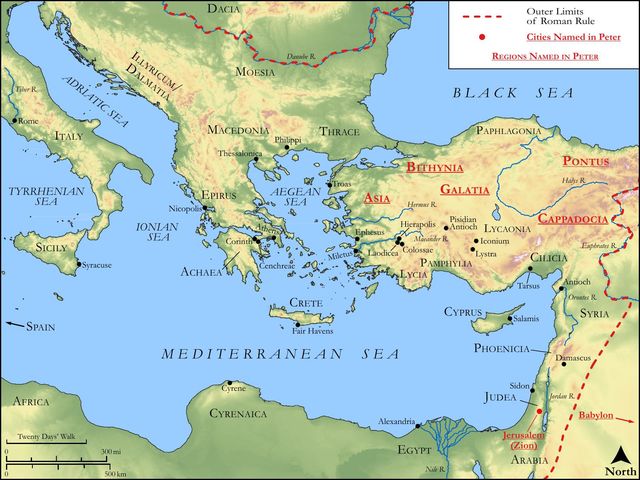
Peter addresses Christians scattered throughout various Roman provinces in Asia Minor, including Pontus, Galatia, Cappadocia, Asia, and Bithynia, as mentioned in 1 Peter 1:1. These believers were likely a mix of Jewish and Gentile converts, facing social ostracism, verbal abuse, and potentially sporadic, localized persecution for their refusal to participate in Roman civic and religious cults. They were considered "strangers" or "aliens" (paroikoi) in their own lands, a theme Peter emphasizes throughout the letter to describe their spiritual identity as pilgrims on earth. The Roman Empire's pervasive polytheism and emperor worship created an environment where Christian monotheism and exclusive allegiance to Christ were viewed with suspicion, leading to various forms of suffering, as alluded to in 1 Peter 4:12-16. Peter's message of hope rooted in God's mercy and Christ's resurrection would have been a vital lifeline for those enduring such trials.
Key Themes
ShowHideFirst Peter 1:3 introduces several pivotal themes that permeate the entire epistle. The primary theme is Divine Praise and Blessing, establishing God as the ultimate source of all spiritual blessings and the proper object of worship. Closely linked is the theme of God's Abundant Mercy, highlighting His gracious initiative in salvation, not based on human merit but on His boundless compassion, a truth echoed in Ephesians 2:4-5. The verse also introduces Spiritual Regeneration or "new birth," a radical transformation that grants believers a new spiritual life, a concept profoundly explored by Jesus in John 3:3-8. This new birth leads to a Lively Hope, a dynamic, living expectation of future glory, which stands in stark contrast to the fleeting hopes of the world. Crucially, this hope is firmly anchored in the Resurrection of Jesus Christ, which is presented as the historical and theological foundation for the believer's salvation and future inheritance, a truth central to the apostolic proclamation found in Acts 2:24. These themes collectively provide a robust framework for understanding the believer's identity, security, and purpose amidst a hostile world.
Exposition and Analysis
ShowHideKey Word Analysis
ShowHideThis adjective, derived from the verb meaning "to speak well of" or "to praise," describes God as "adorable" or "worthy of praise." It is a declaration that God Himself is the object of blessing, not that He is blessed by us in the sense of receiving something from us, but that He is inherently worthy of all praise and adoration. This term emphasizes God's intrinsic goodness and the appropriate response of humanity to His character and actions.
This compound verb combines "ana" (again, anew) with "gennao" (to beget, to give birth). It signifies a spiritual rebirth, a regeneration that is entirely a divine act. It implies a fundamental transformation of nature, not merely a moral improvement or a change of mind, but a new life imparted by God. This "new birth" is the initiation of the believer's spiritual existence, distinguishing them from their former unregenerate state.
The phrase combines záō (to live, alive, quick) with elpís (expectation, confidence, hope). This is not a mere wish or a vague optimism, but a vibrant, active, and enduring hope. It is "lively" because it is rooted in the living God and the living Christ, and it produces life and vitality in the believer. Unlike worldly hopes that can be dashed, this hope is dynamic and secure, providing a confident expectation of future realities.
Verse Breakdown
ShowHide"Blessed [be] the God and Father of our Lord Jesus Christ,"
This opening phrase is a doxology, a declaration of praise. It identifies the recipient of the blessing as God, specifically in His triune manifestation as the Father of our Lord Jesus Christ. This immediately establishes the theological framework for Christian faith, centering on the relationship between God the Father and God the Son, Jesus Christ, as the foundation of all spiritual blessings.
"which according to his abundant mercy hath begotten us again unto a lively hope"
This clause explains how God blesses us and what He has done. It attributes the spiritual rebirth ("begotten us again") directly to God's "abundant mercy." This emphasizes that salvation is not a result of human merit or effort but flows solely from God's boundless compassion and grace. The purpose of this regeneration is to bring believers "unto a lively hope," indicating that this new birth is not an end in itself but a means to a vibrant, living expectation of future glory.
"by the resurrection of Jesus Christ from the dead,"
This final clause specifies the means by which God's abundant mercy has begotten us again unto a lively hope. The resurrection of Jesus Christ is presented as the historical and theological bedrock of this new life and hope. It is the definitive act that validates Christ's identity, secures victory over sin and death, and guarantees the believer's future inheritance and resurrection. Without Christ's resurrection, the "lively hope" would be baseless and futile.
Literary Devices
ShowHideThe verse employs several significant literary devices. It begins with a Doxology, a formal expression of praise and glory to God, which immediately sets a tone of worship and reverence for the divine source of all blessings. The phrase "begotten us again" serves as a powerful Metaphor for spiritual regeneration or new birth, drawing on the imagery of physical birth to convey a radical, life-altering transformation initiated by God. This metaphor highlights the profound change in a believer's spiritual state. The description of hope as "lively" is an example of Personification or Figurative Language, giving an abstract concept (hope) the quality of being alive and dynamic, emphasizing its active and enduring nature. Furthermore, the verse demonstrates Causal Language, clearly linking the effect (new birth, lively hope) to its divine cause (God's abundant mercy) and its instrumental means (Christ's resurrection), establishing a clear theological chain of events.
Theological and Thematic Connections
ShowHideFirst Peter 1:3 is a foundational text for understanding the Christian's spiritual identity and destiny. It underscores the absolute sovereignty and gracious initiative of God in salvation, emphasizing that our new life is entirely a gift of His "abundant mercy." This mercy is not merely passive pity but an active, transformative force that regenerates us. The concept of being "begotten again" points to a radical, supernatural work of the Holy Spirit, creating a new spiritual nature within us, distinct from our former state. This new birth is inextricably linked to the resurrection of Jesus Christ, making it the historical anchor of our "lively hope." Our hope is not wishful thinking but a confident expectation of future glory, grounded in the demonstrable power of God displayed in Christ's triumph over death. This hope empowers believers to endure present sufferings, knowing their ultimate inheritance is secure and imperishable.
Reflection and Application
ShowHideFirst Peter 1:3 offers profound comfort and a robust foundation for Christian living, especially in times of difficulty. It calls us to fix our gaze not on our circumstances or merits, but on the character of God—His abundant mercy—and the finished work of Christ—His resurrection. This "lively hope" is not a passive waiting but an active, vibrant expectation that shapes our present reality. It means that even amidst trials, persecution, or personal suffering, our spiritual identity and future are secure, rooted in a divine act of regeneration and guaranteed by Christ's victory over death. This truth should ignite our praise, cultivate our endurance, and motivate us to live lives that reflect the transforming power of God's grace. Our hope is not in fleeting earthly things but in an imperishable inheritance, empowering us to live with joy and purpose, knowing that our ultimate destiny is eternally secure in Christ.
Questions for Reflection
ShowHideFAQ
ShowHideWhat does "begotten us again" mean in a practical sense?
ShowHideTo be "begotten us again" means to experience a spiritual rebirth, a radical transformation of one's inner being by the power of God. It's not merely turning over a new leaf or making a resolution, but a divine act that imparts new spiritual life, changing one's nature and orientation towards God. This new birth is essential for entering the kingdom of God, as Jesus taught in John 3:3. Practically, it means a new desire for God's word, a growing hatred for sin, and a newfound love for righteousness and for God's people.
How is "lively hope" different from mere optimism or wishful thinking?
ShowHide"Lively hope" (Greek: elpis zosa) is distinct from optimism or wishful thinking because it is not based on uncertain possibilities or human sentiment, but on the certain, historical reality of Jesus Christ's resurrection. It is "lively" because it is active, dynamic, and enduring, rooted in the living God and the living Christ. Unlike worldly hopes that can be dashed by circumstances, this hope is secure, producing vitality and endurance in the believer, knowing that God's promises are guaranteed by Christ's triumph over death, as affirmed in 1 Corinthians 15:20.
Christ-Centered Fulfillment
ShowHideFirst Peter 1:3 finds its ultimate Christ-centered fulfillment in the person and work of Jesus Christ, particularly His resurrection. It is through Christ that God's "abundant mercy" is fully manifested, as He is the divine agent of our spiritual regeneration. The new birth, or being "begotten us again," is a direct result of Christ's atoning sacrifice and His triumphant resurrection. His death paid the penalty for our sins, and His resurrection demonstrated God's power over death and sin, making possible our new life in Him. As Romans 6:4 explains, "Therefore we are buried with him by baptism into death: that like as Christ was raised up from the dead by the glory of the Father, even so we also should walk in newness of life." This "lively hope" is not a vague concept but a confident expectation of future glory, secured by Christ's ascension and His promise to return, as seen in John 14:1-3. Our future inheritance, described in 1 Peter 1:4, is imperishable precisely because it is founded upon the imperishable, resurrected Christ. Thus, every facet of this verse—God's mercy, our regeneration, and our living hope—is inextricably linked to and fulfilled in Jesus Christ, the risen Lord.