


1 Peter 1:2
Bible text: King James Version (1769 Blayney text) · Public domain
Bible text: King James Version with Strong's numbers · Public domain
Bible text: Berean Standard Bible · Public domain
Bible text: American Standard Version (1901) · Public domain
Bible text: World English Bible, Messianic edition · Public domain
Bible text: Geneva Bible (1599) · Public domain
Bible text: Young's Literal Translation · Public domain
- κατὰkataaccording toG2596PREPPreposition
- πρόγνωσινprognōsin[the] foreknowledgeG4268N-ASFNoun Accusative Singular Feminine
- θεοῦtheouof GodG2316N-GSM-TNoun Genitive Singular Masculine Title
- πατρὸςpatros[the] FatherG3962N-GSM-TNoun Genitive Singular Masculine Title
- ἐνenbyG1722PREPPreposition
- ἁγιασμῷhagiasmō[the] sanctificationG38N-DSMNoun Dative Singular Masculine
- πνεύματοςpneumatosof [the] SpiritG4151N-GSNNoun Genitive Singular Neuter
- εἰςeisuntoG1519PREPPreposition
- ὑπακοὴνhupakoēn[the] obedienceG5218N-ASFNoun Accusative Singular Feminine
- καὶkaiandG2532CONJConjunction
- ῥαντισμὸνrhantismonsprinklingG4473N-ASMNoun Accusative Singular Masculine
- αἵματοςaimatosof [the] bloodG129N-GSNNoun Genitive Singular Neuter
- ἸησοῦIēsouof JesusG2424N-GSM-PNoun Genitive Singular Masculine Individual
- Χριστοῦ·ChristouChristG5547N-GSM-TNoun Genitive Singular Masculine Title
- χάριςcharisGraceG5485N-NSFNoun Nominative Singular Feminine
- ὑμῖνhuminto youG4771P-2DPPersonal pronoun Dative 2nd Plural
- καὶkaiandG2532CONJConjunction
- εἰρήνηeirēnēpeaceG1515N-NSFNoun Nominative Singular Feminine
- πληθυνθείηplēthuntheiēwould be multipliedG4129V-APO-3SVerb Aorist Passive Optative 3rd Singular
English is a literal word-by-word gloss of the Greek, not the KJV's wording. Why?
This is the original text the KJV's translators worked from — each Greek word with its own literal English meaning in this verse, prepared by scholars at Tyndale House, Cambridge. The KJV translates whole sentences, not word by word, so its wording differs: one Greek word can become several English words, and the KJV may choose “charity” where the gloss reads “love”. Both are faithful — they answer different questions. For the KJV's own rendering, switch to the KJV text.
Details
See on the biblical-era maps

Study this verse
Public-domain commentary
Matthew Henry
From his Commentary on the Whole Bible. Henry comments on passages, not single verses — this entry covers 1 Peter 1:1–2. His four-level outline is real structure in the source text, so it is rendered as structure.
In this inscription we have three parts: -
I.The author of it, described,
1.By his name - Peter. His first name was Simon, and Jesus Christ gave him the surname of Peter, which signifies a rock, as a commendation of his faith, and to denote that he should be an eminent pillar in the church of God, Gal 2:9.
2.By his office - an apostle of Jesus Christ. The word signifies one sent, a legate, a messenger, any one sent in Christ's name and about his work; but more strictly it signifies the highest office in the Christian church. Co1 12:28, God hath set some in the church, first apostles. Their dignity and pre-eminence lay in these things: - They were immediately chosen by Christ himself, - they were first witnesses, then preachers, of the resurrection of Christ, and so of the entire gospel-dispensation, - their gifts were excellent and extraordinary, - they had a power of working miracles, not at all times, but when Christ pleased, - they were led into all truth, were endowed with the spirit of prophecy, and they had an extent of power and jurisdiction beyond all others; every apostle was a universal bishop in all churches, and over all ministers. In this humble manner Peter,
(1.)Asserts his own character as an apostle. Hence learn, A man may lawfully acknowledge, and sometimes is bound to assert, the gifts and graces of God to him. To pretend to what we have not is hypocrisy; and to deny what we have is ingratitude.
(2.)He mentions his apostolical function as his warrant and call to write this epistle to these people. Note, It concerns all, but especially ministers, to consider well their warrant and call from God to their work. This will justify them to others, and give them inward support and comfort under all dangers and discouragements.
II.The persons to whom this epistle was addressed, and they are described,
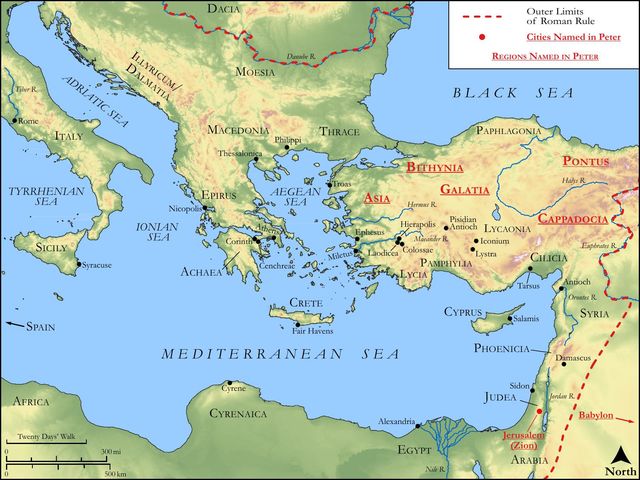
1.By their external condition - Strangers dispersed throughout Pontus, Galatia, etc. They were chiefly Jews, descended (as Dr. Prideaux thinks) from those Jews who were translated from Babylon, by order of Antiochus king of Syria, about two hundred years before the coming of Christ, and placed in the cities of Asia Minor. It is very likely that our apostle had been among them, and converted them, being the apostle of the circumcision, and that he afterwards wrote this epistle to them from Babylon, where multitudes of the Jewish nation then resided. At present, their circumstances were poor and afflicted.
(1.)The best of God's servants may, through the hardships of times and providences, be dispersed about, and forced to leave their native countries. Those of whom the world was not worthy have been forced to wander in mountains, in dens and caves of the earth.
(2.)We ought to have a special regard to the dispersed persecuted servants of God. These were the objects of this apostle's particular care and compassion. We should proportion our regard to the excellency and to the necessity of the saints.
(3.)The value of good people ought not to be estimated by their present external condition. Here was a set of excellent people, beloved of God, and yet strangers, dispersed and poor in the world; the eye of God was upon them in all their dispersions, and the apostle was tenderly careful to write to them for their direction and consolation.
2.They are described by their spiritual condition: Elect according to the foreknowledge of God the Father, etc. These poor strangers, who were oppressed and despised in the world, were nevertheless in high esteem with the great God, and in the most honourable state that any person can be in during this life; for they were,
(1.)Elect according to the foreknowledge of God the Father. Election is either to an office: so Saul was the man whom the Lord chose to be king (Sa1 10:24), and our Lord says to his apostles, Have not I chosen you twelve? (Joh 6:70); or it is to a church-state, for the enjoyment of special privileges: thus Israel was God's elect (Deu 7:6), For thou art a holy people unto the Lord thy God; the Lord thy God hath chosen thee to be a special people unto himself above all people that are upon the face of the earth; or it is to eternal salvation: God hath from the beginning chosen you to salvation, through sanctification of the Spirit and belief of the truth. This is the election here spoken of, importing God's gracious decree or resolution to save some, and bring them, through Christ, by proper means, to eternal life.
[1.]This election is said to be according to the foreknowledge of God. Foreknowledge may be taken in two ways: - First, for mere prescience, foresight, or understanding, that such a thing will be, before it comes to pass. Thus a mathematician certainly foreknows that at such a time there will be an eclipse. This sort of foreknowledge is in God, who at one commanding view sees all things that ever were, or are, or ever will be. But such a prescience is not the cause why any thing is so or so, though in the event it certainly will be so, as the mathematician who foresees an eclipse does not thereby cause that eclipse to be. Secondly, Foreknowledge sometimes signifies counsel, appointment, and approbation. Act 2:23, Him being delivered by the determinate counsel and foreknowledge of God. The death of Christ was not only foreseen, but fore-ordained, as Pe1 1:20. Take it thus here; so the sense is, elect according to the counsel, ordination, and free grace of God.
[2.]It is added, according to the foreknowledge of God the Father. By the Father we are here to understand the first person of the blessed Trinity. There is an order among the three persons, though no superiority; they are equal in power and glory, and there is an agreed economy in their works. Thus, in the affair of man's redemption, election is by way of eminency ascribed to the Father, as reconciliation is to the Son and sanctification to the Holy Ghost, though in each of these one person is not so entirely interested as to exclude the other two. Hereby the persons of the Trinity are more clearly discovered to us, and we are taught what obligations we are under to each of them distinctly.
(2.)They were elect through sanctification of the Spirit, unto obedience, and sprinkling of the blood of Jesus Christ. The end and last result of election is eternal life and salvation; but, before this can be accomplished, every elect person must be sanctified by the Spirit, and justified by the blood of Jesus. God's decree for man's salvation always operates through sanctification of the Spirit and sprinkling of the blood of Jesus. By sanctification here understand, not a federal sanctification only, but a real one, begun in regeneration, whereby we are renewed after the image of God and made new creatures, and carried on in the daily exercise of holiness, mortifying our sins more and more, and living to God in all the duties of a Christian life, which is here summed up in one word, obedience, comprehending all the duties of Christianity. By the Spirit some would have the apostle to mean the spirit of man, the subject sanctified. The legal or typical sanctification operated no further than the purifying of the flesh, but the Christian dispensation takes effect upon the spirit of man, and purifies that. Others, with better reason, think that by spirit is meant the Holy Ghost, the author of sanctification. He renews the mind, mortifies our sins (Rom 8:13), and produces his excellent fruits in the hearts of Christians, Gal 5:22, Gal 5:23. This sanctification of the Spirit implies the use of means. Sanctify them through thy truth; thy word is truth, Joh 17:17. Unto obedience. This word, as it is pointed in our translation, is referred to what goes before it, and denotes the end of sanctification, which is, to bring rebellious sinners to obedience again, to universal obedience, to obey the truth and gospel of Christ: You have purified your souls in obeying the truth through the Spirit, Pe1 1:22.
(3.)They were elected also to the sprinkling of the blood of Jesus. They were designed by God's decree to be sanctified by the Spirit, and to be purified by the merit and blood of Christ. Here is a manifest allusion to the typical sprinklings of blood under the law, which language these Jewish converts understood very well. The blood of the sacrifices must not only be shed but sprinkled, to denote that the benefits designed thereby are applied and imputed to the offerers. Thus the blood of Christ, the grand and all-sufficient sacrifice, typified by the legal sacrifices, was not only shed, but must be sprinkled and communicated to every one of these elect Christians, that through faith in his blood they may obtain remission of sin, Rom 3:25. This blood of sprinkling justifies before God (Rom 5:9), seals the covenant between God and us, of which the Lord's supper is a sign (Luk 22:20), cleanses from all sin (Jo1 1:7), and admits us into heaven, Heb 10:19. Note,
[1.]God hath elected some to eternal life, some, not all; persons, not qualification.
[2.]All that are chosen to eternal life as the end are chosen to obedience as the way.
[3.]Unless a person be sanctified by the Spirit, and sprinkled with the blood of Jesus, there will be no true obedience in the life.
[4.]There is a consent and co-operation of all the persons of the Trinity in the affair of man's salvation, and their acts are commensurate one to another: whoever the Father elects the Spirit sanctifies unto obedience, and the Son redeems and sprinkles with his blood.
[5.]The doctrine of the Trinity lies at the foundation of all revealed religion. If you deny the proper deity of the Son and Holy Spirit, you invalidate the redemption of the one and the gracious operations of the other, and by this means destroy the foundation of your own safety and comfort.
III.The salutation follows:
Grace unto you, and peace be multiplied. The blessings desired for them are grace and peace.
1.Grace - the free favour of God, with all its proper effects, pardoning, healing, assisting, and saving.
2.Peace. All sorts of peace may be here intended, domestic, civil, ecclesiastical peace in the church, and spiritual peace with God, with the feeling of it in our own consciences. 3. here is the request or prayer, in relations to these blessings - that they may be multiplied, which implies that they were already possessed in some degree of these blessings, and he wishes them the continuation, the increase, and the perfection of them. Learn,
(1.)Those who possess spiritual blessings in their own souls earnestly desire the communication of the same to others. The grace of God is a generous, not a selfish principle.
(2.)The best blessings we can desire for ourselves, or one for another, are grace and peace, with the multiplication of them; therefore the apostles so often make this their prayer in the beginning and end of their epistles.
(3.)Solid peace cannot be enjoyed where there is no true grace; first grace, then peace. Peace without grace is mere stupidity; but grace may be true where there is for a time no actual peace; as Heman was distracted with terror, and Christ was once in an agony.
(4.)The increase of grace and peace, as well as the first gift of them, is from God. Where he gives true grace he will give more grace; and every good man earnestly desires the improvement and multiplication of these blessings in himself and others.
Historical interpretation
Seven Centuries of Reception
7 surviving comments on this verse. Each one is dated, so this reads as a timeline rather than a list.
Select a marker to jump to its quote. Markers stagger vertically where authors wrote within a few decades of each other.
We must not suppose that the Spirit knows God as we do, only through the historic revelation of the Son. For if the Holy Spirit knows God only in this way, then he has passed from ignorance to knowledge, and it is certainly as impious as it is foolish to confess him as the Holy Spirit and then ascribe a prior ignorance to him.
May it be granted to us, after we have struggled nobly and subdued the spirit of the flesh, which was at enmity with God, when our soul is in a calm and tranquil state, to be called the children of peace and to share the blessing of God in peace.
What Peter says agrees with the statements of Paul, such as: “He has chosen us in himself before the foundation of the world, to be holy and spotless before him in love, predestinating us to be adopted as sons.” … Foreknowledge is not to be regarded as anything other than the contemplation of the future. It becomes knowledge as the things which are foreseen come to pass. Therefore, although the people to whom Peter was writing had once been chosen according to God’s foreknowledge, by the time he was writing to them their election had already taken place.
See how Peter says that he was called to be an apostle of Jesus Christ by the foreknowledge of God the Father. Furthermore, he explains what his apostleship is like by saying that it is in the sanctification of the Spirit, for obedience and sprinkling with the blood of Jesus Christ. Moreover, we who believe in him have also been sanctified by the Spirit, and he sprinkles us too with his blood in order to cleanse us. For how can we not know that God sanctifies us by his own Spirit and cleanses us believers with his own blood? For Christ was God in human flesh.
May grace and peace be multiplied. So that what you have well begun, you may complete perfectly. He first names grace, then peace, because without the grace of Christ we cannot attain to the peace of reconciliation, indeed we cannot have anything peaceful except through His grace.
According to the foreknowledge of God the Father, etc. These verses are connected to what was previously stated, "To the elect exiles." For they were chosen according to the foreknowledge of God the Father. Hence the apostle also says: "Those whom He foreknew He also predestined to be conformed to the image of His Son." And elsewhere: "He chose us in Him before the foundation of the world." They were elected to this end, that by the gift of the Holy Spirit they might be sanctified, cleansed from all sins, to begin to obey the Lord Jesus Christ, who had perished due to the proto-parent's disobedience, that being sprinkled with His blood they might avoid the power of Satan, just as Israel avoided the dominion of the Egyptians through the lamb's blood. He speaks of sprinkling in the manner of the old Scripture, where those things which were to be sanctified were usually sprinkled with the blood of sacrifices. Otherwise, the Lord Himself speaks clearly about this: "Unless you eat the flesh of the Son of Man and drink His blood, you have no life in you" (John 6).
Peter, Apostle of Jesus Christ, to the chosen sojourners of the dispersion in Pontus, Galatia, Cappadocia, Asia, and Bithynia, according to the foreknowledge of God the Father, in the sanctification of the Spirit, for obedience and sprinkling of the blood of Jesus Christ, grace to you and peace be multiplied.
The series and order are now collected: Peter, Apostle of Jesus Christ, according to the foreknowledge of God the Father, in the sanctification of the Spirit, for obedience and sprinkling of the blood of Jesus Christ. The rest, however, will be placed by interjection: for they signify to whom the letter is written. However, that particle is used according to the foreknowledge of God, to signify that there is no prophet who is inferior in anything, except in time. That they were sent, says Isaiah: "He has sent me to announce good news to the poor." (Isa. 61:1) But although later times have brought this to pass, it is not, however, the foreknowledge of God; rather, in this, he shows himself equal to Jeremiah, who was known and sanctified before he was formed in the womb and designated as a prophet to the nations. And since the prophets, among other things, had foretold the coming of Christ (for this reason they were sent), he adds the necessity of his apostleship, saying:
"I was sent in the sanctification of the Spirit, for obedience and the sprinkling of the blood of Jesus Christ," signifying through what is proposed: "This is the manner of my apostleship, to be set apart." The name signifies through sanctification: as it is said, "And you shall be to me a peculiar people sanctified," (Deut. 14:2) that is, separated from other nations. Therefore, the manner of his apostleship was to separate through spiritual gifts obedient nations, sprinkled with the passion and blood of Christ, not with the ashes of a heifer, when it must be purified, taken from the pollution of the Gentiles: but with the blood received from the passion of Christ. At the same time, it also touches upon a certain prolog to martyrdom of blood for Christ suffered by those who believe in him: for he who follows the footsteps of the teacher through obedience, when it is absolutely necessary, will not refuse to shed his own blood for him who poured out his for the whole world.
"Peter, Apostle of Jesus Christ." Here Peter writes to those who were of the circumcision, as does blessed James, but he indeed addresses all Jews who inhabited the world, wherever they were; however, this one specifically addresses the regions of Pontus in Galatia. He also added Pontus to Galatia. For there is another Galatia near the Celts which is also truly Galatia, from which those he is now discussing had migrated. Therefore, he directs his speech to these and other nations which are mentioned in the preface, using this letter universally or generally. The series of letters is therefore this, with the addition of those things that have been said through deficiency for the sake of manifestation, for this reason also he employs rearrangement and the alteration of figures to the word.
Peter, apostle of Jesus Christ… receiving the end of your faith1, and what is that? Salvation of the soul: concerning which salvation even the prophets searched and inquired,
"To the chosen sojourners." Sojourners, either because of dispersion he said, or also because all who live according to God are sojourners on earth, as David also says: "I am a sojourner with you and a pilgrim as all my fathers were." (Ps. 38:13) The name “sojourner” [παρεπίδηµος] signifies something different from a “newcomer” προσήλυτος. The former indicates someone who has come from elsewhere or from abroad, while the latter παρεπίδηµος denotes something more shameful. For just as a πάρεργον, that is, something incidental, is less valuable than an ἔργον, that is, a work, and a πάροδος, that is, a passage, is less than a ὁδός, that is, a way: Indeed, work and way are proper and are pursued with intention, while passage and what is done incidentally are like those things that intrude upon these. Thus, the term παρεπίδῃηµος, as it intrudes upon existence, seems indeed to signify more abjectly than ἔπίδημος.
"grace to you and peace be multiplied." Grace, because you are saved freely, having contributed nothing to it, "And peace”, for this is necessary for those who have offended their Lord and have become His enemies.
Continue studying 1 Peter 1:2 across the web’s major study libraries — every link below opens this exact verse, chapter, or book on the destination site.
Read & Compare
 BibleGatewayThis verse in more than 200 translations and 70 languages.
 Bible.comThe YouVersion reader — hundreds of translations, reading plans, and highlights.
 ESV.orgCrossway's official English Standard Version reader.
 NET BibleThe NET translation with 60,000+ translators' notes on every rendering decision.
 STEP BibleTyndale House's free study tool — original text, vocabulary, and scholarly resources.
 BibliaLogos Bible Software's free web reader.
 USCCBThe New American Bible (Revised Edition) with the U.S. bishops' study notes.
Commentaries
 BibleHub CommentariesDozens of classic commentaries on this verse, gathered on one page.
 StudyLightMore than 100 commentary sets — the largest collection on the web.
 BibleRefPlain-English commentary on what this verse means, verse by verse.
 Enduring WordDavid Guzik's free commentary on this chapter, widely used by Bible teachers.
 Bible Study ToolsVerse commentary alongside Greek and Hebrew study aids.
Original Language & Research
- BibleHub InterlinearThe verse word by word — original language, transliteration, and English.
- BibleHub LexiconEvery word's original-language definition and Strong's entry.
 Blue Letter BibleDeep-study tools — Strong's numbers, concordance, and word studies.
 CNTR CollationThe earliest Greek manuscripts of this verse, collated letter by letter.
Sermons, Hymns & Audio


TrulyRandomVerse is not affiliated with these sites and doesn’t control their content. They’re linked because they’re genuinely useful.
Summary
1 Peter 1:2 encapsulates the Trinitarian foundation of Christian salvation, establishing the identity and destiny of believers as those divinely chosen by God the Father, set apart by the Holy Spirit, and cleansed by the atoning blood of Jesus Christ, all leading to a life of obedient response and an overflowing experience of God's grace and peace. This verse serves as a profound theological bedrock for Peter's subsequent exhortations to endurance and holy living amidst trials.
Context
ShowHideLiterary Context
This verse immediately follows Peter's opening salutation in 1 Peter 1:1, which identifies his audience as "elect exiles of the Dispersion" in various Roman provinces of Asia Minor. As such, 1 Peter 1:2 functions as a foundational theological statement that grounds the identity and security of these dispersed believers in the Triune God's redemptive work. It sets the stage for the glorious hope and divine inheritance described in the subsequent verses (1 Peter 1:3-12), providing the theological bedrock upon which Peter builds his exhortations to holy living and steadfastness in suffering throughout the rest of the epistle. The verse establishes the divine initiative in salvation before addressing the practical implications for their lives.
Historical & Cultural Context
Peter addresses Christians, likely a mix of Jewish and Gentile converts, who are living as "strangers scattered" (Greek: parepidēmoi diasporas) across Roman provinces in Asia Minor. This term evokes the Old Testament concept of the Jewish diaspora, suggesting a sense of displacement, alienation, and vulnerability. These believers were experiencing social ostracism, and likely nascent forms of persecution, for their faith in Christ. In this context, Peter's emphasis on their divine election, sanctification, and cleansing through Christ's blood would have provided immense comfort and assurance, reminding them that their true identity and security were rooted in God's eternal plan, not in their earthly circumstances. The imagery of "sprinkling of the blood" would have resonated deeply with Old Testament covenant rituals, signifying purification and the establishment of a new covenant relationship with God.
Key Themes
ShowHide1 Peter 1:2 introduces several pivotal themes that permeate the entire epistle. Foremost is the sovereignty of God in salvation, highlighting His eternal initiative and purposeful election of believers. This verse also powerfully articulates the Trinitarian nature of redemption, demonstrating the distinct yet unified roles of God the Father, the Holy Spirit, and Jesus Christ in bringing about salvation. The concept of sanctification is presented as both a divine act of setting apart and an ongoing process of spiritual transformation. Central to the verse is the atoning work of Christ through His shed blood, which provides complete cleansing from sin and establishes the New Covenant. Finally, the verse underscores the importance of obedience as the natural and grateful response of the redeemed, and the abundant provision of grace and peace as divine blessings that empower believers to endure suffering and live faithfully, a theme Peter returns to repeatedly, particularly in his encouragement to suffer for righteousness' sake (1 Peter 3:13-17).
Exposition and Analysis
ShowHideKey Word Analysis
ShowHideDerived from a verb meaning "to pick out" or "to choose," this term signifies those who are divinely selected or chosen by God. It emphasizes God's sovereign initiative in salvation, highlighting that believers are not merely self-selected but are the objects of God's deliberate and purposeful choice, making them His "favorite" or "peculiar" people. This divine choosing provides profound security and assurance to the believer.
This word denotes God's prior knowledge or pre-determination. In a theological context, it refers to God's eternal, all-encompassing knowledge of all things, including His sovereign plan for salvation. It implies not just a passive awareness but an active, purposeful pre-arrangement, underscoring the security and certainty of the divine plan for those who are chosen.
Meaning "purification," "holiness," or "being set apart," this term describes the process by which believers are consecrated and made holy. It encompasses both an initial act of separation from sin and the world at conversion, and an ongoing transformation into Christlikeness, empowered by the Holy Spirit. This setting apart is for God's purposes and service, enabling believers to live a life pleasing to Him.
Verse Breakdown
ShowHide"Elect according to the foreknowledge of God the Father"
This foundational clause establishes the divine origin of salvation. Believers are not chosen based on their merit or works, but by the sovereign, eternal, and purposeful choice of God the Father. His "foreknowledge" is not simply a passive awareness of future events but an active, determinative knowledge that undergirds His electing purpose. This provides ultimate security and assurance for the believer's identity and destiny.
"through sanctification of the Spirit"
The means by which God's election is actualized in the believer's life is through the work of the Holy Spirit. The Spirit sets believers apart from the world and unto God, initiating and sustaining the process of holiness. This "sanctification" involves both an initial consecration at conversion and an ongoing transformation into Christ's image, making them fit for God's purposes and enabling them to live a life pleasing to Him.
"unto obedience and sprinkling of the blood of Jesus Christ"
This phrase describes the dual purpose and result of the Trinitarian work. "Obedience" is the desired outcome and natural response of the elect, flowing from a transformed heart, not as a condition for salvation but as evidence of it. The "sprinkling of the blood of Jesus Christ" points to the atoning sacrifice of Christ on the cross. This imagery, rich with Old Testament covenantal and sacrificial allusions (e.g., Exodus 24:8), signifies the complete cleansing from sin, the establishment of the New Covenant, and the reconciliation of believers to God through Christ's shed blood.
"Grace unto you, and peace, be multiplied."
This concluding benediction is Peter's fervent prayer and apostolic blessing for his readers. "Grace" refers to God's unmerited favor and divine enablement, while "peace" signifies spiritual well-being, wholeness, and reconciliation with God. The desire for these to be "multiplied" emphasizes the abundant and ever-increasing supply of God's favor and inner tranquility available to believers, especially crucial for those facing trials and persecution.
Literary Devices
ShowHidePeter employs several literary devices to convey profound theological truths within this concise verse. The verse exhibits a clear Trinitarian Structure, systematically presenting the distinct yet unified roles of God the Father (election, foreknowledge), the Holy Spirit (sanctification), and Jesus Christ (atoning blood, purpose of obedience). This highlights the comprehensive nature of salvation as a work of the entire Godhead. The phrase "sprinkling of the blood" functions as a powerful Allusion and Typology, drawing on Old Testament covenant ratification ceremonies (e.g., Exodus 24) and sacrificial rites, thereby emphasizing the finality, efficacy, and covenantal significance of Christ's sacrifice. Furthermore, the concluding wish for "Grace unto you, and peace, be multiplied" serves as an Apostolic Benediction, a common epistolary closing that conveys a pastoral blessing and expresses a fervent desire for the spiritual flourishing of the recipients, particularly in their challenging circumstances.
Theological and Thematic Connections
ShowHideThis verse is a theological powerhouse, encapsulating the grand narrative of redemption from eternity past to the believer's present experience. It firmly establishes the divine initiative in salvation, asserting that our standing with God is rooted in His sovereign choice and eternal plan, not in human merit. This Trinitarian work of the Father's election, the Spirit's sanctification, and the Son's atoning sacrifice forms the bedrock of Christian identity and security. It demonstrates that salvation is a holistic process, moving from divine decree to spiritual transformation and culminating in a life of responsive obedience and overflowing divine favor. The "sprinkling of the blood" connects the New Covenant reality directly to the Old Testament types, showing Christ as the ultimate fulfillment of all sacrificial systems and the basis for true cleansing and reconciliation.
Reflection and Application
ShowHide1 Peter 1:2 offers profound comfort and a clear call to living for the contemporary believer. In a world that often defines identity by achievement, status, or self-will, this verse grounds our identity in God's eternal, unchangeable choice. Knowing that we are "elect according to the foreknowledge of God the Father" provides an unshakeable assurance of our salvation and security, freeing us from the anxiety of earning God's favor. The ongoing "sanctification of the Spirit" reminds us that Christian living is a dynamic process of being set apart for God's purposes, empowering us to pursue holiness and grow in Christlikeness. This divine work is not passive; it leads "unto obedience," a grateful and joyful response to the immense grace received through Christ's atoning blood. This obedience, coupled with the promise of multiplied "grace and peace," equips us to navigate life's challenges, including suffering and uncertainty, with divine strength and inner tranquility, confident that God is at work in us and for us.
Questions for Reflection
ShowHideFAQ
ShowHideWhat does "elect according to the foreknowledge of God the Father" truly mean for a believer?
ShowHideThis phrase signifies that a believer's salvation originates not from human decision or merit, but from God's eternal, sovereign initiative. "Foreknowledge" (Greek: prógnōsis) here is more than just knowing in advance; it implies a purposeful, loving pre-determination or choice by God. It means God, in His infinite wisdom and power, has set His affections upon and chosen certain individuals for salvation before the foundation of the world. This truth provides immense security and assurance, as our salvation is grounded in God's unchangeable character and eternal plan, not in our fluctuating performance. It underscores that salvation is entirely a gift of God's grace, as seen in passages like Ephesians 1:4-5.
How does the "sprinkling of the blood of Jesus Christ" apply to Christians today, given its Old Testament origins?
ShowHideThe imagery of "sprinkling of the blood" draws directly from Old Testament covenant rituals, particularly the ratification of the Mosaic Covenant (e.g., Exodus 24:8) and the purification rites involving sacrificial blood (e.g., Leviticus 14:7). For Christians today, this signifies the complete and perfect atonement accomplished by Jesus Christ through His sacrificial death on the cross. His shed blood is the ultimate means of purification from sin, establishing the New Covenant and reconciling believers to God. Unlike the temporary and repeated Old Testament rituals, Christ's "sprinkling" is a once-for-all act that permanently cleanses us from sin, makes us holy, and brings us into a secure relationship with God, as powerfully articulated in Hebrews 9:12-14. It means we are fully forgiven, justified, and set apart for God's purposes through His perfect sacrifice.
Christ-Centered Fulfillment
ShowHide1 Peter 1:2 profoundly reveals Christ as the central figure in God's redemptive plan, bringing to fulfillment the ancient promises and types. While election originates with the Father and sanctification is by the Spirit, both are ultimately "unto obedience and sprinkling of the blood of Jesus Christ." Christ is the object of our obedience, as our lives are now lived in submission to His Lordship, and He is the means of our cleansing. The "sprinkling of the blood" is the pivotal point, directly fulfilling the Old Testament sacrificial system where blood was shed for atonement and covenant ratification. Unlike the repeated sacrifices of animals that could never truly take away sin, Christ's "one sacrifice for sins forever" (Hebrews 10:12) perfectly cleanses and establishes the New Covenant, making us holy and acceptable to God. He is the Lamb of God who takes away the sin of the world, and through His blood, we have redemption, the forgiveness of sins (Ephesians 1:7). Thus, Christ is not merely a component of salvation; He is the active agent and the very essence of the grace and peace that are multiplied to believers, for "in Him all the fullness of God was pleased to dwell" (Colossians 1:19).