


2 Thessalonians 2:13
Bible text: King James Version (1769 Blayney text) · Public domain
Bible text: King James Version with Strong's numbers · Public domain
Bible text: Berean Standard Bible · Public domain
Bible text: American Standard Version (1901) · Public domain
Bible text: World English Bible, Messianic edition · Public domain
Bible text: Geneva Bible (1599) · Public domain
Bible text: Young's Literal Translation · Public domain
- ἩμεῖςHēmeisWe ourselvesG3165P-1NPPersonal pronoun Nominative 1st Plural
- δὲdehoweverG1161CONJConjunction
- ὀφείλομενopheilomenoughtG3784V-PAI-1PVerb Present Active Indicative 1st Plural
- εὐχαριστεῖνeucharisteinto give thanksG2168V-PANVerb Present Active Infinitive
- τῷtō<the>G3588T-DSMDefinite article Dative Singular Masculine
- θεῷtheōto GodG2316N-DSM-TNoun Dative Singular Masculine Title
- πάντοτεpantotealwaysG3842ADVAdverb
- περὶpericoncerningG4012PREPPreposition
- ὑμῶνhumōnyouG4771P-2GPPersonal pronoun Genitive 2nd Plural
- ἀδελφοὶadelphoibrothersG80N-VPMNoun Vocative Plural Masculine
- ἠγαπημένοιēgapēmenoibelovedG25V-RPP-VPMVerb Perfect Passive Participle Vocative Plural Masculine
- ὑπὸhupobyG5259PREPPreposition
- κυρίουkuriou[the] LordG2962N-GSM-TNoun Genitive Singular Masculine Title
- ὅτιhotithatG3754CONJConjunction
- εἵλατοeilatohas chosenG138V-AMI-3SVerb Aorist Middle Indicative 3rd Singular
- ὑμᾶςhumasyouG4771P-2APPersonal pronoun Accusative 2nd Plural
- ὁho<the>G3588T-NSMDefinite article Nominative Singular Masculine
- θεὸςtheosGodG2316N-NSM-TNoun Nominative Singular Masculine Title
- ἀπαρχὴνaparchēnfrom [the] beginningG536N-ASFNoun Accusative Singular Feminine
- εἰςeisuntoG1519PREPPreposition
- σωτηρίανsōtēriansalvationG4991N-ASFNoun Accusative Singular Feminine
- ἐνeninG1722PREPPreposition
- ἁγιασμῷhagiasmō[the] sanctificationG38N-DSMNoun Dative Singular Masculine
- πνεύματοςpneumatosof [the] SpiritG4151N-GSNNoun Genitive Singular Neuter
- καὶkaiandG2532CONJConjunction
- πίστειpistei[by] faithG4102N-DSFNoun Dative Singular Feminine
- ἀληθείαςalētheiasof [the] truthG225N-GSFNoun Genitive Singular Feminine
English is a literal word-by-word gloss of the Greek, not the KJV's wording. Why?
This is the original text the KJV's translators worked from — each Greek word with its own literal English meaning in this verse, prepared by scholars at Tyndale House, Cambridge. The KJV translates whole sentences, not word by word, so its wording differs: one Greek word can become several English words, and the KJV may choose “charity” where the gloss reads “love”. Both are faithful — they answer different questions. For the KJV's own rendering, switch to the KJV text.
Details
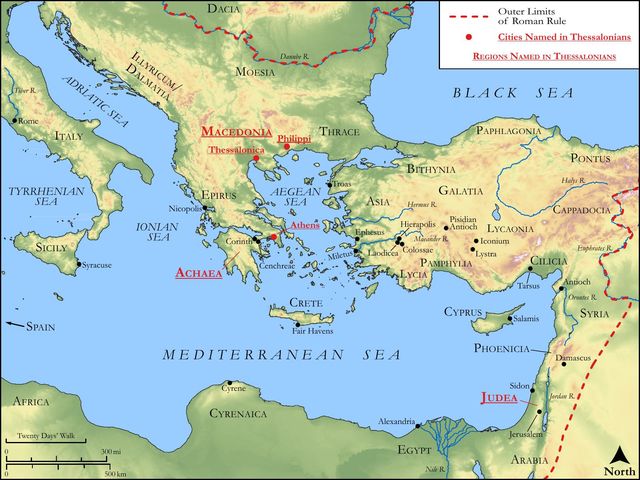
See on the biblical-era maps

Study this verse
Public-domain commentary
Matthew Henry
From his Commentary on the Whole Bible. Henry comments on passages, not single verses — this entry covers 2 Thessalonians 2:13–15. His three-level outline is real structure in the source text, so it is rendered as structure.
Here observe, I. The consolation the Thessalonians might take against the terrors of this apostasy, Th2 2:13, Th2 2:14. For they were chosen to salvation, and called to the obtaining of glory. Note, When we hear of the apostasy of many, it is matter of great comfort and joy that there is a remnant according to the election of grace which does and shall persevere; and especially we should rejoice if we have reason to hope that we are of that number. The apostle reckoned himself bound in duty to be thankful to God on this account: We are bound to give thanks to God always for you. He had often given thanks on their behalf, and he is still abounding in thanksgiving for them; and there was good reason, because they were beloved by the Lord, as appeared in this matter - their security from apostatizing. This preservation of the saints is owing,
1.To the stability of the election of grace, Th2 2:13. Therefore were they beloved of the Lord, because God had chosen them from the beginning. He had loved them with an everlasting love. Concerning this election of God we may observe,
(1.)The eternal date of it - it is from the beginning; not the beginning of the gospel, but the beginning of the world, before the foundation of the world, Eph 1:4. Then,
(2.)The end to which they were chosen - salvation, complete and eternal salvation from sin and misery, and the full fruition of all good.
(3.)The means in order to obtaining this end - sanctification of the spirit and belief of the truth. The decree of election therefore connects the end and the means, and these must not be separated. We are not the elected of God because we were holy, but that we might be holy. Being chosen of God, we must not live as we list; but, if we are chosen to salvation as the end, we must be prepared for it by sanctification as the necessary means to obtain that end, which sanctification is by the operation of the Holy Spirit as the author and by faith on our part. There must be the belief of the truth, without which there can be by true sanctification, nor perseverance in grace, nor obtaining of salvation. Faith and holiness must be joined together, as well as holiness and happiness; therefore our Saviour prayed for Peter that his faith might not fail (Luk 22:32), and for his disciples (Joh 17:17), Sanctify them by thy truth; thy word is truth.
2.To the efficacy of the gospel call, Th2 2:14. As they were chosen to salvation, so they were called thereunto by the gospel. Whom he did predestinate those he also called, Rom 8:30. The outward call of God is by the gospel; and this is rendered effectual by the inward operation of the Spirit. Note, Wherever the gospel comes it calls and invites men to the obtaining of glory; it is a call to honour and happiness, even the glory of our Lord Jesus Christ, the glory he has purchased, and the glory he is possessed of, to be communicated unto those who believe in him and obey his gospel; such shall be with Christ, to behold his glory, and they shall be glorified with Christ and partake of his glory. Hereupon there follows,
II.An exhortation to stedfastness and perseverance:
Therefore, brethren, stand fast, Th2 2:15. Observe, He does not say, "You are chosen to salvation, and therefore you may be careless and secure;" but therefore stand fast. God's grace in our election and vocation is so far from superseding our diligent care and endeavour that it should quicken and engage us to the greatest resolution and diligence. So the apostle John having told those to whom he wrote that they had received the anointing which should abide in them, and that they should abide in him (in Christ), subjoins this exhortation, Now abide in him, Jo1 2:27, Jo1 2:28. The Thessalonians are exhorted to stedfastness in their Christian profession, to hold fast the traditions which they had been taught, or the doctrine of the gospel, which had been delivered by the apostle, by word or epistle. As yet the canon of scripture was not complete, and therefore some things were delivered by the apostles in their preaching, under the guidance of the infallible Spirit, which Christians were bound to observe as coming from God; other things were afterwards by them committed to writing, as the apostle had written a former epistle to these Thessalonians; and these epistles were written as the writers were moved by the Holy Ghost. Note, There is no argument hence for regarding oral traditions in our days, now that the canon of scripture is complete, as of equal authority with the sacred writings. Such doctrines and duties as were taught by the inspired apostles we must stedfastly adhere to; but we have no certain evidence of any thing delivered by them more than what we find contained in the holy scriptures.
Historical interpretation
Five Centuries of Reception
3 surviving comments on this verse. Each one is dated, so this reads as a timeline rather than a list.
Select a marker to jump to its quote. Markers stagger vertically where authors wrote within a few decades of each other.
And the apostle also teaches that the Holy Spirit sanctifies. For he speaks thus, “We are bound to give thanks to God always for you, brothers dearly beloved of the Lord; because God chose you as first fruits for salvation, in sanctification of the Spirit, and belief of the truth.” So, then, the Father sanctifies, the Son also sanctifies, and the Holy Spirit sanctifies; but the sanctification is one, and the grace of the sacrament is one.
"But we are bound to give thanks alway to God for you, brethren beloved of the Lord, for that God chose you from the beginning unto salvation, in sanctification of the Spirit and belief of the truth."
How unto salvation? By sanctifying you through the Spirit. For these are the things that are the efficient causes of our salvation. It is nowhere of works, nowhere of righteous deeds, but through belief of the truth. Here again, "in" is used for "through." "And through sanctification of the Spirit," he says.
With these words they show that they were converted to faith by his teaching. The purpose was for the acquisition of the glory of our Lord Jesus Christ. As if he should say, "Therefore you were drawn to the faith by our teaching, so that you might obtain for yourselves the glory of the Lord."
Continue studying 2 Thessalonians 2:13 across the web’s major study libraries — every link below opens this exact verse, chapter, or book on the destination site.
Read & Compare
 BibleGatewayThis verse in more than 200 translations and 70 languages.
 Bible.comThe YouVersion reader — hundreds of translations, reading plans, and highlights.
 ESV.orgCrossway's official English Standard Version reader.
 NET BibleThe NET translation with 60,000+ translators' notes on every rendering decision.
 STEP BibleTyndale House's free study tool — original text, vocabulary, and scholarly resources.
 BibliaLogos Bible Software's free web reader.
 USCCBThe New American Bible (Revised Edition) with the U.S. bishops' study notes.
Commentaries
 BibleHub CommentariesDozens of classic commentaries on this verse, gathered on one page.
 StudyLightMore than 100 commentary sets — the largest collection on the web.
 BibleRefPlain-English commentary on what this verse means, verse by verse.
 Enduring WordDavid Guzik's free commentary on this chapter, widely used by Bible teachers.
 Bible Study ToolsVerse commentary alongside Greek and Hebrew study aids.
Original Language & Research
- BibleHub InterlinearThe verse word by word — original language, transliteration, and English.
- BibleHub LexiconEvery word's original-language definition and Strong's entry.
 Blue Letter BibleDeep-study tools — Strong's numbers, concordance, and word studies.
 CNTR CollationThe earliest Greek manuscripts of this verse, collated letter by letter.
Sermons, Hymns & Audio


TrulyRandomVerse is not affiliated with these sites and doesn’t control their content. They’re linked because they’re genuinely useful.
Summary
Second Thessalonians 2:13 stands as a profound declaration of divine grace and assurance, contrasting sharply with the preceding warnings of apostasy and judgment. Paul expresses an unceasing obligation to thank God for the Thessalonian believers, affirming their unique status as those "beloved of the Lord." This gratitude stems from the foundational truth that God, in His sovereign wisdom, chose them for salvation "from the beginning," a salvation realized through the transformative work of the Holy Spirit's sanctification and their personal embrace of the truth.
Context
ShowHideLiterary Context
This verse marks a pivotal transition in Paul's second letter to the Thessalonians. Immediately preceding it, Paul has delivered a sober and detailed prophecy concerning the "man of lawlessness" and the great apostasy that will precede Christ's return, culminating in God's judgment upon those who refuse to love and believe the truth, instead believing "the lie" (2 Thessalonians 2:3-12). Verse 13, introduced by the adversative "But," provides a stark and comforting contrast. It shifts the focus from the doomed to the redeemed, from divine judgment to divine election, offering the Thessalonian believers a powerful reassurance of their secure standing in Christ amidst the eschatological turmoil Paul has just described. This serves as a pastoral balm, reminding them that they are not destined for the same deception and destruction.
Historical & Cultural Context
The Thessalonian church was relatively young, founded during Paul's second missionary journey (Acts 17:1-9). They faced significant persecution and pressure, which likely contributed to their eschatological anxieties and misunderstanding about the Day of the Lord, as evidenced in both of Paul's letters to them. Paul's emphasis on God's eternal choice and the Spirit's work would have been incredibly encouraging to a community grappling with external opposition and internal confusion. The concept of "truth" was paramount in a world saturated with pagan myths and philosophical speculation, and Paul's affirmation of "belief of the truth" underscores the unique, revealed nature of the Gospel message over against prevailing falsehoods.
Key Themes
ShowHideThis verse encapsulates several critical theological themes central to Paul's thought and the broader biblical narrative. It highlights divine sovereignty in salvation, emphasizing that God's choice is foundational and "from the beginning." This divine initiative does not negate human responsibility, as salvation is realized "through... belief of the truth." The verse also underscores the essential role of the Holy Spirit in the believer's life, specifically through "sanctification," a process of being set apart and made holy. Furthermore, it reinforces the theme of assurance for believers, contrasting their secure position with the fate of those who reject God's truth. Finally, it serves as a powerful call to thanksgiving, recognizing that their salvation is entirely a work of God's grace, prompting Paul's constant gratitude for them, as he often expresses in his letters, such as in [Philippians 1:3-6](/ philippians/1-3-6 "Paul's Thanksgiving and Prayer for the Philippians").
Exposition and Analysis
ShowHideKey Word Analysis
ShowHideThis word (G138) signifies "to take for oneself, i.e. to prefer." In this context, it speaks to God's sovereign act of selection or election. It emphasizes that the initiative for salvation originates entirely with God, who actively and intentionally chose the Thessalonian believers for a specific purpose—salvation. This choice is not based on foreseen merit but on God's own will and purpose.
Derived from G38, this term means "purification, i.e. (the state) purity; concretely (by Hebraism) a purifier." Here, it refers to the process by which the Holy Spirit sets believers apart for God's holy purposes and progressively transforms them into Christlikeness. It is both an initial act of setting apart at conversion and an ongoing work of purification throughout the Christian life, making them holy.
This term (G225) denotes "truth" or "verity." In the context of Paul's letters, and especially contrasting with "the lie" in the preceding verses, "the truth" refers specifically to the revealed Gospel message—the reality of God's character, His plan of salvation through Christ, and the authentic way of life prescribed by Him. Belief in this truth is the human response that God's election works through.
Verse Breakdown
ShowHide"But we are bound to give thanks alway to God for you, brethren beloved of the Lord,"
Paul begins with a strong adversative ("But," G1161 dé), signaling a sharp contrast with the preceding discussion of judgment. He declares an unceasing moral obligation ("bound," G3784 opheílō) to offer gratitude ("give thanks," G2168 eucharistéō) to God for the Thessalonian believers. The affectionate address "brethren beloved of the Lord" (G25 agapáō) highlights their cherished status in God's eyes, emphasizing His deep affection for them and their secure relationship with Him, which is the very reason for Paul's thanksgiving.
"because God hath from the beginning chosen you to salvation"
This clause provides the foundational reason for Paul's gratitude. The term "because" (G3754 hóti) introduces the divine initiative. God (G2316 theós), not human will or merit, is the subject of the action. The phrase "from the beginning" (G575 apó G746 archḗ) points to an eternal, pre-temporal choice, indicating God's sovereign plan for their salvation was established before time began. This "choosing" (G138 hairéomai) is specifically "to salvation" (G1519 eis G4991 sōtēría), which encompasses deliverance from sin, judgment, and eternal life in Christ.
"through sanctification of the Spirit and belief of the truth:"
This final clause specifies the means or instruments through which God's eternal election is realized in the lives of believers. Salvation is not attained apart from these. It is "through" (G1722 en) two intertwined processes: first, "sanctification of the Spirit" (G38 hagiasmós G4151 pneûma), referring to the Holy Spirit's work of setting believers apart for God and progressively making them holy; and second, "belief of the truth" (G2532 kaí G4102 pístis G225 alḗtheia), which signifies the personal, trusting embrace of the Gospel message. These two aspects are inseparable: the Spirit's work enables and empowers belief, and belief is the human response to the truth revealed by the Spirit.
Literary Devices
ShowHidePaul employs several literary devices to convey his message of assurance. The most prominent is Contrast, as the verse opens with "But," sharply distinguishing the destiny of the Thessalonians from those described in the preceding verses who are given over to deception. This creates a powerful rhetorical shift, providing immediate comfort. There is also a strong element of Affirmation and Declaration, as Paul states unequivocally God's action ("God hath... chosen you") and their status ("beloved of the Lord"). The phrase "from the beginning" functions as a Hyperbole or Emphasis to underscore the eternal, unchangeable nature of God's plan. Finally, the pairing of "sanctification of the Spirit and belief of the truth" demonstrates Parallelism and Complementarity, showing the divine and human aspects of salvation working in concert.
Theological and Thematic Connections
ShowHideThis verse is a cornerstone for understanding the intricate relationship between divine sovereignty and human responsibility in salvation. It affirms God's eternal, unmerited choice as the ultimate source of salvation, a choice made "from the beginning" before any human action. However, it simultaneously emphasizes that this divine election is not arbitrary or detached from human experience; it is realized "through" the transformative work of the Holy Spirit, who sets believers apart and purifies them, and through their active "belief of the truth." This highlights that salvation is a holistic process initiated by God, enabled by the Spirit, and appropriated by faith, leading to a life of holiness. It assures believers that their standing is secure, rooted in God's unchanging purpose and His active work in their lives.
Reflection and Application
ShowHideSecond Thessalonians 2:13 offers profound comfort and a robust foundation for Christian assurance. To know that one is "beloved of the Lord" and "chosen... from the beginning" by God Himself should ignite an unceasing gratitude in the heart of every believer. This truth anchors our identity and destiny not in our fluctuating performance or uncertain circumstances, but in the steadfast, eternal purpose of a loving God. It reminds us that our salvation is not a precarious achievement but a gracious gift, prompting us to live lives of thanksgiving and joyful submission. Furthermore, the verse underscores the ongoing necessity of yielding to the Holy Spirit's sanctifying work and continually embracing the truth of God's Word. In a world increasingly prone to deception and moral relativism, standing firm in "belief of the truth" is not merely an intellectual exercise but a vital spiritual discipline, safeguarding our hearts and minds against error and strengthening our walk with God. This divine election should motivate us not to complacency, but to a deeper commitment to holiness and a bolder proclamation of the Gospel.
Questions for Reflection
ShowHideFAQ
ShowHideDoes this verse imply that human free will plays no part in salvation?
ShowHideThis verse emphasizes God's sovereign initiative in salvation, stating that He "chose you from the beginning." However, it also explicitly states that this salvation is realized "through sanctification of the Spirit and belief of the truth." This indicates that while God's choice is foundational and primary, it works through the means of human faith and the Spirit's transforming work. It presents a divine-human partnership where God's sovereign election enables and empowers the human response of faith, rather than negating it. The Bible consistently presents both God's sovereign choice and humanity's responsibility to believe (John 3:16 and Ephesians 2:8-9 are good examples).
What is the practical meaning of "sanctification of the Spirit"?
ShowHide"Sanctification of the Spirit" refers to the Holy Spirit's work of setting believers apart for God's holy purposes and progressively making them more like Christ. It has two main aspects: positional and progressive. Positionally, at conversion, the Spirit sets believers apart as holy to God. Progressively, the Spirit continually purifies and transforms believers, enabling them to live lives of increasing holiness and obedience to God's will. This process involves conviction of sin, empowerment for righteousness, and growth in spiritual maturity. It is a lifelong work that the Spirit performs in those who are "chosen" and who "believe the truth."
How does "belief of the truth" relate to being chosen "from the beginning"?
ShowHide"Belief of the truth" is the instrumental means through which God's eternal choice for salvation is actualized in a person's life. God's choice "from the beginning" is His sovereign decree, but it is not a detached, abstract concept. Instead, it is a choice unto a process that includes the Spirit's work and the individual's faith. Those whom God has chosen are precisely those who, by the Spirit's enablement, will respond in faith to the Gospel message—"the truth." Thus, belief is not the cause of election but the evidence and means by which God's election is brought to fruition in the believer's experience. It highlights the purposeful nature of God's election, leading to a genuine, saving faith.
Christ-Centered Fulfillment
ShowHideSecond Thessalonians 2:13, while not explicitly mentioning Jesus by name, is profoundly Christ-centered in its theological implications. The "salvation" to which believers are chosen "from the beginning" is uniquely found in Christ, for He is the one through whom God's eternal plan of redemption is accomplished (Ephesians 1:3-7). He is the ultimate "truth" that believers are called to embrace, as He Himself declared, "I am the way, the truth, and the life; no one comes to the Father except through Me" (John 14:6). The "sanctification of the Spirit" points to the work of the Holy Spirit, who is sent by Christ to indwell believers, empowering them to live holy lives that reflect their union with Him (John 16:7-15). Indeed, God's choice of believers is always "in Christ" (Ephesians 1:4), meaning that the elect are chosen to be united with Him, to share in His righteousness, and to be conformed to His image. Thus, the thanksgiving Paul expresses is ultimately for God's grace revealed and applied through the person and work of Jesus Christ, the beloved Son, who secures the salvation of those "beloved of the Lord."