


2 Thessalonians 2:14
Bible text: King James Version (1769 Blayney text) · Public domain
Bible text: Berean Standard Bible · Public domain
Bible text: American Standard Version (1901) · Public domain
Bible text: World English Bible, Messianic edition · Public domain
Bible text: Geneva Bible (1599) · Public domain
Bible text: Young's Literal Translation · Public domain
- εἰςeistoG1519PREPPreposition
- ὃhothisG3739R-ASNRelative pronoun Accusative Singular Neuter
- ἐκάλεσενekalesenHe calledG2564V-AAI-3SVerb Aorist Active Indicative 3rd Singular
- ὑμᾶςhumasyouG4771P-2APPersonal pronoun Accusative 2nd Plural
- διὰdiathroughG1223PREPPreposition
- τοῦtoutheG3588T-GSNDefinite article Genitive Singular Neuter
- εὐαγγελίουeuangeliougospelG2098N-GSNNoun Genitive Singular Neuter
- ἡμῶνhēmōnof usG3165P-1GPPersonal pronoun Genitive 1st Plural
- εἰςeistoG1519PREPPreposition
- περιποίησινperipoiēsin[the] obtainingG4047N-ASFNoun Accusative Singular Feminine
- δόξηςdoxēsof [the] gloryG1391N-GSFNoun Genitive Singular Feminine
- τοῦtouof theG3588T-GSMDefinite article Genitive Singular Masculine
- κυρίουkuriouLordG2962N-GSM-TNoun Genitive Singular Masculine Title
- ἡμῶνhēmōnof usG3165P-1GPPersonal pronoun Genitive 1st Plural
- ἸησοῦIēsouJesusG2424N-GSM-PNoun Genitive Singular Masculine Individual
- ΧριστοῦChristouChristG5547N-GSM-TNoun Genitive Singular Masculine Title
English is a literal word-by-word gloss of the Greek, not the KJV's wording. Why?
This is the original text the KJV's translators worked from — each Greek word with its own literal English meaning in this verse, prepared by scholars at Tyndale House, Cambridge. The KJV translates whole sentences, not word by word, so its wording differs: one Greek word can become several English words, and the KJV may choose “charity” where the gloss reads “love”. Both are faithful — they answer different questions. For the KJV's own rendering, switch to the KJV text.
Details
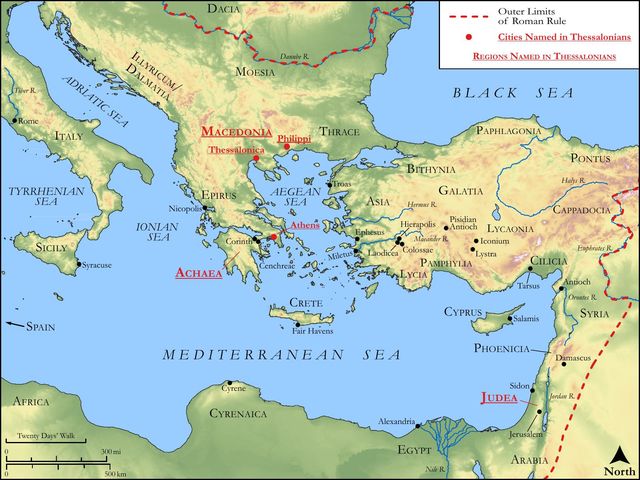
See on the biblical-era maps

Study this verse
Public-domain commentary
Matthew Henry
From his Commentary on the Whole Bible. Henry comments on passages, not single verses — this entry covers 2 Thessalonians 2:13–15. His three-level outline is real structure in the source text, so it is rendered as structure.
Here observe, I. The consolation the Thessalonians might take against the terrors of this apostasy, Th2 2:13, Th2 2:14. For they were chosen to salvation, and called to the obtaining of glory. Note, When we hear of the apostasy of many, it is matter of great comfort and joy that there is a remnant according to the election of grace which does and shall persevere; and especially we should rejoice if we have reason to hope that we are of that number. The apostle reckoned himself bound in duty to be thankful to God on this account: We are bound to give thanks to God always for you. He had often given thanks on their behalf, and he is still abounding in thanksgiving for them; and there was good reason, because they were beloved by the Lord, as appeared in this matter - their security from apostatizing. This preservation of the saints is owing,
1.To the stability of the election of grace, Th2 2:13. Therefore were they beloved of the Lord, because God had chosen them from the beginning. He had loved them with an everlasting love. Concerning this election of God we may observe,
(1.)The eternal date of it - it is from the beginning; not the beginning of the gospel, but the beginning of the world, before the foundation of the world, Eph 1:4. Then,
(2.)The end to which they were chosen - salvation, complete and eternal salvation from sin and misery, and the full fruition of all good.
(3.)The means in order to obtaining this end - sanctification of the spirit and belief of the truth. The decree of election therefore connects the end and the means, and these must not be separated. We are not the elected of God because we were holy, but that we might be holy. Being chosen of God, we must not live as we list; but, if we are chosen to salvation as the end, we must be prepared for it by sanctification as the necessary means to obtain that end, which sanctification is by the operation of the Holy Spirit as the author and by faith on our part. There must be the belief of the truth, without which there can be by true sanctification, nor perseverance in grace, nor obtaining of salvation. Faith and holiness must be joined together, as well as holiness and happiness; therefore our Saviour prayed for Peter that his faith might not fail (Luk 22:32), and for his disciples (Joh 17:17), Sanctify them by thy truth; thy word is truth.
2.To the efficacy of the gospel call, Th2 2:14. As they were chosen to salvation, so they were called thereunto by the gospel. Whom he did predestinate those he also called, Rom 8:30. The outward call of God is by the gospel; and this is rendered effectual by the inward operation of the Spirit. Note, Wherever the gospel comes it calls and invites men to the obtaining of glory; it is a call to honour and happiness, even the glory of our Lord Jesus Christ, the glory he has purchased, and the glory he is possessed of, to be communicated unto those who believe in him and obey his gospel; such shall be with Christ, to behold his glory, and they shall be glorified with Christ and partake of his glory. Hereupon there follows,
II.An exhortation to stedfastness and perseverance:
Therefore, brethren, stand fast, Th2 2:15. Observe, He does not say, "You are chosen to salvation, and therefore you may be careless and secure;" but therefore stand fast. God's grace in our election and vocation is so far from superseding our diligent care and endeavour that it should quicken and engage us to the greatest resolution and diligence. So the apostle John having told those to whom he wrote that they had received the anointing which should abide in them, and that they should abide in him (in Christ), subjoins this exhortation, Now abide in him, Jo1 2:27, Jo1 2:28. The Thessalonians are exhorted to stedfastness in their Christian profession, to hold fast the traditions which they had been taught, or the doctrine of the gospel, which had been delivered by the apostle, by word or epistle. As yet the canon of scripture was not complete, and therefore some things were delivered by the apostles in their preaching, under the guidance of the infallible Spirit, which Christians were bound to observe as coming from God; other things were afterwards by them committed to writing, as the apostle had written a former epistle to these Thessalonians; and these epistles were written as the writers were moved by the Holy Ghost. Note, There is no argument hence for regarding oral traditions in our days, now that the canon of scripture is complete, as of equal authority with the sacred writings. Such doctrines and duties as were taught by the inspired apostles we must stedfastly adhere to; but we have no certain evidence of any thing delivered by them more than what we find contained in the holy scriptures.
Historical interpretation
Eleven Centuries of Reception
9 surviving comments on this verse. Each one is dated, so this reads as a timeline rather than a list.
Select a marker to jump to its quote. Markers stagger vertically where authors wrote within a few decades of each other.
In this order, and by this succession, the ecclesiastical tradition from the apostles, and the preaching of the truth, have come down to us. And this is most abundant proof that there is one and the same vivifying faith, which has been preserved in the Church from the apostles until now, and handed down in truth.
In order for God's foreknoledge to remain favorable to their salvation, Paul warns them to stand and to presevere in the traditon of the Gospel. They must take care not to grow weary through idleness or sloth and so fail to complete the work of God which they have begun.
In learning and professing the faith, embrace and guard that only which is now delivered to you by the church and confirmed by all the Scriptures. For since not everyone has the education and the leisure required to read and know the Scriptures, to prevent the soul perishing from ignorance, we sum up the whole doctrine of the faith in a few lines.… For the present, just listen and memorize the creed as I recite it, and you will receive in due course the testimony from Scripture of each of its propositions. For the articles of faith have not been composed to please human desire, but the most important points collected from the Scriptures make up one complete teaching of the faith. And just as the mustard seed in a small grain contains in embryo many future branches, so also the creed embraces in a few words all the religious knowledge in both the Old and New Testament. Pay attention, therefore, brothers, and cling to the teachings which are now delivered to you, and “write them on the tablet of your heart.”
That is, by succession from the Apostles through the saints who came after them.
The very tradition, teaching, and faith of the Catholic Church from the beginning was preached by the Apostles and preserved by the Fathers.
We must turn to tradition, for everything cannot be received from the divine Scriptures. That is why the holy Apostles handed down certain things in writings but others by traditions.
"Whereunto He called you through our Gospel to the obtaining of the glory of our Lord Jesus Christ."
This too is no little thing, if Christ considers our salvation His glory. For it is the glory of the Friend of man that they that are saved should be many. Great then is our Lord, if the Holy Spirit so desires our salvation. Why did he not say faith first? Because even after sanctification we have yet need of much faith, that we may not be shaken. Seest thou how He shows that nothing is of themselves, but all of God?
Here perhaps, someone may ask: Since the canon of the Scripture is complete and more than sufficient in itself, why is it necessary to add to it the authority of ecclesiastical interpretation? As a matter of fact, Holy Scripture, because of its depth, is not universally accepted in one and the same sense. The same text is interpreted different by different people, so that one may almost gain the impression that it can yield as many different meanings as there are men. Thus, because of the great distortions caused by various errors, it is, indeed, necessary that the trend of the interpretation of the prophetic and apostolic writings be directed in accordance with the rule of the ecclesiastical and Catholic meaning.
The Apostles, led by the inward instinct of the Holy Spirit, handed down to the churches certain instructions which they did not put in writing, but which have been ordained, in accordance with the observance of the Church as practiced by the faithful as time went on.
Continue studying 2 Thessalonians 2:14 across the web’s major study libraries — every link below opens this exact verse, chapter, or book on the destination site.
Read & Compare
 BibleGatewayThis verse in more than 200 translations and 70 languages.
 Bible.comThe YouVersion reader — hundreds of translations, reading plans, and highlights.
 ESV.orgCrossway's official English Standard Version reader.
 NET BibleThe NET translation with 60,000+ translators' notes on every rendering decision.
 STEP BibleTyndale House's free study tool — original text, vocabulary, and scholarly resources.
 BibliaLogos Bible Software's free web reader.
 USCCBThe New American Bible (Revised Edition) with the U.S. bishops' study notes.
Commentaries
 BibleHub CommentariesDozens of classic commentaries on this verse, gathered on one page.
 StudyLightMore than 100 commentary sets — the largest collection on the web.
 BibleRefPlain-English commentary on what this verse means, verse by verse.
 Enduring WordDavid Guzik's free commentary on this chapter, widely used by Bible teachers.
 Bible Study ToolsVerse commentary alongside Greek and Hebrew study aids.
Original Language & Research
- BibleHub InterlinearThe verse word by word — original language, transliteration, and English.
- BibleHub LexiconEvery word's original-language definition and Strong's entry.
 Blue Letter BibleDeep-study tools — Strong's numbers, concordance, and word studies.
 CNTR CollationThe earliest Greek manuscripts of this verse, collated letter by letter.
Sermons, Hymns & Audio


TrulyRandomVerse is not affiliated with these sites and doesn’t control their content. They’re linked because they’re genuinely useful.
Summary
Second Thessalonians 2:14 articulates the divine initiative in salvation, emphasizing that God sovereignly calls believers through the proclamation of the gospel. This calling is not an end in itself but a purposeful journey toward a glorious destiny: the full participation in and experience of the very splendor and honor of the Lord Jesus Christ, securing the believer's future inheritance and ultimate conformity to His image.
Context
ShowHideLiterary Context
This verse serves as a profound theological anchor within a chapter primarily dedicated to eschatological warnings and the revelation of the "man of lawlessness." Immediately preceding 2 Thessalonians 2:14, Paul reassures the Thessalonian believers, distinguishing them from those who will fall prey to deception. 2 Thessalonians 2:13 states that God "hath from the beginning chosen you to salvation through sanctification of the Spirit and belief of the truth." Verse 14 then elaborates on how this divine choice is actualized: by God's calling through the gospel. It transitions from the eternal decree of God's choice to the practical means and ultimate purpose of that choice, providing a comforting counterpoint to the preceding warnings about apostasy and divine judgment on those who reject the truth.
Historical & Cultural Context
Paul's second letter to the Thessalonians was written relatively soon after his first, likely to address ongoing misunderstandings and anxieties regarding the "day of the Lord" and the return of Christ. The Thessalonian believers were facing persecution (2 Thessalonians 1:4-5) and were susceptible to false teachings that suggested the Day of the Lord had already come (2 Thessalonians 2:1-2). In this climate of confusion and suffering, Paul's affirmation of God's sovereign calling and glorious destiny was crucial. It provided stability, hope, and a clear understanding of their position in God's eternal plan, contrasting sharply with the chaotic and deceptive forces at work in the world.
Key Themes
ShowHide2 Thessalonians 2:14 contributes significantly to several major themes within the epistle. Firstly, it underscores Divine Sovereignty and Election, reinforcing the idea that salvation originates entirely with God, who chooses and calls His people. This aligns with the broader theme of God's control over history and salvation, even amidst tribulation. Secondly, the verse highlights the Efficacy of the Gospel, presenting it as the divinely appointed instrument through which God's saving purpose is realized. This emphasizes the vital importance of faithful gospel proclamation, a recurring theme in Paul's ministry (Romans 1:16). Finally, it articulates the Believer's Glorious Destiny, pointing to the ultimate hope of sharing in Christ's glory. This eschatological hope provides profound encouragement and motivation for perseverance, a theme central to Paul's pastoral care for the suffering Thessalonians, as seen in his discussion of future rest and reward in 2 Thessalonians 1:7-10.
Exposition and Analysis
ShowHideKey Word Analysis
ShowHideThis word signifies an effective summons or invitation. It is not merely an offer but a purposeful act initiated by God that brings about a response, leading to salvation. In the biblical context, divine calling is often irresistible and determinative, reflecting God's sovereign choice and active involvement in drawing individuals to Himself.
Meaning "good message" or "glad tidings." This term refers specifically to the message of salvation through the death, burial, and resurrection of Jesus Christ. Paul's use of "our gospel" emphasizes the specific, authoritative, and unadulterated message of Christ that he and his companions faithfully proclaimed, which is inherently God's message for humanity.
This word denotes splendor, majesty, honor, or praise. In reference to God and Christ, it signifies their inherent divine radiance, supreme majesty, and intrinsic worth. The "glory of our Lord Jesus Christ" refers to His divine splendor, both in His pre-existent state, His resurrected and ascended state, and His future return in power and majesty. Believers are called to participate in this very divine radiance.
Verse Breakdown
ShowHide"Whereunto he called you by our gospel"
This clause establishes the divine initiative and the means of salvation. "He" refers to God, who is the ultimate agent of the call. The phrase "whereunto" (referring back to the salvation, sanctification, and belief of truth in 2 Thessalonians 2:13) signifies the purpose or end for which they were called. The instrument of this divine call is "our gospel," highlighting the indispensable role of the good news of Jesus Christ as proclaimed by Paul and his fellow missionaries. This underscores that salvation is not earned but received through faith in the message of Christ.
"to the obtaining of the glory of our Lord Jesus Christ"
This second clause reveals the ultimate purpose and glorious destiny of the divine calling. "To the obtaining" (Greek: peripoíēsis) implies acquisition, possession, or preservation—a secure and certain inheritance. The object of this obtaining is "the glory of our Lord Jesus Christ." This refers to the future glorification of believers, where they will fully participate in and reflect the divine splendor, honor, and majesty of Christ Himself. It is the culmination of God's saving work, assuring believers of a future free from suffering and filled with the very presence and radiance of God.
Literary Devices
ShowHideThe verse effectively employs Divine Sovereignty as a central theme, emphasizing that God is the primary agent ("he called you"). This highlights the unmerited grace of salvation, which originates entirely from God's initiative rather than human effort. There is also a strong element of Teleology, as the verse clearly states the ultimate purpose or end goal of this divine calling: "to the obtaining of the glory of our Lord Jesus Christ." This purposeful design provides profound assurance and hope, framing the believer's journey within God's eternal plan. Furthermore, the verse implicitly uses Contrast by positioning God's secure and glorious calling against the backdrop of the deception and apostasy described earlier in the chapter, providing a stark differentiation between those who are chosen for salvation and those who will be given over to delusion.
Theological and Thematic Connections
ShowHideThis verse profoundly articulates the doctrine of effectual calling, where God's sovereign initiative through the gospel leads to a certain and glorious end. It integrates the concepts of divine election, the instrumental power of the gospel, and the ultimate glorification of believers. The call is not merely an invitation but an act of God that brings about the desired result, securing the believer's participation in Christ's own glory. This future glory is not just an external reward but an internal transformation, a sharing in the very nature and splendor of the Son of God.
Reflection and Application
ShowHideFor the contemporary believer, 2 Thessalonians 2:14 serves as a powerful reminder of the secure foundation of our faith and the magnificent trajectory of our spiritual journey. In a world often marked by uncertainty, deception, and suffering, this verse anchors our hope in God's unchanging character and His unfailing purpose. It reassures us that our salvation is not dependent on our fluctuating efforts or merits but is rooted in God's sovereign, gracious, and effective call. This truth should cultivate deep humility and profound gratitude, knowing that we are recipients of an unearned, divine invitation to eternal glory. Furthermore, recognizing the gospel as the divinely appointed means of this call ignites a renewed passion for its proclamation. If the gospel is the instrument through which God draws people to Himself and to a glorious destiny, then sharing this good news becomes an urgent and joyful privilege, extending the same hope we possess to a world desperately in need of it. Finally, the promise of "obtaining the glory of our Lord Jesus Christ" provides an enduring perspective that transcends present trials, motivating perseverance, holy living, and a steadfast gaze upon our future inheritance with Christ.
Questions for Reflection
ShowHideFAQ
ShowHideWhat is the significance of "he called you" in this verse?
ShowHideThe phrase "he called you" is highly significant because it emphasizes God's sovereign initiative in salvation. It signifies an "effectual call," meaning it's not merely an invitation that can be accepted or rejected, but a divine act that effectively draws individuals to Himself, leading to their salvation. This highlights that salvation is fundamentally a work of God's grace, not a result of human merit or decision alone. It underscores the truth that God is the primary agent in bringing people into a saving relationship with Him, as seen in passages like Romans 8:30 where calling is part of a divine chain leading to glorification.
What does it mean to "obtain the glory of our Lord Jesus Christ"?
ShowHideTo "obtain the glory of our Lord Jesus Christ" refers to the believer's ultimate destiny and inheritance. It encompasses several aspects: firstly, it means sharing in Christ's divine splendor and honor, reflecting His image and character perfectly. Secondly, it implies a full participation in the blessedness and perfection of the resurrected life, free from sin, suffering, and death. This is the culmination of God's redemptive plan, where believers are fully conformed to the image of Christ and experience the fullness of His presence and majesty. It's a secure possession, guaranteed by God's calling, as also promised in Colossians 3:4 and 1 John 3:2.
Christ-Centered Fulfillment
ShowHideSecond Thessalonians 2:14 finds its ultimate fulfillment and deepest meaning in the person and work of Jesus Christ. He is not merely the subject of the "gospel" but its very content and power; it is "our gospel" because it proclaims Him. The divine call, initiated by God, is always "by our gospel" because Christ's atoning death, victorious resurrection, and glorious ascension are the sole means by which humanity can be reconciled to God and enter into His saving purpose. The ultimate destination of this call—"the obtaining of the glory of our Lord Jesus Christ"—reveals Christ as both the source and the goal of our salvation. Believers are called to share in His glory, a glory He possessed before the foundation of the world (John 17:5), which He displayed in His resurrection and ascension (Philippians 2:9-11), and which He will fully manifest at His return (Titus 2:13). Our glorification is inextricably linked to our union with Christ; as He is glorified, so too shall we, His body, be glorified with Him (Romans 8:17). Thus, the entire trajectory of salvation, from God's sovereign call to our ultimate glorification, is centered on and accomplished through Jesus Christ, the Lamb of God and the glorious King.