


2 Thessalonians 2:15
Bible text: King James Version (1769 Blayney text) · Public domain
Bible text: Berean Standard Bible · Public domain
Bible text: American Standard Version (1901) · Public domain
Bible text: World English Bible, Messianic edition · Public domain
Bible text: Geneva Bible (1599) · Public domain
Bible text: Young's Literal Translation · Public domain
- ἌραAraSoG686CONJConjunction
- οὖνounthenG3767CONJConjunction
- ἀδελφοίadelphoibrothersG80N-VPMNoun Vocative Plural Masculine
- στήκετεstēketedo stand firmG4739V-PAM-2PVerb Present Active Imperative 2nd Plural
- καὶkaiandG2532CONJConjunction
- κρατεῖτεkrateitedo hold fastG2902V-PAM-2PVerb Present Active Imperative 2nd Plural
- τὰςtasto theG3588T-APFDefinite article Accusative Plural Feminine
- παραδόσειςparadoseistraditionsG3862N-APFNoun Accusative Plural Feminine
- ἃςhasthatG3739R-APFRelative pronoun Accusative Plural Feminine
- ἐδιδάχθητεedidachthēteyou were taughtG1321V-API-2PVerb Aorist Passive Indicative 2nd Plural
- εἴτεeitewhetherG1535CONDConjunction
- διὰdiathroughG1223PREPPreposition
- λόγουlogouwordG3056N-GSMNoun Genitive Singular Masculine
- εἴτεeiteorG1535CONDConjunction
- δι᾽di᾽throughG1223PREPPreposition
- ἐπιστολῆςepistolēsletterG1992N-GSFNoun Genitive Singular Feminine
- ἡμῶνhēmōnfrom usG3165P-1GPPersonal pronoun Genitive 1st Plural
English is a literal word-by-word gloss of the Greek, not the KJV's wording. Why?
This is the original text the KJV's translators worked from — each Greek word with its own literal English meaning in this verse, prepared by scholars at Tyndale House, Cambridge. The KJV translates whole sentences, not word by word, so its wording differs: one Greek word can become several English words, and the KJV may choose “charity” where the gloss reads “love”. Both are faithful — they answer different questions. For the KJV's own rendering, switch to the KJV text.
Details
See on the biblical-era maps

Study this verse
Public-domain commentary
Matthew Henry
From his Commentary on the Whole Bible. Henry comments on passages, not single verses — this entry covers 2 Thessalonians 2:13–15. His three-level outline is real structure in the source text, so it is rendered as structure.
Here observe, I. The consolation the Thessalonians might take against the terrors of this apostasy, Th2 2:13, Th2 2:14. For they were chosen to salvation, and called to the obtaining of glory. Note, When we hear of the apostasy of many, it is matter of great comfort and joy that there is a remnant according to the election of grace which does and shall persevere; and especially we should rejoice if we have reason to hope that we are of that number. The apostle reckoned himself bound in duty to be thankful to God on this account: We are bound to give thanks to God always for you. He had often given thanks on their behalf, and he is still abounding in thanksgiving for them; and there was good reason, because they were beloved by the Lord, as appeared in this matter - their security from apostatizing. This preservation of the saints is owing,
1.To the stability of the election of grace, Th2 2:13. Therefore were they beloved of the Lord, because God had chosen them from the beginning. He had loved them with an everlasting love. Concerning this election of God we may observe,
(1.)The eternal date of it - it is from the beginning; not the beginning of the gospel, but the beginning of the world, before the foundation of the world, Eph 1:4. Then,
(2.)The end to which they were chosen - salvation, complete and eternal salvation from sin and misery, and the full fruition of all good.
(3.)The means in order to obtaining this end - sanctification of the spirit and belief of the truth. The decree of election therefore connects the end and the means, and these must not be separated. We are not the elected of God because we were holy, but that we might be holy. Being chosen of God, we must not live as we list; but, if we are chosen to salvation as the end, we must be prepared for it by sanctification as the necessary means to obtain that end, which sanctification is by the operation of the Holy Spirit as the author and by faith on our part. There must be the belief of the truth, without which there can be by true sanctification, nor perseverance in grace, nor obtaining of salvation. Faith and holiness must be joined together, as well as holiness and happiness; therefore our Saviour prayed for Peter that his faith might not fail (Luk 22:32), and for his disciples (Joh 17:17), Sanctify them by thy truth; thy word is truth.
2.To the efficacy of the gospel call, Th2 2:14. As they were chosen to salvation, so they were called thereunto by the gospel. Whom he did predestinate those he also called, Rom 8:30. The outward call of God is by the gospel; and this is rendered effectual by the inward operation of the Spirit. Note, Wherever the gospel comes it calls and invites men to the obtaining of glory; it is a call to honour and happiness, even the glory of our Lord Jesus Christ, the glory he has purchased, and the glory he is possessed of, to be communicated unto those who believe in him and obey his gospel; such shall be with Christ, to behold his glory, and they shall be glorified with Christ and partake of his glory. Hereupon there follows,
II.An exhortation to stedfastness and perseverance:
Therefore, brethren, stand fast, Th2 2:15. Observe, He does not say, "You are chosen to salvation, and therefore you may be careless and secure;" but therefore stand fast. God's grace in our election and vocation is so far from superseding our diligent care and endeavour that it should quicken and engage us to the greatest resolution and diligence. So the apostle John having told those to whom he wrote that they had received the anointing which should abide in them, and that they should abide in him (in Christ), subjoins this exhortation, Now abide in him, Jo1 2:27, Jo1 2:28. The Thessalonians are exhorted to stedfastness in their Christian profession, to hold fast the traditions which they had been taught, or the doctrine of the gospel, which had been delivered by the apostle, by word or epistle. As yet the canon of scripture was not complete, and therefore some things were delivered by the apostles in their preaching, under the guidance of the infallible Spirit, which Christians were bound to observe as coming from God; other things were afterwards by them committed to writing, as the apostle had written a former epistle to these Thessalonians; and these epistles were written as the writers were moved by the Holy Ghost. Note, There is no argument hence for regarding oral traditions in our days, now that the canon of scripture is complete, as of equal authority with the sacred writings. Such doctrines and duties as were taught by the inspired apostles we must stedfastly adhere to; but we have no certain evidence of any thing delivered by them more than what we find contained in the holy scriptures.
Historical interpretation
Seven Centuries of Reception
11 surviving comments on this verse. Each one is dated, so this reads as a timeline rather than a list.
Select a marker to jump to its quote. Markers stagger vertically where authors wrote within a few decades of each other.
To which course many nations of those barbarians who believe in Christ do assent, having salvation written in their hearts by the Spirit, without paper or ink, and, carefully preserving the ancient tradition,
"When I was a child," he says, "as a child I spake, as a child I understood; but when I became a man, those (things) which had been the child's I abandoned: " so truly did he turn away from his early opinions: nor did he sin by becoming an emulator not of ancestral but of Christian traditions, wishing even the precision of them who advised the retention of circumcision.
And so they upbraid the discipline of monogamy with being a heresy; nor is there any other cause whence they find themselves compelled to deny the Paraclete more than the fact that they esteem Him to be the institutor of a novel discipline, and a discipline which they find most harsh: so that this is already the first ground on which we must join issue in a general handling (of the subject), whether there is room for maintaining that the Paraclete has taught any such thing as can either be charged with novelty, in opposition to catholic tradition, or with burdensomeness, in opposition to the "light burden" of the Lord.
Therefore, brethren, stand fast and hold the tradition of the apostles and the apostolic seat, "that our Lord Jesus Christ and our Father, which hath loved us, and hath given us everlasting consolation and good hope through grace, may comfort your hearts, and stablish you in every good work and word."
In answer to the objection that the doxology in the form “with the Spirit” has no written authority, we maintain that if there is no other instance of that which is unwritten, then this must not be received. But if the greater number of our mysteries are admitted into our constitution without written authority, then, in company with the many others, let us receive this one. For I hold it apostolic to abide also by the unwritten traditions. “I praise you,” it is said, “that you remember me in all things and keep the ordinances as I delivered them to you,” and “Hold fast the traditions which you have been taught whether by word or by our epistle.”
In learning and professing the faith, embrace and guard that only which is now delivered to you by the church and confirmed by all the Scriptures. For since not everyone has the education and the leisure required to read and know the Scriptures, to prevent the soul perishing from ignorance, we sum up the whole doctrine of the faith in a few lines.… For the present, just listen and memorize the creed as I recite it, and you will receive in due course the testimony from Scripture of each of its propositions. For the articles of faith have not been composed to please human desire, but the most important points collected from the Scriptures make up one complete teaching of the faith. And just as the mustard seed in a small grain contains in embryo many future branches, so also the creed embraces in a few words all the religious knowledge in both the Old and New Testament. Pay attention, therefore, brothers, and cling to the teachings which are now delivered to you, and “write them on the tablet of your heart.”
Again, that thou mayest know that the Father is, and the Son is, and that the work of the Father and of the Son is one, follow the saying of the Apostle: "Now may God Himself, and our Father, and our Lord Jesus Christ direct our way unto you." Both Father and Son are named, but there is unity of direction, because unity of power.
"So then, brethren, stand fast, and hold the traditions which ye were taught, whether by word, or by Epistle of ours."
Hence it is manifest, that they did not deliver all things by Epistle, but many things also unwritten, and in like manner both the one and the other are worthy of credit. Therefore let us think the tradition of the Church also worthy of credit. It is a tradition, seek no farther. Here he shows that there were many who were shaken.
Paul did not instruct Timothy in his duty through letters alone, but also through the spoken word. He shows this, both in many other passages, as where he says, “whether by word or our epistle,” and especially here. Let us not, therefore, suppose that Paul spoke anything imperfectly that was related to doctrine. For he delivered many things to Timothy without writing. He reminds him of these when he says, “Hold fast the form of sound words, which you have heard from me.” After the manner of artists, I have impressed on you the image of virtue, fixing in your soul a sort of rule, model and outline of all things pleasing to God. Therefore, cling to these things, and whether you are meditating on any matter of faith or love, or of a sound mind, form your ideas from what I have taught you. It will not be necessary to consult others for examples, when all has been deposited within yourself.
who has loved us
So much so that He gave us His only Son.
and who has given us an everlasting consolation
For He is their Fater, He consoles them, and they cannot be his sons without consolation. And because there is consolation in prosperous lands, Paul adds "eternal" so that he might separate earthly consolation from that which is in eternal things.
and good hope in grace
Becase there is hope in prperous times, he added "good" so that he might separate earthly hope from that which is in heavenly things.
Continue studying 2 Thessalonians 2:15 across the web’s major study libraries — every link below opens this exact verse, chapter, or book on the destination site.
Read & Compare
 BibleGatewayThis verse in more than 200 translations and 70 languages.
 Bible.comThe YouVersion reader — hundreds of translations, reading plans, and highlights.
 ESV.orgCrossway's official English Standard Version reader.
 NET BibleThe NET translation with 60,000+ translators' notes on every rendering decision.
 STEP BibleTyndale House's free study tool — original text, vocabulary, and scholarly resources.
 BibliaLogos Bible Software's free web reader.
 USCCBThe New American Bible (Revised Edition) with the U.S. bishops' study notes.
Commentaries
 BibleHub CommentariesDozens of classic commentaries on this verse, gathered on one page.
 StudyLightMore than 100 commentary sets — the largest collection on the web.
 BibleRefPlain-English commentary on what this verse means, verse by verse.
 Enduring WordDavid Guzik's free commentary on this chapter, widely used by Bible teachers.
 Bible Study ToolsVerse commentary alongside Greek and Hebrew study aids.
Original Language & Research
- BibleHub InterlinearThe verse word by word — original language, transliteration, and English.
- BibleHub LexiconEvery word's original-language definition and Strong's entry.
 Blue Letter BibleDeep-study tools — Strong's numbers, concordance, and word studies.
 CNTR CollationThe earliest Greek manuscripts of this verse, collated letter by letter.
Sermons, Hymns & Audio


TrulyRandomVerse is not affiliated with these sites and doesn’t control their content. They’re linked because they’re genuinely useful.
Summary
Second Thessalonians 2:15 serves as a pivotal apostolic exhortation, urging believers to maintain unwavering steadfastness and fidelity to the foundational truths they received from Paul and his companions. Coming immediately after a detailed warning about future apostasy and the revelation of the "man of lawlessness," this verse provides a crucial directive for navigating spiritual deception by firmly adhering to the authoritative traditions conveyed through both oral teaching and written epistles. It underscores the enduring importance of apostolic instruction as the bulwark against error and a guide for faithful living in uncertain times.
Context
ShowHideLiterary Context
This verse marks a significant transition in Paul's second letter to the Thessalonians. Chapters 1 and the beginning of chapter 2 address the believers' persecution and clarify misunderstandings about the "day of the Lord." Paul has just concluded a lengthy discussion (2 Thessalonians 2:1-12) detailing the coming "apostasy" (a great falling away) and the revelation of the "man of lawlessness," a figure empowered by Satan who will deceive those who refuse to love the truth. He describes this figure's deceptive signs and wonders, and the ultimate judgment awaiting those who embrace falsehood. Immediately preceding 2 Thessalonians 2:15, Paul expresses profound gratitude to God that the Thessalonian believers are among those chosen for salvation and sanctification through belief in the truth (2 Thessalonians 2:13-14). Therefore, 2 Thessalonians 2:15 acts as a logical and imperative conclusion to this theological exposition, pivoting from future eschatological warnings and divine election to a present, practical command for the believers: to stand firm in the truth they have already received.
Historical & Cultural Context
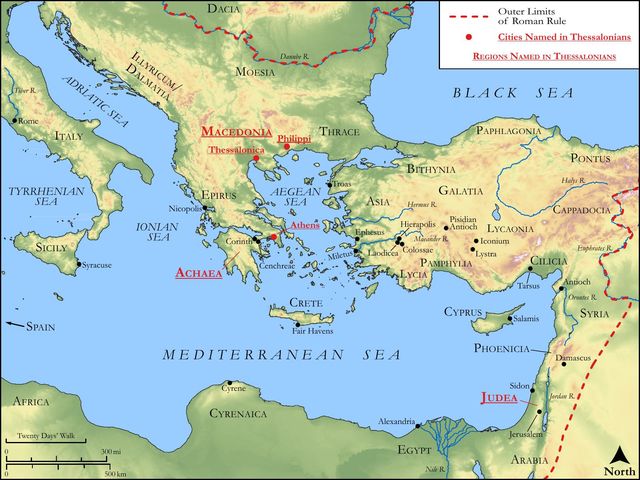
The Thessalonian church was relatively young, having been founded by Paul during his second missionary journey (Acts 17). They faced significant external persecution from both Jewish and Gentile opposition (1 Thessalonians 2:14; 2 Thessalonians 1:4). Internally, they were grappling with confusion and anxiety, particularly concerning the timing of the Lord's return and the resurrection of the dead (1 Thessalonians 4:13-18; 2 Thessalonians 2:1-2). False teachers or misinterpretations of Paul's previous letter had led some to believe that the "day of the Lord" had already arrived, causing distress and even idleness among some members (2 Thessalonians 3:6-12). In this environment of external pressure and internal confusion, Paul's emphasis on "traditions" was crucial. Unlike the later negative connotations of "traditions" as human-made rules (e.g., Mark 7:8), Paul here refers to the authoritative, divinely revealed teachings "handed down" by the apostles themselves, which were the bedrock of their faith and practice.
Key Themes
ShowHideSecond Thessalonians 2:15 contributes significantly to several major themes within the epistle and Paul's broader theology. Firstly, it underscores the theme of Steadfastness and Perseverance in the face of adversity and deception. The command to "stand fast" is a military metaphor, urging believers to hold their ground against spiritual enemies and false doctrines, echoing similar calls for resilience found in passages like Ephesians 6:13. Secondly, it highlights the Authority and Sufficiency of Apostolic Teaching. Paul emphasizes that the "traditions" he delivered, whether orally or in writing, were not mere human opinions but divine truth, forming the indispensable foundation for Christian faith and conduct. This theme is vital for understanding the early church's reliance on direct apostolic witness. Finally, the verse implicitly addresses the theme of Discernment and Truth. In a context where "strong delusion" (2 Thessalonians 2:11) is a real threat, adhering to the established truth becomes the primary means by which believers can distinguish genuine revelation from deceptive falsehoods, ensuring their spiritual stability and growth.
Exposition and Analysis
ShowHideKey Word Analysis
ShowHideFrom the perfect tense of hístēmi, meaning "to be stationary," this word is used figuratively here to mean "to persevere." It conveys the idea of holding one's ground firmly, not giving way under pressure. In a military context, it describes a soldier maintaining their position against an attacking force. Spiritually, it implies an unwavering commitment and stability in faith and doctrine, refusing to be moved by false teachings or persecution.
Derived from krátos (strength), this verb means "to use strength, to seize or retain." It implies a firm grip or tenacious adherence. In this context, it is not merely passive reception but an active, strong retention of the truths received. Believers are not just to know the traditions but to grasp them firmly and maintain them against any attempts to dislodge them.
From paradídōmi (to hand over), this term literally means "transmission" or "things handed down." Crucially, in this context, it refers to the authoritative teachings and practices transmitted by the apostles. Unlike the negative sense of human traditions that supersede God's commands (e.g., Matthew 15:2-6), Paul uses parádosis here positively to denote the divinely inspired body of truth, doctrine, and moral instruction that he and his fellow apostles delivered to the churches.
Verse Breakdown
ShowHide"Therefore, brethren,"
The conjunction "Therefore" (Greek: ára oûn) signals a logical conclusion drawn from the preceding discussion, particularly Paul's thanksgiving for their election and calling to salvation (2 Thessalonians 2:13-14). It transitions from theological exposition to practical exhortation. "Brethren" (adelphós) is a common Pauline term of endearment, emphasizing the familial bond and shared spiritual identity among believers, softening the command with pastoral affection.
"stand fast,"
This is a direct, imperative command (Greek: stḗkete). It calls for a firm, unyielding posture in their faith and conduct. In light of the deceptions described earlier in the chapter, this is an urgent call to spiritual stability and steadfastness, resisting any force that would seek to move them from their foundation.
"and hold the traditions"
This second imperative (Greek: krateíte) complements "stand fast," indicating the specific object of their steadfastness. They are to "hold fast" or "retain firmly" the parádosis, the specific body of teaching and practice that Paul and his co-workers had communicated to them. This is an active, ongoing responsibility to guard and live by these truths.
"which ye have been taught,"
The relative pronoun "which" (hós) clarifies that these "traditions" are not vague or undefined, but precisely those specific teachings that the Thessalonians had already received. The passive voice "ye have been taught" (Greek: edidáchthēte) highlights that these truths were authoritatively delivered to them by the apostles.
"whether by word,"
This specifies the first mode of transmission. "By word" (Greek: diá lógou) refers to the oral instruction, preaching, and personal teaching that Paul and his missionary team imparted during their time in Thessalonica (e.g., Acts 17:1-4). This acknowledges the vital role of spoken apostolic authority in the early church.
"or our epistle."
This specifies the second mode of transmission. "Our epistle" (Greek: hēmōn epistolḗ) refers to Paul's written correspondence, primarily his first letter to the Thessalonians (1 Thessalonians) and perhaps even this second letter, which itself contains further apostolic teaching. This highlights the dual nature of apostolic authority: both spoken and written communication served as authoritative sources of divine truth for the early church.
Literary Devices
ShowHidePaul employs several effective literary devices in 2 Thessalonians 2:15. The primary device is Exhortation, as the verse functions as a direct, imperative command ("stand fast," "hold") to the believers. This direct address underscores the urgency and importance of the message. There is also an implicit Contrast at play; having just warned about the "strong delusion" and "lying wonders" of the man of lawlessness, Paul presents the "traditions" as the antithesis and antidote to such deception. By adhering to what is true, they can resist what is false. Furthermore, the phrase "stand fast" utilizes Military Imagery or Metaphor, evoking the posture of a soldier holding their ground against an enemy. This metaphor powerfully conveys the idea of spiritual resilience, firmness, and unwavering commitment in the face of spiritual warfare, encouraging the believers to maintain their position and not retreat from the truth.
Theological and Thematic Connections
ShowHideThe profound theological implication of 2 Thessalonians 2:15 lies in its affirmation of the authoritative nature of apostolic teaching as the foundational source of Christian truth. In a world prone to deception, Paul grounds the believers' stability not in subjective experience or fleeting trends, but in the objective, divinely revealed "traditions" handed down by those directly commissioned by Christ. This highlights the early church's reliance on both the oral proclamation and written documentation of the apostles as the definitive standard for doctrine and practice. It underscores the necessity of a fixed, external standard of truth—what would later become the inspired Scriptures—to guard against error and ensure genuine faith. The verse thus champions the principle of sola Scriptura in its nascent form, emphasizing that the church's stability rests on adherence to the revealed Word of God, whether initially spoken or subsequently written.
Reflection and Application
ShowHideIn an age characterized by a proliferation of information, diverse ideologies, and often conflicting spiritual claims, 2 Thessalonians 2:15 serves as a timeless anchor for believers. The call to "stand fast" and "hold the traditions" is profoundly relevant, urging us to cultivate a deep and unwavering commitment to the foundational truths of the Christian faith. This means more than passive agreement; it demands active engagement with and adherence to the inspired Word of God, which is the written embodiment of the apostolic traditions. We are called to be discerning, to rigorously test all teachings against the plumb line of Scripture, and to resist the allure of novel doctrines or cultural currents that deviate from biblical truth. Our spiritual stability and resilience in the face of deception, doubt, or difficulty are directly proportional to our steadfastness in the revealed truth. This verse encourages us to be learners and doers of the Word, building our lives on the unshakeable foundation of Christ's teachings as delivered through His apostles, thereby enabling us to navigate the complexities of life with clarity, conviction, and courage.
Questions for Reflection
ShowHideFAQ
ShowHideWhat does Paul mean by "traditions" in this verse, and how does it differ from other uses of the word?
ShowHideIn 2 Thessalonians 2:15, "traditions" (Greek: parádosis) refers specifically to the authoritative, divinely revealed teachings, doctrines, and moral instructions that Paul and his fellow apostles personally delivered to the Thessalonian believers. These were the core truths of the Gospel, communicated both orally ("by word") during their ministry among them and in written form ("our epistle," referring to his letters like 1 Thessalonians). This usage stands in stark contrast to other instances where "traditions" refers to human-made customs or religious rules that often contradict or nullify God's commands, as seen in Jesus's rebuke of the Pharisees' traditions in Mark 7:8-13. Here, Paul emphasizes the legitimacy and divine origin of the apostolic traditions as the essential foundation for Christian faith and practice, a bulwark against the very deceptions he warns about in 2 Thessalonians 2:9-12.
Christ-Centered Fulfillment
ShowHideSecond Thessalonians 2:15, while a direct command to the Thessalonians, finds its ultimate Christ-centered fulfillment in the person and work of Jesus Christ Himself. He is the very content and embodiment of the "traditions" that Paul handed down. Jesus is the "Word" (Greek: lógos) made flesh, the ultimate revelation of God (as seen in John 1:1-14 and Hebrews 1:1-3). The apostolic teaching, whether oral or written, was fundamentally about Christ—His life, death, resurrection, and future return. Therefore, to "stand fast" and "hold the traditions" is, at its core, to stand fast in Christ and hold fast to the truth about Him. He is the "way, the truth, and the life" (John 14:6), the one in whom all truth resides. The steadfastness commanded in this verse is ultimately a steadfastness in Him, for it is by being rooted and built up in Him that believers are strengthened in the faith and guarded against deception, as highlighted in Colossians 2:6-7. Thus, the enduring power and relevance of these "traditions" stem from their origin and focus on the Lord Jesus Christ, through whom believers are called to salvation and sanctification (2 Thessalonians 2:13-14).