


2 Thessalonians 3:6
Bible text: King James Version (1769 Blayney text) · Public domain
Bible text: King James Version with Strong's numbers · Public domain
Bible text: Berean Standard Bible · Public domain
Bible text: American Standard Version (1901) · Public domain
Bible text: World English Bible, Messianic edition · Public domain
Bible text: Geneva Bible (1599) · Public domain
Bible text: Young's Literal Translation · Public domain
- ΠαραγγέλλομενParangellomenWe commandG3853V-PAI-1PVerb Present Active Indicative 1st Plural
- δὲdenowG1161CONJConjunction
- ὑμῖνhuminyouG4771P-2DPPersonal pronoun Dative 2nd Plural
- ἀδελφοίadelphoibrothersG80N-VPMNoun Vocative Plural Masculine
- ἐνeninG1722PREPPreposition
- ὀνόματιonomati[the] nameG3686N-DSNNoun Dative Singular Neuter
- τοῦtouof theG3588T-GSMDefinite article Genitive Singular Masculine
- κυρίουkuriouLordG2962N-GSM-TNoun Genitive Singular Masculine Title
- ἡμῶνhēmōnof usG3165P-1GPPersonal pronoun Genitive 1st Plural
- ἸησοῦIēsouJesusG2424N-GSM-PNoun Genitive Singular Masculine Individual
- ΧριστοῦChristouChristG5547N-GSM-TNoun Genitive Singular Masculine Title
- στέλλεσθαιstellesthaiare to withdrawG4724V-PMNVerb Present Middle Infinitive
- ὑμᾶςhumasyouG4771P-2APPersonal pronoun Accusative 2nd Plural
- ἀπὸapofromG575PREPPreposition
- παντὸςpantoseveryG3956A-GSMAdjective Genitive Singular Masculine
- ἀδελφοῦadelphoubrotherG80N-GSMNoun Genitive Singular Masculine
- ἀτάκτωςataktōsidlyG814ADVAdverb
- περιπατοῦντοςperipatountoswalkingG4043V-PAP-GSMVerb Present Active Participle Genitive Singular Masculine
- καὶkaiandG2532CONJConjunction
- μὴmēnotG3361PRT-NNegative Particle Negative
- κατὰkataaccording toG2596PREPPreposition
- τὴνtēntheG3588T-ASFDefinite article Accusative Singular Feminine
- παράδοσινparadosintraditionG3862N-ASFNoun Accusative Singular Feminine
- ἣνhēnthatG3739R-ASFRelative pronoun Accusative Singular Feminine
- παρελάβοσανparelabosanthey receivedG3880V-2AAI-3PVerb 2nd Aorist Active Indicative 3rd Plural
- παρ᾽par᾽fromG3844PREPPreposition
- ἡμῶνhēmōnusG3165P-1GPPersonal pronoun Genitive 1st Plural
English is a literal word-by-word gloss of the Greek, not the KJV's wording. Why?
This is the original text the KJV's translators worked from — each Greek word with its own literal English meaning in this verse, prepared by scholars at Tyndale House, Cambridge. The KJV translates whole sentences, not word by word, so its wording differs: one Greek word can become several English words, and the KJV may choose “charity” where the gloss reads “love”. Both are faithful — they answer different questions. For the KJV's own rendering, switch to the KJV text.
Details
See on the biblical-era maps
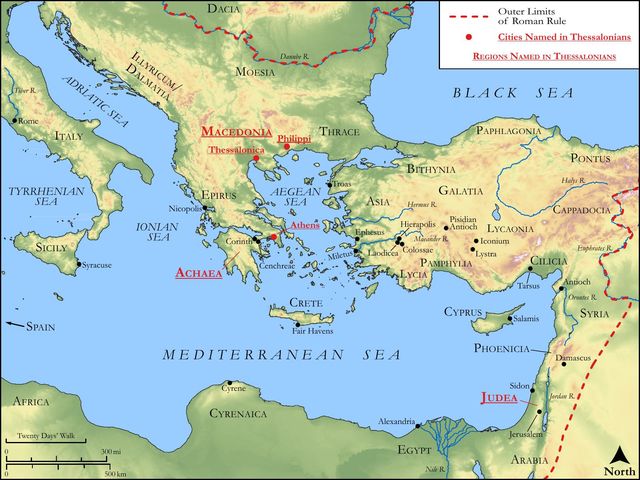

Study this verse
Public-domain commentary
Matthew Henry
From his Commentary on the Whole Bible. Henry comments on passages, not single verses — this entry covers 2 Thessalonians 3:6–15. His four-level outline is real structure in the source text, so it is rendered as structure.
The apostle having commended their obedience for the time past, and mentioned his confidence in their obedience for the time to come, proceeds to give them commands and directions to some who were faulty, correcting some things that were amiss among them. Observe, The best society of Christians may have some faulty persons among them, and some things that ought to be reformed. Perfection is not to be found on this side heaven: but evil manners beget good laws; the disorders that Paul heard of as existing among the Thessalonians occasioned the good laws we find in these verses, which are of constant use to us, and all others whom they may concern. Observe,
I.That which was amiss among the Thessalonians, which is expressed,
1.More generally. There were some who walked disorderly, not after the tradition they received from the apostle, Th2 3:6. Some of the brethren were guilty of this disorderly walking; they did not live regularly, nor govern themselves according to the rules of Christianity, nor agreeably to their profession of religion; not according to the precepts delivered by the apostle, which they had received, and pretended to pay a regard to. Note, It is required of those who have received the gospel, and who profess a subjection to it, that they live according to the gospel. If they do not, they are to be counted disorderly persons.
2.In particular, there were among them some idle persons and busy-bodies, Th2 3:11. This the apostle was so credibly informed of that he had sufficient reason to give commands and directions with relation to such persons, how they ought to behave, and how the church should act towards them.
(1.)There were some among them who were idle, not working at all, or doing nothing. It does not appear that they were gluttons or drunkards, but idle, and therefore disorderly people. It is not enough for any to say they do no hurt; for it is required of all persons that they do good in the places and relations in which Providence has placed them. It is probable that these persons had a notion (by misunderstanding some passages in the former epistle) concerning the near approach of the coming of Christ, which served them for a pretence to leave off the work of their callings, and live in idleness. Note, It is a great error, or abuse of religion, to make it a cloak for idleness or any other sin. If we were sure that the day of judgment were ever so near, we must, notwithstanding, do the work of the day in its day, that when our Lord comes he may find us doing. The servant who waits for the coming of his Lord aright must be working as his Lord has commanded, that all may be ready when he comes. Or, it may be, these disorderly persons pretended that the liberty wherewith Christ had made them free discharged them from the services and business of their particular callings and employments in the world: whereas they were to abide in the same calling wherein they were called of God, and therein abide with God, Co1 7:20, Co1 7:24. Industry in our particular callings as men is a duty required of us by our general calling as Christians. Or perhaps the general charity there was then among Christians to their poor brethren encouraged some to live in idleness, as knowing the church would maintain them: whatever was the cause, they were much to blame.
(2.)There were busy-bodies among them: and it should seem, by the connection, that the same persons who were idle were busy-bodies also. This may seem to be a contradiction; but so it is, that most commonly those persons who have no business of their own to do, or who neglect it, busy themselves in other men's matters. If we are idle, the devil and a corrupt heart will soon find us something to do. The mind of man is a busy thing; if it be not employed in doing good, it will be doing evil. Note, Busy-bodies are disorderly walkers, such as are guilty of vain curiosity, and impertinent meddling with things that do not concern them, and troubling themselves and others with other men's matters. The apostle warns Timothy (Ti1 5:13) to beware of such as learn to be idle, wandering about from house to house, and are not only idle, but tatlers also, and busy-bodies, speaking things which they ought not.
II.The good laws which were occasioned by these evil manners, concerning which we may take notice,
1.Whose laws they are: they are commands of the apostles of our Lord, given in the name of their Lord and ours, that is, the commands of our Lord himself. We command you, brethren, in the name of the Lord Jesus Christ, Th2 3:6. Again, We command and exhort you by our Lord Jesus Christ, Th2 3:12. The apostle uses words of authority and entreaty: and, where disorders are to be rectified or prevented, there is need of both. The authority of Christ should awe our minds to obedience, and his grace and goodness should allure us.
2.What the good laws and rules are. The apostle gives directions to the whole church, commands to those disorderly persons, and an exhortation to those in particular who did well among them.
(1.)His commands and directions to the whole church regard,
[1.]Their behaviour towards the disorderly persons who were among them, which is thus expressed (Th2 3:6), to withdraw themselves from such, and afterwards to mark that man, and have no company with him, that he may be ashamed; yet not to count him as an enemy, but to admonish him as a brother. The directions of the apostle are carefully to be observed in our conduct towards disorderly persons. We must be very cautious in church-censures and church-discipline. We must, First, Note that man who is suspected or charged with not obeying the word of God, or walking contrary thereto, that is, we must have sufficient proof of his fault before we proceed further. We must, Secondly, Admonish him in a friendly manner; we must put him in mind of his sin, and of his duty; and this should be done privately (Mat 18:15); then, if he will not hear, we must, Thirdly, Withdraw from him, and not keep company with him, that is, we must avoid familiar converse and society with such, for two reasons, namely, that we may not learn his evil ways; for he who follows vain and idle persons, and keeps company with such, is in danger of becoming like them. Another reason is for the shaming, and so the reforming, of those that offend, that when idle and disorderly persons see how their loose practices are disliked by all wise and good people they may be ashamed of them, and walk more orderly. Love therefore to the persons of our offending brethren, even when we hate their vices, should be the motive of our withdrawing from them; and even those who are under the censures of the church must not be accounted as enemies (Th2 3:15); for, if they be reclaimed and reformed by these censures, they will recover their credit and comfort, and right to church-privileges as brethren.
[2.]Their general conduct and behaviour ought to be according to the good example the apostle and those who were with him had given them: Yourselves know how you ought to follow us, Th2 3:7. Those who planted religion among them had set a good example before them; and the ministers of the gospel should be ensamples to the flock. It is the duty of Christians not only to walk according to the traditions of the apostles, and the doctrines they preached, but also according to the good example they set before them, to be followers of them so far as they were followers of Christ. The particular good example the apostle mentions was their diligence, which was so different from what was found in the disorderly walkers he takes notice of: "We behaved not ourselves disorderly among you (Th2 3:7), we did not spend our time idly, in idle visits, idle talk, idle sports." They took pains in their ministry, in preaching the gospel, and in getting their own living. Neither did we eat any man's bread for nought, Th2 3:8. Though he might justly have demanded a maintenance, because those who preach the gospel may of right expect to live by the gospel. This is a just debt that people owe to their ministers, and the apostle had power or authority to have demanded this (Th2 3:9); but he waived his right from affection to them, and for the sake of the gospel, and that he might be an example for them to follow (Th2 3:9), that they might learn how to fill up time, and always be employed in something that would turn to good account.
(2.)He commands and directs those that live idle lives to reform, and set themselves to their business. He had given commandments to this purport, as well as a good example of this, when he was among them: Even when we were with you, this we commanded you, that if any man would not work neither should he eat, Th2 3:10. It was a proverbial speech among the Jews, He who does not labour does not deserve to eat. The labourer is worthy of his meat; but what is the loiterer worthy of? It is the will of God that every man should have a calling, and mind his calling, and make a business of it, and that none should live like useless drones in the world. Such persons do what in them lies to defeat the sentence, In the sweat of thy face shalt thou eat thy bread. It was not the mere humour of the apostle, who was an active stirring man himself and therefore would have every body else to be so too, but it was the command of our Lord Jesus Christ, that with quietness we work, and eat our own bread, Th2 3:12. Men ought some way or other to earn their own living, otherwise they do not eat their own bread. Observe, There must be work or labour, in opposition to idleness; and there must be quietness, in opposition to being busy-bodies in other men's matters. We must study to be quiet, and do our own business. This is an excellent but rare composition, to be of an active yet quiet spirit, active in our own business and yet quiet as to other people's.
(3.)He exhorts those that did well not to be weary in well-doing (Th2 3:13); as if he had said, "Go on and prosper. The Lord is with you while you are with him. See that whatever you do, that is good, you persevere therein. Hold on your way, and hold out to the end. You must never give over, nor tire in your work. It will be time enough to rest when you come to heaven, that everlasting rest which remains for the people of God."
Historical interpretation
Two Centuries of Reception
10 surviving comments on this verse. Each one is dated, so this reads as a timeline rather than a list.
Select a marker to jump to its quote. Markers stagger vertically where authors wrote within a few decades of each other.
To which course many nations of those barbarians who believe in Christ do assent, having salvation written in their hearts by the Spirit, without paper or ink, and, carefully preserving the ancient tradition, believing in one God, the Creator of heaven and earth, and all things therein, by means of Christ Jesus, the Son of God; who, because of His surpassing love towards His creation, condescended to be born of the virgin, He Himself uniting man through Himself to God, and having suffered under Pontius Pilate, and rising again, and having been received up in splendour, shall come in glory, the Saviour of those who are saved, and the Judge of those who are judged, and sending into eternal fire those who transform the truth, and despise His Father and His advent.
For I offer you withal, for your investigation, this very question: Whether there were in the first Epistle others, too, who "wholly saddened" the apostle by "acting disorderly," and "were wholly saddened" by him, through incurring (his) "rebuke," according to the sense of the second Epistle; of whom some particular one may in that (second Epistle) have received pardon.
Again, they say the same apostle has left a precept, according to his own example, "That each one work with his own hands for a living." If this precept is maintained in respect to all hands, I believe even the bath-thieves live by their hands, and robbers themselves gain the means to live by their hands; forgers, again, execute their evil handwritings, not of course with their feet, but hands; actors, however, achieve a livelihood not with hands alone, but with their entire limbs.
And so they upbraid the discipline of monogamy with being a heresy; nor is there any other cause whence they find themselves compelled to deny the Paraclete more than the fact that they esteem Him to be the institutor of a novel discipline, and a discipline which they find most harsh: so that this is already the first ground on which we must join issue in a general handling (of the subject), whether there is room for maintaining that the Paraclete has taught any such thing as can either be charged with novelty, in opposition to catholic tradition, or with burdensomeness, in opposition to the "light burden" of the Lord.
What more disgraceful than immodesties? If, moreover, even from a "brother" who "walketh idly" he warns the Thessalonians to withdraw themselves, how much more withal from a fornicator! For these are the deliberate judgments of Christ, "loving the Church," who "hath delivered Him self up for her, that He may sanctify her (purifying her utterly by the layer of water) in the word, that He may present the Church to Him self glorious, not having stain or wrinkle"-of course after the laver-"but (that) she may be holy and without reproach; " thereafter, to wit, being "without wrinkle" as a virgin, "without stain" (of fornication) as a spouse, "without disgrace" (of vileness), as having been "utterly purified.
The words of the apostle’s testimony are, “We command you in the name of the Lord Jesus Christ that you withdraw from all brothers who are living disorderly lives and not according to the tradition which they received from us.” And again he says, “Let no one deceive you with empty words; for because of these things the wrath of God comes on the children of disobedience. Don’t be, therefore, partakers with them.” We must withdraw, indeed flee from those who fall away, lest, while one is joined with them while they walk wickedly, passing over the paths of error and crime, wandering apart from the way of the true road, he himself also be caught in a similar crime. God is one and Christ one and his church one and the faith one and the people one, all joined together by the tie of concord into a solid unity of body. The unity cannot be torn apart, nor can the one body be separated by a division of its structure, nor torn into bits by the lacerating of its entrails. Whoever departs from the root of the parent body will not be able to breathe and live apart. By departing one loses the substance of health.
“And now there remain faith, hope, charity, these three; but the greatest of these is charity.” In view of such declarations on the part of our Lord and the apostle, I marvel, I say, how it is that men display such zeal and such intense absorption in the pursuit of goods that will come to an end and be destroyed but have no regard for that which will remain, especially charity, the greatest of all goods, the distinguishing mark of the Christian. And not only this, but they show hostility to those who are zealous in its practice, and in fighting against them they fulfill the words of the Lord, namely, that they themselves do not enter in and those that are entering in they hinder. I beg and implore you, therefore, to be content with the words of the saints and of the Lord himself. Desist from curious inquiry and unseemly controversies. Think on those things that are worthy of your heavenly calling. Live in a manner befitting the gospel of Christ, relying on the hope of eternal life and the heavenly kingdom prepared for all those who keep the commandments of God the Father, according to the gospel of Jesus Christ our Lord in the Holy Spirit and in truth. CONCERNING FAITH.Basil the Great: [Paul] says, “Knowing this, that our old nature is crucified with him, that the body of sin may be destroyed to the end that we may serve sin no longer.” By these words we are taught that he who is baptized in Christ is baptized in his death, and is not only buried with Christ and planted together with him but is first of all crucified with him. Thus we are instructed that as he who is crucified is separated from the living, so also he who has been crucified with Christ in the likeness of his death is completely set apart from those who live according to the old nature. Hence the Lord commanded us to beware of false prophets, and the apostle says, “And we command you, brothers, that you withdraw yourselves from every brother walking disorderly and not according to the tradition which they have received of us.” The “old nature” mentioned by the apostle signifies all sin and defilement, taken individually and together, as if they represented his own members.
Since every congregation not everyone is obedient to the word of doctrine and some prefer their own pleasure and determination, not that of the law, Paul directs the Thessalonians to turn away from them so that they will realize their error. *A brother who is caught doing such things the bishop can bar him not only from the Sacraments but also from common intercourse with his fellows, so that when he is avoided by them he may feel ashamed and repent.
"Now we command you, brethren, in the name of our Lord Jesus Christ, that ye withdraw yourselves from every brother that walketh disorderly and not after the tradition which they received of us."
That is, it is not we that say these things, but Christ, for that is the meaning of "in the name of our Lord Jesus Christ"; equivalent to "through Christ." Showing the fearfulness of the message, he says, through Christ. Christ therefore commanded us in no case to be idle. "That ye withdraw yourselves," he says, "from every brother." Tell me not of the rich, tell me not of the poor, tell me not of the holy. This is disorder. "That walketh," he says, that is, liveth. "And not after the tradition which they received from me." Tradition, he says, which is through works. And this he always calls properly tradition.
Lastly, those very people [the Thessalonians] whom in his first epistle Paul had treated with the gentle application of his words, he endeavors in his second epistle to heal with severer and sterner remedies, as those who had not profited from any more gentle treatment. And he no longer applies the treatment of gentle words, no mild and kindly expressions such as, “But we ask you, brothers.” Rather he says, “We command you, brothers, in the name of our Lord Jesus Christ, that you withdraw from every brother that lives in a disorderly fashion.” In the first letter Paul asks; in the second he commands. In the first we see the kindness of one who is persuading; in the second the sternness of one protesting and threatening. “We command you, brothers,” because, when we first asked you, you scorned our words. Now at least obey our threats. Paul renders this commandment severe, not by his bare word but by the imprecation of the name of our Lord Jesus Christ. He is concerned that they might again scorn his teaching as merely a human word, considering it of little importance. And so quite directly, like a well-skilled physician operating on infected limbs to which he could not apply the remedy of a mild treatment, Paul attempts to cure by an incision with a spiritual knife.… He bids them withdraw from those who will not make time for work and to cut them off like limbs tainted with the festering sores of leisure. This is so that the malady of idleness, like some deadly contagion, might not infect even the healthy portion of their limbs by the gradual advance of infection.
Continue studying 2 Thessalonians 3:6 across the web’s major study libraries — every link below opens this exact verse, chapter, or book on the destination site.
Read & Compare
 BibleGatewayThis verse in more than 200 translations and 70 languages.
 Bible.comThe YouVersion reader — hundreds of translations, reading plans, and highlights.
 ESV.orgCrossway's official English Standard Version reader.
 NET BibleThe NET translation with 60,000+ translators' notes on every rendering decision.
 STEP BibleTyndale House's free study tool — original text, vocabulary, and scholarly resources.
 BibliaLogos Bible Software's free web reader.
 USCCBThe New American Bible (Revised Edition) with the U.S. bishops' study notes.
Commentaries
 BibleHub CommentariesDozens of classic commentaries on this verse, gathered on one page.
 StudyLightMore than 100 commentary sets — the largest collection on the web.
 BibleRefPlain-English commentary on what this verse means, verse by verse.
 Enduring WordDavid Guzik's free commentary on this chapter, widely used by Bible teachers.
 Bible Study ToolsVerse commentary alongside Greek and Hebrew study aids.
Original Language & Research
- BibleHub InterlinearThe verse word by word — original language, transliteration, and English.
- BibleHub LexiconEvery word's original-language definition and Strong's entry.
 Blue Letter BibleDeep-study tools — Strong's numbers, concordance, and word studies.
 CNTR CollationThe earliest Greek manuscripts of this verse, collated letter by letter.
Sermons, Hymns & Audio


TrulyRandomVerse is not affiliated with these sites and doesn’t control their content. They’re linked because they’re genuinely useful.
Summary
In 2 Thessalonians 3:6, the Apostle Paul issues a solemn and authoritative command to the Thessalonian believers, urging them to distance themselves from any fellow Christian whose conduct is disorderly and deviates from the apostolic teachings they had received. This directive underscores the importance of communal integrity, responsible living, and adherence to established Christian principles, particularly in light of some members' idleness and disruptive behavior within the church.
Context
ShowHideLiterary Context
This verse stands as a crucial turning point in Paul's second letter to the Thessalonians, shifting from general encouragement and eschatological correction to specific ethical instruction and church discipline. Immediately preceding this command, Paul prays for the Thessalonians, asking the Lord to direct their hearts into God's love and Christ's steadfastness 2 Thessalonians 3:5. He also requests prayer for himself and his companions, that they might be delivered from unreasonable and wicked men 2 Thessalonians 3:1-2. This emphasis on divine guidance and protection sets the stage for the strong, divinely-backed command in verse 6, highlighting that the church's internal order is as vital as its external witness. The verses that follow 2 Thessalonians 3:7-12 further elaborate on the specific nature of the "disorderly" conduct—namely, idleness and busybody behavior—and Paul's own diligent example.
Historical & Cultural Context
The church in Thessalonica was a relatively young community, established amidst a bustling Roman port city known for its trade and diverse population. Paul's first letter addressed various issues, including misunderstandings about the Lord's return, which had led some to believe Christ's coming was so imminent that daily work was unnecessary. This eschatological fervor, coupled with perhaps a misinterpretation of Christian communal sharing, resulted in some believers becoming idle, dependent on others, and disruptive ("busybodies"). Among the Greeks and Romans, idleness was generally looked down upon, and self-sufficiency was valued. Paul, a tentmaker by trade, consistently modeled hard work and self-support, refusing to be a burden to the churches he served 1 Thessalonians 2:9 and 2 Thessalonians 3:8. This command, therefore, directly counters a specific social problem that was undermining the church's witness and internal harmony.
Key Themes
ShowHideThis verse powerfully contributes to several overarching themes in 2 Thessalonians and Paul's broader theology. It emphasizes Apostolic Authority, as Paul issues the command "in the name of our Lord Jesus Christ," asserting the divine backing for his instructions. The theme of Church Discipline and Order is paramount, highlighting the necessity for the community to maintain internal health and accountability by addressing disruptive behavior. This discipline is not punitive for its own sake but aims at restoration and the preservation of the church's integrity. Furthermore, the verse underscores the importance of Faithful Living and Christian Ethics, particularly the call to diligent work and responsible conduct, which Paul had previously taught as part of the "tradition" received from him 2 Thessalonians 3:10. The concept of Tradition here refers to the authoritative body of teaching and practical instruction passed down from the apostles, which served as the foundation for Christian life and practice.
Exposition and Analysis
ShowHideKey Word Analysis
ShowHideThis word signifies a strong, authoritative instruction or injunction, often used in military contexts for an order. Paul is not merely advising or suggesting; he is issuing a direct and binding directive to the Thessalonian church, backed by the authority of Christ. It implies a formal and serious charge, indicating the gravity with which Paul views the issue of disorderly conduct.
Literally meaning "to set fast" or "to repress," this term, when used reflexively, means "to abstain from associating with" or "to keep oneself away from." It suggests a deliberate and purposeful separation, not necessarily a complete excommunication, but a cessation of familiar or intimate association. The purpose is to create a social consequence for the disorderly behavior, prompting reflection and repentance, as further clarified in 2 Thessalonians 3:14-15.
This adverb, derived from military vocabulary, describes someone "out of rank," "undisciplined," or "not keeping order." In a civilian context, it came to denote idleness, shirking duties, or living an irresponsible, unruly life. In Thessalonica, it specifically referred to those who refused to work, became busybodies, and were a burden on the community, violating the established "tradition" of diligent labor and orderly conduct.
Verse Breakdown
ShowHide"Now we command you, brethren, in the name of our Lord Jesus Christ"
Paul, along with Silvanus and Timothy, asserts apostolic authority, grounding their directive not in human wisdom but in the divine mandate of Jesus Christ. This phrase elevates the command to a sacred imperative, emphasizing its seriousness and the spiritual weight it carries for the community. It signifies that this is not a mere suggestion but a divinely authorized instruction for the well-being of the church.
"that ye withdraw yourselves from every brother that walketh disorderly"
This is the core of the command. The church is instructed to deliberately distance itself from any fellow believer whose conduct is "disorderly." This "walking disorderly" refers to a persistent pattern of behavior that is out of step with Christian norms, specifically the idleness and busybody actions described elsewhere in the letter. The withdrawal is a form of communal discipline, a social sanction intended to highlight the seriousness of the offense and to prompt the individual to change their ways.
"and not after the tradition which he received of us."
This clause defines the standard against which the "disorderly" conduct is measured. The "tradition" refers to the authoritative teachings and practical instructions that Paul and his companions had personally delivered to the Thessalonians. This included not only doctrinal truths but also ethical guidelines for daily living, such as the command to work diligently and not be a burden on others. The disorderly brother is one who disregards or disobeys these foundational apostolic teachings.
Literary Devices
ShowHidePaul employs several literary devices to convey the gravity and authority of his command. The use of Apostolic Authority is prominent, as he explicitly states the command is given "in the name of our Lord Jesus Christ," lending divine weight to his words and underscoring that this is God's will for the church. The phrase "walketh disorderly" is a powerful Metaphor derived from military language, depicting someone who is "out of rank" or "undisciplined." This vivid imagery effectively communicates the disruption and lack of order caused by the unrighteous behavior. Furthermore, the verse uses Contrast by juxtaposing the "disorderly" conduct with adherence to "the tradition which he received of us," clearly delineating acceptable Christian living from that which is unacceptable and requires communal intervention. The Imperative Mood of "we command" and "withdraw yourselves" reinforces the non-negotiable nature of the instruction, demanding immediate and serious action from the church.
Theological and Thematic Connections
ShowHideThis verse is foundational for understanding the New Testament's teaching on church discipline and the importance of communal responsibility. It establishes that Christian liberty is not an excuse for idleness or disruptive behavior, and that the integrity of the body of Christ requires members to live in accordance with apostolic teaching. The command to "withdraw" is not an act of condemnation but a loving, yet firm, measure designed to bring about repentance and restoration, protecting the community from negative influence while seeking the spiritual welfare of the erring individual. It highlights the church's role in upholding God's standards and ensuring that its witness to the world is not compromised by internal disorder.
Reflection and Application
ShowHide2 Thessalonians 3:6 offers profound principles for contemporary Christian living and community dynamics. It challenges believers to consider how their personal conduct impacts the collective witness and health of the church. In a world that often prioritizes individual autonomy above communal responsibility, Paul's command reminds us that our actions have ripple effects within the body of Christ. It calls us to a diligent, orderly life that reflects the teachings of Christ and the apostles, rather than becoming a burden or a source of disunity. Furthermore, it provides a framework for addressing persistent, unrepentant "disorderly" behavior within the church, emphasizing that discipline, when exercised with love and a view towards restoration, is a necessary function of a healthy spiritual community. This withdrawal is not about shaming or abandoning, but about creating a space for the individual to recognize their deviation and be drawn back into alignment with Christ's path.
Questions for Reflection
ShowHideFAQ
ShowHideWhat does "walketh disorderly" specifically mean in this context?
ShowHideIn 2 Thessalonians 3:6, "walketh disorderly" (Greek: atáktōs) specifically refers to a pattern of behavior characterized by idleness, irresponsibility, and being a busybody. This term, originally from military language describing soldiers out of formation, was applied in civilian life to those who shirked their duties, refused to work, and thus became a burden on the community. Paul further clarifies this in 2 Thessalonians 3:11, stating, "For we hear that there are some which walk among you disorderly, working not at all, but are busybodies." It's not about minor imperfections but a persistent refusal to live according to the established Christian ethic of diligent labor and orderly conduct.
Christ-Centered Fulfillment
ShowHideWhile 2 Thessalonians 3:6 addresses practical matters of church discipline and conduct, its underlying authority and purpose are profoundly Christ-centered. Paul issues this command "in the name of our Lord Jesus Christ," signifying that the standard for orderly living and the imperative for communal integrity flow directly from Christ's authority and character. Jesus Himself consistently modeled a life of purpose, diligence, and submission to the Father's will, declaring, "My food is to do the will of Him who sent Me, and to accomplish His work" John 4:34. The "tradition" Paul delivered was not merely his own invention but the practical outworking of the gospel of Christ, reflecting the new life found in Him. The goal of withdrawing from a disorderly brother is ultimately redemptive, mirroring Christ's own pursuit of the lost and His desire for the restoration of His people Luke 19:10. The church, as the body of Christ, is called to reflect His order, holiness, and redemptive love, ensuring that its internal life honors the Head of the Church and serves as a compelling witness to the world of the transforming power of the Risen Lord Ephesians 4:1-3.