


2 Thessalonians 3:7
- αὐτοὶautoiYourselvesG846P-NPMPersonal pronoun Nominative Plural Masculine
- γὰρgarforG1063CONJConjunction
- οἴδατεoidateyou knowG1492V-RAI-2PVerb Perfect Active Indicative 2nd Plural
- πῶςpōshowG4459PRT-IInterrogative Particle Interrogative
- δεῖdeiit behooves [you]G1163V-PAI-3SVerb Present Active Indicative 3rd Singular
- μιμεῖσθαιmimeisthaito imitateG3401V-PNNVerb Present Middle Or Passive Deponent Infinitive
- ἡμᾶς·hēmasusG3165P-1APPersonal pronoun Accusative 1st Plural
- ὅτιhotibecauseG3754CONJConjunction
- οὐκouknotG3756PRT-NNegative Particle Negative
- ἠτακτήσαμενētaktēsamenwe were idleG812V-AAI-1PVerb Aorist Active Indicative 1st Plural
- ἐνenamongG1722PREPPreposition
- ὑμῖνhuminyouG4771P-2DPPersonal pronoun Dative 2nd Plural
English is a literal word-by-word gloss of the Greek, not the KJV's wording. Why?
This is the original text the KJV's translators worked from — each Greek word with its own literal English meaning in this verse, prepared by scholars at Tyndale House, Cambridge. The KJV translates whole sentences, not word by word, so its wording differs: one Greek word can become several English words, and the KJV may choose “charity” where the gloss reads “love”. Both are faithful — they answer different questions. For the KJV's own rendering, switch to the KJV text.
Details
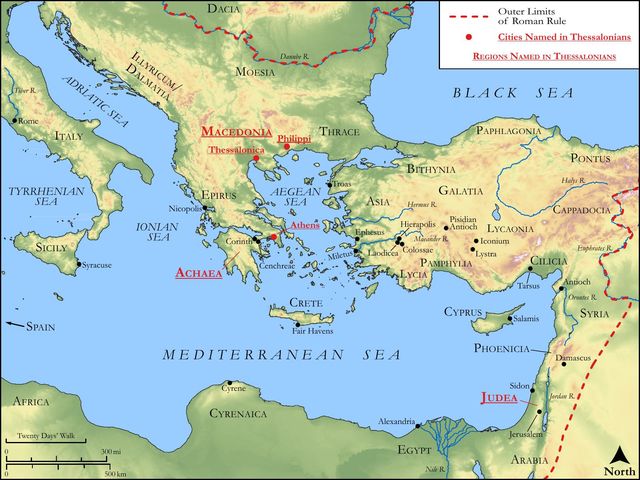
See on the biblical-era map

Study this verse
Public-domain commentary
Matthew Henry
From his Commentary on the Whole Bible. Henry comments on passages, not single verses — this entry covers 2 Thessalonians 3:6–15. His four-level outline is real structure in the source text, so it is rendered as structure.
The apostle having commended their obedience for the time past, and mentioned his confidence in their obedience for the time to come, proceeds to give them commands and directions to some who were faulty, correcting some things that were amiss among them. Observe, The best society of Christians may have some faulty persons among them, and some things that ought to be reformed. Perfection is not to be found on this side heaven: but evil manners beget good laws; the disorders that Paul heard of as existing among the Thessalonians occasioned the good laws we find in these verses, which are of constant use to us, and all others whom they may concern. Observe,
I.That which was amiss among the Thessalonians, which is expressed,
1.More generally. There were some who walked disorderly, not after the tradition they received from the apostle, Th2 3:6. Some of the brethren were guilty of this disorderly walking; they did not live regularly, nor govern themselves according to the rules of Christianity, nor agreeably to their profession of religion; not according to the precepts delivered by the apostle, which they had received, and pretended to pay a regard to. Note, It is required of those who have received the gospel, and who profess a subjection to it, that they live according to the gospel. If they do not, they are to be counted disorderly persons.
2.In particular, there were among them some idle persons and busy-bodies, Th2 3:11. This the apostle was so credibly informed of that he had sufficient reason to give commands and directions with relation to such persons, how they ought to behave, and how the church should act towards them.
(1.)There were some among them who were idle, not working at all, or doing nothing. It does not appear that they were gluttons or drunkards, but idle, and therefore disorderly people. It is not enough for any to say they do no hurt; for it is required of all persons that they do good in the places and relations in which Providence has placed them. It is probable that these persons had a notion (by misunderstanding some passages in the former epistle) concerning the near approach of the coming of Christ, which served them for a pretence to leave off the work of their callings, and live in idleness. Note, It is a great error, or abuse of religion, to make it a cloak for idleness or any other sin. If we were sure that the day of judgment were ever so near, we must, notwithstanding, do the work of the day in its day, that when our Lord comes he may find us doing. The servant who waits for the coming of his Lord aright must be working as his Lord has commanded, that all may be ready when he comes. Or, it may be, these disorderly persons pretended that the liberty wherewith Christ had made them free discharged them from the services and business of their particular callings and employments in the world: whereas they were to abide in the same calling wherein they were called of God, and therein abide with God, Co1 7:20, Co1 7:24. Industry in our particular callings as men is a duty required of us by our general calling as Christians. Or perhaps the general charity there was then among Christians to their poor brethren encouraged some to live in idleness, as knowing the church would maintain them: whatever was the cause, they were much to blame.
(2.)There were busy-bodies among them: and it should seem, by the connection, that the same persons who were idle were busy-bodies also. This may seem to be a contradiction; but so it is, that most commonly those persons who have no business of their own to do, or who neglect it, busy themselves in other men's matters. If we are idle, the devil and a corrupt heart will soon find us something to do. The mind of man is a busy thing; if it be not employed in doing good, it will be doing evil. Note, Busy-bodies are disorderly walkers, such as are guilty of vain curiosity, and impertinent meddling with things that do not concern them, and troubling themselves and others with other men's matters. The apostle warns Timothy (Ti1 5:13) to beware of such as learn to be idle, wandering about from house to house, and are not only idle, but tatlers also, and busy-bodies, speaking things which they ought not.
II.The good laws which were occasioned by these evil manners, concerning which we may take notice,
1.Whose laws they are: they are commands of the apostles of our Lord, given in the name of their Lord and ours, that is, the commands of our Lord himself. We command you, brethren, in the name of the Lord Jesus Christ, Th2 3:6. Again, We command and exhort you by our Lord Jesus Christ, Th2 3:12. The apostle uses words of authority and entreaty: and, where disorders are to be rectified or prevented, there is need of both. The authority of Christ should awe our minds to obedience, and his grace and goodness should allure us.
2.What the good laws and rules are. The apostle gives directions to the whole church, commands to those disorderly persons, and an exhortation to those in particular who did well among them.
(1.)His commands and directions to the whole church regard,
[1.]Their behaviour towards the disorderly persons who were among them, which is thus expressed (Th2 3:6), to withdraw themselves from such, and afterwards to mark that man, and have no company with him, that he may be ashamed; yet not to count him as an enemy, but to admonish him as a brother. The directions of the apostle are carefully to be observed in our conduct towards disorderly persons. We must be very cautious in church-censures and church-discipline. We must, First, Note that man who is suspected or charged with not obeying the word of God, or walking contrary thereto, that is, we must have sufficient proof of his fault before we proceed further. We must, Secondly, Admonish him in a friendly manner; we must put him in mind of his sin, and of his duty; and this should be done privately (Mat 18:15); then, if he will not hear, we must, Thirdly, Withdraw from him, and not keep company with him, that is, we must avoid familiar converse and society with such, for two reasons, namely, that we may not learn his evil ways; for he who follows vain and idle persons, and keeps company with such, is in danger of becoming like them. Another reason is for the shaming, and so the reforming, of those that offend, that when idle and disorderly persons see how their loose practices are disliked by all wise and good people they may be ashamed of them, and walk more orderly. Love therefore to the persons of our offending brethren, even when we hate their vices, should be the motive of our withdrawing from them; and even those who are under the censures of the church must not be accounted as enemies (Th2 3:15); for, if they be reclaimed and reformed by these censures, they will recover their credit and comfort, and right to church-privileges as brethren.
[2.]Their general conduct and behaviour ought to be according to the good example the apostle and those who were with him had given them: Yourselves know how you ought to follow us, Th2 3:7. Those who planted religion among them had set a good example before them; and the ministers of the gospel should be ensamples to the flock. It is the duty of Christians not only to walk according to the traditions of the apostles, and the doctrines they preached, but also according to the good example they set before them, to be followers of them so far as they were followers of Christ. The particular good example the apostle mentions was their diligence, which was so different from what was found in the disorderly walkers he takes notice of: "We behaved not ourselves disorderly among you (Th2 3:7), we did not spend our time idly, in idle visits, idle talk, idle sports." They took pains in their ministry, in preaching the gospel, and in getting their own living. Neither did we eat any man's bread for nought, Th2 3:8. Though he might justly have demanded a maintenance, because those who preach the gospel may of right expect to live by the gospel. This is a just debt that people owe to their ministers, and the apostle had power or authority to have demanded this (Th2 3:9); but he waived his right from affection to them, and for the sake of the gospel, and that he might be an example for them to follow (Th2 3:9), that they might learn how to fill up time, and always be employed in something that would turn to good account.
(2.)He commands and directs those that live idle lives to reform, and set themselves to their business. He had given commandments to this purport, as well as a good example of this, when he was among them: Even when we were with you, this we commanded you, that if any man would not work neither should he eat, Th2 3:10. It was a proverbial speech among the Jews, He who does not labour does not deserve to eat. The labourer is worthy of his meat; but what is the loiterer worthy of? It is the will of God that every man should have a calling, and mind his calling, and make a business of it, and that none should live like useless drones in the world. Such persons do what in them lies to defeat the sentence, In the sweat of thy face shalt thou eat thy bread. It was not the mere humour of the apostle, who was an active stirring man himself and therefore would have every body else to be so too, but it was the command of our Lord Jesus Christ, that with quietness we work, and eat our own bread, Th2 3:12. Men ought some way or other to earn their own living, otherwise they do not eat their own bread. Observe, There must be work or labour, in opposition to idleness; and there must be quietness, in opposition to being busy-bodies in other men's matters. We must study to be quiet, and do our own business. This is an excellent but rare composition, to be of an active yet quiet spirit, active in our own business and yet quiet as to other people's.
(3.)He exhorts those that did well not to be weary in well-doing (Th2 3:13); as if he had said, "Go on and prosper. The Lord is with you while you are with him. See that whatever you do, that is good, you persevere therein. Hold on your way, and hold out to the end. You must never give over, nor tire in your work. It will be time enough to rest when you come to heaven, that everlasting rest which remains for the people of God."
Historical interpretation
Nine Centuries of Reception
3 surviving comments on this verse. Each one is dated, so this reads as a timeline rather than a list.
Select a marker to jump to its quote. Markers stagger vertically where authors wrote within a few decades of each other.
"For yourselves know how ye ought to imitate us: for we behaved not ourselves disorderly among you; neither did we eat bread for nought at any man's hand."
And yet even if they had eaten, it would not have been for nought. "For the laborer," he says, "is worthy of his hire."
"But in labor and travail, working night and day, that we might not burden any of you. Not because we have not the right, but to make ourselves an ensample unto you that ye should imitate us."
A teacher demonstrates great confidence if he uses his own good actions to reprove his disciples. And so Paul writes, “For yourselves know how you ought to imitate us.” And he ought to be a teacher more of life than of the word. Let no one think that Paul says this because of a boastful heart. The necessity of the situation in Thessalonica drove him to speak this way, with a view to the advantage of the entire community.
For you yourselves know: That is, knowing from experience.
Continue studying 2 Thessalonians 3:7 across the web’s major study libraries — every link below opens this exact verse, chapter, or book on the destination site.
Read & Compare
 BibleGatewayThis verse in more than 200 translations and 70 languages.
 Bible.comThe YouVersion reader — hundreds of translations, reading plans, and highlights.
 ESV.orgCrossway's official English Standard Version reader.
 NET BibleThe NET translation with 60,000+ translators' notes on every rendering decision.
 STEP BibleTyndale House's free study tool — original text, vocabulary, and scholarly resources.
 BibliaLogos Bible Software's free web reader.
 USCCBThe New American Bible (Revised Edition) with the U.S. bishops' study notes.
Commentaries
 BibleHub CommentariesDozens of classic commentaries on this verse, gathered on one page.
 StudyLightMore than 100 commentary sets — the largest collection on the web.
 BibleRefPlain-English commentary on what this verse means, verse by verse.
 Enduring WordDavid Guzik's free commentary on this chapter, widely used by Bible teachers.
 Bible Study ToolsVerse commentary alongside Greek and Hebrew study aids.
Original Language & Research
- BibleHub InterlinearThe verse word by word — original language, transliteration, and English.
- BibleHub LexiconEvery word's original-language definition and Strong's entry.
 Blue Letter BibleDeep-study tools — Strong's numbers, concordance, and word studies.
 CNTR CollationThe earliest Greek manuscripts of this verse, collated letter by letter.
Sermons, Hymns & Audio


TrulyRandomVerse is not affiliated with these sites and doesn’t control their content. They’re linked because they’re genuinely useful.
Summary
In 2 Thessalonians 3:7, the Apostle Paul appeals to his own conduct and that of his companions (Silas and Timothy) as a living example for the Thessalonian believers. He reminds them that they personally witnessed his diligent, self-sufficient, and orderly behavior, which stood in stark contrast to the idleness and disruptive conduct of some within their community, thereby establishing a clear standard for Christian living and discipleship.
Context
ShowHideLiterary Context
This verse is strategically placed within Paul's practical exhortations concerning Christian conduct, following his theological discussions and prayers in the preceding chapters. Specifically, 2 Thessalonians 3:6 introduces the urgent command to "withdraw yourselves from every brother that walketh disorderly, and not after the tradition which he received of us." Verse 7 then provides the crucial justification and foundation for this command: Paul's own blameless example. He is not merely giving abstract rules but pointing to a lived reality. This section, extending through 2 Thessalonians 3:15, addresses a significant problem of idleness and busybody behavior that had taken root in the Thessalonian church, possibly exacerbated by misunderstandings about the timing of Christ's return. Paul's personal example serves as the authoritative and tangible "tradition" they were to follow.
Historical & Cultural Context
The city of Thessalonica was a bustling Roman port city, and its inhabitants would have been familiar with Roman societal expectations regarding work and civic order. While the Greco-Roman world had varying attitudes towards manual labor, a strong work ethic was generally valued, especially for the stability of the family and community. Within the Thessalonian church, some believers had apparently ceased working, perhaps due to an over-realized eschatology (believing Christ's return was so imminent that daily responsibilities were obsolete) or simply a general lack of discipline. This idleness led to them becoming a burden on others and engaging in disruptive "busybody" behavior, as noted in 2 Thessalonians 3:11. Paul, a tentmaker by trade, consistently demonstrated a commitment to self-sufficiency, working with his own hands to avoid being a financial burden, even when he had the right to be supported by the churches (1 Corinthians 9:1-18). His behavior directly challenged the emerging problem and provided a counter-cultural model of Christian diligence.
Key Themes
ShowHide2 Thessalonians 3:7 contributes significantly to several key themes within the broader book and Paul's theology. Firstly, it powerfully underscores the theme of Apostolic Example and Discipleship. Paul consistently presents himself and his co-workers as a living embodiment of the gospel message and Christian conduct, urging believers to imitate him as he imitates Christ. Secondly, the verse highlights the critical importance of Orderly Conduct and Diligence within the Christian community. The contrast between Paul's "not disorderly" behavior and the "disorderly" conduct of some members is central to the passage's purpose. This theme emphasizes that Christian faith is not merely intellectual assent but requires practical, responsible living that contributes to the well-being of the community and the witness of the church. Finally, it touches on Community Responsibility, as the idleness of some directly impacted the resources and harmony of the entire body, necessitating Paul's strong admonition.
Exposition and Analysis
ShowHideKey Word Analysis
ShowHideThis verb, often used in its perfect tense, signifies a settled, experiential knowledge or direct perception. Paul is not appealing to abstract teaching but to what the Thessalonians themselves "saw" and "perceived" of his conduct. It implies a firsthand, undeniable understanding of his behavior, making his appeal to their memory a powerful rhetorical tool.
This impersonal verb conveys a sense of necessity, obligation, or what is fitting and proper. It's not merely a suggestion but an imperative, indicating a moral or divine compulsion. The Thessalonians "ought" to follow Paul's example because it aligns with God's will for their lives and the health of the community. It speaks to a binding requirement for Christian conduct.
Derived from a military term meaning "out of rank" or "out of order," this word describes behavior that is undisciplined, irregular, or irresponsible. In this context, it specifically refers to idleness and neglecting one's duties, leading to a disruptive and unproductive lifestyle. Paul's assertion that "we behaved not ourselves disorderly" directly refutes the problematic conduct he is addressing, presenting his consistent, disciplined work ethic as the antithesis of this "disorderly" state.
Verse Breakdown
ShowHide"For yourselves know how ye ought to follow us"
Paul begins with an appeal to the Thessalonians' personal knowledge and experience. The phrase "yourselves know" (αὐτοὶ γὰρ οἴδατε) emphasizes their direct observation and internal conviction regarding the exemplary conduct of Paul and his companions. The imperative "ought to follow us" (δεῖ μιμεῖσθαι ἡμᾶς) establishes a clear expectation of imitation. This is not a casual suggestion but a moral obligation rooted in the visible, lived example of the apostles, who served as tangible models of Christian living.
"for we behaved not ourselves disorderly among you;"
This clause provides the substantiation for the preceding statement. Paul explains how they were to be followed: by observing the apostles' disciplined and responsible conduct. The negative assertion "we behaved not ourselves disorderly" (οὐκ ἠτακτήσαμεν) is key. It directly addresses the problem of idleness and disruptive behavior that had emerged in the church. By stating what they didn't do, Paul implicitly defines the positive standard of orderly, diligent, and self-sufficient living that the Thessalonians were to emulate. The phrase "among you" highlights that this was not a distant or theoretical example but one lived out in their midst.
Literary Devices
ShowHidePaul effectively employs Apostolic Example/Modeling in this verse, presenting his own life and the lives of Silas and Timothy as a concrete, visible pattern for the Thessalonians to emulate. This is a form of Ethos, where Paul leverages his established credibility and the Thessalonians' direct experience of his blameless conduct to bolster his authority and the force of his instruction. He also utilizes Contrast by implicitly setting his "not disorderly" behavior against the "disorderly" conduct of some within the community, thereby highlighting the undesirable nature of idleness and the virtue of diligence. The use of the negative ("not disorderly") functions as a form of Litotes, emphasizing the positive quality of their orderly conduct by denying its opposite.
Theological and Thematic Connections
ShowHide2 Thessalonians 3:7 is a powerful testament to the incarnational nature of Christian discipleship. It underscores that faith is not merely a set of beliefs but a way of life, demonstrated and passed on through tangible examples. Paul's insistence on his own orderly conduct reveals a profound theological conviction: that the gospel transforms not only one's spiritual standing but also one's practical daily habits, including work ethic, self-sufficiency, and contribution to the community. This verse connects the abstract principles of Christian living to the concrete reality of human behavior, emphasizing that a vibrant faith produces a disciplined life. It also highlights the responsibility of spiritual leaders to live lives worthy of imitation, serving as models of godliness and diligence for those they shepherd.
Reflection and Application
ShowHide2 Thessalonians 3:7 serves as a timeless reminder that our lives are often the most powerful sermons we preach. For believers today, this verse challenges us to consider if our conduct aligns with the gospel we profess. Are we diligent in our responsibilities, whether at home, in the workplace, or within the church community? Do we contribute positively, or do we, through idleness or irresponsible behavior, become a burden or a poor witness? Paul's example calls us to a life of integrity, where our actions consistently reflect our faith. It encourages a strong work ethic, recognizing that God calls us to be productive members of society, using our gifts and time wisely, and to avoid the pitfalls of idleness that can lead to gossip, busybody behavior, or unhealthy dependence on others. Living an "orderly" life is not just about personal discipline; it's about maintaining the health, harmony, and credible testimony of the entire Christian community in a world that observes our actions.
Questions for Reflection
ShowHideFAQ
ShowHideWhy was Paul's example so important for the Thessalonians?
ShowHidePaul's example was crucial because it provided a concrete, living demonstration of the Christian principles he taught. The Thessalonians were struggling with idleness and disorderly conduct, possibly due to a misunderstanding of Christ's imminent return or simply a lack of discipline. Paul, Silas, and Timothy had lived among them, working diligently with their own hands to avoid being a burden (as he further explains in 2 Thessalonians 3:8-9). This firsthand observation made their instruction not merely theoretical but deeply practical and authoritative, showing that true faith expresses itself in responsible, productive living. It gave them a tangible model to imitate, reinforcing the "tradition" they had received.
What does "disorderly" specifically mean in this context?
ShowHideThe Greek word translated "disorderly" is ataktos (ἀτάκτως), which literally means "out of rank" or "out of order." It was a military term describing a soldier who broke formation or was undisciplined. In the context of 2 Thessalonians 3, it primarily refers to idleness, neglecting one's responsibilities, and consequently becoming a burden on others. This idleness often led to "busybody" behavior, meddling in others' affairs because they had too much time on their hands (2 Thessalonians 3:11). So, "disorderly" here signifies a lifestyle characterized by a lack of discipline, productivity, and responsible contribution to the community.
Christ-Centered Fulfillment
ShowHideWhile 2 Thessalonians 3:7 highlights Paul's exemplary conduct, its ultimate Christ-centered fulfillment lies in the perfect life and ministry of Jesus Himself. Paul's call to "follow us" is always qualified by his broader teaching to imitate him as he imitates Christ. Jesus is the ultimate model of an "orderly" life, perfectly aligned with the Father's will. His entire earthly ministry was characterized by diligent obedience, purposeful action, and unwavering focus on His divine mission, even to the point of death on the cross (John 4:34 where Jesus declares, "My meat is to do the will of him that sent me, and to finish his work"). Unlike humanity's inherent "disorder" due to sin, Christ embodied perfect order, humility, and self-giving service, culminating in His redemptive work. He did not behave "disorderly" but perfectly fulfilled every righteous requirement (Philippians 2:5-8). Therefore, Paul's example, and indeed our own call to orderly living, is a reflection of the greater pattern set by Christ, who is the source and standard of all true discipline and purpose.