


Philippians 3:17
Bible text: King James Version (1769 Blayney text) · Public domain
Bible text: Berean Standard Bible · Public domain
Bible text: American Standard Version (1901) · Public domain
Bible text: World English Bible, Messianic edition · Public domain
Bible text: Geneva Bible (1599) · Public domain
Bible text: Young's Literal Translation · Public domain
- ΣυμμιμηταίSummimētaiImitators togetherG4831N-NPMNoun Nominative Plural Masculine
- μουmouof meG3165P-1GSPersonal pronoun Genitive 1st Singular
- γίνεσθεginesthedo beG1096V-PNM-2PVerb Present Middle Or Passive Deponent Imperative 2nd Plural
- ἀδελφοίadelphoibrothersG80N-VPMNoun Vocative Plural Masculine
- καὶkaiandG2532CONJConjunction
- σκοπεῖτεskopeitedo observeG4648V-PAM-2PVerb Present Active Imperative 2nd Plural
- τοὺςtousthoseG3588T-APMDefinite article Accusative Plural Masculine
- οὕτωhoutōthusG3779ADVAdverb
- περιπατοῦνταςperipatountaswalkingG4043V-PAP-APMVerb Present Active Participle Accusative Plural Masculine
- καθὼςkathōseven asG2531CONJConjunction
- ἔχετεecheteyou haveG2192V-PAI-2PVerb Present Active Indicative 2nd Plural
- τύπονtupon[for] a patternG5179N-ASMNoun Accusative Singular Masculine
- ἡμᾶςhēmasusG3165P-1APPersonal pronoun Accusative 1st Plural
English is a literal word-by-word gloss of the Greek, not the KJV's wording. Why?
This is the original text the KJV's translators worked from — each Greek word with its own literal English meaning in this verse, prepared by scholars at Tyndale House, Cambridge. The KJV translates whole sentences, not word by word, so its wording differs: one Greek word can become several English words, and the KJV may choose “charity” where the gloss reads “love”. Both are faithful — they answer different questions. For the KJV's own rendering, switch to the KJV text.
Details
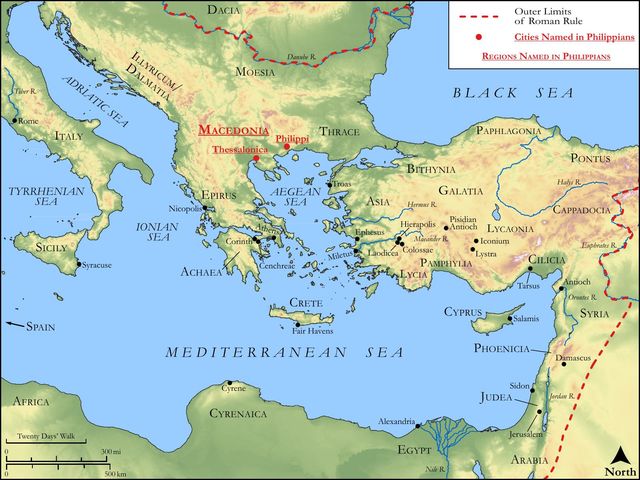
See on the biblical-era maps

Study this verse
Public-domain commentary
Matthew Henry
From his Commentary on the Whole Bible. Henry comments on passages, not single verses — this entry covers Philippians 3:17–21. His three-level outline is real structure in the source text, so it is rendered as structure.
He closes the chapter with warnings and exhortations.
I.He warns them against following the examples of seducers and evil teachers (Phi 3:18, Phi 3:19):
Many walk, of whom I have told you often, and now tell you weeping, that they are the enemies of the cross of Christ. Observe,
1.There are many called by Christ's name who are enemies to Christ's cross, and the design and intention of it. Their walk is a surer evidence what they are than their profession. By their fruits you shall know them, Mat 7:20. The apostle warns people against such,
(1.)Very frequently: I have told you often. We so little heed the warnings given us that we have need to have them repeated. To write the same things is safe, Phi 3:1.
(2.)Feelingly and affectionately: I now tell you weeping. Paul was upon proper occasions a weeping preacher, as Jeremiah was a weeping prophet. Observe, An old sermon may be preached with new affections; what we say often we may say again, if we say it affectionately, and are ourselves under the power of it.
2.He gives us the characters of those who were the enemies of the cross of Christ.
(1.)Whose God is their belly. They minded nothing but their sensual appetites. A wretched idol it is, and a scandal for any, but especially for Christians, to sacrifice the favour of God, the peace of their conscience, and their eternal happiness to it. Gluttons and drunkards make a god of their belly, and all their care is to please it and make provision for it. The same observance which good people give to God epicures give to their appetites. Of such he says, They serve not the Lord Jesus Christ, but their own bellies, Rom 16:18.
(2.)They glory in their shame. They not only sinned, but boasted of it and gloried in that of which they ought to have been ashamed. Sin is the sinner's shame, especially when it is gloried in. "They value themselves for what is their blemish and reproach." (3.) They mind earthly things. Christ came by his cross to crucify the world to us and us to the world; and those who mind earthly things act directly contrary to the cross of Christ, and this great design of it. They relish earthly things, and have no relish of the things which are spiritual and heavenly. They set their hearts and affections on earthly things; they love them, and even dote upon them, and have a confidence and complacency in them. He gives them this character, to show how absurd it would be for Christians to follow the example of such or be led away by them; and, to deter us all from so doing, he reads their doom. (4.) Whose end is destruction. Their way seems pleasant, but death and hell are at the end of it. What fruit had you then in those things whereof you are now ashamed? For the end of those things is death, Rom 6:21. It is dangerous following them, though it is going down the stream; for, if we choose their way, we have reason to fear their end. Perhaps he alludes to the total destruction of the Jewish nation.
II.He proposes himself and his brethren for an example, in opposition to these evil examples:
Brethren, be followers together of me, and mark those who walk as you have us for an example, Phi 3:17. Mark them out for your pattern. He explains himself (Phi 3:20) by their regard to Christ and heaven: For our conversation is in heaven. Observe, Good Christians, even while they are here on earth, have their conversation in heaven. Their citizenship is there, politeuma. As if he had said, We stand related the that world, and are citizens of the New Jerusalem. This world is not our home, but that is. There our greatest privileges and concerns lie. And, because our citizenship is there, our conversation is there; being related to that world, we keep up a correspondence with it. The life of a Christian is in heaven, where his head is, and his home is, and where he hopes to be shortly; he sets his affections upon things above; and where his heart is there will his conversation be. The apostle had pressed them to follow him and other ministers of Christ: "Why," might they say, "you are a company of poor, despised, persecuted people, who make no figure, and pretend to no advantages in the world; who will follow you?" "Nay," says he, "but our conversation is in heaven. We have a near relation and a great pretension to the other world, and are not so mean and despicable as we are represented." It is good having fellowship with those who have fellowship with Christ, and conversation with those whose conversation is in heaven.
1.Because we look for the Saviour from heaven (Phi 3:20): Whence also we look for the Saviour, the Lord Jesus Christ. He is not here, he has ascended, he has entered within the veil for us; and we expect his second coming thence, to gather in all the citizens of that New Jerusalem to himself.
2.Because at the second coming of Christ we expect to be happy and glorified there. There is good reason to have our conversation in heaven, not only because Christ is now there, but because we hope to be there shortly: Who shall change our vile bodies, that they may be fashioned like unto his glorious body, Phi 3:21. There is a glory reserved for the bodies of the saints, which they will be instated in at the resurrection. The body is now at the best a vile body, to sōma tēs tapeinōseōs hēmōn - the body of our humiliation: it has its rise and origin from the earth, it is supported out of the earth, and is subject to many diseases and to death at last. Besides, it is often the occasion and instrument of much sin, which is called the body of this death, Rom 7:24. Or it may be understood of its vileness when it lies in the grave; at the resurrection it will be found a vile body, resolved into rottenness and dust; the dust will return to the earth as it was, Ecc 12:7. But it will be made a glorious body; and not only raised again to life, but raised to great advantage. Observe,
(1.)The sample of this change, and that is, the glorious body of Christ; when he was transfigured upon the mount, his face did shine as the sun, and his raiment was white as the light, Mat 17:2. He went to heaven clothed with a body, that he might take possession of the inheritance in our nature, and be not only the first-born from the dead, but the first-born of the children of the resurrection. We shall be conformed to the image of his Son, that he may be the first-born among many brethren, Rom 8:29.
(2.)The power by which this change will be wrought: According to the working whereby he is able even to subdue all things unto himself. There is an efficacy of power, an exceeding greatness of power, and the working of mighty power, Eph 1:19. It is matter of comfort to us that he can subdue all things to himself, and sooner or later will bring over all into his interest. And the resurrection will be wrought by this power. I will raise him up at the last day, Joh 6:44. Let this confirm our faith of the resurrection, that we not only have the scriptures, which assure us it shall be, but we know the power of God, which can effect it, Mat 22:29. At Christ's resurrection was a glorious instance of the divine power, and therefore he is declared to be the Son of God with power, by the resurrection from the dead (Rom 1:4), so will our resurrection be: and his resurrection is a standing evidence, as well as pattern, of ours. And then all the enemies of the Redeemer's kingdom will be completely conquered. Not only he who had the power of death, that is, the devil (Heb 2:14), but the last enemy, shall be destroyed, that is, death, Co1 15:26, shall be swallowed up in victory, Co1 15:54.
Historical interpretation
Historical reception
1 surviving comment on this verse from the historical church.
"Brethren, be ye imitators of me, and mark them which so walk even as ye have us for an ensample."
He had said above, "beware of dogs," from such he had led them away; he brings them near to these whom they ought to imitate. If any one, saith he, wishes to imitate me, if any one wishes to walk the same road, let him take heed to them; though I am not present, ye know the manner of my walk, that is, my conduct in life. For not by words only did he teach, but by deeds too; as in the chorus, and the army, the rest must imitate the leader of the chorus or the army, and thus advance in good order. For it is possible that the order may be dissolved by sedition.
The Apostles therefore were a type, and kept throughout a certain archetypal model. Consider how entirely accurate their life was, so that they are proposed as an archetype and example, and as living laws. For what was said in their writings, they manifested to all in their actions. This is the best teaching; thus he will be able to carry on his disciple. But if he indeed speaks as a philosopher, yet in his actions doth the contrary, he is no longer a teacher. For mere verbal philosophy is easy even for the disciple: but there is need of that teaching and leading which comes of deeds. For this both makes the teacher to be reverenced, and prepares the disciple to yield obedience. How so? When one sees him delivering philosophy in words, he will say he commands impossibilities; that they are impossibilities, he himself is the first to show, who does not practice them. But if he sees his virtue fully carried out in action, he will no longer be able to speak thus. Yet although the life of our teacher be careless, let us take heed to ourselves, and let us listen to the words of the prophet; "They shall be all taught of God." (Isa. liv. 13) "And they shall teach no more every man his brother, saying, Know the Lord, for they shall all know me from the least of them to the greatest of them." (Jer. xxxi. 34) Hast thou a teacher who is not virtuous? Still thou hast Him who is truly a Teacher, whom alone thou shouldest call a Teacher. Learn from Him: He hath said, "Learn of Me, for I am meek." (Matt. xi. 29) Take not heed, then, to thy teacher, but to Him and to His lessons. Take thence thy examples, thou hast a most excellent model, to it conform thyself. There are innumerable models laid before thee in the Scriptures of virtuous lives; whichsoever thou wilt, come, and after the Master find it in the disciples.
Continue studying Philippians 3:17 across the web’s major study libraries — every link below opens this exact verse, chapter, or book on the destination site.
Read & Compare
 BibleGatewayThis verse in more than 200 translations and 70 languages.
 Bible.comThe YouVersion reader — hundreds of translations, reading plans, and highlights.
 ESV.orgCrossway's official English Standard Version reader.
 NET BibleThe NET translation with 60,000+ translators' notes on every rendering decision.
 STEP BibleTyndale House's free study tool — original text, vocabulary, and scholarly resources.
 BibliaLogos Bible Software's free web reader.
 USCCBThe New American Bible (Revised Edition) with the U.S. bishops' study notes.
Commentaries
 BibleHub CommentariesDozens of classic commentaries on this verse, gathered on one page.
 StudyLightMore than 100 commentary sets — the largest collection on the web.
 BibleRefPlain-English commentary on what this verse means, verse by verse.
 Enduring WordDavid Guzik's free commentary on this chapter, widely used by Bible teachers.
 Bible Study ToolsVerse commentary alongside Greek and Hebrew study aids.
Original Language & Research
- BibleHub InterlinearThe verse word by word — original language, transliteration, and English.
- BibleHub LexiconEvery word's original-language definition and Strong's entry.
 Blue Letter BibleDeep-study tools — Strong's numbers, concordance, and word studies.
 CNTR CollationThe earliest Greek manuscripts of this verse, collated letter by letter.
Sermons, Hymns & Audio


TrulyRandomVerse is not affiliated with these sites and doesn’t control their content. They’re linked because they’re genuinely useful.
Summary
In Philippians 3:17, the Apostle Paul issues a profound exhortation to the believers in Philippi, urging them to collectively imitate his Christ-centered life and to carefully observe others who walk according to this same godly pattern. This verse serves as a powerful call to intentional discipleship, emphasizing the critical role of spiritual examples in the Christian journey and the necessity of discerning those whose lives genuinely reflect the pursuit of Christ.
Context
ShowHideLiterary Context
This verse is strategically placed within a pivotal section of Paul's letter, immediately following his deeply personal and passionate discourse on his relentless pursuit of Christ. In Philippians 3:12-16, Paul articulates his unwavering commitment to pressing toward the goal of knowing Christ more fully, attaining righteousness not by law but through faith, and experiencing the power of His resurrection. He humbly admits he has not yet "arrived" but encourages all mature believers to adopt this same mindset of forward spiritual momentum. Against this backdrop of intense Christ-focus and spiritual striving, Paul presents himself and his fellow workers (like Timothy and Epaphroditus) as tangible models for the Philippians to emulate. This instruction also serves as a stark contrast to the "enemies of the cross of Christ" whom he will lament in Philippians 3:18-19, highlighting the urgent need for discernment in following true examples.
Historical & Cultural Context
Philippi was a Roman colony, and its citizens prided themselves on their Roman identity and customs. The concept of imitation (Greek: mimēsis) was prevalent among both the Greeks and the Jews. In philosophical schools, students would imitate their teachers' lives and doctrines. In Judaism, disciples followed the patterns set by revered rabbis and prophets. Paul, in this context, does not present himself as an infallible deity but as a faithful disciple of Christ, whose life provides a concrete, accessible example of what it means to live out the gospel. The Philippian church faced external pressures from paganism and internal threats from false teachers (likely Judaizers, who emphasized law-keeping for salvation, and possibly antinomians, who advocated for lawless living). Paul's call to imitate him and "mark" others was therefore crucial for the church's theological purity and practical holiness, providing a clear standard against competing influences.
Key Themes
ShowHideThe overarching theme of Philippians 3 is the supreme value of knowing Christ and gaining righteousness through Him, contrasting with any human achievement or religious pedigree. Within this chapter, Philippians 3:17 contributes significantly to several key themes. Imitation and Discipleship are central, as Paul explicitly calls for a collective following of his example, which he elsewhere clarifies is an imitation of Christ Himself (1 Corinthians 11:1). This highlights the importance of spiritual mentorship and the practical outworking of faith. The theme of Godly Example underscores the power of a visible, consistent Christian life as a living pattern for others. Finally, Discernment is crucial, as believers are instructed to "mark" or carefully observe those whose lives genuinely align with the apostolic pattern, distinguishing them from those who might lead astray, a warning echoed in 2 Peter 2:1-3.
Exposition and Analysis
ShowHideKey Word Analysis
ShowHideMeaning "a brother (literally or figuratively) near or remote." Paul frequently uses this term to address fellow believers, emphasizing their familial bond in Christ. It establishes a tone of loving exhortation rather than authoritarian command, appealing to a shared identity and common purpose within the Christian community.
Meaning "a co-imitator, i.e. fellow votary." This compound word, combining "together with" (syn) and "imitator" (mimētēs), emphasizes a collective, shared act of imitation. It's not just individual discipleship but a communal commitment to follow a specific pattern of life. Paul invites them to join him in his pursuit of Christ, implying a mutual journey.
Meaning "to take aim at (spy), i.e. (figuratively) regard." This verb implies a careful, deliberate, and attentive observation, not a casual glance. It suggests fixing one's gaze on something with a view to understanding or emulating it. In this context, it calls for active discernment and intentional identification of those whose lives genuinely embody the gospel.
Meaning "a die (as struck), i.e. (by implication) a stamp or scar; by analogy, a shape, i.e. a statue, (figuratively) style or resemblance; specially, a sampler ("type"), i.e. a model (for imitation) or instance (for warning)." Here, it denotes a pattern, model, or blueprint. Paul presents his life and the lives of those like him as a tangible standard or mold by which the Philippians can measure their own conduct and shape their spiritual walk.
Verse Breakdown
ShowHide"Brethren, be followers together of me"
Paul opens with a term of endearment, "Brethren," fostering a sense of shared identity and mutual respect. The core command, "be followers together of me," is an imperative that calls the entire community to a collective imitation of Paul's life. This is not an act of self-aggrandizement but an invitation to adopt his Christ-centered values, priorities, and conduct, which he has just detailed in the preceding verses (e.g., counting all things as loss for Christ, pressing toward the goal).
"and mark them which walk so"
This clause introduces a crucial element of discernment. The conjunction "and" links the command to imitate Paul with the imperative to "mark" or carefully observe others. "Them which walk so" refers to those whose lives consistently align with the pattern Paul has set—a life characterized by the pursuit of Christ, humility, self-sacrifice, and obedience to the gospel. This implies that not all who claim to be followers of Christ truly embody His principles, necessitating careful observation by the believers.
"as ye have us for an ensample"
This final phrase provides the standard for both imitation and discernment. Paul explicitly states that he and his companions (e.g., Timothy, Epaphroditus) serve as the "ensample" or model. Their lives are the living blueprint, the tangible demonstration of what it means to "walk so." This provides a clear, accessible, and authoritative pattern for the Philippian believers to follow, grounding the abstract call to Christ-likeness in concrete, observable human examples.
Literary Devices
ShowHidePhilippians 3:17 employs several effective literary devices to convey its powerful message. The most prominent is Imperative Mood, as Paul issues direct commands ("be followers," "mark them"), underscoring the urgency and non-negotiable nature of his exhortation. This direct address creates a sense of immediate responsibility for the readers. Paul also uses Metaphor with the phrase "them which walk so," where "walk" (Greek: peripatéō) serves as a common biblical metaphor for one's manner of life, conduct, or spiritual journey. This vivid imagery helps the audience understand that the pattern to be observed is not merely intellectual assent but lived experience. Furthermore, the verse functions as a clear Exhortation, a strong encouragement to a particular course of action, rooted in Paul's pastoral concern for the Philippians' spiritual well-being. Finally, the verse is deeply Didactic, serving to teach and instruct the church on the practical aspects of discipleship, the importance of spiritual models, and the necessity of discernment in the Christian community.
Theological and Thematic Connections
ShowHidePhilippians 3:17 is a profound statement on the nature of Christian discipleship and the role of spiritual example within the body of Christ. It underscores the theological truth that faith is not merely a set of beliefs but a lived reality, a "walk" that is observable and imitable. Paul's willingness to present himself as an "ensample" is rooted in his prior declaration that he himself imitates Christ, making his life a transparent conduit for Christ's character and mission. This highlights the vital importance of spiritual mentorship and the communal aspect of sanctification, where believers learn from and encourage one another in their pursuit of Christ-likeness. The command to "mark them which walk so" further emphasizes the critical theological principle of discernment, urging believers to carefully evaluate the lives and teachings of others against the standard of apostolic truth and Christ's example, safeguarding the purity of the gospel within the church.
Reflection and Application
ShowHidePhilippians 3:17 presents a timeless challenge and encouragement for believers today. It compels us to consider whose lives we are following and, conversely, what kind of example we are setting for others. In an age saturated with diverse influences, the call to "mark them which walk so" is more crucial than ever, demanding a discerning eye to identify genuine Christ-followers whose lives align with biblical truth and godly character. This requires intentional observation, prayer, and a deep grounding in God's Word to distinguish authentic spiritual leadership from superficial or even harmful patterns. For those of us who are called to lead, teach, or simply live out our faith in public, Paul's example serves as a sobering reminder of the responsibility inherent in our Christian walk. Our lives are not merely our own; they are a living commentary on the gospel, a "typos" or pattern that others may consciously or unconsciously imitate. Therefore, we are exhorted to live with integrity, humility, and a relentless pursuit of Christ, knowing that our "walk" can either draw others closer to Him or lead them astray.
Questions for Reflection
ShowHideFAQ
ShowHideIs it arrogant for Paul to tell people to imitate him?
ShowHideNo, it is not arrogant for Paul to tell the Philippians to imitate him. Paul consistently grounds his call for imitation in his own imitation of Christ. As he explicitly states in 1 Corinthians 11:1, "Be imitators of me, as I am of Christ." Paul's life was a living demonstration of the gospel he preached, particularly his willingness to suffer for Christ, his relentless pursuit of Christ-likeness, and his abandonment of all earthly advantages for the sake of knowing Jesus (as detailed in Philippians 3:4-11). He was not inviting them to follow him for his own glory, but to follow the Christ whom he embodied. His authority came from his apostolic calling and his genuine, transparent devotion to Jesus, making him a reliable and accessible "ensample" of Christian living.
Christ-Centered Fulfillment
ShowHidePhilippians 3:17, while calling believers to imitate Paul, ultimately points beyond Paul to Christ Himself as the supreme and perfect "ensample." Paul's life was not the end goal, but a living demonstration of what it means to truly follow Jesus. He had just articulated his profound desire to "gain Christ" and be found in Him, counting all things as loss for the surpassing worth of knowing Jesus Christ his Lord (Philippians 3:8). Therefore, when Paul urges the Philippians to "be followers together of me," he is implicitly directing them to follow his Christ-centered values, priorities, and conduct. Jesus Himself issued the ultimate call to discipleship, saying, "Follow me, and I will make you fishers of men" (Matthew 4:19). He is the embodiment of perfect obedience (Philippians 2:8), selfless love (John 15:13), and unwavering faith. The Christian's ultimate aim is to be conformed to the image of His Son (Romans 8:29), and Paul's life served as a tangible, though imperfect, blueprint for that transformation, always redirecting the gaze to the one true pattern, Jesus Christ, who lives in believers and empowers them to walk as He walked (1 John 2:6).