


Philippians 3:18
Bible text: King James Version (1769 Blayney text) · Public domain
Bible text: King James Version with Strong's numbers · Public domain
Bible text: Berean Standard Bible · Public domain
Bible text: American Standard Version (1901) · Public domain
Bible text: World English Bible, Messianic edition · Public domain
Bible text: Geneva Bible (1599) · Public domain
Bible text: Young's Literal Translation · Public domain
- πολλοὶpolloiManyG4183A-NPMAdjective Nominative Plural Masculine
- γὰρgarforG1063CONJConjunction
- περιπατοῦσινperipatousinare walking —G4043V-PAI-3PVerb Present Active Indicative 3rd Plural
- οὓςhous[of] whomG3739R-APMRelative pronoun Accusative Plural Masculine
- πολλάκιςpollakisoftenG4178ADVAdverb
- ἔλεγονelegonI was tellingG3004V-IAI-1SVerb Imperfect Active Indicative 1st Singular
- ὑμῖνhuminyouG4771P-2DPPersonal pronoun Dative 2nd Plural
- νῦνnunnowG3568ADVAdverb
- δὲdeindeedG1161CONJConjunction
- καὶkaievenG2532CONJConjunction
- κλαίωνklaiōnweepingG2799V-PAP-NSMVerb Present Active Participle Nominative Singular Masculine
- λέγωlegōI say —G3004V-PAI-1SVerb Present Active Indicative 1st Singular
- τοὺςtous[as] theG3588T-APMDefinite article Accusative Plural Masculine
- ἐχθροὺςechthrousenemiesG2190N-APMNoun Accusative Plural Masculine
- τοῦtouof theG3588T-GSMDefinite article Genitive Singular Masculine
- σταυροῦstauroucrossG4716N-GSMNoun Genitive Singular Masculine
- τοῦtou<the>G3588T-GSMDefinite article Genitive Singular Masculine
- ΧριστοῦChristouof ChristG5547N-GSM-TNoun Genitive Singular Masculine Title
English is a literal word-by-word gloss of the Greek, not the KJV's wording. Why?
This is the original text the KJV's translators worked from — each Greek word with its own literal English meaning in this verse, prepared by scholars at Tyndale House, Cambridge. The KJV translates whole sentences, not word by word, so its wording differs: one Greek word can become several English words, and the KJV may choose “charity” where the gloss reads “love”. Both are faithful — they answer different questions. For the KJV's own rendering, switch to the KJV text.
Details
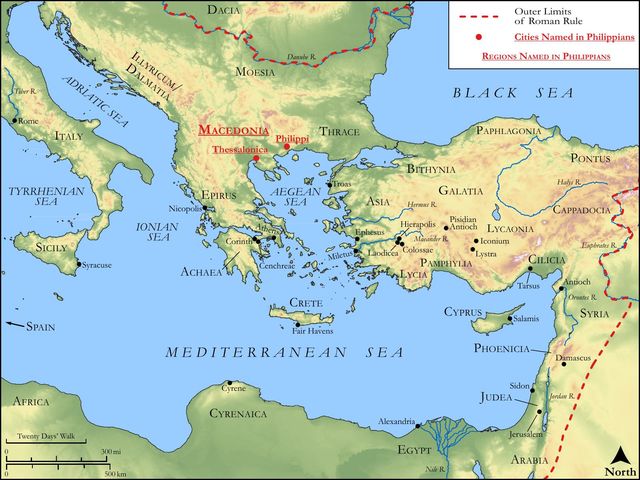
See on the biblical-era maps

Study this verse
Public-domain commentary
Matthew Henry
From his Commentary on the Whole Bible. Henry comments on passages, not single verses — this entry covers Philippians 3:17–21. His three-level outline is real structure in the source text, so it is rendered as structure.
He closes the chapter with warnings and exhortations.
I.He warns them against following the examples of seducers and evil teachers (Phi 3:18, Phi 3:19):
Many walk, of whom I have told you often, and now tell you weeping, that they are the enemies of the cross of Christ. Observe,
1.There are many called by Christ's name who are enemies to Christ's cross, and the design and intention of it. Their walk is a surer evidence what they are than their profession. By their fruits you shall know them, Mat 7:20. The apostle warns people against such,
(1.)Very frequently: I have told you often. We so little heed the warnings given us that we have need to have them repeated. To write the same things is safe, Phi 3:1.
(2.)Feelingly and affectionately: I now tell you weeping. Paul was upon proper occasions a weeping preacher, as Jeremiah was a weeping prophet. Observe, An old sermon may be preached with new affections; what we say often we may say again, if we say it affectionately, and are ourselves under the power of it.
2.He gives us the characters of those who were the enemies of the cross of Christ.
(1.)Whose God is their belly. They minded nothing but their sensual appetites. A wretched idol it is, and a scandal for any, but especially for Christians, to sacrifice the favour of God, the peace of their conscience, and their eternal happiness to it. Gluttons and drunkards make a god of their belly, and all their care is to please it and make provision for it. The same observance which good people give to God epicures give to their appetites. Of such he says, They serve not the Lord Jesus Christ, but their own bellies, Rom 16:18.
(2.)They glory in their shame. They not only sinned, but boasted of it and gloried in that of which they ought to have been ashamed. Sin is the sinner's shame, especially when it is gloried in. "They value themselves for what is their blemish and reproach." (3.) They mind earthly things. Christ came by his cross to crucify the world to us and us to the world; and those who mind earthly things act directly contrary to the cross of Christ, and this great design of it. They relish earthly things, and have no relish of the things which are spiritual and heavenly. They set their hearts and affections on earthly things; they love them, and even dote upon them, and have a confidence and complacency in them. He gives them this character, to show how absurd it would be for Christians to follow the example of such or be led away by them; and, to deter us all from so doing, he reads their doom. (4.) Whose end is destruction. Their way seems pleasant, but death and hell are at the end of it. What fruit had you then in those things whereof you are now ashamed? For the end of those things is death, Rom 6:21. It is dangerous following them, though it is going down the stream; for, if we choose their way, we have reason to fear their end. Perhaps he alludes to the total destruction of the Jewish nation.
II.He proposes himself and his brethren for an example, in opposition to these evil examples:
Brethren, be followers together of me, and mark those who walk as you have us for an example, Phi 3:17. Mark them out for your pattern. He explains himself (Phi 3:20) by their regard to Christ and heaven: For our conversation is in heaven. Observe, Good Christians, even while they are here on earth, have their conversation in heaven. Their citizenship is there, politeuma. As if he had said, We stand related the that world, and are citizens of the New Jerusalem. This world is not our home, but that is. There our greatest privileges and concerns lie. And, because our citizenship is there, our conversation is there; being related to that world, we keep up a correspondence with it. The life of a Christian is in heaven, where his head is, and his home is, and where he hopes to be shortly; he sets his affections upon things above; and where his heart is there will his conversation be. The apostle had pressed them to follow him and other ministers of Christ: "Why," might they say, "you are a company of poor, despised, persecuted people, who make no figure, and pretend to no advantages in the world; who will follow you?" "Nay," says he, "but our conversation is in heaven. We have a near relation and a great pretension to the other world, and are not so mean and despicable as we are represented." It is good having fellowship with those who have fellowship with Christ, and conversation with those whose conversation is in heaven.
1.Because we look for the Saviour from heaven (Phi 3:20): Whence also we look for the Saviour, the Lord Jesus Christ. He is not here, he has ascended, he has entered within the veil for us; and we expect his second coming thence, to gather in all the citizens of that New Jerusalem to himself.
2.Because at the second coming of Christ we expect to be happy and glorified there. There is good reason to have our conversation in heaven, not only because Christ is now there, but because we hope to be there shortly: Who shall change our vile bodies, that they may be fashioned like unto his glorious body, Phi 3:21. There is a glory reserved for the bodies of the saints, which they will be instated in at the resurrection. The body is now at the best a vile body, to sōma tēs tapeinōseōs hēmōn - the body of our humiliation: it has its rise and origin from the earth, it is supported out of the earth, and is subject to many diseases and to death at last. Besides, it is often the occasion and instrument of much sin, which is called the body of this death, Rom 7:24. Or it may be understood of its vileness when it lies in the grave; at the resurrection it will be found a vile body, resolved into rottenness and dust; the dust will return to the earth as it was, Ecc 12:7. But it will be made a glorious body; and not only raised again to life, but raised to great advantage. Observe,
(1.)The sample of this change, and that is, the glorious body of Christ; when he was transfigured upon the mount, his face did shine as the sun, and his raiment was white as the light, Mat 17:2. He went to heaven clothed with a body, that he might take possession of the inheritance in our nature, and be not only the first-born from the dead, but the first-born of the children of the resurrection. We shall be conformed to the image of his Son, that he may be the first-born among many brethren, Rom 8:29.
(2.)The power by which this change will be wrought: According to the working whereby he is able even to subdue all things unto himself. There is an efficacy of power, an exceeding greatness of power, and the working of mighty power, Eph 1:19. It is matter of comfort to us that he can subdue all things to himself, and sooner or later will bring over all into his interest. And the resurrection will be wrought by this power. I will raise him up at the last day, Joh 6:44. Let this confirm our faith of the resurrection, that we not only have the scriptures, which assure us it shall be, but we know the power of God, which can effect it, Mat 22:29. At Christ's resurrection was a glorious instance of the divine power, and therefore he is declared to be the Son of God with power, by the resurrection from the dead (Rom 1:4), so will our resurrection be: and his resurrection is a standing evidence, as well as pattern, of ours. And then all the enemies of the Redeemer's kingdom will be completely conquered. Not only he who had the power of death, that is, the devil (Heb 2:14), but the last enemy, shall be destroyed, that is, death, Co1 15:26, shall be swallowed up in victory, Co1 15:54.
Historical interpretation
Three Centuries of Reception
7 surviving comments on this verse. Each one is dated, so this reads as a timeline rather than a list.
Select a marker to jump to its quote. Markers stagger vertically where authors wrote within a few decades of each other.
And after the observance of the Sabbath, let every friend of Christ keep the Lord's Day as a festival, the resurrection-day, the queen and chief of all the days [of the week]. Looking forward to this, the prophet declared, "To the end, for the eighth day," on which our life both sprang up again, and the victory over death was obtained in Christ, whom the children of perdition, the enemies of the Saviour, deny, "whose god is their belly, who mind earthly things," who are "lovers of pleasure, and not lovers of God, having a form of godliness, but denying the power thereof." These make merchandise of Christ, corrupting His word, and giving up Jesus to sale: they are corrupters of women, and covetous of other men's possessions, swallowing up wealth insatiably; from whom may ye be delivered by the mercy of God through our Lord Jesus Christ!
These things I write to you, thou new olive-tree of Christ, not that I am aware you hold any such opinions, but that I may put you on your guard, as a father does his children. Beware, therefore, of those that hasten to work mischief, those "enemies of the cross of Christ, whose end is destruction, whose glory is in their shame." Beware of those "dumb dogs," those trailing serpents, those scaly dragons, those asps, and basilisks, and scorpions. For these are subtle wolves, and apes that mimic the appearance of men.
Do ye also avoid those wicked offshoots of his, Simon his firstborn son, and Menander, and Basilides, and all his wicked mob of followers, the worshippers of a man, whom also the prophet Jeremiah pronounces accursed. Flee also the impure Nicolaitanes, falsely so called, who are lovers of pleasure, and given to calumnious speeches. Avoid also the children of the evil one, Theodotus and Cleobulus, who produce death-bearing fruit, whereof if any one tastes, he instantly dies, and that not a mere temporary death, but one that shall endure for ever. These men are not the planting of the Father, but are an accursed brood. And says the Lord, "Let every plant which my heavenly Father has not planted be rooted up." For if they had been branches of the Father, they would not have been "enemies of the cross of Christ," but rather of those who "killed the Lord of glory." But now, by denying the cross, and being ashamed of the passion, they cover the transgression of the Jews, those fighters against God, those murderers of the Lord; for it were too little to style them merely murderers of the prophets. But Christ invites you to [share in] His immortality, by His passion and resurrection, inasmuch as ye are His members.
An exhortation is stronger when it is accompanied by what is fearful in its alternative.… Paul expresses heartfelt affection when he describes the evils suffered by those who live otherwise, saying, “I say it with tears.”
There are two types of misunderstanding of Christ, or rather one class of two descriptions, who are enemies of Christ. For some in their carnal thoughts deride the cross of Christ, thinking of Christ merely as a man raised onto a cross.… These pay attention to nothing but the flesh. To them “their god is a belly” and their “glory is in filthiness.” These are the ones who “think earthly thoughts” and whose end is death. On the other hand, there are those who think of Christ only as a spirit. They do not think of him as incarnate or crucified. They too are enemies to the cross of Christ, having death as their end.
Those who bring him to tears are the very ones who had already overthrown the Galatians. By treacherous proceedings they were destroying the churches in the name of Christ.… He speaks of these people with grief and tears. They were impeding the salvation of the faithful by raising questions about the eating of or abstinence from food. It is as though salvation were in food or as if “God were a belly,” one whom they believed to take delight in worldly foods according to the law while they gloried in the circumcision of their private parts. This is what it is to “think earthly thoughts.” One who “thinks spiritual thoughts” glories in faith, hope and charity.
"Many walk, of whom I told you often, and now tell you even weeping, that they are the enemies of the cross of Christ." Since there were some who made a pretense of Christianity, yet lived in ease and luxury, and this is contrary to the Cross: therefore he thus spoke. For the cross belongs to a soul at its post for the fight, longing to die, seeking nothing like ease, whilst their conduct is of the contrary sort. So that even if they say, they are Christ's, still they are as it were enemies of the Cross. For did they love the Cross, they would strive to live the crucified life. Was not thy Master hung upon the tree? Do thou otherwise imitate Him. Crucify thyself, though no one crucify thee. Crucify thyself, not that thou mayest slay thyself, God forbid, for that is a wicked thing, but as Paul said, "The world hath been crucified unto me and I unto the world." If thou lovest thy Master, die His death. Learn how great is the power of the Cross; how many good things it hath achieved, and doth still: how it is the safety of our life. Through it all things are done. Baptism is through the Cross, for we must receive that seal. The laying on of hands is through the Cross. If we are on journeys, if we are at home, wherever we are, the Cross is a great good, the armor of salvation, a shield which cannot be beaten down, a weapon to oppose the devil; thou bearest the Cross when thou art at enmity with him, not simply when thou sealest thyself by it, but when thou sufferest the things belonging to the Cross. Christ thought fit to call our sufferings by the name of the Cross. As when he saith, "Except a man take up his cross and follow Me," i.e. except he be prepared to die.
But these being base, and lovers of life, and lovers of their bodies, are enemies of the Cross. And every one, who is a friend of luxury, and of present safety, is an enemy of that Cross in which Paul makes his boast: which he embraces, with which he desires to be incorporated. As when he saith, "I am crucified unto the world, and the world unto me." But here he saith, "I now tell you weeping." Wherefore? Because the evil was urgent, because such deserve tears. Of a truth the luxurious are worthy of tears, who make fat that which is thrown about them, I mean the body, and take no thought of that soul which must give account. Behold thou livest delicately, behold thou art drunken, to-day and to-morrow, ten years, twenty, thirty, fifty, a hundred, which is impossible; but if thou wilt, let us suppose it. What is the end? What is the gain? Nought at all. Doth it not then deserve tears, and lamentations, to lead such a life; God hath brought us into this course, that He may crown us, and we take our departure without doing any noble action. Wherefore Paul weepeth, where others laugh, and live in pleasure.
Continue studying Philippians 3:18 across the web’s major study libraries — every link below opens this exact verse, chapter, or book on the destination site.
Read & Compare
 BibleGatewayThis verse in more than 200 translations and 70 languages.
 Bible.comThe YouVersion reader — hundreds of translations, reading plans, and highlights.
 ESV.orgCrossway's official English Standard Version reader.
 NET BibleThe NET translation with 60,000+ translators' notes on every rendering decision.
 STEP BibleTyndale House's free study tool — original text, vocabulary, and scholarly resources.
 BibliaLogos Bible Software's free web reader.
 USCCBThe New American Bible (Revised Edition) with the U.S. bishops' study notes.
Commentaries
 BibleHub CommentariesDozens of classic commentaries on this verse, gathered on one page.
 StudyLightMore than 100 commentary sets — the largest collection on the web.
 BibleRefPlain-English commentary on what this verse means, verse by verse.
 Enduring WordDavid Guzik's free commentary on this chapter, widely used by Bible teachers.
 Bible Study ToolsVerse commentary alongside Greek and Hebrew study aids.
Original Language & Research
- BibleHub InterlinearThe verse word by word — original language, transliteration, and English.
- BibleHub LexiconEvery word's original-language definition and Strong's entry.
 Blue Letter BibleDeep-study tools — Strong's numbers, concordance, and word studies.
 CNTR CollationThe earliest Greek manuscripts of this verse, collated letter by letter.
Sermons, Hymns & Audio


TrulyRandomVerse is not affiliated with these sites and doesn’t control their content. They’re linked because they’re genuinely useful.
Summary
In Philippians 3:18, the Apostle Paul issues a grave warning to the church in Philippi, expressing profound sorrow over individuals whose conduct and priorities fundamentally contradict the core message and transformative power of the Gospel. These individuals, whom Paul has often warned about, and now laments with tears, are identified as "enemies of the cross of Christ," signifying their opposition not necessarily through direct persecution, but through a lifestyle that undermines the very essence of Christ's atoning sacrifice and its call to self-denial and new life.
Context
ShowHideLiterary Context
This verse is situated within a crucial section of Paul's letter where he passionately contrasts true righteousness, found only in Christ, with false confidence derived from human achievement or legalistic observance. Having just urged the Philippians to imitate his own pursuit of Christ and to follow those who live according to this example, Paul immediately pivots to warn against those whose lives are antithetical to this path. The verse serves as a stark counterpoint to Paul's earlier declaration of counting all things loss for the surpassing worth of knowing Christ Jesus his Lord (Philippians 3:7-11). The subsequent verse, Philippians 3:19, elaborates on the tragic characteristics and ultimate destruction awaiting these enemies, further emphasizing the urgency and gravity of Paul's warning.
Historical & Cultural Context
Philippi was a Roman colony, proud of its Roman citizenship, and its inhabitants were often influenced by Roman cultural values, including a focus on honor, status, and material prosperity. The specific identity of these "enemies of the cross" is debated among scholars, but they likely represent a group (or groups) whose behavior, rather than explicit doctrine, betrayed the Gospel. They could have been Judaizers, emphasizing circumcision and law-keeping over Christ's finished work, or antinomians, who, misunderstanding Christian liberty, indulged in fleshly desires. Given Paul's emphasis on their "belly" and "shame" in the following verse, a strong case can be made for those who prioritized worldly appetites and self-indulgence over the self-sacrificial call of the cross. Paul's deep emotional connection to the Philippian church, which he founded, underscores his profound anguish over any threat to their spiritual well-being.
Key Themes
ShowHidePhilippians 3:18 contributes significantly to several key themes within the letter. First, it highlights the centrality of the cross in Christian theology and practice. For Paul, the cross is not merely a historical event but the defining characteristic of Christian life, demanding self-denial and a reorientation of priorities. Second, it addresses the theme of true versus false righteousness, contrasting Paul's single-minded pursuit of Christ's righteousness with the self-serving or worldly pursuits of these "enemies." Third, Paul's "weeping" underscores the theme of pastoral anguish and genuine concern for the spiritual state of believers, even those who stray. This deep emotional expression reveals the profound love and responsibility Paul felt for the churches he served, echoing his concern for other communities like those in Galatia or Corinth. Finally, the verse implicitly touches upon discipleship and imitation, serving as a negative example against which true followers of Christ are to measure their lives, reinforcing the call to "walk" in a manner worthy of the Gospel (Philippians 1:27).
Exposition and Analysis
ShowHideKey Word Analysis
ShowHideThis verb, G4043, literally means "to tread all around" or "walk at large." Figuratively, as used here, it signifies one's manner of life, conduct, or deportment. Paul is not merely talking about physical movement but the entire trajectory and character of these individuals' lives. Their "walk" or lifestyle is what reveals their true allegiance.
G2799 is a strong verb indicating a loud wail or sob, distinct from silent crying. Paul's use of this word conveys profound grief, sorrow, and anguish. It is not an expression of anger or condemnation but of deep heartbreak over the spiritual demise and destructive path of these individuals, and the potential harm they could inflict on the church.
Derived from a root meaning "to hate," describes someone who is hateful (passively, odious) or actively hostile. When used as a noun, it refers to an adversary. Here, it denotes a deep-seated antagonism. These individuals are not merely misguided or mistaken; their very way of life is fundamentally opposed to, or hostile towards, the principles and power embodied by the cross of Christ.
Verse Breakdown
ShowHide"(For many walk,"
Paul introduces the reason for his warning. The term "walk" (peripatéō) signifies a consistent lifestyle or manner of conduct. The "many" implies that this is not an isolated issue but a widespread problem, indicating a significant number of people whose lives are characterized by this opposition.
"of whom I have told you often, and now tell you even weeping,"
This clause reveals Paul's persistent pastoral concern and the depth of his emotional pain. He has repeatedly warned the Philippians about these individuals, indicating an ongoing struggle or recurring threat. The phrase "even weeping" powerfully conveys his profound sorrow, demonstrating that his warnings stem from love and anguish, not anger or judgment. His tears underscore the gravity of their spiritual condition and the destructive consequences of their path.
"[that they are] the enemies of the cross of Christ:"
This is the core identification. These individuals are not necessarily external persecutors of Christianity, but rather those whose lives, priorities, or teachings undermine the very essence of Christ's atoning work on the cross. The "cross of Christ" represents not only His sacrificial death for sin but also the call to self-denial, humility, and a life transformed by His power. To be an "enemy" of the cross means to live in a way that fundamentally opposes its saving power, its ethical demands, or its transformative impact, often by prioritizing self-indulgence, worldly gain, or a works-based righteousness.
Literary Devices
ShowHidePaul employs several powerful literary devices in this verse to convey his urgent message. The use of pathos is particularly prominent, as Paul explicitly states he is "weeping." This direct expression of intense emotion is designed to evoke a similar sense of sorrow and urgency in his readers, emphasizing the gravity of the situation and the depth of his pastoral concern. There is also a strong element of contrast implied: Paul's own life, characterized by a single-minded pursuit of Christ and a willingness to suffer for the Gospel, stands in stark opposition to the "walk" of these enemies. The phrase "enemies of the cross" functions as a potent metaphor, vividly describing their spiritual antagonism. It's not a literal battle against a wooden structure, but a profound ideological and lifestyle opposition to everything the cross represents: atonement, self-sacrifice, humility, and redemption. Finally, the repetition of "I have told you often, and now tell you" serves as a form of emphasis, highlighting the persistent nature of the threat and Paul's consistent warnings, thereby underscoring the critical importance of his message.
Theological and Thematic Connections
ShowHidePhilippians 3:18 serves as a profound theological statement on the nature of authentic Christian discipleship and the ever-present danger of internal opposition to the Gospel. It underscores that true faith is not merely intellectual assent but a life lived in conformity to the self-sacrificial pattern of Christ's cross. Those who are "enemies of the cross" are not necessarily atheists or external persecutors, but often individuals who, while perhaps claiming some form of religious adherence, live in a manner that fundamentally negates the cross's call to humility, self-denial, and spiritual transformation. Their "walk" reveals a heart still enslaved to worldly desires, fleshly appetites, or human boasting, thereby nullifying the power and implications of Christ's ultimate sacrifice. Paul's weeping highlights the pastoral heart of God, deeply grieving over those who reject the path of life, even when they are seemingly within the community of faith.
Reflection and Application
ShowHidePaul's tearful warning in Philippians 3:18 resonates deeply with believers today, serving as a powerful call to introspection and discernment. It challenges us to examine our own "walk"—our daily lives, priorities, and affections—to ensure they are truly aligned with the radical implications of the cross of Christ. Are we embracing the self-denial, humility, and sacrificial love that the cross embodies, or are we, perhaps subtly, prioritizing our own desires, worldly comforts, or human achievements in a way that undermines its transformative power? This verse reminds us that genuine faith is evidenced not just by what we say, but by how we live. Furthermore, Paul's profound sorrow models for us a truly compassionate pastoral heart. It calls us to grieve over those who stray from the truth, to warn them with love and tears rather than anger or judgment, and to earnestly pray for their repentance and restoration. It is a reminder that the spiritual battle is not just against external forces, but often against subtle corruptions within the church that can lead souls away from the life-giving power of Christ's sacrifice.
Questions for Reflection
ShowHideFAQ
ShowHideWho are these "enemies of the cross of Christ" that Paul refers to?
ShowHidePaul is likely not referring to external persecutors of the church, but rather to individuals, possibly even within the Christian community or those who claim to be religious, whose lifestyle and priorities fundamentally contradict the core message of the cross. As indicated in the following verse (Philippians 3:19), their characteristics include having their "God is their belly" (prioritizing sensual appetites or material gain), glorying "in their shame" (boasting in things that should cause shame), and having their "mind on earthly things." These could include legalists who rely on human effort rather than Christ's finished work, or antinomians who abuse Christian liberty for self-indulgence. Their "enmity" is expressed through a life that negates the cross's call to self-sacrifice, humility, and transformation.
Christ-Centered Fulfillment
ShowHidePhilippians 3:18, though a warning against those who oppose the cross, ultimately magnifies the centrality and redemptive power of Christ's work. The very concept of being an "enemy of the cross" highlights the profound significance of what Christ accomplished there. The cross is the ultimate demonstration of God's love (John 3:16) and the means by which humanity is reconciled to God (2 Corinthians 5:18-19). Those who are "enemies" reject or undermine the self-emptying humility of Christ, who, though in the form of God, did not consider equality with God a thing to be grasped, but emptied Himself, taking the form of a servant, and became obedient to the point of death, even death on a cross. Their focus on earthly things stands in stark contrast to Christ's heavenly focus and His call for His followers to seek first the kingdom of God and His righteousness. Ultimately, the cross is the victory over sin and death (Colossians 2:14-15), and to be its enemy is to stand against the very means of salvation and the transformative power of the resurrected Christ, whose return will bring ultimate judgment upon all who oppose His redemptive work (Philippians 3:20-21).