


Philippians 3:19
Bible text: King James Version (1769 Blayney text) · Public domain
Bible text: Berean Standard Bible · Public domain
Bible text: American Standard Version (1901) · Public domain
Bible text: World English Bible, Messianic edition · Public domain
Bible text: Geneva Bible (1599) · Public domain
Bible text: Young's Literal Translation · Public domain
- ὧνhōnwhoseG3739R-GPMRelative pronoun Genitive Plural Masculine
- τὸto<the>G3588T-NSNDefinite article Nominative Singular Neuter
- τέλοςtelosend [is]G5056N-NSNNoun Nominative Singular Neuter
- ἀπώλειαapōleiadestructionG684N-NSFNoun Nominative Singular Feminine
- ὧνhōnwhoseG3739R-GPMRelative pronoun Genitive Plural Masculine
- ὁho<the>G3588T-NSMDefinite article Nominative Singular Masculine
- θεὸςtheosGod [is]G2316N-NSM-TNoun Nominative Singular Masculine Title
- ἡhētheG3588T-NSFDefinite article Nominative Singular Feminine
- κοιλίαkoiliabellyG2836N-NSFNoun Nominative Singular Feminine
- καὶkaiandG2532CONJConjunction
- ἡhē<the>G3588T-NSFDefinite article Nominative Singular Feminine
- δόξαdoxagloryG1391N-NSFNoun Nominative Singular Feminine
- ἐνen[is] inG1722PREPPreposition
- τῇtēatheG3588T-DSFDefinite article Dative Singular Feminine
- αἰσχύνῃaischunēshameG152N-DSFNoun Dative Singular Feminine
- αὐτῶνautōnof themG846P-GPMPersonal pronoun Genitive Plural Masculine
- οἱhoithoseG3588T-NPMDefinite article Nominative Plural Masculine
- τὰta<the> [things]G3588T-APNDefinite article Accusative Plural Neuter
- ἐπίγειαepigeiaearthlyG1919A-APNAdjective Accusative Plural Neuter
- φρονοῦντεςphronountesmindingG5426V-PAP-NPMVerb Present Active Participle Nominative Plural Masculine
English is a literal word-by-word gloss of the Greek, not the KJV's wording. Why?
This is the original text the KJV's translators worked from — each Greek word with its own literal English meaning in this verse, prepared by scholars at Tyndale House, Cambridge. The KJV translates whole sentences, not word by word, so its wording differs: one Greek word can become several English words, and the KJV may choose “charity” where the gloss reads “love”. Both are faithful — they answer different questions. For the KJV's own rendering, switch to the KJV text.
Details
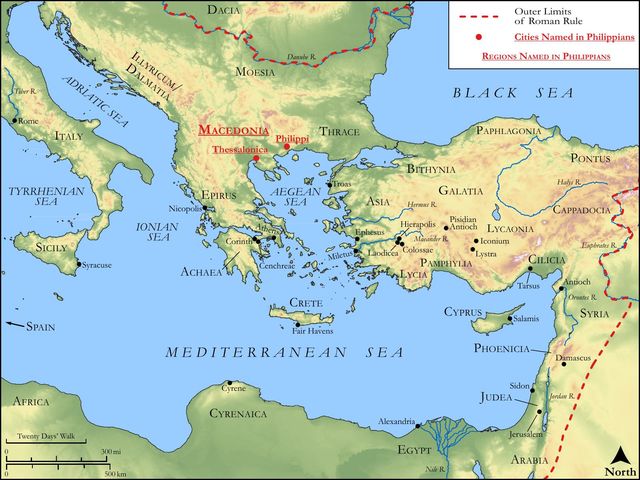
See on the biblical-era maps

Study this verse
Public-domain commentary
Matthew Henry
From his Commentary on the Whole Bible. Henry comments on passages, not single verses — this entry covers Philippians 3:17–21. His three-level outline is real structure in the source text, so it is rendered as structure.
He closes the chapter with warnings and exhortations.
I.He warns them against following the examples of seducers and evil teachers (Phi 3:18, Phi 3:19):
Many walk, of whom I have told you often, and now tell you weeping, that they are the enemies of the cross of Christ. Observe,
1.There are many called by Christ's name who are enemies to Christ's cross, and the design and intention of it. Their walk is a surer evidence what they are than their profession. By their fruits you shall know them, Mat 7:20. The apostle warns people against such,
(1.)Very frequently: I have told you often. We so little heed the warnings given us that we have need to have them repeated. To write the same things is safe, Phi 3:1.
(2.)Feelingly and affectionately: I now tell you weeping. Paul was upon proper occasions a weeping preacher, as Jeremiah was a weeping prophet. Observe, An old sermon may be preached with new affections; what we say often we may say again, if we say it affectionately, and are ourselves under the power of it.
2.He gives us the characters of those who were the enemies of the cross of Christ.
(1.)Whose God is their belly. They minded nothing but their sensual appetites. A wretched idol it is, and a scandal for any, but especially for Christians, to sacrifice the favour of God, the peace of their conscience, and their eternal happiness to it. Gluttons and drunkards make a god of their belly, and all their care is to please it and make provision for it. The same observance which good people give to God epicures give to their appetites. Of such he says, They serve not the Lord Jesus Christ, but their own bellies, Rom 16:18.
(2.)They glory in their shame. They not only sinned, but boasted of it and gloried in that of which they ought to have been ashamed. Sin is the sinner's shame, especially when it is gloried in. "They value themselves for what is their blemish and reproach." (3.) They mind earthly things. Christ came by his cross to crucify the world to us and us to the world; and those who mind earthly things act directly contrary to the cross of Christ, and this great design of it. They relish earthly things, and have no relish of the things which are spiritual and heavenly. They set their hearts and affections on earthly things; they love them, and even dote upon them, and have a confidence and complacency in them. He gives them this character, to show how absurd it would be for Christians to follow the example of such or be led away by them; and, to deter us all from so doing, he reads their doom. (4.) Whose end is destruction. Their way seems pleasant, but death and hell are at the end of it. What fruit had you then in those things whereof you are now ashamed? For the end of those things is death, Rom 6:21. It is dangerous following them, though it is going down the stream; for, if we choose their way, we have reason to fear their end. Perhaps he alludes to the total destruction of the Jewish nation.
II.He proposes himself and his brethren for an example, in opposition to these evil examples:
Brethren, be followers together of me, and mark those who walk as you have us for an example, Phi 3:17. Mark them out for your pattern. He explains himself (Phi 3:20) by their regard to Christ and heaven: For our conversation is in heaven. Observe, Good Christians, even while they are here on earth, have their conversation in heaven. Their citizenship is there, politeuma. As if he had said, We stand related the that world, and are citizens of the New Jerusalem. This world is not our home, but that is. There our greatest privileges and concerns lie. And, because our citizenship is there, our conversation is there; being related to that world, we keep up a correspondence with it. The life of a Christian is in heaven, where his head is, and his home is, and where he hopes to be shortly; he sets his affections upon things above; and where his heart is there will his conversation be. The apostle had pressed them to follow him and other ministers of Christ: "Why," might they say, "you are a company of poor, despised, persecuted people, who make no figure, and pretend to no advantages in the world; who will follow you?" "Nay," says he, "but our conversation is in heaven. We have a near relation and a great pretension to the other world, and are not so mean and despicable as we are represented." It is good having fellowship with those who have fellowship with Christ, and conversation with those whose conversation is in heaven.
1.Because we look for the Saviour from heaven (Phi 3:20): Whence also we look for the Saviour, the Lord Jesus Christ. He is not here, he has ascended, he has entered within the veil for us; and we expect his second coming thence, to gather in all the citizens of that New Jerusalem to himself.
2.Because at the second coming of Christ we expect to be happy and glorified there. There is good reason to have our conversation in heaven, not only because Christ is now there, but because we hope to be there shortly: Who shall change our vile bodies, that they may be fashioned like unto his glorious body, Phi 3:21. There is a glory reserved for the bodies of the saints, which they will be instated in at the resurrection. The body is now at the best a vile body, to sōma tēs tapeinōseōs hēmōn - the body of our humiliation: it has its rise and origin from the earth, it is supported out of the earth, and is subject to many diseases and to death at last. Besides, it is often the occasion and instrument of much sin, which is called the body of this death, Rom 7:24. Or it may be understood of its vileness when it lies in the grave; at the resurrection it will be found a vile body, resolved into rottenness and dust; the dust will return to the earth as it was, Ecc 12:7. But it will be made a glorious body; and not only raised again to life, but raised to great advantage. Observe,
(1.)The sample of this change, and that is, the glorious body of Christ; when he was transfigured upon the mount, his face did shine as the sun, and his raiment was white as the light, Mat 17:2. He went to heaven clothed with a body, that he might take possession of the inheritance in our nature, and be not only the first-born from the dead, but the first-born of the children of the resurrection. We shall be conformed to the image of his Son, that he may be the first-born among many brethren, Rom 8:29.
(2.)The power by which this change will be wrought: According to the working whereby he is able even to subdue all things unto himself. There is an efficacy of power, an exceeding greatness of power, and the working of mighty power, Eph 1:19. It is matter of comfort to us that he can subdue all things to himself, and sooner or later will bring over all into his interest. And the resurrection will be wrought by this power. I will raise him up at the last day, Joh 6:44. Let this confirm our faith of the resurrection, that we not only have the scriptures, which assure us it shall be, but we know the power of God, which can effect it, Mat 22:29. At Christ's resurrection was a glorious instance of the divine power, and therefore he is declared to be the Son of God with power, by the resurrection from the dead (Rom 1:4), so will our resurrection be: and his resurrection is a standing evidence, as well as pattern, of ours. And then all the enemies of the Redeemer's kingdom will be completely conquered. Not only he who had the power of death, that is, the devil (Heb 2:14), but the last enemy, shall be destroyed, that is, death, Co1 15:26, shall be swallowed up in victory, Co1 15:54.
Historical interpretation
Two Centuries of Reception
5 surviving comments on this verse. Each one is dated, so this reads as a timeline rather than a list.
Select a marker to jump to its quote. Markers stagger vertically where authors wrote within a few decades of each other.
Such are the men who believe in their belly, "whose God is their belly, whose glory is in their shame, who mind earthly things. "To them the apostle predicted no good when he said, "whose end is destruction."
Not one of such women knows how to speak of the good of single-husbandhood; for their "god," as the apostle says, "is their belly; " and so, too, what is neighbour to the belly.
Deservedly, therefore, while they do not cover their head, in order that they may be solicited for the sake of glory, they are forced to cover their bellies by the ruin resulting from infirmity. For it is emulation, not religion, which impels them. Sometimes it is that god- their belly -himself; because the brotherhood readily undertakes the maintenance of virgins.
every toil of forced complaisance, with a view to ensnaring the childless; which makes the slaves of the belly submit to contumelious patronage, in the subjection of their liberty to their gullet.
"Whose God," saith he, "is the belly." For this have they a God! That is, "let us eat and drink!" Dost thou see, how great an evil luxury is? to some their wealth, and to others their belly is a god. Are not these too idolaters, and worse than the common? And their "glory is in their shame." Some say it is circumcision. I think not so, but this is its meaning, they make a boast of those things, of which they ought to be ashamed. It is a fearful thing to do shameful actions; yet to do them, and be ashamed, is only half so dreadful. But where a man even boasts himself of them, it is excessive senselessness.
Do these words apply to them alone? And do those who are here present escape the charge? And will no one have account to render of these things? Does no one make a god of his belly, or glory in his shame? I wish, earnestly I wish, that none of these charges lay against us, and that I did not know any one involved in what I have said. But I fear lest the words have more reference to us than to the men of those times. For when one consumes his whole life in drinking and reveling, and expends some small trifle on the poor, whilst he consumes the larger portion on his belly, will not these words with justice apply to him? No words are more apt to call attention, or more cutting in reproof, than these: "Whose god is the belly, whose glory is in their shame." And who are these? They, he says, who mind earthly things. "Let us build houses." Where, I ask? On the earth, they answer. Let us purchase farms; on the earth again: let us obtain power; again on the earth: let us gain glory; again on the earth: let us enrich ourselves; all these things are on the earth. These are they, whose god is their belly; for if they have no spiritual thoughts, but have all their possessions here, and mind these things, with reason have they their belly for their god, in saying, "Let us eat and drink, for to-morrow we die." And about thy body, thou grievest, tell me, that it is of earth, though thus thou art not at all injured. But thy soul thou draggest down to the earth, when thou oughtest to render even thy body spiritual; for thou mayest, if thou wilt. Thou hast received a belly, that thou mayest feed, not distend it, that thou mayest have the mastery over it, not have it as mistress over thee: that it may minister to thee for the nourishment of the other parts, not that thou mayest minister to it, not that thou mayest exceed limits. The sea, when it passes its bounds, doth not work so many evils, as the belly doth to our body, together with our soul. The former overfloweth all the earth, the latter all the body. Put moderation for a boundary to it, as God hath put the sand for the sea. Then if its waves arise, and rage furiously, rebuke it, with the power which is in thee. See how God hath honored thee, that thou mightest imitate Him, and thou wilt not; but thou seest the belly overflowing, destroying and overwhelming thy whole nature, and darest not to restrain or moderate it.
"Whose God," he saith, "is their belly." Let us see how Paul served God: let us see how gluttons serve their belly. Do not they undergo ten thousand such deaths? do not they fear to disobey whatever it orders? do not they minister impossibilities to it? Are not they worse than slaves?
Continue studying Philippians 3:19 across the web’s major study libraries — every link below opens this exact verse, chapter, or book on the destination site.
Read & Compare
 BibleGatewayThis verse in more than 200 translations and 70 languages.
 Bible.comThe YouVersion reader — hundreds of translations, reading plans, and highlights.
 ESV.orgCrossway's official English Standard Version reader.
 NET BibleThe NET translation with 60,000+ translators' notes on every rendering decision.
 STEP BibleTyndale House's free study tool — original text, vocabulary, and scholarly resources.
 BibliaLogos Bible Software's free web reader.
 USCCBThe New American Bible (Revised Edition) with the U.S. bishops' study notes.
Commentaries
 BibleHub CommentariesDozens of classic commentaries on this verse, gathered on one page.
 StudyLightMore than 100 commentary sets — the largest collection on the web.
 BibleRefPlain-English commentary on what this verse means, verse by verse.
 Enduring WordDavid Guzik's free commentary on this chapter, widely used by Bible teachers.
 Bible Study ToolsVerse commentary alongside Greek and Hebrew study aids.
Original Language & Research
- BibleHub InterlinearThe verse word by word — original language, transliteration, and English.
- BibleHub LexiconEvery word's original-language definition and Strong's entry.
 Blue Letter BibleDeep-study tools — Strong's numbers, concordance, and word studies.
 CNTR CollationThe earliest Greek manuscripts of this verse, collated letter by letter.
Sermons, Hymns & Audio


TrulyRandomVerse is not affiliated with these sites and doesn’t control their content. They’re linked because they’re genuinely useful.
Summary
Philippians 3:19 serves as a stark and somber warning from the Apostle Paul, delineating the characteristics and ultimate fate of those who live in opposition to the true gospel of Christ. These individuals, whom Paul identifies as "enemies of the cross," are characterized by their carnal pursuits, their idolatrous devotion to self-gratification, their perverted sense of honor in shameful acts, and their exclusive focus on temporal, earthly matters, all of which lead inevitably to spiritual ruin.
Context
ShowHideLiterary Context
This verse stands as a powerful and sorrowful indictment, immediately following Paul's tearful lament in Philippians 3:18. Paul has just passionately described his own pursuit of Christ-likeness, counting all his former achievements as loss for the surpassing worth of knowing Christ Jesus (Philippians 3:7-11). He urges the Philippians to imitate him and those who live similarly (Philippians 3:17). In stark contrast, verse 19 describes those whose lives contradict the very essence of the cross, serving as a negative example. This sets the stage for Paul's subsequent declaration of the believer's true citizenship and future hope in Christ's return (Philippians 3:20-21). The entire chapter is a profound exposition on true righteousness by faith versus reliance on human effort or carnal indulgence.
Historical & Cultural Context
Paul's warning likely targets specific groups or tendencies prevalent among the Gentiles and within early Christian communities. While some scholars suggest these "enemies" could be Judaizers (who emphasized works of the Law), the description in verse 19 leans more towards antinomians or hedonists—those who, perhaps under the guise of Christian liberty, indulged in sensual appetites and worldly pursuits. The city of Philippi itself, a Roman colony, would have been familiar with a culture that often celebrated physical pleasure, material wealth, and worldly status. The concept of "citizenship" (which Paul introduces in Philippians 3:20) was highly significant to Philippians, and Paul deliberately contrasts their earthly citizenship with the believer's heavenly one, highlighting the spiritual dangers of being consumed by the values of this world.
Key Themes
ShowHidePhilippians 3:19 contributes significantly to several key themes within the letter and broader Pauline theology. It underscores the theme of false teaching and its consequences, warning against those whose lives betray their supposed faith. It vividly portrays idolatry, where the "belly" (representing carnal desires and self-gratification) replaces God as the object of ultimate devotion. The verse also highlights the crucial distinction between earthly-mindedness and heavenly-mindedness, a recurring tension in Paul's epistles (e.g., Colossians 3:1-2). Furthermore, it speaks to the theme of eschatological destiny, contrasting the "destruction" awaiting the unrepentant with the glorious transformation awaiting believers at Christ's return (Philippians 3:20-21). This verse serves as a sober reminder that genuine faith is demonstrated by a transformed life and a heavenly orientation, not by mere profession or worldly indulgence.
Exposition and Analysis
ShowHideKey Word Analysis
ShowHideFrom a presumed derivative of apóllumi, meaning ruin or loss (physical, spiritual or eternal). This term signifies ultimate perdition, not necessarily annihilation, but a state of utter ruin, waste, and separation from God's presence and blessing. It is the antithesis of salvation and eternal life, indicating the tragic end of a life lived apart from Christ.
Literally meaning a cavity, especially the abdomen, or by implication, the womb. Figuratively, as used here, it represents the seat of carnal desires, sensual appetites, and base instincts. It's not merely about food, but about any physical or material pleasure that becomes one's controlling passion and object of worship, effectively replacing God.
From epí (upon) and gē (earth), meaning worldly (physically or morally), in earth, terrestrial. This word describes the nature of the things these individuals "mind" or set their affections upon. It signifies a preoccupation with the temporal, material, and humanistic aspects of life, in contrast to spiritual, eternal, and divine realities.
Verse Breakdown
ShowHide"Whose end [is] destruction"
This clause pronounces the inevitable and dreadful destiny of those described. Their chosen path, characterized by self-indulgence and worldly focus, culminates in apṓleia—a state of utter ruin, loss, and eternal separation from God. This is not a casual outcome but a divinely ordained consequence of their rebellion against the cross of Christ.
"whose God [is their] belly"
This is a powerful and shocking metaphor. It reveals the idolatrous nature of their lives, where the satisfaction of their physical appetites and carnal desires has become their ultimate devotion and guiding principle. Rather than worshipping the true God, they serve their own cravings, making their koilía (belly, representing all base desires) their functional deity.
"and [whose] glory [is] in their shame"
This clause highlights a profound moral and spiritual perversion. These individuals find pride, honor, and boastfulness (dóxa) in activities, lifestyles, or achievements that are, in God's eyes, morally reprehensible and disgraceful (aischýnē). Their value system is inverted; what should cause shame brings them glory, demonstrating a complete distortion of divine standards.
"who mind earthly things"
This final clause summarizes their entire orientation. Their thoughts, affections, ambitions, and entire mental disposition (phronéō) are fixed exclusively on epígeios—the temporal, material, and worldly aspects of existence. Their focus is not on heavenly realities, spiritual growth, or the kingdom of God, but on the fleeting comforts, status, and pleasures of this present world.
Literary Devices
ShowHidePaul employs several potent literary devices in Philippians 3:19 to underscore his warning. The most prominent is Metaphor, specifically in the phrase "whose God is their belly." This vivid image personifies carnal appetite, elevating it to the status of a deity, effectively illustrating the idolatry of self-indulgence. There is also striking Irony in "whose glory is in their shame," where the very things that should evoke disgrace are sources of pride for these individuals, highlighting their inverted moral compass. Furthermore, the entire verse functions as a powerful Contrast to the life of genuine believers, whose citizenship is in heaven and whose minds are set on Christ (Philippians 3:20). This stark juxtaposition serves to clarify the two divergent paths and their ultimate destinations.
Theological and Thematic Connections
ShowHidePhilippians 3:19 profoundly articulates the theological truth that one's ultimate allegiance determines one's eternal destiny. By making their "belly" their god and minding "earthly things," these individuals demonstrate a profound form of practical atheism and idolatry, effectively rejecting the sovereignty of the one true God. Their pursuit of self-gratification and worldly values leads them away from the cross of Christ, which demands self-denial and a heavenly orientation. This verse serves as a crucial reminder that the Christian life is not merely about profession but about a transformed heart and a reordered set of priorities, where Christ is supreme and eternal realities outweigh temporal desires. The "destruction" they face is the just consequence of their chosen path, emphasizing the gravity of spiritual choices.
Reflection and Application
ShowHidePhilippians 3:19 serves as a timeless mirror, inviting believers to a profound self-examination. It challenges us to honestly assess where our true allegiances lie. Are our affections, ambitions, and daily pursuits genuinely centered on Christ and the advancement of His kingdom, or are we subtly allowing worldly comforts, material possessions, fleeting pleasures, or even our own desires to become our functional "god"? This verse calls us to discernment, urging us to recognize and resist any teaching or lifestyle, whether overt or subtle, that undermines the transformative power of the cross by promoting self-indulgence or an exclusive focus on the temporal. It is a powerful reminder that true Christian living involves a radical reorientation of our values, where we find our glory not in earthly achievements or carnal satisfaction, but in Christ alone, embracing the humility and self-sacrifice embodied by the cross. Our citizenship is in heaven, and our lives should reflect that eternal reality, eagerly awaiting the return of our Savior.
Questions for Reflection
ShowHideFAQ
ShowHideWho are the "enemies of the cross of Christ" that Paul refers to?
ShowHideWhile Paul doesn't explicitly name them, the context and characteristics described in Philippians 3:19 suggest they are not necessarily overt persecutors of Christians. Instead, they are likely individuals (possibly within the Christian community or those who profess some form of faith) whose lifestyle, values, and teaching fundamentally undermine the message and implications of the cross. This could include antinomians (those who believe grace allows for lawlessness), hedonists (those devoted to pleasure), or even legalists (who, by relying on works, diminish the cross's sufficiency). Their "enemy" status arises from their practical denial of the cross's call to self-denial, spiritual transformation, and heavenly focus.
What does "whose God is their belly" mean?
ShowHideThis is a powerful metaphor indicating that these individuals are enslaved to their carnal appetites and physical desires. The "belly" here represents not just literal food, but any form of self-indulgence, sensual pleasure, or material gratification. For them, satisfying these desires becomes their ultimate priority, their guiding principle, and effectively, their object of worship, replacing the true God. It signifies a life driven by selfish cravings rather than by spiritual devotion or obedience to Christ. This concept is echoed in Romans 16:18, where Paul speaks of those who "serve not our Lord Jesus Christ, but their own belly."
Christ-Centered Fulfillment
ShowHidePhilippians 3:19, while a stark warning, ultimately points to the profound necessity and transformative power of Christ. The "destruction" it speaks of is the inevitable fate of humanity apart from Him, but Christ offers the way of salvation and eternal life (John 3:16). The "belly-god" finds its antidote in Christ, who taught radical self-denial and the pursuit of God's kingdom above all else (Matthew 6:33). Where these enemies find "glory in their shame," Christ took on shame and humiliation on the cross, making it the source of our true glory and righteousness (Hebrews 12:2). Most profoundly, the "earthly-mindedness" of those described is overcome by Christ, who calls us to a new life where our minds are set on heavenly things because we are united with Him in His death and resurrection (Colossians 3:1-2). Through Christ, believers are given a new nature, a new citizenship in heaven (Philippians 3:20), and the power of the Holy Spirit to live a life transformed, no longer serving the flesh but walking in the Spirit (Romans 8:5-6). Thus, this warning underscores the radical difference Christ makes, offering escape from destruction and a life of true glory centered on Him.