


Colossians 3:5
Bible text: King James Version (1769 Blayney text) · Public domain
Bible text: King James Version with Strong's numbers · Public domain
Bible text: Berean Standard Bible · Public domain
Bible text: American Standard Version (1901) · Public domain
Bible text: World English Bible, Messianic edition · Public domain
Bible text: Geneva Bible (1599) · Public domain
Bible text: Young's Literal Translation · Public domain
- ΝεκρώσατεNekrōsatedo put to deathG3499V-AAM-2PVerb Aorist Active Imperative 2nd Plural
- οὖνounthereforeG3767CONJConjunction
- τὰtatheG3588T-APNDefinite article Accusative Plural Neuter
- μέληmelēmembersG3196N-APNNoun Accusative Plural Neuter
- ὑμῶνhumōnof youG4771P-2GPPersonal pronoun Genitive 2nd Plural
- τὰtawhich [are]G3588T-APNDefinite article Accusative Plural Neuter
- ἐπὶepiuponG1909PREPPreposition
- τῆςtēstheG3588T-GSFDefinite article Genitive Singular Feminine
- γῆςgēsearthG1093N-GSFNoun Genitive Singular Feminine
- πορνείανporneiansexual immoralityG4202N-ASFNoun Accusative Singular Feminine
- ἀκαθαρσίανakatharsianimpurityG167N-ASFNoun Accusative Singular Feminine
- πάθοςpathospassionG3806N-ASNNoun Accusative Singular Neuter
- ἐπιθυμίανepithumiandesireG1939N-ASFNoun Accusative Singular Feminine
- κακὴνkakēnevilG2556A-ASFAdjective Accusative Singular Feminine
- καὶkaiandG2532CONJConjunction
- τὴνtēn<the>G3588T-ASFDefinite article Accusative Singular Feminine
- πλεονεξίανpleonexiancovetousnessG4124N-ASFNoun Accusative Singular Feminine
- ἥτιςhētiswhichG3748R-NSFRelative pronoun Nominative Singular Feminine
- ἐστὶνestinisG1510V-PAI-3SVerb Present Active Indicative 3rd Singular
- εἰδωλολατρίαeidōlolatriaidolatryG1495N-NSFNoun Nominative Singular Feminine
English is a literal word-by-word gloss of the Greek, not the KJV's wording. Why?
This is the original text the KJV's translators worked from — each Greek word with its own literal English meaning in this verse, prepared by scholars at Tyndale House, Cambridge. The KJV translates whole sentences, not word by word, so its wording differs: one Greek word can become several English words, and the KJV may choose “charity” where the gloss reads “love”. Both are faithful — they answer different questions. For the KJV's own rendering, switch to the KJV text.
Details
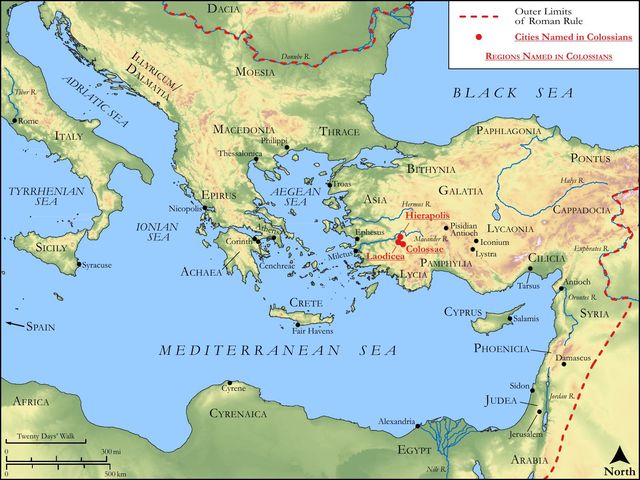
See on the biblical-era maps

Study this verse
Public-domain commentary
Matthew Henry
From his Commentary on the Whole Bible. Henry comments on passages, not single verses — this entry covers Colossians 3:5–7. His two-level outline is real structure in the source text, so it is rendered as structure.
The apostle exhorts the Colossians to the mortification of sin, the great hindrance to seeking the things which are above. Since it is our duty to set our affections upon heavenly things, it is our duty to mortify our members which are upon the earth, and which naturally incline us to the things of the world: "Mortify them, that is, subdue the vicious habits of mind which prevailed in your Gentile state. Kill them, suppress them, as you do weeds or vermin which spread and destroy all about them, or as you kill an enemy who fights against you and wounds you." - Your members which are upon the earth; either the members of the body, which are the earthly part of us, and were curiously wrought in the lower parts of the earth (Psa 139:15), or the corrupt affections of the mind, which lead us to earthly things, the members of the body of death, Rom 7:24. He specifies,
I.The lusts of the flesh, for which they were before so very remarkable:
Fornication, uncleanness, inordinate affection, evil concupiscence - the various workings of the carnal appetites and fleshly impurities, which they indulged in their former course of life, and which were so contrary to the Christian state and the heavenly hope.
II.The love of the world:
And covetousness, which is idolatry; that is, an inordinate love of present good and outward enjoyments, which proceeds from too high a value in the mind, puts upon too eager a pursuit, hinders the proper use and enjoyment of them, and creates anxious fear and immoderate sorrow for the loss of them. Observe, Covetousness is spiritual idolatry: it is the giving of that love and regard to worldly wealth which are due to God only, and carries a greater degree of malignity in it, and is more highly provoking to God, than is commonly thought. And it is very observable that among all the instances of sin which good men are recorded in the scripture to have fallen into (and there is scarcely any but some or other, in one or other part of their life, have fallen into) there is no instance in all the scripture of any good man charged with covetousness. He proceeds to show how necessary it is to mortify sins, Col 3:6, Col 3:7.
1.Because, if we do not kill them, they will kill us: For which things' sake the wrath of God cometh on the children of disobedience, Col 3:6. See what we are all by nature more or less: we are children of disobedience: not only disobedient children, but under the power of sin and naturally prone to disobey. The wicked are estranged from the womb; they go astray as soon as they are born, speaking lies, Psa 58:3. And, being children of disobedience, we are children of wrath, Eph 2:3. The wrath of God comes upon all the children of disobedience. Those who do not obey the precepts of the law incur the penalties of it. The sins he mentions were their sins in their heathen and idolatrous state, and they were then especially the children of disobedience; and yet these sins brought judgments upon them, and exposed them to the wrath of God.
2.We should mortify these sins because they have lived in us: In which you also walked some time, when you lived in them, Col 3:7. Observe, The consideration that we have formerly lived in sin is a good argument why we should now forsake it. We have walked in by-paths, therefore let us walk in them no more. If I have done iniquity, I will do no more, Job 34:32. The time past our lives may suffice us to have wrought the will of the Gentiles, when we walked in lasciviousness, Pe1 4:3. - When you lived among those who did such things (so some understand it), then you walked in those evil practices. It is a hard thing to live among those who do the works of darkness and not have fellowship with them, as it is to walk in the mire and contract no soil. Let us keep out of the way of evil-doers.
Historical interpretation
Eighteen Centuries of Reception
13 surviving comments on this verse. Each one is dated, so this reads as a timeline rather than a list.
Select a marker to jump to its quote. Markers stagger vertically where authors wrote within a few decades of each other.
This same, therefore, was what the Lord came to quicken, that as in Adam we do all die, as being of an animal nature, in Christ we may all live, as being spiritual, not laying aside God's handiwork, but the lusts of the flesh, and receiving the Holy Spirit; as the apostle says in the Epistle to the Colossians: "Mortify, therefore, your members which are upon the earth." And what these are he himself explains: "Fornication, uncleanness, inordinate affection, evil concupiscence; and covetousness, which is idolatry." The laying aside of these is what the apostle preaches; and he declares that those who do such things, as being merely flesh and blood, cannot inherit the kingdom of heaven.
"Mortify therefore your members which are upon the earth; fornication, uncleanness, inordinate affection, and concupiscence, and covetousness, which is idolatry: for which things' sake cometh the wrath of God upon the children of disobedience".
And to the Gnostic false opinion is foreign, as the true belongs to him, and is allied with him. Wherefore the noble apostle calls one of the kinds of fornication, idolatry,
If we think over the rest of faults, tracing them from their generations, let us begin with covetousness, "a root of all evils," wherewith, indeed, some having been ensnared, "have suffered shipwreck about faith." Albeit covetousness is by the same apostle called idolatry. In the next place proceeding to mendacity, the minister of covetousness (of false swearing I am silent, since even swearing is not lawful )-is trade adapted for a servant of God? But, covetousness apart, what is the motive for acquiring? When the motive for acquiring ceases, there will be no necessity for trading.
He demonstrates, too, to the Colossians what "members" they are to"mortify" upon earth: "fornication, impurity, lust, evil concupiscence," and "base talk." Yield up, by this time, to so many and such sentences, the one (passage) to which you cling.
Neither let the new heretics flatter themselves in this, that they say that they do not communicate with idolaters; although among them there are both adulterers and fraudulent persons, who are held guilty of the crime of idolatry, according to the saying of the apostle: "For know this with understanding, that no whoremonger, nor unclean person, nor covetous man, whose guilt is that of idolatry, hath any inheritance in the kingdom of Christ and of God." And again: "Mortify therefore your members which are upon the earth; putting off fornication, uncleanness, and evil concupiscence, and covetousness, which are the service of idols: for which things' sake cometh the wrath of God." For as our bodies are members of Christ, and we are each a temple of God, whosoever violates the temple of God by adultery, violates God; and he who, in committing sins, does the will of the devil, serves demons and idols. For evil deeds do not come from the Holy Spirit, but from the prompting of the adversary, and lusts born of the unclean spirit constrain men to act against God and to obey the devil. Thus it happens that if they say that one is polluted by another's sin, and if they con tend, by their own asseveration, that the idolatry of the delinquent passes over to one who is not guilty according to their own word; they cannot be excused from the crime of idolatry, since from the apostolic proof it is evident that the adulterers and defrauders with whom they communicate are idolaters. But with us, according to our faith and the given rule of divine preaching, agrees the principle of truth, that every one is himself held fast in his own sin; nor can one become guilty for another, since the Lord forewarns us, saying, "The righteousness of the righteous shall be upon him, and the wickedness of the wicked shall be upon him." And again: "The fathers shall not die for the children, and the children shall not die for the fathers. Every one shall die in his own sin." Reading and observing this, we certainly think that no one is to be restrained from the fruit of satisfaction, and the hope of peace, since we know, according to the faith of the divine Scriptures, God Himself being their author, and exhorting in them, both that sinners are brought back to repentance, and that pardon and mercy are not denied to penitents.
But God has appointed fixed limits to all of these; and if they pass these limits and begin to be too great, they must necessarily pervert their nature, and be changed into diseases and vices. And it is a matter of no great labour to show what these limits are.
But the saints, and they who truly practice virtue, “mortify their members” and as the result of this, are pure and without spot, confiding in the promise of our Savior, who said, “Blessed are the pure in heart, for they shall see God.” These, having become dead to the world, who have renounced the merchandise of the world, gain an honorable death.
But why did he begin his list with fornication? For having said, "Mortify your members which are upon the earth," he immediately says, "fornication"; and so he does almost everywhere. Because this passion hath the greatest sway. For even when writing his Epistle to the Thessalonians he did the same. And what wonder? since to Timothy even he saith, "Keep thyself pure"; and again elsewhere, "Follow after peace with all men, and the sanctification," without which "no man shall see the Lord." "Put to death," he says, "your members." Ye know of what sort that is which is dead, namely, hated, loathed, dropping to decay. If thou put anything to death, it doth not when dead continue dead, but presently is corrupted, like the body. Extinguish then the heat; and nothing that is dead will continue. He shows one having the same thing in hand, which Christ wrought in the Laver; therefore also he calleth them "members," as though introducing some champion, thus advancing his discourse to greater emphasis. And he well said, "Which are upon the earth," for here they continue, and here they are corrupted, far rather than these our members. So that not so truly is the body of the earth, as sin is earthly, for the former indeed appears even beautiful at times, but those members never. And those members lust after all things that are upon the earth. If the eye be such, it seeth not the things in the heavens; if the ear, if the hand, if thou mention any other member whatsoever. The eye seeth bodies, and beauties, and riches; these are the things of earth, with these it is delighted: the ear with soft strains, and harp, and pipe, and filthy talking; these are things which are concerned with earth.
When therefore he has placed his hearers above, near the throne, he then says, "Mortify your members which are upon the earth." For it is not possible to stand above with these members; for there is nothing there for them to work upon. And this clay is worse than that, for that clay indeed becometh gold, "for this corruptible," he saith, "must put on incorruption," but this clay can never be retempered more. So that these members are rather "upon the earth" than those. Therefore he said not, "of the earth," but, "which are upon the earth," for it is possible that these should not be upon the earth. For it is necessary that these should be "upon the earth," but that those should, is not necessary. For when the ear hears nothing of what is here uttered, but only in the heavens, when the eye sees nothing of what is here, but only what is above, it is not "upon the earth"; when the mouth speaketh nothing of the things here, it is not "upon the earth"; when the hand doeth no evil thing-these are not of things "upon the earth," but of those in the heavens.
"Mortify therefore your members," he saith, "which are upon the earth." What sayest thou? Was it not thou that saidst, "Ye are buried; ye are buried together with Him; ye are circumcised: we have put off the body of the sins of the flesh"; how then again sayest thou, "Mortify"? Art thou sporting? Dost thou thus discourse, as though those things were in us? There is no contradiction; but like as if one, who has clean scoured a statue that was filthy, or rather who has recast it, and displayed it bright afresh, should say that the rust was eaten off and destroyed, and yet should again recommend diligence in clearing away the rust, he doth not contradict himself, for it is not that rust which he scoured off that he recommends should be cleared away, but that which grew afterwards; so it is not that former putting to death he speaks of, nor those fornications, but those which do afterwards grow.
He said that this is not our life, but another, that which is in heaven. Tell me now. When he said, Mortify your members that are upon the earth, is then the earth also accused? or does he speak of the things upon the earth as themselves sins? "Fornication, uncleanness," he saith. He has passed over the actions which it is not becoming even to mention, and by "uncleanness" has expressed all together.
"Passion," he said, "evil desire."
Lo! he has expressed the whole in the class. For envy, anger, sorrow, all are "evil desire."
"And covetousness," he saith, "which is idolatry."
Now, if thou cut into that which is quick, it produces pain, but if into that which is dead, we are not even sensible of it. So, in truth, is it with the passions; they make the soul unclean; they make the soul, which is immortal, passible.
How covetousness is said to be idolatry, we have oftentimes explained. For the things which do most of all lord it over the human race, are these, covetousness, and unchasteness, and evil desire.
In a general way all that is of the devil is characterized by hatred for God. What is of the devil is idolatry, since all idols are subject to him. Yet Paul elsewhere lays down the law in express terms, saying: “Mortify your members.” Idolatry is not confined to casting incense upon an altar with finger and thumb or to pouring libations of wine out of a cup into a bowl.
Thus, in movements according to the spirit, the soul sometimes opposes other movements of itself according to the flesh. Conversely, in movements according to the flesh, it opposes others which it has according to the spirit, and this is why we say the flesh lusts against the spirit and the spirit lusts against the flesh. But this is also why “it is being renewed day by day,” for the soul does not fail to make progress in virtue as it gradually diminishes the carnal desires to which it does not consent. It is to those already baptized that the apostle says, “Mortify your members, which are on the earth.” .
You must be prepared for the unpleasant things and the discomforts... When you are training soldiers in maneuvers, you practice in blank ammunition because you would like them to have practice before meeting the real enemy. So we must practice in abstaining from pleasures which are not in themselves wicked. If you don't abstain from pleasure. you won't be good when the time comes along. It is purely a matter of practice.
Continue studying Colossians 3:5 across the web’s major study libraries — every link below opens this exact verse, chapter, or book on the destination site.
Read & Compare
 BibleGatewayThis verse in more than 200 translations and 70 languages.
 Bible.comThe YouVersion reader — hundreds of translations, reading plans, and highlights.
 ESV.orgCrossway's official English Standard Version reader.
 NET BibleThe NET translation with 60,000+ translators' notes on every rendering decision.
 STEP BibleTyndale House's free study tool — original text, vocabulary, and scholarly resources.
 BibliaLogos Bible Software's free web reader.
 USCCBThe New American Bible (Revised Edition) with the U.S. bishops' study notes.
Commentaries
 BibleHub CommentariesDozens of classic commentaries on this verse, gathered on one page.
 StudyLightMore than 100 commentary sets — the largest collection on the web.
 BibleRefPlain-English commentary on what this verse means, verse by verse.
 Enduring WordDavid Guzik's free commentary on this chapter, widely used by Bible teachers.
 Bible Study ToolsVerse commentary alongside Greek and Hebrew study aids.
Original Language & Research
- BibleHub InterlinearThe verse word by word — original language, transliteration, and English.
- BibleHub LexiconEvery word's original-language definition and Strong's entry.
 Blue Letter BibleDeep-study tools — Strong's numbers, concordance, and word studies.
 CNTR CollationThe earliest Greek manuscripts of this verse, collated letter by letter.
Sermons, Hymns & Audio


TrulyRandomVerse is not affiliated with these sites and doesn’t control their content. They’re linked because they’re genuinely useful.
Summary
Colossians 3:5 issues a direct and urgent command for believers to actively put to death or render inoperative the sinful desires and behaviors that belong to their former, earthly way of life. This verse lists specific vices—fornication, uncleanness, inordinate affection, evil concupiscence, and covetousness—culminating in the striking declaration that covetousness is, in essence, idolatry, thereby highlighting the profound spiritual nature of these seemingly "earthly" transgressions.
Context
ShowHideLiterary Context
Colossians 3:5 marks a pivotal transition in Paul's letter, moving from theological exposition to practical application. The preceding verses (Colossians 3:1-4) establish the believer's new identity in Christ, emphasizing that they have been "raised with Christ" and their "life is hidden with Christ in God." This foundational truth—that believers are spiritually united with the resurrected Christ and should set their minds on things above—provides the imperative for the ethical demands that follow. Verse 5, therefore, is the logical consequence of this new spiritual reality: because believers are new creations in Christ, they must actively shed the old, sinful patterns of life. The list of vices here is then contrasted with the virtues Paul encourages in the subsequent verses, such as compassion, kindness, humility, meekness, and patience.
Historical & Cultural Context
The city of Colossae, located in Asia Minor, was a melting pot of various philosophical and religious influences, including elements of Jewish mysticism, Gnosticism (or proto-Gnosticism), and pagan practices. Paul's letter addresses a "Colossian heresy" that combined asceticism, angel worship, and a devaluation of Christ's supremacy. While Colossians 3:5 doesn't directly counter these specific heresies, it speaks to the pervasive moral laxity and spiritual syncretism common among the Greeks and Romans. The vices listed—sexual immorality, impurity, and greed—were rampant and often interwoven with pagan religious rituals and societal norms. Paul's call to "mortify" these "earthly members" was a radical summons to a counter-cultural lifestyle, demanding a complete break from the prevailing moral landscape and a commitment to Christ's exclusive Lordship, especially in an environment where people might be tempted to worship angels or adhere to man-made rules rather than true spiritual transformation.
Key Themes
ShowHideThis verse powerfully contributes to several key themes in Colossians and Pauline theology. Foremost is the theme of Sanctification, the ongoing process by which believers are conformed to the image of Christ. The command to "mortify" underscores the active, volitional participation required in this process, moving beyond mere intellectual assent to practical obedience. It also highlights the theme of New Creation, contrasting the "old self" (characterized by these vices) with the "new self" that is being renewed in knowledge after the image of its Creator. The explicit connection between "covetousness" and "idolatry" introduces the theme of Idolatry not merely as the worship of physical idols, but as any misplaced ultimate allegiance or desire, particularly for worldly possessions or pleasures, which effectively displaces God from His rightful place. This broadens the understanding of idolatry beyond ritualistic practices to include internal dispositions and desires, echoing warnings found throughout Scripture against serving other gods.
Exposition and Analysis
ShowHideKey Word Analysis
ShowHideDerived from the word for "dead" (νεκρός, nekrós), this verb literally means "to make dead," "to kill," or "to put to death." In this context, it signifies a decisive, active, and continuous act of rendering something powerless or inoperative. It's not about merely suppressing or managing sin, but about executing it, cutting off its life source, and ensuring it no longer holds sway over the believer's life. This strong imagery conveys the seriousness and radical nature of the command.
This term refers to a "limb or part of the body." In this verse, "members which are upon the earth" is a powerful metaphor for the instruments or faculties through which sin operates in the human experience. These are not physical limbs to be literally amputated, but rather the sinful desires, passions, and inclinations that are deeply ingrained in the fallen human nature and manifest in earthly behaviors. Paul uses this imagery to emphasize that these sinful tendencies are integral parts of the "old self" that must be decisively dealt with.
This word signifies "avarice," "greed," or an "excessive desire to have more." It implies a grasping, insatiable craving, not just for material possessions, but for anything that one does not rightfully possess or that one desires inordinately. It often leads to fraudulence or extortion, driven by a self-centered pursuit of gain. Paul's profound declaration that this particular vice "is idolatry" (Greek, eidōlolatreía) elevates it from a mere moral failing to a direct spiritual affront against God, implying that the object of one's excessive desire becomes a functional god.
Verse Breakdown
ShowHide"Mortify therefore your members which are upon the earth;"
This opening clause serves as the central command. "Therefore" links back to the preceding theological truths about the believer's union with Christ. The imperative "mortify" demands active, ongoing effort. "Your members which are upon the earth" metaphorically refers to the sinful inclinations and practices associated with the fallen human nature and the worldly way of life, which are to be put to death.
"fornication, uncleanness, inordinate affection, evil concupiscence, and covetousness,"
This is an enumeration of specific vices that characterize the "earthly members." "Fornication" (πορνεία, porneía) is a broad term for all sexual immorality outside of marriage. "Uncleanness" (ἀκαθαρσία, akatharsía) refers to moral impurity, often linked to sexual sin but encompassing any defilement. "Inordinate affection" (πάθος, páthos) denotes uncontrolled passions or lusts. "Evil concupiscence" (κακὴ ἐπιθυμία, kakē epithymía) specifies wicked or harmful desires and cravings. These four terms primarily relate to sexual and sensual sins, highlighting their pervasive nature in the "earthly" life.
"which is idolatry:"
This concluding phrase makes a striking and crucial theological point. It directly equates "covetousness" (the final vice listed) with "idolatry." This is not merely a comparison but an identification. It reveals that placing ultimate desire, trust, or pursuit in anything other than God—especially material gain or worldly possessions—is a form of worship, effectively making that object a god in one's life, thereby violating the first commandment.
Literary Devices
ShowHidePaul employs several powerful literary devices in Colossians 3:5 to convey his urgent message. The most prominent is Metaphor, specifically in the phrase "your members which are upon the earth." This vivid imagery likens sinful desires and behaviors to parts of the body that must be surgically removed or killed, emphasizing the radical and decisive action required. It's a powerful way to communicate that these sins are deeply ingrained and require extreme measures to eradicate. Paul also uses Enumeration by listing specific vices: fornication, uncleanness, inordinate affection, evil concupiscence, and covetousness. This detailed list provides concrete examples of the abstract concept of "earthly members," making the command immediately actionable for his audience. Finally, the verse culminates in a powerful Identification or Equation when Paul declares, "covetousness, which is idolatry." This is more than a comparison; it's a direct theological equivalence, elevating covetousness from a mere ethical failing to a profound spiritual offense against God, equating it with the worship of false gods.
Theological and Thematic Connections
ShowHideColossians 3:5 is a profound statement on Christian ethics and the nature of sanctification, deeply rooted in the believer's new identity in Christ. The command to "mortify" or "put to death" the "earthly members" underscores the active role of the believer in the process of spiritual transformation, which is enabled by the Holy Spirit. This is not a passive waiting for God to remove sin, but an intentional, Spirit-empowered battle against indwelling sin. The list of vices, particularly the emphasis on sexual immorality and the identification of covetousness as idolatry, highlights that sin is not merely external action but also internal desire and misplaced worship. The New Testament consistently warns against the deceptive nature of sin and the necessity of a radical break from the patterns of the world, emphasizing that true freedom comes from living according to God's will, not the desires of the flesh.
Reflection and Application
ShowHideColossians 3:5 is a challenging yet liberating call to radical spiritual discipline. It compels us to confront the reality of indwelling sin, not as an abstract concept, but as "members" that are actively seeking to operate within us. The command to "mortify" implies a decisive, ongoing battle, much like putting a dangerous enemy to death. This requires intentionality: identifying the specific "earthly members" (like the vices listed) that are most active in our lives, and then actively starving them of their power by refusing to indulge them, fleeing from temptation, and replacing sinful desires with godly ones. The startling declaration that "covetousness is idolatry" forces us to examine our hearts for any misplaced affections or ultimate desires that compete with our devotion to God. True application means not just avoiding outward acts of sin, but diligently rooting out the internal desires and affections that fuel them, recognizing that anything we desire more than God becomes an idol. This is a lifelong process, empowered by the Holy Spirit, of choosing Christ's reign over the reign of sin in every area of our lives.
Questions for Reflection
ShowHideFAQ
ShowHideWhat does "mortify" mean in a practical sense for believers today?
ShowHideIn Colossians 3:5, "mortify" (Greek, nekróō) means to "put to death" or "render inoperative." Practically, for believers today, it signifies an active, intentional, and ongoing process of decisively weakening and eliminating sinful desires, habits, and thought patterns. It's not a one-time event, but a continuous spiritual discipline. This involves recognizing sin for what it is—a destructive force—and then taking deliberate steps to resist its pull. Examples include fleeing tempting situations, choosing to meditate on Scripture instead of ungodly thoughts, confessing sin, seeking accountability, and cultivating spiritual disciplines that strengthen one's walk with Christ. It's about starving the "old self" and nourishing the "new self" that is being renewed in the image of its Creator.
Why is covetousness specifically called "idolatry" in this verse, and what are the implications?
ShowHidePaul's declaration that "covetousness, which is idolatry" (Colossians 3:5) is a profound theological statement. Covetousness (Greek, pleonexía) is an excessive, insatiable desire for more, particularly for material possessions or worldly gain. It is called idolatry because when a person's ultimate desire, trust, and pursuit are directed towards created things (wealth, possessions, status, etc.) rather than the Creator, those things effectively become their "god." They occupy the place in the heart that rightfully belongs to God alone. The implication is that idolatry is not just about bowing down to physical statues; it's fundamentally about misplaced worship and allegiance. It reveals that the heart's deepest affections and ultimate security are found in something other than God, which is a direct violation of the first commandment: “You shall have no other gods before me”. This broadens our understanding of idolatry to include internal attitudes and desires, making it a pervasive spiritual danger.
Christ-Centered Fulfillment
ShowHideColossians 3:5 finds its ultimate fulfillment and empowerment in Jesus Christ. The command to "mortify your members which are upon the earth" is not a legalistic burden but a joyful response to the new life believers have in Christ. It is because we have been crucified with Christ and raised with Him that we are enabled to put sin to death. Christ's death on the cross was the decisive act that broke the power of sin, and His resurrection inaugurated a new realm of life in the Spirit. Therefore, the "mortification" Paul calls for is not self-effort but a Spirit-empowered participation in Christ's victory over sin. Jesus perfectly exemplified a life free from fornication, uncleanness, inordinate affection, evil concupiscence, and covetousness. He was utterly devoted to the Father's will, never seeking His own gain or glory, but always seeking the will of Him who sent Him. Through our union with Him, His righteousness is imputed to us, and His Spirit indwells us, providing the power to actively put off the old self and put on the new self, which is being renewed in His image. Thus, the command in Colossians 3:5 is a call to live out the reality of Christ's triumph in our daily lives, reflecting His purity and devotion to God.