


Galatians 2:20
- ΧριστῷChristōto ChristG5547N-DSM-TNoun Dative Singular Masculine Title
- συνεσταύρωμαι·sunestaurōmaiI have been crucified withG4957V-RPI-1SVerb Perfect Passive Indicative 1st Singular
- ζῶzōI liveG2198V-PAI-1SVerb Present Active Indicative 1st Singular
- δὲdenowG1161CONJConjunction
- οὐκέτιouketino longerG2089PRT-N + G2089=ADV
- ἐγώegōI myselfG1473P-1NSPersonal pronoun Nominative 1st Singular
- ζῇzēalivesG2198V-PAI-3SVerb Present Active Indicative 3rd Singular
- δὲdehoweverG1161CONJConjunction
- ἐνeninG1722PREPPreposition
- ἐμοὶemoime myselfG1473P-1DSPersonal pronoun Dative 1st Singular
- Χριστός·ChristosChristG5547N-NSM-TNoun Nominative Singular Masculine Title
- ὃhothat whichG3739R-ASNRelative pronoun Accusative Singular Neuter
- δὲdethenG1161CONJConjunction
- νῦνnunnowG3568ADVAdverb
- ζῶzōI liveG2198V-PAI-1SVerb Present Active Indicative 1st Singular
- ἐνeninG1722PREPPreposition
- σαρκίsarki[the] fleshG4561N-DSFNoun Dative Singular Feminine
- ἐνenthroughG1722PREPPreposition
- πίστειpisteifaithG4102N-DSFNoun Dative Singular Feminine
- ζῶzōI liveG2198V-PAI-1SVerb Present Active Indicative 1st Singular
- τῇtēathatG3588T-DSFDefinite article Dative Singular Feminine
- τοῦtoufrom theG3588T-GSMDefinite article Genitive Singular Masculine
- υἱοῦhuiouSonG5207N-GSMNoun Genitive Singular Masculine
- τοῦtou<the>G3588T-GSMDefinite article Genitive Singular Masculine
- θεοῦtheouof GodG2316N-GSM-TNoun Genitive Singular Masculine Title
- τοῦtouthe [One who]G3588T-GSMDefinite article Genitive Singular Masculine
- ἀγαπήσαντόςagapēsantoshaving lovedG25V-AAP-GSMVerb Aorist Active Participle Genitive Singular Masculine
- μεmemeG3165P-1ASPersonal pronoun Accusative 1st Singular
- καὶkaiandG2532CONJConjunction
- παραδόντοςparadontoshaving given upG3860V-2AAP-GSMVerb 2nd Aorist Active Participle Genitive Singular Masculine
- ἑαυτὸνhe'autonHimselfG1438F-3ASMReflexive pronoun Accusative 3rd Singular Masculine
- ὑπὲρhuperforG5228PREPPreposition
- ἐμοῦemoumeG1473S-1SGSNPossessive pronoun Genitive 1st Person Singular Neuter
English is a literal word-by-word gloss of the Greek, not the KJV's wording. Why?
This is the original text the KJV's translators worked from — each Greek word with its own literal English meaning in this verse, prepared by scholars at Tyndale House, Cambridge. The KJV translates whole sentences, not word by word, so its wording differs: one Greek word can become several English words, and the KJV may choose “charity” where the gloss reads “love”. Both are faithful — they answer different questions. For the KJV's own rendering, switch to the KJV text.
Details
See on the biblical-era map
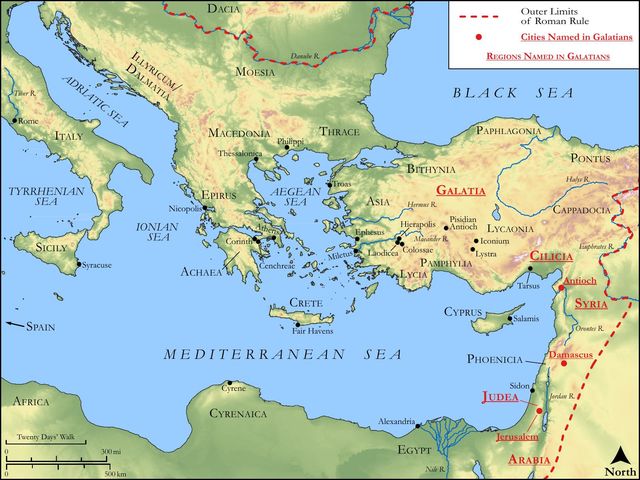

Study this verse
Public-domain commentary
Matthew Henry
From his Commentary on the Whole Bible. Henry comments on passages, not single verses — this entry covers Galatians 2:11–21. His four-level outline is real structure in the source text, so it is rendered as structure.
I.From the account which Paul gives of what passed between him and the other apostles at Jerusalem, the Galatians might easily discern both the falseness of what his enemies had insinuated against him and their own folly and weakness in departing from that gospel which he had preached to them. But to give the greater weight to what he had already said, and more fully to fortify them against the insinuations of the judaizing teachers, he acquaints them with another interview which he had with the apostle Peter at Antioch, and what passed between them there, _Gal 2:11-14. Antioch was one of the chief churches of the Gentile Christians, as Jerusalem was of those Christians who turned from Judaism to the faith of Christ. There is no colour of reason for the supposition that Peter was bishop of Antioch. If he had, surely Paul would not have withstood him in his own church, as we here find he did; but, on the contrary, it is here spoken of as an occasional visit which he made thither. In their other meeting, there had been good harmony and agreement. Peter and the other apostles had both acknowledged Paul's commission and approved his doctrine, and they parted very good friends. But in this Paul finds himself obliged to appose Peter, for he was to be blamed, a plain evidence that he was not inferior to him, and consequently of the weakness of the pope's pretence to supremacy and infallibility, as the successor of Peter. Here we may observe,
1.Peter's fault. When he came among the Gentile churches, he complied with them, and did eat with them, though they were not circumcised, agreeably to the instructions which were given in particular to him (Acts 10), when he was warned by the heavenly vision to call nothing common or unclean. But, when there came some Jewish Christians from Jerusalem, he grew more shy of the Gentiles, only to humour those of the circumcision and for fear of giving them offence, which doubtless was to the great grief and discouragement of the Gentile churches. Then he withdrew, and separated himself. His fault herein had a bad influence upon others, for the other Jews also dissembled with him; though before they might be better disposed, yet now, from his example, they took on them to scruple eating with the Gentiles, and pretended they could not in conscience do it, because they were not circumcised. And (would you think it?) Barnabas himself, one of the apostles of the Gentiles, and one who had been instrumental in planting and watering the churches of the Gentiles, was carried away with their dissimulation. Here note,
(1.)The weakness and inconstancy of the best of men, when left to themselves, and how apt they are to falter in their duty to God, out of an undue regard to the pleasing of men. And,
(2.)The great force of bad examples, especially the examples of great men and good men, such as are in reputation for wisdom and honour.
2.The rebuke which Paul gave him for his fault. Notwithstanding Peter's character, yet, when he observes him thus behaving himself to the great prejudice both of the truth of the gospel and the peace of the church, he is not afraid to reprove him for it. Paul adhered resolutely to his principles, when others faltered in theirs; he was as good a Jew as any of them (for he was a Hebrew of the Hebrews), but he would magnify his office as the apostle of the Gentiles, and therefore would not see them discouraged and trampled upon. When he saw that they walked not uprightly, according to the truth of the gospel - that they did not live up to that principle which the gospel taught, and which they had professed to own and embrace, namely, that by the death of Christ the partition-wall between Jew and Gentile was taken down, and the observance of the law of Moses was no longer in force - when he observed this, as Peter's offence was public, so he publicly reproved him for it: He said unto him before them all, If thou, being a Jew, livest after the manner of the Gentiles, and not as do the Jews, why compellest thou the Gentiles to live as do the Jews? Herein one part of his conduct was a contradiction to the other; for if he, who was a Jew, could himself sometimes dispense with the use of the ceremonial law, and live after the manner of the Gentiles, this showed that he did not look upon the observance of it as still necessary, even for the Jews themselves; and therefore that he could not, consistently with his own practice, impose it upon the Gentile Christians. And yet Paul charges him with this, yea, represents him as compelling the Gentiles to live as did the Jews - not by open force and violence, but this was the tendency of what he did; for it was in effect to signify this, that the Gentiles must comply with the Jews, or else not be admitted into Christian communion.
II.Paul having thus established his character and office, and sufficiently shown that he was not inferior to any of the apostles, no, not to Peter himself, from the account of the reproof he gave him he takes occasion to speak of that great fundamental doctrine of the gospel - That justification is only by faith in Christ, and not by the works of the law (though some think that all he says to the end of the chapter is what he said to Peter at Antioch), which doctrine condemned Peter for his symbolizing with the Jews. For, if it was the principle of his religion that the gospel is the instrument of our justification and not the law, then he did very ill in countenancing those who kept up the law, and were for mixing it with faith in the business of our justification. This was the doctrine which Paul had preached among the Galatians, to which he still adhered, and which it is his great business in this epistle to mention and confirm. Now concerning this Paul acquaints us,
1.With the practice of the Jewish Christians themselves: "We," says he, "who are Jews by nature, and not sinners of the Gentiles (even we who have been born and bred in the Jewish religion, and not among the impure Gentiles), knowing that a man is not justified by the works of the law, but by the faith of Jesus Christ, even we ourselves have believed in Jesus Christ, that we might be justified by the faith of Christ, and not by the works of the law. And, if we have thought it necessary to seek justification by the faith of Christ, why then should we hamper ourselves with the law? What did we believe in Christ for? Was it not that we might be justified by the faith of Christ? And, if so, is it not folly to go back to the law, and to expect to be justified either by the merit of moral works or the influence of any ceremonial sacrifices or purifications? And if it would be wrong in us who are Jews by nature to return to the law, and expect justification by it, would it not be much more so to require this of the Gentiles, who were never subject to it, since by the works of the law no flesh shall be justified?" To give the greater weight to this he adds (Gal 2:17), "But if, while we seek to be justified by Christ, we ourselves also are found sinners, is Christ the minister of sin? If, while we seek justification by Christ alone, and teach others to do so, we ourselves are found giving countenance or indulgence to sin, or rather are accounted sinners of the Gentiles, and such as it is not fit to have communion with, unless we also observe the law of Moses, is Christ the minister of sin? Will it not follow that he is so, if he engage us to receive a doctrine that gives liberty to sin, or by which we are so far from being justified that we remain impure sinners, and unfit to be conversed with?" This, he intimates, would be the consequence, but he rejects it with abhorrence: "God forbid," says he, "that we should entertain such a thought of Christ, or of his doctrine, that thereby he should direct us into a way of justification that is defective and ineffectual, and leave those who embrace it still unjustified, or that would give the least encouragement to sin and sinners." This would be very dishonourable to Christ, and it would be very injurious to them also. "For," says he (Gal 2:18), "if I build again the things which I destroyed - if I (or any other), who have taught that the observance of the Mosaic law is not necessary to justification, should now, by word or practice, teach or intimate that it is necessary - I make myself a transgressor; I own myself to be still an impure sinner, and to remain under the guilt of sin, notwithstanding my faith in Christ; or I shall be liable to be charged with deceit and prevarication, and acting inconsistently with myself." Thus does the apostle argue for the great doctrine of justification by faith without the works of the law from the principles and practice of the Jewish Christians themselves, and from the consequences that would attend their departure from it, whence it appeared that Peter and the other Jews were much in the wrong in refusing to communicate with the Gentile Christians, and endeavouring to bring them under the bondage of the law.
2.He acquaints us what his own judgment and practice were.
(1.)That he was dead to the law. Whatever account others might make of it, yet, for his part, he was dead to it. He knew that the moral law denounced a curse against all that continue not in all things written therein, to do them; and therefore he was dead to it, as to all hope of justification and salvation that way. And as for the ceremonial law, he also knew that it was now antiquated and superseded by the coming of Christ, and therefore, the substance having come, he had no longer any regard to the shadow. He was thus dead to the law, through the law itself; it discovered itself to be at an end. By considering the law itself, he saw that justification was not to be expected by the works of it (since none could perform a perfect obedience to it) and that there was now no further need of the sacrifices and purifications of it, since they were done away in Christ, and a period was put to them by his offering up himself a sacrifice for us; and therefore, the more he looked into it the more he saw that there was no occasion for keeping up that regard to it which the Jews pleaded for. But, though he was thus dead to the law, yet he did not look upon himself as with law. He had renounced all hopes of justification by the works of it, and was unwilling any longer to continue under the bondage of it; but he was far from thinking himself discharged from his duty to God; on the contrary, he was dead to the law, that he might live unto God. The doctrine of the gospel, which he had embraced, instead of weakening the bond of duty upon him, did but the more strengthen and confirm it; and therefore, though he was dead to the law, yet it was only in order to his living a new and better life to God (as Rom 7:4, Rom 7:6), such a life as would be more agreeable and acceptable to God than his observance of the Mosaic law could now be, that is, a life of faith in Christ, and, under the influence thereof, of holiness and righteousness towards God. Agreeably hereunto he acquaints us,
(2.)That, as he was dead to the law, so he was alive unto God through Jesus Christ (Gal 2:20): I am crucified with Christ, etc. And here in his own person he gives us an excellent description of the mysterious life of a believer.
[1.]He is crucified, and yet he lives; the old man is crucified (Rom 6:6), but the new man is living; he is dead to the world, and dead to the law, and yet alive to God and Christ; sin is mortified, and grace quickened.
[2.]He lives, and yet not he. This is strange: I live, and yet not I; he lives in the exercise of grace; he has the comforts and the triumphs of grace; and yet that grace is not from himself, but from another. Believers see themselves living in a state of dependence.
[3.]He is crucified with Christ, and yet Christ lives in him; this results from his mystical union with Christ, by means of which he is interested in the death of Christ, so as by virtue of that to die unto sin; and yet interested in the life of Christ, so as by virtue of that to live unto God.
[4.]He lives in the flesh, and yet lives by faith; to outward appearance he lives as other people do, his natural life is supported as others are; yet he has a higher and nobler principle that supports and actuates him, that of faith in Christ, and especially as eyeing the wonders of his love in giving himself for him. Hence it is that, though he lives in the flesh, yet he does not live after the flesh. Note, Those who have true faith live by that faith; and the great thing which faith fastens upon is Christ's loving us and giving himself for us. The great evidence of Christ's loving us is his giving himself for us; and this is that which we are chiefly concerned to mix faith with, in order to our living to him.
Lastly, The apostle concludes this discourse with acquainting us that by the doctrine of justification by faith in Christ, without the works of the law (which he asserted, and others opposed), he avoided two great difficulties, which the contrary opinion was loaded with: - 1. That he did not frustrate the grace of God, which the doctrine of the justification by the works of the law did; for, as he argues (Rom 11:6), If it be of works, it is no more of grace. 2. That he did not frustrate the death of Christ; whereas, if righteousness come by the law, then it must follow that Christ has died in vain; for, if we look for salvation by the law of Moses, then we render the death of Christ needless: for to what purpose should he be appointed to die, if we might have been saved without it?
Historical interpretation
Six Centuries of Reception
13 surviving comments on this verse. Each one is dated, so this reads as a timeline rather than a list.
Select a marker to jump to its quote. Markers stagger vertically where authors wrote within a few decades of each other.
I no longer wish to live after the manner of men, and my desire shall be fulfilled if ye consent. Be ye willing, then, that ye also may have your desires fulfilled. I entreat you in this brief letter; do ye give credit to me. Jesus Christ will reveal these things to you, [so that ye shall know] that I speak truly. He is the mouth altogether free from falsehood, by which the Father has truly spoken. Pray ye for me, that I may attain [the object of my desire]. I have not written to you according to the flesh, but according to the will of God. If I shall suffer, ye have wished [well] to me; but if I am rejected, ye have hated me.
Since Christ was in Paul, who will doubt that he was also likewise in Peter and John and in every individual among the saints, and not only in those who are on earth but also in those in heaven? For it is absurd to say that Christ was in Peter and Paul but not in the archangel Michael or Gabriel.
Christ is the true Son, and so when we receive the Spirit, we are made sons. For it says; ‘you did not receive the spirit of slavery leading you back into fear, but you have received the Spirit of adopted sonship’ [Romans 8:15]. But when we are made sons in the Spirit, it is clear that we are called children of God in Christ... And when the Spirit is given to us-the Saviour said: ‘Receive the Holy Spirit’ [John 20:22]- God [The Father] is in us... But when God is in us, the Son is also in us. For the Lord Himself said: ‘I and the Father will come and make our home with him’ [John 14:23]. Next, the Son is life-for He said: ‘I am the life’ [John 14:6]- and so we are said to be given life in the Spirit... But when we are given life in the Spirit, Christ Himself is said to live in us. For it says: ‘I am crucified with Christ. It is no longer I who live, but Christ who lives in me.’ (Galatians 2:19-20). - "Letters to Separion On the Spirit, Letter 1, Chapter 19"
One who is fixed to the cross of Christ is one who, in imitation of his footsteps, is not ensnared by any worldly desire. Living to God, he appears dead to the world.
There is no doubt that Christ lives in the one who is delivered from death by faith. When Christ forgives the sins of one who is worthy of death, he himself lives in that person, since by his protection the person is snatched from death.
This means, “Not I, who once ate from the earth [like Adam]. Not I who was once grass, as all flesh is grass, but Christ who lives in me. That is, there lives that living bread which comes from heaven, there lives wisdom, there lives righteousness, there lives the resurrection.”
And again: "It is no longer I that live, but Christ liveth in me." And, to show you that he was as it were in solitude, and so looked upon the things present, hear himself saying, "While we look not at the things which are seen, but at the things which are not seen." What sayest thou? Answer me. And yet what thou sayest is the contrary; thou seest the things invisible, and the visible thou seest not. Such eyes as thou hadst gotten, such are the eyes which are given by Christ: for as these bodily eyes see indeed the things that are seen, but things unseen they see not: so those heavenly eyes do the contrary: no one that beholds the invisible things, beholds the visible: no one beholding the things seen, beholds the invisible.
"That I might live unto God, I have been crucified with Christ." Having said, "I am dead," lest it should be objected, how then dost thou live? he adds the cause of his living, and shows that when alive the Law slew him, but that when dead Christ through death restored him to life. He shows the wonder to be twofold; that by Christ both the dead was begotten into life, and that by means of death. He here means the immortal life, for this is the meaning of the words, "That I might live unto God I am crucified with Christ" How, it is asked, can a man now living and breathing have been crucified? That Christ hath been crucified is manifest, but how canst thou have been crucified, and yet live? He explains it thus;
"Yet I live; and yet no longer I, but Christ liveth in me."
In these words, "I am crucified with Christ," he alludes to Baptism and in the words "nevertheless I live, yet not I," our subsequent manner of life whereby our members are mortified. By saying "Christ liveth in me," he means nothing is done by me, which Christ disapproves; for as by death he signifies not what is commonly understood, but a death to sin; so by life, he signifies a delivery from sin. For a man cannot live to God, otherwise than by dying to sin; and as Christ suffered bodily death, so does Paul a death to sin. "Mortify," says he "your members which are upon the earth; fornication, uncleanness, passion;" (Col. iii: 5), and again, "our old man was crucified," (Rom. vi: 6) which took place in the Bath. After which, if thou remainest dead to sin, thou livest to God, but if thou let it live again, thou art the ruin of thy new life. This however did not Paul, but continued wholly dead; if then, he says, I live to God a life other than that in the Law, and am dead to the Law, I cannot possibly keep any part of the Law. Consider how perfect was his walk, and thou wilt be transported with admiration of this blessed soul. He says not, "I live," but, "Christ liveth in me;" who is bold enough to utter such words? Paul indeed, who had harnessed himself to Christ's yoke, and cast away all worldly things, and was paying universal obedience to His will, says not, "I live to Christ," but what is far higher, "Christ liveth in me." As sin, when it has the mastery, is itself the vital principle, and leads the soul whither it will, so, when it is slain and the will of Christ obeyed, this life is no longer earthly, but Christ liveth, that is, works, has mastery within us. His saying, "I am crucified with Him" "I no longer live," but "am dead," seeming incredible to many, he adds,
"And that life which I now live in the flesh, I live in faith, the faith which is in the Son of God."
The foregoing, says he, relates to our spiritual life, but this life of sense too, if considered, will be found owing to my faith in Christ. For as regards the former Dispensation and Law, I had incurred the severest punishment, and had long ago perished, "for all have sinned, and come short of the glory of God." (Rom. iii: 23) And we, who lay under sentence, have been liberated by Christ, for all of us are dead, if not in fact, at least by sentence; and He has delivered us from the expected blow. When the Law had accused, and God condemned us, Christ came, and by giving Himself up to death, rescued us all from death. So that "the life which I now live in the flesh, I live in faith." Had not this been, nothing could have averted a destruction as general as that which took place at the flood, but His advent arrested the wrath of God, and caused us to live by faith. That such is his meaning appears from what follows. After saying, that "the life which I now live in the flesh, I live in faith," he adds,
"In the Son of God, Who loved me, and gave Himself up for me."
How is this, O Paul! why dost thou appropriate a general benefit, and make thine own what was done for the whole world's sake? for he says not, "Who loved us," but, "Who loved me." And besides the Evangelist says, "God so loved the world;" (John iii: 16) and Paul himself, "He that spared not His own Son, but delivered Him up, not for Paul only, but, "for us all;" (Rom. viii: 32) and again, "that He might purify unto himself a people for his own possession, (Tit. ii: 14) But considering the desperate condition of human nature, and the ineffably tender solicitude of Christ, in what He delivered us from, and what He freely gave us, and kindled by the yearning of affection towards Him, he thus expresses himself. Thus the Prophets often appropriate to themselves Him who is God of all, as in the words, "O God, thou art my God, early will I seek Thee." (Psalm lxiii: 1) Moreover, this language teaches that each individual justly owes as a great debt of gratitude to Christ, as if He had come for his sake alone, for He would not have grudged this His condescension though but for one, so that the measure of His love to each is as great as to the whole world. Truly the Sacrifice was offered for all mankind, and was sufficient to save all, but those who enjoy the blessing are the believing only. Nevertheless it did not deter Him from His so great condescension, that not all would come; but He acted after the pattern of the supper in the Gospel, which He prepared for all, (Luke xiv: 16) yet when the guests came not, instead of withdrawing the viands, He called in others. So too He did not despise that sheep, though one only, which had strayed from the ninety and nine. (Mat. xviii: 12) This too in like manner St. Paul intimates, when he says, speaking about the Jews, "For what if some were without faith, shall their want of faith make of none effect the faithfulness of God? God forbid: yea let God be found true, but every man a liar." (Rom. iii: 3, 4) When He so loved thee as to give Himself up to bring thee who wast without hope to a life so great and blessed, canst thou, thus gifted, have recourse to things gone by? His reasoning being completed, he concludes with a vehement asseveration, saying,
Judas and the priests, with the princes, handed him over, and Pilate, to whom he was finally handed over, handed him over again. But the Father handed him over that he might save the abandoned world. Jesus gave himself, that he might do the Father’s will. But Judas and the priests and elders of the people and Pilate unwittingly handed over their lives to death.
(Verse 20.) But I no longer live; Christ lives in me. The person who once lived under the law no longer lives, for they persecuted the Church. But Christ lives in them, providing wisdom, strength, speech, peace, joy, and other virtues. The one who does not possess these virtues cannot say, 'Christ lives in me.' And all of this is said in opposition to Peter, directed at Peter.
But as for now, I live in the flesh. To be in the flesh is one thing, and to live in the flesh is another. For those who are in the flesh cannot please God (Rom. VIII, 8, 9). Therefore, it is said to those who live well: However, you are not in the flesh.
I live by faith in the Son of God, who loved me and gave himself for me. He speaks about God to the Romans, that he did not spare his own Son, but gave him up for us. Now, about Christ, that he gave himself up: 'He loved me,' he says, 'and gave himself for me.' In the Gospel, where the apostles are listed, it is stated: 'And Judas Iscariot ((also Scariot)), who betrayed him' (Luke 6:16). Again, in the same Gospel: 'Look, the one who will betray me is approaching' (Matthew 26:46). But the Scriptures mention the high priests and elders of the people, who condemned Jesus to death and, binding him, led him and delivered him to Pilate the governor (ibid., XXVII, and Mark XV). And afterwards about Pilate: He released Barabbas to them, but Jesus, after being flogged, he handed over to them to crucify (John XIX). Therefore, the Father handed over the Son, and the Son himself handed over, and Judas and the priests handed him over to the rulers, and finally, having been handed over to him, Pilate himself delivered him. But the Father handed over, in order to save the lost world: Jesus himself handed himself over, in order to do the will of the Father and his own: However, Judas and the priests and the elders of the people, and Pilate, delivered him, ignorant of life unto death. And when she also handed herself over for our salvation, blessed and very happy is he who, with Christ living in him, can say through every thought and action: I live by the faith of the Son of God, who loved me and delivered himself for me.
The human spirit, cleaving to the Spirit of God, struggles against the flesh that is, against itself and on its own behalf. Those impulses natural to humanity, whether in the flesh or in the soul, which remain because of our acquired debility, are restrained by discipline for the sake of obtaining salvation. So the human being who does not live according to human nature can already say, “I live, yet not I, but Christ lives in me.” For where I am not I, I am more happily I. Thus when any reprobate impulse arises according to my old human nature, to which I who serve the law of God with my mind do not consent, I may now say this: “now I am not the one doing that.”
Let us consider how Paul had denied himself, who said: "Yet I live, now not I." For that savage persecutor had been extinguished, and the devout preacher had begun to live. For if he himself were still that same person, he would certainly not be devout. But let him who denies that he lives say from where it is that he proclaims holy words through the teaching of truth. He immediately adds: "But Christ lives in me." As if he were saying openly: I indeed have been extinguished from myself because I do not live carnally; yet I have not died essentially because I live spiritually in Christ.
To the Law he says or inasmuch as it pertains to the Law.
Continue studying Galatians 2:20 across the web’s major study libraries — every link below opens this exact verse, chapter, or book on the destination site.
Read & Compare
 BibleGatewayThis verse in more than 200 translations and 70 languages.
 Bible.comThe YouVersion reader — hundreds of translations, reading plans, and highlights.
 ESV.orgCrossway's official English Standard Version reader.
 NET BibleThe NET translation with 60,000+ translators' notes on every rendering decision.
 STEP BibleTyndale House's free study tool — original text, vocabulary, and scholarly resources.
 BibliaLogos Bible Software's free web reader.
 USCCBThe New American Bible (Revised Edition) with the U.S. bishops' study notes.
Commentaries
 BibleHub CommentariesDozens of classic commentaries on this verse, gathered on one page.
 StudyLightMore than 100 commentary sets — the largest collection on the web.
 BibleRefPlain-English commentary on what this verse means, verse by verse.
 Enduring WordDavid Guzik's free commentary on this chapter, widely used by Bible teachers.
 Bible Study ToolsVerse commentary alongside Greek and Hebrew study aids.
Original Language & Research
- BibleHub InterlinearThe verse word by word — original language, transliteration, and English.
- BibleHub LexiconEvery word's original-language definition and Strong's entry.
 Blue Letter BibleDeep-study tools — Strong's numbers, concordance, and word studies.
 CNTR CollationThe earliest Greek manuscripts of this verse, collated letter by letter.
Sermons, Hymns & Audio


TrulyRandomVerse is not affiliated with these sites and doesn’t control their content. They’re linked because they’re genuinely useful.
Summary
Galatians 2:20 encapsulates the profound theological truth of a believer's radical transformation through union with Christ. Paul declares that his old self has been put to death with Christ on the cross, yet paradoxically, he now lives a new life. This life is not his own, but Christ Himself living within him, enabling him to navigate his earthly existence by a deep, abiding faith in the Son of God, whose ultimate act of love—giving Himself sacrificially—forms the very foundation of this new identity and existence.
Context
ShowHideLiterary Context
Galatians 2:20 is a pivotal statement within Paul's defense of the gospel of grace against the Judaizers, who insisted that Gentile believers must adhere to the Mosaic Law, including circumcision, for salvation and justification. This verse immediately follows Paul's sharp confrontation with Peter in Antioch (Galatians 2:11-14), where Peter had compromised the truth of the gospel by withdrawing from Gentile believers due to pressure from Jewish Christians. Paul then transitions into a theological explanation of justification by faith apart from works of the law, asserting that "a person is not justified by works of the law but by faith in Jesus Christ" (Galatians 2:16). Verse 20 serves as the climax of this argument, illustrating the personal, transformative reality of this justification and the source of the new life in Christ. It explains how one is no longer under the law but lives by faith.
Historical & Cultural Context
The letter to the Galatians was written to churches in the Roman province of Galatia, likely in response to the infiltration of "Judaizers"—Jewish Christians who taught that Gentile converts needed to be circumcised and observe the Mosaic Law to be truly saved and righteous. This teaching directly contradicted Paul's gospel of salvation by grace through faith alone. The cultural context involved a clash between Jewish identity, deeply rooted in the Law and covenant markers like circumcision, and the universal reach of the gospel, which offered salvation to all, Jew and Gentile, on the same terms. Paul's emphasis on being "crucified with Christ" directly challenges the notion that one's identity or righteousness is found in adherence to external legal codes, instead rooting it in a spiritual union with Christ's death and resurrection, which transcends ethnic and cultural distinctions.
Key Themes
ShowHideThis verse powerfully contributes to several overarching themes in Galatians. Firstly, it underscores the theme of Justification by Faith (Galatians 2:16), demonstrating that righteousness comes not from human effort or adherence to the Law, but from a radical union with Christ. Secondly, it highlights the New Creation or New Identity in Christ, where the old self, bound by sin and law, dies, and a new life, empowered by Christ, emerges (Galatians 6:15). Thirdly, the verse emphasizes the Indwelling Christ and the Spirit's Role in the believer's life, showing that the Christian life is not lived by self-effort but by the dynamic presence of Christ within (Galatians 3:3). Finally, it powerfully articulates the Sacrificial Love of Christ as the foundational act that enables this entire transformation, shifting the focus from human performance to divine grace.
Exposition and Analysis
ShowHideKey Word Analysis
ShowHideMeaning "to impale in company with (literally or figuratively)." This word vividly conveys the believer's spiritual identification with Christ's death on the cross. It signifies a radical break from the old life, the "old self," and its dominion by sin and the Law. It's not merely a metaphor for suffering, but a declaration of a definitive, shared death with Christ, leading to a new existence.
Meaning "to live (literally or figuratively); life(-time), (a-)live(-ly), quick." This term appears multiple times in the verse, highlighting the paradox of death leading to true life. It refers to a spiritual vitality and existence that is qualitatively different from the former life, now empowered and sustained by Christ Himself.
Meaning "persuasion, i.e. credence; moral conviction (of religious truth, or the truthfulness of God or a religious teacher), especially reliance upon Christ for salvation; abstractly, constancy in such profession; by extension, the system of religious (Gospel) truth itself." In this context, it denotes both the act of believing and the object of that belief (Christ). It is the means by which the believer appropriates the reality of their union with Christ and lives out their new identity.
Meaning "to surrender, i.e. yield up, intrust, transmit." This verb, combined with the reflexive pronoun heautoû (G1438, "himself"), powerfully describes Christ's voluntary and sacrificial act of self-giving. It underscores the active, intentional nature of His atonement, emphasizing that His love was not passive but manifested in a decisive, redemptive surrender unto death for the benefit of others.
Verse Breakdown
ShowHide"I am crucified with Christ:"
Paul begins with a profound declaration of spiritual union. This is not a future event or a mere aspiration, but a present reality for the believer. Through faith, the "old I," characterized by its identity under the Law and its bondage to sin, has been decisively put to death with Christ on the cross. This crucifixion signifies a complete break from the former way of life and its condemnation, establishing a new, definitive identity in union with Christ's atoning work.
"nevertheless I live; yet not I, but Christ liveth in me:"
This clause presents a glorious paradox. Despite the crucifixion of the old self, a new, true life has emerged. However, Paul immediately clarifies that this new life is not a resuscitation of the old self or a renewed effort by human will. Instead, the very essence and power of this life come from Christ Himself, who indwells the believer through His Spirit. The emphasis shifts from human agency to divine indwelling, asserting that the believer's life is now animated and directed by Christ.
"and the life which I now live in the flesh I live by the faith of the Son of God,"
Paul addresses the practical outworking of this Christ-indwelt life in the physical realm ("in the flesh"). This is not a disembodied spiritual existence, but a tangible, daily reality. The means by which this life is lived is "by the faith of the Son of God." This phrase carries a dual meaning: it encompasses both the faithfulness of Christ (His finished work and ongoing reliability) and the believer's active trust and reliance in Him. The Christian life is therefore sustained not by legalistic adherence or self-effort, but by continuous dependence on Christ's perfect work and character.
"who loved me, and gave himself for me."
The verse culminates in the ultimate foundation for this radical transformation: Christ's personal, sacrificial love. The phrase "who loved me" highlights the intimate and individual nature of Christ's affection, while "and gave himself for me" points to the voluntary, substitutionary nature of His atoning death. This selfless act of divine love is the ultimate basis for the believer's crucifixion with Christ, the indwelling life, and the life lived by faith. It underscores that salvation and new life are entirely a gift, rooted in Christ's initiative and sacrifice.
Literary Devices
ShowHidePaul masterfully employs several literary devices to convey the profound truths of Galatians 2:20. The most prominent is Paradox, evident in the juxtaposition of "I am crucified with Christ" and "nevertheless I live; yet not I, but Christ liveth in me." This creates a tension that highlights the supernatural nature of the Christian life: death to self leads to true life, a life not of one's own making but of Christ's indwelling. The phrase "Christ liveth in me" also utilizes Personification, attributing the active quality of living directly to Christ within the believer, emphasizing His dynamic presence as the source of life. There is also significant Emphasis through repetition of the verb "live" (záō), which appears four times, underscoring the central theme of new life and how it is sustained. Furthermore, Paul's use of the first-person singular pronoun ("I," "me") throughout the verse, culminating in "who loved me, and gave himself for me," is a powerful example of Personalization. This makes the theological truths deeply relatable and impactful, transforming abstract doctrines into a personal testimony of radical transformation and divine love.
Theological and Thematic Connections
ShowHideGalatians 2:20 stands as a foundational text for understanding the doctrine of union with Christ. It articulates that salvation is not merely a legal transaction (justification) but a profound, mystical identification with Christ in His death, burial, and resurrection. This union means that the believer's old identity, marked by sin and the Law's condemnation, is decisively terminated, and a new identity, characterized by Christ's indwelling life, is inaugurated. This truth underpins the entire Christian life, shifting the focus from human effort to divine enablement. It emphasizes that the Christian life is not about trying to live for Christ, but allowing Christ to live through the believer by faith, rooted in His unconditional, sacrificial love. This active indwelling of Christ is the power source for sanctification and righteous living, freeing believers from legalism and self-reliance.
Reflection and Application
ShowHideGalatians 2:20 calls every believer to a radical re-evaluation of their identity and the source of their spiritual life. It challenges the common tendency to rely on self-effort, good works, or adherence to external rules for righteousness and spiritual growth. Instead, it invites us into the liberating truth that our old self, with its striving and failures, has been crucified with Christ. The Christian life is not about trying harder to be good, but about recognizing that Christ Himself lives within, empowering, guiding, and sustaining us. This means daily surrendering our will, our anxieties, and our perceived inadequacies to His indwelling presence. It encourages a life of profound dependence, where our faith is not merely a mental assent but an active, moment-by-moment reliance on the Son of God who loved us so personally and gave Himself so completely. Embracing this truth fosters humility, deepens our worship, and liberates us to live authentically by His power, rather than our own.
Questions for Reflection
ShowHideFAQ
ShowHideDoes "I am crucified with Christ" mean I no longer struggle with sin?
ShowHideNo, "I am crucified with Christ" (Galatians 2:20) does not mean a believer instantly achieves sinless perfection or that the struggle with sin ceases. Rather, it signifies a decisive break from the dominion and condemnation of sin and the Law. In union with Christ's death, the believer's old identity, which was enslaved to sin, is put to death. This is a positional truth: in God's eyes, the believer is no longer defined by their former sinful nature but by their new identity in Christ. However, the presence of sin (what Paul calls "the flesh" in Galatians 5:17) remains a reality in this life. The ongoing Christian walk involves learning to "walk by the Spirit" (Galatians 5:16) and "put to death the deeds of the body" (Romans 8:13), relying on Christ's indwelling power to overcome temptation. The crucifixion of the old self is a past event that empowers a present, ongoing process of sanctification.
What is the difference between "faith of the Son of God" and "faith in the Son of God"?
ShowHideThe Greek phrase "pistis Christou" (rendered "faith of the Son of God" in KJV) is grammatically ambiguous, allowing for two interpretations: the "subjective genitive" (Christ's own faithfulness) or the "objective genitive" (our faith in Christ). Many modern translations opt for "faith in Jesus Christ" (e.g., ESV, NIV in Galatians 2:16), emphasizing the believer's active trust. However, a growing number of scholars argue that Paul likely intended both meanings to be present or at least understood Christ's faithfulness as foundational. In Galatians 2:20, "the faith of the Son of God" can be understood as the faithfulness of Christ, particularly His faithfulness in going to the cross and fulfilling God's redemptive plan, which then becomes the object and ground of our faith in Him. Therefore, the life we live is sustained by both Christ's perfect faithfulness and our active reliance upon Him. It's a rich theological concept that highlights the dual nature of faith: both Christ's and ours.
Christ-Centered Fulfillment
ShowHideGalatians 2:20 finds its ultimate Christ-centered fulfillment not merely as a description of Paul's personal experience, but as a universal truth for all who are united with Jesus Christ. The "crucifixion with Christ" points directly to His singular, historical crucifixion on Calvary, which fundamentally altered humanity's relationship with sin and death. Christ's death was not just an example, but a substitutionary act, bearing the penalty for sin so that believers could die to their old selves and be raised to new life. The declaration "Christ liveth in me" foreshadows the New Covenant promise of God's Spirit indwelling His people, making Christ's presence a living reality within the believer, as promised by Jesus in John 14:23 and fulfilled at Pentecost (Acts 2:1-4). The life "by the faith of the Son of God" highlights Christ as both the object and the perfect embodiment of faith, the "author and perfecter of our faith" (Hebrews 12:2). Finally, the profound statement "who loved me, and gave himself for me" encapsulates the very heart of the gospel: Christ's pre-existent, divine love (as seen in John 3:16) culminating in His voluntary, sacrificial self-giving on the cross (Ephesians 5:2). Thus, Galatians 2:20 is a microcosm of the entire redemptive story, revealing Christ as the beginning, middle, and end of the believer's new life.