


Romans 6:11
Bible text: King James Version (1769 Blayney text) · Public domain
Bible text: King James Version with Strong's numbers · Public domain
Bible text: Berean Standard Bible · Public domain
Bible text: American Standard Version (1901) · Public domain
Bible text: World English Bible, Messianic edition · Public domain
Bible text: Geneva Bible (1599) · Public domain
Bible text: Young's Literal Translation · Public domain
- οὕτωςhoutōsSoG3779ADVAdverb
- καὶkaialsoG2532CONJConjunction
- ὑμεῖςhumeis[you yourselves]G4771P-2NPPersonal pronoun Nominative 2nd Plural
- λογίζεσθεlogizesthedo considerG3049V-PNM-2PVerb Present Middle Or Passive Deponent Imperative 2nd Plural
- ἑαυτοὺςhe'autousyourselvesG1438F-2APMReflexive pronoun Accusative 2nd Plural Masculine
- εἶναιeinaito beG1511V-PANVerb Present Active Infinitive
- νεκροὺςnekrousdeadG3498A-APMAdjective Accusative Plural Masculine
- μὲνmenindeedG3303PRTParticle or Disjunctive
- τῇtēa[the]G3588T-DSFDefinite article Dative Singular Feminine
- ἁμαρτίᾳhamartiato sinG266N-DSFNoun Dative Singular Feminine
- ζῶνταςzōntaslivingG2198V-PAP-APMVerb Present Active Participle Accusative Plural Masculine
- δὲdehoweverG1161CONJConjunction
- τῷtō[the]G3588T-DSMDefinite article Dative Singular Masculine
- θεῷtheōto GodG2316N-DSM-TNoun Dative Singular Masculine Title
- ἐνeninG1722PREPPreposition
- ΧριστῷChristōChristG5547N-DSM-TNoun Dative Singular Masculine Title
- ἸησοῦIēsouJesusG2424N-DSM-PNoun Dative Singular Masculine Individual
- τῷtōtheG3588T-DSMDefinite article Dative Singular Masculine
- κυρίῳkuriōLordG2962N-DSM-TNoun Dative Singular Masculine Title
- ἡμῶνhēmōnof usG3165P-1GPPersonal pronoun Genitive 1st Plural
English is a literal word-by-word gloss of the Greek, not the KJV's wording. Why?
This is the original text the KJV's translators worked from — each Greek word with its own literal English meaning in this verse, prepared by scholars at Tyndale House, Cambridge. The KJV translates whole sentences, not word by word, so its wording differs: one Greek word can become several English words, and the KJV may choose “charity” where the gloss reads “love”. Both are faithful — they answer different questions. For the KJV's own rendering, switch to the KJV text.
Words in [ ] are added by the English.
- reckon (KJV) / count (BSB) λογίζομαι
Details
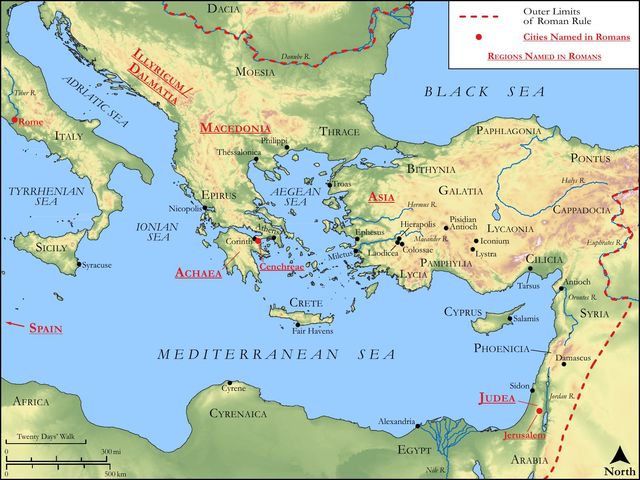
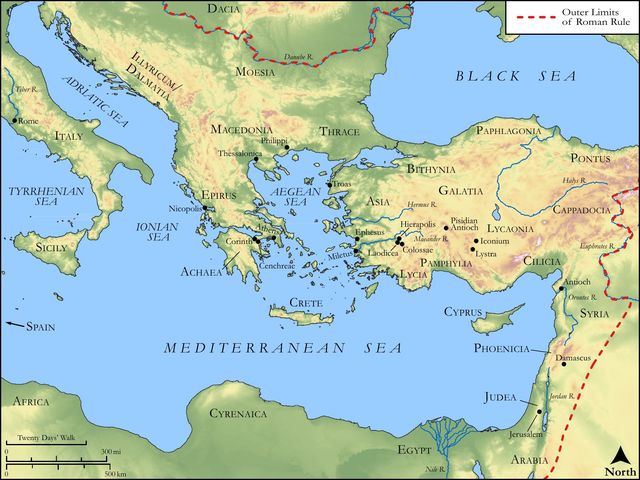
See on the biblical-era maps
Study this verse
Public-domain commentary
Matthew Henry
From his Commentary on the Whole Bible. Henry wrote on whole passages, and this entry covers Romans 6:1–23. He set out his notes in a four-level outline, kept here as he numbered it.
The apostle's transition, which joins this discourse with the former, is observable: "What shall we say then? Romans 6:1. What use shall we make of this sweet and comfortable doctrine? Shall we do evil that good may come, as some say we do? Romans 3:8. Shall we continue in sin that grace may abound? Shall we hence take encouragement to sin with so much the more boldness, because the more sin we commit the more will the grace of God be magnified in our pardon? Is this a use to be made of it?" No, it is an abuse, and the apostle startles at the thought of it (Romans 6:2): "God forbid; far be it from us to think such a thought." He entertains the objection as Christ did the devil's blackest temptation (Matthew 4:10): Get thee hence, Satan. Those opinions that give any countenance to sin, or open a door to practical immoralities, how specious and plausible soever they be rendered, by the pretension of advancing free grace, are to be rejected with the greatest abhorrence; for the truth as it is in Jesus is a truth according to godliness, Titus 1:1. The apostle is very full in pressing the necessity of holiness in this chapter, which may be reduced to two heads: - His exhortations to holiness, which show the nature of it; and his motives or arguments to enforce those exhortations, which show the necessity of it.
I.For the first, we may hence observe the nature of sanctification, what it is, and wherein it consists.
In general it has two things in it, mortification and vivification - dying to sin and living to righteousness, elsewhere expressed by putting off the old man and putting on the new, ceasing to do evil and learning to do well.
1.Mortification, putting off the old man; several ways this is expressed.
(1.)We must live no longer in sin (Romans 6:2), we must not be as we have been nor do as we have done. The time past of our life must suffice, 1 Peter 4:3. Though there are none that live without sin, yet, blessed be God, there are those that do not live in sin, do not live in it as their element, do not make a trade of it: this is to be sanctified.
(2.)The body of sin must be destroyed, Romans 6:6. The corruption that dwelleth in us is the body of sin, consisting of many parts and members, as a body. This is the root to which the axe must be laid. We must not only cease from the acts of sin (this may be done through the influence of outward restraints, or other inducements), but we must get the vicious habits and inclinations weakened and destroyed; not only cast away the idols of iniquity out of the heart. - That henceforth we should not serve sin. The actual transgression is certainly in a great measure prevented by the crucifying and killing of the original corruption. Destroy the body of sin, and then, though there should be Canaanites remaining in the land, yet the Israelites will not be slaves to them. It is the body of sin that sways the sceptre, wields the iron rod; destroy this, and the yoke is broken. The destruction of Eglon the tyrant is the deliverance of oppressed Israel from the Moabites.
(3.)We must be dead indeed unto sin, Romans 6:11. As the death of the oppressor is a release, so much more is the death of the oppressed, Job 3:17, Job 3:18. Death brings a writ of ease to the weary. Thus must we be dead to sin, obey it, observe it, regard it, fulfil its will no more than he that is dead doth his quandam task-masters - be as indifference to the pleasures and delights of sin as a man that is dying is to his former diversions. He that is dead is separated from his former company, converse, business, enjoyments, employments, is not what he was, does not what he did, has not what he had. Death makes a mighty change; such a change doth sanctification make in the soul, it cuts off all correspondence with sin.
(4.)Sin must not reign in our mortal bodies that we should obey it, Romans 6:12. Though sin may remain as an outlaw, though it may oppress as a tyrant, yet let it not reign as a king. Let it not make laws, nor preside in councils, nor command the militia; let it not be uppermost in the soul, so that we should obey it. Though we may be sometimes overtaken and overcome by it, yet let us never be obedient to it in the lusts thereof; let not sinful lusts be a law to you, to which you would yield a consenting obedience. In the lusts thereof - en tais epithumiais autou. It refers to the body, not to sin. Sin lies very much in the gratifying of the body, and humouring that. And there is a reason implied in the phrase your mortal body; because it is a mortal body, and hastening apace to the dust, therefore let not sin reign in it. It was sin that made our bodies mortal, and therefore do not yield obedience to such an enemy.
(5.)We must not yield our members as instruments of unrighteousness, Romans 6:13. The members of the body are made use of by the corrupt nature as tools, by which the wills of the flesh are fulfilled; but we must not consent to that abuse. The members of the body are fearfully and wonderfully made; it is a pity they should be the devil's tools of unrighteousness unto sin, instruments of the sinful actions, according to the sinful dispositions. Unrighteousness is unto sin; the sinful acts confirm and strengthen the sinful habits; one sin begets another; it is like the letting forth of water, therefore leave it before it be meddled with. The members of the body may perhaps, through the prevalency of temptation, be forced to be instruments of sin; but do not yield them to be so, do not consent to it. This is one branch of sanctification, the mortification of sin.
2.Vivification, or living to righteousness; and what is that?
(1.)It is to walk in newness of life, Romans 6:4. Newness of life supposes newness of heart, for out of the heart are the issues of life, and there is not way to make the stream sweet but by making the spring so. Walking, in scripture, is put for the course and tenour of the conversation, which must be new. Walk by new rules, towards new ends, from new principles. Make a new choice of the way. Choose new paths to walk in, new leaders to walk after, new companions to walk with. Old things should pass away, and all things become new. The man is what he was not, does what he did not.
(2.)It is to be alive unto God through Jesus Christ our Lord, Romans 6:11. To converse with God, to have a regard to him, a delight in him, a concern for him, the soul upon all occasions carried out towards him as towards an agreeable object, in which it takes a complacency: this is to be alive to God. The love of God reigning in the heart is the life of the soul towards God. Anima est ubi amat, non ubi animat - The soul is where it loves, rather than where it lives. It is to have the affections and desires alive towards God. Or, living (our live in the flesh) unto God, to his honour and glory as our end, by his word and will as our rule - in all our ways to acknowledge him, and to have our eyes ever towards him; this is to live unto God. - Through Jesus Christ our Lord. Christ is our spiritual life; there is no living to God but through him. He is the Mediator; there can be no comfortable receivings from God, nor acceptable regards to God, but in and through Jesus Christ; no intercourse between sinful souls and a holy God, but by the mediation of the Lord Jesus. Through Christ as the author and maintainer of this life; through Christ as the head from whom we receive vital influence; through Christ as the root by which we derive sap and nourishment, and so live. In living to God, Christ is all in all.
(3.)It is to yield ourselves to God, as those that are alive from the dead, Romans 6:13. The very life and being of holiness lie in the dedication of ourselves to the Lord, giving our own selves to the Lord, 2 Corinthians 8:5. "Yield yourselves to him, not only as the conquered yields to the conqueror, because he can stand it out no longer; but as the wife yields herself to her husband, to whom her desire is, as the scholar yields himself to the teacher, the apprentice to his master, to be taught and ruled by him. Not yield your estates to him, but yield yourselves; nothing less than your whole selves;" parastēsate eautous - accommodate vos ipsos Deo - accommodate yourselves to God; so Tremellius, from the Syriac. "Not only submit to him, but comply with him; not only present yourselves to him once for all, but be always ready to serve him. Yield yourselves to him as wax to the seal, to take any impression, to be, and have, and do, what he pleases." When Paul said, Lord, what wilt thou have me to do? (Acts 9:6) he was then yielded to God. As those that are alive from the dead. To yield a dead carcase to a living God is not to please him, but to mock him: "Yield yourselves as those that are alive and good for something, a living sacrifice," Romans 12:1. The surest evidence of our spiritual life is the dedication of ourselves to God. It becomes those that are alive from the dead (it may be understood of a death in law), that are justified and delivered from death, to give themselves to him that hath so redeemed them.
(4.)It is to yield our members as instruments of righteousness to God. The members of our bodies, when withdrawn from the service of sin, are not to lie idle, but to be made use of in the service of God. When the strong man armed is dispossessed, let him whose right it is divide the spoils. Though the powers and faculties of the soul be the immediate subjects of holiness and righteousness, yet the members of the body are to be instruments; the body must be always ready to serve the soul in the service of God. Thus (Romans 6:19), "Yield your members servants to righteousness unto holiness. Let them be under the conduct and at the command of the righteous law of God, and that principle of inherent righteousness which the Spirit, as sanctifier, plants in the soul." Righteousness unto holiness, which intimates growth, and progress, and ground obtained. As every sinful act confirms the sinful habit, and makes the nature more and more prone to sin (hence the members of a natural man are here said to be servants to iniquity unto iniquity - one sin makes the heart more disposed for another), so every gracious act confirms the gracious habit: serving righteousness is unto holiness; one duty fits us for another; and the more we do the more we may do for God. Or serving righteousness, eis hagiasmon - as an evidence of sanctification.
II.The motives or arguments here used to show the necessity of sanctification.
There is such an antipathy in our hearts by nature to holiness that it is no easy matter to bring them to submit to it: it is the Spirit's work, who persuades by such inducements as these set home upon the soul.
1.He argues from our sacramental conformity to Jesus Christ. Our baptism, with the design and intention of it, carried in it a great reason why we should die to sin, and live to righteousness. Thus we must improve our baptism as a bridle of restraint to keep us in from sin, as a spur of constraint to quicken us to duty. Observe this reasoning.
(1.)In general, we are dead to sin, that is, in profession and in obligation. Our baptism signifies our cutting off from the kingdom of sin. We profess to have no more to do with sin. We are dead to sin by a participation of virtue and power for the killing of it, and by our union with Christ and interest in him, in and by whom it is killed. All this is in vain if we persist in sin; we contradict a profession, violate an obligation, return to that to which we were dead, like walking ghosts, than which nothing is more unbecoming and absurd. For (Romans 6:7) he that is dead is freed from sin; that is, he that is dead to it is freed from the rule and dominion of it, as the servant that is dead is freed from his master, Job 3:19. Now shall we be such fools as to return to that slavery from which we are discharged? When we are delivered out of Egypt, shall we talk of going back to it again?
(2.)In particular, being baptized into Jesus Christ, we were baptized into his death, Romans 6:3. We were baptized eis Christon - unto Christ, as 1 Corinthians 10:2, eis Mōsēn - unto Moses. Baptism binds us to Christ, it binds us apprentice to Christ as our teacher, it is our allegiance to Christ as our sovereign. Baptism is externa ansa Christi - the external handle of Christ, by which Christ lays hold on men, and men offer themselves to Christ. Particularly, we were baptized into his death, into a participation of the privileges purchased by his death, and into an obligation both to comply with the design of his death, which was to redeem us from all iniquity, and to conform to the pattern of his death, that, as Christ died for sin, so we should die to sin. This was the profession and promise of our baptism, and we do not do well if we do not answer this profession, and make good this promise.
[1.]Our conformity to the death of Christ obliges us to die unto sin; thereby we know the fellowship of his sufferings, Philippians 3:10. Thus we are here said to be planted together in the likeness of is death (Romans 6:5), tō homoiōmati, not only a conformity, but a conformation, as the engrafted stock is planted together into the likeness of the shoot, of the nature of which it doth participate. Planting is in order to life and fruitfulness: we are planted in the vineyard in a likeness to Christ, which likeness we should evidence in sanctification. Our creed concerning Jesus Christ is, among other things, that he was crucified, dead, and buried; now baptism is a sacramental conformity to him in each of these, as the apostle here takes notice. First, Our old man is crucified with him, Romans 6:6. The death of the cross was a slow death; the body, after it was nailed to the cross, gave many a throe and many a struggle: but it was a sure death, long in expiring, but expired at last; such is the mortification of sin in believers. It was a cursed death, Galatians 3:13. Sin dies as a malefactor, devoted to destruction; it is an accursed thing. Though it be a slow death, yet this must needs hasten it that it is an old man that is crucified; not in the prime of its strength, but decaying: that which waxeth old is ready to vanish away, Hebrews 8:13. Crucified with him - sunestaurōthē, not in respect of time, but in respect of causality. The crucifying of Christ for us has an influence upon the crucifying of sin in us. Secondly, We are dead with Christ, Romans 6:8. Christ was obedient to death: when he died, we might be said to die with him, as our dying to sin is an act of conformity both to the design and to the example of Christ's dying for sin. Baptism signifies and seals our union with Christ, our engrafting into Christ; so that we are dead with him, and engaged to have no more to do with sin than he had. Thirdly, We are buried with him by baptism, Romans 6:4. Our conformity is complete. We are in profession quite cut off from all commerce and communion with sin, as those that are buried are quite cut off from all the world; not only not of the living, but no more among the living, have nothing more to do with them. Thus must we be, as Christ was, separate from sin and sinners. We are buried, namely, in profession and obligation: we profess to be so, and we are bound to be so: it was our covenant and engagement in baptism; we are sealed to be the Lord's, therefore to be cut off from sin. Why this burying in baptism should so much as allude to any custom of dipping under water in baptism, any more than our baptismal crucifixion and death should have any such references, I confess I cannot see. It is plain that it is not the sign, but the thing signified, in baptism, that the apostle here calls being buried with Christ, and the expression of burying alludes to Christ's burial. As Christ was buried, that he might rise again to a new and more heavenly life, so we are in baptism buried, that is, cut off from the life of sin, that we may rise again to a new life of faith and love.
[2.]Our conformity to the resurrection of Christ obliges us to rise again to newness of life. This is the power of his resurrection which Paul was so desirous to know, Philippians 3:10. Christ was raised up from the dead by the glory of the Father, that is, by the power of the Father. The power of God is his glory; it is glorious power, Colossians 1:11. Now in baptism we are obliged to conform to that pattern, to be planted in the likeness of his resurrection (Romans 6:5), to live with him, Romans 6:8. See Colossians 2:12. Conversion is the first resurrection from the death of sin to the life of righteousness; and this resurrection is conformable to Christ's resurrection. This conformity of the saints to the resurrection of Christ seems to be intimated in the rising of so many of the bodies of the saints, which, though mentioned before by anticipation, is supposed to have been concomitant with Christ's resurrection, Matthew 27:52. We have all risen with Christ. In two things we must conform to the resurrection of Christ: - First, He rose to die no more, Romans 6:9. We read of many others that were raised from the dead, but they rose to die again. But, when Christ rose, he rose to die no more; therefore he left his grave-clothes behind him, whereas Lazarus, who was to die again, brought them out with him, as one that should have occasion to use them again: but over Christ death has no more dominion; he was dead indeed, but he is alive, and so alive that he lives for evermore, Revelation 1:18. Thus we must rise from the grave of sin never again to return to it, nor to have any more fellowship with the works of darkness, having quitted that grave, that land of darkness as darkness itself. Secondly, He rose to live unto God (Romans 6:10), to live a heavenly life, to receive that glory which was set before him. Others that were raised from the dead returned to the same life in every respect which they had before lived; but so did not Christ: he rose again to leave the world. Now I am no more in the world, John 13:1; John 17:11. He rose to live to God, that is, to intercede and rule, and all to the glory of the Father. Thus must we rise to live to God: this is what he calls newness of life (Romans 6:4), to live from other principles, by other rules, with other aims, than we have done. A life devoted to God is a new life; before, self was the chief and highest end, but now God. To live indeed is to live to God, with our eyes ever towards him, making him the centre of all our actions.
2.He argues from the precious promises and privileges of the new covenant, Romans 6:14. It might be objected that we cannot conquer and subdue sin, it is unavoidably too hard for us: "No," says he, "you wrestle with an enemy that may be dealt with and subdued, if you will but keep your ground and stand to your arms; it is an enemy that is already foiled and baffled; there is strength laid up in the covenant of grace for your assistance, if you will but use it. Sin shall not have dominion." God's promises to us are more powerful and effectual for the mortifying of sin than our promises to God. Sin may struggle in a believer, and may create him a great deal of trouble, but it shall not have dominion; it may vex him, but shall not rule over him. For we are not under the law, but under grace, not under the law of sin and death, but under the law of the spirit of life, which is in Christ Jesus: we are actuated by other principles than we have been: new lords, new laws. Or, not under the covenant of works, which requires brick, and gives no straw, which condemns upon the least failure, which runs thus, "Do this, and live; do it not, and die;" but under the covenant of grace, which accepts sincerity as our gospel perfection, which requires nothing but what it promises strength to perform, which is herein well ordered, that every transgression in the covenant does not put us out of covenant, and especially that it does not leave our salvation in our own keeping, but lays it up in the hands of the Mediator, who undertakes for us that sin shall not have dominion over us, who hath himself condemned it, and will destroy it; so that, if we pursue the victory, we shall come off more than conquerors. Christ rules by the golden sceptre of grace, and he will not let sin have dominion over those that are willing subjects to that rule. This is a very comfortable word to all true believers. If we were under the law, we were undone, for the law curses every one that continues not in every thing; but we are under grace, grace which accepts the willing mind, which is not extreme to mark what we do amiss, which leaves room for repentance, which promises pardon upon repentance; and what can be to an ingenuous mind a stronger motive than this to have nothing to do with sin? Shall we sin against so much goodness, abuse such love? Some perhaps might suck poison out of this flower, and disingenuously use this as an encouragement to sin. See how the apostle starts at such a thought (Romans 6:15): Shall we sin because we are not under the law, but under grace? God forbid. What can be more black and ill-natured than from a friend's extraordinary expressions of kindness and good-will to take occasion to affront and offend him? To spurn at such bowels, to spit in the face of such love, is that which, between man and man, all the world would cry out shame on.
3.He argues from the evidence that this will be of our state, making for us, or against us (Romans 6:16): To whom you yield yourselves servants to obey, his servants you are. All the children of men are either the servants of God, or the servants of sin; these are the two families. Now, if we would know to which of these families we belong, we must enquire to which of these masters we yield obedience. Our obeying the laws of sin will be an evidence against us that we belong to that family on which death is entailed. As, on the contrary, our obeying the laws of Christ will evidence our relation to Christ's family.
4.He argues from their former sinfulness, Romans 6:17-21, where we may observe,
(1.)What they had been and done formerly. We have need to be often reminded of our former state. Paul frequently remembers it concerning himself, and those to whom he writes. [1.] You were the servants of sin. Those that are now the servants of God would do well to remember the time when they were the servants of sin, to keep them humble, penitent, and watchful, and to quicken them in the service of God. It is a reproach to the service of sin that so many thousands have quitted the service, and shaken off the yoke; and never any that sincerely deserted it, and gave themselves to the service of God, have returned to the former drudgery. "God be thanked that you were so, that is, that though you were so, yet you have obeyed. You were so; God be thanked that we can speak of it as a thing past: you were so, but you are not now so. Nay, your having been so formerly tends much to the magnifying of divine mercy and grace in the happy change. God be thanked that the former sinfulness is such a foil and such a spur to your present holiness." [2.] You have yielded your members servants to uncleanness, and to iniquity unto iniquity, Romans 6:19. It is the misery of a sinful state that the body is made a drudge to sin, than which there could not be a baser or a harder slavery, like that of the prodigal that was sent into the fields to feed swine. You have yielded. Sinners are voluntary in the service of sin. The devil could not force them into the service, if they did not yield themselves to it. This will justify God in the ruin of sinners, that they sold themselves to work wickedness: it was their own act and deed. To iniquity unto iniquity. Every sinful act strengthens and confirms the sinful habit: to iniquity as the work unto iniquity as the wages. Sow the wind, and reap the whirlwind; growing worse and worse, more and more hardened. This he speaks after the manner of men, that is, he fetches a similitude from that which is common among men, even the change of services and subjections. [3.] You were free from righteousness (Romans 6:20); not free by any liberty given, but by a liberty taken, which is licentiousness: "You were altogether void of that which is good, - void of any good principles, motions, or inclinations, - void of all subjection to the law and will of God, of all conformity to his image; and this you were highly pleased with, as a freedom and a liberty; but a freedom from righteousness is the worst kind of slavery."
(2.)How the blessed change was made, and wherein it did consist.
[1.]You have obeyed from the heart that form of doctrine which was delivered to you, Romans 6:17. This describes conversion, what it is; it is our conformity to, and compliance with, the gospel which was delivered to us by Christ and his ministers. - Margin. Whereto you were delivered; eis hon paredothēte - into which you were delivered. And so observe, First, The rule of grace, that form of doctrine - tupon didachēs. The gospel is the great rule both of truth and holiness; it is the stamp, grace is the impression of that stamp; it is the form of healing words, 2 Timothy 1:13. Secondly, The nature of grace, as it is our conformity to that rule. 1. It is to obey from the heart. The gospel is a doctrine not only to be believed, but to be obeyed, and that from the heart, which denotes the sincerity and reality of that obedience; not in profession only, but in power - from the heart, the innermost part, the commanding part of us. 2. It is to be delivered into it, as into a mould, as the wax is cast into the impression of the seal, answering it line for line, stroke for stroke, and wholly representing the shape and figure of it. To be a Christian indeed is to be transformed into the likeness and similitude of the gospel, our souls answering to it, complying with it, conformed to it - understanding, will, affections, aims, principles, actions, all according to that form of doctrine.
[2.]Being made free from sin, you became servants of righteousness (Romans 6:18), servants to God, Romans 6:22. Conversion is, First, A freedom from the service of sin; it is the shaking off of that yoke, resolving to have no more to do with it. Secondly, A resignation of ourselves to the service of God and righteousness, to God as our master, to righteousness as our work. When we are made free from sin, it is not that we may live as we list, and be our own masters; no: when we are delivered out of Egypt, we are, as Israel, led to the holy mountain, to receive the law, and are there brought into the bond of the covenant. Observe, We cannot be made the servants of God till we are freed from the power and dominion of sin; we cannot serve two masters so directly opposite one to another as God and sin are. We must, with the prodigal, quit the drudgery of the citizen of the country, before we can come to our Father's house.
(3.)What apprehensions they now had of their former work and way. He appeals to themselves (Romans 6:21), whether they had not found the service of sin,
[1.]An unfruitful service: "What fruit had you then? Did you ever get any thing by it? Sit down, and cast up the account, reckon your gains, what fruit had you then?" Besides the future losses, which are infinitely great, the very present gains of sin are not worth mentioning. What fruit? Nothing that deserves the name of fruit. The present pleasure and profit of sin do not deserve to be called fruit; they are but chaff, ploughing iniquity, sowing vanity, and reaping the same.
[2.]It is an unbecoming service; it is that of which we are now ashamed - ashamed of the folly, ashamed of the filth, of it. Shame came into the world with sin, and is still the certain product of it - either the shame of repentance, or, if not that, eternal shame and contempt. Who would wilfully do that which sooner or later he is sure to be ashamed of?
5.He argues from the end of all these things. it is the prerogative of rational creatures that they are endued with a power of prospect, are capable of looking forward, considering the latter end of things. To persuade us from sin to holiness here are blessing and cursing, good and evil, life and death, set before us; and we are put to our choice.
(1.)The end of sin is death (Romans 6:21): The end of those things is death. Though the way may seem pleasant and inviting, yet the end is dismal: at the last it bites; it will be bitterness in the latter end. The wages of sin is death, Romans 6:23. Death is as due to a sinner when he hath sinned as wages are to a servant when he hath done his work. This is true of every sin. There is no sin in its own nature venial. Death is the wages of the least sin. Sin is here represented either as the work for which the wages are given, or as the master by whom the wages are given; all that are sin's servants and do sin's work must expect to be thus paid.
(2.)If the fruit be unto holiness, if there be an active principle of true and growing grace, the end will be everlasting life - a very happy end! - Though the way be up-hill, though it be narrow, and thorny, and beset, yet everlasting life at the end of it is sure. So, Romans 6:23, The gift of God is eternal life. Heaven is life, consisting in the vision and fruition of God; and it is eternal life, no infirmities attending it, no death to put a period to it. This is the gift of God. The death is the wages of sin, it comes by desert; but the life is a gift, it comes by favour. Sinners merit hell, but saints do not merit heaven. There is no proportion between the glory of heaven and our obedience; we must thank God, and not ourselves, if ever we get to heaven. And this gift is through Jesus Christ our Lord. It is Christ that purchased it, prepared it, prepares us for it, preserves us to it; he is the Alpha and Omega, All in all in our salvation.
Historical interpretation
Two Centuries of Reception
6 surviving comments on this verse. Each one is dated, so this reads as a timeline rather than a list.
Select a marker to jump to its quote. Markers stagger vertically where authors wrote within a few decades of each other.
Likewise also Paul in the Epistle to the Romans writes: "We who are dead to sin, how shall we any longer live in it? Because our old man is crucified with him, that the body of sin might be destroyed," down to the words, "do not present your members as instruments of unrighteousness to sin."
Whoever thinks or considers that he is dead will not sin. For example, if lust for a woman gets hold of me or if greed for silver, gold or riches stirs me and I say in my heart that I have died with Christ … the lust is immediately quenched and sin disappears.The addition of “alive to God in Christ Jesus” does not seem to me to be superfluous. It is as if Paul were saying that we are alive to God in wisdom, peace, righteousness and sanctification, all of which Christ is. Living to God in these is the same as living to God in Christ Jesus. For as nobody lives to God without righteousness, peace, sanctification and the other virtues, so it is certain that no one can live to God except in Christ Jesus.
Paul attributes death to sin, i.e., to our body, but life to God, to whose nature it belongs that he lives, so that we must die to our body in order to live in Christ Jesus. While assuming the body of our sin, Christ already lives wholly for God, since he has united the nature that he shared with us in a mutual participation in the divine immortality.
He well says, "reckon," because there is no setting that, which he is speaking of, before the eyes as yet. And what are we to reckon? one may ask. That we "are dead unto sin, but alive unto God. In Jesus Christ our Lord." For he that so liveth will lay hold of every virtue, as having Jesus Himself for his ally. For that is what, "in Christ," means, for if He raised them when dead, much more when alive will He be able to keep them so.
As members of Christ you should understand that having died with him once for all you ought now always to live for God in Christ. In him our life is hidden with God, and since we have been clothed with him we should follow his example.
[Daniel 5:19] "'He slew whomever he would and smote to death whomever he wished to; those whom he wished he set on high, and brought low whomever he would.'" Thus he sets forth the example of the king's great-grandfather, in order to teach him the justice of God and make it clear that his great-grandson too was to suffer similar treatment because of his pride. Now if Nebuchadnezzar slew whomever he would and smote to death whomever he wished to; if he set on high those whom he would and brought low whomever he wished to, there is certainly no Divine providence or Scriptural injunction behind these honors and slayings, these acts of promotion and humiliation. But rather, such things ensue from the will of the men themselves who do the slaying and promoting to honor, and all the rest. If this be the case, the question arises as to how we are to understand the Scripture: "The heart of a king reposes in the hand of God; He will incline it in whatever direction He wishes" (Proverbs 21:1). Perhaps we might say that every saint is a king, for sin does not reign in his mortal body, and his heart therefore is kept safe, for he is in God's hand (Romans 6:1-23). And whatever has once come into the hand of God the Father, according to the Gospel, no man is able to take it away (John 10:28). And whoever is taken away, it is understood that he never was in God's hand at all.
Continue studying Romans 6:11 across the web’s major study libraries — every link below opens this exact verse, chapter, or book on the destination site.
Read & Compare
 BibleGatewayThis verse in more than 200 translations and 70 languages.
 Bible.comThe YouVersion reader — hundreds of translations, reading plans, and highlights.
 ESV.orgCrossway's official English Standard Version reader.
 NET BibleThe NET translation with 60,000+ translators' notes on every rendering decision.
 STEP BibleTyndale House's free study tool — original text, vocabulary, and scholarly resources.
 BibliaLogos Bible Software's free web reader.
 USCCBThe New American Bible (Revised Edition) with the U.S. bishops' study notes.
Commentaries
 BibleHub CommentariesDozens of classic commentaries on this verse, gathered on one page.
 StudyLightMore than 100 commentary sets — the largest collection on the web.
 BibleRefPlain-English commentary on what this verse means, verse by verse.
 Enduring WordDavid Guzik's free commentary on this chapter, widely used by Bible teachers.
 Bible Study ToolsVerse commentary alongside Greek and Hebrew study aids.
Original Language & Research
- BibleHub InterlinearThe verse word by word — original language, transliteration, and English.
- BibleHub LexiconEvery word's original-language definition and Strong's entry.
 Blue Letter BibleDeep-study tools — Strong's numbers, concordance, and word studies.
 CNTR CollationThe earliest Greek manuscripts of this verse, collated letter by letter.
Sermons, Hymns & Audio


TrulyRandomVerse is not affiliated with these sites and doesn’t control their content. They’re linked because they’re genuinely useful.
Written with AI assistance. Always check it against Scripture.
This verse
As it is with Christ, so we are to count ourselves truly dead to sin and alive to God through Jesus Christ our Lord.
“Likewise reckon ye also yourselves”
As with Christ, so with you. “Reckon” (logízomai) is to count as true what God has made true.
“to be dead indeed unto sin,”
Really dead (nekrós) to sin’s claim and rule.
“but alive unto God”
The same life toward God that Christ lives, with a new Master and a new aim.
“through Jesus Christ our Lord.”
The only source of this new life, given by grace.
Dead to Sin, Alive to God
Romans 6:1–11
Summary
Paul has just written that “where sin abounded, grace did much more abound”, and he knows someone will ask whether we should keep sinning to give grace more room. His answer is “God forbid”, and these eleven verses give the reason. Everyone who has been baptized into Christ has been joined to him in his death, his burial and his resurrection. Our old man was crucified with him, sin’s claim on us has been broken, and we have been raised to walk in newness of life. Christ died to sin once and now lives to God forever, and we are to count ourselves dead to sin and alive to God through him.
Why grace gives no licence to keep sinning
Romans 6:1 follows straight on from Romans 5:20: “where sin abounded, grace did much more abound.” That sentence magnifies the reach of God’s grace, and Paul foresees the twisted conclusion someone could draw from it. If grace grows as sin grows, someone could argue that more sin means more grace. “What shall we say then?” is his familiar way of raising an objection in order to answer it, and it draws the reader into the argument as if in conversation. The thinking he answers is usually called antinomianism, from words meaning “against the law”: the idea that the moral law has stopped binding a believer. The church in Rome was made up of Jewish and Gentile believers, and a message of forgiveness and new life apart from the law of Moses was open to the charge that it encouraged loose living. The force of Paul’s answer suggests the mistake was a real one in the early church.
The verb “continue” is epiménō, to stay on, remain or persevere. Paul is asking about a settled way of life, staying in sin on purpose. The little word “that” (hina) makes it a purpose clause: shall we sin in order that grace may increase? Put that way, the question turns grace into a reward for rebellion. There is a bitter irony in it, because the grace it hopes to multiply is the very grace that sets people free from sin.
“Sin” is hamartía, missing the mark and falling short of God’s righteous standard. In this verse and through the chapter it is singular, and it means sin as a power that holds people in bondage, a master that “reigned unto death” (Romans 5:21), more than a list of wrong acts. “Grace” is cháris, God’s free and undeserved favour, his kindness toward us, and also his influence on the heart and its reflection in a life. Grace exists to overcome sin, so the idea that it could depend on sin or be fed by sin turns it upside down.
This verse is the hinge between the earlier chapters on justification, how God declares us righteous by faith, and the teaching on sanctification, how we come to live righteously. Later in this chapter Paul says that sin shall not have dominion over us, because we are under grace (Romans 6:14). He warns the Galatians against turning their liberty into an occasion for the flesh (Galatians 5:13), and he tells Titus that the grace of God which brings salvation also teaches us to deny ungodliness and to live soberly and righteously (Titus 2:11–12).
God forbid
Paul answers with mḗ genoito, which the KJV renders “God forbid”. It joins mḗ, “not”, to a form of gínomai, “to become” or “to happen”, and it means “may it never be”. It is the strongest refusal he has, an outburst of moral outrage, and he uses it whenever a false conclusion is drawn from his teaching (Romans 3:4), as when he asks whether the law is sin (Romans 7:7) and whether Christ is the minister of sin (Galatians 2:17). Here it says that sinning for grace’s sake would be an affront to God and to the salvation he has given.
Then he gives his reason as a second question: “How shall we, that are dead to sin, live any longer therein?” The verb for dying is apothnḗskō, to die off, used of literal death and of figurative death alike. Paul speaks of this death as a past and finished event, a fact about who believers now are. Sin is pictured as a master and as a realm, and “therein” means living inside that realm as though it still ruled. A dead man answers to no orders, and a believer has died to sin’s rule over him. Death to sin and life in sin are opposites, and Paul’s question asks the reader to see that for himself. The verses that follow explain how this death came about.
Does one sin put a believer outside grace?
Paul is speaking here of sin as a chosen and continuing way of life, staying in it with the expectation that it will bring more grace. The occasional stumble of a repentant believer is a different matter. God’s grace is enough for every sin of those who are in Christ, past, present and future, and the same grace gives the power to leave sin behind. “If we confess our sins, he is faithful and just to forgive us our sins, and to cleanse us from all unrighteousness” (1 John 1:9). What this verse weighs is the direction of a life and a person’s attitude toward sin.
Does “dead to sin” mean a Christian never sins?
Being dead to sin means that sin’s reign is over, and believers still live with its presence until this life ends. Before salvation we were “the servants of sin” (Romans 6:17), and now we are “made free from sin” and have become “the servants of righteousness” (Romans 6:18). The pull of the flesh remains, and Paul describes that struggle honestly in Romans 7:14–25. That is why, straight after this passage, he says, “Let not sin therefore reign in your mortal body” (Romans 6:12). A command like that is given to people who could still yield to sin and who are now free to refuse it. The same holds for “destroyed” in verse 6 and “freed from sin” in verse 7, which both speak of sin’s mastery and its claim on us. What Paul rules out is accepting sin as the normal way to live.
Baptized into Christ’s death
“Know ye not” is agnoéō, to be ignorant through lack of information, or to ignore something through unwillingness. The question carries a mild rebuke, since anyone who has been baptized ought already to grasp what Paul is about to say. “Baptized” is baptízō, to immerse, submerge or make fully wet, the word the New Testament uses for ceremonial washing and above all for Christian baptism. It speaks of being wholly taken into something. “Into” is eis, the preposition of movement toward a point and into it. To be baptized into Jesus Christ is to be brought into union with him, with a transfer of allegiance and a new identity found in him. To be baptized “into his death” is to be so identified with that death that it becomes one’s own. Paul writes “so many of us”, and the truth holds for every baptized believer.
Ritual washings and immersions were common among the Jews of the time. Christian baptism stood apart from them as a public declaration of conversion, a break with one’s past life and an entry into a new community, and for many in Rome it meant renouncing pagan practices. Some Gentile mystery religions had initiation rites that acted out a death and a rebirth, and Christian baptism shares a surface likeness with them. Its meaning belongs to it alone, because it joins a person to the real death and resurrection of the historical Christ.
Paul says the same elsewhere: “I am crucified with Christ” (Galatians 2:20), and believers are “buried with him in baptism, wherein also ye are risen with him through the faith of the operation of God” (Colossians 2:12). Peter calls baptism “the answer of a good conscience toward God” (1 Peter 3:21). Christ’s death is the act that broke sin’s power, and our part in it rests on his obedience and sacrifice, for God “made him to be sin for us, who knew no sin” (2 Corinthians 5:21).
What does baptism itself do?
Believers differ on how much the water itself conveys. Many hold that we die to sin through faith in Christ, and that water baptism is the outward symbol and public declaration of that inward union. Others speak of baptism as the sign and seal of the union, joined closely to it. Both agree that the power lies in Christ’s death and resurrection and in God’s working, and that we are saved by grace through faith, as Paul writes in Ephesians 2:8–9. Colossians holds the two together when it speaks of being risen with him in baptism “through the faith of the operation of God”.
Buried with him, raised to walk in newness of life
“Therefore” draws verse 4 out of verse 3. Since we were baptized into his death, we were also “buried with him”. The verb is syntháptō, to bury in company with someone, and burial seals a death as final. The old self is laid away for good. “By baptism” (dia baptismatos) names the means by which this burial is signified and entered, and “into death” (eis thanaton) names where it leads. Baptism was often by immersion, which made the picture plain: going down into the water is like being laid in the grave, and coming up out of it is like rising to a new life.
“Like as” (hosper) and “even so” (houtō kai) set the two halves side by side. Christ “was raised up”, egeírō, a verb that means to waken, rouse or lift up, from sleep, sickness or death. Here it means his bodily resurrection, and the passive voice points to the one who raised him, the Father. “The glory of the Father” means his majestic power and splendour. The same power that raised Christ is at work in those who believe, as Paul prays the Ephesians will understand (Ephesians 1:19–20). Christ’s death destroyed the power of death and delivered those held in bondage by the fear of it (Hebrews 2:14–15), and his rising is the spring from which our new life flows, for he is himself “the life” (John 14:6).
The “that” of this verse (hina) again states a purpose: we were buried with him so that we “should walk in newness of life”. To walk (peripateō) is the Bible’s common picture for the way a person lives. “Newness” is kainótēs, renewal, newness of quality, as distinct from neos, which means recent. The phrase en kainotēti zōēs describes an existence different in kind from the old life under sin. In practice it means a mind renewed by God (Romans 12:2), new desires that love righteousness, and a new ability to obey, as the righteousness of the law is fulfilled in those who walk after the Spirit (Romans 8:4). It is a lifelong process of putting off the old man and putting on the new (Ephesians 4:22–24). The verse moves from what God has done, our union with Christ’s death, to how we are therefore to live.
Planted together in the likeness of his death
Verse 5 opens with gár, “for”, giving the reason behind what Paul has just said. “Planted together” is sýmphytos, grown along with, and so closely united. It is a picture from growing things: two plants whose roots have grown into each other, or a graft that has taken and become one living plant with its stock. Our union with Christ is that close and that alive. Jesus gave the same picture when he called himself the vine and his disciples the branches (John 15:5).
“Likeness” is homoíōma, a form or resemblance. It describes a true correspondence that falls short of being a copy. Believers are spared a cross of wood, and yet they share in the nature and effect of Christ’s death, which is death to sin. Greek thought spoke of likeness as imitation, and Paul uses the word for a real union with Christ.
The second half follows with certainty: “we shall be also in the likeness of his resurrection”. “Shall be” is ésomai, a future, and “also” is kaí, binding the two halves together. In the Greek the words “in the likeness of his” are carried over from the first half and understood. “Resurrection” is anástasis, a standing up again. It covers Christ’s own rising from the dead, the new life believers have now, and the bodily resurrection still to come, when God will quicken our mortal bodies by his Spirit (Romans 8:11). Christ is “the firstfruits of them that slept” (1 Corinthians 15:20), and he promised, “because I live, ye shall live also” (John 14:19). Anyone in Christ “is a new creature” (2 Corinthians 5:17), and Paul’s own longing was to know “the power of his resurrection” (Philippians 3:10).
Is “likeness” only a symbol?
The word tells us what kind of union this is, and the union is real. Christ’s physical death and resurrection were unique and historical events. Our share in them is spiritual and genuine: the old self truly is crucified with him (verse 6), and the life we receive from his resurrection is a real gift of new life and power to walk in newness of life (verse 4). This is a sharing in Christ’s own life, more than an imitation of him.
Our old man crucified with him
“Knowing this” calls for a conscious grasp of the truth, an understanding that shapes the way a believer lives. “Our old man” is palaiós ánthrōpos. Palaiós means old in the sense of worn out and belonging to a former time, set against kainos, new in quality, and ánthrōpos is simply a human being. The old man is the whole person as we were before conversion, our former identity, character and disposition, enslaved to sin and turned away from God. It is far more than a set of bad habits.
That old man “is crucified with him”. The verb is systauróō, literally to impale in company with, and its form, an aorist passive, describes a finished act done to us, whose effects go on. Crucifixion was a brutal Roman execution and a common, terrifying sight, so the word carried the weight of a violent and final end to the old life.
The purpose follows: “that the body of sin might be destroyed”. The body of sin is the whole human person as the instrument through which sin used to exercise its rule. Paul calls nothing evil in the physical body by that phrase. “Destroyed” is katargéō, to make entirely idle or useless, to abolish, to bring to nothing. Sin’s ruling power over us has been made of no effect, while its presence and its temptations remain. And so “henceforth we should not serve sin”. “Serve” (douleúō) means to serve as a slave. Slavery was woven through Roman society, and Paul’s readers knew exactly what it meant to belong to a master and then to be set free. Later in the chapter he calls believers to yield their members as “instruments of righteousness unto God” (Romans 6:13) and says they have “become servants to God” (Romans 6:22).
All of this rests on the cross. Christ is “the Lamb of God, which taketh away the sin of the world” (John 1:29). On the cross he blotted out the handwriting that was against us and spoiled the principalities and powers (Colossians 2:14–15). And so “there is therefore now no condemnation to them which are in Christ Jesus” (Romans 8:1), for “the law of the Spirit of life in Christ Jesus hath made me free from the law of sin and death” (Romans 8:2).
The one who has died is freed from sin
Verse 7 states a principle everyone knows: death ends every claim on a person. In the Roman world a slave who died passed beyond his master’s authority, and Paul uses the same reasoning in the next chapter, where a wife is bound by the law to her husband only while he lives (Romans 7:1–3). The believer who has died with Christ (apothnḗskō again) has passed beyond sin’s authority.
The word “freed” is dikaióō, from dikaios, just or righteous. It means to show or regard someone as just or innocent, and elsewhere in Romans it is the word for being justified, declared righteous before God. Here it carries the sense of being acquitted or discharged, released from sin’s claim and service, as a court’s verdict released a person from charges. The form, dedikaiotai, is a perfect passive: a finished act with lasting results, and an act God does for us. “From sin” (apo hamartías) means separation from sin’s power and authority. “If the Son therefore shall make you free, ye shall be free indeed” (John 8:36). Christ triumphed over the powers that held us captive (Colossians 2:15), paid the penalty for sin and broke its hold, so that we are “made free from sin” (Romans 6:18).
Paul and Peter speak of this death with Christ again and again. “Ye are dead, and your life is hid with Christ in God” (Colossians 3:3), and Christ bore our sins in his own body on the tree so that we, being dead to sins, should live unto righteousness (1 Peter 2:24).
If we died with Christ, we shall live with him
Verse 8 opens with “if” (ei), which here carries the sense of “since”. Paul assumes what he has already shown. “Dead with Christ” sums up verses 3 to 7, and “we believe” uses pisteúō, to have faith, to credit something as true, to entrust oneself to someone. It is a settled conviction resting on God’s faithfulness and on the fact that Christ has risen. “Live with” is syzáō, to live together with, to share a common life. The repeated sýn, “with”, runs through the passage: buried with him, planted together, crucified with him, dead with Christ, living with him. It speaks of a bond that cannot be broken.
Living with him begins now, in a new life lived free from sin’s mastery and empowered by the Spirit, and it reaches its fullness in the resurrection of the body and eternal fellowship with Christ in glory, the hope Paul unfolds in Romans 8. Paul quotes a saying very like this verse to Timothy: “if we be dead with him, we shall also live with him” (2 Timothy 2:11). To the Colossians he says that since they are risen with Christ they should seek the things above, and that when Christ appears they will appear with him in glory (Colossians 3:1–4). This is the new covenant God promised, in which he changes his people from within by writing his law on their hearts (Jeremiah 31:31–34). To Jewish hearers a Messiah who died was a scandal, and Paul shows that his death is the very way into life.
Christ, raised from the dead, dies no more
“Knowing” in verse 9 is eídō, a settled knowledge of something seen and grasped. The permanence of Christ’s resurrection is an established fact on which our faith and life are built. “Being raised” is egeírō once more, and its passive voice again points to God the Father, who raised him.
“Dieth no more” is the heart of the verse. Others in Scripture were raised from the dead, such as Lazarus (John 11) and Jairus’s daughter (Mark 5), and they came back to mortal life and later died again. Christ rose into a life beyond death, and his victory over it is complete and permanent. Because he “continueth ever”, he holds an unchangeable priesthood (Hebrews 7:24) and lives forever to intercede for his people. He says, “I am he that liveth, and was dead; and, behold, I am alive for evermore”, and he holds “the keys of hell and of death” (Revelation 1:18).
“Death hath no more dominion over him” uses kyrieúō, to rule or be lord over. Death is pictured as a ruler, a tyrant that held all humanity captive and held Christ for a time in the tomb, and that ruler has been stripped of its authority. In a society built on lordship and slavery the picture was easy to grasp. Daniel had spoken of the many who sleep in the dust awaking to everlasting life (Daniel 12:2), and in Christ’s rising that hope has begun. As in Adam all die, even so in Christ shall all be made alive (1 Corinthians 15:21–22). Paul calls sin the sting of death (1 Corinthians 15:56), and Christ has drawn that sting. Through his death he destroyed the devil, who had the power of death (Hebrews 2:14–15), and he is “the resurrection, and the life” for all who believe in him (John 11:25–26).
What does Christ’s victory over death mean for us?
Because believers are united with Christ in his death and resurrection, death has lost its final hold over us too. We still face the death of the body for now, and for those in Christ it is a passage into eternal life with him, with separation from God and victory for sin both behind it. The spiritual death that sin brings, separation from God, has been overcome as well, and that is what frees us to live in newness of life today.
He died to sin once, and lives to God
Verse 10 sets the death and the life of Christ side by side. “In that he died” (hos) means “the death he died”, and the verb is apothnḗskō. “Unto sin” (te hamartia) is in the Greek dative case, which here means “in relation to sin”. Christ’s death dealt with sin, with its power, its penalty and its dominion, and broke sin’s claim, both over him and over all who are joined to him.
Did Christ die because he himself had sinned?
Christ died as the spotless “Lamb of God, which taketh away the sin of the world” (John 1:29), and God “made him to be sin for us, who knew no sin” (2 Corinthians 5:21). His death was a substitutionary atonement and an act of perfect obedience to the Father’s will, bearing the sins of others to conquer sin on behalf of all who believe.
Once for all
“Once” is ephápax, once for all time. It marks Christ’s death as a single act, unrepeatable, complete and fully sufficient. The animal sacrifices of the old covenant were offered over and over and could never take away sins (Hebrews 10:1–4). Christ offered himself once (Hebrews 7:27). He appeared once at the end of the world to put away sin by the sacrifice of himself (Hebrews 9:26–28), and we are sanctified “through the offering of the body of Jesus Christ once for all” (Hebrews 10:10). The priests stood daily offering the same sacrifices, while by one offering he has perfected for ever them that are sanctified (Hebrews 10:11–14). Peter says the same: “Christ also hath once suffered for sins, the just for the unjust” (1 Peter 3:18). For Jewish believers used to repeated sacrifices, this was a great thing to learn. The work is finished, and the redemption it gives is eternal.
The life he lives to God
“But” (dé) turns from his death to his life. “Liveth” is záō, to live, and the life is continuous and active, the new and incorruptible life of the risen Christ. “Unto God” (to theo) is again the dative: the whole of that life is directed toward the Father, lived in perfect fellowship with him and perfect obedience, for his purposes and his glory. Christ is the new Adam, the head of a new humanity that lives free and righteous before God, and his risen life is both the pattern and the source of ours (Colossians 3:1–4).
Reckon yourselves dead to sin and alive to God
Here, for the first time in the chapter, Paul gives a command. “Likewise” ties it to the two verses before: as it is with Christ, so it is with you. “Reckon” is logízomai, to calculate, count or compute, to regard something as true. It comes from keeping accounts, where a sum is entered in the ledger because it is there. Paul asks believers to count as true about themselves what God has already made true in Christ. Reckoning is an act of faith, to believe what God says about us and then act on it. “Yourselves” makes it personal and direct.
“Dead indeed unto sin” uses nekrós, dead, here in the figurative sense of being cut off from sin and unresponsive to its former rule, and “indeed” stresses that this is real. “Alive unto God” uses záō again, the same word used of Christ’s risen life in verse 10. Our life now has a new source, a new aim and a new Master, and it is lived in fellowship with God and for his glory. “Through Jesus Christ our Lord” names the only way any of this comes to us. It is a gift of grace, rooted in his finished work.
This is the old teaching of the chapter in a single sentence: “I am crucified with Christ” (Galatians 2:20), “ye are dead” (Colossians 3:3), “being dead to sins, should live unto righteousness” (1 Peter 2:24). God forgave us all trespasses and blotted out what stood against us (Colossians 2:13–14). He made us alive together with Christ, raised us up together and made us sit together in heavenly places in him (Ephesians 2:4–6). The command leads straight into the call that follows, not to let sin reign and to present ourselves to God (Romans 6:12–14).
Is reckoning the same as trying harder?
Paul’s command is a call to faith, and the power behind it is Christ’s. He has already shown that believers died to sin’s power through their union with Christ (verses 6 and 7). To reckon is to bring our thinking and our actions into line with that fact, empowered by the Holy Spirit, who dwells in every believer (Romans 8:9–11). It is to live as what we already are in Christ. The death to sin is a decisive break made once, and the life to God is a continuing journey of growth and devotion to him.
Living as those who are alive to God
Your baptism says something about you that stays true on your worst day. You were joined to Christ in his death, and the old self that served sin was crucified with him. When temptation comes, you meet it as someone whose old master has been dethroned, with the power that raised Christ from the dead at work in you. When you fail, you can confess it, and he is faithful to forgive and cleanse, because Christ died to sin once for all and that sacrifice needs nothing added to it.
The life you now live is a life toward God, and it grows as it is fed, through prayer, through Scripture and through the fellowship of other believers. And because Christ dieth no more, you can face your own death with hope. The One who holds the keys of death has said that because he lives, you shall live also.
Romans 6:1
“What shall we say then?”
Paul’s way of stating an objection in order to answer it, here the conclusion someone might draw from Romans 5:20.
“Shall we continue in sin,”
“Continue” (epiménō) means to stay on and remain, a deliberate and settled way of life. In the Greek, epimenōmen tē hamartiā.
“that grace may abound?”
“That” (hina) states a purpose: sinning in order to bring more grace, which would make grace an incentive for rebellion.
Romans 6:2
“God forbid.”
Mḗ genoito, “may it never be”, Paul’s strongest refusal of a false conclusion.
“How shall we, that are dead to sin,”
The death is spoken of as a past, completed fact, a statement of identity more than an aspiration.
“live any longer therein?”
“Therein” is sin as a sphere or realm, a place to live in as if it still held sway.
Romans 6:3
“Know ye not,”
A question that expects the reader to know the answer already, with a gentle rebuke in it.
“that so many of us as were baptized into Jesus Christ”
It applies to every baptized believer. Baptism “into” him is an immersion into Christ himself, with a new identity and allegiance.
“were baptized into his death?”
The union is specifically with his death, the death that broke the power of sin.
Romans 6:4
“Therefore we are buried with him by baptism into death:”
Burial follows and confirms death, and the old life is laid away.
“that like as Christ was raised up from the dead by the glory of the Father,”
The resurrection is credited to the Father’s glory, his majestic power.
“even so we also should walk in newness of life.”
“Walk” is the whole conduct of a life, and “newness” (kainótēs) is newness of kind.
Romans 6:5
“For if we have been planted together”
Sýmphytos, grown together, the picture of a graft that has taken.
“in the likeness of his death,”
A real sharing in the effect of his death, death to sin, though we are spared his cross.
“we shall be also in the likeness of his resurrection:”
A certain future, which begins in new life now and is completed in the resurrection of the body.
Romans 6:6
“Knowing this,”
A truth to be grasped and lived by.
“that our old man is crucified with him,”
The former self under sin, put to death with Christ in a completed act.
“that the body of sin might be destroyed,”
Sin’s rule through the whole person made idle and of no effect (katargéō).
“that henceforth we should not serve sin.”
From now on, the believer is no slave of sin (douleúō, to serve as a slave).
Romans 6:7
“For he that is dead”
The believer who has died with Christ, as verses 3 to 6 describe.
“is freed from sin.”
Dedikaiotai, acquitted and released, a finished act of God with lasting results, like a dead slave’s release from his master.
Romans 6:8
“Now if we be dead with Christ,”
“If” here means “since”, resting on what Paul has shown.
“we believe that we shall also live with him:”
A confident faith in a shared life with Christ, both now and in eternal glory (2 Timothy 2:11).
Romans 6:9
“Knowing that Christ being raised from the dead”
A known and settled fact, with the Father as the one who raised him.
“dieth no more;”
Unlike those raised to mortal life who later died, Christ rose to deathless life.
“death hath no more dominion over him.”
Death is a ruler stripped of its lordship (kyrieúō).
Romans 6:10
“For in that he died, he died unto sin once:”
His death dealt with sin, once for all time (ephápax), and never needs repeating.
“but in that he liveth, he liveth unto God.”
His risen life is wholly given to the Father, in fellowship and obedience.
Romans 6:11 This verse
“Likewise reckon ye also yourselves”
As with Christ, so with you. “Reckon” (logízomai) is to count as true what God has made true.
“to be dead indeed unto sin,”
Really dead (nekrós) to sin’s claim and rule.
“but alive unto God”
The same life toward God that Christ lives, with a new Master and a new aim.
“through Jesus Christ our Lord.”
The only source of this new life, given by grace.
Last revised