


1 Peter 3:21
Bible text: King James Version (1769 Blayney text) · Public domain
Bible text: King James Version with Strong's numbers · Public domain
Bible text: Berean Standard Bible · Public domain
Bible text: American Standard Version (1901) · Public domain
Bible text: World English Bible, Messianic edition · Public domain
Bible text: Geneva Bible (1599) · Public domain
Bible text: Young's Literal Translation · Public domain
- ὃhowhichG3739R-NSNRelative pronoun Nominative Singular Neuter
- καὶkaialsoG2532CONJConjunction
- ὑμᾶςhumasyouG4771P-2APPersonal pronoun Accusative 2nd Plural
- ἀντίτυπονantituponprefiguresG499A-NSNAdjective Nominative Singular Neuter
- νῦνnunnowG3568ADVAdverb
- σῴζειsōzeisavingG4982V-PAI-3SVerb Present Active Indicative 3rd Singular
- βάπτισμαbaptismabaptismG908N-NSNNoun Nominative Singular Neuter
- οὐounotG3756PRT-NNegative Particle Negative
- σαρκὸςsarkosof fleshG4561N-GSFNoun Genitive Singular Feminine
- ἀπόθεσιςapothesisa putting awayG595N-NSFNoun Nominative Singular Feminine
- ῥύπουrhupouof [the] filthG4509N-GSMNoun Genitive Singular Masculine
- ἀλλὰallabutG235CONJConjunction
- συνειδήσεωςsuneidēseōsof a conscienceG4893N-GSFNoun Genitive Singular Feminine
- ἀγαθῆςagathēsgoodG18A-GSFAdjective Genitive Singular Feminine
- ἐπερώτημαeperōtēma[the] demandG1906N-NSNNoun Nominative Singular Neuter
- εἰςeistowardG1519PREPPreposition
- θεόνtheonGodG2316N-ASM-TNoun Accusative Singular Masculine Title
- δι᾽di᾽throughG1223PREPPreposition
- ἀναστάσεωςanastaseōs[the] resurrectionG386N-GSFNoun Genitive Singular Feminine
- ἸησοῦIēsouof JesusG2424N-GSM-PNoun Genitive Singular Masculine Individual
- ΧριστοῦChristouChristG5547N-GSM-TNoun Genitive Singular Masculine Title
English is a literal word-by-word gloss of the Greek, not the KJV's wording. Why?
This is the original text the KJV's translators worked from — each Greek word with its own literal English meaning in this verse, prepared by scholars at Tyndale House, Cambridge. The KJV translates whole sentences, not word by word, so its wording differs: one Greek word can become several English words, and the KJV may choose “charity” where the gloss reads “love”. Both are faithful — they answer different questions. For the KJV's own rendering, switch to the KJV text.
Details
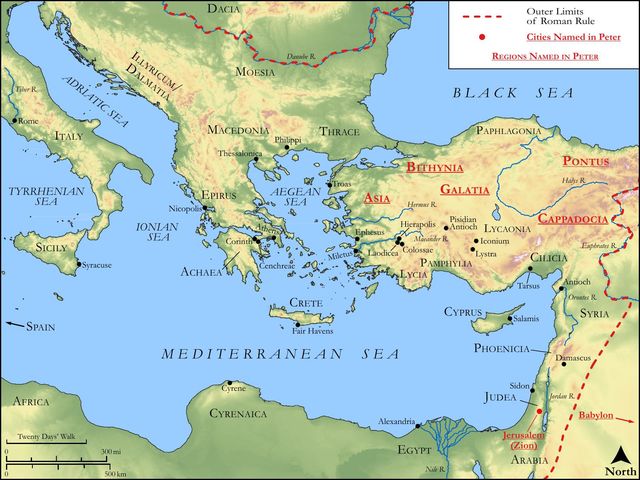
See on the biblical-era maps

Study this verse
Public-domain commentary
Matthew Henry
From his Commentary on the Whole Bible. Henry comments on passages, not single verses — this entry covers 1 Peter 3:21–22. His two-level outline is real structure in the source text, so it is rendered as structure.
Noah's salvation in the ark upon the water prefigured the salvation of all good Christians in the church by baptism; that temporal salvation by the ark was a type, the antitype whereunto is the eternal salvation of believers by baptism, to prevent mistakes about which the apostle,
I.Declares what he means by saving baptism; not the outward ceremony of washing with water, which, in itself, does no more than put away the filth of the flesh, but it is that baptism wherein there is a faithful answer or restipulation of a resolved good conscience, engaging to believe in, and be entirely devoted to, God, the Father, Son, and Holy Ghost, renouncing at the same time the flesh, the world, and the devil. The baptismal covenant, made and kept, will certainly save us. Washing is the visible sign; this is the thing signified.
II.The apostle shows that the efficacy of baptism to salvation depends not upon the work done, but upon the resurrection of Christ, which supposes his death, and is the foundation of our faith and hope, to which we are rendered conformable by dying to sin, and rising again to holiness and newness of life. Learn, 1. the sacrament of baptism, rightly received, is a means and a pledge of salvation. Baptism now saveth us. God is pleased to convey his blessings to us in and by his ordinances, Act 2:38; Act 22:16. 2. The external participation of baptism will save no man without an answerable good conscience and conversation. There must be the answer of a good conscience towards God. - Obj. Infants cannot make such an answer, and therefore ought not to be baptized. - Answer, the true circumcision was that of the heart and of the spirit (Rom 2:29), which children were no more capable of then than our infants are capable of making this answer now; yet they were allowed circumcision at eight days old. The infants of the Christian church therefore may be admitted to the ordinance with as much reason as the infants of the Jewish, unless they are barred from it by some express prohibition of Christ.
III.The apostle, having mentioned the death and resurrection of Christ, proceeds to speak of his ascension, and sitting at the right hand of the Father, as a subject fit to be considered by these believers for their comfort in their suffering condition, Pe1 3:22. If the advancement of Christ was so glorious after his deep humiliation, let not his followers despair, but expect that after these short distresses they shall be advanced to transcendent joy and glory. Learn,
1.Jesus Christ, after he had finished his labours and his sufferings upon earth, ascended triumphantly into heaven, of which see Act 1:9-11; Mar 16:19. He went to heaven to receive his own acquired crown and glory (Joh 17:5), to finish that part of his mediatorial work which could not be done on earth, and make intercession for his people, to demonstrate the fulness of his satisfaction, to take possession of heaven for his people, to prepare mansions for them, and to send down the Comforter, which was to be the first-fruits of his intercession, Joh 16:7.
2.Upon his ascension into heaven, Christ is enthroned at the right hand of the Father. His being said to sit there imports absolute rest and cessation from all further troubles and sufferings, and an advancement to the highest personal dignity and sovereign power.
3.Angels, authorities, and powers, are all made subject to Christ Jesus: all power in heaven and earth, to command, to give law, issue orders, and pronounce a final sentence, is committed to Jesus, God - man, which his enemies will find to their everlasting sorrow and confusion, but his servants to their eternal joy and satisfaction.
Historical interpretation
Sixteen Centuries of Reception
11 surviving comments on this verse. Each one is dated, so this reads as a timeline rather than a list.
Select a marker to jump to its quote. Markers stagger vertically where authors wrote within a few decades of each other.
"For Christ," he says, "has once suffered for our sins, the just for the unjust, that he might present us to God; being put to death in the flesh, but quickened in the spirit." He says these things, reducing them to their faith. That is, He became alive in our spirits.
"Coming," he says, "He preached to those who were once unbelieving." They saw not His form, but they heard His voice.
"When the long-suffering of God" holds out. God is so good, as to work the result by the teaching of salvation.
"By the resurrection," it is said, "of Jesus Christ:" that, namely, which is effected in us by faith.
"Angels being subjected to Him," which are the first order; and "principalities" being subject, who are of the second order; and "powers" being also subject, which are said to belong to the third order.
"Why are they then baptized for the dead," he asks, unless the bodies rise again which are thus baptized? For it is not the soul which is sanctified by the baptismal bath: its sanctification comes from the "answer." "And why," he inquires, "stand we in jeopardy every hour? " -meaning, of course, through the flesh.
The "ring" also he is then Wont to receive for the first time, wherewith, after being interrogated, he publicly seals the agreement of faith, and thus thenceforward feeds upon the "fatness" of the Lord's body,-the Eucharist, to wit.
But neither must we pass over what has been necessarily remarked by you, that the Church, according to the Song of Songs, is a garden enclosed, and a fountain sealed, a paradise with the fruit of apples. They who have never entered into this garden, and have not seen the paradise planted by God the Creator, how shall they be able to afford to another the bring water of the saving lava from the fountain which is enclosed within, and sealed with a divine seal? And as the ark of Noah was nothing else than the sacrament of the Church of Christ, which then, when all without were perishing, kept those only safe who were within the ark, we are manifestly instructed to look to the unity of the Church. Even as also the Apostle Peter laid down, saying, "Thus also shall baptism in like manner make you safe; " showing that as they who were not in the ark with Noah not only were not purged and saved by water, but at once perished in that deluge; so now also, whoever are not in the Church with Christ will perish outside, unless they are converted by penitence to the only and saving lava of the Church.
If some people have the worst consciences, full of every fault and crime, unchanged by penance for their evil deeds, baptism nevertheless saves them, for on the basis of the foundation which is laid in baptism they will be saved, even if it is through fire.
The water of the flood is a type of baptism because it both punished evil people and saved the good, just as baptism expels evil spirits and saves those who turn to Christ. This shows the great power of baptism, and how much we need it.
Not the removal of the filth of the flesh, etc. For where is a good conscience, except where there is also unfeigned faith? For the apostle Paul teaches that the goal of the commandment is love from a pure heart, and a good conscience, and unfeigned faith (1 Tim. 1). Therefore, the water of the flood did not save those placed outside the ark, but killed them; without a doubt, it prefigured that every heretic, even if having the sacrament of baptism, is not uplifted by the waters but plunged into hell by them, whereas the ark is elevated to heaven. The number eight of the souls who were saved through water also signifies that the holy Church received the washing of baptism as a sacrament of the Lord's resurrection, so that just as He rose from the dead by the glory of the Father, so too we, cleansed from sins through the water of regeneration, might walk in newness of life (Rom. 6). For on the eighth day, that is, after the seventh of the Sabbath, the Lord, rising from the dead, showed us an example of future resurrection and the mystery of a new way of life, by which, placed on earth, we would lead a heavenly life. Peter also added this by explaining, saying:
Through the resurrection of Jesus Christ, etc. For just as He, rising from the dead, ascended into heaven and sits at the right hand of God, so also has He, through baptism, marked the way of salvation and the entrance to the heavenly kingdom open for us. Well indeed does it say: Swallowing death; for what we swallow, we cause never to appear again by the power of our bodies. And the Lord swallowed death, which, by rising from the dead, He so completely consumed that it could not have any power against Him through any contact with corruption, and, retaining the appearance of a true body, all stain of the former frailty was completely absent. This same thing is also promised to us in the end, as the Apostle says when speaking of our resurrection: Then will come about the saying that is written: Death is swallowed up in victory (1 Cor. 15). Well swallowed up, because when we also have been made partakers of eternal life, the power of the immortal body will so take away all defect of past corruption just as the flame of fire consumes a drop of water by its heat.
In which also he went and preached to the spirits who were in prison, who had formerly been disobedient, when the patience of God waited in the days of Noah, while the ark was being prepared, in which a few, that is, eight souls, were saved through water. Equivalent to this figure, baptism now saves us, not the removal of the filth of the flesh, but the appeal of a good conscience to God, through the resurrection of Jesus Christ, who is at the right hand of God, having gone into heaven, with angels and authorities and powers made subject to Him.
"In which also." Here, ἐν ᾧ is taken causally for "therefore." For when Peter had said that he died for us, the unjust, and from this had shown that he endured death for the salvation of all men, he now says that for this reason also he preached to those who were held in Hades. "O ἄντίτυπον, etc." (The context of the Greek words here is obscure, and therefore rendered in Latin with more words; yet by rendering the Greek expressions literally, it would be arranged thus:) that baptism, corresponding to the figures, now also saves you, which is now not the removal of the filth of the flesh, but the ἐπερώτημα of a good conscience, which is toward God, or according to God. Furthermore, ἐπερώτημα, that is, to the angels, evidently to the united man.
Not the putting away: As much as to say, that baptism has not its efficacy, in order to salvation, from its washing away any bodily filth or dirt; but from its purging the conscience from sin, when accompanied with suitable dispositions in the party, to answer the interrogations made at that time, with relation to faith, the renouncing of Satan with all his works; and the obedience to God's commandments.
Whereunto baptism: Baptism is said to be of the like form with the water by which Noe was saved, because the one was a figure of the other.
Continue studying 1 Peter 3:21 across the web’s major study libraries — every link below opens this exact verse, chapter, or book on the destination site.
Read & Compare
 BibleGatewayThis verse in more than 200 translations and 70 languages.
 Bible.comThe YouVersion reader — hundreds of translations, reading plans, and highlights.
 ESV.orgCrossway's official English Standard Version reader.
 NET BibleThe NET translation with 60,000+ translators' notes on every rendering decision.
 STEP BibleTyndale House's free study tool — original text, vocabulary, and scholarly resources.
 BibliaLogos Bible Software's free web reader.
 USCCBThe New American Bible (Revised Edition) with the U.S. bishops' study notes.
Commentaries
 BibleHub CommentariesDozens of classic commentaries on this verse, gathered on one page.
 StudyLightMore than 100 commentary sets — the largest collection on the web.
 BibleRefPlain-English commentary on what this verse means, verse by verse.
 Enduring WordDavid Guzik's free commentary on this chapter, widely used by Bible teachers.
 Bible Study ToolsVerse commentary alongside Greek and Hebrew study aids.
Original Language & Research
- BibleHub InterlinearThe verse word by word — original language, transliteration, and English.
- BibleHub LexiconEvery word's original-language definition and Strong's entry.
 Blue Letter BibleDeep-study tools — Strong's numbers, concordance, and word studies.
 CNTR CollationThe earliest Greek manuscripts of this verse, collated letter by letter.
Sermons, Hymns & Audio


TrulyRandomVerse is not affiliated with these sites and doesn’t control their content. They’re linked because they’re genuinely useful.
Summary
First Peter 3:21 presents Christian baptism not as a mere ritualistic washing, but as the spiritual counterpart to Noah's salvation through water, emphasizing its profound significance as an appeal from a good conscience to God. The verse clarifies that the true efficacy of baptism lies not in external cleansing, but in its connection to the transformative power of the resurrection of Jesus Christ, which is the ultimate source of salvation and new life.
Context
ShowHideLiterary Context
This verse concludes a significant theological argument Peter makes regarding suffering and salvation, drawing a profound parallel between the flood in Noah's time and Christian baptism. In 1 Peter 3:18-20, Peter discusses Christ's suffering, death, and resurrection, followed by His proclamation to "spirits in prison" who were disobedient during Noah's day. The mention of Noah's ark, where "few, that is, eight souls were saved by water," directly precedes and sets up the analogy for baptism in verse 21. Peter uses this historical event as a type or figure (ἀντίτυπον, antítypon) to explain the spiritual reality of baptism, shifting from Christ's victory over spiritual forces to its implications for believers' salvation.
Historical & Cultural Context
In the Greco-Roman world, various ritual washings and purifications were common, often associated with mystery religions or cultic practices for cleansing from defilement. Jewish tradition also included ritual immersions (mikvah) for purification. Against this backdrop, early Christians adopted baptism as a distinctive rite of initiation. However, Peter is careful to distinguish Christian baptism from mere external rites. He emphasizes that its power is not inherent in the water or the act itself, but in the spiritual reality it signifies—a reality rooted in the death and resurrection of Christ. This distinction was crucial for early believers who might have been tempted to view baptism as a magical or automatic means of salvation, rather than a symbol of an internal spiritual transformation.
Key Themes
ShowHideThis passage contributes to several overarching themes in 1 Peter. First, it reinforces the theme of salvation through suffering and resurrection, as seen in Christ's own journey and applied to the believer's experience. Second, it highlights the spiritual nature of Christian life, contrasting superficial external acts with genuine internal transformation, a theme echoed in Peter's calls for holy living and a pure conscience throughout the epistle (e.g., 1 Peter 1:15-16 and 1 Peter 2:16). Third, the analogy to Noah's ark underscores God's judgment and salvation, demonstrating His consistent pattern of preserving the righteous through seemingly destructive events. Finally, the emphasis on a "good conscience toward God" speaks to the theme of ethical living and integrity as an outflow of faith, which is a constant refrain in Peter's exhortations to his suffering audience.
Exposition and Analysis
ShowHideKey Word Analysis
ShowHideThis word, translated as "like figure whereunto," signifies a corresponding type or counterpart. In this context, Noah's salvation through the floodwaters is the "type," and Christian baptism is the "antitype." The antitype is not merely a copy but the fulfillment or spiritual reality to which the type pointed. Peter is asserting that while Noah's experience was a physical salvation through water, baptism is the spiritual reality that corresponds to it, offering salvation in a deeper, spiritual sense.
This term, translated as "answer," is crucial and has been subject to various interpretations. From its root, it means "an inquiry" or "a question." However, in a legal or covenantal context, it can refer to a "pledge," "appeal," or "solemn promise" made in response to an inquiry or demand. Here, it is best understood as a sincere appeal or commitment made from a good conscience to God, signifying a personal, conscious act of faith and dedication rather than a passive reception of a ritual.
Meaning "a standing up again" or "resurrection from death," this word anchors the saving power of baptism not in the act itself, but in the historical and theological reality of Christ's triumph over death. It emphasizes that the efficacy of the spiritual reality signified by baptism—the cleansing of conscience and new life—is directly powered by and dependent upon the resurrection of Jesus Christ. It is the resurrection that validates Christ's atoning work and makes new life possible for believers.
Verse Breakdown
ShowHide"The like figure whereunto [even] baptism doth also now save us"
Peter introduces the core analogy, stating that baptism serves as the spiritual counterpart (antitype) to Noah's salvation through the flood. He asserts that this baptism "now saves us," immediately raising the question of how, which he then clarifies. The "now" emphasizes its present efficacy for believers.
"(not the putting away of the filth of the flesh,"
This parenthetical clause immediately clarifies what baptism is not. It is not a physical cleansing, like washing dirt from the body. Peter explicitly distinguishes Christian baptism from mere external ablutions, firmly rejecting any magical or automatic efficacy derived from the physical act itself.
"but the answer of a good conscience toward God,)"
This is the positive clarification of what baptism is. It is a spiritual act, an "answer" or "pledge" that originates from a "good conscience." This "good conscience" is one that has been purified and made right through faith in Christ, enabling the believer to make a sincere appeal or commitment to God. This phrase highlights the internal, volitional, and ethical dimension of baptism.
"by the resurrection of Jesus Christ:"
This final phrase identifies the ultimate source and power behind this saving reality. The "good conscience" and the salvation it signifies are not self-generated but are made possible "by" (διὰ, diá – through the channel of) the resurrection of Jesus Christ. Christ's resurrection is the foundational event that validates His atoning work, secures victory over sin and death, and empowers the believer's new life and purified conscience.
Literary Devices
ShowHidePeter masterfully employs several literary devices to convey his profound theological message. The primary device is Typology, where Noah's ark and the flood serve as a type (a historical event or person that foreshadows a future spiritual reality) and Christian baptism is the antitype (the fulfillment or corresponding spiritual reality). This analogy highlights God's consistent pattern of salvation through judgment and water. Peter also uses Contrast ("not the putting away of the filth of the flesh, but the answer of a good conscience") to sharply distinguish between the external, physical aspect of baptism and its true internal, spiritual significance. This clarifies that the saving power is not in the ritual itself but in the spiritual reality it represents. Finally, the use of a Parenthetical Explanation allows Peter to immediately qualify his statement about baptism saving, preventing misunderstanding and providing crucial theological precision within the flow of his argument.
Theological and Thematic Connections
ShowHideFirst Peter 3:21 profoundly shapes our understanding of Christian baptism, moving beyond a mere ritual to a deep theological reality. It asserts that baptism, as a public declaration, is intrinsically linked to an internal spiritual transformation—a conscience made right with God. This transformation is not achieved by human effort or ritualistic efficacy, but is entirely dependent upon the finished work of Christ, specifically His resurrection. The verse underscores that true salvation is a spiritual reality, a new relationship with God characterized by a cleansed conscience and a sincere commitment, all made possible through Christ's victory over sin and death. It serves as a powerful reminder that the outward sign points to an inward grace, rooted in the power of the risen Christ.
Reflection and Application
ShowHideThis verse challenges us to look beyond the external act of baptism to its profound spiritual meaning. It calls believers to understand baptism not as a magical charm or a mere tradition, but as a solemn and sincere pledge from a conscience made good by God's grace, empowered by Christ's resurrection. For those who have been baptized, it serves as a powerful reminder of the covenant they have entered into with God—a life lived with a clear conscience, striving for holiness and obedience, knowing that their salvation is secured by Christ's victory over death. For those considering baptism, it emphasizes the necessity of a genuine internal transformation and a conscious commitment to Christ, rather than simply going through the motions. Ultimately, it directs our gaze to the resurrection of Jesus Christ as the wellspring of all spiritual life and the foundation of our hope.
Questions for Reflection
ShowHideFAQ
ShowHideDoes this verse mean that baptism itself saves a person, or is it merely a symbol?
ShowHidePeter carefully clarifies that baptism "now saves us" but immediately qualifies this statement. He explicitly states it is "not the putting away of the filth of the flesh" (i.e., not a physical cleansing or a magical act), "but the answer of a good conscience toward God." This means the saving efficacy is not in the water or the ritual itself, but in the spiritual reality it signifies: a sincere, conscious appeal or pledge to God from a heart made right by faith. Baptism is the outward sign and public declaration of an inward spiritual transformation that has already occurred or is occurring. Its saving power is derived from its connection to the resurrection of Jesus Christ, which is the true source of salvation. Thus, it is a symbol that powerfully participates in and testifies to the saving work of Christ, rather than being a standalone salvific act.
Christ-Centered Fulfillment
ShowHideFirst Peter 3:21, though speaking of baptism, finds its ultimate Christ-centered fulfillment in the person and work of Jesus Christ, particularly His resurrection. The "like figure" of Noah's ark, where a remnant was saved through water, foreshadows Christ's victory over sin and death, which is the true means of salvation. Just as Noah passed through judgment to new life, believers are united with Christ in His death and resurrection through baptism, symbolizing their passage from the old life of sin to a new life in Him. The "answer of a good conscience toward God" is only possible because Christ Himself, through His atoning sacrifice and glorious resurrection, has cleansed our consciences from dead works to serve the living God (Hebrews 9:14). His resurrection is the power that overcomes sin and death, enabling believers to walk in newness of life (Romans 6:4). Therefore, baptism, as the outward sign, powerfully testifies to the believer's identification with the resurrected Christ, through whom alone salvation, a purified conscience, and eternal life are secured (Colossians 2:12-13).