


Mark 16:19
Bible text: King James Version (1769 Blayney text) · Public domain
Bible text: Berean Standard Bible · Public domain
Bible text: American Standard Version (1901) · Public domain
Bible text: World English Bible, Messianic edition · Public domain
Bible text: Geneva Bible (1599) · Public domain
Bible text: Young's Literal Translation · Public domain
- ὉHo<the>G3588T-NSMDefinite article Nominative Singular Masculine
- μὲνmenIndeedG3303PRTParticle or Disjunctive
- οὖνounthereforeG3767CONJConjunction
- κύριοςkurios[the] LordG2962N-NSM-TNoun Nominative Singular Masculine Title
- μετὰmetaafterG3326PREPPreposition
- τὸto<the>G3588T-ASNDefinite article Accusative Singular Neuter
- λαλῆσαιlalēsaispeakingG2980V-AANVerb Aorist Active Infinitive
- αὐτοῖςautoisto themG846P-DPMPersonal pronoun Dative Plural Masculine
- ἀνελήφθηanelēphthēwas taken upG353V-API-3SVerb Aorist Passive Indicative 3rd Singular
- εἰςeisintoG1519PREPPreposition
- τὸνtontheG3588T-ASMDefinite article Accusative Singular Masculine
- οὐρανὸνouranonheavenG3772N-ASMNoun Accusative Singular Masculine
- καὶkaiandG2532CONJConjunction
- ἐκάθισενekathisensatG2523V-AAI-3SVerb Aorist Active Indicative 3rd Singular
- ἐκekat [the]G1537PREPPreposition
- δεξιῶνdexiōnright handG1188A-GPNAdjective Genitive Plural Neuter
- τοῦtou<the>G3588T-GSMDefinite article Genitive Singular Masculine
- θεοῦtheouof GodG2316N-GSM-TNoun Genitive Singular Masculine Title
English is a literal word-by-word gloss of the Greek, not the KJV's wording. Why?
This is the original text the KJV's translators worked from — each Greek word with its own literal English meaning in this verse, prepared by scholars at Tyndale House, Cambridge. The KJV translates whole sentences, not word by word, so its wording differs: one Greek word can become several English words, and the KJV may choose “charity” where the gloss reads “love”. Both are faithful — they answer different questions. For the KJV's own rendering, switch to the KJV text.
Details
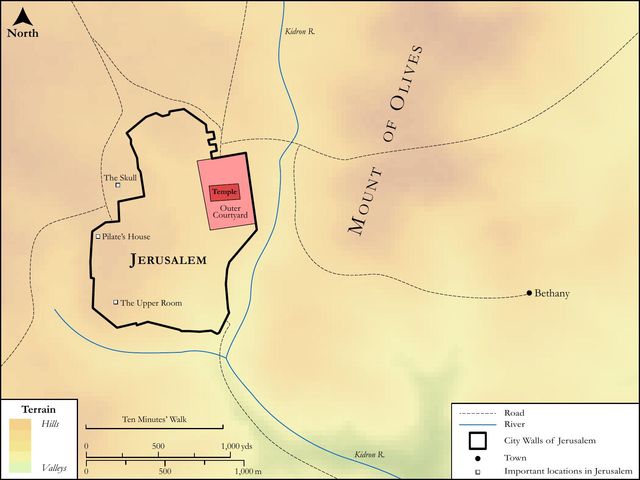
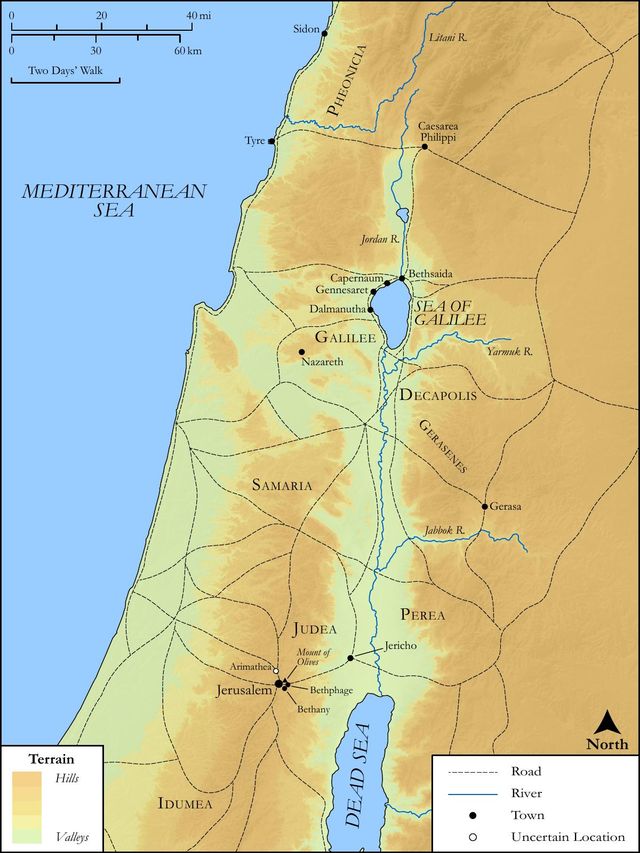
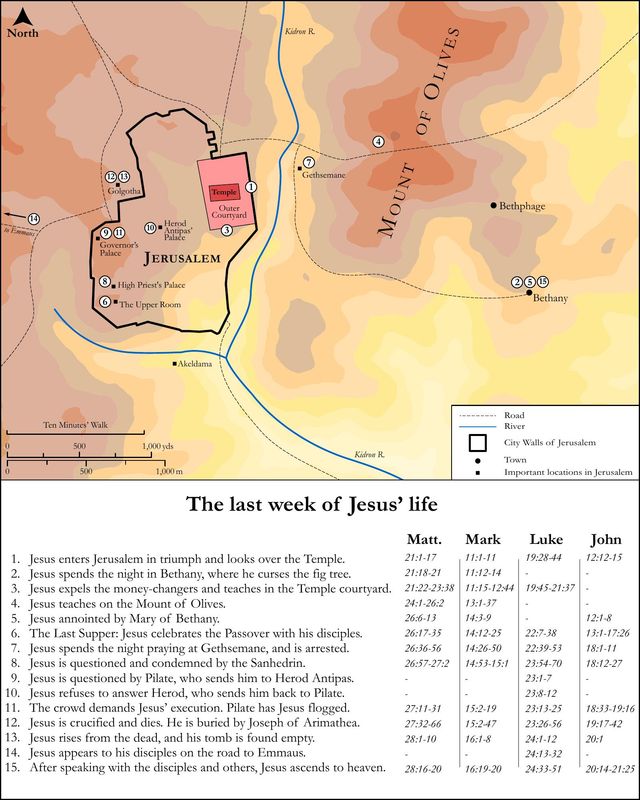
See on the biblical-era maps
Study this verse
Public-domain commentary
Matthew Henry
From his Commentary on the Whole Bible. Henry comments on passages, not single verses — this entry covers Mark 16:19–20. His three-level outline is real structure in the source text, so it is rendered as structure.
Here is, 1. Christ welcomed into the upper world (Mar 16:19): After the Lord had spoken what he had to say to his disciples, he went up into heaven, in a cloud; which we have a particular account of (Act 1:9), and he had not only an admission, but an abundant entrance, into his kingdom there; he was received up, received in state, with loud acclamations of the heavenly hosts; and he sat on the right hand of God: sitting in a posture of rest, for now he had finished his work, and a posture of rule, for now he took possession of his kingdom; he sat at the right hand of God, which denotes the sovereign dignity he is advanced to, and the universal agency he is entrusted with. Whatever God does concerning us, gives to us, or accepts from us, it is by his Son. Now he is glorified with the glory he had before the world.
2.Christ welcomed in this lower world; his being believed on in the world, and received up into glory, are put together, Ti1 3:16.
(1.)We have here the apostles working diligently for him; they went forth, and preached every where far and near. Though the doctrine they preached, was spiritual and heavenly, and directly contrary to the spirit and genius of the world, though it met with abundance of opposition, and was utterly destitute of all secular supports and advantages, yet the preachers of it were neither afraid nor ashamed; they were so industrious in spreading the gospel, that within a few years the sound of it went forth into the ends of the earth, Rom 10:18.
(2.)We have here God working effectually with them, to make their labours successful, by confirming the word with signs following, partly by the miracles that were wrought upon the bodies of the people, which were divine seals to the Christian doctrine, and partly by the influence it had upon the minds of the people, through the operation of the Spirit of God, see Heb 2:4. These were properly signs following the word - the reformation of the world, the destruction of idolatry, the conversion of sinners, the comfort of saints; and these signs still follow it, and that they may do so more and more, for the honour of Christ and the good of mankind, the evangelist prays, and teaches us to say Amen. Father in heaven, thus let thy name be hallowed, and let thy kingdom come.
Historical interpretation
Nine Centuries of Reception
16 surviving comments on this verse. Each one is dated, so this reads as a timeline rather than a list.
Select a marker to jump to its quote. Markers stagger vertically where authors wrote within a few decades of each other.
The Lord Jesus, who had descended from heaven to give liberty to our weak nature, Himself also ascended above the heavens; wherefore it is said, So then after the Lord had spoken unto them, he was received up into heaven.
As he finishes his Gospel, Mark concludes: “So then the Lord Jesus, after he had spoken to them, was taken up into heaven, and sat down at the right hand of God.” The ascension confirms what had been spoken by the prophet: “The Lord said to my Lord, Sit thou on my right hand, until I make thy foes thy footstool.” Thus God who was announced by the prophets is truly one and the same as God who is celebrated in the true gospel, whom we Christians worship and love with the whole heart as the maker of heaven and earth, and of all things within it.
"He sitteth at the Father's right hand " -not the Father at His own.
He dies, but he makes alive and by death destroys death. He is buried, yet he rises again. He goes down to Hades, yet he leads souls up, ascends to heaven, and will come to judge the living and the dead, and to probe discussions like these.
Hail! Thou king of all the living;
Hail! Thou judge of all the dead,
At the right hand of thy Father,
Thou art throned in highest power,
And from thence just judge of sinners,
Thou shalt one day come again.
Do not doubt, then, that the man Christ Jesus is now there whence he shall come again. Cherish in your memory and hold faithfully to the profession of your Christian faith that he rose from the dead, ascended into heaven, sits at the right hand of the Father, and will come from no other place but there to judge the living and the dead. He will so come, on the testimony of the angel’s voice, as he was seen going into heaven, that is, in the same form and substance of flesh to which, it is true, he gave immortality, but did not take away its nature. According to this fleshly form, we are not to think that he is everywhere present. We must beware of so stressing the divinity of the man that we destroy the reality of his body. It does not follow that what is in God is in him so as to be everywhere as God is. The Scripture says, with perfect truth: “In him we live and move and are,” yet we are not everywhere present as he is, but man is in God after one manner, while God is in man quite differently, in his own unique manner. God and man in him are one person, and both are the one Jesus Christ who is everywhere as God, but in heaven as man.
While such things are mystifying if we take them in a carnal sense, we may be warned thereby to think of them as ineffably spiritual. For this reason, even if we think of the Lord’s body, which was raised from the tomb and ascended into heaven, only as having a human appearance and parts, we are not to think that he sits at the right hand of the Father in such a way that the Father should seem to sit [literally] at his left hand. Indeed, in that bliss which surpasses human understanding, the only right hand and the same right hand is a name for that same bliss.
Having vanquished the devil by the resurrection, he sits at the right hand of the Father, where he dies no more, and death no longer over him shall have dominion.
(Con. Evang. iii. 25) By which words He seems to show clearly enough that the foregoing discourse was the last that He spake to them upon earth, though it does not appear to bind us down altogether to this opinion. For He does not say, After He had thus spoken unto them, wherefore it admits of being understood not as if that was the last discourse, but that the words which are here used, After the Lord had spoken unto them, he was received into heaven, might belong to all His other discourses. But since the arguments which we have used above make us rather suppose that this was the last time, therefore we ought to believe that after these words, together with those which are recorded in the Acts of the Apostles, our Lord ascended into heaven.
(de Symbolo, 4) Let us not therefore understand this sitting as though He were placed there in human limbs, as if the Father sat on the left, the Son on the right, but by the right hand itself we understand the power which He as man received from God, that He should come to judge, who first had come to be judged. For by sitting we express habitation, as we say of a person, he sat himself down in that country for many years; in this way then believe that Christ dwells at the right hand of God the Father. For He is blessed and dwells in blessedness, which is called the right hand of the Father; for all is right hand there, since there is no misery.
And so while at Easter it was the Lord’s resurrection which was the cause of our joy, our present rejoicing is due to his ascension into heaven. With all due solemnity we are commemorating that day on which our poor human nature was carried up in Christ above all the hosts of heaven, above all the ranks of angels, beyond those heavenly powers to the very throne of God the Father. It is upon this ordered structure of divine acts that we have been firmly established, so that the grace of God may show itself still more marvelous when, in spite of the withdrawal from our sight of everything that is rightly felt to command our reverence, faith does not fail, hope is not shaken, charity does not grow cold.… It was in order that we might be capable of such blessedness that on the fortieth day after his resurrection, after he had made careful provision for everything concerning the preaching of the gospel and the mysteries of the new covenant, our Lord Jesus Christ was taken up to heaven before the eyes of his disciples, and so his bodily presence among them came to an end. From that time onward he was to remain at the Father’s right hand until the completion of the period ordained by God for the church’s children to increase and multiply, after which, in the same body with which he ascended, he will come again to judge the living and the dead. And so our redeemer’s visible presence has passed into the sacraments. Our faith is nobler and stronger because empirical sight has been replaced by a reliable teaching whose authority is accepted by believing hearts, enlightened from on high.
And indeed the Lord Jesus, after he had spoken to them, was taken up into heaven, and sits at the right hand of God.
In the Old Testament we learned that Elijah was caught up into heaven. But the aerial heaven is one thing, the ethereal heaven another. For the aerial heaven is nearest to the earth; whence we also speak of the birds of heaven, because we see them flying in the air. Elijah therefore was lifted up into the aerial heaven, so that he might suddenly be led to a certain secret region of the earth, where he might live in great rest of flesh and spirit, until he returns at the end of the world and pays the debt of death. For he postponed death, he did not escape it. But our Redeemer, because he did not postpone it, overcame it, and by rising again consumed it, and by ascending declared the glory of his resurrection.
It should also be noted that Elijah is recorded to have ascended in a chariot, so that it might be openly demonstrated that a mere man needed the help of another. For those aids were made and shown through angels, because he could not ascend even into the aerial heaven by himself, whom the weakness of his own nature weighed down. But our Redeemer is not recorded to have been lifted up by a chariot or by angels, because he who had made all things was certainly borne above all things by his own power. For he was returning to where he was, and he was going back from where he remained, because when he ascended into heaven through his humanity, through his divinity he equally contained both earth and heaven.
Just as Joseph, sold by his brothers, prefigured the selling of our Redeemer, so Enoch, translated, and Elijah, raised up to the aerial heaven, designated the Lord's Ascension. Therefore the Lord had forerunners and witnesses of His Ascension, one before the law, the other under the law, so that He Himself might come in due time who could truly penetrate the heavens. Hence the very order in the elevation of both of them is also distinguished by certain gradations. For Enoch is recorded as having been translated, but Elijah as having been carried up to heaven, so that He might come afterward who, neither translated nor carried up, would penetrate the ethereal heaven by His own power.
We must consider what it means that Mark says: He sits at the right hand of God; while Stephen says: I see the heavens opened, and the Son of man standing at the right hand of God. What does it mean that Mark testifies he is sitting, while Stephen testifies that he saw him standing? But you know, brothers, that sitting belongs to one who judges, while standing belongs to one who fights or helps. Therefore, because our Redeemer, having been taken up into heaven, both now judges all things and at the end comes as judge of all, Mark describes him as sitting after his assumption, because after the glory of his Ascension he will be seen as judge at the end. But Stephen, placed in the labor of struggle, saw him standing whom he had as helper, because in order that Stephen might overcome on earth the unbelief of his persecutors, his grace fought for him from heaven.
(ubi sup.) Are we then without faith because we cannot do these signs? Nay, but these things were necessary in the beginning of the Church, for the faith of believers was to be nourished by miracles, that it might increase. Thus we also, when we plant groves, pour water upon them, until we see that they have grown strong in the earth; but when once they have firmly fixed their roots, we leave off irrigating them. These signs and miracles have other things which we ought to consider more minutely. For Holy Church does every day in spirit what then the Apostles did in body; for when her Priests by the grace of exorcism lay their hands on believers, and forbid the evil spirits to dwell in their minds, what do they, but cast out devils? And the faithful who have left earthly words, and whose tongues sound forth the Holy Mysteries, speak a new language; they who by their good warnings take away evil from the hearts of others, take up serpents; and when they are hearing words of pestilent persuasion, without being at all drawn aside to evil doing, they drink a deadly thing, but it will never hurt them; whenever they see their neighbours growing weak in good works, and by their good example strengthen their life, they lay their hands on the sick, that they may recover. And all these miracles are greater in proportion as they are spiritual, and by them souls and not bodies are raised.
(ubi sup.) We have seen in the Old Testament that Elias was taken up into heaven. But the ethereal heaven is one thing, the aerial is another. The aerial heaven is nearer the earth, Elias then was raised into the aerial heaven, that he might be carried off suddenly into some secret region of the earth, there to live in great calmness of body and spirit, until he return at the end of the world, and pay the debt of death. We may also observe that Elias mounted up in a chariot, that by this they might understand that a mere man requires help from without. But our Redeemer, as we read, was not carried up by a chariot, not by angels, because He who had made all things was borne over all by His own power. We must also consider what Mark subjoins, And sat at the right hand of God, since Stephen says, I see the heavens opened, and the Son of Man standing at the right hand of God. Now sitting is the attitude of a judge, standing of one fighting or helping. Therefore Stephen, when toiling in the contest, saw Him standing, whom he had for his helper; but Mark describes Him as sitting after His assumption into heaven, because after the glory of His assumption, He will in the end be seen as a judge.
(ubi sup.) But what should we consider in these words, if it be not that obedience follows the precept and signs follow the obedience? For the Lord had commanded them, Go into all the world preaching the Gospel, and, Ye shall be witnesses even unto the ends of the earth.
And indeed the Lord Jesus, after having spoken to them, was taken up into heaven and sits at the right hand of God. We must consider what it is that Mark says: He sits at the right hand of God, and Stephen says, I see the heavens opened, and the Son of Man standing at the right hand of God (Acts VII). What is it that Mark says he sees sitting, while Stephen testifies he sees standing? But we know that to sit pertains to one who judges, and to stand to one who fights or helps. Therefore, because our Redeemer, taken up into heaven, now judges everything and will come as the judge of all at the end, Mark describes him as sitting after the ascension, because he will be seen as the judge in his glory at the end. But Stephen, positioned in the struggle of toil, saw him standing, whom he had as a helper. Because he, in order to overcome the unbelief of the persecutors on earth, was fought for by the grace of him from heaven. It follows:
(ubi sup.) Observe that in proportion as Mark began his history later, so he makes it reach in writing to more distant times, for he began from the commencement of the preaching of the Gospel by John, and he reaches in his narrative those times in which the Apostles sowed the same word of the Gospel throughout the world.
But we must also know from this that words are confirmed by deeds as then in the Apostles works confirmed their words, for signs followed. Grant then, O Christ, that the good words which we speak may be confirmed by works and deeds, so that at the last, Thou working with us in word and in deed, we may be perfect, for Thine as is fitting is the glory both of word and deed. Amen.
Continue studying Mark 16:19 across the web’s major study libraries — every link below opens this exact verse, chapter, or book on the destination site.
Read & Compare
 BibleGatewayThis verse in more than 200 translations and 70 languages.
 Bible.comThe YouVersion reader — hundreds of translations, reading plans, and highlights.
 ESV.orgCrossway's official English Standard Version reader.
 NET BibleThe NET translation with 60,000+ translators' notes on every rendering decision.
 STEP BibleTyndale House's free study tool — original text, vocabulary, and scholarly resources.
 BibliaLogos Bible Software's free web reader.
 USCCBThe New American Bible (Revised Edition) with the U.S. bishops' study notes.
Commentaries
 BibleHub CommentariesDozens of classic commentaries on this verse, gathered on one page.
 StudyLightMore than 100 commentary sets — the largest collection on the web.
 BibleRefPlain-English commentary on what this verse means, verse by verse.
 Enduring WordDavid Guzik's free commentary on this chapter, widely used by Bible teachers.
 Bible Study ToolsVerse commentary alongside Greek and Hebrew study aids.
Original Language & Research
- BibleHub InterlinearThe verse word by word — original language, transliteration, and English.
- BibleHub LexiconEvery word's original-language definition and Strong's entry.
 Blue Letter BibleDeep-study tools — Strong's numbers, concordance, and word studies.
 CNTR CollationThe earliest Greek manuscripts of this verse, collated letter by letter.
Sermons, Hymns & Audio


TrulyRandomVerse is not affiliated with these sites and doesn’t control their content. They’re linked because they’re genuinely useful.
Summary
Mark 16:19 encapsulates the climactic moment of Jesus' earthly ministry following His resurrection: His glorious Ascension into heaven and His subsequent enthronement at the right hand of God. This pivotal event signifies the completion of His redemptive work, His triumphant victory over sin and death, and His assumption of supreme divine authority and sovereign rule over all creation, marking the transition from His physical presence on earth to His ongoing heavenly intercession and reign.
Context
ShowHideLiterary Context
Mark 16:19 appears at the conclusion of what is often referred to as the "longer ending" of Mark's Gospel (Mark 16:9-20). While scholarly debate exists regarding the authenticity of this section, it has historically been included in many ancient manuscripts and translations, providing a summary of Jesus' post-resurrection appearances and His final instructions to His disciples. Immediately preceding this verse, Jesus commissions His followers to "Go ye into all the world, and preach the gospel to every creature" (Mark 16:15). Thus, Mark 16:19 serves as the ultimate culmination of Jesus' earthly mission, providing the theological foundation for the disciples' subsequent global evangelistic endeavor, empowered by the authority of their ascended Lord.
Historical & Cultural Context
The concept of a divine figure ascending to the heavens and taking a seat of authority was familiar from Scripture itself, as in Daniel's vision of one like the Son of man brought near before the Ancient of days. In the Jewish context, the "right hand of God" was a deeply significant idiom, signifying the place of ultimate power, honor, and authority. For a human figure to sit at God's right hand was an unparalleled claim to divine co-regency and sovereignty, fulfilling Old Testament prophecies concerning the Messiah's exaltation, such as Psalm 110:1. The Ascension, therefore, was not merely a departure but a visible, public declaration of Jesus' unique status as the Son of God, the Messiah, and the rightful King.
Key Themes
ShowHideMark 16:19 powerfully contributes to several overarching themes within the Gospel of Mark and broader biblical theology. Foremost among these is the theme of Christ's Exaltation and Divine Authority. His being "received up into heaven" and sitting "on the right hand of God" underscores His victory over death and His rightful place of supreme power, fulfilling the divine plan. This verse also reinforces the theme of Jesus' Messianic Identity, confirming Him as the promised King and Lord. Furthermore, it sets the stage for the Empowerment of the Church, as Jesus' departure precedes the promised coming of the Holy Spirit (though not explicitly mentioned in Mark, it is a crucial New Testament theme, as seen in Acts 1:8), enabling the disciples to carry out the Great Commission. The Ascension is thus the transition point from Jesus' incarnate ministry to His universal, spiritual reign through His Church.
Exposition and Analysis
ShowHideKey Word Analysis
ShowHideMeaning "to take up." The passive voice ("was received up") is crucial here, emphasizing that Jesus was not merely floating away, but was actively taken up by divine power. This signifies God the Father's active role in His Son's exaltation and acceptance into glory, rather than a self-initiated departure. It underscores the divine orchestration of the Ascension.
Meaning "to seat down" or "to sit." This is not a casual act but a deliberate, decisive action signifying the assumption of a permanent position of authority. In ancient contexts, sitting on a throne or at a king's right hand denotes a settled, established reign. Jesus "sat" because His work was complete, and He was now taking His rightful place of sovereign rule.
Referring to the "right side or hand." This is a powerful biblical idiom, not to be taken literally as a physical location, but as a symbolic representation of supreme power, honor, and authority. To be at the right hand of God means to share in God's divine sovereignty, to be co-regent, and to possess all authority in heaven and on earth.
Verse Breakdown
ShowHide"So then after the Lord had spoken unto them"
This clause establishes the immediate temporal context, indicating that the Ascension occurred subsequent to Jesus' final instructions and interactions with His disciples during His post-resurrection appearances. It highlights the completion of His direct, verbal communication and teaching on earth.
"he was received up into heaven"
This phrase describes the act of Ascension itself. The passive voice ("was received up") emphasizes divine agency—Jesus did not ascend by His own power alone, but was divinely taken up, signifying God's acceptance and exaltation of Him. "Into heaven" denotes His return to the spiritual realm, the abode of God, transcending earthly limitations.
"and sat on the right hand of God"
This climactic statement describes Jesus' enthronement. "Sat" indicates a settled, permanent position of authority, not merely a temporary visit. "On the right hand of God" is a powerful idiom signifying the highest possible position of power, honor, and shared divine sovereignty. It means Jesus is now exercising supreme authority over all creation, co-reigning with the Father.
Literary Devices
ShowHideMark 16:19 employs several significant literary devices. The primary device is Symbolism, particularly in the phrase "sat on the right hand of God." This is not a literal description of a physical seat but a powerful symbolic representation of Jesus' supreme authority, power, and honor. It conveys His divine exaltation and co-regency with the Father. The verse also uses Idiom, as "the right hand of God" is a well-established biblical idiom for ultimate power and favor, understood by its original audience to denote a position of unparalleled authority. Furthermore, the use of the Passive Voice in "he was received up" is a subtle but important device, emphasizing divine agency. It indicates that Jesus' Ascension was not merely a self-initiated departure but an act orchestrated and accomplished by God, underscoring the Father's affirmation and exaltation of the Son. The entire verse functions as a Climax, serving as the final, triumphant act of Jesus' earthly ministry in Mark's narrative, bringing His redemptive work to its glorious conclusion.
Theological and Thematic Connections
ShowHideMark 16:19 is profoundly significant in Christian theology, serving as the capstone of Jesus' redemptive work and the inauguration of His heavenly reign. The Ascension is not merely Jesus' departure but His enthronement, signifying His triumph over sin and death, and His assumption of universal sovereignty. From this position of supreme authority, Jesus continues His ministry, not physically on earth, but as the reigning Lord, interceding for His people, governing all things, and preparing for His second coming. This truth assures believers of His absolute power and His ongoing care for His Church, providing both comfort and a call to mission under His divine authority.
Reflection and Application
ShowHideMark 16:19 offers immense encouragement and a powerful framework for Christian living. Understanding that Jesus is not merely a historical figure but the ascended, reigning Lord at the right hand of God transforms our perspective on life, suffering, and mission. It assures us that His victory is complete, His authority absolute, and His power limitless. This truth empowers us to face challenges with confidence, knowing that our King is sovereign over all circumstances. It calls us to live with an eternal perspective, fixing our gaze on the one who rules from heaven and who will one day return. Our mission, given by this ascended Lord, is therefore not based on human strength but on His divine authority and presence. We are called to live as citizens of His heavenly kingdom, reflecting His reign in our daily lives and participating in His ongoing work in the world.
Questions for Reflection
ShowHideFAQ
ShowHideWhat is the significance of Jesus sitting "on the right hand of God"?
ShowHideThe phrase "sat on the right hand of God" is a profound biblical idiom signifying Jesus' supreme authority, honor, and power. In Israel, the position at the right hand of a king or dignitary was the place of highest favor, trust, and delegated authority. For Jesus, it means He is enthroned as the sovereign King, co-reigning with God the Father over all creation. It is not a literal physical seat, but a symbolic representation of His divine status and the completion of His redemptive work, fulfilling prophecies like Psalm 110:1. This position signifies His ongoing rule, intercession for believers (Romans 8:34), and ultimate headship over the Church (Ephesians 1:20-23).
Christ-Centered Fulfillment
ShowHideMark 16:19 finds its ultimate Christ-centered fulfillment in the person and work of Jesus as the triumphant Messiah and eternal King. The Ascension is not merely a historical event but the very act by which Christ, having completed His earthly redemptive mission through His death and resurrection, assumes His rightful place of universal dominion. This moment directly echoes Old Testament prophecies, particularly Psalm 110:1, which foretells the Messiah's enthronement at God's right hand. In the New Testament, this truth is foundational to understanding Christ's ongoing ministry: He is the Great High Priest who intercedes for us (Hebrews 7:25), the Head of the Church who governs all things for her good (Ephesians 1:22-23), and the one who prepares a place for His followers (John 14:2-3). The Ascension confirms Jesus' divine identity, His completed victory over sin and death, and His present, active reign, from which He will one day return in glory (Acts 1:11).