


Acts 2:33
Bible text: King James Version (1769 Blayney text) · Public domain
Bible text: King James Version with Strong's numbers · Public domain
Bible text: Berean Standard Bible · Public domain
Bible text: American Standard Version (1901) · Public domain
Bible text: World English Bible, Messianic edition · Public domain
Bible text: Geneva Bible (1599) · Public domain
Bible text: Young's Literal Translation · Public domain
- τῇtēaTo theG3588T-DSFDefinite article Dative Singular Feminine
- δεξιᾷdexiaright handG1188A-DSFAdjective Dative Singular Feminine
- οὖνounthereforeG3767CONJConjunction
- τοῦtou<the>G3588T-GSMDefinite article Genitive Singular Masculine
- θεοῦtheouof GodG2316N-GSM-TNoun Genitive Singular Masculine Title
- ὑψωθεὶςhupsōtheishaving been exaltedG5312V-APP-NSMVerb Aorist Passive Participle Nominative Singular Masculine
- τήνtēn<the>G3588T-ASFDefinite article Accusative Singular Feminine
- τεteandG5037CONJConjunction
- ἐπαγγελίανepangelianthe promiseG1860N-ASFNoun Accusative Singular Feminine
- τοῦtouof theG3588T-GSNDefinite article Genitive Singular Neuter
- πνεύματοςpneumatosSpiritG4151N-GSNNoun Genitive Singular Neuter
- τοῦtou<the>G3588T-GSNDefinite article Genitive Singular Neuter
- ἁγίουhagiouHolyG40A-GSNAdjective Genitive Singular Neuter
- λαβὼνlabōnhaving receivedG2983V-2AAP-NSMVerb 2nd Aorist Active Participle Nominative Singular Masculine
- παρὰparafromG3844PREPPreposition
- τοῦtoutheG3588T-GSMDefinite article Genitive Singular Masculine
- πατρὸςpatrosFatherG3962N-GSM-TNoun Genitive Singular Masculine Title
- ἐξέχεενexecheenHe has poured outG1632V-AAI-3SVerb Aorist Active Indicative 3rd Singular
- τοῦτοtoutothisG3778D-ASNDemonstrative pronoun Accusative Singular Neuter
- ὃhowhichG3739R-ASNRelative pronoun Accusative Singular Neuter
- νὺνnunnowG3568ADVAdverb
- ὑμεῖςhumeisyou yourselvesG4771P-2NPPersonal pronoun Nominative 2nd Plural
- βλέπετεblepeteare seeingG991V-PAI-2PVerb Present Active Indicative 2nd Plural
- καὶkaiandG2532CONJConjunction
- ἀκούετεakouetehearingG191V-PAI-2PVerb Present Active Indicative 2nd Plural
English is a literal word-by-word gloss of the Greek, not the KJV's wording. Why?
This is the original text the KJV's translators worked from — each Greek word with its own literal English meaning in this verse, prepared by scholars at Tyndale House, Cambridge. The KJV translates whole sentences, not word by word, so its wording differs: one Greek word can become several English words, and the KJV may choose “charity” where the gloss reads “love”. Both are faithful — they answer different questions. For the KJV's own rendering, switch to the KJV text.
Details
See on the biblical-era maps
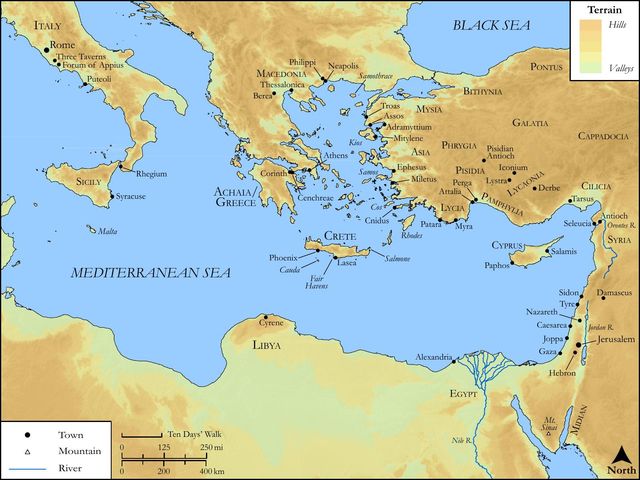
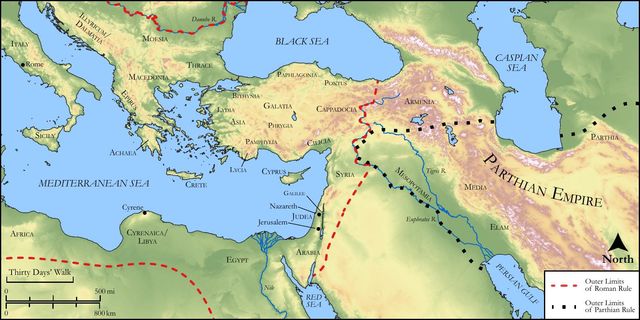
Study this verse
Public-domain commentary
Matthew Henry
From his Commentary on the Whole Bible. Henry comments on passages, not single verses — this entry covers Acts 2:14–36. His four-level outline is real structure in the source text, so it is rendered as structure.
We have here the first-fruits of the Spirit in the sermon which Peter preached immediately, directed, not to those of other nations in a strange language (we are not told what answer he gave to those that were amazed, and said, What meaneth this?) but to the Jews in the vulgar language, even to those that mocked; for he begins with the notice of that (v. 15), and addresses his discourse (v. 14) to the men of Judea and the inhabitants of Jerusalem; but we have reason enough to think that the other disciples continued to speak to those who understood them (and therefore flocked about them), in the languages of their respective countries, the wonderful works of God. And it was not by Peter's preaching only, but that of all, or most, of the rest of the hundred and twenty, that three thousand souls were that day converted, and added to the church; but Peter's sermon only is recorded, to be an evidence for him that he was thoroughly recovered from his fall, and thoroughly restored to the divine favour. He that had sneakingly denied Christ now as courageously confesses him. Observe,
I.His introduction or preface, wherein he craves the attention of the auditory, or demands it rather:
Peter stood up (v. 14), to show that he was not drunk, with the eleven, who concurred with him in what he said, and probably in their turns spoke likewise to the same purport; those that were of greatest authority stood up to speak to the scoffing Jews, and to confront those who contradicted and blasphemed, but left the seventy disciples to speak to the willing proselytes from other nations, who were not so prejudiced, in their own language. Thus among Christ's ministers, some of greater gifts are called out to instruct those that oppose themselves, to take hold of sword and spear; others of meaner abilities are employed in instructing those that resign themselves, and to be vine-dressers and husband-men. Peter lifted up his voice, as one that was both well assured of and much affected with what he said, and was neither afraid nor ashamed to own it. He applied himself to the men of Judea, andres Ioudaioi—the men that were Jews; so it should be read; "and you especially that dwell at Jerusalem, who were accessory to the death of Jesus, be this known unto you, which you did not know before, and which you are concerned to know now, and hearken to my words, who would draw you to Christ, and not to the words of the scribes and Pharisees, that would draw you from him. My Master is gone, whose words you have often heard in vain, and shall hear no more as you have done, but he speaks to you by us; hearken now to our words."
II.His answer to their blasphemous calumny (v.
15): "These men are not drunken, as you suppose. These disciples of Christ, that now speak with other tongues, speak good sense, and know what they say, and so do those they speak to, who are led by their discourses into the knowledge of the wonderful works of God. You cannot think they are drunk, for it is but the third hour of the day," nine of the clock in the morning; and before this time, on the sabbaths and solemn feasts, the Jews did not eat nor drink: nay, ordinarily, those that are drunk are drunk in the night, and not in the morning; those are besotted drunkards indeed who, when they awake, immediately seek it yet again, Prov. xxiii. 35.
III.His account of the miraculous effusion of the Spirit, which is designed to awaken them all to embrace the faith of Christ, and to join themselves to his church. Two things he resolves it into:—that it was the fulfilling of the scripture, and the fruit of Christ's resurrection and ascension, and consequently the proof of both.
1.That it was the accomplishment of the prophecies of the Old Testament which related to the kingdom of the Messiah, and therefore an evidence that this kingdom is come, and the other predictions of it are fulfilled. He specifies one, that of the prophet Joel, ch. ii. 28. It is observable that though Peter was filled with the Holy Ghost, and spoke with tongues as the Spirit gave him utterance, yet he did not set aside the scriptures, nor think himself above them; nay, much of his discourse is quotation out of the Old Testament, to which he appeals, and with which he proves what he says. Christ's scholars never learn above their Bible; and the Spirit is given not to supersede the scriptures, but to enable us to understand and improve the scriptures. Observe,
(1.)The text itself that Peter quotes, v. 17-21. It refers to the last days, the times of the gospel, which are called the last days because the dispensation of God's kingdom among men, which the gospel sets up, is the last dispensation of divine grace, and we are to look for no other than the continuation of this to the end of time. Or, in the last days, that is, a great while after the ceasing of prophecy in the Old-Testament church. Or, in the days immediately preceding the destruction of the Jewish nation, in the last days of that people, just before that great and notable day of the Lord spoken of, v. 20. "It was prophesied of and promised, and therefore you ought to expect it, and not to be surprised at it; to desire it, and bid it welcome, and not to dispute it, as not worth taking notice of." The apostle quotes the whole paragraph, for it is good to take scripture entire; now it was foretold,
[1.]That there should be a more plentiful and extensive effusion of the Spirit of grace from on high than had ever yet been. The prophets of the Old Testament had been filled with the Holy Ghost, and it was said of the people of Israel that God gave them his good Spirit to instruct them, Neh. ix. 20. But now the Spirit shall be poured out, not only upon the Jews, but upon all flesh, Gentiles as well as Jews, though yet Peter himself did not understand it so, as appears, ch. xi. 17. Or, upon all flesh, that is, upon some of all ranks and conditions of men. The Jewish doctors taught that the Spirit came only upon wise and rich men, and such as were of the seed of Israel; but God will not tie himself to their rules.
[2.]That the Spirit should be in them a Spirit of prophecy; by the Spirit they should be enabled to foretel things to come, and to preach the gospel to every creature. This power shall be given without distinction of sex—now only your sons, but your daughters shall prophesy; without distinction of age—both your young men and your old men shall see visions, and dream dreams, and in them receive divine revelations, to be communicated to the church; and without distinction of outward condition—even the servants and handmaids shall receive of the Spirit, and shall prophesy (v. 18); or, in general, men and women, whom God calls his servants and his handmaids. In the beginning of the age of prophecy in the Old Testament there were schools of the prophets, and, before that, the Spirit of prophecy came upon the elders of Israel that were appointed to the government; but now the Spirit shall be poured out upon persons of inferior rank, and such as were not brought up in the schools of the prophets, for the kingdom of the Messiah is to be purely spiritual. The mention of the daughters (v. 17) and the handmaidens (v. 18) would make one think that the women who were taken notice of (ch. i. 14) received the extraordinary gifts of the Holy Ghost, as well as the men. Philip, the evangelist, had four daughters who did prophesy (ch. xxi. 9), and St. Paul, finding abundance of the gifts both of tongues and prophecy in the church of Corinth, saw it needful to prohibit women's use of those gifts in public, 1 Cor. xiv. 26, 34.
[3.]That one great thing which they should prophesy of should be the judgment that was coming upon the Jewish nation, for this was the chief thing that Christ himself had foretold (Matt. xxiv.) at his entrance into Jerusalem (Luke xix. 41); and when he was going to die (Luke xxiii. 29); and these judgments were to be brought upon them to punish for their contempt of the gospel, and their opposition to it, though it came to them thus proved. Those that would not submit to the power of God's grace, in this wonderful effusion of his Spirit, should fall and lie under the pourings out of the vials of his wrath. Those shall break that will not bend. First, The destruction of Jerusalem, which was about forty years after Christ's death, is here called that great and notable day of the Lord, because it put a final period to the Mosaic economy; the Levitical priesthood and the ceremonial law were thereby for ever abolished and done away. The desolation itself was such as was never brought upon any place or nation, either before or since. It was the day of the Lord, for it was the day of his vengeance upon that people for crucifying Christ, and persecuting his ministers; it was the year of recompences for that controversy; yea, and for all the blood of the saints and martyrs, from the blood of righteous Abel, Matt. xxiii. 35. It was a little day of judgment; it was a notable day: in Joel it is called a terrible day, for so it was to men on earth; but here epiphane (after the Septuagint), a glorious, illustrious day, for so it was to Christ in heaven; it was the epiphany, his appearing, so he himself spoke of it, Matt. xxiv. 30. The destruction of the Jews was the deliverance of the Christians, who were hated and persecuted by them; and therefore that day was often spoken of by the prophets of that time, for the encouragement of suffering Christians, that the Lord was at hand, the coming of the Lord drew nigh, the Judge stood before the door, James v. 8, 9. Secondly, The terrible presages of that destruction are here foretold: There shall be wonders in heaven above, the sun turned into darkness and the moon into blood; and signs too in the earth beneath, blood and fire. Josephus, in his preface to his history of the wars of the Jews, speaks of the signs and prodigies that preceded them, terrible thunders, lightnings, and earthquakes; there was a fiery comet that hung over the city for a year, and a flaming sword was seen pointing down upon it; a light shone upon the temple and the altar at midnight, as if it had been noon-day. Dr. Lightfoot gives another sense of these presages: The blood of the Son of God, the fire of the Holy Ghost now appearing, the vapour of the smoke in which Christ ascended, the sun darkened, and the moon made blood, at the time of Christ's passion, were all loud warnings given to that unbelieving people to prepare for the judgments coming upon them. Or, it may be applied, and very fitly, to the previous judgments themselves by which that desolation was brought on. The blood points at the wars of the Jews with the neighbouring nations, with the Samaritans, Syrians, and Greeks, in which abundance of blood was shed, as there was also in their civil wars, and the struggles of the seditious (as they called them), which were very bloody; there was no peace to him that went out nor to him that came in. The fire and vapour of smoke, here foretold, literally came to pass in the burning of their cities, and towns, and synagogues, and temple at last. And this turning of the sun into darkness, and the moon into blood, bespeaks the dissolution of their government, civil and sacred, and the extinguishing of all their lights. Thirdly, The signal preservation of the Lord's people is here promised (v. 21): Whosoever shall call upon the name of the Lord Jesus (which is the description of a true Christian, 1 Cor. i. 2) shall be saved, shall escape that judgment which shall be a type and earnest of everlasting salvation. In the destruction of Jerusalem by the Chaldeans, there was a remnant sealed to be hid in the day of the Lord's anger; and in the destruction by the Romans not one Christian perished. Those that distinguish themselves by singular piety shall be distinguished by special preservation. And observe, the saved remnant are described by this, that they are a praying people: they call on the name of the Lord, which intimates that they are not saved by any merit or righteousness of their own, but purely by the favour of God, which must be sued out by prayer. It is the name of the Lord which they call upon that is their strong tower.
(2.)The application of this prophecy to the present event (v. 16): This is that which was spoken by the prophet Joel; it is the accomplishment of that, it is the full accomplishment of it. This is that effusion of the Spirit upon all flesh which should come, and we are to look for no other, no more than we are to look for another Messiah; for as our Messiah ever lives in heaven, reigning and interceding for his church on earth, so this Spirit of grace, the Advocate, or Comforter, that was given now, according to the promise, will, according to the same promise, continue with the church on earth to the end, and will work all its works in it and for it, and every member of it, ordinary and extraordinary, by means of the scriptures and the ministry.
2.That it was the gift of Christ, and the product and proof of his resurrection and ascension. From this gift of the Holy Ghost, he takes occasion to preach unto them Jesus; and this part of his sermon he introduces with another solemn preface (v. 22): "You men of Israel, hear these words. It is a mercy that you are within hearing of them, and it is your duty to give heed to them." Words concerning Christ should be acceptable words to the men of Israel. Here is,
(1.)An abstract of the history of the life of Christ, v. 22. He calls him Jesus of Nazareth, because by that name he was generally known, but (which was sufficient to roll away that reproach) he was a man approved of God among you, censured and condemned by men, but approved of God: God testified his approbation of his doctrine by the power he gave him to work miracles: a man marked out by God, so Dr. Hammond reads it; "signalized and made remarkable among you that now hear me. He was sent to you, set up, a glorious light in your land; you yourselves are witnesses how he became famous by miracles, wonders, and signs, works above the power of nature, out of its ordinary course, and contrary to it, which God did by him; that is, which he did by that divine power with which he was clothed, and in which God plainly went along with him; for no man could do such works unless God were with him." See what a stress Peter lays upon Christ's miracles. [1.] The matter of fact was not to be denied: "They were done in the midst of you, in the midst of your country, your city, your solemn assemblies, as you yourselves also know. You have been eyewitnesses of his miracles; I appeal to yourselves whether you have any thing to object against them or can offer any thing to disprove them." [2.] The inference from them cannot be disputed; the reasoning is as strong as the evidence; if he did those miracles, certainly God approved him, declared him to be, what he declared himself to be, the Son of God and the Saviour of the world; for the God of truth would never set his seal to a lie.
(2.)An account of his death and sufferings which they were witness of also but a few weeks ago; and this was the greatest miracle of all, that a man approved of God should thus seem to be abandoned of him; and a man thus approved among the people, and in the midst of them, should be thus abandoned by them too. But both these mysteries are here explained (v. 23), and his death considered,
[1.]As God's act; and in him it was an act of wonderful grace and wisdom. He delivered him to death; not only permitted him to be put to death, but gave him up, devoted him: this is explained Rom. viii. 32, He delivered him up for us all. And yet he was approved of God, and there was nothing in this that signified the disapproving of him; for it was done by the determinate counsel and foreknowledge of God, in infinite wisdom, and for holy ends, which Christ himself concurred in, and in the means leading to them. Thus divine justice must be satisfied, sinners saved, God and man brought together again, and Christ himself glorified. It was not only according to the will of God, but according to the counsel of his will, that he suffered and died; according to an eternal counsel, which could not be altered. This reconciled him to the cross: Father, thy will be done; and Father, glorify thy name; let thy purpose take effect, and let the great end of it be attained.
[2.]As the people's act; and in them it was an act of prodigious sin and folly; it was fighting against God to persecute one whom he approved as the darling of heaven; and fighting against their own mercies to persecute one that was the greatest blessing of this earth. Neither God's designing it from eternity, nor his bringing good out of it to eternity, would in the least excuse their sin; for it was their voluntary act and deed, from a principle morally evil, and therefore "they were wicked hands with which you have crucified and slain him." It is probable that some of those were here present who had cried, Crucify him, crucify him, or had been otherwise aiding and abetting in the murder; and Peter knew it. However, it was justly looked upon as a national act, because done both by the vote of the great council and by the voice of the great crowd. It is a rule, Refertur ad universos quod publice fit per majorem paretm—That which is done publicly by the greater part we attribute to all. He charges it particularly on them as parts of the nation on which it would be visited, the more effectually to bring them to faith and repentance, because that was the only way to distinguish themselves from the guilty and discharge themselves from the guilt.
(3.)An attestation of his resurrection, which effectually wiped away the reproach of his death (v. 24): Whom God raised up; the same that delivered him to death delivers him from death, and thereby gave a higher approbation of him than he had done by any other of the signs and wonders wrought by him, or by all put together. This therefore he insists most largely upon.
[1.]He describes his resurrection: God loosed the pains of death, because it was impossible that he should be holden of it; odinas—the sorrows of death; the word is used for travailing pains, and some think it signifies the trouble and agony of his soul, in which it was exceedingly sorrowful, even to the death; from these pains and sorrows of soul, this travail of soul, the Father loosed him when at his death he said, It is finished. Thus Dr. Godwin understands it: "Those terrors which made Heman's soul lie like the slain (Ps. lxxxviii. 5, 15) had hold of Christ; but he was too strong for them, and broke through them; this was the resurrection of his soul (and it is a great thing to bring a soul out of the depths of spiritual agonies); this was not leaving his soul in hell; as that which follows, that he should not see corruption, speaks of the resurrection of his body; and both together make up the great resurrection." Dr. Lightfoot gives another sense of this: "Having dissolved the pains of death, in reference to all that believe in him, God raised up Christ, and by his resurrection broke all the power of death, and destroyed its pangs upon his own people. He has abolished death, has altered the property of it, and, because it was not possible that he should be long holden of it, it is not possible that they should be for ever holden." But most refer this to the resurrection of Christ's body. And death (says Mr. Baxter) is by privation a penal state, though not dolorous by positive evil. But Dr. Hammond shows that the Septuagint, and from them the apostle here, uses the word for cords and bands (as Ps. xviii. 4), to which the metaphor of loosing and being held best agrees. Christ was imprisoned for our debt, was thrown into the bands of death; but, divine justice being satisfied, it was not possible he should be detained there, either by right or by force; for he had life in himself, and in his own power, and had conquered the prince of death.
[2.]He attests the truth of his resurrection (v. 32): God hath raised him up, whereof we all are witnesses—we apostles, and others our companions, that were intimately acquainted with him before his death, were intimately conversant with him after his resurrection, did eat and drink with him. They received power, by the descent of the Holy Ghost upon them, on purpose that they might be skilful, faithful, and courageous witnesses of this thing, notwithstanding their being charged by his enemies as having stolen him away.
[3.]He showed it to be the fulfilling of the scripture, and, because the scripture had said that he must rise again before he saw corruption, therefore it was impossible that he should be holden by death and the grave; for David speaks of his being raised, so it comes in, v. 25. The scripture he refers to is that of David (Ps. xvi. 8-11), which, though in part applicable to David as a saint, yet refers chiefly to Jesus Christ, of whom David was a type. Here is,
First, The text quoted at large (v. 25-28), for it was all fulfilled in him, and shows us, 1. The constant regard that our Lord Jesus had to his Father in his whole undertaking: I foresaw the Lord before me continually. He set before him his Father's glory as his end in all—for he saw that his sufferings would redound abundantly to the honour of God, and would issue in his own joy; these were set before him, and these he had an eye to, in all he did and suffered; and with the prospect of these he was borne up and carried on, John xiii. 31, 32; xvii. 4, 5. 2. The assurance he had of his Father's presence and power going along with him: "He is on my right hand, the hand of action, strengthening, guiding, and upholding that, that I should not be moved, nor driven off from my undertaking, notwithstanding the hardships I must undergo." This was an article of the covenant of redemption (Ps. lxxxix. 21), With him my hand shall be established, my arm also shall strengthen him; and therefore he is confident the work shall not miscarry in his hand. If God be at our right hand we shall not be moved. 3. The cheerfulness with which our Lord Jesus went on in his work, notwithstanding the sorrows he was to pass through: "Being satisfied that I shall not be moved, but the good pleasure of the Lord shall prosper in my hand, therefore doth my heart rejoice, and my tongue is glad, and the thought of my sorrow is as nothing to me." Note, It was a constant pleasure to our Lord Jesus to look to the end of his work, and to be sure that the issue would be glorious; so well pleased is he with his undertaking that it does his heart good to think how the issue would answer the design. He rejoiced in spirit, Luke x. 21. My tongue was glad. In the psalm it is, My glory rejoiceth; which intimates that our tongue is our glory, the faculty of speaking is an honour to us, and never more so than when it is employed in praising God. Christ's tongue was glad, for when he was just entering upon his sufferings, in the close of his last supper, he sang a hymn. 4. The pleasing prospect he had of the happy issue of his death and sufferings; it was this that carried him, not only with courage, but with cheerfulness, through them; he was putting off the body, but my flesh shall rest; the grave shall be to the body, while it lies there, a bed of repose, and hope shall give it a sweet repose; it shall rest in hope, hoti, that thou wilt not leave my soul in hell; what follows is the matter of his hope, or assurance rather, (1.) That the soul shall not continue in a state of separation from the body; for, besides that this is some uneasiness to a human soul made for its body, it would be the continuance of death's triumph over him who was in truth a conqueror over death: "Thou wilt not leave my soul in hell" (in hades, in the invisible state, so hades properly signifies); "but, though thou suffer it for a time to remove thither, and to remain there, yet thou wilt remand it; thou wilt not leave it there, as thou dost the souls of other men." (2.) That the body shall lie but a little while in the grave: Thou wilt not suffer thy Holy One to see corruption; the body shall not continue dead so long as to begin to putrefy or become noisome; and therefore it must return to life on or before the third day after its death. Christ was God's Holy One, sanctified and set apart to his service in the work of redemption; he must die, for he must be consecrated by his own blood; but he must not see corruption, for his death was to be unto God of a sweet smelling savour. This was typified by the law concerning the sacrifice, that no part of the flesh of the sacrifice which was to be eaten should be kept till the third day, for fear it should see corruption and begin to putrefy, Lev. vii. 15-18. (3.) That his death and sufferings should be, not to him only, but to all his, an inlet to a blessed immortality: "Thou has made known to me the ways of life, and by me made them known to the world, and laid them open." When the Father gave to the Son to have life in himself, a power to lay down his life and to take it again, then he showed him the way of life, both to and fro; the gates of death were open to him and the doors of the shadow of death (Job xxxviii. 17), to pass and repass through them, as his occasion led him, for man's redemption. (4.) That all his sorrows and sufferings should end in perfect and perpetual felicity: Thou shalt make me full of joy with thy countenance. The reward set before him was joy, a fulness of joy, and that in God's countenance, in the countenance he gave to his undertaking, and to all those, for his sake, that should believe in him. The smiles with which the Father received him, when, at his ascension, he was brought to the Ancient of days, filled him with joy unspeakable, and that is the joy of our Lord, into which all his shall enter, and in which they shall be for ever happy.
Secondly, The comment upon this text, especially so much of it as relates to the resurrection of Christ. He addresses himself to them with a title of respect, Men and brethren, v. 29. "You are men, and therefore should be ruled by reason; you are brethren, and therefore should take kindly what is said to you by one who, being nearly related to you, is heartily concerned for you, and wishes you well. Now, give me leave freely to speak to you concerning the patriarch David, and let it be no offence to you if I tell you that David cannot be understood here as speaking of himself, but of the Christ to come." David is here called a patriarch, because he was the father of the royal family, and a man of great note and eminency in his generation, and whose name and memory were justly very precious. Now when we read that psalm of his, we must consider, 1. That he could not say that of himself, for he died, and was buried, and his sepulchre remained in Jerusalem till now, when Peter spoke this, and his bones and ashes in it. Nobody ever pretended that he had risen, and therefore he could never say of himself that he should not see corruption; for it was plain he did see corruption. St. Paul urges this, ch. xiii. 35-37. Though he was a man after God's own heart, yet he went the way of all the earth, as he saith himself (1 Kings ii. 2), both in death and burial. 2. Therefore certainly he spoke it as a prophet, with an eye to the Messiah, whose sufferings the prophets testified beforehand, and with them the glory that should follow; so did David in that psalm, as Peter here plainly shows. (1.) David knew that the Messiah should descend from his loins (v. 30), that God had sworn to him, that of the fruit of his loins, according to the flesh, he would raise up Christ to sit on his throne. He promised him a Son, the throne of whose kingdom should be established for ever, 2 Sam. vii. 12. And it is said (Ps. cxxxii. 11), God swore it in truth unto David. When our Lord Jesus was born, it was promised that the Lord God would give him the throne of his father David, Luke i. 32. And all Israel knew that the Messiah was to be the Son of David, that is, that, according to the flesh, he should be so by his human nature; for otherwise, according to the spirit, and by his divine nature, he was to be David's Lord, not his son. God having sworn to David that the Messiah, promised to his fathers, should be his son and successor, the fruit of his loins, and heir to his throne, he kept this in view, in penning his psalms. (2.) Christ being the fruit of his loins, and consequently in his loins when he penned that psalm (as Levi is said to be in Abraham's loins when he paid tithes to Melchizedek), if what he says, as in his own person, be not applicable to himself (as it is plain that it is not), we must conclude it points to that son of his that was then in his loins, in whom his family and kingdom were to have their perfection and perpetuity; and therefore, when he says that his soul should not be left in its separate state, nor his flesh see corruption, without doubt he must be understood to speak of the resurrection of Christ, v. 31. And as Christ died, so he rose again, according to the scriptures; and that he did so we are witnesses. (3.) Here is a glance at his ascension too. As David did not rise from the dead, so neither did he ascend into the heavens, bodily, as Christ did, v. 34. And further, to prove that when he spoke of the resurrection he meant it of Christ, he observes that when in another psalm he speaks of the next step of his exaltation he plainly shows that he spoke of another person, and such another as was his Lord (Ps. cx. 1): "The Lord said unto my Lord, when he had raised him from the dead, Sit thou at my right hand, in the highest dignity and dominion there; be thou entrusted with the administration of the kingdom both of providence and grace; sit there as king, until I make thy foes either thy friends or thy footstool," v. 35. Christ rose from the grave to rise higher, and therefore it must be of his resurrection that David spoke, and not his own, in the 16th Psalm; for there was no occasion for him to rise out of his grave who was not to ascend to heaven.
(4.)The application of this discourse concerning the death, resurrection, and ascension of Christ.
[1.]This explains the meaning of the present wonderful effusion of the Spirit in those extraordinary gifts. Some of the people had asked (v. 12), What meaneth this? I will tell you the meaning of it, says Peter. This Jesus being exalted to the right hand of God, so some read it, to sit there; exalted by the right hand of God, so we read it, by his power and authority—it comes all to one; and having received of the Father, to whom he has ascended, the promise of the Holy Ghost, he hath given what he received (Ps. lxviii. 18), and hath shed forth this which you now see and hear; for the Holy Ghost was to be given when Jesus was glorified, and not before, John vii. 39. You see and hear us speak with tongues that we never learned; probably there was an observable change in the air of their countenances, which they saw, as well as heard the change of their voice and language; now this is from the Holy Ghost, whose coming is an evidence that Jesus is exalted, and he has received this gift from the Father, to confer it upon the church, which plainly bespeaks him to be the Mediator, or middle person between God and the church. The gift of the Holy Ghost was, First, A performance of divine promises already made; here it is called the promise of the Holy Ghost; many exceedingly great and precious promises the divine power has given us, but this is the promise, by way of eminency, as that of the Messiah had been, and this is the promise that includes all the rest; hence God's giving the Holy Spirit to those that ask him (Luke xi. 13) is his giving them all good things, Matt. vii. 11. Christ received the promise of the Holy Ghost, that is, the promised gift of the Holy Ghost, and has given it to us; for all the promises are yea and amen in him. Secondly, It was a pledge of all divine favours further intended; what you now see and hear is but an earnest of greater things.
[2.]This proves what you are all bound to believe, that Christ Jesus is the true Messiah and Saviour of the world; this he closes his sermon with, as the conclusion of the whole matter, the quod erat demonstrandum—the truth to be demonstrated (v. 36): Therefore let all the house of Israel know assuredly that this truth has now received its full confirmation, and we our full commission to publish it, That God has made that same Jesus whom you have crucified both Lord and Christ. They were charged to tell no man that he was Jesus the Christ till after his resurrection (Matt. xvi. 20; xvii. 9); but now it must be proclaimed on the housetops, to all the house of Israel; he that hath ears to hear, let him hear it. It is not proposed as probable, but deposed as certain: Let them know it assuredly, and know that it is their duty to receive it as a faithful saying, First, That God has glorified him whom they have crucified. This aggravates their wickedness, that they crucified one whom God designed to glorify, and put him to death as a deceiver who had given such pregnant proofs of his divine mission; and it magnifies the wisdom and power of God that though they crucified him, and thought thereby to have put him under an indelible mark of infamy, yet God had glorified him, and the indignities they had done him served as a foil to his lustre. Secondly, That he has glorified him to such a degree as to make him both Lord and Christ: these signify the same; he is Lord of all, and he is not a usurper, but is Christ, anointed to be so. He is one Lord to the Gentiles, who had had lords many; and to the Jews he is Messiah, which includes all his offices. He is the king Messiah, as the Chaldee paraphrast calls him; or, as the angel to Daniel, Messiah the prince, Dan. ix. 25. This is the great truth of the gospel which we are to believe, that that same Jesus, the very same that was crucified at Jerusalem, is he to whom we owe allegiance, and from whom we are to expect protection, as Lord and Christ.
Historical interpretation
Four Centuries of Reception
8 surviving comments on this verse. Each one is dated, so this reads as a timeline rather than a list.
Select a marker to jump to its quote. Markers stagger vertically where authors wrote within a few decades of each other.
"And He had in His right hand seven stars." He said that in His right hand He had seven stars, because the Holy Spirit of sevenfold agency was given into His power by the Father. As Peter exclaimed to the Jews: "Being at the right hand of God exalted, He hath shed forth this Spirit received from the Father, which ye both see and hear." Moreover, John the Baptist had also anticipated this, by saying to his disciples: "For God giveth not the Spirit by measure unto Him. The Father," says he, "loveth the Son, and hath given all things into His hands." Those seven stars are the seven churches, which he names in his addresses by name, old calls them to whom he wrote epistles. Not that they are themselves the only, or even the principal churches; but what he says to one, he says to all. For they are in no respect different, that on that ground any one should prefer them to the larger number of similar small ones. In the whole world Paul taught that all the churches are arranged by sevens, that they are called seven, and that the Catholic Church is one. And first of all, indeed, that he himself also might maintain the type of seven churches, he did not exceed that number. But he wrote to the Romans, to the Corinthians, to the Galatians, to the Ephesians, to the Thessalonians, to the Philippians, to the Colossians; afterwards he wrote to individual persons, so as not to exceed the number of seven churches. And abridging in a short space his announcement, he thus says to Timothy: "That thou mayest know how thou oughtest to behave thyself in the Church of the living God." We read also that this typical number is announced by the Holy Spirit by the month of Isaiah: "Of seven women which took hold of one man." The one man is Christ, not born of seed; but the seven women are seven churches, receiving His bread, and clothed with his apparel, who ask that their reproach should be taken away, only that His name should be called upon them. The bread is the Holy Spirit, which nourishes to eternal life, promised to them, that is, by faith. And His garments wherewith they desire to be clothed are the glory of immortality, of which Paul the apostle says: "For this corruptible must put on incorruption, and this mortal must put on mortality." Moreover, they ask that their reproach may be taken away-that is, that they may be cleansed from their sins: for the reproach is the original sin which is taken away in baptism, and they begin to be called Christian men, which is, "Let thy name be called upon us." Therefore in these seven churches, of one Catholic Church are believers, because it is one in seven by the quality of faith and election. Whether writing to them who labour in the world, and live of the frugality of their labours, and are patient, and when they see certain men in the Church wasters, and pernicious, they hear them, lest there should become dissension, he yet admonishes them by love, that in what respects their faith is deficient they should repent; or to those who dwell in cruel places among persecutors, that they should continue faithful; or to those who, under the pretext of mercy, do unlawful sins in the Church, and make them manifest to be done by others; or to those that are at ease in the Church; or to those who are negligent, and Christians only in name; or to those who are meekly instructed, that they may bravely persevere in faith; or to those who study the Scriptures, and labour to know the mysteries of their announcement, and are unwilling to do God's work that is mercy and love: to all he urges penitence, to all he declares judgment.
"This Jesus" - observe how he does not call Him otherwise - "hath God raised up; whereof all we are witnesses. Being therefore by the right hand of God exalted": again he takes refuge with the Father, and yet it had been enough to say what precedes: but he knows what a great point this is. Here he has hinted at the Ascension also, and that Christ is in heaven: but neither does he say this openly. "And having received," says he, "the promise of the Holy Ghost." Observe how, in the beginning of his discourse, he does not say that Jesus Himself had sent It, but the Father: now, however, that he has mentioned His signs and the things done to Him by the Jews, and has spoken of His resurrection, he boldly introduces what he has to say about these matters, again adducing themselves as witnesses by both senses: "He hath shed forth this, which ye do see and hear." And of the resurrection he has made continual mention, but of their outrageous deed he has spoken once for all.
"He hath poured it out," he says; not requiring worthiness: and not simply gave, but with abundance.
"And having received the promise of the Holy Ghost." This again is great. "The promise," he says; because promised before His Passion. Observe how he now makes it all His "He hath poured forth this", covertly making a great point. For if it was He that poured it forth, it is of Him that the Prophet has spoken above, "In the last days I will pour forth of My Spirit on My Servants, and on Mine handmaids, and I will do wonders in the heaven above." Observe what he secretly puts into it! But then, because it was a great thing, he again veils it with the expression of "His having received of the Father." He has spoken of the good things fulfilled, of the signs; has said, that He is king, the point that touched them; has said, that it is He that gives the Spirit.
and having received from the Father the Promise of the Holy Spirit:
Therefore also the Lord Jesus Christ Himself not only gave the Holy Spirit as God, but also received it as man, and therefore He is said to be full of grace, of the Holy Spirit (Lk 2:52). He is to be understood to have been then anointed with that mystical and invisible unction, when the Word of God was made flesh when human nature, without any precedent merits of good works, was joined to God the Word in the womb of the Virgin, so that with it it became one person. Therefore it is that we confess Him to have been born of the Holy Spirit and of the Virgin Mary.
Who then was exalted? The lowly or the most high? And what is the lowly if it be not the human? And what is the most high save the divine? But God being most high needs no exaltation, and so the apostle says that the human is exalted, exalted that is in being “made both Lord and Christ.” Therefore the apostle does not mean by this term “he made” the everlasting existence of the Lord but the change of the lowly to the exalted that took place on the right hand of God. By this word he declares the mystery of religion, for when he says “by the right hand of God exalted” he plainly reveals the ineffable economy of the mystery that the right hand of God, which created all things, which is the Lord by whom all things were made and without whom nothing consists of things that were made, through the union lifted up to its own exaltation the manhood united to it.
And having received the promise of the Holy Spirit from the Father, He has poured out this which you see and hear. In Greek it is translated thus: He has poured out this gift which you now see and hear. Indeed, concerning Jesus, whom the Jews crucified and whom God raised, He taught that He is the Christ; but now gradually leading the listeners to higher belief, He signifies that this is the true God, by confirming that He has poured out the gift of the Holy Spirit, which any wise person recognizes to be of divine power alone. And fittingly, He used the same word 'pouring,' which the prophetic statement previously mentioned has the Lord say, to teach them from this that it is the same Lord Jesus Christ who both before taking flesh was accustomed to speaking in the prophets; who disposed the future ages according to His will; who gave signs and wonders in the heaven and on earth; who would save all invoking His name, and fulfill the other things described in prophetic discourse as the Son of God and true God.
Exalted therefore by the right hand of God, because the Psalm had said: "Because He is at my right hand, I shall not be moved." And having received from the Father the promise of the Holy Spirit, He poured out this, which you both see and hear. You see the fiery tongues, you hear in our speech. But that which He says, that He received the promise of the Holy Spirit from the Father and poured it out, shows both natures of the same Christ, because He received as man, and poured out as God.
Continue studying Acts 2:33 across the web’s major study libraries — every link below opens this exact verse, chapter, or book on the destination site.
Read & Compare
 BibleGatewayThis verse in more than 200 translations and 70 languages.
 Bible.comThe YouVersion reader — hundreds of translations, reading plans, and highlights.
 ESV.orgCrossway's official English Standard Version reader.
 NET BibleThe NET translation with 60,000+ translators' notes on every rendering decision.
 STEP BibleTyndale House's free study tool — original text, vocabulary, and scholarly resources.
 BibliaLogos Bible Software's free web reader.
 USCCBThe New American Bible (Revised Edition) with the U.S. bishops' study notes.
Commentaries
 BibleHub CommentariesDozens of classic commentaries on this verse, gathered on one page.
 StudyLightMore than 100 commentary sets — the largest collection on the web.
 BibleRefPlain-English commentary on what this verse means, verse by verse.
 Enduring WordDavid Guzik's free commentary on this chapter, widely used by Bible teachers.
 Bible Study ToolsVerse commentary alongside Greek and Hebrew study aids.
Original Language & Research
- BibleHub InterlinearThe verse word by word — original language, transliteration, and English.
- BibleHub LexiconEvery word's original-language definition and Strong's entry.
 Blue Letter BibleDeep-study tools — Strong's numbers, concordance, and word studies.
 CNTR CollationThe earliest Greek manuscripts of this verse, collated letter by letter.
Sermons, Hymns & Audio


TrulyRandomVerse is not affiliated with these sites and doesn’t control their content. They’re linked because they’re genuinely useful.
Summary
Acts 2:33 stands as a foundational declaration by the Apostle Peter on the Day of Pentecost, succinctly explaining the profound spiritual phenomena witnessed by the astonished crowd. It articulates that Jesus, having been supremely exalted to the right hand of God after His resurrection and ascension, has consequently received from the Father the long-promised Holy Spirit. This Spirit, then, has been poured out by Jesus Himself, resulting in the undeniable visible and audible manifestations that the gathered multitude was experiencing, thereby ushering in a new era of divine presence and empowerment for believers.
Context
ShowHideLiterary Context
This verse is the climactic point in Peter's sermon on the Day of Pentecost, delivered to a diverse, multilingual crowd in Jerusalem. Having witnessed the disciples speaking in tongues, the crowd was perplexed, with some mocking them as drunk. Peter rises to address this confusion, systematically arguing that the events are not intoxication but the direct fulfillment of Old Testament prophecy and the immediate consequence of Jesus' resurrection and ascension. He has just presented compelling evidence for Jesus' messianic identity, drawing heavily from the Psalms, notably Psalm 16:8-11 concerning Christ's resurrection and Psalm 110:1 regarding His exaltation to God's right hand. Acts 2:33 serves as the logical and theological bridge, connecting Jesus' glorification directly to the visible and audible outpouring of the Holy Spirit, which was the initial event described in Acts 2:4. It provides the divine explanation for the miraculous phenomena, attributing them to the sovereign work of the exalted Christ.
Historical & Cultural Context
The setting is Jerusalem during the Feast of Pentecost (Shavuot), one of the three major pilgrimage festivals for Jews. This meant the city was teeming with devout Jews from "every nation under heaven" (Acts 2:5), making the multilingual speaking in tongues particularly impactful and verifiable. The concept of the "right hand of God" held profound significance in Jewish culture, symbolizing supreme power, authority, and honor. To be seated at God's right hand meant sharing in His dominion and majesty, a concept deeply rooted in biblical tradition (e.g., Psalm 110:1). Furthermore, there was a long-standing expectation of a future outpouring of God's Spirit, prophesied by prophets like Joel (quoted by Peter in Acts 2:17-21), which would mark the dawn of the Messianic age. The events of Pentecost, therefore, were understood by those with spiritual discernment as the long-awaited fulfillment of these ancient prophecies, authenticated by the very signs and wonders they were witnessing.
Key Themes
ShowHideThis verse powerfully encapsulates several key themes central to the book of Acts and Christian theology. Foremost is the Exaltation and Lordship of Jesus Christ, emphasizing His post-resurrection glorification and His current reign at God's right hand, signifying His ultimate authority and successful completion of His redemptive work. This theme is foundational to Peter's entire sermon, culminating in the declaration that God has made Jesus "both Lord and Christ" (Acts 2:36). Another crucial theme is the Fulfillment of Divine Promise, particularly concerning the Holy Spirit. The "promise of the Holy Ghost" refers to God's covenantal pledge to send His Spirit, reiterated by Jesus Himself prior to His ascension, as seen in Luke 24:49 and John 14:26. The outpouring on Pentecost serves as the tangible and dramatic fulfillment of this long-anticipated divine covenant. Finally, the verse highlights the Empowering Presence of the Holy Spirit, marking a new era where the Spirit is poured out not just on prophets or kings, but on all believers. This event signifies the inauguration of the church age, where believers are indwelt and empowered by the Spirit for witness and service, directly fulfilling prophecies like Joel 2:28-29.
Exposition and Analysis
ShowHideKey Word Analysis
ShowHideMeaning to elevate (literally or figuratively); to lift up or glorify. In this context, it signifies Jesus being raised to a position of supreme honor, power, and authority at the right hand of God, far above all earthly or heavenly powers. It speaks to His divine vindication and glorification after His suffering and resurrection.
Meaning to take, get hold of, or obtain. This word emphasizes Jesus' active reception of the Holy Spirit from the Father. It is not merely a passive experience but an active taking or obtaining of the promised Spirit, which He then, in turn, bestows upon His followers. This highlights Jesus' active role in the divine economy of salvation and the distribution of spiritual gifts.
Meaning to pour forth, often in abundance; figuratively, to bestow. This term vividly describes the generous, copious, and undeniable outpouring of the Holy Spirit. It conveys the idea of a mighty flood, not a mere trickle, emphasizing the overwhelming and manifest presence of the Spirit that was evident to all present through the "see and hear" phenomena.
Verse Breakdown
ShowHide"Therefore being by the right hand of God exalted"
This clause establishes the foundational premise for the Spirit's outpouring. Peter asserts Jesus' post-resurrection glorification and ascension to the place of ultimate authority and honor—the right hand of God. This position signifies His divine vindication, His completed work of redemption, and His supreme rule over all creation. It is His status as the exalted Lord that enables the subsequent action.
"and having received of the Father the promise of the Holy Ghost"
This part reveals the direct consequence of Jesus' exaltation. Having ascended to the Father, Jesus, as the glorified Son, actively receives the Holy Spirit, which had been promised by the Father throughout salvation history and specifically by Jesus Himself before His departure. This highlights the Trinitarian cooperation in salvation: the Father promises, the Son receives, and then the Spirit is sent.
"he hath shed forth this, which ye now see and hear"
This final clause connects Jesus' reception of the Spirit directly to the Pentecost event. The exalted Jesus is the one who "pours out" the Spirit in abundance. The "this" refers to the tangible, observable manifestations of the Spirit—the speaking in tongues, the prophetic utterances, and the accompanying divine power—which were undeniable to the crowd. The phrase "see and hear" emphasizes the empirical, sensory evidence of the Spirit's arrival, validating Peter's claims and demonstrating God's active presence.
Literary Devices
ShowHidePeter's sermon, and this verse in particular, employs several potent literary devices. Symbolism is evident in "the right hand of God," which universally symbolizes supreme power, authority, and honor. Jesus' exaltation to this position signifies His ultimate victory and sovereign rule. The phrase "shed forth" utilizes a powerful Metaphor of pouring water or liquid, vividly conveying the abundant, overflowing, and undeniable nature of the Holy Spirit's outpouring. This is not a hesitant drip but a mighty torrent. The verse also functions as a powerful Cause and Effect statement: Jesus' exaltation (cause) leads to His reception of the Spirit, which in turn leads to the Spirit's outpouring (effect), resulting in the visible and audible phenomena. This logical progression strengthens Peter's argument. Finally, the use of Sensory Language ("see and hear") directly appeals to the audience's immediate experience, grounding the theological explanation in their empirical reality and making the divine event undeniable.
Theological and Thematic Connections
ShowHideActs 2:33 is a cornerstone for understanding the work of the Trinity in salvation history and the inauguration of the new covenant. It reveals the Father's faithfulness in fulfilling His ancient promises, the Son's active role as the exalted Lord who mediates the Spirit, and the Spirit's empowering presence as a tangible reality for the church. The outpouring signifies the new era where God's Spirit indwells all believers, not just a select few, enabling them for worship, witness, and service. This event marks the birth of the church, empowered by God Himself to carry out the Great Commission. The Spirit's presence is the down payment of our inheritance, assuring believers of their adoption into God's family and their future glorification with Christ.
Reflection and Application
ShowHideActs 2:33 offers profound encouragement and a call to action for believers today. It assures us that the Holy Spirit, the very power of God, is not merely a historical phenomenon confined to the early church but remains an active, empowering, and indwelling presence in the lives of all who believe in the exalted Christ. This verse reminds us that God is faithful to His promises, and the same Spirit that equipped the early disciples for their extraordinary witness is available to us to empower us for our own unique callings in a complex world. Recognizing that the Spirit has been "shed forth" means we are recipients of an abundant, not meager, supply of divine power, wisdom, and comfort. This should compel us to live in conscious reliance on the Spirit, seeking His guidance, yielding to His sanctifying work, and boldly proclaiming the Gospel with the assurance that He will empower our words and actions. The visible and audible manifestations of Pentecost may differ from the Spirit's work today, but His transformative power in changed lives, spiritual gifts, and the ongoing spread of the Gospel remains undeniable evidence of His presence.
Questions for Reflection
ShowHideFAQ
ShowHideWhat does it mean for Jesus to be "by the right hand of God exalted"?
ShowHideThis phrase signifies Jesus' ultimate glorification, vindication, and supreme authority after His resurrection and ascension. In ancient Near Eastern and biblical contexts, the "right hand" symbolized power, honor, and authority. Therefore, being "exalted by the right hand of God" means that God the Father has raised Jesus to the highest possible position of honor and power in the universe. It underscores His divine sovereignty and His reigning status as Lord over all creation, as prophesied in passages like Psalm 110:1. This exaltation is the basis for His subsequent action of pouring out the Holy Spirit.
How does Acts 2:33 relate to the concept of the Trinity?
ShowHideActs 2:33 beautifully illustrates the distinct yet cooperative roles of the three persons of the Trinity in the plan of salvation. It shows God the Father as the source of the promise of the Holy Spirit and the one who exalts Jesus. Jesus, God the Son, is the exalted mediator who "receives" the promised Spirit from the Father and then "sheds forth" or pours out the Spirit upon humanity. The Holy Spirit is the divine Person who is sent, manifesting God's presence and power in the world. This verse demonstrates the unity of purpose and action within the Godhead, with each person fulfilling their unique role in bringing about the new covenant and empowering the church.
Is the outpouring of the Holy Spirit described in Acts 2:33 still happening today?
ShowHideYes, the outpouring of the Holy Spirit initiated on Pentecost continues to be a reality for believers today, though its manifestations may vary. Peter's sermon immediately following this verse quotes Joel 2:28-29, indicating that the Spirit would be poured out on "all flesh"—sons and daughters, young and old, male and female servants (Acts 2:17-18). While the dramatic, initial signs of Pentecost (like speaking in tongues as a universal language for evangelism) were unique to that foundational event, the indwelling presence, empowering work, and spiritual gifts of the Holy Spirit remain active in the lives of believers and in the church throughout history. The Spirit continues to convict, regenerate, sanctify, empower for witness, and bestow spiritual gifts, enabling the church to fulfill its mission until Christ's return.
Christ-Centered Fulfillment
ShowHideActs 2:33 stands as a pivotal declaration of Christ's ultimate triumph and the inauguration of the new covenant age, centered entirely on His finished work. The "exalted" Christ, having completed His redemptive mission through His atoning death, victorious resurrection, and glorious ascension, now sits at the "right hand of God," signifying His supreme authority and ongoing reign as Lord of all (Philippians 2:9-11). It is from this position of divine authority that He "received of the Father the promise of the Holy Ghost," fulfilling His own promise to send the Helper to His disciples (John 16:7). The act of "shedding forth this, which ye now see and hear" is the tangible demonstration of Christ's continued active ministry from heaven. He is not merely a historical figure, but the living Lord who pours out His Spirit, empowering His church to continue His mission on earth (Acts 1:8). This outpouring of the Spirit is the very lifeblood of the church, uniting believers to Christ as His body (1 Corinthians 12:13) and enabling them to live out the new creation reality in Him (2 Corinthians 5:17). Thus, Acts 2:33 powerfully demonstrates that the Pentecost event is not merely an isolated miracle but the Christ-centered fulfillment of God's redemptive plan, establishing the Spirit's indwelling as the ongoing reality for all who are united to the exalted Christ.