


Luke 24:49
Bible text: King James Version (1769 Blayney text) · Public domain
Bible text: King James Version with Strong's numbers · Public domain
Bible text: Berean Standard Bible · Public domain
Bible text: American Standard Version (1901) · Public domain
Bible text: World English Bible, Messianic edition · Public domain
Bible text: Geneva Bible (1599) · Public domain
Bible text: Young's Literal Translation · Public domain
- καὶkaiAndG2532CONJConjunction
- ἰδοὺidoubeholdG2400INJInterjection
- ἐγὼegōI myselfG1473P-1NSPersonal pronoun Nominative 1st Singular
- ἀποστέλλωapostellōam sendingG649V-PAI-1SVerb Present Active Indicative 1st Singular
- τὴνtēntheG3588T-ASFDefinite article Accusative Singular Feminine
- ἐπαγγελίανepangelianpromiseG1860N-ASFNoun Accusative Singular Feminine
- τοῦtouof theG3588T-GSMDefinite article Genitive Singular Masculine
- πατρόςpatrosFatherG3962N-GSM-TNoun Genitive Singular Masculine Title
- μουmouof MineG3165P-1GSPersonal pronoun Genitive 1st Singular
- ἐφ᾽eph᾽uponG1909PREPPreposition
- ὑμᾶςhumasyouG4771P-2APPersonal pronoun Accusative 2nd Plural
- ὑμεῖςhumeisyou yourselvesG4771P-2NPPersonal pronoun Nominative 2nd Plural
- δὲdehoweverG1161CONJConjunction
- καθίσατεkathisatedo remainG2523V-AAM-2PVerb Aorist Active Imperative 2nd Plural
- ἐνeninG1722PREPPreposition
- τῇtēatheG3588T-DSFDefinite article Dative Singular Feminine
- πόλειpoleicityG4172N-DSFNoun Dative Singular Feminine
- ἹερουσαλήμHi'erousalēmJerusalemG2419N-DSF-LNoun Dative Singular Feminine Location
- ἕωςhe'ōsuntilG2193PREPPreposition
- οὗhouthatG3739R-GSMRelative pronoun Genitive Singular Masculine
- ἐνδύσησθεendusēstheyou may be clothed withG1746V-AMS-2PVerb Aorist Middle Subjunctive 2nd Plural
- ἐξexfromG1537PREPPreposition
- ὕψουςhupsouson highG5311N-GSNNoun Genitive Singular Neuter
- δύναμινdunaminpowerG1411N-ASFNoun Accusative Singular Feminine
English is a literal word-by-word gloss of the Greek, not the KJV's wording. Why?
This is the original text the KJV's translators worked from — each Greek word with its own literal English meaning in this verse, prepared by scholars at Tyndale House, Cambridge. The KJV translates whole sentences, not word by word, so its wording differs: one Greek word can become several English words, and the KJV may choose “charity” where the gloss reads “love”. Both are faithful — they answer different questions. For the KJV's own rendering, switch to the KJV text.
Details
See on the biblical-era maps

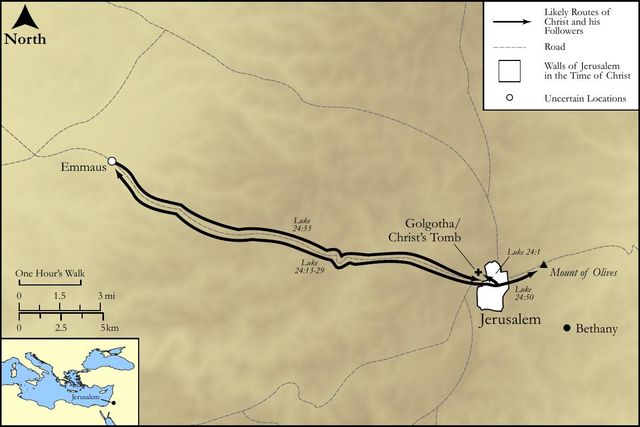
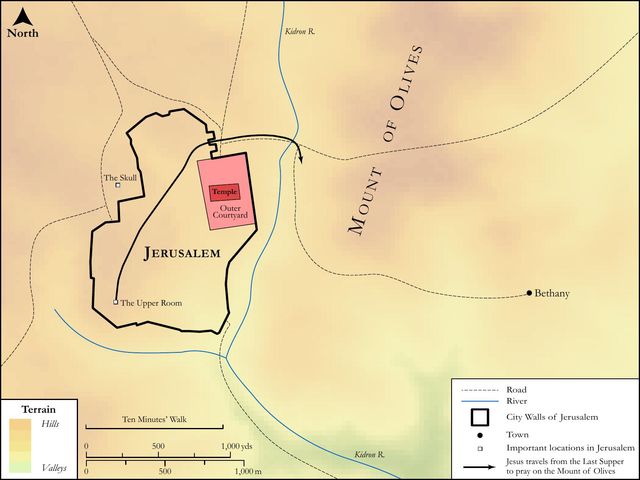
Study this verse
Public-domain commentary
Matthew Henry
From his Commentary on the Whole Bible. Henry comments on passages, not single verses — this entry covers Luke 24:36–49. His four-level outline is real structure in the source text, so it is rendered as structure.
Five times Christ was seen the same day that he rose: by Mary Magdalene alone in the garden (Joh 20:14), by the women as they were going to tell the disciples (Mat 28:9), by Peter alone, by the two disciples going to Emmaus, and now at night by the eleven, of which we have an account in these verses, as also Joh 20:19. Observe,
1.The great surprise which his appearing gave them. He came in among them very seasonably, as they were comparing notes concerning the proofs of his resurrection: As they thus spoke, and were ready perhaps to put it to the question whether the proofs produced amounted to evidence sufficient of their Master's resurrection or no, and how they should proceed, Jesus himself stood in the midst of them, and put it out of question. Note, Those who make the best use they can of their evidences for their comfort may expect further assurances, and that the Spirit of Christ will witness with their spirits (as Christ here witnessed with the disciples, and confirmed their testimony) that they are the children of God, and risen with Christ. Observe, 1. The comfort Christ spoke to them: Peace be unto you. This intimates in general that it was a kind visit which Christ now paid them, a visit of love and friendship. Though they had very unkindly deserted him in his sufferings, yet he takes the first opportunity of seeing them together; for he deals not with us as we deserve. They did not credit those who had seen him; therefore he comes himself, that they might not continue in their disconsolate incredulity. He had promised that after his resurrection he would see them in Galilee; but so desirous was he to see them, and satisfy them, that he anticipated the appointment and sees them at Jerusalem. Note, Christ is often better than his word, but never worse. Now his first word to them was, Peace be to you; not in a way of compliment, but of consolation. This was a common form of salutation among the Jews, and Christ would thus express his usual familiarity with them, though he had now entered into his state of exaltation. Many, when they are advanced, forget their old friends and take state upon them; but we see Christ as free with them as ever. Thus Christ would at the first word intimate to them that he did not come to quarrel with Peter for denying him and the rest for running away from him; no, he came peaceably, to signify to them that he had forgiven them, and was reconciled to them. 2. The fright which they put themselves into upon it (Luk 24:37): They were terrified, supposing that they had seen a spirit, because he came in among them without any noise, and was in the midst of them ere they were aware. The word used (Mat 14:26), when they said It is a spirit, is phantasma, it is a spectre, an apparition; but the word here used is pneuma, the word that properly signifies a spirit; they supposed it to be a spirit not clothed with a real body. Though we have an alliance and correspondence with the world of spirits, and are hastening to it, yet while we are here in this world of sense and matter it is a terror to us to have a spirit so far change its own nature as to become visible to us, and conversable with us, for it is something, and bodes something, very extraordinary.
II.The great satisfaction which his discourse gave them, wherein we have,
1.The reproof he gave them for their causeless fears: Why are you troubled, and why do frightful thoughts arise in your hearts? Luk 24:38. Observe here,
(1.)That when at any time we are troubled, thoughts are apt to rise in our hearts that do us hurt. Sometimes the trouble is the effect of the thoughts that arise in our hearts; our griefs and fears take rise from those things that are the creatures of our own fancy. Sometimes the thoughts arising in the heart are the effect of the trouble, without are fightings and then within are fears. Those that are melancholy and troubled in mind have thoughts arising in their hearts which reflect dishonour upon God, and create disquiet to themselves. I am cut off from thy sight. The Lord has forsaken and forgotten me.
(2.)That many of the troublesome thoughts with which our minds are disquieted arise from our mistakes concerning Christ. They here thought that they had seen a spirit, when they saw Christ, and that put them into this fright. We forget that Christ is our elder brother, and look upon him to be at as great a distance from us as the world of spirits is from this world, and therewith terrify ourselves. When Christ is by his Spirit convincing and humbling us, when he is by his providence trying and converting us, we mistake him, as if he designed our hurt, and this troubles us.
(3.)That all the troublesome thoughts which rise in our hearts at any time are known to the Lord Jesus, even at the first rise of them, and they are displeasing to him. He chid his disciples for such thoughts, to teach us to chide ourselves for them. Why art thou cast down, O my soul? Why art thou troubled? Why do thoughts arise that are neither true nor good, that have neither foundation nor fruit, but hinder our joy in God, unfit us for our duty, give advantage to Satan, and deprive us of the comforts laid up for us?
2.The proof he gave them of his resurrection, both for the silencing of their fears by convincing them that he was not a spirit, and for the strengthening of their faith in that doctrine which they were to preach to the world by giving them full satisfaction concerning his resurrection. Two proofs he gives them: -
(1.)He shows them his body, particularly his hands and his feet. They saw that he had the shape, and features, and exact resemblance, of their Master; but is it not his ghost? "No," saith Christ, "behold my hands and my feet; you see I have hands and feet, and therefore have a true body; you see I can move these hands and feet, and therefore have a living body; and you see the marks of the nails in my hands and feet, and therefore it is my own body, the same that you saw crucified, and not a borrowed one." He lays down this principle - that a spirit has not flesh and bones; it is not compounded of gross matter, shaped into various members, and consisting of divers heterogeneous parts, as our bodies are. He does not tell us what a spirit is (it is time enough to know that when we go to the world of spirits), but what it is not: It has not flesh and bones. Now hence he infers, "It is I myself, whom you have been so intimately acquainted with, and have had such familiar conversation with; it is I myself, whom you have reason to rejoice in, and not to be afraid of." Those who know Christ aright, and know him as theirs, will have no reason to be terrified at his appearances, at his approaches.
[1.]He appeals to their sight, shows them his hands and his feet, which were pierced with the nails. Christ retained the marks of them in his glorified body, that they might be proofs that it was he himself; and he was willing that they should be seen. He afterwards showed them to Thomas, for he is not ashamed of his sufferings for us; little reason then have we to be ashamed of them, or of ours for him. As he showed his wounds here to his disciples, for the enforcing of his instructions to them, so he showed them to his Father, for the enforcing of his intercessions with him. He appears in heaven as a Lamb that had been slain (Rev 5:6); his blood speaks, Heb 12:24. He makes intercession in the virtue of his satisfaction; he says to the Father, as here to the disciples, Behold my hands and my feet, Zac 13:6, Zac 13:7.
[2.]He appeals to their touch: Handle me, and see. He would not let Mary Magdalene touch him at that time, Joh 20:17. But the disciples here are entrusted to do it, that they who were to preach his resurrection, and to suffer for doing so, might be themselves abundantly satisfied concerning it. He bade them handle him, that they might be convinced that he was not a spirit. If there were really no spirits, or apparitions of spirits (as by this and other instances it is plain that the disciples did believe there were), this had been a proper time for Christ to have undeceived them, by telling them there were no such things; but he seems to take it for granted that there have been and may be apparitions of spirits, else what need was there of so much pains to prove that he was not one? There were many heretics in the primitive times, atheists I rather think they were, who said that Christ had never any substantial body, but that it was a mere phantasm, which was neither really born nor truly suffered. Such wild notions as these, we are told, the Valentinians and Manichees had, and the followers of Simon Magus; they were called Dokētai and Phantusiastai. Blessed be God, these heresies have long since been buried; and we know and are sure that Jesus Christ was no spirit or apparition, but had a true and real body, even after his resurrection.
(2.)He eats with them, to show that he had a real and true body, and that he was willing to converse freely and familiarly with his disciples, as one friend with another. Peter lays a great stress upon this (Act 10:41): We did eat and drink with him after he rose from the dead.
[1.]When they saw his hands and his feet, yet they knew not what to say, They believed not for joy, and wondered, Luk 24:41. It was their infirmity that they believed not, that yet they believed not, eti apistountōn autōn - they as yet being unbelievers. This very much corroborates the truth of Christ's resurrection that the disciples were so slow to believe it. Instead of stealing away his body, and saying, He is risen, when he is not, as the chief priests suggested they would do, they are ready to say again and again, He is not risen, when he is. Their being incredulous of it at first, and insisting upon the utmost proofs of it, show that when afterwards they did believe it, and venture their all upon it, it was not but upon the fullest demonstration of the thing that could be. But, though it was their infirmity, yet it was an excusable one; for it was not from any contempt of the evidence offered them that they believed not: but, First, They believed not for joy, as Jacob, when he was told that Joseph was alive; they thought it too good news to be true. When the faith and hope are therefore weak because the love and desires are strong, that weak faith shall be helped, and not rejected. Secondly, They wondered; they thought it not only too good, but too great, to be true, forgetting both the scriptures and the power of God.
[2.]For their further conviction and encouragement, he called for some meat. He sat down to meat with the two disciples at Emmaus, but it is not said that he did eat with them; now, lest that should be made an objection, he here did actually eat with them and the rest, to show that his body was really and truly returned to life, though he did not eat and drink, and converse constantly, with them, as he had done (and as Lazarus did after his resurrection, who not only returned to life, but to his former state of life, and to die again), because it was not agreeable to the economy of the state he was risen to. They gave him a piece of a broiled fish, and of a honey-comb, Luk 24:42. The honey-comb, perhaps, was used as sauce to the broiled fish, for Canaan was a land flowing with honey. This was mean fare; yet, if it be the fare of the disciples, their Master will fare as they do, because in the kingdom of our Father they shall fare as he does, shall eat and drink with him in his kingdom.
3.The insight he gave them into the word of God, which they had heard and read, by which faith in the resurrection of Christ is wrought in them, and all the difficulties are cleared.
(1.)He refers them to the word which they had heard from him when he was with them, and puts them in mind of that as the angel had done (Luk 24:44): These are the words which I said unto you in private, many a time, while I was yet with you. We should better understand what Christ does, if we did but better remember what he hath said, and had but the art of comparing them together.
(2.)He refers them to the word they had read in the Old Testament, to which the word they had heard from him directed them: All things must be fulfilled which were written. Christ had given them this general hint for the regulating of their expectations - that whatever they found written concerning the Messiah, in the Old Testament, must be fulfilled in him, what was written concerning his sufferings as well as what was written concerning his kingdom; these God had joined together in the prediction, and it could not be thought that they should be put asunder in the event. All things must be fulfilled, even the hardest, even the heaviest, even the vinegar; he could not die till he had that, because he could not till then say, It is finished. The several parts of the Old Testament are here mentioned, as containing each of them things concerning Christ: The law of Moses, that is, the Pentateuch, or the five books written by Moses, - the prophets, containing not only the books that are purely prophetical, but those historical books that were written by prophetical men, - the Psalms, containing the other writings, which they called the Hagiographa. See in what various ways of writing God did of old reveal his will; but all proceeded from one and the self-same Spirit, who by them gave notice of the coming and kingdom of the Messiah; for to him bore all the prophets witness.
(3.)By an immediate present work upon their minds, of which they themselves could not but be sensible, he gave them to apprehend the true intent and meaning of the Old Testament prophecies of Christ, and to see them all fulfilled in him: Then opened he their understanding, that they might understand the scriptures, Luk 24:45. In his discourse with the two disciples he took the veil from off the text, by opening the scriptures; here he took the veil from off the heart, by opening the mind. Observe here,
[1.]That Jesus Christ by his Spirit operates on the minds of men, on the minds of all that are his. He has access to our spirits, and can immediately influence them. It is observable how he did now after his resurrection give a specimen of those two great operations of his Spirit upon the spirits of men, his enlightening the intellectual faculties with a divine light, when he opened the understandings of his disciples, and his invigorating the active powers with a divine heat, when he made their hearts burn within them.
[2.]Even good men need to have their understandings opened; for though they are not darkness, as they were by nature, yet in many things they are in the dark. David prays, Open mine eyes. Give me understanding. And Paul, who knows so much of Christ, sees his need to learn more.
[3.]Christ's way of working faith in the soul, and gaining the throne there, is by opening the understanding to discern the evidence of those things that are to be believed. Thus he comes into the soul by the door, while Satan, as a thief and a robber, climbs up some other way.
[4.]The design of opening the understanding is that we may understand the scriptures; not that we may be wise above what is written, but that we may be wiser in what is written, and may be made wise to salvation by it. The Spirit in the word and the Spirit in the heart say the same thing. Christ's scholars never learn above their bibles in this world; but they need to be learning still more and more out of their bibles, and to grow more ready and mighty in the scriptures. That we may have right thoughts of Christ, and have our mistakes concerning him rectified, there needs no more than to be made to understand the scriptures.
4.The instructions he gave them as apostles, who were to be employed in setting up his kingdom in the world. They expected, while their Master was with them, that they should be preferred to posts of honour, of which they thought themselves quite disappointed when he was dead. "No," saith, he, "you are now to enter upon them; you are to be witnesses of these things (Luk 24:48), to carry the notice of them to all the world; not only to report them as matter of news, but to assert them as evidence given upon the trial of the great cause that has been so long depending between God and Satan, the issue of which must be the casting down and casting out of the prince of this world. You are fully assured of these things yourselves, you are eye and ear-witnesses of them; go, and assure the world of them; and the same Spirit that has enlightened you shall go along with you for the enlightening of others." Now here they are told,
(1.)What they must preach. They must preach the gospel, must preach the New Testament as the full accomplishment of the Old, as the continuation and conclusion of divine revelation. They must take their bibles along with them (especially when they preached to the Jews; nay, and Peter, in his first sermon to the Gentiles, directed them to consult the prophets, Act 10:43), and must show people how it was written of old concerning the Messiah, and the glories and graces of his kingdom, and then must tell them how, upon their certain knowledge, all this was fulfilled in the Lord Jesus.
[1.]The great gospel truth concerning the death and resurrection of Jesus Christ must be published to the children of men (Luk 24:46): Thus it was written in the sealed book of the divine counsels from eternity, the volume of that book of the covenant of redemption; and thus it was written in the open book of the Old Testament, among the things revealed; and therefore thus it behoved Christ to suffer, for the divine counsels must be performed, and care taken that no word of God fall to the ground. "Go, and tell the world," First, "That Christ suffered, as it was written of him. Go, preach Christ crucified; be not ashamed of his cross, not ashamed of a suffering Jesus. Tell them what he suffered, and why he suffered, and how all the scriptures of the Old Testament were fulfilled in his sufferings. Tell them that it behoved him to suffer, that it was necessary to the taking away of the sin of the world, and the deliverance of mankind from death and ruin: nay, it became him to be perfected through sufferings," Heb 2:10. Secondly, "That he rose from the dead on the third day, by which not only all the offence of the cross was rolled away, but he was declared to be the Son of God with power, and in this also the scriptures were fulfilled (see Co1 15:3, Co1 15:4); go, tell the world how often you saw him after he rose from the dead, and how intimately you conversed with him. Your eyes see" (as Joseph said to his brethren, when his discovering himself to them was as life from the dead) "that it is my mouth that speaketh unto you, Gen 45:12. Go, and tell them, then, that he that was dead is alive, and lives for evermore, and has the keys of death and the grave,"
[2.]The great gospel duty of repentance must be pressed upon the children of men. Repentance for sin must be preached in Christ's name, and by his authority, Luk 24:47. All men every where must be called and commanded to repent, Act 17:30. "Go, and tell all people that the God that made them, and the Lord that bought them, expects and requires that, immediately upon this notice given, they turn from the worship of the gods that they have made to the worship of the God that made them; and not only so, but from serving the interests of the world and the flesh; they must turn to the service of God in Christ, must mortify all sinful habits, and forsake all sinful practices. Their hearts and lives must be changed, and they must be universally renewed and reformed."
[3.]The great gospel privilege of the remission of sins must be proposed to all, and assured to all that repent, and believe the gospel. "Go, tell a guilty world, that stands convicted and condemned at God's bar, that an act of indemnity has passed the royal assent, which all that repent and believe shall have the benefit of, and not only be pardoned, but preferred by. Tell them that there is hope concerning them."
(2.)To whom they must preach. Whither must they carry these proposals, and how far does their commission extend? They are here told,
[1.]That they must preach this among all nations. They must disperse themselves, like the sons of Noah after the flood, some one way and some another, and carry this light along with them wherever they go. The prophets had preached repentance and remission to the Jews, but the apostles must preach them to all the world. None are exempted from the obligations the gospel lays upon men to repent, nor are any excluded from those inestimable benefits which are included in the remission of sins, but those that by their unbelief and impenitency put a bar in their own door.
[2.]That they must begin at Jerusalem There they must preach their first gospel sermon; there the gospel church must be first formed; there the gospel day must dawn, and thence that light shall go forth which must take hold on the ends of the earth. And why must they begin there? First, Because thus it was written, and therefore it behoved them to take this method. The word of the Lord must go forth from Jerusalem, Isa 2:3. And see Joe 2:32; Joe 3:16; Oba 1:21; Zac 14:8. Secondly, Because there the matters of fact on which the gospel was founded were transacted; and therefore there they were first attested, where, if there had been any just cause for it, they might be best contested and disproved. So strong, so bright, is the first shining forth of the glory of the risen Redeemer that it dares face those daring enemies of his that had put him to an ignominious death, and sets them at defiance. "Begin at Jerusalem, that the chief priests may try their strength to crush the gospel, and may rage to see themselves disappointed." Thirdly, Because he would give us a further example of forgiving enemies. Jerusalem had put the greatest affronts imaginable upon him (both the rulers and the multitude), for which that city might justly have been excepted by name out of the act of indemnity; but no, so far from that, the first offer of gospel grace is made to Jerusalem, and thousands there are in a little time brought to partake of that grace.
(3.)What assistance they should have in preaching. It is a vast undertaking that they are here called to, a very large and difficult province, especially considering the opposition this service would meet with, and the sufferings it would be attended with. If therefore they ask, Who is sufficient for these things? here is an answer ready: Behold, I send the promise of my Father upon you, and you shall be endued with power from on high, Luk 24:49. He here assures them that in a little time the Spirit should be poured out upon them in greater measures than ever, and they should thereby be furnished with all those gifts and graces which were necessary to their discharge of this great trust; and therefore they must tarry at Jerusalem, and not enter upon it till this be done. Note,
[1.]Those who receive the Holy Ghost are thereby endued with a power from on high, a supernatural power, a power above any of their own; it is from on high, and therefore draws the soul upward, and makes it to aim high.
[2.]Christ's apostles could never have planted his gospel, and set up his kingdom in the world, as they did, if they had not been endued with such a power; and their admirable achievements prove that there was an excellency of power going along with them.
[3.]This power from on high was the promise of the Father, the great promise of the New Testament, as the promise of the coming of Christ was of the Old Testament. And, if it be the promise of the Father, we may be sure that the promise is inviolable and the thing promised invaluable.
[4.]Christ would not leave his disciples till the time was just at hand for the performing of this promise. It was but ten days after the ascension of Christ that there came the descent of the Spirit.
[5.]Christ's ambassadors must stay till they have their powers, and not venture upon their embassy till they have received full instructions and credentials. Though, one would think, never was such haste as now for the preaching of the gospel, yet the preachers must tarry till they be endued with power from on high, and tarry at Jerusalem, though a place of danger, because there this promise of the Father was to find them, Joe 2:28.
Historical interpretation
Nine Centuries of Reception
17 surviving comments on this verse. Each one is dated, so this reads as a timeline rather than a list.
Select a marker to jump to its quote. Markers stagger vertically where authors wrote within a few decades of each other.
After His resurrection He promises in a pledge to His disciples that He will send them the promise of His Father; and lastly, He commands them to baptize into the Father and the Son and the Holy Ghost, not into a unipersonal God.
For it was said, Ask of me, and I will give thee the heathen for thine inheritance. (Ps. 2:8.) But it was necessary that those who were converted from the Gentiles should be purged from a certain stain and defilement through His virtue, being as it were corrupted by the evil of the worship of devils, and as lately converted from an abominable and unchaste life. And therefore He says that it behoves that first repentance should be preached, but next, remission of sins, to all nations. For to those who first showed repentance for their sins, by His saving grace He granted pardon of their transgression, for whom also He endured death.
But if those things which Christ foretold are already receiving their accomplishment, and His word is perceived by a seeing faith to be living and effectual throughout the whole world; it is time for men not to be unbelieving towards Him who uttered that word. For it is necessary that He should live a divine life, whose living works are shown to be agreeable to His words; and these indeed have been fulfilled by the ministry of the Apostles. Hence He adds, But ye are witnesses of these things, &c. that is, of My death and resurrection.
But let us consider how according to John they received the Holy Spirit, while here they are ordered to stay in the city until they should be endued with power from on high. Either He breathed the Holy Spirit into the eleven, as being more perfect, and promised to give it to the rest afterwards; or to the same persons He breathed in the one place, He promised in the other. Nor does there seem to be any contradiction, since there are diversities of graces. Therefore one operation He breathed into them there, another He promised here. For there the grace of remitting sins was given, which seems to be more confined, and therefore is breathed into them by Christ, that you may believe the Holy Spirit to be of Christ, to be from God. For God alone forgiveth sins. But Luke describes the pouring forth of the grace of speaking with tongues.
(Hom. i. in Act.) Further, lest any should say that abandoning their acquaintances they went to show themselves, (or as it were to vaunt themselves with a kind of pomp,) to strangers, therefore first among the very murderers themselves are the signs of the resurrection displayed, in that very city wherein the frantic outrage burst forth. For where the crucifiers themselves are seen to believe, there the resurrection is most of all demonstrated.
(Hom. i. in Act.) But as a general does not permit his soldiers who are about to meet a large number, to go out until they are armed, so also the Lord does not permit His disciples to go forth to the conflict before the descent of the Spirit. And hence He adds, But tarry ye in the city of Jerusalem, until ye be endued with power from on high.
(ut sup.) But why did not the Spirit come while Christ was present, or immediately on His departure? Because it was fitting that they should become desirous of grace, and then at length receive it. For we are then most awakened towards God, when difficulties press upon us. It was necessary in the mean time that our nature should appear in Heaven, and the covenants be completed, and that then the Spirit should come, and pure joys be experienced. Mark also what a necessity He imposed upon them of being at Jerusalem, in that He promised that the Spirit should there be given them. For lest they should again flee away after His resurrection, by this expectation, as it were a chain, He kept them all there together. But He says, until ye be endued from on high. He did not express the time when, in order that they may be constantly watchful. But why then marvel that He does not reveal to us our last day, when He would not even make known this day which was close at hand.
Or He said, Receive ye the Holy Spirit, that He might make them fit to receive it, or indicated as present that which was to come.
The Lord did not only shed his blood, but he also applied his death to the preparation of the cure. He rose again to present us with a sample of resurrection. He suffered with patience all his own to teach us the patience we should have. In his resurrection, he showed us the reward of patience. As you know and we all confess, he ascended into heaven, and then he sent the Holy Spirit as he had previously promised. You remember that he said to his disciples, "Stay in the city until you are clothed with power from on high." His promise came true. The Holy Spirit came, he filled the disciples, and they started speaking with the tongues of all nations. A sign of unity was enacted in them. One person spoke then in all languages, because the unity of the church was going to speak in all languages.
(de Trin. 15. c. 26.) Or the Lord after His resurrection gave the Holy Spirit twice, once on earth, because of the love of our neighbour, and again from heaven, because of the love of God.
There is still more for you to hear. He ascends into heaven, accompanied by the eyes of the disciples gazing after him. He lets them observe it, and he makes them witnesses.… They certainly saw, touched and felt him. They confirmed their faith by looking at him and touching him. They accompanied him with their gaze as he ascended into heaven. With attentive ears, they heard the angel's voice assuring them and foretelling that Christ would come again.All these things were completed for them. Neither sight alone nor handling of the Lord's limbs was still enough to ensure that they would become witnesses of Christ and bravely endure everything for the preaching of the truth, fighting against falsehood even to the shedding of their blood. Who gave them such a capability? Listen to the Lord himself. "Stay in the city until you are clothed with power from on high." "You have seen and touched, but you are still not able to preach and die for what you have seen and touched, until you are clothed with power from on high. Let human beings go now and attribute it to their own powers, if they can do anything. There was Peter, and he had not yet been confirmed in the rock. He had not yet been clothed with power from on high, because "nobody can receive anything, unless it has been given him from heaven."
The Savior promises the disciples the descent of the Holy Spirit, which God announced of old by Joel. He also promises power from above, so that they might be strong, invincible and fearlessly preach the divine mystery to people everywhere.He says to them that they received the Spirit after the resurrection, "Receive the Holy Spirit." He adds, "Wait for the promise of the Father, which you heard from me, for John baptized with water, but before many days you shall be baptized with the Holy Spirit." It will not be in water any longer, because they already had received that, but it will be with the Holy Spirit. He does not add water to water but completes that which was deficient by adding what it lacked.
(de Past. 3. c. 25.) They then are to be warned, whom age or imperfection hinders from the office of preaching, and yet rashness impels, lest while they hastily arrogate to themselves so responsible an office, they should cut themselves off from the way of future amendment. For the Truth Itself which could suddenly strengthen those whom it wished, in order to give an example to those that follow, that imperfect men should not presume to preach, after having fully instructed the disciples concerning the virtue of preaching, commanded them to abide in the city, until they were endued with power from on high. For we abide in a city, when we keep ourselves close within the gates of our minds, lest by speaking we wander beyond them; that when we are perfectly endued with divine power, we may then as it were go out beyond ourselves to instruct others.
But you are witnesses of these things, and I send the promise of my Father upon you. The grace of the Holy Spirit is called the promise of the Father, and in the Gospel of John it is more fully and also briefly intimated here when it follows:
The preaching of repentance and the forgiveness of sins through confession of Christ’s name appropriately started from Jerusalem. The first root of faith in him would be brought out where the splendor of his teaching and virtues, the triumph of his passion, the joy of his resurrection and ascension were accomplished. The first shoot of the blooming church, like some kind of great vine, would be planted. By an increase in the spreading of the Word, the church would extend the branches of its teaching into the whole wide world. The prophecy of Isaiah would be brought to fulfillment. He said, “The law will go forth from Zion and the word of the Lord from Jerusalem, and he will judge the nations and convict many peoples.” It was appropriate that the preaching of repentance and the forgiveness of sins, good news to be proclaimed to idolatrous nations and those defiled by various evil deeds, should start from Jerusalem. Perhaps some of the nations, thoroughly terrified by the magnitude of Jerusalem’s offenses, might doubt the possibility of obtaining pardon if it performed fruits worthy of repentance. He granted pardon even to those at Jerusalem who had blasphemed and crucified the Son of God.
He said, “You are witnesses of these things. And I send upon you the promise of my Father.” He calls the gift of the Holy Spirit “the promise of his Father.” … He added something about their promised waiting when he said, “Stay in the city until you are clothed with power from on high.” He pledged that power would come down upon them from on high, because although they already possessed the Holy Spirit, they received him more fully once Christ ascended into heaven. Even before his passion, by the power of the Holy Spirit they were casting out many demons, healing many sick persons and preaching the word of life to whom they could. Once he had risen from the dead, they were especially refreshed by the grace of the same Spirit. John writes, “Receive the Holy Spirit. If you forgive the sins of any, they are forgiven; if you retain the sins of any, they are retained.” He clothed them with his greater virtue from on high when they received him in fiery tongues ten days after the Lord’s ascension. They were inflamed with such great assurance of strength that any threats from the rulers could not prevent them from speaking to everyone in the name of Jesus.
The disciples learned that their Maker subjected himself to countless kinds of abuses at the hands of the wicked and even to the sentence of death for their salvation. This effectively stirred them up to tolerate adversities of every kind for their salvation. They remembered that through his sacraments they had been cleansed, sanctified and united to the body of him who, when he had tasted death for them, presented an example of a speedy rising from death. For what other reason might they more fittingly receive the hope of their own resurrection?“It was necessary for the Christ to suffer and rise from the dead on the third day,” he said, “and for you to preach repentance and forgiveness of sins in his name among all nations.” There was certainly a necessary sequence. First, Christ had to shed his blood for the redemption of the world. Then, through his resurrection and ascension, he opened to human beings the gate of the heavenly kingdom. Last, he sent those who would preach to all nations throughout the world the word of life and administer the sacraments of faith. By these sacraments, they could be saved and arrive at the joys of the heavenly fatherland, with the human being Jesus Christ. He is the very mediator between God and human beings working with them. He lives and reigns forever and ever. Amen.
"But you, stay in the city until you are clothed with power from on high. About which power, that is, the Holy Spirit, the angel also says to Mary: And the power of the Most High shall overshadow you (Luke 1). And the Lord himself elsewhere says: For I know that power has gone out from me (Luke 8). And even Luke more openly mentions in the Acts of the Apostles that the promised power from on high and the commanded stay in the city. He commanded them (he says) not to depart from Jerusalem, but to wait for the promise of the Father, which you have heard from my mouth. Because John indeed baptized with water, but you will be baptized with the Holy Spirit not many days from now (Acts 1). And a little later: But you will receive power when the Holy Spirit has come upon you, and you will be my witnesses (Ibid.). It should be noted indeed that there are those who are prevented from the office of preaching either by imperfection or by age, and yet are driven by rashness, who should be warned to consider that Truth itself, which could suddenly strengthen those whom it wished, as an example to followers so that the imperfect would not presume to preach, after fully instructing the disciples in the power of preaching, immediately added: But you, stay in the city until you are clothed with power from on high. We indeed stay in the city if we confine ourselves within the enclosures of our minds, so that speaking outwardly we do not wander, so that when we are perfectly clothed with divine power, then we may go out as if from ourselves also instructing others."
When he was about to ascend into heaven, our Lord first took care to instruct his disciples diligently concerning the mystery of faith in him. They might therefore preach it with greater certainty to the world, because they had received it from the mouth of Truth himself and recognized that the words of the prophets had long ago foreshadowed it. He appeared to them after the triumph of his resurrection, according to what we heard just now when the Gospel was read. He said, “These are the words which I spoke to you when I was still with you.” That means, “When I still had a corruptible and mortal body like yours.” “Everything written about me in the law of Moses and the prophets and the psalms must be fulfilled.” He said that he fulfilled the mysteries which Moses, the prophets and the psalms proclaimed. It is perfectly evident that the church is one in all its saints and that the faith of all the chosen is the same, of those who preceded and who followed his coming in the flesh. We are saved through faith in his incarnation, passion and resurrection that have been accomplished.
After having presented Himself to be seen with the eye, and handled with hands, and having brought to their minds the Scriptures of the law, He next opened their understanding that they should understand what was read.
But Christ would have lost the fruit of His Passion had He not been the Truth of the resurrection, therefore it is said, And to rise from the dead. He then after having commended to them the truth of the body, commends the unity of the Church, adding, And that repentance and remission of sins should be preached in his name among all nations.
Not only because to them were entrusted the oracles of God, and theirs is the adoption and the glory, but also that the Gentiles entangled in various errors might by this sign of Divine mercy be chiefly invited to come to hope, seeing that to them even who crucified the Son of God pardon is granted.
But concerning the power, that is, the Holy Spirit, the Angel also says to Mary, And the power of the Highest shall overshadow thee. (Luke 1:35.) And the Lord Himself says elsewhere, For I know that virtue is gone out of me. (Luke 8:45.)
Otherwise, how would their agitated and perplexed minds have learnt the mystery of Christ. But He taught them by His words; for it follows, And said unto them, Thus it is written, and thus it behoved Christ to suffer, that is, by the wood of the Cross.
But herein that He says, Repentance and remission of sins, He also makes mention of baptism, in which by the putting off of our past sins there follows pardon of iniquity. But how must we understand baptism to be performed in the name of Christ alone, whereas in another place He commands it to be in the name of the Father, and the Son, and the Holy Ghost. First indeed we say that it is not meant that baptism is administered in Christ's name alone, but that a person is baptized with the baptism of Christ, that is, spiritually, not Judaically, nor with the baptism, wherewith John baptized unto repentance only, but unto the participation of the blessed Spirit; as Christ also when baptized in Jordan manifested the Holy Spirit in the form of a dove. Moreover you must understand baptism in Christ's name to be in His death. For as He after death rose again on the third day, so we also are three times dipped in the water, and fitly brought out again, receiving thereby an earnest of the immortality of the Spirit. This name of Christ also contains in itself both the Father as the Anointer, and the Spirit as the Anointing, and the Son as the Anointed, that is, in His human nature. But it was fitting that the race of man should no longer be divided into Jews and Gentiles, and therefore that He might unite all in one, He commanded that their preaching should begin at Jerusalem, but be finished with the Gentiles. Hence it follows, Beginning at Jerusalem. (Rom. 3:2, Rom. 9:4.)
Afterwards, lest they should be troubled at the thought, How shall we private individuals give our testimony to the Jews and Gentiles who have killed Thee? He subjoins, And, behold, I send the promise of my Father upon you, &c. which indeed He had promised by the mouth of the prophet Joel, I will pour my Spirit upon all flesh. (Joel 2:18.)
That is, not with human but heavenly power. He said not, until ye receive, but be endued with, showing the entire protection of the spiritual armour.
Continue studying Luke 24:49 across the web’s major study libraries — every link below opens this exact verse, chapter, or book on the destination site.
Read & Compare
 BibleGatewayThis verse in more than 200 translations and 70 languages.
 Bible.comThe YouVersion reader — hundreds of translations, reading plans, and highlights.
 ESV.orgCrossway's official English Standard Version reader.
 NET BibleThe NET translation with 60,000+ translators' notes on every rendering decision.
 STEP BibleTyndale House's free study tool — original text, vocabulary, and scholarly resources.
 BibliaLogos Bible Software's free web reader.
 USCCBThe New American Bible (Revised Edition) with the U.S. bishops' study notes.
Commentaries
 BibleHub CommentariesDozens of classic commentaries on this verse, gathered on one page.
 StudyLightMore than 100 commentary sets — the largest collection on the web.
 BibleRefPlain-English commentary on what this verse means, verse by verse.
 Enduring WordDavid Guzik's free commentary on this chapter, widely used by Bible teachers.
 Bible Study ToolsVerse commentary alongside Greek and Hebrew study aids.
Original Language & Research
- BibleHub InterlinearThe verse word by word — original language, transliteration, and English.
- BibleHub LexiconEvery word's original-language definition and Strong's entry.
 Blue Letter BibleDeep-study tools — Strong's numbers, concordance, and word studies.
 CNTR CollationThe earliest Greek manuscripts of this verse, collated letter by letter.
Sermons, Hymns & Audio


TrulyRandomVerse is not affiliated with these sites and doesn’t control their content. They’re linked because they’re genuinely useful.
Summary
Luke 24:49 captures Jesus' final, pivotal instruction to His disciples before His ascension: to remain in Jerusalem and await the outpouring of the Holy Spirit. This verse serves as a critical bridge between Jesus' earthly ministry and the birth of the Church, emphasizing that the disciples' future mission to proclaim the gospel to all nations was utterly dependent upon receiving divine empowerment—the "promise of the Father"—from heaven itself. It underscores the necessity of God's supernatural enablement for effective Christian witness and service.
Context
ShowHideLiterary Context
This verse is the climactic point of Luke's Gospel, providing Jesus' ultimate post-resurrection command to His disciples. Following His miraculous resurrection, Jesus had spent forty days appearing to His followers, opening their understanding of the Scriptures concerning Himself (Luke 24:44-45) and commissioning them to preach repentance and forgiveness of sins to all nations, beginning in Jerusalem (Luke 24:46-48). Luke 24:49, therefore, is not merely an instruction but a prerequisite for the fulfillment of the Great Commission. It directly precedes Jesus' ascension into heaven (Luke 24:50-53) and sets the stage for the narrative in the Book of Acts, which immediately details the disciples' obedience to this command and the subsequent outpouring of the Holy Spirit on the Day of Pentecost. Thus, it functions as a theological and narrative hinge, connecting the Person and work of Christ to the mission and empowerment of His Church.
Historical & Cultural Context
Jerusalem, the specified location for the disciples' waiting, was not just a city but the spiritual, political, and cultural heart of Judaism. It was the place of the Temple, the center of Jewish worship, and the site of Jesus' crucifixion and resurrection. For the Jewish disciples, Jerusalem held immense religious significance. The command to "tarry" there was a directive to remain within a familiar, albeit recently hostile, environment, reinforcing the idea that the new covenant's spiritual power would emerge from the very place where the old covenant's rituals were centered and where the Messiah had been rejected. Furthermore, the concept of divine empowerment was not alien to Jewish thought; prophets and kings in the Old Testament were often "anointed" or "filled with the Spirit" for specific tasks. However, the promise of the Spirit in this context was for an unprecedented, widespread indwelling and empowering of all believers, marking a new era in God's redemptive plan, moving from a localized, ethnic focus to a global, inclusive mission.
Key Themes
ShowHideLuke 24:49 is rich with significant theological themes. First, it highlights The Divine Promise, unequivocally referring to the Holy Spirit, whom Jesus had previously promised as the Helper or Advocate. This promise underscores God's faithfulness and His intention to dwell with and empower His people in a new way under the New Covenant. Second, the verse emphasizes Empowerment for Mission. The phrase "endued with power from on high" signifies that the disciples' ability to effectively carry out the Great Commission would not stem from their own human strength or wisdom but from a supernatural, divine equipping. This power was essential for their witness to be effective in a hostile world (Acts 1:8). Finally, the command to "tarry ye in the city of Jerusalem" introduces the theme of Patient Obedience and Divine Timing. It teaches that spiritual readiness often involves a period of waiting, dependence, and prayer, rather than immediate action based on human initiative. The disciples needed to be in the right place, at the right time, with the right spiritual posture, to receive what God had promised for their global task.
Exposition and Analysis
ShowHideKey Word Analysis
ShowHideThis term signifies an "announcement" or "divine assurance of good," specifically a "pledge." In this context, it refers to the Holy Spirit, whom Jesus had previously promised as the Helper or Advocate (John 14:26, 15:26, 16:7). The use of "promise" emphasizes the Spirit's arrival not as an arbitrary event but as the fulfillment of God's long-anticipated covenantal pledge, rooted in His faithfulness and foretold by the prophets (e.g., Joel 2:28-29).
Meaning "to seat down," "to sit," or "to settle," and by extension, "to continue" or "to tarry." This imperative command for the disciples to "tarry" in Jerusalem was not a passive waiting but an active, expectant posture of obedience. It underscored the necessity of a specific geographical location and a divinely appointed timing for the Spirit's outpouring, highlighting that true spiritual power is received through dependence on God, not generated by human effort or haste.
Denoting "force," "ability," "strength," and specifically "miraculous power." This is the inherent, dynamic energy of God Himself, enabling supernatural feats and effective witness. It implies more than mere human capability; it is a divine equipping that transforms the disciples into potent agents of God's kingdom, empowering them to perform the "mighty works" that accompany the gospel and bear witness to Christ with boldness and authority.
Verse Breakdown
ShowHide"And, behold, I send the promise of my Father upon you:"
Jesus, as the resurrected Lord and the one invested with all authority in heaven and on earth, asserts His sovereign prerogative to dispatch the divine promise—the Holy Spirit—upon His disciples. The interjection "behold" (G2400 idoú) draws immediate attention to the profound and certain significance of this impending event. This "sending" is not merely a future possibility but a definite, authoritative act initiated by Christ, fulfilling the Father's long-standing covenantal pledge to His people.
"but tarry ye in the city of Jerusalem,"
This clause introduces a crucial, direct, and imperative command for the disciples to remain in Jerusalem, the very city where Jesus was crucified, resurrected, and where the gospel was first proclaimed. The conjunction "but" (G1161 dé) introduces a necessary condition or instruction following the promise. This period of waiting was essential for their preparation, fostering unity, prayer, and a posture of dependence before the Spirit's arrival, underscoring that spiritual power is received through obedience and patience, rather than through immediate action based on human strength.
"until ye be endued with power from on high."
This final clause explicitly states the purpose and duration of their waiting: to be "endued" (G1746 endýō), which literally means "clothed" or "invested with." This is a profound metaphor, suggesting that the power would envelop them, becoming an integral part of their being, much like putting on a garment. This "power" (G1411 dýnamis) originates "from on high" (G1537 ek G5311 hýpsos), signifying its divine, heavenly source. It underscores that the spiritual authority and ability for their global mission would not be self-generated but divinely bestowed, transforming them into effective witnesses for Christ.
Literary Devices
ShowHideLuke 24:49 employs several literary devices to convey its profound message. The most prominent is Metaphor, specifically in the phrase "endued with power from on high." The Greek word endýō literally means "to put on" or "to clothe," creating a vivid image of the Holy Spirit's power enveloping the disciples like a garment. This suggests that the power would not be an external accessory but an intrinsic, empowering presence that would fully equip them for their mission, transforming their very identity and capacity for service. The verse also utilizes Imperative commands ("tarry"), which underscore the non-negotiable nature of Jesus' instructions and the necessity of obedience. Furthermore, the entire verse functions as Foreshadowing, directly pointing to the dramatic events of Pentecost in Acts 2, where the promise of the Spirit is fulfilled, and the disciples are indeed "clothed" with divine power, enabling them to boldly proclaim the gospel and perform miraculous signs.
Theological and Thematic Connections
ShowHideLuke 24:49 stands as a foundational text for understanding the role of the Holy Spirit in the life of the believer and the mission of the Church. It reveals that the Great Commission, though given by the resurrected Christ, could not be fulfilled by human effort alone. The "promise of the Father," the Holy Spirit, is the divine enablement for all true ministry, transforming fearful disciples into bold witnesses. This empowerment is not merely for miraculous signs but for the very ability to comprehend, proclaim, and live out the truth of the gospel. The waiting period in Jerusalem emphasizes God's sovereign timing and the necessity of dependence and prayer before embarking on divine assignments. The Spirit's coming signifies the inauguration of the New Covenant, where God's law is written on hearts, and His people are empowered from within to live righteously and spread His kingdom.
Reflection and Application
ShowHideLuke 24:49 offers profound lessons for believers today, reminding us that Christian life and service are not to be undertaken in human strength or wisdom. Just as the disciples needed the Holy Spirit's empowerment to fulfill their daunting mission, so too do we rely on the supernatural power of the Holy Spirit for effective ministry, personal transformation, and daily living. This verse calls us to a posture of dependence on God, recognizing that true spiritual impact comes from being "clothed" with power from on high. It encourages us to patiently wait on God's timing and provision, to seek His divine enablement through prayer and spiritual disciplines, and to resist the temptation to rush into endeavors without His anointing. Our effectiveness in sharing the gospel, living a holy life, and serving others is directly proportional to our reliance on and submission to the indwelling Holy Spirit.
Questions for Reflection
ShowHideFAQ
ShowHideWhat is "the promise of my Father" that Jesus refers to?
ShowHide"The promise of my Father" unequivocally refers to the Holy Spirit. This promise is a central theme throughout Jesus' farewell discourse in John's Gospel, where He repeatedly assures His disciples that He will send the Helper, the Spirit of Truth. The Old Testament also foreshadowed a time when God would pour out His Spirit on all flesh (e.g., Joel 2:28-29). The fulfillment of this promise is dramatically chronicled in Acts 2, on the Day of Pentecost, when the Holy Spirit descended upon the disciples, empowering them for their mission.
Why did Jesus command the disciples to "tarry in the city of Jerusalem"?
ShowHideThe command to "tarry" (or wait) in Jerusalem was crucial for several reasons. First, it emphasized God's sovereign timing; the Holy Spirit would be poured out at a divinely appointed moment. Second, it provided a period for the disciples to gather, pray, and unite in anticipation, preparing their hearts and minds for the unprecedented outpouring. Third, Jerusalem was the strategic starting point for the gospel message, as Jesus had commanded them to preach repentance and forgiveness of sins to all nations, "beginning at Jerusalem" (Luke 24:47). The waiting was not passive but an active posture of obedience and dependence, essential before embarking on their global mission.
Christ-Centered Fulfillment
ShowHideLuke 24:49 finds its ultimate Christ-centered fulfillment in the ongoing work of the ascended Lord, who, having completed His redemptive work on the cross and secured victory through His resurrection, now pours out His Spirit as the "promise of the Father." This verse reveals that the mission of the Church is not merely a continuation of Jesus' earthly ministry by human effort, but a Spirit-empowered extension of Christ's own work through His body. Jesus is the one who "sends" the Spirit, demonstrating His divine authority and His active role in equipping His followers. The Holy Spirit, often called the Spirit of Christ, empowers believers to bear witness to Jesus, to live lives that reflect His character, and to carry forward His redemptive purposes in the world. Thus, the "power from on high" is fundamentally Christ's power, enabling His Church to be His hands and feet, His voice and heart, until He returns, ensuring that the work He began will be completed through His Spirit-filled people.