


Joel 2:32
Bible text: King James Version (1769 Blayney text) · Public domain
Bible text: King James Version with Strong's numbers · Public domain
Bible text: Berean Standard Bible · Public domain
Bible text: American Standard Version (1901) · Public domain
Bible text: World English Bible, Messianic edition · Public domain
Bible text: Geneva Bible (1599) · Public domain
Bible text: Young's Literal Translation · Public domain
- וְהָיָהve·ha·Yahand it will beH1961Conj-w ¦ V-Qal-ConsecPerf-3msVerb Qal Consecutive Perfect 3rd Singular Masculineוְandהָיָהit will be
- כֹּלkoleveryH3605N-msNoun Singular Masculine Absolute
- אֲשֶׁר'a·Sher[one] whoH834RelParticle Relative
- יִקְרָאyik·Ra'he will callH7121V-Qal-Imperf-3msVerb Qal Imperfect 3rd Singular Masculine
- בְּשֵׁםbe·Shemon [the] name ofH8034Prep-b ¦ N-mscNoun Singular Masculine Constructבְּonשֵׁם[the] name of
- יְהוָהYah·wehYahwehH3068N-properNoun Proper Title
- יִמָּלֵטyi·ma·Lethe will escapeH4422V-Niphal-Imperf-3msVerb Niphal Imperfect 3rd Singular Masculine
- כִּיkiforH3588PrtParticle Conditional
- בְּהַרbe·haron [the] mountain ofH2022Prep-b ¦ N-mscNoun Singular Masculine Constructבְּonהַר[the] mountain of
- צִיּוֹןtzi·YonZionH6726N-properNoun Proper Location
- וּבִירוּשָׁלִַםu·vi·ru·sha·Limand in JerusalemH3389Conj-w ¦ Prep-b ¦ N-properNoun Proper LocationוּandבִinירוּשָׁלִַםJerusalem
- תִּהְיֶהtih·Yehit will beH1961V-Qal-Imperf-3fsVerb Qal Imperfect 3rd Singular Feminine
- פְלֵיטָהfe·lei·Tahan escaped remnantH6413N-fsNoun Singular Feminine Absolute
- כַּאֲשֶׁרka·'a·Sherjust asH834Prep-k ¦ RelParticle Relativeכַּjustאֲשֶׁרas
- אָמַר'a·Marhe has saidH559V-Qal-Perf-3msVerb Qal Perfect 3rd Singular Masculine
- יְהוָהYah·wehYahwehH3068N-properNoun Proper Title
- וּבַשְּׂרִידִיםu·Va·se·ri·Dimand among the survivorsH8300Conj-w ¦ Prep-b ¦ N-mpNoun Plural Masculine Absoluteוּandבַamong theשְּׂרִידִיםsurvivors
- אֲשֶׁר'a·SherwhomH834RelParticle Relative
- יְהוָהYah·wehYahwehH3068N-properNoun Proper Title
- קֹרֵאko·Re'[will be] callingH7121V-Qal-Prtcpl-msVerb Qal Participle Singular Masculine Absolute
English is a literal word-by-word gloss of the Hebrew, not the KJV's wording. Why?
This is the original text the KJV's translators worked from — each Hebrew word with its own literal English meaning in this verse, prepared by scholars at Tyndale House, Cambridge. The KJV translates whole sentences, not word by word, so its wording differs: one Hebrew word can become several English words, and the KJV may choose “the LORD” where the gloss reads “Yahweh”. Both are faithful — they answer different questions. For the KJV's own rendering, switch to the KJV text.
Details
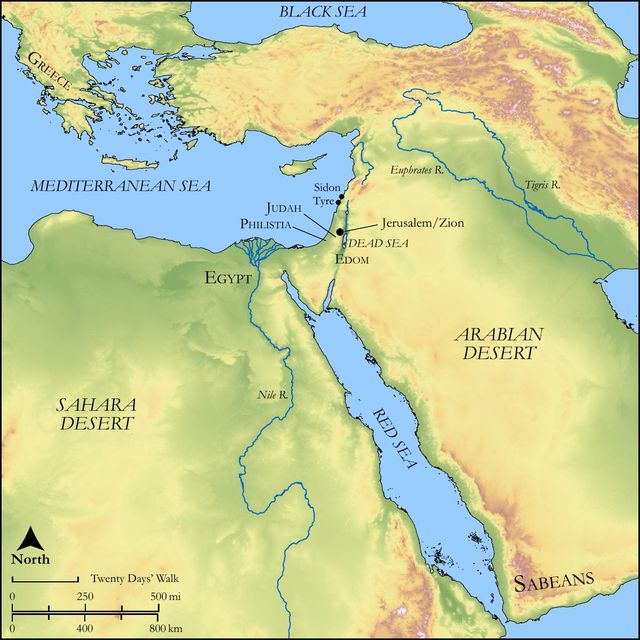
See on the biblical-era map
Study this verse
Public-domain commentary
Matthew Henry
From his Commentary on the Whole Bible. Henry comments on passages, not single verses — this entry covers Joel 2:28–32. His three-level outline is real structure in the source text, so it is rendered as structure.
The promises of corn, and wine, and oil, in the foregoing verses, would be very acceptable to a wasted country; but here we are taught that we must not rest in those things. God has reserved some better things for us, and these verses have reference to those better things, both the kingdom of grace and the kingdom of glory, with the happiness of true believers in both. We are here told,
I.How the kingdom of grace shall be introduced by a plentiful effusion of the Spirit, (Joe 2:28, Joe 2:29).
We are not at a loss about the meaning of this promise, nor in doubt what it refers to and wherein it had its accomplishment, for the apostle Peter has given us an infallible explication and application of it, assuring us that when the Spirit was poured out upon the apostles, on the day of Pentecost (Act 2:1, etc.), that was the very thing which was spoken of here by the prophet Joel, Joe 2:16, Joe 2:17. That was the gift of the Spirit, which, according to this prediction, was to come, and we are not to look for any other, any more than for another accomplishment of the promise of the Messiah. Now,
1.The blessing itself here promised is the pouring out of the Spirit of God, his gifts, graces, and comforts, which the blessed Spirit is the author of. We often read in the Old Testament of the Spirit of the Lord coming by drops, as it were, upon the judges and prophets whom God raised up for extraordinary services; but now the Spirit shall be poured out plentifully in a full stream, as was promised with an eye to gospel-times, Isa 44:3. I will pour my Spirit upon thy seed.
2.The time fixed for this is afterwards; after the fulfilling of the foregoing promises this shall be fulfilled. St. Peter expounds this of the last days, the days of the Messiah, by whom the world was to have its last revelation of the divine will and grace in the last days of the Jewish church, a little before its dissolution.
3.The extent of this blessing, in respect of the persons on whom it shall be bestowed. The Spirit shall be poured out upon all flesh, not as hitherto upon Jews only, but upon Gentiles also; for in Christ there is no distinction between Jew and Greek, Rom 10:11, Rom 10:12. Hitherto divine revelation was confined to the seed of Abraham, none but those of the land of Israel had the Spirit of prophecy; but, in the last days, all flesh shall see the glory of God (Isa 40:5) and shall come to worship before him, Isa 66:23. The Jews understand it of all flesh in the land of Israel, and Peter himself did not fully understand it as speaking of the Gentiles till he saw it accomplished in the descent of the Holy Ghost upon Cornelius and his friends, who were Gentiles (Act 10:44, Act 10:45), which was but a continuation of the same gift which was bestowed on the day of Pentecost. The Spirit shall be poured out upon all flesh, that is, upon all those whose hearts are made hearts of flesh, soft and tender, and so prepared to receive the impressions and influences of the Holy Ghost. Upon all flesh, that is, upon some of all sorts of men; the gifts of the Spirit shall not be so sparing, or so much confined, as they have been, but shall be more general and diffusive of themselves.
(1.)The Spirit shall be poured out upon some of each sex. Not your sons only, but your daughters, shall prophesy; we read of four sisters in one family that were prophetesses, Act 21:9. Not the parents only, but the children, shall be filled with the Spirit, which intimates the continuance of this gift for some ages successively in the church.
(2.)Upon some of each age: "Your old men, who are past their vigour and whose spirits begin to decay, your young men, who have yet but little acquaintance with and experience of divine things, shall yet dream dreams and see visions;" God will reveal himself by dreams and visions both to the young and old.
(3.)Upon those of the meanest rank and condition, even upon the servants and the handmaids. The Jewish doctors say, Prophecy does not reside on any but such as are wise, valiant, and rich, not upon the soul of a poor man, or a man in sorrow. But in Christ Jesus there is neither bond nor free, Gal 3:28. There were many that were called being servants (Co1 7:21), but that was no obstruction to their receiving the Holy Ghost.
(4.)The effect of this blessing: They shall prophesy; they shall receive new discoveries of divine things, and that not for their own use only, but for the benefit of the church. They shall interpret scripture, and speak of things secret, distant, and future, which by the utmost sagacities of reason, and their natural powers, they could not have any insight into nor foresight of. By these extraordinary gifts the Christian church was first founded and set up, and the scriptures were written, and the ministry settled, by which, with the ordinary operations and influences of the Spirit, it was to be afterwards maintained and kept up.
II.How the kingdom of glory shall be introduced by the universal change of nature, Joe 2:30, Joe 2:31.
The pouring out of the Spirit will be very comfortable to the righteous; but let the unrighteous hear this, and tremble. There is a great and terrible day of the Lord coming, which shall be ushered in with wonders in heaven and earth, blood, and fire, and pillars of smoke, the turning of the sun into darkness and the moon into blood. This is to have its full accomplishment (as the learned Dr. Pocock thinks) in the day of judgment, at the end of time, before which these signs will be performed in the letter of them, yet so that it was accomplished in part in the death of Christ (which is called the judgment of this world, when the earth quaked and the sun was darkened, and a great and terrible day it was), and more fully in the destruction of Jerusalem, which was a type and figure of the general judgment, and before which there were many amazing prodigies, besides the convulsions of states and kingdoms prophesied of under the figurative expressions of turning the sun into darkness and the moon into blood, and the wars and rumours of wars, and distress of nations, which our Saviour spoke of as the beginning of these sorrows, Mat 24:6, Mat 24:7. But before the last judgment there will be wonders indeed in heaven and earth, the dissolution of both, without a metaphor. The judgments of God upon a sinful world, and the frequent destruction of wicked kingdoms by fire and sword, are prefaces to and presages of the judgment of the world in the last day. Those on whom the Spirit is poured out shall foresee and foretel that great and terrible day of the Lord, and expound the wonders in heaven and earth that go before it; for, as to his first coming, so to his second, all the prophets did and do bear witness, Rev 10:7.
III.The safety and happiness of all true believers both in the first and second coming of Jesus Christ, Joe 2:32.
This speaks of particular persons, for to them the New Testament has more respect, and less to kingdoms and nations, than the Old. Now observe here,
1.That there is a salvation wrought out. Though the day of the Lord will be great and terrible, yet in Mount Zion and in Jerusalem there shall be deliverance from the terror of it. It is the day of the Lord, the day of his judgment, who knows how to separate between the precious and the vile. In the everlasting gospel, which went from Zion, in the church of the first-born typified by Mount Zion, and which is the Jerusalem that is from above, there is deliverance; a way of escaping the wrath to come is found out and laid open. Christ is himself not only the Saviour, but the salvation; he is so to the ends of the earth. This deliverance, laid up for us in the covenant of grace, is in performance of the promises made to the fathers. There shall be deliverance, as the Lord has said. See Luk 1:72. Note, This is ground of comfort and hope to sinners, that, whatever danger there is in their case, there is also deliverance, deliverance for them, if it be not their own fault. And, if we would share in this deliverance, we must ourselves apply to the gospel - Zion, to God's Jerusalem.
2.That there is a remnant interested in this salvation, and for whom the deliverance is wrought. It is in that remnant (that is, among them) that the deliverance is, or in their souls and spirits; there are the earnests and evidences of it. Christ in you, the hope of glory. They are called a remnant, because they are but a few in comparison with the multitudes that are left to perish; a little remnant but a chosen one, a remnant according to the election of grace. And here we are told who they are that shall be delivered in the great day.
(1.)Those that sincerely call upon God: Whosoever shall call upon the name of the Lord, whether Jew or Gentile (for the apostle so expounds it, Rom 10:13, where he lays this down as the great rule of the gospel by which we must all be judged), shall be delivered. This calling on God supposes knowledge of him, faith in him, desire towards him, dependence on him, and, as an evidence of the sincerity of all this, a conscientious obedience to him; for, without that, crying Lord, Lord, will not stand us in any stead. Note, It is the praying remnant that shall be the saved remnant. And it will aggravate the ruin of those who perish that they might have been saved on such easy terms.
(2.)Those that are effectually called to God. The deliverance is sure to the remnant whom the Lord shall call, not only with the common call of the gospel, with which many are called that are not chosen, but with a special call into the fellowship of Jesus Christ, whom the Lord predestinates, or prepares, so the Chaldee. St. Peter borrows this phrase, Act 2:39. Note, Those only shall be delivered in the great day that are now effectually called from sin to God, from self to Christ, from things below to things above.
Historical interpretation
Four Centuries of Reception
9 surviving comments on this verse. Each one is dated, so this reads as a timeline rather than a list.
Select a marker to jump to its quote. Markers stagger vertically where authors wrote within a few decades of each other.
For Moses describeth the righteousness which is of the law, That the man which doeth those things shall live by them. But the righteousness which is of faith speaketh on this wise, Say not in thine heart, Who shall ascend into heaven? (that is, to bring Christ down from above:) Or, Who shall descend into the deep? (that is, to bring up Christ again from the dead.) But what saith it? The word is nigh thee, even in thy mouth, and in thy heart: that is, the word of faith, which we preach; That if thou shalt confess with thy mouth the Lord Jesus, and shalt believe in thine heart that God hath raised him from the dead, thou shalt be saved. For with the heart man believeth unto righteousness; and with the mouth confession is made unto salvation. For the scripture saith, Whosoever believeth on him shall not be ashamed. For there is no difference between the Jew and the Greek: for the same Lord over all is rich unto all that call upon him. For whosoever shall call upon the name of the Lord shall be saved. [Joel 2:28-32]
And when the day of Pentecost was fully come, they were all with one accord in one place. And suddenly there came a sound from heaven as of a rushing mighty wind, and it filled all the house where they were sitting. And there appeared unto them cloven tongues like as of fire, and it sat upon each of them. And they were all filled with the Holy Ghost, and began to speak with other tongues, as the Spirit gave them utterance. And there were dwelling at Jerusalem Jews, devout men, out of every nation under heaven. Now when this was noised abroad, the multitude came together, and were confounded, because that every man heard them speak in his own language. And they were all amazed and marvelled, saying one to another, Behold, are not all these which speak Galilaeans? And how hear we every man in our own tongue, wherein we were born? Parthians, and Medes, and Elamites, and the dwellers in Mesopotamia, and in Judaea, and Cappadocia, in Pontus, and Asia, Phrygia, and Pamphylia, in Egypt, and in the parts of Libya about Cyrene, and strangers of Rome, Jews and proselytes, Cretes and Arabians, we do hear them speak in our tongues the wonderful works of God. And they were all amazed, and were in doubt, saying one to another, What meaneth this? Others mocking said, These men are full of new wine. But Peter, standing up with the eleven, lifted up his voice, and said unto them, Ye men of Judaea, and all ye that dwell at Jerusalem, be this known unto you, and hearken to my words: For these are not drunken, as ye suppose, seeing it is but the third hour of the day. But this is that which was spoken by the prophet Joel; And it shall come to pass in the last days, saith God,I will pour out of my Spirit upon all flesh: and your sons and your daughters shall prophesy, and your young men shall see visions, and your old men shall dream dreams: And on my servants and on my handmaidens I will pour out in those days of my Spirit; and they shall prophesy: And I will show wonders in heaven above, and signs in the earth beneath; blood, and fire, and vapour of smoke: The sun shall be turned into darkness, and the moon into blood, before that great and notable day of the Lord come: And it shall come to pass, that whosoever shall call on the name of the Lord shall be saved. [Joel 2:28-32] Ye men of Israel, hear these words; Jesus of Nazareth, a man approved of God among you by miracles and wonders and signs, which God did by him in the midst of you, as ye yourselves also know: Him, being delivered by the determinate counsel and foreknowledge of God, ye have taken, and by wicked hands have crucified and slain: Whom God hath raised up, having loosed the pains of death: because it was not possible that he should be holden of it.
Martyrdom is customarily called “the cup of salvation,” as we find in the Gospel. For when those who wish to sit on Jesus’ right and left in his kingdom yearn for so great an honor, the Lord says to them, “Are you able to drink the cup that I am to drink?” By “cup” he means martyrdom; and the point is clear because of the verse, “Father, if it be possible, remove this cup from me; nevertheless, not as I will, but as you will.” We learn, moreover, that the person who drinks that cup which Jesus drank will sit with him and rule and judge with the King of kings. Thus this is the “cup of salvation,” and when someone takes it, he will “call upon the name of the Lord.” For whoever calls upon the name of the Lord shall be saved.
Well then, someone will say, will the large number of Christians who do not keep all the commandments practice the observance of some of them in vain? In this connection, it is well to recall blessed Peter, who, after he had performed so many good actions and had been a recipient of such great blessings, was told, upon his being guilty of one lapse only: “If I do not wash you, you will have no part with me.” I shall not point out that his act bore no signs of indifference or contempt but was a demonstration of honor and reverence. But, someone might say, it is written, “Everyone who calls on the name of the Lord shall be saved.”
Return, then, to the Church, those of you who have wickedly separated yourselves. For He promises forgiveness to all who are converted, since it is written: "Whosoever shall call on the Name of the Lord shall be saved." And lastly, the Jewish people who said of the Lord Jesus, "He hath a devil," and "He casteth out devils through Beelzebub," and who crucified the Lord Jesus, are, by the preaching of Peter, called to baptism, that they may put away the guilt of so great a wickedness.
(Verse 32) Because on Mount Zion and in Jerusalem there will be salvation: as the Lord has said: and in the remnant whom the Lord has called. LXX: Because on Mount Zion and in Jerusalem there will be the one who has been saved: as the Lord has said: and the announcer whom the Lord has called. In that place, where we have set ourselves, salvation, or the one who has been saved, and in Hebrew it is written Phaleta (), Symmachus translated, the one who has fled. And again where we have said, in the remnant, and the Septuagint translated, announcer, in Hebrew it is read Saridim (( Al. Saradim)) (), which the Jews believe is the name of the place. Therefore, when the great and dreadful day of the Lord came, and whoever called upon his name after the resurrection of the Lord, everyone who was on Mount Zion and in Jerusalem was saved. For the law came forth from Zion, and the word of the Lord from Jerusalem (Isaiah 2), of which it is written: A prophet does not perish outside Jerusalem (Luke 13:33). So the beginning of their salvation was in Zion and Jerusalem, in the watchtower and in the vision of peace, and in those who remained, whom the Lord called. We must understand those remnants who believed from the Jewish people, of whom Isaiah speaks: Unless the Lord of hosts had left us a seed, we would have become like Sodom, and would have been made like Gomorrah (Isaiah 1:9). The Lord called and evangelized these remnants, whom He called, for so the LXX interpreted. This passage is very difficult, and receiving multiple explanations: so that under tropology we may refer everything that has been said to those times, to which Peter and Paul the apostles related, that is, when the Lord suffered and rose again." } For it is not possible that we understand the previous events during the time of suffering, and the events that follow on the day of judgment, especially when it is said: 'For behold, in those days, and in that time.' And this verse, connecting the subsequent events with the preceding ones, declares that everything was accomplished at once.
Blessed Peter used this text in speaking to Jews on the occasion of the descent of the Holy Spirit. And rightly so, since the law contained a shadow of all things to come, whereas the people were granted care owing to the expectation of what would appear at the coming of Christ the Lord. What happened in their time was all insignificant and like a shadow, so that the account was given with use of hyperbole rather than containing facts. The reality of the account was found to be realized in the time of Christ the Lord, when everything was important and awesome, novel and really baffling, surpassing what had happened under the law to the greatest extent imaginable.
But whether he or some partners of his error are with you—for they are too numerous to make it possible for us to hope they are not, and when they are not refuted they mislead others into their sect and increase so much that I do not know where they will break out next—we would rather see them cured in the body of the church than cut off from the body as rotten members, if necessity allows even that. We have to fear that others will be infected, if we spare their infection. But the mercy of our Lord is able rather to free them from disease, and no doubt he will do it if they note and hold faithfully to what is written: “Whoever shall call upon the name of the Lord shall be saved.”
When the holy apostle wished to show that the prophets had foretold the coming of those times when it should come to pass that all nations would believe in God, he cited the testimony that reads, “And it shall come to pass that everyone who calls on the name of the Lord shall be saved.” For the name of God who has made heaven and earth used to be invoked among the Israelites only. The rest of the nations used to call upon deaf and dumb idols and were not heard by them; or they invoked demons and were heard to their own harm. “But when the fullness of time had come,” then was fulfilled what had been foretold. “And it shall come to pass, that everyone who calls upon the name of the Lord shall be saved.” Hence the Jews—even those of them who believed in Christ—begrudged the gospel of the Gentiles and maintained that the gospel of Christ ought not to be preached to the uncircumcised.
Continue studying Joel 2:32 across the web’s major study libraries — every link below opens this exact verse, chapter, or book on the destination site.
Read & Compare
 BibleGatewayThis verse in more than 200 translations and 70 languages.
 Bible.comThe YouVersion reader — hundreds of translations, reading plans, and highlights.
 ESV.orgCrossway's official English Standard Version reader.
 NET BibleThe NET translation with 60,000+ translators' notes on every rendering decision.
 STEP BibleTyndale House's free study tool — original text, vocabulary, and scholarly resources.
 BibliaLogos Bible Software's free web reader.
 USCCBThe New American Bible (Revised Edition) with the U.S. bishops' study notes.
Commentaries
 BibleHub CommentariesDozens of classic commentaries on this verse, gathered on one page.
 StudyLightMore than 100 commentary sets — the largest collection on the web.
 BibleRefPlain-English commentary on what this verse means, verse by verse.
 Enduring WordDavid Guzik's free commentary on this chapter, widely used by Bible teachers.
 Bible Study ToolsVerse commentary alongside Greek and Hebrew study aids.
Original Language & Research
- BibleHub InterlinearThe verse word by word — original language, transliteration, and English.
- BibleHub LexiconEvery word's original-language definition and Strong's entry.
 Blue Letter BibleDeep-study tools — Strong's numbers, concordance, and word studies.
 SefariaThe Hebrew text with Rashi and centuries of Jewish commentary.
Sermons, Hymns & Audio


TrulyRandomVerse is not affiliated with these sites and doesn’t control their content. They’re linked because they’re genuinely useful.
Summary
Joel 2:32 stands as a pivotal prophetic declaration, extending a universal promise of deliverance and salvation to all who genuinely seek the LORD. Amidst warnings of impending judgment and the unfolding of the "Day of the LORD," this verse shines as a beacon of divine grace, assuring that refuge and rescue are found exclusively through calling upon God's name, with Mount Zion and Jerusalem symbolizing the ultimate source of this spiritual salvation and the preservation of a faithful remnant.
Context
ShowHideLiterary Context
Joel 2:32 serves as the climactic conclusion to a significant prophetic segment in the Book of Joel. The preceding verses (Joel 2:28-31) detail the glorious outpouring of God's Spirit upon all flesh, accompanied by awe-inspiring celestial signs that herald the "great and dreadful Day of the LORD." This outpouring of the Spirit enables the very "calling on the name of the LORD" that verse 32 describes, linking divine empowerment directly to human response and salvation. The entire chapter transitions from a dire warning of judgment (Joel 2:1-11) and a fervent call to repentance (Joel 2:12-17) to a profound promise of restoration, blessing, and ultimately, salvation for those who turn to God. Thus, Joel 2:32 provides the ultimate hope and a way of escape from the very judgments previously described.
Historical & Cultural Context
The prophecy of Joel was likely delivered during a period of significant agricultural devastation, possibly a severe locust plague, which the prophet interprets as a harbinger of the "Day of the LORD"—a recurring Old Testament theme signifying a time of divine intervention, judgment, and salvation. For ancient Israel, Mount Zion and Jerusalem were not merely geographical locations but held immense theological significance as the chosen dwelling place of God, the site of the Temple, and the spiritual heart of the nation. The promise of deliverance "in Mount Zion and in Jerusalem" would have resonated deeply with a people whose identity and security were intrinsically linked to God's presence in their sacred city. The concept of a "remnant" was also a familiar one in Israelite prophecy, referring to a faithful portion of God's people preserved through periods of judgment or exile, demonstrating God's unwavering covenant faithfulness.
Key Themes
ShowHideJoel 2:32 encapsulates several profound theological themes central to the book and broader biblical narrative. Firstly, it highlights the universality of salvation, extending the offer of deliverance to "whosoever shall call on the name of the LORD," transcending national or ethnic boundaries. This theme is echoed powerfully in the New Testament, as seen in Acts 2:21 and Romans 10:13. Secondly, the verse emphasizes the sovereignty of God in salvation, particularly through the mention of the "remnant whom the LORD shall call," indicating divine initiative and election alongside human response. This concept of a preserved remnant is a recurring motif, found in passages like Isaiah 10:21-22 and Romans 9:27. Thirdly, the verse underscores the centrality of Jerusalem and Mount Zion as the locus of God's redemptive activity, symbolizing the spiritual source from which deliverance flows. Finally, it powerfully portrays God's faithfulness to His promises, as indicated by "as the LORD hath said," reinforcing the certainty of His word and His redemptive plan.
Exposition and Analysis
ShowHideKey Word Analysis
ShowHideThis word (H7121) is a primitive root meaning "to call out to," "to address by name," or "to proclaim." In the context of "calling on the name of the LORD," it signifies more than a mere utterance; it implies an act of sincere invocation, an appeal to God's character, authority, and power, and a public declaration of reliance upon Him. It encompasses worship, prayer, and a turning to God in faith.
This (H3068) is the sacred covenant name of God, often transliterated as Yahweh, signifying "the self-Existent or Eternal." It emphasizes God's unchanging nature, His covenant faithfulness, and His absolute sovereignty. To call upon the name of "the LORD" is to appeal to the one true God who reveals Himself and acts on behalf of His people.
This primitive root (H4422) means "to escape," "to save oneself," or "to be rescued." It conveys a sense of urgent flight from danger and being brought to safety, often implying a narrow escape or a swift rescue. In Joel 2:32, it highlights that salvation is an active, decisive rescue by God from impending peril and judgment.
Derived from a root meaning "to survive," this word (H8300) refers to a survivor or an escaped portion. In prophetic literature, it often denotes a faithful group preserved by God's grace through judgment, highlighting God's sovereign choice and preservation of a people for Himself, even when the majority may fall away.
Verse Breakdown
ShowHide"And it shall come to pass, that whosoever shall call on the name of the LORD shall be delivered:"
This opening clause presents a universal and conditional promise. The phrase "it shall come to pass" emphasizes the certainty of the prophetic declaration. The inclusive "whosoever" transcends ethnic or national boundaries, extending the offer of salvation to all humanity. The core action, "call on the name of the LORD," signifies a personal, active, and faith-filled invocation of God, acknowledging His identity and authority. The promised outcome, "shall be delivered," assures rescue, preservation, and salvation from the impending judgment and peril.
"for in mount Zion and in Jerusalem shall be deliverance, as the LORD hath said,"
This clause provides the geographical and theological locus of this promised deliverance. Mount Zion and Jerusalem, the spiritual and political heart of Israel, are identified as the source or place from which salvation emanates. This signifies that deliverance is not a random occurrence but is rooted in God's established plan and presence. The phrase "as the LORD hath said" underscores the divine origin and absolute certainty of this promise, grounding it in God's immutable word and covenant faithfulness.
"and in the remnant whom the LORD shall call."
This final clause clarifies the recipients of this deliverance, identifying them as "the remnant whom the LORD shall call." This highlights God's sovereign election and preservation of a faithful few who respond to His divine summons. It suggests that while the offer is universal, only those who are divinely drawn and respond in faith will ultimately experience this promised deliverance. This concept of a remnant is crucial throughout prophetic literature, indicating God's ongoing work to preserve a people for Himself.
Literary Devices
ShowHideJoel 2:32 employs several powerful literary devices. The most prominent is Prophecy, as the entire verse is a future-oriented declaration of God's certain action and promise. The phrase "it shall come to pass" explicitly marks its prophetic nature. There is also significant Symbolism in "Mount Zion and Jerusalem," which are not merely literal locations but represent the spiritual dwelling place of God, the center of His redemptive activity, and the ultimate source of salvation for His people. The phrase "call on the name of the LORD" is a form of Metonymy, where "name" stands for the entire character, authority, and being of God, implying a full reliance on Him. Finally, the verse exhibits Universal Reach ("whosoever") alongside Exclusivity ("the remnant whom the LORD shall call"), creating a tension that highlights both the broad offer of grace and the specific nature of God's chosen people who respond to His divine summons.
Theological and Thematic Connections
ShowHideJoel 2:32 is a profound theological statement that bridges the Old Testament understanding of God's covenant faithfulness with a New Testament anticipation of universal salvation. It reveals God as both a righteous judge and a merciful deliverer, always providing a way of escape for those who turn to Him. The emphasis on "calling on the name of the LORD" underscores the active, personal nature of faith and reliance on God, while the mention of Zion and Jerusalem roots salvation in God's specific redemptive plan centered on His chosen place and people. The concept of the "remnant" further highlights God's sovereign preservation and calling, ensuring that His purposes will always be fulfilled through a faithful few. This verse beautifully encapsulates the tension between divine sovereignty and human responsibility in the process of salvation.
Reflection and Application
ShowHideJoel 2:32 offers timeless truths that resonate deeply with believers today, providing both profound comfort and a clear call to action. In a world often characterized by uncertainty, fear, and impending crises—whether personal, societal, or global—this verse serves as an unwavering anchor of hope. It assures us that no matter the depth of the challenge or the severity of the judgment, there is always a path to deliverance available through God. The simplicity of the requirement—to "call on the name of the LORD"—is a powerful reminder that salvation is not earned through complex rituals or arduous works, but is freely offered to all who genuinely turn to God in faith and dependence. This verse challenges us to examine where our ultimate trust lies and encourages us to continually invoke God's name in every circumstance, knowing that He is faithful to His word and will surely deliver those who seek Him. It also reminds us of our responsibility to share this liberating truth with others, inviting them into the same hope and deliverance we have found.
Questions for Reflection
ShowHideFAQ
ShowHideWhat does "calling on the name of the LORD" truly entail?
ShowHide"Calling on the name of the LORD" (Hebrew: qara' b'shem YHWH) is far more than a casual mention or a simple utterance. It signifies a profound act of faith, trust, and dependence. It involves acknowledging God's true identity, His authority, His power, and His character as revealed in Scripture. It implies a turning to Him in prayer, repentance, and sincere reliance for salvation and help. It's an act of worship and submission, recognizing Him as the only one who can deliver. This concept is foundational in the Old Testament, seen from Genesis 4:26 to the prophets, and is carried into the New Testament as the means of salvation, as highlighted in Romans 10:9-10.
Why are Mount Zion and Jerusalem mentioned as places of deliverance?
ShowHideMount Zion and Jerusalem hold deep symbolic and theological significance in the Bible. Historically, Jerusalem was the capital city of Israel, and Mount Zion was the hill within it where the Temple, the dwelling place of God's presence, was located. Therefore, they represent the very heart of God's covenant relationship with His people and the place from which His salvation and blessings emanate. Prophetically, they symbolize the spiritual dwelling place of God, His ultimate kingdom, and the source of divine deliverance. While the physical locations were important, the emphasis is on the fact that deliverance originates from God Himself, who is uniquely associated with these sacred places. In the New Testament, this symbolism expands to represent the heavenly Jerusalem and the Church as God's spiritual dwelling, as seen in Hebrews 12:22.
Christ-Centered Fulfillment
ShowHideJoel 2:32 finds its ultimate and most profound fulfillment in Jesus Christ. The promise that "whosoever shall call on the name of the LORD shall be delivered" is directly applied to Jesus in the New Testament, most notably by Peter on the Day of Pentecost (Acts 2:21) and by Paul in his exposition of salvation (Romans 10:13). Jesus Himself is revealed as the "LORD" (Greek: Kyrios) upon whose name one must call for salvation. His atoning death and resurrection are the means by which this deliverance is secured, offering escape from the judgment of sin and death. Furthermore, the concept of deliverance originating from "Mount Zion and in Jerusalem" foreshadows Christ's redemptive work, which was accomplished in Jerusalem through His crucifixion and resurrection, establishing a new, spiritual Jerusalem—the Church—as the dwelling place of God's Spirit and the source of salvation for all nations (Galatians 4:26; Hebrews 12:22-24). The "remnant whom the LORD shall call" finds its fulfillment in those whom the Father draws to Christ (John 6:44) and who, by faith, become part of God's chosen people, the Church, Jew and Gentile alike (Ephesians 2:11-22). Thus, Joel 2:32 is a powerful Old Testament prophecy pointing directly to the universal and inclusive salvation offered uniquely through faith in Jesus Christ, the Lamb of God (John 1:29) and the true Deliverer.