


Joel 3:1
Bible text: King James Version (1769 Blayney text) · Public domain
Bible text: Berean Standard Bible · Public domain
Bible text: American Standard Version (1901) · Public domain
Bible text: World English Bible, Messianic edition · Public domain
Bible text: Geneva Bible (1599) · Public domain
Bible text: Young's Literal Translation · Public domain
- כִּיKithatH3588PrtParticle Conditional
- הִנֵּהhi·Nehthere!H2009PrtParticle Interjection
- בַּיָּמִיםbai·ya·Mimin the daysH3117Prep-b ¦ N-mpNoun Plural Masculine Absoluteבַּin theיָּמִיםdays
- הָהֵמָּהha·He·mah<the> thoseH1992Art ¦ Pro-3mpPronoun Personal 3rd Plural Masculineהָ<the>הֵמָּהthose
- וּבָעֵתu·va·'Etand at the timeH6256Conj-w ¦ Prep-b ¦ N-csNoun Singular common gender Absoluteוּandבָat theעֵתtime
- הַהִיאha·Hi'<the> thatH1931Art ¦ Pro-3fsPronoun Personal 3rd Singular Feminineהַ<the>הִיאthat
- אֲשֶׁר'a·SherwhenH834RelParticle Relative
- אָשִׁיב'a·shuvI will cause to turn backH7725V-Hiphil-Imperf-1csVerb Hiphil Imperfect 1st Singular common gender
- אֶת'et<obj.>H853DirObjMParticle Object Indicator
- שְׁבוּתshe·Vut[the] captivity ofH7622N-fscNoun Singular Feminine Construct
- יְהוּדָהye·hu·DahJudahH3063N-properNoun Proper Location
- וִירוּשָׁלִָםvi·ru·sha·Limand JerusalemH3389Conj-w ¦ N-properNoun Proper LocationוִandירוּשָׁלִָםJerusalem
English is a literal word-by-word gloss of the Hebrew, not the KJV's wording. Why?
This is the original text the KJV's translators worked from — each Hebrew word with its own literal English meaning in this verse, prepared by scholars at Tyndale House, Cambridge. The KJV translates whole sentences, not word by word, so its wording differs: one Hebrew word can become several English words, and the KJV may choose “the LORD” where the gloss reads “Yahweh”. Both are faithful — they answer different questions. For the KJV's own rendering, switch to the KJV text.
Details
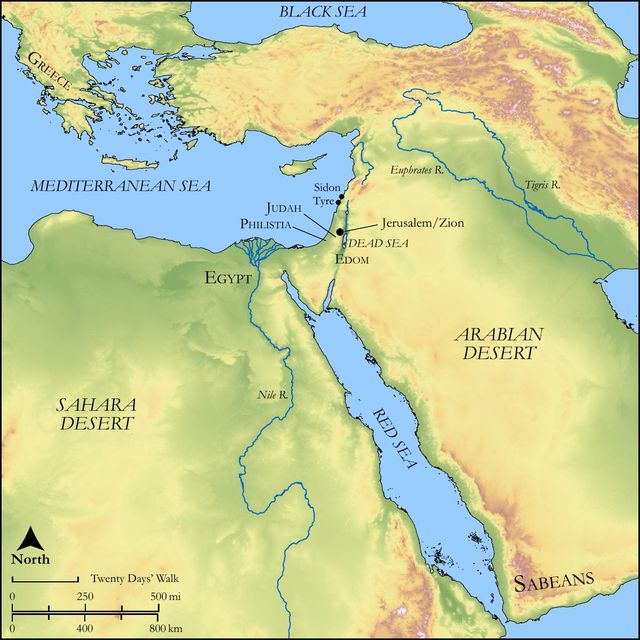
See on the biblical-era map
Study this verse
Public-domain commentary
Matthew Henry
From his Commentary on the Whole Bible. Henry comments on passages, not single verses — this entry covers Joel 3:1–8. His four-level outline is real structure in the source text, so it is rendered as structure.
We have often heard of the year of the redeemed, and the year of recompences for the controversy of Zion; now here we have a description of the transactions of that year, and a prophecy of what shall be done when it comes, whenever it comes, for it comes often, and at the end of time it will come once for all.
I.It shall be the year of the redeemed, for God will bring again the captivity of Judah and Jerusalem, Joe 3:1.
Though the bondage of God's people may be grievous and very long, yet it shall not be everlasting. That in Egypt ended at length in their deliverance into the glorious liberty of the children of God. Let my son go, the he may serve me. That in Babylon shall likewise end well. And the Lord Jesus will provide for the effectual redemption of poor enslaved souls from under the dominion of sin and Satan, and will proclaim that acceptable year, the year of jubilee, the release of debts and servants, and the opening of the prison to those that were bound. There is a day, there is a time, fixed for the bringing again of the captivity of God's children, for the redeeming of them from the power of the grave; and it shall be the last day and the end of all time.
II.It shall be the year of recompences for the controversy of Zion.
Though God may suffer the enemies of his people to prevail against them very far and for a long time, yet he will call them to an account for it, and will lead captivity captive (Psa 68:18), will lead those captive that led his people captive, Rev 13:10. Observe,
1.Who those are that shall be reckoned with - all nations, Joe 3:2. This intimates,
(1.)That all the nations had made themselves liable to the judgment of God for wrong done to his people. Persecution is the reigning crying sin of the world; that lying in wickedness itself is set against godliness. The enmity that is in the old serpent, the god of this world, against the seed of the woman, appears more or less in the children of this world. Marvel not if the world hate you.
(2.)That, whatsoever nation injured God's nation, they should not go unpunished; for he that touches the Israel of God shall be made to know that he touches the apple of his eye. Jerusalem will be a burdensome stone to all people, Zac 12:3. But the neighboring nations shall be particularly reckoned with - Tyre, and Sidon, and all the coasts of Palestine, or the Philistines, who have been troublesome neighbours to the Israel of God, Joe 3:4. When the more remote and potent nations that laid Israel wastes are reckoned with the impotent malice of those that lay near them, and helped forward the affliction, (Zac 1:15), and made a hand of it (Eze 26:2), shall not be passed by. Note, Little persecutors shall be called to an account as well as great ones; and, though they could not do much mischief, shall be reckoned with according to the wickedness of their endeavors and the mischief they would have done.
2.The sitting of this court for judgment. They shall all be gathered (Joe 3:2), that those who have combined together against God's people, with one consent (Psa 83:5), may together receive their doom. They shall be brought down into the valley of Jehoshaphat, which lay near Jerusalem, and there God will plead with them,
(1.)Because it is fit that criminals should be tried in the same country where they did the fact.
(2.)For their greater confusion, when they shall see that Jerusalem which they have so long endeavored and hoped for the ruin of, in spite of all their rage, made a praise in the earth.
(3.)For the greater comfort and honor of God's Jerusalem, which shall see God pleading their cause.
(4.)Then shall be re-acted what God did for Jehoshaphat when he gave him victory over those that invaded him, and furnished him and his people with matter of joy and praise, in the valley of Berachah. See Ch2 20:26.
(5.)It was in this valley of Jehoshaphat (as Dr. Lightfoot suggests) that Sennacherib's army, or part of it, lay, when it was destroyed by an angel. They came together to ruin Jerusalem, but God brought them together for their own ruin, as sheaves into the floor, Mic 4:12.
3.The plaintiff called, on whose behalf this prosecution is set on foot; it is for my people, and for my heritage Israel. It is their cause that God will now plead with jealousy. Note, God's people are his heritage, his peculiar, his portion, his treasure, above all people, Exo 19:5; Deu 32:9. They are his demesne, and therefore he has a good action against those that trespass upon them.
4.The charge exhibited against them, which is very particular. Many affronts they had put upon God by their idolatries, but that for which God has a quarrel with them is the affront they have put upon his people and upon the vessels of his sanctuary.
(1.)They had been very abusive to the people of Israel, had scattered them among the nations and forced them to seek for shelter where they could find a place, or carried them captive into their respective countries and there industriously dispersed them, for fear of their incorporating for their common safety. They parted their land, and took every one his share of it as their own; nay, they have cast lots for my people, and sold them. When they had taken them prisoners,
[1.]They made a jest of them, made a scorn of them as of no value. They would not release them and yet thought them not worth the keeping; they made nothing of playing them away at dice. Or they made a dividend of the prisoners by lot, as the soldiers did of Christ's garments.
[2.]They made a gain of them. When they had them they sold them, yet with so much contempt that they did not increase their wealth by their price, but sold them for their pleasure rather than their profit; they gave a boy taken in war for the hire of a harlot, and a girl for so many bottles of wine as would serve them for one sitting, a goodly price at which they valued them, and goodly preferment for a son and daughter of Israel to be a slave and a drudge in a tavern or a brothel. Observe, here, how that which is got by sin is commonly spent upon another. The spoil which these enemies of the Jews gathered by injustice and violence they scattered and threw away in drinking and whoring; such is frequently the character, and such the conversation, of the enemies and persecutors of the people of God. The Tyrians and Philistines, when they seized any of the children of Judah and Jerusalem, either took them prisoners in war or kidnapped them, they sold them to the Grecians (with whom the men of Tyre traded in the persons of men, Eze 27:13), that they might remove them far from their own border, Joe 3:6. It was a great reproach to Israel, God's first-born, his free-born, to be thus bought and sold among the heathen.
(2.)They had unjustly seized God's silver and gold (Joe 3:5), by which some understand the wealth of Israel. The silver and gold which God's people had he calls his, because they had received it from him and devoted it to him; and whosoever robbed them God took it as if they had robbed him and would make reprisals accordingly. Those who take away the estates of good men for well-doing will be found guilty of sacrilege; they take God's silver and gold. But it seems rather to be meant of the vessels and treasures of the temple, which God here calls his goodly pleasant things, precious and desirable to him and all that are his. These they carried into their temples as trophies of their victory over God's Israel, thinking that therein they triumphed over Israel's God, nay, and that their idols triumphed over him. Thus the ark was put in Dagon's temple. Thus they did unjustly. "What have you to do with me (Joe 3:4), with my people; what wrong have they done you? What provocation have they given you? You had nothing to do with them, and yet you do all this against them. Devices are devised against the quiet in the land, and those offended and harmed that are harmless and inoffensive: Will you render me a recompence?" Can they pretend that either God or his people have done them any injury, for which they may justify themselves by the law of retaliation in doing them these mischiefs? No; they have no colour for it. Note, It is no new thing for those who have been very civil and obliging to their neighbours to find them very unkind and unneighbourly and for those who do no injuries to suffer many.
5.The sentence passed upon them. In general (Joe 3:4), "If you recompense me, if you pretend a quarrel with me, if you provoke me thus to jealousy, if you touch the apple of my eye, I will swiftly and speedily return your recompence upon your own head." Those that contend with God will find themselves unable to make their part good with him. He will recompense them suddenly, when they little think of it, and have not time to prevent it; if he take them to task, he will soon effect their ruin. Particularly, it is threatened,
(1.)That they should not gain their end in the mischief they designed against God's people. They thought to remove them so far from their border that they should never return to it again, Joe 3:6. But (says God) "I will raise them out of the place whither you have sold them, and they shall not, as you intended, be buried alive there." Men's selling the people of God will not deprive him of his property in them.
(2.)That they shall be paid in their own coin, as Adonibezek was (Joe 3:8): "I will sell your sons and your daughters into the hands of the children of Judah; you shall lie as much at their mercy as they have been at yours," Isa 60:14. Thus the Jews had rule over those that hated them, Est 9:1. And then they shall justly be sold to the Sabeans, to a people far off. This (some think) had its accomplishment in the victories obtained by the Maccabees over the enemies of the Jews; others think it looks as far forward as the last day, when the upright shall have dominion (Psa 49:14) and the saints shall judge the world. It is certain that none ever hardened his heart against God, or his church, and prospered long; no, not Pharaoh himself, for the Lord has spoken it, for the comfort of all his suffering servants, that vengeance is his and he will repay.
Historical interpretation
Historical reception
2 surviving comments on this verse. Each one is dated, so this reads as a timeline rather than a list.
For those who believe, salvation is in Mount Zion and Jerusalem. In the latter days, the Lord will gather the called remnant from the people of Judah, who with the apostles and through the apostles believed. He will return the captives of Judah to Jerusalem. He is the one who came to preach sight to the blind, forgiveness to the captives and freedom to those who confess the Lord and abide in the church, in which is the vision of peace. He will gather all the nations who are unwilling to believe, however, and throw them into the valley of Jehoshaphat. The Greek renders kataxō, which is true to the Hebrew, that is, “I will lead you downwards, and drag you down from the highest heights to the lowest depths.”
(Chapter 3, verses 1 onwards) For behold, in those days and at that time, when I restore the fortunes of Judah and Jerusalem, I will gather all the nations and bring them down to the Valley of Jehoshaphat. There I will enter into judgment against them concerning my people, my heritage Israel, whom they have scattered among the nations and have divided up my land. They have cast lots for my people and traded boys for prostitutes; they have sold girls for wine that they may drink. LXX: For behold, in those days and at that time, when I restore the fortunes of Judah and Jerusalem, I will gather all the nations and bring them down to the Valley of Jehoshaphat. There I will enter into judgment against them concerning my inheritance, my people Israel, for they scattered my people among the nations and divided up my land. They cast lots for my people and traded boys for prostitutes; they sold girls for wine to drink. Let us say that we promised, first connecting the later things to the earlier ones according to anagoge, if we are able, we will try to refer them to the day of judgment. With the believers saved on Mount Zion and in Jerusalem, and with the rest of the people of Judaea called, who believed with the apostles and through the apostles, at that time after the Lord had turned the captivity of Judah and Jerusalem, who had come to preach seen, and to the captives, remission, and delivered those who confess the Lord, and who are in the Church, in which there is a vision of peace, will gather all the nations that did not want to believe: and will lead them into the valley of Jehoshaphat, which more significantly, according to the Hebrew truth, is said in Greek κατάξω, that is, I will lead them down, and I will draw them from the highest to the lowest. At the same time, consider when the Lord summons unbelievers, even hostile powers, to judgment and disputes with them on behalf of his people: 'I will bring them down to the Valley of Jehoshaphat.' But when he encourages believers to battle, he says: 'Stir up the strong ones: let all the warriors come forth and ascend.' The nations are urged not to descend, but to ascend into the Valley of Jehoshaphat. For everyone who is judged because of their sins is placed in the valley, which is called Jehoshaphat, that is, the judgment of the Lord. For whoever believes in the Lord will not be judged. And there he will argue with them, not by the power of majesty, but by convincing them with the truth of reason, those who have divided the people of God and dispersed his inheritance among the nations, in order to compel the servants of God to serve themselves. And they divided his land, separating it with many errors among themselves, so that some worshiped Jupiter, others Juno, and Minerva, and fever, and rust, and Anubis, and the crocodile, and the ibis, and the owls, and hawks, and storks. Under these names, the people of God were once divided: those hostile nations, that is, the princes of this world and the rulers of darkness, not only divided the people of God among themselves, but they also put boys in brothels, forcing them to change their natural disposition, about whom the Apostle speaks: Therefore, God handed them over to shameful passions: indeed, their women exchanged the natural use (or, their own nature) for that which is against nature. Similarly, men, forsaking natural use with women, were inflamed with lust for one another, men committing indecent acts with other men, and receiving in themselves the penalty that was due for their error. And not content with this, they sold the girl for wine, so that they could drink and satisfy their lustful desire. All of these things, according to the Jews, were fulfilled in the times of Vespasian, Titus, and especially Hadrian, exactly as described. But if we want to refer to what is written on the day of judgment, we say that everyone who is saved is saved in the Church, whether in heavenly Jerusalem. And after the captivity of the Jews and Jerusalem is turned, then all are to be gathered and led into the valley of Josaphat: and there the Lord will judge with those who persecuted his people, and divided for themselves the inheritance of the Lord, and scattered them among the nations, and cast lots for their land: which we must not only accept concerning heretics, who divided God's people for themselves and made them into gentiles, but also against every rigid and proud teacher, who rule over the clergy under the name of doctrine and priesthood, and oppress those who are subject to them. And when they are negligent and cause scandal to one of the least, they even place boys in brothels or hand them over to prostitutes. They sell girls for the sake of their pleasure, whose god is their belly, and they glory in their shame (Philippians 3). Furthermore, they entrust young men to prostitutes and sell girls for the sake of luxury, not hesitating to corrupt wrongdoers for the sake of shameful profit.
Continue studying Joel 3:1 across the web’s major study libraries — every link below opens this exact verse, chapter, or book on the destination site.
Read & Compare
 BibleGatewayThis verse in more than 200 translations and 70 languages.
 Bible.comThe YouVersion reader — hundreds of translations, reading plans, and highlights.
 ESV.orgCrossway's official English Standard Version reader.
 NET BibleThe NET translation with 60,000+ translators' notes on every rendering decision.
 STEP BibleTyndale House's free study tool — original text, vocabulary, and scholarly resources.
 BibliaLogos Bible Software's free web reader.
 USCCBThe New American Bible (Revised Edition) with the U.S. bishops' study notes.
Commentaries
 BibleHub CommentariesDozens of classic commentaries on this verse, gathered on one page.
 StudyLightMore than 100 commentary sets — the largest collection on the web.
 BibleRefPlain-English commentary on what this verse means, verse by verse.
 Enduring WordDavid Guzik's free commentary on this chapter, widely used by Bible teachers.
 Bible Study ToolsVerse commentary alongside Greek and Hebrew study aids.
Original Language & Research
- BibleHub InterlinearThe verse word by word — original language, transliteration, and English.
- BibleHub LexiconEvery word's original-language definition and Strong's entry.
 Blue Letter BibleDeep-study tools — Strong's numbers, concordance, and word studies.
 SefariaThe Hebrew text with Rashi and centuries of Jewish commentary.
Sermons, Hymns & Audio


TrulyRandomVerse is not affiliated with these sites and doesn’t control their content. They’re linked because they’re genuinely useful.
Summary
Joel 3:1 marks a profound transition in the prophetic book, shifting the focus from the immediate, localized judgments and calls for repentance described in earlier chapters to a grand, future, and globally significant divine intervention. This pivotal verse introduces God's solemn declaration concerning a specific future era when He will decisively act to reverse the fortunes of His people, Judah and Jerusalem, restoring them from a state of captivity or desolation to their rightful place of prosperity and blessing. It sets the stage for a comprehensive eschatological vision encompassing both divine judgment upon the nations and ultimate salvation for Israel.
Context
ShowHideLiterary Context
Joel 3:1 serves as a crucial hinge in the prophecy, moving from the immediate crisis of the locust plague and subsequent call to national repentance in Joel 1 and Joel 2:1-27 to a sweeping eschatological vision. Immediately preceding this verse, Joel 2:28-32 promises the outpouring of God's Spirit and signs preceding the great and dreadful "Day of the Lord." Joel 3:1 then picks up this future orientation, specifying the "days" and "time" when God's ultimate plan for His people and the nations will unfold. The subsequent verses in Joel 3 detail God's judgment on the nations for their mistreatment of Israel, followed by the glorious restoration and blessing of Judah and Jerusalem, culminating in God's dwelling among His people forever.
Historical & Cultural Context
While the precise dating of Joel is debated, the prophecy consistently addresses Judah and Jerusalem, implying a post-exilic or pre-exilic context where the memory or threat of national subjugation and exile was potent. The concept of "captivity" (Hebrew: shĕbûṯ) was deeply embedded in Israelite consciousness, often referring to literal deportation, as experienced during the Assyrian and Babylonian exiles. However, it also carried a broader connotation of national distress, desolation, or a reversal of fortunes. For God to "bring again the captivity" or "restore the fortunes" was a powerful promise of divine intervention, echoing the covenant promises of blessing and restoration after periods of judgment (e.g., Deuteronomy 30:1-5). Culturally, the restoration of Judah and Jerusalem meant not just a physical return to the land, but a re-establishment of their national identity, religious purity, and covenant relationship with Yahweh, often accompanied by material prosperity and security.
Key Themes
ShowHideThis verse powerfully contributes to several overarching themes in Joel and the broader prophetic corpus. Firstly, it underscores Divine Sovereignty and Faithfulness, emphasizing that God Himself ("I shall bring again") is the active agent in history, orchestrating the destiny of nations and fulfilling His covenant promises to Israel despite their failures. Secondly, it highlights Eschatological Hope and Restoration, pointing to a future era when God will fully vindicate His people and reverse their misfortunes, a hope that transcends immediate historical circumstances and looks to a comprehensive, ultimate renewal. This theme is echoed in other prophetic visions of restoration, such as in Jeremiah 29:14 and Ezekiel 36:24. Lastly, it introduces the theme of Divine Justice, as the restoration of Judah and Jerusalem is intrinsically linked to God's impending judgment upon the nations who oppressed His chosen people, setting the stage for the dramatic events of the "Day of the Lord."
Exposition and Analysis
ShowHideKey Word Analysis
ShowHideWhile literally referring to a 24-hour period, yôwm here, especially when coupled with "in that time," signifies a specific, often extended, and significant period in the future. In prophetic contexts, "those days" or "that time" often denotes an eschatological era, a divinely appointed season when God's ultimate purposes will be brought to pass. It points to a decisive moment in salvation history, distinct from the immediate present.
This primitive root means "to turn back," "return," or "restore." In this context, it is used transitively, meaning God will cause the captivity to return or be reversed. It implies a comprehensive reversal of fortune, not merely a physical return from exile but a restoration to a former or even greater state of prosperity, well-being, and covenant favor. The verb emphasizes God's active, intentional, and powerful role in this reversal.
This term refers to "exile" or "prisoners." However, it is often used idiomatically in the Old Testament to mean "a former state of prosperity" or "fortunes." Thus, "bring again the captivity" (or "restore the captivity") is best understood as "restore the fortunes" or "reverse the state of desolation." It encompasses not just physical release from bondage but a holistic restoration—spiritual, social, economic, and national—to a state of blessing and flourishing.
Verse Breakdown
ShowHide"¶ For, behold,"
This introductory phrase serves as a powerful attention-grabber. "For" (Hebrew: kî) links this declaration to the preceding promises of the Spirit's outpouring and the Day of the Lord, indicating that what follows is a consequence or further elaboration of those events. "Behold" (Hebrew: hinnēh) draws the reader's attention to a profound, certain, and divinely ordained future event, signaling its immense importance and certainty.
"in those days, and in that time,"
This temporal marker points to a specific, future period that is yet to unfold. It is not an immediate historical event but a divinely appointed era, often associated with the eschatological "Day of the Lord" mentioned previously in Joel 2:31. The repetition of "days" and "time" emphasizes the certainty and distinctiveness of this future epoch.
"when I shall bring again the captivity"
This is the central promise of the verse. The "I" refers unequivocally to Yahweh, emphasizing His sole agency and sovereign power in this act of restoration. As explored in the Key Word Analysis, "bring again the captivity" is an idiom signifying a complete reversal of fortunes, a comprehensive restoration from a state of desolation, exile, or distress to one of blessing and prosperity. It is a divine initiative, not dependent on human effort alone.
"of Judah and Jerusalem,"
These names specify the recipients of God's promised restoration. Judah represents the southern kingdom, the remnant of Israel, and Jerusalem is its capital, the spiritual and political heart of the nation, the city of David and the temple. This highlights the particularity of God's covenant faithfulness to His chosen people and the central place of His holy city in His redemptive plan.
Literary Devices
ShowHideJoel 3:1 employs several powerful literary devices to convey its message. The opening "For, behold," acts as an Exclamation and a Call to Attention, immediately signaling the profound importance and certainty of the divine declaration that follows. The phrase "in those days, and in that time" utilizes Temporal Framing to set the prophecy firmly in a future, eschatological context, creating a sense of anticipation and divine timing. Most significantly, the expression "bring again the captivity" is a well-known Hebrew Idiom (שוב שְׁבוּת, shuv shĕbûṯ), which, while literally meaning to "return the captivity," is consistently understood in prophetic literature to mean "restore the fortunes" or "reverse the state of desolation." This idiom encompasses a holistic restoration—physical, spiritual, and national—and serves as a powerful Symbol of God's comprehensive redemptive work. The verse also functions as Foreshadowing, setting the stage for the detailed descriptions of judgment and restoration that follow in Joel 3:2-21.
Theological and Thematic Connections
ShowHideJoel 3:1 is a profound declaration of God's unwavering covenant faithfulness and His ultimate sovereignty over history. It assures us that despite periods of judgment, suffering, or apparent abandonment, God remains committed to His people and His redemptive plan. The promise to "bring again the captivity" speaks to God's power to reverse any state of desolation, whether national, communal, or personal. This is not merely a political or geographical restoration but a deep, spiritual renewal that signifies God's active presence and blessing. The verse firmly grounds future hope in God's character and His unchangeable purposes, providing a bedrock of assurance for all who trust in Him. It reminds believers that God's ultimate justice will prevail, His promises will be fulfilled, and His kingdom will be established in its fullness.
Reflection and Application
ShowHideJoel 3:1 offers immense comfort and a robust framework for understanding God's activity in the world, both in ancient Israel and in our contemporary lives. It calls us to cultivate a deep trust in God's sovereign control over all circumstances, even when our own "captivity" (whether literal, spiritual, emotional, or societal) seems overwhelming. This verse reminds us that God has a perfect timetable ("in those days, and in that time") for His redemptive work, and His promises of restoration are sure. For believers, this means holding onto hope amidst trials, knowing that God is actively working to reverse desolation and bring about His ultimate good. It encourages us to look beyond immediate difficulties to the grand narrative of God's kingdom, where justice will ultimately prevail, and all things will be made new. Our response should be one of patient endurance, faithful expectation, and active participation in God's ongoing work of restoration in the world around us, even as we await His final, glorious return.
Questions for Reflection
ShowHideFAQ
ShowHideWhat does "bring again the captivity" (KJV) or "restore the fortunes" (NIV/ESV) truly mean in Joel 3:1?
ShowHideThe Hebrew phrase is shuv shĕbûṯ (שׁוּב שְׁבוּת), which is an idiom that literally means "to return the captivity" but is widely understood in biblical scholarship to signify "to restore the fortunes" or "to reverse the state of desolation." It goes beyond a mere physical return from exile, encompassing a comprehensive and holistic restoration of a people or nation to a state of well-being, prosperity, and covenant blessing. This includes spiritual renewal, social flourishing, economic stability, and national vindication. In Joel 3:1, it points to God's powerful and decisive act to reverse the suffering and oppression experienced by Judah and Jerusalem, bringing them into a glorious future state of blessing and security under His rule. This idiom is found in many prophetic books, such as Deuteronomy 30:3 and Jeremiah 30:3.
Is the prophecy of Joel 3:1 about the restoration of Judah and Jerusalem already fulfilled?
ShowHideWhile there have been historical instances of the Jewish people returning from exile (e.g., the Babylonian captivity), the language and context of Joel 3 point to an ultimate, eschatological fulfillment that extends beyond any single historical event. The "days" and "time" described are linked to the "great and dreadful Day of the Lord" (Joel 2:31), a period of global judgment and signs in the heavens culminating in God's direct intervention. While some aspects may find partial fulfillment in historical returns or the establishment of modern Israel, the comprehensive nature of the restoration (including judgment on all nations, God dwelling in Zion, and perpetual blessing) suggests a future, complete fulfillment that aligns with the consummation of God's redemptive plan, often associated with the second coming of Christ and the establishment of His eternal kingdom.
Christ-Centered Fulfillment
ShowHideJoel 3:1, with its promise of God bringing again the captivity of Judah and Jerusalem, finds its ultimate and most profound fulfillment in the person and work of Jesus Christ. While the immediate context speaks to a physical and national restoration for Israel, the New Testament reveals that true "captivity" for humanity is not merely physical exile but spiritual bondage to sin and death (Romans 6:23). Jesus, as the ultimate Redeemer, came to "proclaim liberty to the captives" (Luke 4:18), setting free those enslaved by sin (John 8:36). The "restoration of fortunes" that Joel prophesied is realized spiritually in the new covenant, where believers from every nation are brought into God's family, forming the spiritual Israel, the church (Galatians 3:28-29). Furthermore, the promise of God dwelling in Zion (Joel 3:21) is ultimately fulfilled in Christ, who is Emmanuel, "God with us," and in the New Jerusalem, where God's tabernacle is with humanity forever (Revelation 21:3). Thus, Joel 3:1 points forward to the comprehensive, eternal restoration initiated by Christ's first coming and consummated at His glorious return, when all things will be made new, and God's people will dwell in perfect freedom and blessing in His presence.