


Zephaniah 3:19
Bible text: King James Version (1769 Blayney text) · Public domain
Bible text: King James Version with Strong's numbers · Public domain
Bible text: Berean Standard Bible · Public domain
Bible text: American Standard Version (1901) · Public domain
Bible text: World English Bible, Messianic edition · Public domain
Bible text: Geneva Bible (1599) · Public domain
Bible text: Young's Literal Translation · Public domain
- הִנְנִיhi·Nihere IH2005Prt ¦ 1csParticle InterjectionהִנְhereנִיI
- עֹשֶׂה'o·Seh[am] about to dealH6213V-Qal-Prtcpl-msVerb Qal Participle Singular Masculine Absolute
- אֶת'etwithH853DirObjMParticle Object Indicator
- כָּלkolallH3605N-mscNoun Singular Masculine Construct
- מְעַנַּיִךְme·'a·Na·yikh[those who] afflicted youH6031V-Piel-Prtcpl-mp ¦ 2fsVerb Piel Participle Plural Masculine Constructמְעַנַּיִ[those who] afflictedךְyou
- בָּעֵתba·'Etat the timeH6256Prep-b ¦ N-csNoun Singular common gender Absoluteבָּat theעֵתtime
- הַהִיאha·Hi'<the> thatH1931Art ¦ Pro-3fsPronoun Personal 3rd Singular Feminineהַ<the>הִיאthat
- וְהוֹשַׁעְתִּיve·ho·sha'·Tiand I will saveH3467Conj-w ¦ V-Hiphil-ConsecPerf-1csVerb Hiphil Consecutive Perfect 1st Singular common genderוְandהוֹשַׁעְתִּיI will save
- אֶת'et<obj.>H853DirObjMParticle Object Indicator
- הַצֹּלֵעָהha·tzo·le·'Ahthe lame [person]H6760Art ¦ V-Qal-Prtcpl-fsVerb Qal Participle Singular Feminine Absoluteהַtheצֹּלֵעָהlame [person]
- וְהַנִּדָּחָהve·han·ni·da·Chahand the outcast [person]H5080Conj-w ¦ Art ¦ V-Niphal-Prtcpl-fsVerb Niphal Participle Singular Feminine Absoluteוְandהַtheנִּדָּחָהoutcast [person]
- אֲקַבֵּץ'a·ka·BetzI will gatherH6908V-Piel-Imperf-1csVerb Piel Imperfect 1st Singular common gender
- וְשַׂמְתִּיםve·sam·Timand I will make themH7760Conj-w ¦ V-Qal-ConsecPerf-1cs ¦ 3mpVerb Qal Consecutive Perfect 1st Singular common genderוְandשַׂמְתִּיI will makeםthem
- לִתְהִלָּהlit·hi·Lah<into> praiseH8416Prep-l ¦ N-fsNoun Singular Feminine Absoluteלִ<into>תְהִלָּהpraise
- וּלְשֵׁםu·le·Shemand <into> a nameH8034Conj-w ¦ Prep-l ¦ N-msNoun Singular Masculine Absoluteוּandלְ<into>שֵׁםa name
- בְּכָלbe·khol[was] in allH3605Prep-b ¦ N-mscNoun Singular Masculine Constructבְּ[was] inכָלall
- הָאָרֶץha·'A·retzthe earthH776Art ¦ N-fsNoun Singular Feminine Absoluteהָtheאָרֶץearth
- בָּשְׁתָּםba·she·Tamtheir shameH1322N-fsc ¦ 3mpNoun Singular Feminine Constructבָּשְׁתָּshameםtheir
English is a literal word-by-word gloss of the Hebrew, not the KJV's wording. Why?
This is the original text the KJV's translators worked from — each Hebrew word with its own literal English meaning in this verse, prepared by scholars at Tyndale House, Cambridge. The KJV translates whole sentences, not word by word, so its wording differs: one Hebrew word can become several English words, and the KJV may choose “the LORD” where the gloss reads “Yahweh”. Both are faithful — they answer different questions. For the KJV's own rendering, switch to the KJV text.
Details
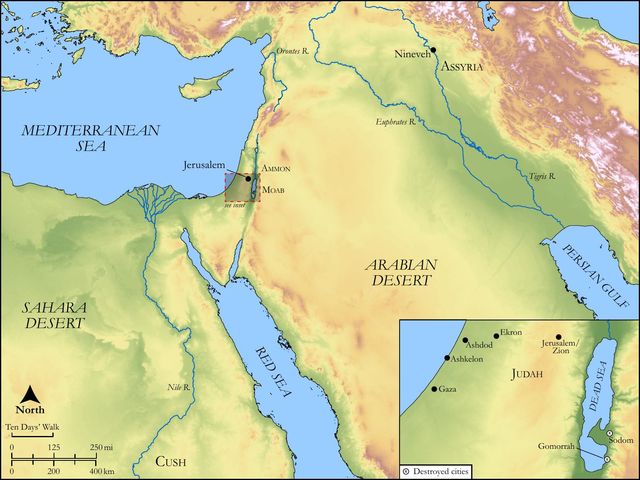
See on the biblical-era map
Study this verse
Public-domain commentary
Matthew Henry
From his Commentary on the Whole Bible. Henry comments on passages, not single verses — this entry covers Zephaniah 3:14–20. His three-level outline is real structure in the source text, so it is rendered as structure.
After the promises of the taking away of sin, here follow promises of the taking away of trouble; for when the cause is removed the effect will cease. What makes a people holy will make them happy of course. The precious promises here made to the purified people were to have their full accomplishment in the comforts of the gospel, in the hope, and much more in the enjoyment, of which, they are here called upon, 1. To rejoice and sing (Zep 3:14): Sing, O daughter of Zion! sing for joy; Shout, O Israel! in a holy transport and exultation; be glad and rejoice with all the heart; let the joy be inward, let it be great. Those that love God with all their heart have occasion with all their heart to rejoice in him. It was promised (Zep 3:13) that their sins should be mortified and their fears silenced, and then follows, Sing and rejoice. Note, Those that reform have cause to rejoice, whereas Israel cannot rejoice for joy as other people, while she goes a whoring from her God. God's promises, applied by faith, furnish the saints with constant and abundant matter for joy; they are filled with joy and peace in believing them. 2. To throw off all their discouragements (Zep 3:16): In that day it shall be said to Jerusalem (God will say it by his prophets, by his providences, their neighbours shall say it, they shall say it to one another), "Fear thou not, be not disposed to fear, do not easily admit the impressions of it; when things are bad, fear not their being worse, but hope they will mend; frighten not thyself upon every occasion. Let not thy hands be slack or faint; wring not thy hands in despair; drop not thy hands in despondence; disfit not thyself for thy work and warfare by giving way to doubts and fears. Pluck up thy spirits, and, in token of that, lift up thy hands, the hands that hung down, Heb 12:12; Isa 35:3. Lift up thy hands in prayer to God; lift up thy hands to help thyself." Fear makes the hands slack, but faith and hope make them vigorous, and the joy of the Lord will be our strength both for doing and suffering.
Let us now see what these precious promises are which are here made to the people of God, for the banishing of their griefs and fears and the encouraging of their hopes and joys; and to us are these promises made as well as to them.
I.An end shall be put to all their troubles and distresses (Zep 3:15):
"The Lord has taken away thy judgments, has removed all the calamities thou hast been groaning under, which were the punishments of thy sin; the noise of war shall be silenced, the reproach of famine done away, and the captivity brought back. Though some grievances remain, they shall be only afflictions, and not judgments, for sin shall be pardoned. He has cast out thy enemy, that has thrust himself into thy land, and triumphed over thee. He has swept out thy enemy" (so some read it), "as dirt is swept out of the house to the dunghill." When they sweep out their sins with the besom of reformation God will sweep out their enemies with the besom of destruction. If they should need correction, they shall fall into the hands of the Lord, whose mercies are great, and shall not again fall into the hands of man, whose tender mercies are cruel: "Thou shalt not see evil any more, not such evil days as thou hast seen." Note, The way to get clear of the evil of trouble is to keep clear from the evil of sin; and to those that do so trouble has no real evil in it.
II.God will give them the tokens of his presence with them; though he has long seemed to stand at a distance (they having provoked him to withdraw), he will make it to appear that he is with them of a truth: "The Lord is in the midst of thee, O Zion! of thee, O Jerusalem! as the sun in the centre of the universe, to diffuse his light and influence upon every part. He is in the midst of thee, to preside in all thy affairs and to take care of all thy interests." And, 1. "He is the King of Israel (Zep 3:15) and is in the midst of thee as a king in the midst of his people." With an eye to this, our Lord Jesus is called the King of Israel (Joh 1:49); and he is, and will be, in the midst of his church always, even to the end of the world, to receive the homage of his subjects, and to give out his favours to them, even where but two or three are gathered together in his name. 2. "He is the Lord thy God, thine in covenant, and he is in the midst of thee as thy God, whom thou hast an interest in and whose own thou art. He has put himself into dear relations to thee, laid himself by promise under obligations to thee, and, that thou mayest have abundant comfort in both, he is in the midst of thee, nigh at hand to answer both." 3. "He that is in the midst of thee as thy God and King is mighty, is almighty, is able to do all that for thee that thou needest and canst desire." 4. "He has engaged his power for thy succour: He will save. He will be Jesus, will answer the name, for he will save his people from their sins."
III.God will take delight in them, and in doing them good.
The expressions of this are very lively and affecting (Zep 3:17): He will rejoice over thee with joy, will not only be well pleased with thee, upon thy repentance and reformation, and take thee into favour, but will take a complacency in thee, as the bridegroom does in his bride, or the bride in her ornaments, Isa 62:3-5. The conversion of sinners and the consolation of saints are the joy of angels, for they are the joy of God him-self. The church should be the joy of the whole earth (Psa 48:2), for it is the joy of the whole heaven. He will rest in his love, will be silent in his love, so the word is. "I will not rebuke thee as I have done, for thy sins; I will acquiesce in thee, and in my relation to thee." I know not where there is the like expression of Christ's love to his church, unless in that song of songs, Sol 4:9, Thou hast ravished my heart, my sister, my spouse, with one of thy eyes. O the condescensions of divine grace! The great God not only loves his saints, but he loves to love them, is pleased that he has pitched upon these objects of his love. He will joy over them with singing. He that is grieved for the sin of sinners rejoices in the graces and services of the saints, and is ready to express that joy by singing over them. The Lord takes pleasure in those that fear him, and in them Jesus Christ will shortly be glorified and admired.
IV.God will comfort Zion's mourners, who sympathize with her in her griefs, and will wipe away their tears (Zep 3:18):
I will gather those who are sorrowful for the solemn assemblies, to whom the reproach of it was a burden. See,
1.Who those are whom God will rejoice in and make to rejoice. They are such as are sorrowful. Those only must expect to reap in joy that sow in tears. The sorrowful now shall be for ever joyful.
2.What is the great matter of sorrow to Zion's mourners, when Zion is in mourning. Many are her calamities. The city is ruined, and the palaces are demolished; trade is at an end, and the administration of public justice; but all these are nothing to them in comparison with the desolations of the sanctuary, the destruction of the temple and the altar, to attend on which, in solemn feasts, all Israel used to come together three times a year. It is for those sacred solemn assemblies that they are sorrowful,
(1.)Because they are dispersed; there is no temple to come up to, or, if there were, no people to come up to it; so that the solemn feasts and sabbaths are forgotten in Zion, Lam 2:6. Note, The restraining of public assemblies for religious worship, the scattering of them by their enemies, or the forsaking of them by their friends, so that either there are no assemblies or not solemn ones, is a very sorrowful thing to all good people. If the ways of Zion mourn, the sons of Zion mourn too. And hereby they make it to appear that they are indeed of Zion, living members of that body with the grievances of which they are so sensibly affected.
(2.)Because they are despised; the reproach of the solemn assemblies is a burden to them. It had been the lot of the solemn assemblies to lie under a great deal of reproach. Satan and his instruments having a particular spite at them, as the great support of the interest of God's kingdom among men. Black and odious characters have been put upon those assemblies; and this is a burden to all those that have a cordial concern for the glory of God and the welfare of the souls of men. They reckon that the reproaches of those who reproach the solemn assemblies fall upon them, fall foul upon them.
V.God will recover the captives out of the hands of their oppressors, and bring home the banished that seemed to be expelled, Zep 3:19, Zep 3:20.
1.Their enemies shall be disabled to detain them in bondage: "At that time I will undo all that afflict thee, will break their power, and blast their counsels, so that they shall be forced to surrender the prey they have taken." Conficiam - I will take them to task; "I will be doing with them shortly, and so as to make an end of them." Note, Those that abuse and oppress God's people take the ready way to undo themselves.
2.They shall be enabled to assert and recover their liberty, and all the difficulties in the way of it shall be surmounted. Is the church weak and wounded? I will save her that halts, as was promised, Mic 4:7. He will help her when she cannot help herself; even the lame shall take the prey, Isa 33:23. Is she dispersed, and not likely to incorporate for her common benefit? I will gather her that was driven out, and bring her again at the time that I gather her. One act of mercy and grace shall serve both to collect them out of their dispersions and to conduct them to their own land. When the people's hearts are prepared, the work will be done suddenly; and who can hinder it if God undertake to effect it? "I will turn back your captivity before your eyes, saith the Lord; you shall plainly discern the hand of God in it, and say, This is the Lord's doing."
VI.God will by all this put honour upon them and gain them respect from all about them.
Israel was at first made high above all nations in praise and fame, Deu 26:19. The reproach brought upon them was therefore one of the sorest of their grievances (nothing cuts deeper to those that are in honour than disgrace does); and therefore when God returns, in mercy, to his church, it is here promised that she shall regain her credit; all the reproach shall be for ever rolled way, as Israel's at Gilgal, Jos 5:9. The church shall be as honourable as ever she had been despicable.
1.Even those that reproached her shall be made to respect her: "I will get them praise and fame in every land, where they have been put to shame, that the same who were the witnesses of their disgrace may see cause to change their mind concerning them." Those that said, "This is Zion whom no man looks after," shall say, "This is Zion whom the great God looks after." And she that was looked upon to be the offscouring of the earth now appears to be the darling of heaven.
2.Even those that never knew her shall be brought to honour her (Zep 3:20): I will make you a name and a praise among all people of the earth. So the Jewish church was when the fear of the Jews fell upon their neighbours (Est 8:17), and some of all nations said, we will go with you, for we have heard that God is with you, Zac 8:23. So the Christian church was when it was made to flourish in the world, for there is that in it which may justly recommend it to the value and esteem of all the people of the earth. And so the universal church of the firstborn will be in the great day, when the saints shall be brought together to Christ, that he may be admired and glorified in them, and they admired and glorified in him before angels and men. Then will God's Israel be made a name and a praise to eternity.
Historical interpretation
Historical reception
2 surviving comments on this verse. Each one is dated, so this reads as a timeline rather than a list.
Select a marker to jump to its quote. Markers stagger vertically where authors wrote within a few decades of each other.
Verse 19, 20: Behold, I will kill all those who have afflicted you at that time; and I will save the lame, and gather her who was cast out; and I will make them a praise and a name in all the earth's confusion. In the time when I bring you; and in the time when I gather you: for I will give you a name and a praise to all the peoples of the earth, when I turn your captivity before your eyes, says the Lord. LXX: Behold, I will do in you, for you, at that time, and I will save the oppressed, and I will receive the rejected, and I will place them in glory, and those who are named in all the earth. And they will be confounded at that time, when I have done well to you: and at the time when I have received you, for I will give you a name, and glory among all the peoples of the earth; when I turn your captivity before you, says the Lord. And this is the synagogue that does not limp, but is cut off on both feet, promising itself in the coming of its Christ, whom it hopes to come: and it thinks that all the nations that have afflicted Israel will be destroyed by the Lord, and the synagogue will be saved, and the one who had received the bill of divorce will be gathered, and they will be placed in praise, and in the name in all the land of their captivity, where they were previously confused. And this happened during the time when the captivity of Jerusalem had been reduced, and the temple had been rebuilt, and the remaining order of ceremonies had been observed. She promises this to herself, and therefore does not repent, and while she hopes for uncertain things, she loses certain salvation. I am not surprised that the synagogue says these things, which, because it does not receive Christ, it hurts its eyes, and when it winks, it is not loved by Jacob, and when Rachel succeeds, it is neglected (Gen. XXIX). I marvel at the Christians, or rather semi-Jews, who claim to be of the Church and profess those things which, if true, we believe in vain in Christ, and all our sacraments are taken away, and we are more miserable than all men, believing in him who did not come. But since our hope is certain and the vows of the Jews are empty, according to the earlier understanding, let us now weave the present and final chapter and let us bring forth the testimony of Jesus son of Sirach: He who casts a stone high, casts it upon his own head (Eccl. XXIII). For indeed, because Zion and Jerusalem are situated on high, whoever detracts from Zion and Jerusalem and hurls stones of contempt at them, casts them upon his own head; and their reproach will return upon his own head. And his pain and wickedness will descend upon his own head. How many today reproach the souls that seek God's mysteries, that desire to see His peace, and say: He is insane and drunk, and full of wine; he avoids the company of men; he spurns pleasure; he considers gold as mud; he loves only poverty. But those who are unbelievers even reproach the cross of Christ to Him, even though when they see Him in distress and temptation, they say: Where are Your mercies and the justice that You have wrought? What shall I say concerning unbelievers, when certain leaders of the Churches reproach such men and consider their lives folly, and do not praise their present conduct, but reproach their old sins? Nor do they hear that it is commanded: Do not reproach a man who turns away from his sins (Eccl. VIII). Woe therefore to him who brought reproach and took it upon himself, and surrendered himself to such a duty, to slander Zion and the city of God. For by this injury, the Lord is the avenger of his own city, and he will say to Zion: Behold, I will do in you for your sake, that is, I will do your vengeance, and I will save the afflicted, or as it is said in Greek, the oppressed; so that the meaning may be: I will save her, who at present is like a grape and an olive, so pressed and afflicted by trials and troubles, as if she were crushed and pressed by a winepress and a beam, in order to make wine and oil, and Jesus would drink of the wine in the kingdom of his Father; but he would be anointed with the oil by his fellow partakers. I think that because of the expression of such wine and oil, Job suffered many things; but after he had made wine and oil, he heard from the Lord, 'Do you think that I have responded to you in any other way, except that you may appear just?' (Job 40:70). As if he were speaking to a grape and an olive; Do you think that I have pressed and afflicted and crushed you in any other way, except that I may extract wine and oil from you? It follows: And I will receive her who was rejected. It seems that God repels us when he allows temptation. Hence Job says, 'The visitation of the Lord has looked upon me' (Job 10:12). And not only do the just speak, saying, 'But now you have repelled and confounded us,' as it is written in the forty-third psalm, but the Lord and Savior himself, speaking in the person of the man he had assumed, says, 'But you have repelled and despised: you have delayed your Christ; you have overthrown the testament of your servant.' But the identity of the righteous person is confirmed in the 43rd psalm, which says: Now you have rejected and humiliated us, but all these things have come upon us, and we have not forgotten you, nor have we acted unjustly in your covenant; our heart has not turned back. Therefore, the Lord will receive her who appeared cast down in temptations, and he will place them in glory and make them renowned throughout the earth, namely, the children of the Church, who have been manifested and rejected. But who else can we understand as children of the Church, if not the apostles? Look at Peter and Paul and Matthew and John; and consider this that was promised to Abraham: I will magnify your name, accomplished in them by their works. Every day their names are mentioned in the Church, every day their names are magnified: not because it benefits them to be mentioned by us in the Church, but because by magnifying their names and reading what they wrote, we obtain salvation. In that time, he says, when the repulsed attack had been undertaken, and his sons had been placed in glory (for the Lord glorifies in his athletes, when he sees them crowned, just as he gloried against the devil concerning Job), so the Apostle, rejoicing in the progress of his disciples, says: Even through your glory, those who were your adversaries will be confounded, and they who had hurled reproach against you will see those whom they had considered miserable to be happy, and those whom they had regarded as poor and lowly to become powerful and glorious. Then they will see their captivity, by which they had been subjected to a harsh rule in this world, being brought back to heavenly Jerusalem; and they themselves rising to eternal shame and confusion. Grant us, Jesus Christ, who are expressed and afflicted and rejected in this world, that you may receive us and place us in glory: may confusion prevail in the time of his remaining, may his idle words cease, may his poisons become dull, and may his confusion lead to salvation. This according to the Septuagint. However, the Hebrew text does not require much explanation because, apart from the beginning that we mentioned at the end of the previous chapter, it does not differ significantly from their translation.
The salvation of human beings rests with divine lovingkindness alone: we do not earn it as the wages of righteousness; rather, it is a gift of divine goodness. Hence the Lord says, “on your behalf I shall save and welcome” and make my own what has become another’s, render it conspicuous, make it more famous than all others, free it from its former shame, and from being captives and slaves I shall make them free people and my own. Now, as I have said, this he both made a gift of to those returning from Babylon at that time and also granted to all people later. We who were once in thrall to the devil but are now freed from that harsh captivity and unmindful of the error of polytheism have become God’s own, being famous beyond pagans and barbarians, according to the prophecy, and we who were once far off have become near, according to the divine apostle.
Continue studying Zephaniah 3:19 across the web’s major study libraries — every link below opens this exact verse, chapter, or book on the destination site.
Read & Compare
 BibleGatewayThis verse in more than 200 translations and 70 languages.
 Bible.comThe YouVersion reader — hundreds of translations, reading plans, and highlights.
 ESV.orgCrossway's official English Standard Version reader.
 NET BibleThe NET translation with 60,000+ translators' notes on every rendering decision.
 STEP BibleTyndale House's free study tool — original text, vocabulary, and scholarly resources.
 BibliaLogos Bible Software's free web reader.
 USCCBThe New American Bible (Revised Edition) with the U.S. bishops' study notes.
Commentaries
 BibleHub CommentariesDozens of classic commentaries on this verse, gathered on one page.
 StudyLightMore than 100 commentary sets — the largest collection on the web.
 BibleRefPlain-English commentary on what this verse means, verse by verse.
 Enduring WordDavid Guzik's free commentary on this chapter, widely used by Bible teachers.
 Bible Study ToolsVerse commentary alongside Greek and Hebrew study aids.
Original Language & Research
- BibleHub InterlinearThe verse word by word — original language, transliteration, and English.
- BibleHub LexiconEvery word's original-language definition and Strong's entry.
 Blue Letter BibleDeep-study tools — Strong's numbers, concordance, and word studies.
 SefariaThe Hebrew text with Rashi and centuries of Jewish commentary.
Sermons, Hymns & Audio


TrulyRandomVerse is not affiliated with these sites and doesn’t control their content. They’re linked because they’re genuinely useful.
Summary
Zephaniah 3:19 presents a profound divine promise of future restoration and vindication for God's afflicted people. It declares the Lord's active intervention to dismantle their oppressors, bring salvation and healing to the vulnerable and scattered, and transform their widespread shame into global praise and renown. This verse stands as a glorious culmination to a book largely focused on judgment, shifting dramatically to a vision of God's redemptive grace and ultimate honor for His remnant.
Context
ShowHideLiterary Context
Zephaniah 3:19 is situated at the climax of the book of Zephaniah, following a series of severe prophecies of judgment against Judah and surrounding nations in Zephaniah 1-2 and a specific indictment of Jerusalem's sins in Zephaniah 3:1-7. However, beginning with Zephaniah 3:8, the tone shifts dramatically to a message of hope, purification, and restoration for a faithful remnant. Specifically, Zephaniah 3:14-17 describes the Lord's joyous presence among His people, the removal of their fear, and His rejoicing over them. Verse 19 then builds directly on this, detailing the practical outworking of this divine favor: the removal of oppressors, the gathering of the dispersed, and the reversal of shame, setting the stage for the book's glorious conclusion in Zephaniah 3:20.
Historical & Cultural Context
The prophecy of Zephaniah was delivered during the early reign of King Josiah (c. 640-609 BC), a period marked by a significant religious reform movement aimed at eradicating idolatry and re-establishing covenant faithfulness. Despite Josiah's efforts, deep-seated idolatry, oppression, and syncretism persisted in Judah, leading to God's pronouncements of impending judgment. The "affliction" and "shame" mentioned in the verse refer to the suffering endured by God's people, both from internal corruption and from the looming threat of powerful external enemies (such as the Assyrians and the rising Babylonian empire) who would eventually lead them into exile. The concept of "gathering the driven out" would have resonated deeply with a people who had experienced or were soon to experience displacement and dispersion, reflecting a common theme of restoration in prophetic literature for exiles. The promise of "praise and fame in every land" would have been a radical reversal of their current status as a humiliated and defeated nation among the powerful empires of that day.
Key Themes
ShowHideZephaniah 3:19 powerfully encapsulates several overarching themes found throughout the book and broader prophetic literature. Firstly, it highlights Divine Justice and Sovereignty, demonstrating God's ultimate control over history and His commitment to righting wrongs by "undoing all that afflict." Secondly, it underscores God's Compassionate Restoration for His people, particularly the vulnerable and overlooked, as seen in the promise to "save her that halteth, and gather her that was driven out." This echoes the shepherd imagery of God's tender care for His flock found in passages like Ezekiel 34:16. Finally, the verse emphasizes Vindication and Glorification, transforming the nation's "shame" into "praise and fame," a complete reversal of their public humiliation. This theme of God turning sorrow into joy and disgrace into honor is also prominently featured in Isaiah 61:7.
Exposition and Analysis
ShowHideKey Word Analysis
ShowHideThis primitive root signifies to depress literally or figuratively. It encompasses meanings such as to abase, humble, hurt, or deal harshly with. In Zephaniah 3:19, God's promise to "undo all that afflict thee" implies His active intervention to counteract and reverse the oppressive actions and suffering inflicted upon His people, demonstrating His commitment to justice and liberation from their tormentors.
Derived from H3467, this primitive root means to be open, wide, or free, and by implication, to be safe. Causatively, it means to free or succor, encompassing concepts like delivering, helping, preserving, and bringing salvation. God's promise to "save her that halteth" indicates a comprehensive act of deliverance and healing for the vulnerable and broken among His people, restoring them to wholeness and security.
This word refers to the feeling and condition of shame, as well as its cause. It can also imply confusion or a shameful thing. The phrase "where they have been put to shame" highlights the public disgrace and humiliation endured by God's people. God's promise to transform this into "praise and fame" signifies a complete reversal of their public reputation, moving from ignominy to honor and renown by divine decree.
Verse Breakdown
ShowHide"Behold, at that time I will undo all that afflict thee"
This opening clause emphasizes God's sovereign timing ("at that time," H6256, ʻêth) and His decisive action ("I will undo," H6213, ʻâsâh) against the oppressors of His people. The verb ʻâsâh here, while broadly meaning "to do or make," carries the strong implication of dealing with, punishing, or bringing about judgment upon those who have caused affliction (H6031, ʻânâh). It signifies a divine reversal of their suffering, where God Himself takes responsibility for their vindication.
"and I will save her that halteth, and gather her that was driven out"
This phrase highlights God's compassionate care for the most vulnerable and dispersed among His people. "Her that halteth" (H6760, tsâlaʻ) refers to those who are weak, lame, or spiritually stumbling, indicating a need for healing and support. "Her that was driven out" (H5080, nâdach) points to those who have been exiled, scattered, or overlooked, emphasizing their displacement and longing for return. God's promise to "save" (H3467, yâshaʻ) and "gather" (H6908, qâbats) them underscores a holistic restoration, both physical and spiritual, bringing them back into His fold and restoring their well-being.
"and I will get them praise and fame in every land where they have been put to shame"
This climactic promise signifies a complete and public reversal of the nation's fortunes. God declares His intention to "get" (H7760, sûwm, meaning to put or appoint) for them "praise" (H8416, tᵉhillâh, laudation or hymn) and "fame" (H8034, shêm, renown or honor). Crucially, this honor will be bestowed "in every land" (H776, ʼerets) – globally – and specifically "where they have been put to shame" (H1322, bôsheth). This means their former disgrace will be transformed into widespread recognition and glory, not just within their own borders but precisely in the places where they suffered ignominy, demonstrating God's powerful vindication.
Literary Devices
ShowHidePersonification is subtly employed in the phrase "her that halteth," attributing a human characteristic (limping or weakness) to the collective nation or remnant, thereby evoking empathy and highlighting their vulnerable state. The verse also employs powerful Contrast and Reversal, moving from the state of "affliction," "halting," "driven out," and "shame" to divine intervention, "saving," "gathering," "praise," and "fame." This stark juxtaposition underscores the magnitude of God's redemptive power to transform utterly the circumstances of His people. Furthermore, the phrase "in every land where they have been put to shame" utilizes Hyperbole to emphasize the global scope and completeness of their vindication, suggesting a renown that extends far beyond their immediate geographical context, serving as a testament to God's ultimate sovereignty and faithfulness.
Theological and Thematic Connections
ShowHideZephaniah 3:19 stands as a profound testament to God's unwavering commitment to justice and restoration for His covenant people. Theologically, it affirms God's active sovereignty over human history, demonstrating that He is not a passive observer but an engaged deliverer who intervenes to right wrongs and vindicate the oppressed. This promise underscores His compassionate nature, revealing a God who cares deeply for the vulnerable, the broken, and the lowly, actively seeking to heal and gather them. Furthermore, the transformation from shame to praise speaks to the eschatological hope of God's ultimate kingdom, where all suffering will be reversed, and His people will be glorified in His presence, reflecting His divine honor upon them. It is a promise of complete vindication, not merely a return to a former state, but an elevation to a new level of honor and renown orchestrated by God Himself.
Reflection and Application
ShowHideZephaniah 3:19 offers immense comfort and profound hope for believers navigating a world fraught with injustice, suffering, and personal shame. It serves as a powerful reminder that our present circumstances, no matter how dire or humiliating, do not define our ultimate destiny in God's redemptive plan. We are assured that God is a God of perfect justice who sees every affliction, every instance of neglect, and every moment of shame. He is actively at work to dismantle oppressive forces and to bring about complete restoration. This verse encourages us to trust in His timing and His power, knowing that He meticulously cares for the "halteth" and the "driven out" among us, promising to transform our deepest shames into public praise and honor. It calls us to patience and perseverance, anchoring our hope in the divine promise of ultimate vindication and glorification, both individually and collectively as the people of God.
Questions for Reflection
ShowHideFAQ
ShowHideDoes this prophecy apply only to ancient Israel, or does it have relevance for believers today?
ShowHideWhile Zephaniah 3:19 was initially delivered to ancient Israel, particularly the remnant facing judgment and exile, its underlying theological principles have enduring relevance for believers today. The promise of God's justice against oppressors, His compassionate care for the vulnerable, and His power to reverse shame into honor are universal attributes of God. Christians understand these promises to find their ultimate fulfillment in the redemptive work of Christ and the future establishment of His eternal kingdom, where all wrongs will be righted and God's people will be fully glorified, as seen in Revelation 21:4. Therefore, it serves as a source of hope and assurance for all who trust in God's sovereign plan.
How does God "undo all that afflict" His people?
ShowHideGod "undoes" affliction in various ways throughout history and in the lives of individuals. This can involve direct divine intervention, such as supernaturally removing oppressors or empowering His people to overcome them. It also includes the working of His providence, where He orchestrates circumstances to bring about justice and deliverance, often through human instruments. Ultimately, the fullest "undoing" of affliction is realized through the cross of Christ, which defeats the power of sin and death, the ultimate sources of human suffering. In the eschatological future, God will completely eradicate all forms of evil and suffering, bringing about a new heaven and new earth where righteousness dwells, as promised in 2 Peter 3:13.
What is the significance of God promising "praise and fame in every land"?
ShowHideThe promise of "praise and fame in every land" signifies a complete and public vindication of God's people, transforming their global reputation from one of shame and humiliation to one of honor and renown. In that day, defeat and exile brought immense public disgrace. God's promise reverses this completely, demonstrating His power to restore not just their physical well-being but also their dignity and standing among the nations. This foreshadows the ultimate glory of God's redeemed people, whose light will shine before all, bringing glory to their Father in heaven, as Jesus teaches in Matthew 5:16. It speaks to God's desire for His people to be a testimony to His greatness, not a byword for shame.
Christ-Centered Fulfillment
ShowHideZephaniah 3:19, while a promise to ancient Israel, finds its ultimate and most profound fulfillment in the person and work of Jesus Christ. He is the one who truly "undoes all that afflict" humanity, not merely external oppressors, but the foundational powers of sin, death, and the devil that hold humanity captive, as seen in Colossians 2:15. Jesus is the Good Shepherd who came to "save her that halteth" – those spiritually lame, broken, and lost – and to "gather her that was driven out" – drawing people from every tribe, tongue, and nation into His one flock, fulfilling His promise in John 10:16. Through His atoning sacrifice on the cross, Christ bore the ultimate "shame" and humiliation, becoming a curse for us, as described in Galatians 3:13. Yet, through His resurrection and ascension, He was given "the name that is above every name," transforming His shame into unparalleled "praise and fame" that extends "in every land" (Philippians 2:9-11). Thus, the church, as His body, shares in His vindication, being called out of darkness into His marvelous light, destined to share in His glory and renown, turning our past shame into eternal praise.