


Micah 7:10
Bible text: King James Version (1769 Blayney text) · Public domain
Bible text: King James Version with Strong's numbers · Public domain
Bible text: Berean Standard Bible · Public domain
Bible text: American Standard Version (1901) · Public domain
Bible text: World English Bible, Messianic edition · Public domain
Bible text: Geneva Bible (1599) · Public domain
Bible text: Young's Literal Translation · Public domain
- וְתֵרֶאve·te·Re'and she will seeH7200Conj-w ¦ V-Qal-Imperf-3fsVerb Qal Imperfect 3rd Singular Feminineוְandתֵרֶאshe will see
- אֹיַבְתִּי'o·Yav·timy enemyH341V-Qal-Prtcpl-fs ¦ 1csVerb Qal Participle Singular Feminine Constructאֹיַבְתִּenemyיmy
- וּתְכַסֶּהָu·te·kha·Se·haand it will cover herH3680Conj-w ¦ V-Piel-ConjImperf-2ms ¦ 3fsVerb Piel Conjunction+Imperfect 2nd Singular Masculineוּandתְכַסֶּit will coverהָher
- בוּשָׁהvu·ShahshameH955N-fsNoun Singular Feminine Absolute
- הָאֹמְרָהha·'o·me·Rah[she] who saysH559Art ¦ V-Qal-Prtcpl-fsVerb Qal Participle Singular Feminine Absoluteהָ[she] whoאֹמְרָהsays
- אֵלַי'e·Laito meH413Prep ¦ 1csPrepositionאֵלַtoיme
- אַיּוֹ'ai·Yowhere [is]? heH335Interrog ¦ 3msParticle Interrogativeאַיּwhere [is]?וֹhe
- יְהוָהYah·wehYahwehH3068N-properNoun Proper Title
- אֱלֹהָיִךְ'e·lo·Ha·yikhyour GodH430N-mpc ¦ 2fsNoun Plural Masculine ConstructאֱלֹהָיִGodךְyour
- עֵינַי'ei·Naimy eyesH5869N-fdc ¦ 1csNoun Dual Feminine Constructעֵינַeyesיmy
- תִּרְאֶינָּהtir·'Ei·nahthey will lookH7200V-Qal-Imperf-3fpVerb Qal Imperfect 3rd Plural Feminine
- בָּהּBahon herPrep-b ¦ 3fsSuffix Personal 3rd Singular Feminineבָּonהּher
- עַתָּה'a·TahnowH6258AdvAdverb
- תִּהְיֶהtih·Yehshe will becomeH1961V-Qal-Imperf-3fsVerb Qal Imperfect 3rd Singular Feminine
- לְמִרְמָסle·mir·Mas<into> a trampling placeH4823Prep-l ¦ N-msNoun Singular Masculine Absoluteלְ<into>מִרְמָסa trampling place
- כְּטִיטke·Titlike [the] mud ofH2916Prep-k ¦ N-mscNoun Singular Masculine Constructכְּlikeטִיט[the] mud of
- חוּצוֹתchu·Tzot[the] streetsH2351N-fpNoun Plural Feminine Absolute
English is a literal word-by-word gloss of the Hebrew, not the KJV's wording. Why?
This is the original text the KJV's translators worked from — each Hebrew word with its own literal English meaning in this verse, prepared by scholars at Tyndale House, Cambridge. The KJV translates whole sentences, not word by word, so its wording differs: one Hebrew word can become several English words, and the KJV may choose “the LORD” where the gloss reads “Yahweh”. Both are faithful — they answer different questions. For the KJV's own rendering, switch to the KJV text.
Details
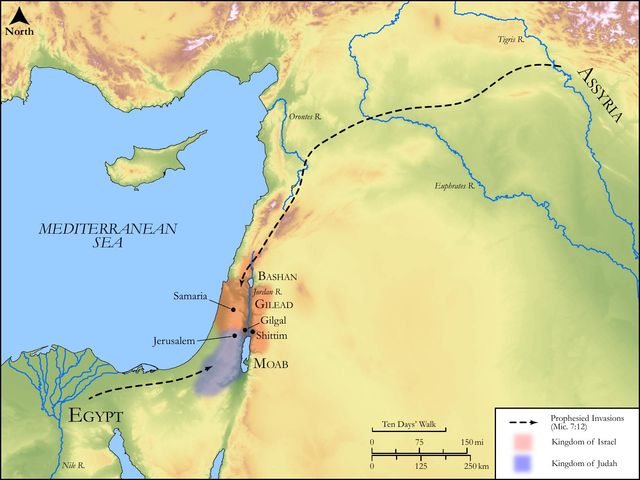
See on the biblical-era map
Study this verse
Public-domain commentary
Matthew Henry
From his Commentary on the Whole Bible. Henry comments on passages, not single verses — this entry covers Micah 7:7–13. His two-level outline is real structure in the source text, so it is rendered as structure.
The prophet, having sadly complained of the wickedness of the times he lived in, here fastens upon some considerations for the comfort of himself and his friends, in reference thereunto. The case is bad, but it is not desperate. Yet now there is hope in Israel concerning this thing.
I."Though God be now displeased he shall be reconciled to us, and then all will be well, Mic 7:7, Mic 7:9.
We are now under the indignation of the Lord; God is angry with us, and justly, because we have sinned against him." Note, It is our sin against God that provokes his indignation against us; and we must see it, and own it, whenever we are under divine rebukes, that we may justify God, and may study to answer his end in afflicting us, by repenting of sin and breaking off from it. Now, at such a time,
1.We must have recourse to God under our troubles (Mic 7:7): Therefore I will look unto the Lord. When a child of God has ever so much occasion to cry, Woe is me (as the prophet here, Mic 7:1), yet it may be a comfort to him that he has a God to look to, a God to come to, to fly to, in whom he may rejoice and have satisfaction. All may look bright above him when all looks black and dark about him. The prophet had been complaining that there was no comfort to be had, no confidence to be put, in friends and relations on earth, and this drives him to his God: Therefore I will look unto the Lord. The less reason we have to delight in any creature the more reason we have to delight in God. If princes are not to be trusted, we may say, Happy is the man that has the God of Jacob for his help, and happy am I, even in the midst of my present woes, if he be my help. If men be false, this is our comfort, that God is faithful; if relations be unkind, he is and will be gracious. Let us therefore look above and beyond them, and overlook our disappointment in them, and look unto the Lord.
2.We must submit to the will of God in our troubles: "I will bear the indignation of the Lord, will bear it patiently, without murmuring and repining, because I have sinned against him." Note, Those that are truly penitent for sin will see a great deal of reason to be patient under affliction. Wherefore should a man complain for the punishment of his sin? When we complain to God of the badness of the times we ought to complain against ourselves for the badness of our own hearts.
3.We must depend upon God to work deliverance for us, and put a good issue to our troubles in due time; we must not only look to him, but look for him: "I will wait for the God of my salvation, and for his gracious returns to me." In our greatest distresses we shall see no reason to despair of salvation if by faith we eye God as the God of our salvation, who is able to save the weakest upon their humble petition, and willing to save the worst upon their true repentance. And, if we depend on God as the God of our salvation, we must wait for him, and for his salvation, in his own way and his own time. Let us now see what the church is here taught to expect and promise herself from God, even when things are brought to the last extremity. (1.) My God will hear me; if the Lord be our God, he will hear our prayers, and grant an answer of peace to them. (2.) "When I fall, and am in danger of being dashed in pieces by the fall, yet I shall arise, and recover myself again. I fall, but am not utterly cast down," Psa 37:24. (3.) "When I sit in darkness, desolate and disconsolate, melancholy and perplexed, and not knowing what to do, nor which way to look for relief, yet then the Lord shall be a light to me, to comfort and revive me, to instruct and teach me, to direct and guide me, as a light to my eyes, a light to my feet, a light in a dark place." (4.) He will plead my cause, and execute judgment for me, Mic 7:9. If we heartily espouse the cause of God, the just but injured cause of religion and virtue, and make it our cause, we may hope he will own our cause, and plead it. The church's cause, though it seem for a time to go against her, will at length be pleaded with jealousy, and judgment not only given against, but executed upon, the enemies of it. (5.) "He will bring me forth to the light, make me shine eminently out of obscurity, and become conspicuous, will make my righteousness shine evidently from under the dark cloud of calumny, Psa 37:6; Isa 58:10. The morning of comfort shall shine forth out of the long and dark night of trouble." (6.) "I shall behold his righteousness; I shall see the equity of his proceedings concerning me and the performance of his promises to me."
II.Though enemies triumph and insult, they shall be silenced and put to shame, Mic 7:8, Mic 7:10. Observe here,
1.How proudly the enemies of God's people trample upon them in their distress. They said, Where is the Lord their God? As if because they were afflicted God had forsaken them, and they knew not where to find him with their prayers, and he knew not how to help them with his favours. This David's enemies said to him, and it was a sword in his bones, Psa 42:10, and see Psa 115:2. Thus, in reproaching Israel as an abandoned people, they reflected on the God of Israel as an unkind unfaithful God.
2.How comfortably the people of God by faith bear up themselves under these insults (Mic 7:8): "Rejoice not against me, O my enemy! I am now down, but shall not be always so, and when my God appears for me then she that is my enemy shall see it, and be ashamed" (not only being disappointed in her expectations of the church's utter ruin, but having the same cup of trembling put into her hand), "then my eyes shall behold her in the same deplorable condition that I am now in; now shall she be trodden down." Note, The deliverance of the church will be the confusion of her enemies; and their shame shall be double, when, as they have trampled upon God's people, so they shall themselves be trampled upon.
III.Though the land continue a great while desolate, yet it shall at length be replenished again, when the time, even the set time, of its deliverance comes.
1.Its salvation shall not come till after it has been desolate; so the margin reads it, Mic 7:13. God has a controversy with the land, and it must lie long under his rebukes, because of those that dwell therein; it is their iniquity that makes their land desolate (Psa 107:34); it is for the fruit of their doings, their evil doings which they have been themselves guilty of, and the evil fruit of them, the sins of others, which they have been accessory to by their bad influence and example. For this they must expect to smart a great while; for the world shall know that God hates sin even in his own people.
2.When it does come it shall be a complete salvation; and it seems to refer to their deliverance out of Babylon by Cyrus, which Isaiah about this time prophesied of, as a type of our redemption by Christ. (1.) The decree shall be far removed. God's decree concerning their captivity, and Nebuchadnezzar's decree concerning the perpetuity of it, his resolution never to release them, "these shall be set aside and revoked, and you shall hear no more of them; they shall no more lie as a yoke upon thy neck." (2.) Jerusalem and the cities of Judah shall be again reared: Then thy walls shall be built, walls for habitation, walls for defence, house-walls, town-walls, temple-walls; it is in order to these that the decree is repealed, Isa 44:28. Though Zion's walls may lie long in ruins, there will come a day when they shall be repaired. (3.) All that belong to the land of Israel, whithersoever dispersed, and howsoever distressed, far and wide over the face of the whole earth, shall come flocking to it again (Mic 7:12): He shall come even to thee, having liberty to return and a heart to return, from Assyria, whither the ten tribes were carried away, though it lay remote, and from the fortified cities, and from the fortress, those strongholds in which they thought they had them fast; for when God's time comes, though Pharaoh will not let the people go, God will fetch them out with a high hand. They shall come from all the remote parts, from sea to sea and from mountain to mountain, not turning back for fear of your discouragements, but they shall go from strength to strength till they come to Zion. Thus in the great day of redemption God will gather his elect from the four winds.
Historical interpretation
Fourteen Centuries of Reception
2 surviving comments on this verse. Each one is dated, so this reads as a timeline rather than a list.
Select a marker to jump to its quote. Markers stagger vertically where authors wrote within a few decades of each other.
(Verse 8 onwards) Do not rejoice, my enemy, over me, for I have fallen: I will rise again. When I sit in darkness, the Lord is my light: I will bear the anger of the Lord, because I have sinned against him, until he judges my cause and executes judgment for me, and brings me into the light, and I will see his righteousness, and my enemy will behold it, and she will be covered with shame, who says to me: Where is your God? My eyes will see her; now she will be trampled as the mud of the streets. The day will come when your walls will be rebuilt. On that day the law will go forth afar off: on that day it will come even to you from Assyria, and even to fortified cities, and from fortified cities even to the river, and from the river even to the sea, and from the sea even to the mountain. And the land will be a desolation because of its inhabitants, and because of the fruit of their thoughts. LXX: Do not insult me, my enemy: for I have fallen, and I will rise again: if I walk in darkness, the Lord will enlighten me. I will bear the anger of the Lord, for I have sinned against Him, until He pleads my cause and executes judgment for me. He will bring me out to the light, and I will see His righteousness. My enemy will see this and be covered with shame, the one who said to me, 'Where is your God?' My eyes will see her; at that time she will be trampled down like mud in the streets. The day of your punishment has come, O Assyria; the time has come for your destruction. The Lord will abolish your power and authority. Your cities will be laid waste, from Tyre to the river, from sea to sea, and from mountain to mountain. The land and its inhabitants will be scattered because of their wickedness. It seems to me that in the literal sense, Jerusalem speaks against Babylon and the other nations that had insulted it: Do not rejoice in my downfall, for with the mercy of the Lord, I will rise again. After I have sat in captivity, He will bring me out of darkness, and He will be my light. I will endure the wrath of the Lord, for I know that I deserve what I have suffered, until I take vengeance upon the nations, and my judgment is fulfilled. I know that He will bring me into the light, and I will see His justice, and Babylon, my enemy, and the other nations around will be covered in shame, those who now mockingly say: Where is your God, O Lord? My eyes will see her, not long after time, but now and in the present trampled, as if the mud of the streets. Thus far Jerusalem, or rather the prophet speaking on behalf of the people: Now God is brought in responding to Jerusalem: O Jerusalem, the days have come for your walls to be rebuilt, which were destroyed by the Babylonian devastator. On that day a law will be established, or rather an ordinance and command, as interpreted by Symmachus and Theodotion, saying, ἐπιταγὴν καὶ πρόσταγμα; and the meaning is: You will no longer be subject to the rule of the Babylonians, on that day when your walls are rebuilt, people will come to you from Assyria and fortified cities: from the fortified cities, I say, as far as the Jordan, which the people crossed over before, and from the Red Sea, and from all the nations as far as the Dead Sea, which is near your land, and to Mount Zion, from the mountains of Persia and Media, where they were previously taken; and the land will be a remnant of the Chaldeans and those who laid you waste, because of their inhabitants and their wicked deeds. The Jews promise themselves this until today, and in that place where we exposed ourselves: On that day the law will be far-reaching, as it seems to us, and as their wiser ones argue, some frivolously lie and say: On that day, when the walls of Jerusalem were built by Christ, the holy Scriptures of the Law and the Prophets, which are now held by us, will be taken from our hands and given to the Jewish people. For what is said according to the Septuagint, 'a day of smoothing out the edge, your erasure,' is not understood to be in Jerusalem, as we have explained according to the Hebrew; but we understand it to be said even now to Babylon, for it too must be erased and trampled upon like an edge. And that legitimate day will repel, not the legitimate day of God, but the legitimate day that you, Babylon, commanded to be observed against the law of God. And your cities will come to an end, or to division, as the Assyrians fight against you (for Babylon was a city of the Chaldeans, not of the Assyrians). And your fortified cities will be divided by the hostile army, from Tyre to the Tigris River, which you encircle, and from the Great Sea to the Red Sea, which touches your regions as they travel from the side to India. And from mountain to mountain: from the mountains of Judea to the mountains of Media and Persia, all of Mesopotamia and the entire region that is now held by you in the middle, will be subjugated by the empire of the enemies. And the land will be in desolation because of the evil fruits of your studies. Where the Seventy were interpreted, let us know about Tyre, it is written in Hebrew, Masor, (): which word, if it is divided into the preposition Ma and the name Sor, is understood about Tyre; but if it is one word, it signifies a stronghold. Finally, they transferred everything, the territory, the enclosure, and the siege, not from Tyre, as the Septuagint says, but from the fortified city. This is in accordance with the Hebrew, and the prayers of the Israelites and the people of circumcision, as if a superfluous discourse had preceded. Now let us come to the spiritual understanding, and with the Holy Spirit himself as the interpreter, let us explore even the most difficult passages. It seems to me that every soul of Jerusalem, in which the temple of the Lord was built, and the vision of peace, and the knowledge of the Scriptures; and afterwards, having been overcome by sins, was led into captivity, and handed over to torments, speaks against Babylon, that is, the confusion of this world, and against the opposing strength that presides over this world: Do not insult me, my enemy, because I have fallen and will rise again: for the Lord raises the fallen (Ps. 144), and speaks through the prophet. Will he not rise again who falls? (Jer. VIII, 4). And: I do not desire the death of a sinner, but rather that he may be converted and live (Ezek. XXXIII, 11). But if you despise me because I suffer torments, learn from Ezekiel that punishments are inflicted first on the more holy, and it is said by the Lord: Begin with my saints (ibid., IX, 6). For even if I walk in darkness, the Lord is my light. For although the rulers of these dark spirits have deceived me, and I sit in darkness and the shadow of death, and my feet are stuck in dark mountains, nevertheless, while sitting in darkness and the shadow of death, a light has dawned, and the light shines in the darkness (Isaiah, IX, 2). And the Lord is my light and my salvation, whom shall I fear? (Psalm 27:1) And I will speak to Him, and say: Your word is a lamp to my feet, O Lord, and a light to my paths. (Psalm 119:105) For He Himself commanded me, when the darkness of this world comes: Let your loins be girded, and your lamps burning in your hands. (Luke 12:35) It follows: I will bear the wrath of the Lord, because I have sinned against Him: until He justifies my cause, and executes judgment for me, and brings me out into the light, and I shall behold His justice. Every correction for the present time does not seem to be of joy, but of sorrow, and afterwards it will yield the peaceful fruit of righteousness to those who have been trained by it. Therefore, feeling that the soul has sinned and has the wounds of sins, and lives in dead flesh, and needs cauterization, it steadfastly says to the physician: Burn my flesh, cut the wounds, constrict all the harmful humors and discharge with a harsh hellebore potion. It was my fault to be wounded; let it be my pain to endure so many torments, so that afterwards I may receive healing. And the true physician shows the cause of the medicine to the one who is already safe and secure, and teaches that he has done rightly what he did. Finally, after torture and punishments, the soul is brought out from the outer darkness, and with the last coin restored, it says: I will see his justice, and I will speak: Your judgments are justified, O God. But if Christ has become for us from God wisdom, and justice, and sanctification, and redemption (1 Cor. 1): he who says he sees the justice after the wrath of God, promises to himself the sight of Christ. And this, however, is only about penitents. However, it is much better to not have wounds and not need a doctor. Healing is not the happiness of the healed, but rather the consolation after pain. Therefore, someone who has been healed should be careful not to sin again, lest something worse happen to them again. We read in Leviticus (Lev. 13), if indeed we read with open eyes, that the covering prescribed in the Law does not exclude the view of the inner eye; in fact, leprosy is accustomed to develop in a vesicle and scar from a burn, and to change the color of the hair, and to add a new deformity to the previous disfigurement of the scar. For this reason, so that no one is secure about repentance, because after sin he can say: I will endure the wrath of God because I have sinned against Him, until he justifies my cause, let him sin and need a cautery, and when he is healed, let him be wounded again. But when the Lord brings us into the light, and we see His justice, then our enemy Babylon will see and be covered in confusion, those who previously spoke against us: Where is your God? thinking that Jerusalem cannot be healed after wounds. And our eyes will look upon her, and she will become trampled like the mud of the streets. And because the end of all punishments is the beginning of good things, and pain leads to healing, bricks will be made from her mud, and her destruction will become the formation of bricks. And on that day, the old errors will be cast aside, and the cities that were poorly fortified will come to an end, whether in unity or in division, and they will be separated from the Assyrians; and from Tyre, which means 'confinement', that is, narrowness, other strengths will arise, and there will be discord even among those who delight in the corruption of this world, and they will generate desires in people. And from sea to sea, and from mountain to mountain, wars will arise against one another, so that bitterness may fight against bitterness, and a lofty pride may fight against another height, and then it will truly be fulfilled: 'Come, let us go down and confuse their languages, so that each one may not understand the voice of their neighbor' (Gen. XI, 7), for it is profitable indeed for the worst strengths not to have harmony among themselves. And when Satan is divided against Satan, then at last his entire kingdom will be destroyed. And what often happens in great armies, that after the tyrant is slain, his followers divide his kingdom among themselves, rise against each other, and there is civil war among them: this will also happen at the end of the world, when the walls of Jerusalem are built and Babylon falls, and the Assyrians and Tyrians from the river, and from the sea, and from the mountains, that is, all the demon nations will fight among themselves, and with their kingdom destroyed, the kingdom of the Lord Jesus will come, and every knee will bow, of those in heaven, on earth, and under the earth, and every tongue will confess that Jesus is Lord, to the glory of God the Father. But so that you may know that the outcome of this rebellion is advantageous, the land of Babylon will be brought to ruin along with all its inhabitants, and the Babylonians will not bear fruit.
She shall be covered: Viz., Babylon my enemy.
Continue studying Micah 7:10 across the web’s major study libraries — every link below opens this exact verse, chapter, or book on the destination site.
Read & Compare
 BibleGatewayThis verse in more than 200 translations and 70 languages.
 Bible.comThe YouVersion reader — hundreds of translations, reading plans, and highlights.
 ESV.orgCrossway's official English Standard Version reader.
 NET BibleThe NET translation with 60,000+ translators' notes on every rendering decision.
 STEP BibleTyndale House's free study tool — original text, vocabulary, and scholarly resources.
 BibliaLogos Bible Software's free web reader.
 USCCBThe New American Bible (Revised Edition) with the U.S. bishops' study notes.
Commentaries
 BibleHub CommentariesDozens of classic commentaries on this verse, gathered on one page.
 StudyLightMore than 100 commentary sets — the largest collection on the web.
 BibleRefPlain-English commentary on what this verse means, verse by verse.
 Enduring WordDavid Guzik's free commentary on this chapter, widely used by Bible teachers.
 Bible Study ToolsVerse commentary alongside Greek and Hebrew study aids.
Original Language & Research
- BibleHub InterlinearThe verse word by word — original language, transliteration, and English.
- BibleHub LexiconEvery word's original-language definition and Strong's entry.
 Blue Letter BibleDeep-study tools — Strong's numbers, concordance, and word studies.
 SefariaThe Hebrew text with Rashi and centuries of Jewish commentary.
Sermons, Hymns & Audio


TrulyRandomVerse is not affiliated with these sites and doesn’t control their content. They’re linked because they’re genuinely useful.
Summary
Micah 7:10 serves as a powerful declaration of divine vindication and a dramatic reversal of fortunes, following a period of national lament and repentance. It proclaims that the enemy who once mocked God's people by questioning His presence and power will be utterly shamed and publicly humiliated. This verse assures the faithful remnant that God will actively intervene, demonstrating His unwavering faithfulness and justice by exalting His people and bringing low their adversaries, ultimately silencing all detractors and affirming His sovereign rule.
Context
ShowHideLiterary Context
Micah 7:10 stands as a triumphant declaration within the concluding chapter of the prophet Micah's book. The preceding verses (Micah 7:1-6) present a stark and sorrowful lament over the pervasive moral corruption and societal decay within Judah, depicting a nation where even the most fundamental relationships are fractured by treachery and distrust. This deep despair, however, gives way to a profound shift in tone in Micah 7:7-9, where the prophet expresses unwavering hope and resolute trust in God for salvation and deliverance. Micah declares his personal commitment to wait for the God of his salvation and acknowledges God's discipline as a necessary, refining process. Verse 10, therefore, is the climactic pronouncement of the divine vindication that will inevitably follow this period of patient waiting and repentance, a public demonstration of God's faithfulness and power that reverses the fortunes of His people and their enemies.
Historical & Cultural Context
Micah prophesied during a tumultuous period in Judah's history, spanning the reigns of Jotham, Ahaz, and Hezekiah (approximately 740-687 BC). This era was marked by significant political instability, the looming threat of the Assyrian Empire (which had already devastated the Northern Kingdom of Israel), and widespread spiritual apostasy within Judah itself. The people had largely abandoned the covenant with Yahweh, engaging in idolatry, oppression, and moral depravity. In this context, the taunt "Where is the LORD thy God?" was not merely a rhetorical question but a deeply cutting challenge to the very existence and efficacy of Judah's God, often hurled by pagan nations or even by disillusioned Israelites. In that day, public shame and humiliation were potent forms of defeat and disgrace, making the imagery of the enemy being "trodden down as the mire of the streets" a vivid and culturally resonant depiction of utter subjugation and contempt.
Key Themes
ShowHideMicah 7:10 powerfully contributes to several overarching themes found throughout the book of Micah and the broader prophetic literature. It underscores the theme of Divine Vindication, asserting God's unwavering commitment to defend and restore His faithful remnant, even after a period of judgment and suffering. This vindication is inextricably linked to the Reversal of Fortunes, where the proud and mocking adversary is brought low, and the humbled people of God are exalted, echoing the principle found in Psalm 75:7. Furthermore, the verse highlights God's Unfailing Faithfulness to His Covenant, demonstrating that despite Judah's profound unfaithfulness and rebellion, God will not abandon His promises to His people. Finally, it offers a profound message of Hope Amidst Despair, assuring believers that their present suffering, ridicule, or perceived abandonment is not the final word, but rather a prelude to God's ultimate triumph and the restoration of His people, a hope that resonates with the prophet's declaration in Micah 7:7.
Exposition and Analysis
ShowHideKey Word Analysis
ShowHideFrom an active participle meaning "hating," this word refers to an adversary or foe. In Micah 7:10, it personifies the nations or entities that have oppressed and mocked Judah, particularly those who questioned the presence and power of Yahweh. It encapsulates the hostile opposition faced by God's people.
This feminine passive participle conveys a strong sense of disgrace, humiliation, and confusion. It denotes a public and complete exposure of folly or failure. Here, it signifies the utter public humiliation that will befall the enemy, a direct consequence of their arrogant mockery and a stark contrast to their former pride.
Derived from a root meaning "to trample," this word signifies abasement, the act or state of being trodden underfoot. It vividly portrays utter defeat, subjugation, and worthlessness. The imagery conveys the complete and contemptuous subjugation of the enemy, reduced to something utterly without value or power.
Verse Breakdown
ShowHide"Then [she that is] mine enemy shall see [it],"
This clause sets the stage for the dramatic reversal. "She that is mine enemy" refers to the hostile nations or oppressors who have afflicted Judah. The "it" refers to God's intervention and vindication of His people, which the enemy will witness with their own eyes. This seeing implies not merely observation but a forced acknowledgment of God's power and justice.
"and shame shall cover her which said unto me, Where is the LORD thy God?"
This is the core declaration of the enemy's humiliation. The "shame" is a direct consequence of their arrogant taunt, "Where is the LORD thy God?" This rhetorical question was a challenge to God's existence, power, or faithfulness in the face of Judah's suffering. The "shame shall cover her" signifies a complete, overwhelming, and inescapable disgrace, publicly exposing their error and folly.
"mine eyes shall behold her:"
This phrase emphasizes the personal satisfaction and vindication of God's people. Just as the enemy saw Judah's distress, now Judah will witness the enemy's downfall. It underscores the certainty of the judgment and the full reversal of roles, providing solace and assurance to those who have endured mockery.
"now shall she be trodden down as the mire of the streets."
This powerful simile vividly describes the enemy's ultimate fate. To be "trodden down as the mire of the streets" means to be reduced to utter insignificance, contempt, and powerlessness, something easily trampled underfoot by all. It portrays a complete and irreversible subjugation, symbolizing their utter defeat and worthlessness in the eyes of God and His people.
Literary Devices
ShowHideMicah 7:10 is rich with Imagery, particularly in its concluding phrase, "trodden down as the mire of the streets." This vivid image evokes a sense of utter degradation, worthlessness, and public humiliation, painting a picture of the enemy reduced to the lowest possible state, easily walked over and despised. The phrase "shame shall cover her" employs Personification, attributing the action of "covering" to an abstract concept, "shame," thereby emphasizing its pervasive and inescapable nature upon the enemy. The verse also utilizes a Rhetorical Question in the enemy's taunt, "Where is the LORD thy God?" This question, intended to mock and undermine faith, sets up the dramatic Contrast between the enemy's former arrogance and their future abasement. This contrast highlights the divine justice at play, where the proud are humbled and God's faithfulness is unequivocally demonstrated.
Theological and Thematic Connections
ShowHideMicah 7:10 profoundly articulates the biblical theme of divine justice and the ultimate vindication of God's people. It asserts God's active sovereignty over history and nations, demonstrating that He will not allow the mockery of His name or the oppression of His people to go unaddressed indefinitely. This verse assures believers that even in times of suffering and apparent abandonment, God remains faithful to His covenant promises, and His ultimate plan includes the public display of His power, turning the tables on those who defy Him. It is a powerful affirmation that God hears the taunts against His children and will respond in His perfect timing, bringing glory to His name and comfort to His faithful.
Reflection and Application
ShowHideMicah 7:10 offers profound encouragement and a steadfast anchor for believers navigating a world that often questions, ridicules, or actively opposes faith. In moments of personal or collective distress, when our trust in God is challenged by circumstances or by the taunts of skeptics asking, "Where is your God?", this verse reminds us that our present suffering or perceived weakness is not the final word. It calls us to cultivate a patient endurance, trusting in God's perfect timing and His unwavering commitment to justice. We are assured that God sees every tear, hears every taunt, and will, in His sovereign wisdom, bring about a dramatic reversal. Our hope is not in our own strength or cleverness, but in the character of a faithful God who will ultimately vindicate His name and His people, turning the enemy's shame into a public testimony of His glory. This truth empowers us to persevere in faith, knowing that the ultimate victory belongs to the Lord, and those who patiently wait upon Him will witness His powerful hand at work, transforming humiliation into triumph.
Questions for Reflection
ShowHideFAQ
ShowHideWho is "she that is mine enemy" in Micah 7:10, and how does this apply to us today?
ShowHideIn its immediate historical context, "she that is mine enemy" primarily refers to the nations that oppressed and mocked Judah, particularly Assyria and later Babylon, who frequently taunted God's people by questioning the power of Yahweh. It can also broadly refer to any entity or nation that stands in opposition to God's people and His purposes. For contemporary believers, this "enemy" can be understood on multiple levels: it can represent spiritual forces of darkness that seek to undermine faith (Ephesians 6:12), societal systems or ideologies that are hostile to Christian values, or even individuals who actively mock or persecute those who follow Christ. The promise remains that God will ultimately vindicate His name and His people against all such adversaries.
Christ-Centered Fulfillment
ShowHideMicah 7:10 finds its ultimate and most profound fulfillment in the person and work of Jesus Christ. While the verse speaks of God's vindication of Israel against her national enemies, the New Testament reveals that true enmity is against God Himself, and the ultimate victory is over sin, death, and the devil. Jesus, the suffering servant, perfectly embodied the one who was mocked and questioned, just as the enemy in Micah 7:10 questioned God's presence. He was reviled, his claims to divinity challenged, and his crucifixion appeared to be the ultimate triumph of his adversaries. Yet, in His resurrection, God dramatically vindicated Christ, turning the ultimate shame of the cross into the greatest triumph. As Philippians 2:8-11 declares, because Jesus humbled Himself and became obedient to death, God highly exalted Him, giving Him a name above every name, so that every knee should bow. The enemy—Satan, sin, and death—who once seemed to have the upper hand, was decisively "trodden down" through Christ's victory. For believers, our vindication is found in our union with Christ; we share in His triumph over the very enemies that once held us captive, and we are assured that one day, every enemy will be put under His feet (1 Corinthians 15:25). Thus, Micah's prophecy points forward to the ultimate shame of God's enemies and the eternal glory of His people, secured definitively by the Lamb of God.