


Jeremiah 50:33
Bible text: King James Version (1769 Blayney text) · Public domain
Bible text: King James Version with Strong's numbers · Public domain
Bible text: Berean Standard Bible · Public domain
Bible text: American Standard Version (1901) · Public domain
Bible text: World English Bible, Messianic edition · Public domain
Bible text: Geneva Bible (1599) · Public domain
Bible text: Young's Literal Translation · Public domain
- כֹּהkohthusH3541AdvAdverb
- אָמַר'a·Marhe saysH559V-Qal-Perf-3msVerb Qal Perfect 3rd Singular Masculine
- יְהוָהYah·wehYahwehH3068N-properNoun Proper Title
- צְבָאוֹתtze·va·'otof hostsH6635N-fpNoun Plural Feminine Absolute
- עֲשׁוּקִים'a·shu·Kim[are] oppressedH6231V-Qal-PassPrtcpl-mpVerb Qal Participle Passive Plural Masculine Absolute
- בְּנֵיbe·nei[the] people ofH1121N-mpcNoun Plural Masculine Construct
- יִשְׂרָאֵלYis·ra·'ElIsraelH3478N-properNoun Proper Location
- וּבְנֵיu·ve·neiand [the] people ofH1121Conj-w ¦ N-mpcNoun Plural Masculine Constructוּandבְנֵי[the] people of
- יְהוּדָהye·hu·DahJudahH3063N-properNoun Proper Location
- יַחְדָּוyach·DavtogetherH3162AdvAdverb
- וְכָלve·kholand allH3605Conj-w ¦ N-mscNoun Singular Masculine Constructוְandכָלall
- שֹׁבֵיהֶםshoei·Hemtheir captorsH7617V-Qal-Prtcpl-mp ¦ 3mpVerb Qal Participle Plural Masculine Constructשֹׁבֵיcaptorsהֶםtheir
- הֶחֱזִיקוּhe·che·Zi·kuthey have kept holdH2388V-Hiphil-Perf-3cpVerb Hiphil Perfect 3rd Plural common gender
- בָםVamon <the> themPrep-b ¦ 3mpSuffix Personal 3rd Plural Masculineבָon <the>םthem
- מֵאֲנוּme·'a·Nuthey have refusedH3985V-Piel-Perf-3cpVerb Piel Perfect 3rd Plural common gender
- שַׁלְּחָםsha·le·Chamto let go themH7971V-Piel-Inf ¦ 3mpVerb Piel Infinitive Constructשַׁלְּחָto let goםthem
English is a literal word-by-word gloss of the Hebrew, not the KJV's wording. Why?
This is the original text the KJV's translators worked from — each Hebrew word with its own literal English meaning in this verse, prepared by scholars at Tyndale House, Cambridge. The KJV translates whole sentences, not word by word, so its wording differs: one Hebrew word can become several English words, and the KJV may choose “the LORD” where the gloss reads “Yahweh”. Both are faithful — they answer different questions. For the KJV's own rendering, switch to the KJV text.
Details
See on the biblical-era map
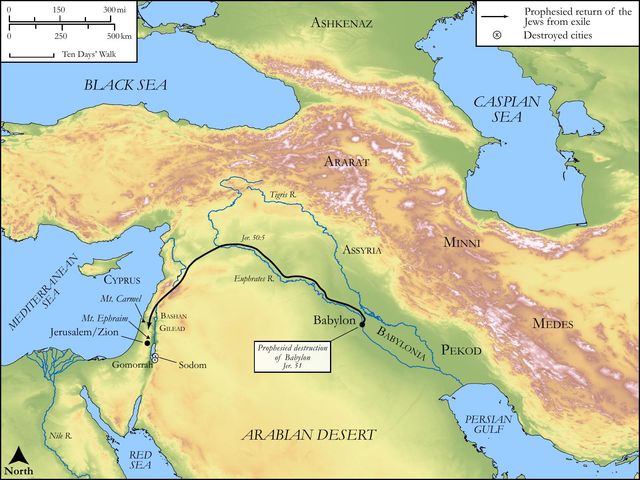
Study this verse
Public-domain commentary
Matthew Henry
From his Commentary on the Whole Bible. Henry comments on passages, not single verses — this entry covers Jeremiah 50:33–46. His four-level outline is real structure in the source text, so it is rendered as structure.
We have in these verses,
I.Israel's sufferings, and their deliverance out of those sufferings.
God takes notice of the bondage of his people in Babylon, as he did of their bondage in Egypt; he has surely seen it, and has heard their cry. Israel and Judah were oppressed together, Jer 50:33. Those that remained of the captives of the ten tribes, upon the uniting of the kingdoms of Assyria and Chaldea, seem to have come and mingled with t hose of the two tribes, and to have mingled tears with them, so that they were oppressed together. They were humble suppliants for their liberty, and that was all; they could not attempt any thing towards it, for all that took them captives held them fast, and were much too hard for them. But this is their comfort in distress, that, though they are weak, their Redeemer is strong (Jer 50:34), their Avenger (so the word signifies), he that has a right to them, and will claim his right and make good his claim. He is stronger than their enemies that hold them fast; he can overpower all the force that is against them, and put strength into his own people though they are very weak. The Lord of hosts is his name, and he will answer to his name, and make it to appear that he is what his people call him, and will be that to them for which they depend upon him. Note, It is the unspeakable comfort of the people of God that, though they have hosts against them, they have the Lord of hosts for them and he shall thoroughly plead their cause, pleading he shall plead it, plead it with jealousy, plead it effectually, plead it and carry it, that he may give rest to the land, and to his people's land, rest from all their enemies round about. This is applicable to all believers, who complain of the dominion of sin and corruption, and of their own weakness and manifold infirmities. Let them know that their Redeemer is strong; he is able to keep what they commit to him, and he will plead their cause. Sin shall not have dominion over them; he will make them free, and they shall be free indeed; he will give them rest, that rest which remains for the people of God.
II.Babylon's sin, and their punishment for that sin.
1.The sins they are here charged with are idolatry and persecution.
(1.)They oppressed the people of God; they held them fast, and would not let them go. They opened not the house of his prisoners, Isa 14:17. This was God's quarrel with them, as of old with Pharaoh; it cost him dear, and yet they would not take warning. The inhabitants of Babylon must be disquieted (Jer 50:34) because they have disquieted God's people, whose honour and comfort he is jealous for, and therefore will recompense tribulation to those that trouble them, as well as rest to those that are troubled, Th2 1:6, Th2 1:7.
(2.)They wronged God himself, and robbed him, giving that glory to others which is due to him alone; for (Jer 50:38) it is the land of graven images. All parts of the country abounded with idols, and they were mad upon them, were in love with them and doted on them, cared not what cost and pains they were at in the worship of them, were unwearied in paying their respects to them; and in all this they were wretchedly infatuated and acted like men out of their wits; they were carried on in their idolatry without reason or discretion, like men in a perfect fury. The word here used for idols properly signifies terrors - Enim, the name given to giants that were formidable, because they made the images of their gods to look frightful, to strike a terror upon fools and children. Their idols were scarecrows, yet they doted on them. Babylon was the mother of harlots (Rev 17:5), the source of idolatry. Note, It is the maddest thing in the world to make a god of any creature; and those who are proud against the Lord, the true God, are justly given up to strong delusions, to be mad upon idols that cannot profit. But this madness is wickedness, for which sinners will be certainly and severely reckoned with.
2.The judgments of God upon them for these sins are such as will quite lay them waste and ruin them.
(1.)All that should be their defence and support shall be cut off by the sword. The Chaldeans had long been God's sword, wherewith he had done execution upon the sinful nations round about: but now, they being as bad as any of them, or worse, a sword is brought upon them, even upon the inhabitants of Babylon (Jer 50:35), a sword of war; and, as it is in God's hand, sent and directed by him, it is a sword of justice. It shall be,
[1.]Upon their princes; they shall fall by it, and their dignity, wealth, and power, shall not secure them.
[2.]Upon their wise men, their philosophers, their statesmen, and privy-counsellors; their learning and policy shall neither secure them nor stand the public in any stead.
[3.]Upon their soothsayers and astrologers, here called the liars (Jer 50:36), for they cheated with their prognostications of peace and prosperity; the sword upon them shall make them dote, so that they shall talk like fools, and be as men that have lost all their wits. Note, God has a sword that can reach the soul and affect the mind, and bring men under spiritual plagues.
[4.]Upon their mighty men. A sword shall be upon their spirits; if they are not slain, yet they shall be dismayed, and shall be no longer mighty men; for what stead will their hands stand them in when their hearts fail them?
[5.]Upon their militia (Jer 50:37): The sword shall be upon their horses and chariots; the invaders shall make themselves masters of all their warlike stores, shall seize their horses and chariots for themselves, or destroy them. The troops of other nations that were in their service shall be quite disheartened: The mingled people shall become as weak and timorous as women.
[6.]Upon their exchequer: The sword shall be upon her treasures, which are the sinews of war, and they shall be robbed, and made use of by the enemy against them. See what universal destruction the sword makes when it comes with commission.
(2.)The country shall be made desolate (Jer 50:38): The waters shall be dried up, the water that secures the city. Cyrus drew the river Euphrates into so many channels as made it passable for his army, so that they got with ease to the walls of Babylon, which, if was thought, that river had rendered inaccessible. "The water likewise that made the country fruitful shall be dried up, so that it shall be turned into barrenness, and shall be no more inhabited by the children of men, but by the wild beasts of the desert," Jer 50:39. This was foretold concerning Babylon, Isa 13:19-22. It shall become like Sodom and Gomorrah, Jer 50:40. The same was foretold concerning Edom, Jer 49:18. As the Chaldeans had laid Edom waste, so they shall themselves be laid waste.
(3.)The king and kingdom shall be put into the utmost confusion and consternation by the enemies' invading them, Jer 50:41-43. All the expressions here used to denote the formidable power of the invaders, the terrors wherewith they should array themselves, and the great fright which both court and country should be put into thereby, we met with before (Jer 6:22-24) concerning the Chaldeans' invading the land of Judah. The battle which is there said to be against thee, O daughter of Zion! is here said to be against thee, O daughter of Babylon! to intimate that they should be paid in their own coin. God can find out such as shall be for terror and destruction to those that are for terror and destruction to others; and those who have dealt cruelly, and have shown no mercy, may expect to be cruelly dealt with, and to find no mercy. Only there is one difference between these passages; there it is said, We have heard the fame thereof and our hands wax feeble; here it is said, The king of Babylon has heard the report and his hands waxed feeble, which intimates that that proud and daring prince shall, in the day of his distress, be as weak and dispirited as the meanest Israelites were in the day of their distress.
(4.)That they shall be as much hurt as frightened, for the invader shall come up like a lion to tear and destroy (Jer 50:44) and shall make them and their habitation desolate (Jer 50:45), and the desolation shall be so astonishing that all the nations about shall be terrified by it, Jer 50:46. These three verses we had before (Jer 49:19-21) in the prophecy of the destruction of Edom, which was accomplished by the Chaldeans, and they are here repeated, mutatis mutandis - with a few necessary alterations, in the prophecy of the destruction of Babylon, which was to be accomplished upon the Chaldeans, to show that though the distributions of Providence may appear unequal for a time its retributions will be equal at last; when thou shalt make an end to spoil thou shalt be spoiled, Isa 33:1; Rev 13:10.
Continue studying Jeremiah 50:33 across the web’s major study libraries — every link below opens this exact verse, chapter, or book on the destination site.
Read & Compare
 BibleGatewayThis verse in more than 200 translations and 70 languages.
 Bible.comThe YouVersion reader — hundreds of translations, reading plans, and highlights.
 ESV.orgCrossway's official English Standard Version reader.
 NET BibleThe NET translation with 60,000+ translators' notes on every rendering decision.
 STEP BibleTyndale House's free study tool — original text, vocabulary, and scholarly resources.
 BibliaLogos Bible Software's free web reader.
 USCCBThe New American Bible (Revised Edition) with the U.S. bishops' study notes.
Commentaries
 BibleHub CommentariesDozens of classic commentaries on this verse, gathered on one page.
 StudyLightMore than 100 commentary sets — the largest collection on the web.
 BibleRefPlain-English commentary on what this verse means, verse by verse.
 Enduring WordDavid Guzik's free commentary on this chapter, widely used by Bible teachers.
 Bible Study ToolsVerse commentary alongside Greek and Hebrew study aids.
Original Language & Research
- BibleHub InterlinearThe verse word by word — original language, transliteration, and English.
- BibleHub LexiconEvery word's original-language definition and Strong's entry.
 Blue Letter BibleDeep-study tools — Strong's numbers, concordance, and word studies.
 SefariaThe Hebrew text with Rashi and centuries of Jewish commentary.
Sermons, Hymns & Audio


TrulyRandomVerse is not affiliated with these sites and doesn’t control their content. They’re linked because they’re genuinely useful.
Summary
Jeremiah 50:33 provides a poignant divine declaration regarding the prolonged and unjust oppression of both the Northern Kingdom of Israel and the Southern Kingdom of Judah. It vividly portrays their shared suffering under the unyielding grip of their Babylonian captors, who adamantly refused to release them. This verse serves as a powerful preamble to God's impending judgment against Babylon, underscoring the profound helplessness of His people and the deliberate cruelty of their enemies, thereby justifying the Lord of hosts' decisive intervention as their righteous deliverer. The LORD's answer follows at once, for their Redeemer is strong, the LORD of hosts is His name, and He shall thoroughly plead their cause.
Context
ShowHideLiterary Context
This verse is strategically placed within a monumental prophetic oracle spanning Jeremiah chapters 50 and 51, which is entirely dedicated to pronouncing God's severe judgment against Babylon. This extended prophecy marks a significant shift in Jeremiah's book; previous chapters meticulously detail Judah's persistent apostasy and the consequent, divinely ordained Babylonian exile. Chapters 50-51, however, pivot dramatically to Babylon's inevitable downfall, demonstrating that even God's instruments of discipline are not exempt from His righteous judgment when they exceed their mandate or act with excessive cruelty and pride. Jeremiah 50:33 specifically highlights the dire predicament of the exiles, building a compelling case for God's forthcoming intervention by emphasizing the utter powerlessness of His covenant people and the unyielding obstinacy of their oppressors. This portrayal not only justifies the severe judgment pronounced upon Babylon but also offers profound reassurance to the exiled Israelites and Judeans that their suffering is fully seen and will be avenged by their sovereign God.
Historical & Cultural Context
The historical backdrop of Jeremiah 50:33 is one of profound national trauma and despair. By the time this prophecy was delivered, the Northern Kingdom of Israel had already been brutally conquered and dispersed by the Assyrian Empire in 722 BC. The Southern Kingdom of Judah had more recently endured multiple waves of deportation to Babylon, culminating in the catastrophic destruction of Jerusalem and its sacred temple in 586 BC. The Babylonian Empire, under the formidable Nebuchadnezzar, stood at the zenith of its power, celebrated for its military might, architectural marvels, and a ruthless imperial policy towards conquered peoples. Captives were typically integrated into the Babylonian economy, often as forced labor, and their release was virtually unheard of unless it served a specific political or economic advantage for the empire. The phrase "held them fast; they refused to let them go" accurately reflects this imperial strategy of retaining valuable human resources and maintaining absolute control over subjugated territories. The prophecy thus speaks directly into a context of deep despair among the exiles, who had lost their land, their temple, and their political independence, feeling utterly abandoned by their God and completely at the mercy of a seemingly invincible empire.
Key Themes
ShowHideJeremiah 50:33 powerfully contributes to several overarching themes pervasive within the book of Jeremiah and the broader prophetic literature. Firstly, it emphatically underscores the theme of Divine Justice and Retribution, affirming that God, identified as the "LORD of hosts," will ultimately hold all nations accountable for their actions, particularly their mistreatment of His covenant people. This motif is a consistent thread throughout biblical narrative, evident in God's decisive judgment against Egypt at the Red Sea, as recounted in Exodus 14, and against Assyria, depicted as God's rod of anger in Isaiah 10. Secondly, the verse vividly portrays the Suffering and Oppression of God's People, highlighting their profound vulnerability and desperate need for divine intervention. The shared plight of "the children of Israel and the children of Judah" also powerfully introduces the theme of Restoration and Reunion, foreshadowing a future era when God would gather His scattered people and bring them back to their land, a promise richly elaborated upon in Jeremiah 31 with the New Covenant. Finally, the authoritative declaration, "Thus saith the LORD of hosts," unequivocally reinforces the theme of God's Sovereignty over History and Nations, asserting that even the most formidable human empires are ultimately subject to His supreme will and overarching redemptive purposes.
Exposition and Analysis
ShowHideKey Word Analysis
ShowHideThis term, while literally meaning "son" or "descendant," is used here in a broader, collective sense to refer to a nation or people. Its application to "Israel" and "Judah" emphasizes their familial and covenantal relationship with God, portraying them not merely as conquered subjects but as God's own "children" who are suffering. This highlights the intimate nature of their oppression from God's perspective and His personal concern for their plight.
This root signifies "to press upon," "defraud," or "do violence." It conveys a strong sense of active, unjust, and forceful subjugation. The use of the passive voice ("were oppressed") underscores their victimhood and the external, coercive force exerted upon them, emphasizing the severity, injustice, and burden of their captivity.
This word means "to fasten upon," "seize," "be strong," or "retain." It vividly describes the firm, unyielding, and determined grip of the captors, implying a resolute refusal to release their prisoners. This word choice emphasizes the human impossibility of escape or liberation without divine intervention, highlighting the captors' strength and resolve.
Meaning "to refuse" or "utterly deny." This term highlights the deliberate, intentional, and unyielding will of the captors. It signifies that their continued bondage was not an oversight or a temporary situation, but a hardened, conscious decision to maintain their hold, underscoring the depth of their cruelty and the utter hopelessness of the exiles' situation from a human vantage point.
Verse Breakdown
ShowHide"Thus saith the LORD of hosts;"
This opening phrase functions as a quintessential prophetic formula, unequivocally asserting the divine origin and absolute authority of the message that follows. The title "The LORD of hosts" (Hebrew: Yahweh Sabaoth) emphasizes God's supreme power and sovereignty over all creation, including heavenly armies and earthly nations, setting the tone for a declaration of ultimate authority that transcends and confronts seemingly insurmountable human power.
"The children of Israel and the children of Judah [were] oppressed together:"
This clause precisely identifies the suffering parties—both the Northern Kingdom (Israel) and the Southern Kingdom (Judah)—acknowledging their shared experience of suffering despite their historical political and spiritual divisions. The term "oppressed" underscores the unjust, burdensome, and violent nature of their captivity, emphasizing their collective plight under foreign domination and the injustice they endured.
"and all that took them captives held them fast;"
This segment vividly describes the relentless and firm grip of the captors, primarily the Babylonian Empire. The phrase "held them fast" powerfully conveys the strength, determination, and unyielding resolve of the oppressors to maintain their control, indicating the immense difficulty, if not outright impossibility, of the exiles' liberation through any human effort or negotiation.
"they refused to let them go."
This final clause underscores the deliberate, conscious, and unyielding will of the captors. It signifies a conscious and persistent denial of freedom, illustrating the depth of the exiles' bondage and the complete lack of any human prospect for release. This emphasizes the profound hopelessness of their situation, thereby amplifying the urgent and absolute necessity for divine intervention.
Literary Devices
ShowHideJeremiah 50:33 masterfully employs several potent literary devices to convey its profound message of divine justice and human suffering. The verse opens with the classic "Thus saith the LORD of hosts," an exemplary prophetic oracle formula that immediately establishes the divine authority and the absolute certainty of the pronouncement. The phrase "the children of Israel and the children of Judah" utilizes synecdoche, a rhetorical device where a part (the children or descendants) represents the whole (the nations or kingdoms), effectively emphasizing their identity as God's unique covenant people. The parallel structure observed in "held them fast" and "refused to let them go" creates a powerful sense of emphatic repetition and intensification, underscoring both the severity and the deliberate, unyielding nature of the captors' oppression. This also functions as a form of hyperbole, highlighting the seemingly insurmountable nature of their bondage to magnify the eventual, miraculous power of God's intervention. Furthermore, the entire verse functions as a lament, articulating the deep suffering and desperate plight of God's people, which serves as a poignant prelude to the divine promise of justice and ultimate liberation.
Theological and Thematic Connections
ShowHideJeremiah 50:33 profoundly articulates God's unwavering commitment to His covenant people, even in their deepest suffering, dispersion, and apparent abandonment. It reveals a God who is not distant or indifferent, but one who intimately sees the injustice inflicted upon His "children" and is moved to righteous action. The divine title "LORD of hosts" is far more than a ceremonial designation; it signifies God's active power, His supreme authority, and His readiness to marshal all resources—both heavenly armies and earthly forces—to execute His sovereign will, especially in delivering the oppressed and judging their oppressors. This verse sets the stage for the dramatic reversal of fortunes, where the seemingly invincible empire of Babylon will inevitably fall, and God's people will be miraculously released. It powerfully demonstrates that no human power, however mighty or entrenched, can ultimately thwart God's redemptive purposes or escape His righteous judgment. It offers profound reassurance to the faithful that their cries are heard and that God's justice will prevail, even when human circumstances appear utterly hopeless and irreversible.
This truth finds powerful echoes throughout Scripture:
Reflection and Application
ShowHideJeremiah 50:33 offers a profound source of both comfort and challenge for believers navigating the complexities of life today. In a world frequently marked by pervasive injustice, personal oppression, and seemingly insurmountable challenges, this verse serves as a powerful reminder that God is neither distant nor indifferent to the plight of the suffering. He actively sees, He intimately hears, and He decisively acts. Just as He heard the cries of Israel and Judah in their Babylonian captivity, so too does He hear the cries of His people today, whether they are oppressed by societal injustice, personal struggles, spiritual bondage, or the weight of despair. The "LORD of hosts" remains the sovereign commander, fully capable of breaking chains that human effort or political maneuvering cannot possibly loosen. This truth calls us to cultivate a deep and unwavering faith in God's ultimate justice and His omnipotent power to deliver, even when the "captors" of our circumstances "refuse to let us go." Furthermore, it challenges us to actively embody God's justice and compassion in the world, standing with the oppressed and pleading their cause, knowing that we serve a God who is fundamentally against all forms of oppression. Our ultimate hope is not to be found in human strength, political solutions, or fleeting circumstances, but in the unfailing power, righteous character, and immutable promises of the Lord of hosts.
Questions for Reflection
ShowHideFAQ
ShowHideWhat does "LORD of hosts" mean in this context?
ShowHideThe title "LORD of hosts" (Hebrew: Yahweh Sabaoth) is a profound designation emphasizing God's supreme sovereignty, omnipotence, and military might. "Hosts" refers to vast multitudes or armies, encompassing both heavenly armies (angels) and earthly forces (nations, stars, all creation). In this context, it powerfully conveys that God is the ultimate commander and orchestrator of all forces, capable of marshaling events and delivering His people from even the mightiest and most seemingly invincible empires, such as Babylon. It serves as a profound reassurance to the oppressed that their divine deliverer is infinitely more powerful than their human captors, a truth vividly demonstrated throughout the Old Testament, for instance, when God delivered Israel from Pharaoh's formidable army at the Red Sea, as recorded in Exodus 14.
Why are both "children of Israel" and "children of Judah" mentioned?
ShowHideThe explicit mention of both "the children of Israel" and "the children of Judah" acknowledges the historical reality of the two distinct kingdoms that had emerged after the division of the united monarchy. The Northern Kingdom of Israel had been exiled by Assyria centuries earlier (722 BC), while the Southern Kingdom of Judah was more recently exiled by Babylon (586 BC). By including both, Jeremiah's prophecy highlights the collective suffering of God's entire covenant people, emphasizing that God remembers both branches of His family despite their historical divisions and separate exiles. It underscores His comprehensive concern for all His scattered flock and foreshadows a future restoration and reunion, a theme beautifully envisioned in prophecies like Ezekiel 37:15-28, where the two divided sticks representing Israel and Judah are rejoined.
Christ-Centered Fulfillment
ShowHideJeremiah 50:33, while speaking of the literal, historical captivity of Israel and Judah, finds its ultimate and most profound fulfillment in the person and redemptive work of Jesus Christ. Humanity, in its fallen and sinful state, is universally "oppressed" and "held fast" by spiritual captors—primarily sin, death, and the dominion of the devil, as profoundly articulated in passages like Romans 7:23-24 and Hebrews 2:14-15. These spiritual adversaries, much like Babylon, "refused to let them go," holding humanity in what appeared to be an unbreakable and hopeless bondage. However, just as the "LORD of hosts" intervened decisively for His covenant people against Babylon, so too did God, in the person of Jesus Christ, enter our human condition to confront and conquer these ultimate oppressors. Jesus, the true Lamb of God, through His sacrificial death on the cross and His triumphant resurrection, definitively broke the power of sin and death, thereby declaring liberty to the spiritual captives and opening the prison to those who were bound (Isaiah 61:1). He is the ultimate deliverer who not only freed us from the penalty of sin but also empowers us to live in glorious freedom from its dominion (Galatians 5:1). Thus, the hope of liberation and restoration expressed in Jeremiah 50:33 is fully and eternally realized in the spiritual freedom and eternal salvation offered through faith in Jesus Christ, our victorious "LORD of hosts" who has conquered every enemy and will ultimately bring all His children into everlasting liberty (John 8:36).