


Jeremiah 50:32
- וְכָשַׁלve·kha·Shaland it will stumbleH3782Conj-w ¦ V-Qal-ConsecPerf-3msVerb Qal Consecutive Perfect 3rd Singular Masculineוְandכָשַׁלit will stumble
- זָדוֹןza·dOnarroganceH2087N-msNoun Singular Masculine Absolute
- וְנָפַלve·na·Faland it will fallH5307Conj-w ¦ V-Qal-ConsecPerf-3msVerb Qal Consecutive Perfect 3rd Singular Masculineוְandנָפַלit will fall
- וְאֵיןve·'Einand notH369Conj-w ¦ N-mscNoun Singular Masculine Constructוְandאֵיןnot
- לוֹlo[will belong] to <the> itPrep-l ¦ 3msSuffix Personal 3rd Singular Masculineל[will belong] to <the>וֹit
- מֵקִיםme·Kim[one who] raises upH6965V-Hiphil-Prtcpl-msVerb Hiphil Participle Singular Masculine Absolute
- וְהִצַּתִּיve·hi·Tza·tiand I will kindleH3341Conj-w ¦ V-Hiphil-ConsecPerf-1csVerb Hiphil Consecutive Perfect 1st Singular common genderוְandהִצַּתִּיI will kindle
- אֵשׁ'eshfireH784N-csNoun Singular common gender Absolute
- בְּעָרָיוbe·'a·Ravin its citiesH5892Prep-b ¦ N-mpc ¦ 3msNoun Plural Masculine Constructבְּinעָרָיcitiesוits
- וְאָכְלָהve·'a·khe·Lahand it will devourH398Conj-w ¦ V-Qal-ConsecPerf-3fsVerb Qal Consecutive Perfect 3rd Singular Feminineוְandאָכְלָהit will devour
- כָּלkolallH3605N-mscNoun Singular Masculine Construct
- סְבִיבֹתָיוse·vi·vo·Tavaround itH5439N-fpc ¦ 3msNoun Plural Feminine Constructסְבִיבֹתָיaroundוit
English is a literal word-by-word gloss of the Hebrew, not the KJV's wording. Why?
This is the original text the KJV's translators worked from — each Hebrew word with its own literal English meaning in this verse, prepared by scholars at Tyndale House, Cambridge. The KJV translates whole sentences, not word by word, so its wording differs: one Hebrew word can become several English words, and the KJV may choose “the LORD” where the gloss reads “Yahweh”. Both are faithful — they answer different questions. For the KJV's own rendering, switch to the KJV text.
Details
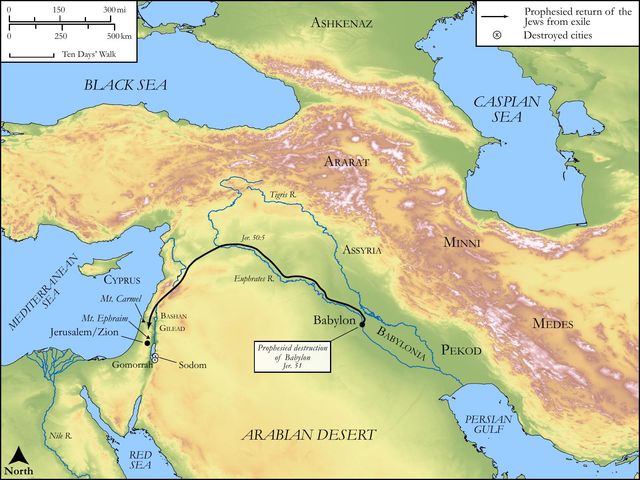
See on the biblical-era map
Study this verse
Public-domain commentary
Matthew Henry
From his Commentary on the Whole Bible. Henry comments on passages, not single verses — this entry covers Jeremiah 50:21–32.
Here, 1. The forces are mustered and commissioned to destroy Babylon, and every thing is got ready for a descent upon that potent kingdom: Go up against that land by Merathaim, the country of the Mardi, that lay part in Assyria and part in Armenia; and go among the inhabitants of Pekod, another country (mentioned Eze 23:23) which Cyrus took in his way to Babylon. The forces of Cyrus are called to go up against Babylon (Jer 50:21), to come against her from the utmost border. Let all come together, for there will be both work and pay enough for them all, Jer 50:26. Distance of place must not be their hindrance from engaging in this work. The archers particularly must be called together against Babylon, Jer 50:29. Thus the Lord hath opened his armoury (Jer 50:25), his treasury (so the word is), and hath brought forth the weapons of his indignation, as great princes fetch out of their magazines and stores all necessary provisions for their armies when they undertake any great expedition. Media and Persia are now God's armoury; thence he fetches the weapons of his wrath, Cyrus and his great officers and armies, whom he will make use of for the destruction of Babylon. Note, Great men are but instruments which the great God makes use of to serve his own purposes. He has variety of instruments, has them at command, has armouries ready to be opened according as the occasion is. This is the work of the Lord God of hosts. Note, When God has work to do he will make it appear that he is God of hosts, and will not want instruments to do it with. 2. Instructions are given them what to do. In general, Do according to all that I have commanded thee, Jer 50:21. It was said of Cyrus (Isa 44:28), He shall perform all my pleasure, in his expedition against Babylon. They must waste and utterly destroy after them; when they have destroyed once they must go over them again, or destroy their posterity that should come after them. They must open her store-houses (Jer 50:26), rifle her treasures, and turn her artillery against herself. They must cast her up as heaps; let all the wealth and pomp of Babylon be shovelled up in a heap of ruins and rubbish. Tread her down as heaps (so the margin reads it) and destroy her utterly. See how little account the great God makes of those things which men so much value and value themselves so much upon. Their princes and great men, who are fat and bulky, shall fall by the sword, not as men of war in the field of battle, which we call a bed of honour, but as beasts by the butcher's hand (Jer 50:27): Slay all her bullocks, all her mighty men; let them go down sottishly and insensibly, as an ox to the slaughter. Woe unto them! their case is the more sad for the little sense they have of it. Their day has come to fall, the time when they must be reckoned with, and they are not aware of it. 3. Assurances are given them of success. Let them do what God commands, and they shall accomplish what he threatens. A great destruction shall be made, Jer 50:22. Babylon shall become a desolation (Jer 50:23); her young men and all her men of war shall be cut off in that day which should have been her defence, Jer 50:30. God is against her (Jer 50:31); he has laid a snare for her (Jer 50:24); he has formed this enterprise against her, that she should be surprised as a bird taken in a snare. Cyrus shall no doubt prevail, for he fights under God. God will kindle a fire in the cities of Babylon (Jer 50:32); and who can stand before him when he is angry, or quench the fire that he has kindled? 4. Reasons are given for these severe dealings with Babylon. Those that are employed in this war may, if they please, know the grounds of it, and be satisfied in the justice of it, which it is fit all should be that are called to such work. (1.) Babylon has been very troublesome, vexatious, and injurious, to all its neighbours; it has been the hammer of the whole earth (Jer 50:23), beating, beating down, and beating to pieces, all the nations far and near. It has done so long enough; it is time now that it be cut asunder and broken. Note, He that is the god of nations will sooner or later assert the injured rights of nations against those that unjustly and violently invade them. The God of the whole earth will break the hammer of the whole earth. (2.) Babylon has bidden defiance to God himself: Thou has striven against the Lord (Jer 50:24), hast joined issue with him (so the word signifies) as in law or battle, hast openly opposed him, set up rivals with him, raised rebellion against him; therefore thou art now found, and caught, as in a snare. Note, Those that strive against the Lord will soon find themselves over-matched. (3.) Babylon ruined Jerusalem, the holy city, and the holy house there, and must now be called to an account for that. This is the manifesto published in Zion, in the day of Babylon's visitation; it is the vengeance of the Lord our God, the vengeance of his temple, Jer 50:28. The burning of the temple, and the carrying away of its vessels, were articles in the charge against Babylon on which greater stress was laid than upon its being the hammer of the whole earth; for Zion was the joy and glory of the whole earth. Note, Whatever wrong is done to God's church (his temple in the world) it will certainly be reckoned for; and no vengeance will be sorer nor heavier than the vengeance of the temple. (4.) Babylon has been very haughty and insolent, and therefore must have a fall; for it is the glory of God to look upon those that are proud and to abase them, Job 40:12. I am against thee, O thou most proud! Jer 50:31 and again Jer 50:32. Thou pride (so the word is), as proud as pride itself. Note, the pride of men's hearts sets God against them and ripens them apace for ruin; for God resists the proud and will bring them down. The most proud shall stumble and fall; they shall fall not so much by others' thrusting them down as by their own stumbling; for they hold their heads so high that they never look under their feet, to choose their way and avoid stumbling-blocks, but walk at all adventures. Babylon's pride must unavoidably be her ruin; for she has been proud against the Lord, against the Holy One of Israel (Jer 50:29), has insulted him in insulting over his people; she has made him her enemy, and therefore, when she has fallen, none shall raise her up, Jer 50:32. Who can help those up whom God will throw down?
Continue studying Jeremiah 50:32 across the web’s major study libraries — every link below opens this exact verse, chapter, or book on the destination site.
Read & Compare
 BibleGatewayThis verse in more than 200 translations and 70 languages.
 Bible.comThe YouVersion reader — hundreds of translations, reading plans, and highlights.
 ESV.orgCrossway's official English Standard Version reader.
 NET BibleThe NET translation with 60,000+ translators' notes on every rendering decision.
 STEP BibleTyndale House's free study tool — original text, vocabulary, and scholarly resources.
 BibliaLogos Bible Software's free web reader.
 USCCBThe New American Bible (Revised Edition) with the U.S. bishops' study notes.
Commentaries
 BibleHub CommentariesDozens of classic commentaries on this verse, gathered on one page.
 StudyLightMore than 100 commentary sets — the largest collection on the web.
 BibleRefPlain-English commentary on what this verse means, verse by verse.
 Enduring WordDavid Guzik's free commentary on this chapter, widely used by Bible teachers.
 Bible Study ToolsVerse commentary alongside Greek and Hebrew study aids.
Original Language & Research
- BibleHub InterlinearThe verse word by word — original language, transliteration, and English.
- BibleHub LexiconEvery word's original-language definition and Strong's entry.
 Blue Letter BibleDeep-study tools — Strong's numbers, concordance, and word studies.
 SefariaThe Hebrew text with Rashi and centuries of Jewish commentary.
Sermons, Hymns & Audio


TrulyRandomVerse is not affiliated with these sites and doesn’t control their content. They’re linked because they’re genuinely useful.
Summary
Jeremiah 50:32 delivers a potent divine judgment against Babylon, identifying it as the epitome of pride and foretelling its catastrophic, irreversible downfall. This prophetic decree underscores God's unwavering opposition to human arrogance and defiance, especially when manifested in the oppression of His covenant people. The verse vividly portrays Babylon's complete collapse, emphasizing that no human power will be capable of its restoration, and that God Himself will ignite a consuming fire within its cities, ensuring total devastation of everything in its vicinity. It stands as a powerful testament to God's ultimate sovereignty over nations and His unyielding commitment to executing perfect justice.
Context
ShowHideLiterary Context
Jeremiah 50:32 is embedded within an extensive prophetic oracle against Babylon, encompassing chapters 50 and 51 of the book of Jeremiah. This section marks a significant thematic shift within Jeremiah's prophecies, moving from pronouncements of judgment primarily against Judah and surrounding nations to a concentrated condemnation of Babylon, the very empire God had previously used as an instrument of His judgment against Judah. These chapters are replete with vivid, often apocalyptic, imagery detailing Babylon's impending destruction, portraying it as a just recompense for its profound pride, rampant idolatry, and particularly its cruel and excessive treatment of God's people. The verses immediately preceding Jeremiah 50:32 depict Babylon's military defeat and the widespread desolation of its land, setting the stage for this specific declaration that identifies its hubris as the fundamental cause of its ruin. Subsequent verses continue to elaborate on the comprehensive nature of Babylon's destruction and the eventual, hopeful restoration of Israel.
Historical & Cultural Context
During the period of this prophecy, the Neo-Babylonian Empire, under the formidable rule of Nebuchadnezzar II, stood as the preeminent global superpower. It had decisively conquered Judah, culminating in the destruction of Jerusalem and its sacred Temple in 586 BC, and subsequently exiled a substantial portion of the Jewish population to Babylon. Babylon itself was celebrated for its immense wealth, awe-inspiring architectural marvels such as the Hanging Gardens and the Ishtar Gate, and its formidable military prowess. This environment fostered an atmosphere of unparalleled arrogance and self-sufficiency among its rulers and populace. Their pantheon of gods, particularly Marduk, was revered as supreme, and their military victories were attributed directly to their deities' power, often in overt defiance of the God of Israel. The prophecy of Jeremiah 50:32 directly confronts this pervasive hubris, declaring that despite its perceived invincibility, Babylon would fall, not solely by the hand of another human empire, but through the direct, sovereign intervention of the God of Israel.
Key Themes
ShowHideThis verse profoundly contributes to several overarching themes pervasive within the book of Jeremiah and the broader biblical narrative. Firstly, it powerfully underscores the theme of Divine Judgment Against Pride, illustrating God's active opposition to and ultimate dismantling of those who exalt themselves, especially against Him or His chosen people. This principle is consistently echoed throughout Scripture, as seen in Proverbs 16:18. Secondly, it highlights God's Absolute Sovereignty Over Nations, demonstrating unequivocally that even the mightiest and most dominant empires are entirely subject to His will and judgment, a truth vividly portrayed in the broader narrative of the book of Daniel. Thirdly, the prophecy emphasizes the Irreversibility of God's Decreed Judgment, signifying that once God's sentence is pronounced and executed, no human effort, power, or cunning can reverse the divinely ordained outcome. Finally, it subtly but powerfully points to God's Justice and Vindication of His People, offering profound assurance to the exiled Israelites that their oppressors would face righteous retribution, and that God would ultimately fulfill His promise to bring them back to their land, a hope beautifully articulated throughout Jeremiah 29.
Exposition and Analysis
ShowHideKey Word Analysis
ShowHideFrom the root zûd, this term denotes a deep-seated arrogance, insolence, or presumptuous pride. It describes a haughty spirit that is defiantly rebellious, often specifically against God or His established order. In the context of Babylon, it signifies an overbearing, self-exalting pride that refuses to acknowledge any higher authority, making it a particularly offensive characteristic in God's eyes, leading directly to their downfall.
A primitive root meaning to totter or waver, often through weakness of the legs or ankles. By implication, it means to falter, stumble, faint, or fall. Here, it vividly portrays the initial loss of stability and power, indicating a sudden and unexpected collapse of what was once considered unshakeable. It suggests an internal weakening or a divinely orchestrated tripping that precedes the complete fall.
A primitive root meaning to burn or set on fire. Figuratively, it means to desolate. This word emphasizes God's direct and active involvement in the destruction of Babylon. It is not merely a natural disaster or a human conquest, but a deliberate act of divine judgment, where God Himself initiates the consuming fire that will bring about utter desolation.
Verse Breakdown
ShowHide"And the most proud shall stumble and fall"
This clause directly identifies Babylon as "the most proud," a nation characterized by extreme arrogance, self-sufficiency, and defiance against the divine. The imagery of stumbling and falling vividly portrays a sudden, undignified, and complete collapse from its elevated position of power and perceived invincibility. It implies an abrupt loss of balance and control, leading to an inevitable and humiliating descent.
"and none shall raise him up"
This powerful declaration underscores the absolute finality and totality of Babylon's destruction. Once God's judgment is executed, no human power, no military alliance, no political maneuver, and no external force will be able to restore the fallen empire to its former glory or even a semblance of its past strength. It signifies an irreversible ruin, a state from which there is no recovery or resurgence.
"and I will kindle a fire in his cities"
Here, God explicitly states His direct agency in Babylon's demise, asserting His active and intentional role. The "fire" is a potent metaphor for destructive judgment, signifying complete and consuming devastation. The act of "kindling" emphasizes God's deliberate initiation of this destruction, not merely allowing it to happen, but actively bringing it about within the very heart of Babylon's strength, wealth, and civilization – its cities.
"and it shall devour all round about him"
This concluding phrase emphasizes the comprehensive and pervasive nature of the destruction. The fire, kindled by God's own hand, will not be confined to a single point but will relentlessly consume everything in its vicinity, leaving no part of the empire untouched. "All round about him" suggests a complete and utter desolation, encompassing its territories, resources, influence, and population, ensuring that nothing remains to signify its former glory.
Literary Devices
ShowHideJeremiah 50:32 employs several potent literary devices to convey its message of divine judgment with profound impact. Personification is evident in the identification of Babylon as "the most proud" and the subsequent use of the masculine singular pronoun "him," treating the entire empire as a singular, arrogant individual who will stumble and fall. This imbues the abstract concept of a nation with human characteristics, making its downfall more visceral and relatable. The phrase "none shall raise him up" utilizes Hyperbole to emphasize the absolute and irreversible nature of Babylon's ruin, suggesting an impossibility of recovery that transcends normal human intervention or capability. The "fire in his cities" functions as a powerful Metaphor for divine judgment and utter destruction, a common and terrifying biblical image for God's wrath and consuming power. Furthermore, the entire verse operates as a Prophetic Oracle, a direct declaration from God conveyed through His prophet, carrying the immutable weight of divine authority and certainty, foretelling future events with absolute assurance and demonstrating God's sovereign control over history.
Theological and Thematic Connections
ShowHideJeremiah 50:32 stands as a profound theological statement on God's unwavering opposition to human pride and His absolute sovereignty over all nations. It teaches that no empire, however mighty, self-assured, or seemingly invincible, can ultimately defy the Creator without facing inevitable and devastating consequences. Babylon's fall serves as a stark historical precedent, illustrating that while God may use nations as instruments of His will, He also holds them strictly accountable for their actions, particularly their arrogance and their treatment of His people. This passage powerfully reinforces the biblical truth that true power resides not in human might, military strength, or earthly dominion, but solely in the divine will of the Almighty, who sovereignly raises up and brings down kingdoms according to His righteous purposes. It offers profound comfort and assurance to the oppressed, reminding them that God sees their suffering and will ultimately bring justice, while simultaneously serving as a sober and timeless warning to those who would wield power with hubris, injustice, and defiance against the divine.
Reflection and Application
ShowHideJeremiah 50:32 offers timeless and profound lessons for both individuals and communities, serving as a potent reminder that pride is a perilous path that inevitably leads to a fall. Whether it manifests as personal arrogance, nationalistic hubris, institutional self-sufficiency, or any posture that defies God or ignores His supreme sovereignty, such a stance is ultimately destined for collapse. This verse calls us to cultivate a profound humility, recognizing that all our strengths, achievements, positions, and perceived invincibility are ultimately gifts from God, and that true security and flourishing lie in acknowledging His supreme authority and dependence upon Him. Furthermore, it offers profound reassurance that God's justice is absolutely certain, even when oppressive powers seem overwhelmingly invincible and unassailable. In a world often marked by pervasive injustice and the apparent triumph of the proud, this prophecy reminds us that God is actively and sovereignly involved in history, orchestrating events to bring about His righteous will and vindication for His people. We are therefore called to trust implicitly in His perfect timing and His ultimate justice, rather than despairing in the face of overwhelming odds. It challenges us deeply to examine our own hearts and the collective attitudes of our communities, ensuring we do not fall prey to the same destructive pride that brought down mighty Babylon.
Questions for Reflection
ShowHideFAQ
ShowHideWho is "the most proud" referred to in Jeremiah 50:32?
ShowHide"The most proud" refers specifically and unequivocally to Babylon, the formidable Neo-Babylonian Empire. Throughout Jeremiah chapters 50 and 51, Babylon is consistently portrayed as a nation characterized by extreme arrogance, profound defiance against God, and relentlessly oppressive actions against His people, Israel. This pervasive pride was deeply rooted in its immense military power, unparalleled wealth, and its perceived invincibility, which ultimately led it to disregard divine authority and boast against the sovereign God of Israel, culminating in its prophesied downfall.
What does the phrase "none shall raise him up" signify regarding Babylon's fate?
ShowHideThe phrase "none shall raise him up" signifies the absolute, irreversible, and complete nature of Babylon's destruction. It means that once God's judgment is executed, no human power, no military alliance, no political maneuver, and no external force will be able to restore Babylon to its former glory, its position of dominance, or even to a semblance of its past strength. This emphasizes the finality of God's decree and His ultimate, unchallenged sovereignty over the rise and fall of nations. It underscores that Babylon's downfall would be so thorough and devastating that any hope of recovery or resurgence would be utterly impossible, a theme powerfully echoed in the symbolic fall of Babylon described in Revelation 18:21.
How did this prophecy of fire and devastation in Babylon's cities come to pass historically?
ShowHideHistorically, Babylon fell to the Persian Empire under Cyrus the Great in 539 BC. While the initial conquest was relatively swift and, in some accounts, bloodless, the prophecy of fire and devastation refers to a more prolonged process of decline and eventual desolation that unfolded over centuries. After its conquest, Babylon's strategic importance waned significantly, and subsequent rebellions against Persian rule led to further destruction and punitive measures by successive empires. Over time, the once-magnificent city gradually fell into ruin, becoming a desolate wasteland, fulfilling the prophetic pronouncements of God's judgment and the kindling of a consuming fire within its cities. The precise historical details align with the spirit of the prophecy, which emphasized complete and irreversible destruction, rather than a single, immediate fiery obliteration, ensuring its ultimate and enduring desolation.
Christ-Centered Fulfillment
ShowHideJeremiah 50:32, with its stark declaration of judgment against Babylon's pervasive pride and its ultimate, irreversible fall, finds profound Christ-centered fulfillment in the person and redemptive work of Jesus Christ. The "most proud" of this fallen world, whether represented by oppressive nations, defiant human systems, or the spiritual forces of darkness, ultimately stand in direct opposition to God's righteous reign. Christ, however, embodies the ultimate and perfect humility, willingly emptying Himself of divine prerogatives to take on the very form of a servant, even to the point of suffering a humiliating death on a cross (Philippians 2:7-8). His decisive victory over sin, death, and the grave through His crucifixion and resurrection was the ultimate blow against the spiritual forces of pride, rebellion, and oppression that hold humanity captive (Colossians 2:15). Just as God promised to kindle a consuming fire in Babylon's cities, Christ's glorious return will bring a final, comprehensive, and consuming judgment upon all forms of unrighteousness, pride, and defiance that resist His eternal kingdom (2 Thessalonians 1:7-9). He is the one who will ultimately "raise up" those who are humble, broken, and fallen in spirit, granting them eternal life and exaltation, while ensuring that those who exalt themselves in pride will be brought low and cast down forever (Matthew 23:12). The irreversible fall of Babylon, therefore, powerfully foreshadows the ultimate and eternal triumph of Christ's humble, righteous kingdom over all earthly and spiritual powers that are marked by pride, defiance, and rebellion, culminating in the establishment of His perfect reign where "none shall raise him up" who dares to oppose Him (Revelation 19:11-16).