


Revelation 18:21
“With violence like this
will the great city Bavel
be hurled down,
never to be found again!
- ΚαὶKaiAndG2532CONJConjunction
- ἦρενērentook upG142V-AAI-3SVerb Aorist Active Indicative 3rd Singular
- εἷςheisoneG1520A-NSMAdjective Nominative Singular Masculine
- ἄγγελοςangelosangelG32N-NSMNoun Nominative Singular Masculine
- ἰσχυρὸςischurosa mightyG2478A-NSMAdjective Nominative Singular Masculine
- λίθονlithonstoneG3037N-ASMNoun Accusative Singular Masculine
- ὡςhōslikeG5613PRTParticle or Disjunctive
- μύλινονmulinona millstoneA-ASMAdjective Accusative Singular Masculine
- μέγανmegangreatG3173A-ASMAdjective Accusative Singular Masculine
- καὶkaiandG2532CONJConjunction
- ἔβαλενebalencast [it]G906V-2AAI-3SVerb 2nd Aorist Active Indicative 3rd Singular
- εἰςeisintoG1519PREPPreposition
- τὴνtēntheG3588T-ASFDefinite article Accusative Singular Feminine
- θάλασσανthalassanseaG2281N-ASFNoun Accusative Singular Feminine
- λέγων·legōnsayingG3004V-PAP-NSMVerb Present Active Participle Nominative Singular Masculine
- οὕτωςhoutōsThusG3779ADVAdverb
- ὁρμήματιhormēmatiwith violenceG3731N-DSNNoun Dative Singular Neuter
- βληθήσεταιblēthēsetaiwill be cast downG906V-FPI-3SVerb Future Passive Indicative 3rd Singular
- ΒαβυλὼνBabulōnBabylonG897N-NSF-LNoun Nominative Singular Feminine Location
- ἡhētheG3588T-NSFDefinite article Nominative Singular Feminine
- μεγάληmegalēgreatG3173A-NSFAdjective Nominative Singular Feminine
- πόλιςpoliscityG4172N-NSFNoun Nominative Singular Feminine
- καὶkaiandG2532CONJConjunction
- οὐoucertainlyG3756PRT-NNegative Particle Negative
- μὴmēnotG3361PRT-NNegative Particle Negative
- εὑρεθῇheurethēamay be foundG2147V-APS-3SVerb Aorist Passive Subjunctive 3rd Singular
- ἔτιetiany longerG2089ADVAdverb
English is a literal word-by-word gloss of the Greek, not the KJV's wording. Why?
This is the original text the KJV's translators worked from — each Greek word with its own literal English meaning in this verse, prepared by scholars at Tyndale House, Cambridge. The KJV translates whole sentences, not word by word, so its wording differs: one Greek word can become several English words, and the KJV may choose “charity” where the gloss reads “love”. Both are faithful — they answer different questions. For the KJV's own rendering, switch to the KJV text.
Details
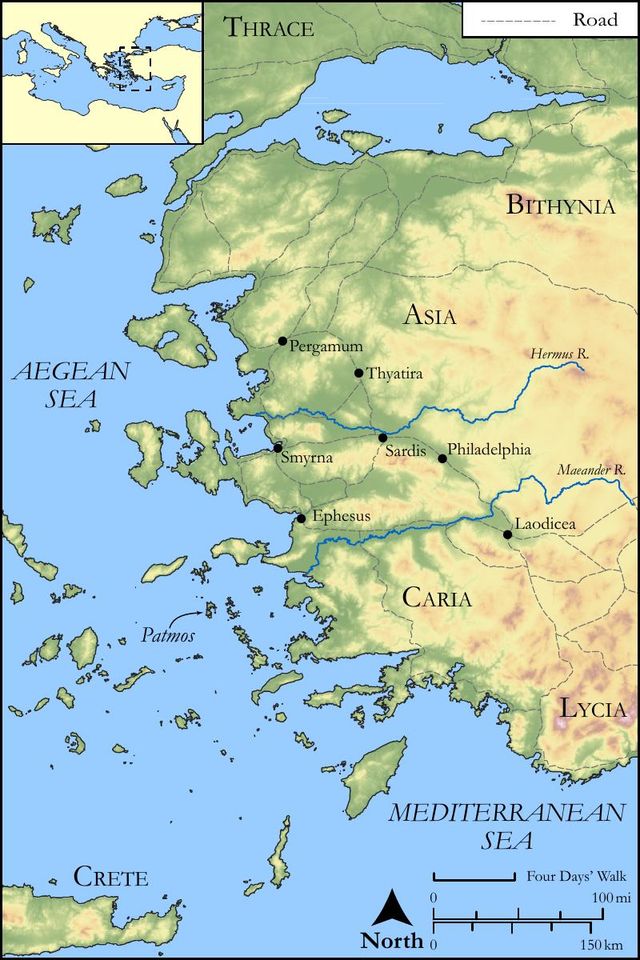
See on the biblical-era map

Study this verse
Public-domain commentary
Matthew Henry
From his Commentary on the Whole Bible. Henry comments on passages, not single verses — this entry covers Revelation 18:9–24. His three-level outline is real structure in the source text, so it is rendered as structure.
Here we have,
I.A doleful lamentation made by Babylon's friends for her fall; and here observe,
1.Who are the mourners, namely, those who had been bewitched by her fornication, those who had been sharers in her sensual pleasures, and those who had been gainers by her wealth and trade - the kings and the merchants of the earth: the kings of the earth, whom she had flattered into idolatry by allowing them to be arbitrary and tyrannical over their subjects, while they were obsequious to her; and the merchants, that is, those who trafficked with her for indulgences, pardons, dispensations, and preferments; these will mourn, because by this craft they got their wealth.
2.What was the manner of their mourning.
(1.)They stood afar off, they durst not come nigh her. Even Babylon's friends will stand at a distance from her fall. Though they had been partakers with her in her sins, and in her sinful pleasures and profits, they were not willing to bear a share in her plagues.
(2.)They made a grievous outcry: Alas! alas! that great city, Babylon, that mighty city!
(3.)They wept, and cast dust upon their heads, Rev 18:19. The pleasures of sin are but for a season, and they will end in dismal sorrow. All those who rejoice in the success of the church's enemies will share with them in their downfall; and those who have most indulged themselves in pride and pleasure are the least able to bear calamities; their sorrows will be as excessive as their pleasure and jollity were before.
3.What was the cause of their mourning; not their sin, but their punishment. They did not lament their fall into idolatry, and luxury, and persecution, but their fall into ruin - the loss of their traffic and of their wealth and power. The spirit of antichrist is a worldly spirit, and their sorrow is a mere worldly sorrow; they did not lament for the anger of God, that had now fallen upon them, but for the loss of their outward comfort. We have a large schedule and inventory of the wealth and merchandise of this city, all which was suddenly lost (Rev 18:12, Rev 18:13), and lost irrecoverably (Rev 18:14): All things which were dainty and goodly have departed from thee, and thou shalt find them no more at all. The church of God may fall for a time, but she shall rise again; but the fall of Babylon will be an utter overthrow, like that of Sodom and Gomorrah. Godly sorrow is some support under affliction, but mere worldly sorrow adds to the calamity.
II.An account of the joy and triumph there was both in heaven and earth at the irrecoverable fall of Babylon:
while her own people were bewailing her, the servants of God were called to rejoice over her, Rev 18:20. Here observe,
1.How universal this joy would be: heaven and earth, angels and saints, would join in it; that which is matter of rejoicing to the servants of God in this world is matter of rejoicing to the angels in heaven.
2.How just and reasonable; and that,
(1.)Because the fall of Babylon was an act of God's vindictive justice. God was then avenging his people's cause. They had committed their cause to him to whom vengeance belongs, and now the year of recompence had come for the controversies of Zion; and, though they did not take pleasure in the miseries of any, yet they had reason to rejoice in the discoveries of the glorious justice of God.
(2.)Because it was an irrecoverable ruin. This enemy should never molest them any more, and of this they were assured by a remarkable token (Rev 18:21): An angel from heaven took up a stone like a great millstone, and cast it into the sea, saying, "Thus shall Babylon be thrown down with violence, and be found no more at all; the place shall be no longer habitable by man, no work shall be done there, no comfort enjoyed, no light seen there, but utter darkness and desolation, as the reward of her great wickedness, first in deceiving the nations with her sorceries, and secondly in destroying and murdering those whom she could not deceive," Rev 18:24. Such abominable sins deserved so great a ruin.
Historical interpretation
Two Centuries of Reception
3 surviving comments on this verse. Each one is dated, so this reads as a timeline rather than a list.
Select a marker to jump to its quote. Markers stagger vertically where authors wrote within a few decades of each other.
Babylon is likened to a great millstone which is thrown down, for the revolving of times, as though it were a millstone, grinds down those who love the world, and it sends them in circles. Of these the Scriptures say, “The wicked walk in a circle.” … “The sound of harpers and musicians and flute players and trumpeters is no longer heard in her.” That is, the joy and happiness of the wicked passes away and is no longer to be found. And it adds the reason for this, “for your merchants were the great men of the earth,” that is, they had received good things in their lives. “The blood of the prophets and the saints was found in her and of all who have been slain by [her] upon the earth.” Did the same city kill the apostles that also killed the prophets and all of the rest of the martyrs? Rather, this is the city of all the proud and arrogant, which Cain established by the blood of his brother and which he named after the name of his son, Enoch, that is, after his posterity. For all the wicked in whom Babylon resides succeed one another and persecute the church of God until the end of the world. In the city of Cain “all the righteous blood” is poured out “from the blood of righteous Abel to the blood of Zechariah,” that is, of the people and of the priests, “between the sanctuary and the altar,” that is, between the people and the priests. This was said because not only the people but also the priests conspired in the death of Zechariah.… This is the city which killed the prophets and stoned those who were sent to it. This is that city that is built upon blood, as the Scriptures say, “Woe to him who builds a city with blood and founds a city on iniquity.”
Just as a millstone sinks with force into the sea, so also the destruction of this Babylon will be sudden, so that afterward no trace of her will be found. The absence of harpers, minstrels and the rest is an indication of this. And he gives the reason for this. [Babylon] deceived all nations with her sorcery and was the recipient of the blood of prophets and the other saints. It is possible that this passage depicts the impious Babylon among the Persians, for at various times until now she has received the blood of many saints and continually rejoices in sorceries and deceptions. And this gives us an occasion for prayer, that she receive the rewards prophesied for arrogance against Christ and his servants.
And a mighty angel took up a stone like a great millstone and threw it into the sea, saying: With this violence shall Babylon be thrown down. Or (as another edition says): Thus with violence shall that great city Babylon be cast down. The city of the world, due to the weight of sins and error, is compared to an unstable millstone. For the wicked walk in a circle. It is rightly absorbed by the waves of vengeance because it oppressed the citizens of Jerusalem with the waves of infidelity, while they, sitting by the rivers of Babylon, wept for the absence of heavenly Zion. For the Lord said that the authors of scandal should be punished with such a penalty. And indeed the Church is compared to a stone, but stable and firm, which scorns the assaults of storms. The millstone can also be understood as the crushing of punishments. For blessed Ignatius is said to have said when about to suffer: "I am the grain of God, ground by the teeth of beasts, that I may become pure bread."
Continue studying Revelation 18:21 across the web’s major study libraries — every link below opens this exact verse, chapter, or book on the destination site.
Read & Compare
 BibleGatewayThis verse in more than 200 translations and 70 languages.
 Bible.comThe YouVersion reader — hundreds of translations, reading plans, and highlights.
 ESV.orgCrossway's official English Standard Version reader.
 NET BibleThe NET translation with 60,000+ translators' notes on every rendering decision.
 STEP BibleTyndale House's free study tool — original text, vocabulary, and scholarly resources.
 BibliaLogos Bible Software's free web reader.
 USCCBThe New American Bible (Revised Edition) with the U.S. bishops' study notes.
Commentaries
 BibleHub CommentariesDozens of classic commentaries on this verse, gathered on one page.
 StudyLightMore than 100 commentary sets — the largest collection on the web.
 BibleRefPlain-English commentary on what this verse means, verse by verse.
 Enduring WordDavid Guzik's free commentary on this chapter, widely used by Bible teachers.
 Bible Study ToolsVerse commentary alongside Greek and Hebrew study aids.
Original Language & Research
- BibleHub InterlinearThe verse word by word — original language, transliteration, and English.
- BibleHub LexiconEvery word's original-language definition and Strong's entry.
 Blue Letter BibleDeep-study tools — Strong's numbers, concordance, and word studies.
 CNTR CollationThe earliest Greek manuscripts of this verse, collated letter by letter.
Sermons, Hymns & Audio


TrulyRandomVerse is not affiliated with these sites and doesn’t control their content. They’re linked because they’re genuinely useful.
Summary
Revelation 18:21 dramatically depicts the swift and irreversible judgment upon "Babylon the Great," a symbolic entity representing all systems and powers that oppose God's righteous rule and exploit humanity. Through the powerful imagery of a mighty angel casting a great millstone into the sea, the verse pronounces the absolute and final demise of this oppressive city, declaring that it will vanish completely and forever. This act serves as a definitive statement of divine justice and the certainty of evil's ultimate overthrow.
Context
ShowHideLiterary Context
Revelation 18:21 marks the culmination of the prophetic pronouncements against "Babylon the Great," which began in Revelation 17 with the identification of the harlot Babylon and continues through Revelation 18 with a detailed lament over its destruction. Preceding this verse, the angel's voice in Revelation 18:4-8 calls God's people to separate from Babylon, followed by a series of laments from kings, merchants, and mariners who mourn the loss of their economic and political partner (Revelation 18:9-19). The symbolic act of the millstone, therefore, serves as a final, visual, and undeniable declaration of Babylon's permanent desolation, reinforcing the preceding textual descriptions of its sudden and complete ruin. It is a prophetic sign-act, similar to those found in Old Testament prophets, solidifying the certainty of the spoken judgment.
Historical & Cultural Context
The imagery of a "great millstone" would have been immediately understood by John's audience. Millstones were essential for daily life, used to grind grain for bread. A "great millstone" (Greek: mylos onikos, literally "ass-millstone") was a massive stone, often turned by a donkey or ox, signifying immense weight and an object that, once submerged, would be utterly irretrievable. This imagery resonates with the ancient practice of executing criminals by tying a heavy stone to them and casting them into the sea, ensuring a complete and irreversible drowning. The "great city Babylon" would have been understood by many early Christians as a veiled reference to Rome, the dominant imperial power of their time, known for its immense wealth, idolatry, persecution of Christians, and moral corruption. The prophecy thus spoke to the cultural experience of living under an oppressive empire, promising its certain downfall.
Key Themes
ShowHideThis verse powerfully contributes to several overarching themes within Revelation and biblical eschatology. The most prominent theme is Irreversible Judgment, emphasizing the absolute finality of God's righteous wrath against evil. Just as the millstone will never resurface, so too will Babylon never be rebuilt or regain its power. This underscores the theme of Divine Sovereignty and Justice, demonstrating that God is in ultimate control, and no earthly power, however formidable, can withstand His judgment. The destruction is not random but a deliberate, powerful act orchestrated by a "mighty angel," highlighting the divine agency behind the collapse of wicked systems. Furthermore, the "violence" of its overthrow speaks to the Decisive Nature of God's Intervention, contrasting Babylon's perceived stability with its sudden and catastrophic demise, a theme echoed in other prophetic judgments against proud nations, such as the destruction of Tyre in Ezekiel 26:21.
Exposition and Analysis
ShowHideKey Word Analysis
ShowHideFrom ischys, meaning strength or power. This word describes the angel, emphasizing that the messenger delivering this judgment is not weak or ordinary, but possesses formidable power, underscoring the divine authority and irresistible force behind Babylon's destruction. It highlights that the judgment is not accidental or merely human, but divinely empowered.
Refers to a grinding stone, specifically a large one, often turned by an animal. The use of "great millstone" (G3173 mégas combined with G3458 mýlos) signifies an object of immense weight, ensuring that anything to which it is attached will sink irretrievably. This imagery conveys the absolute and permanent nature of Babylon's downfall, an irreversible plunge into oblivion.
Derived from hormē, meaning an impulse, a violent motion, or a rushing. This term denotes a sudden, impetuous, and forceful action. It conveys the idea that Babylon's destruction will not be a slow decline but a swift, overwhelming, and decisive act of divine power, emphasizing the suddenness and intensity of its collapse.
Verse Breakdown
ShowHide"And a mighty angel took up a stone like a great millstone,"
This clause introduces the divine agent of judgment—a powerful angel, indicating that the ensuing act is divinely ordained and executed with immense authority. The "great millstone" is a visual metaphor for utter weight and finality, preparing the audience for an irreversible event.
"and cast [it] into the sea, saying,"
The act of casting the millstone into the sea is the central symbolic action. The sea, often a symbol of chaos or the abyss in biblical literature, becomes the recipient of this doomed entity. The act is accompanied by a verbal declaration, making the symbolic action a prophetic utterance.
"Thus with violence shall that great city Babylon be thrown down,"
This is the direct pronouncement of judgment. "Thus" connects the symbolic act to the literal outcome. "With violence" emphasizes the sudden, forceful, and decisive nature of Babylon's overthrow. "That great city Babylon" explicitly names the object of judgment, confirming its identity as the powerful, oppressive rule.
"and shall be found no more at all."
This final phrase declares the absolute and permanent annihilation of Babylon. The double negative "no more at all" (Greek: ou mē eti) intensifies the denial, ensuring that Babylon will not merely be defeated or diminished, but utterly removed from existence, never to rise again.
Literary Devices
ShowHideRevelation 18:21 is rich in Symbolism, using the concrete image of a "great millstone" cast into the "sea" to represent the absolute and irreversible destruction of "Babylon the Great." The millstone, a tool for grinding, here becomes an instrument of crushing judgment, its immense weight signifying an inescapable doom. The sea, often associated with chaos and the abyss, becomes the place of permanent oblivion. The verse also employs Prophetic Action, where the angel's physical act of casting the stone serves as a visual, tangible prophecy, making the future event of Babylon's fall certain and immediate in the mind of the audience. The phrase "shall be found no more at all" is an example of Hyperbole used for emphasis, underscoring the completeness of the destruction beyond any possibility of recovery. The contrast between Babylon's former "greatness" and its sudden, violent demise also creates a sense of Dramatic Irony, highlighting the futility of earthly power when confronted by divine judgment.
Theological and Thematic Connections
ShowHideRevelation 18:21 profoundly underscores the biblical truth of God's ultimate sovereignty and the certainty of His righteous judgment against all forms of evil, oppression, and rebellion. It affirms that no human system, however powerful or entrenched, can ultimately withstand the divine decree. This judgment is not arbitrary but is a just response to Babylon's spiritual idolatry, economic exploitation, and persecution of God's people. The finality of its destruction serves as a powerful assurance to believers that God will indeed bring an end to all suffering and injustice, establishing His perfect kingdom. It also serves as a warning against complicity with worldly systems that stand in opposition to God's values.
Reflection and Application
ShowHideRevelation 18:21 offers a profound message of hope and a sobering call to discernment for believers today. In a world often dominated by powerful, seemingly unshakeable systems that promote materialism, injustice, or spiritual compromise, this verse reminds us that their reign is temporary and their end is certain. It encourages us not to be intimidated or swayed by the allure or apparent strength of such "Babylonian" influences. Instead, it calls us to live with an eternal perspective, investing in God's kingdom values rather than aligning ourselves with transient earthly powers. We are prompted to examine our own lives and ensure we are not inadvertently participating in or benefiting from systems that exploit, oppress, or deny God's truth. This verse provides immense comfort, assuring us that God sees the suffering of His people and will ultimately bring perfect justice, vindicating the righteous and eliminating all evil.
Questions for Reflection
ShowHideFAQ
ShowHideWhat does "Babylon the Great" truly represent in Revelation?
ShowHide"Babylon the Great" in Revelation is primarily a symbolic representation rather than a literal city in John's time. It embodies all systems, powers, and spiritual forces that stand in opposition to God, His people, and His righteous rule. While it likely drew heavily on the historical Babylon's reputation for idolatry, pride, and oppression, and could have been understood by early Christians as a veiled reference to the Roman Empire, its ultimate meaning transcends any single historical entity. It represents the culmination of human rebellion against God, characterized by spiritual harlotry (idolatry), economic exploitation, political tyranny, and the persecution of God's saints. Its destruction signifies the definitive end of all such evil systems.
Why is a "millstone" used as the symbol of destruction?
ShowHideThe "great millstone" is a powerful and culturally resonant symbol for complete and irreversible destruction. In the ancient world, a millstone was incredibly heavy, often requiring an animal to turn it. To cast such a massive object into the sea meant it would sink irretrievably, never to resurface. This imagery conveys the absolute finality and permanence of Babylon's downfall. It's a vivid picture of something being utterly lost and beyond recovery, emphasizing that Babylon's destruction will be so complete that it will "be found no more at all." This symbolism also appears in Matthew 18:6, where Jesus uses the image of a millstone tied around one's neck and cast into the sea to describe the severe judgment awaiting those who cause others to stumble.
Is the destruction of Babylon a literal event or purely symbolic?
ShowHideWhile the imagery in Revelation is highly symbolic, the destruction of "Babylon the Great" points to a real and literal outcome: the definitive end of all evil and oppressive practices that stand against God. The "great city" may not be a single geographical location in the future, but rather the culmination of all anti-God structures and ideologies throughout history that will face God's ultimate judgment. The "casting into the sea" is a symbolic act representing complete annihilation, but the reality of God's final triumph over evil and the establishment of His righteous kingdom is a literal and certain future event. Thus, it is a symbolic portrayal of a literal, eschatological reality.
Christ-Centered Fulfillment
ShowHideRevelation 18:21, though depicting a scene of intense judgment, finds its ultimate Christ-centered fulfillment in the triumph of Jesus over all forces of evil and the establishment of His eternal kingdom. The "mighty angel" casting the millstone into the sea foreshadows the decisive authority of Christ, who, through His death and resurrection, has already disarmed the powers and authorities of this world (Colossians 2:15). The complete and irreversible downfall of "Babylon the Great" is a prophetic echo of Christ's ultimate victory over sin, death, and all rebellion against God. He is the one who holds the keys of death and Hades (Revelation 1:18), and to whom all judgment has been committed by the Father (John 5:22). The finality of Babylon's destruction assures believers that the Lamb of God will indeed reign supreme, bringing an end to all injustice and suffering, and ushering in the new heavens and new earth where righteousness dwells and evil "shall be found no more at all" (Revelation 21:1-4). This verse, therefore, is not merely about destruction, but about the glorious and complete victory of Christ, making way for His eternal reign of peace and justice.