


Jeremiah 7:34
- וְהִשְׁבַּתִּיve·hish·ba·Tiand I will cause to ceaseH7673Conj-w ¦ V-Hiphil-ConsecPerf-1csVerb Hiphil Consecutive Perfect 1st Singular common genderוְandהִשְׁבַּתִּיI will cause to cease
- מֵעָרֵיme·'a·Reifrom [the] cities ofH5892Prep-m ¦ N-mpcNoun Plural Masculine Constructמֵfromעָרֵי[the] cities of
- יְהוּדָהye·hu·DahJudahH3063N-properNoun Proper Location
- וּמֵחֻצוֹתu·me·chu·tzOtand from [the] streets ofH2351Conj-w ¦ Prep-m ¦ N-fpcNoun Plural Feminine Constructוּandמֵfromחֻצוֹת[the] streets of
- יְרוּשָׁלִַםye·Ru·sha·LimJerusalemH3389N-properNoun Proper Location
- קוֹלKol[the] sound ofH6963N-mscNoun Singular Masculine Construct
- שָׂשׂוֹןsa·sOnjoyH8342N-msNoun Singular Masculine Absolute
- וְקוֹלve·Koland [the] sound ofH6963Conj-w ¦ N-mscNoun Singular Masculine Constructוְandקוֹל[the] sound of
- שִׂמְחָהsim·ChahgladnessH8057N-fsNoun Singular Feminine Absolute
- קוֹלKol[the] sound ofH6963N-mscNoun Singular Masculine Construct
- חָתָןcha·Tana bridegroomH2860N-msNoun Singular Masculine Absolute
- וְקוֹלve·Koland [the] sound ofH6963Conj-w ¦ N-mscNoun Singular Masculine Constructוְandקוֹל[the] sound of
- כַּלָּהka·Laha brideH3618N-fsNoun Singular Feminine Absolute
- כִּיkiforH3588PrtParticle Conditional
- לְחָרְבָּהle·cha·re·Bah<into> a desolationH2723Prep-l ¦ N-fsNoun Singular Feminine Absoluteלְ<into>חָרְבָּהa desolation
- תִּהְיֶהtih·Yehit will becomeH1961V-Qal-Imperf-3fsVerb Qal Imperfect 3rd Singular Feminine
- הָאָרֶץha·'A·retzthe landH776Art ¦ N-fsNoun Singular Feminine Absoluteהָtheאָרֶץland
English is a literal word-by-word gloss of the Hebrew, not the KJV's wording. Why?
This is the original text the KJV's translators worked from — each Hebrew word with its own literal English meaning in this verse, prepared by scholars at Tyndale House, Cambridge. The KJV translates whole sentences, not word by word, so its wording differs: one Hebrew word can become several English words, and the KJV may choose “the LORD” where the gloss reads “Yahweh”. Both are faithful — they answer different questions. For the KJV's own rendering, switch to the KJV text.
Details
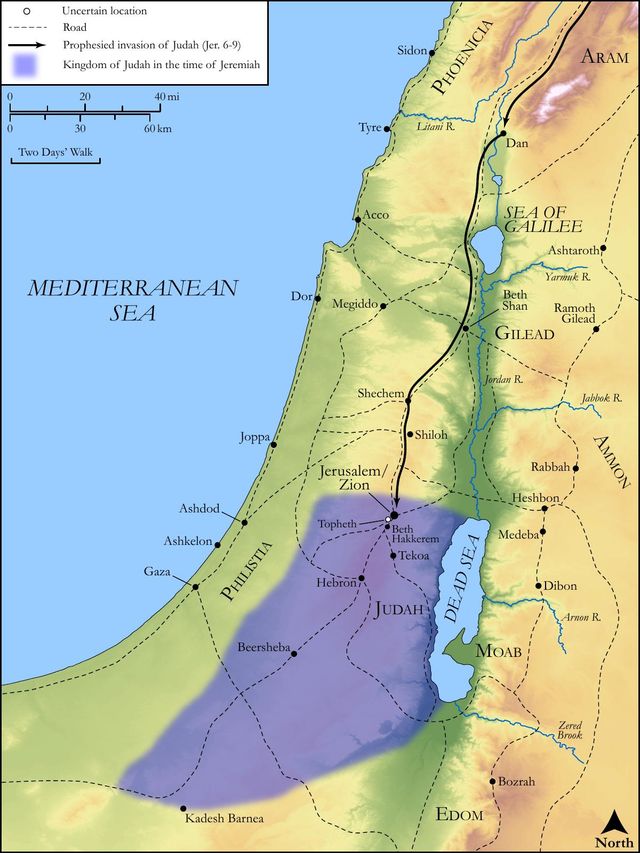
See on the biblical-era map
Study this verse
Public-domain commentary
Matthew Henry
From his Commentary on the Whole Bible. Henry comments on passages, not single verses — this entry covers Jeremiah 7:29–34. His three-level outline is real structure in the source text, so it is rendered as structure.
Here is, I. A loud call to weeping and mourning. Jerusalem, that had been a joyous city, the joy of the whole earth, must now take up a lamentation on high places (Jer 7:29), the high places where they had served their idols; there must they now bemoan their misery. In token both of sorrow and slavery, Jerusalem must now cut off her hair and cast it away; the word is peculiar to the hair of the Nazarites, which was the badge and token of their dedication to God, and it is called their crown. Jerusalem had been a city which was a Nazarite to God, but now must cut off her hair, must be profaned, degraded, and separated from God, as she had been separated to him. It is time for those that have lost their holiness to lay aside their joy.
II.Just cause given for this great lamentation.
1.The sin of Jerusalem appears here very heinous, nowhere worse, or more exceedingly sinful (Jer 7:30): "The children of Judah" (God's profession people, that came forth out of the waters of Judah, Isa 48:1) "have done evil in my sight, under my eye, in my presence; they have affronted me to my face, which very much aggravates the affront:" or, "They have done that which they know to be evil in my sight, and in the highest degree offensive to me." Idolatry was the sin which was above all other sins evil in God's sight. Now here are two things charged upon them in their idolatry, which were very provoking:
(1.)That they were very impudent in it towards God and set him at defiance: They have set their abominations (their abominable idols and the altars erected to them) in the house that is called by my name, in the very courts of the temple, to pollute it (Manasseh did so, Kg2 21:7, Kg2 23:12), as if they thought God would connive at it, or cared not though he was ever so much displeased with it, or as if they would reconcile heaven and hell, God and Baal. The heart is the place which God has chosen to put his name there; if sin have the innermost and uppermost place there, we pollute the temple of the Lord, and therefore he resents nothing more than setting up idols in the heart, Eze 14:4.
(2.)That they were very barbarous in it towards their own children, Jer 7:31. They have particularly built the high places of Tophet, where the image of Moloch was set up, in the valley of the son of Hinnom, adjoining to Jerusalem; and there they burnt their sons and their daughters in the fire, burnt them alive, killed them, and killed them in the most cruel manner imaginable, to honour or appease those idols that were devils and not gods. This was surely the greatest instance that ever was of the power of Satan in the children of disobedience, and of the degeneracy and corruption of the human nature. One would willingly hope that there were not many instances of such a barbarous idolatry; but it is amazing that there should be any, that men could be so perfectly void of natural affection as to do a thing so inhuman as to burn little innocent children, and their own too, that they should be so perfectly void of natural religion as to think it lawful to do this, nay, to think it acceptable. Surely it was in a way of righteous judgment, because they had changed the glory of God into the similitude of a beast, that God gave them up to such vile affections that changed them into worse than beasts. God says of this that it was what he commanded them not, neither cam it into his heart, which is not meant of his not commanding them thus to worship Moloch (this he had expressly forbidden them), but he had never commanded that his worshippers should be at such an expense, nor put such a force upon their natural affection, in honouring him; it never came into his heart to have children offered to him, yet they had forsaken his service for the service of such gods as, by commanding this, showed themselves to be indeed enemies to mankind.
2.The destruction of Jerusalem appears here very terrible. That speaks misery enough in general (Jer 7:29), The Lord hath rejected and forsaken the generation of his wrath. Sin makes those the generation of God's wrath that had ben the generation of his love. And God will reject and quite forsake those who have thus made themselves vessels of wrath fitted to destruction. He will disown them for his. "Verily, I say unto you, I know you not." And he will give them up to the terrors of their own guilt, and leave them in those hands.
(1.)Death shall triumph over them, Jer 7:32. 33. Sin reigns unto death; for that is the wages of it, the end of those things. Tophet, the valley adjoining to Jerusalem, shall be called the valley of slaughter, for there multitudes shall be slain, when, in their sallies out of the city and their attempts to escape, they fall into the hands of the besiegers. Or it shall be called the valley of slaughtered ones, because thither the corpses of those that are slain shall be brought to be buried, all other burying places being full; and there they shall bury until there be no more place to make a grave. This intimates the multitude of those that shall die by the sword, pestilence, and famine. Death shall ride on prosperously, with dreadful pomp and power, conquering and to conquer. The slain of the Lord shall be many. This valley of Tophet was a place where the citizens of Jerusalem walked to take the air; but it shall now be spoiled for that use, for it shall be so full of graves that there shall be no walking there, because of the danger of contracting a ceremonial pollution by the touch of a grave. There it was that they sacrificed some of their children, and dedicated others to Moloch, and there they should fall as victims to divine justice. Tophet had formerly been the burying place, or burning place, of the dead bodies of the besiegers, when the Assyrian army was routed by an angel; and for this it was ordained of old, Isa 30:33. But they having forgotten this mercy, and made it the place of their sin, God will now turn it into a burying place for the besieged. In allusion to this valley, hell is in the New Testament called Gehenna - the valley of Hinnom, for there were buried both the invading Assyrians and the revolting Jews; so hell is a receptacle after death both for infidels and hypocrites, the open enemies of God's church and its treacherous friends; it is the congregation of the dead; it is prepared for the generation of God's wrath. But so great shall that slaughter be that even the spacious valley of Tophet shall not be able to contain the slain; and at length there shall not be enough left alive to bury the dead, so that the carcases of the people shall be meat for the birds and beasts of prey, that shall feed upon them like carrion, and none shall have the concern or courage to frighten them away, as Rizpah did from the dead bodies of Saul's sons, 2 Sa. 28:26, Thy carcase shall be meat to the fowls and beasts, and no man shall drive them away. Thus do the law and the prophets agree, and the execution with both. The decent burying of the dead is a piece of humanity, in remembrance of what the dead body has been - the tabernacle of a reasonable soul. Nay, it is a piece of divinity, in expectation of what the dead body shall be at the resurrection. The want of it has sometimes been an instance of the rage of men against God's witnesses, Rev 11:9. Here it is threatened as an instance of the wrath of God against his enemies, and is an intimation that evil pursues sinners even after death.
(2.)Joy shall depart from them (Jer 7:34): Then will I cause to cease the voice of mirth. God had called by his prophets, and by less judgments, to weeping and mourning; but they walked contrary to him, and would hear of nothing but joy and gladness, Isa 22:12, Isa 22:13. And what came of it? Now God called to lamentation (Jer 7:29), and he made his call effectual, leaving them neither cause nor heart for joy and gladness. Those that will not weep shall weep; those that will not by the grace of God be cured of their vain mirth shall by the justice of God be deprived of all mirth; for when God judges he will overcome. It is threatened here that there shall be nothing to rejoice in. There shall be none of the joy of weddings; no mirth, for there shall be no marriages. The comforts of life shall be abandoned, and all care to keep up mankind upon earth cast off; there shall be none of the voice of the bridegroom and the bride, no music, no nuptial songs. Nor shall there be any more of the joy of the harvest, for the land shall be desolate, uncultivated and unimproved. Both the cities of Judah and the streets of Jerusalem shall look thus melancholy; and when they thus look about them, and see no cause to rejoice, no marvel if they retire into themselves and find no heart to rejoice. Note, God can soon mar the mirth of the most jovial, and make it to cease, which is a reason why we should always rejoice with trembling, be merry and wise.
Historical interpretation
Two Centuries of Reception
2 surviving comments on this verse. Each one is dated, so this reads as a timeline rather than a list.
Select a marker to jump to its quote. Markers stagger vertically where authors wrote within a few decades of each other.
Last of all he sent to those unbelievers his own Son, our Lord Jesus Christ, whom the wicked husbandmen cast out of the vineyard when they had killed him. For this reason, the Lord God gave it up (no longer hedged around but thrown open throughout all the world) to other tenants, who render the fruits in their seasons—the beautiful elect tower being also raised everywhere. For the illustrious church is now everywhere, and everywhere is the winepress dug. Those who do receive the Spirit are everywhere. Because the former tenants have rejected the Son of God and cast him out of the vineyard when they killed him, God has justly rejected them and given to the Gentiles outside the vineyard the fruits of its cultivation. This is in accordance with what Jeremiah says: “The Lord has rejected and cast off the nation that does these things. The children of Judah have done evil in my sight, says the Lord.”
(Verse 34.) And I will cause the cities of Judah to cease, and I will silence in the streets of Jerusalem the voice of joy and the voice of gladness, the voice of the bridegroom and the voice of the bride. For the land shall become a desolation. And when places of idolatry are turned into tombs, the unburied corpses of those who offended God shall lie there, from the once city of Jerusalem and from the other cities that were under its dominion, all joy and mourning and groaning and desolation shall be removed.
Continue studying Jeremiah 7:34 across the web’s major study libraries — every link below opens this exact verse, chapter, or book on the destination site.
Read & Compare
 BibleGatewayThis verse in more than 200 translations and 70 languages.
 Bible.comThe YouVersion reader — hundreds of translations, reading plans, and highlights.
 ESV.orgCrossway's official English Standard Version reader.
 NET BibleThe NET translation with 60,000+ translators' notes on every rendering decision.
 STEP BibleTyndale House's free study tool — original text, vocabulary, and scholarly resources.
 BibliaLogos Bible Software's free web reader.
 USCCBThe New American Bible (Revised Edition) with the U.S. bishops' study notes.
Commentaries
 BibleHub CommentariesDozens of classic commentaries on this verse, gathered on one page.
 StudyLightMore than 100 commentary sets — the largest collection on the web.
 BibleRefPlain-English commentary on what this verse means, verse by verse.
 Enduring WordDavid Guzik's free commentary on this chapter, widely used by Bible teachers.
 Bible Study ToolsVerse commentary alongside Greek and Hebrew study aids.
Original Language & Research
- BibleHub InterlinearThe verse word by word — original language, transliteration, and English.
- BibleHub LexiconEvery word's original-language definition and Strong's entry.
 Blue Letter BibleDeep-study tools — Strong's numbers, concordance, and word studies.
 SefariaThe Hebrew text with Rashi and centuries of Jewish commentary.
Sermons, Hymns & Audio


TrulyRandomVerse is not affiliated with these sites and doesn’t control their content. They’re linked because they’re genuinely useful.
Summary
Jeremiah 7:34 serves as the climactic and somber declaration of divine judgment within the "Temple Sermon," prophesying the complete cessation of all sounds of joy, celebration, and normal societal life—most poignantly, the voices associated with weddings—from the cities and streets of Judah and Jerusalem. This stark pronouncement underscores that the land will be rendered utterly desolate as a direct and severe consequence of the people's persistent idolatry, moral corruption, and unrepentant rebellion against God's covenant.
Context
ShowHideLiterary Context
Jeremiah 7:34 functions as the devastating culmination of the "Temple Sermon" (Jeremiah 7:1-15), a pivotal prophetic address delivered by Jeremiah at the gate of the Lord's house. In this powerful discourse, Jeremiah confronts the people's misguided and dangerous reliance on the physical presence of the Temple as a magical charm against judgment, even while they engaged in rampant idolatry, oppression, and spiritual apostasy. The verses immediately preceding this pronouncement detail Judah's abhorrent practices, including the horrific child sacrifices offered to Molech in the Valley of Ben Hinnom (Jeremiah 7:31). Thus, the judgment declared in verse 34 is not arbitrary but the inevitable, divinely ordained consequence of their flagrant covenant violations, signaling a complete reversal of God's blessings and the dismantling of their societal fabric. It powerfully foreshadows the impending Babylonian invasion and subsequent exile, emphasizing the severity and certainty of God's covenant curses for such profound disobedience.
Historical & Cultural Context
The prophecy in Jeremiah 7:34 is situated within the tumultuous late 7th and early 6th centuries BCE, a period marked by Judah's spiritual decline following the death of the reforming King Josiah. Despite Josiah's efforts, the people quickly reverted to syncretistic worship and idolatry, yet clung to a false sense of security, believing Jerusalem and the Temple were inviolable due to God's presence. Culturally, the "voice of the bridegroom and bride" was far more than a casual sound; it was a profound symbol of life, continuity, prosperity, and the very future of the community. Weddings were central to Israelite society, representing new beginnings, the continuation of family lines, the blessing of procreation, and the overall well-being of the nation. The cessation of these specific sounds would signify the most dire curse imaginable: depopulation, the absolute end of normal life, the collapse of social order, and the shattering of hope for future generations, all direct consequences of their persistent covenant violations.
Key Themes
ShowHideThis verse powerfully encapsulates several major themes woven throughout the book of Jeremiah. It prominently features the theme of Divine Judgment for covenant unfaithfulness, demonstrating that God's justice is unwavering and His patience has limits when confronted with persistent sin. The "Temple Sermon" itself, which this verse concludes, highlights the Futility of Outward Religious Observance without genuine inward transformation and obedience, a "false security" that Jeremiah consistently challenges. The vivid imagery of silenced joy points to Utter Desolation as a consequence of national sin, serving as a stark contrast to the blessings promised for obedience (cf. the curses detailed in Deuteronomy 28:15-68). Furthermore, the specific mention of the bridegroom and bride underscores the breaking of the Covenant Relationship between God and Israel, which is frequently depicted in prophetic literature as a marriage (e.g., Jeremiah 2:2). The land's desolation is thus portrayed as the direct outcome of their spiritual adultery and idolatry, leading to the removal of God's sustaining presence and blessing.
Exposition and Analysis
ShowHideKey Word Analysis
ShowHideA primitive root meaning "to repose, i.e. desist from exertion." This word signifies a complete and decisive stopping, a putting away, or an active termination. In this prophetic context, it denotes God's direct and intentional intervention to bring an absolute end to the normal activities, sounds, and rhythms of life in Judah. It implies not a gradual decline but a divinely ordained, sudden, and complete cessation, emphasizing the severity and finality of the impending judgment.
Referring to "a relative by marriage (especially through the bride)." The bridegroom, along with the bride, stands as a quintessential symbol of the future, new life, procreation, and the vibrant continuation of the community. The silencing of his voice, therefore, is a profoundly powerful symbol of the interruption of generational continuity, the end of family lines, and the complete breakdown of the social and demographic fabric of the nation.
A feminine noun derived from a root meaning "drought," and by implication, "a desolation." This term precisely describes the state of the land after the divine judgment—a place laid waste, ruined, uninhabited, and barren. It conveys not merely emptiness but a comprehensive state of utter ruin, destruction, and abandonment, mirroring the spiritual barrenness and emptiness that had taken root in the hearts of the people.
Verse Breakdown
ShowHide"Then will I cause to cease from the cities of Judah, and from the streets of Jerusalem,"
This opening clause unequivocally establishes divine agency ("I will cause to cease"), highlighting that this judgment is God's direct, purposeful act. It also defines the broad geographical scope of the impending catastrophe—the entire kingdom of Judah, with a particular emphasis on its capital, Jerusalem. The mention of "cities" and "streets" signifies the public, vibrant spaces where daily life, commerce, and celebration typically unfold, underscoring the pervasive and inescapable nature of the coming silence.
"the voice of mirth, and the voice of gladness,"
This phrase describes the general sounds of joy, festivity, and communal celebration. "Mirth" (Hebrew, sâsôwn) and "gladness" (Hebrew, simchâh) are often paired in biblical texts to denote profound, often communal, rejoicing, frequently associated with religious festivals, national celebrations, or times of great prosperity. Their cessation signifies the complete and utter removal of any cause for joy, festivity, or communal celebration from the land.
"the voice of the bridegroom, and the voice of the bride:"
This specific and poignant imagery intensifies the preceding general statement. The voices of the bridegroom and bride are the most iconic sounds of new beginnings, hope, and the continuation of life through marriage and procreation. Their absence paints a devastating picture of a society utterly broken, with no future generations, no new families being formed, and therefore, no hope for continuity or a thriving future.
"for the land shall be desolate."
This final, declarative clause provides both the reason and the ultimate outcome of the preceding pronouncements. The cessation of joy, life's sounds, and future prospects is presented as a direct consequence of the land's desolation. "Desolate" here implies a state of ruin, emptiness, and abandonment, a land utterly laid waste due to divine judgment, rendering it uninhabitable, unproductive, and spiritually barren.
Literary Devices
ShowHideJeremiah 7:34 is rich in evocative Imagery, painting a stark auditory and visual portrait of impending judgment. The repeated phrase "the voice of" at the beginning of successive clauses creates a powerful Anaphora, emphasizing the comprehensive and absolute silencing of all sounds of life, joy, and celebration. The specific mention of "mirth," "gladness," "bridegroom," and "bride" employs Merism or Synecdoche to represent the totality of human joy, social vitality, and societal continuity; by silencing these quintessential sounds, the prophet implies the silencing of all expressions of life, hope, and future prosperity. The verse also utilizes stark Contrast between the expected vibrancy and joyous sounds of a populated, thriving land and the prophesied silence, emptiness, and desolation, thereby heightening the profound impact and severity of God's judgment. The concluding declaration, "for the land shall be desolate," serves as a definitive Statement of Cause and Effect, directly linking Judah's profound unfaithfulness and rebellion to its catastrophic and divinely ordained outcome.
Theological and Thematic Connections
ShowHideJeremiah 7:34 stands as a profound theological statement regarding God's unwavering justice and His covenant faithfulness, even in the execution of judgment. It powerfully reveals that the Lord, who is holy and righteous, will not indefinitely tolerate persistent sin, idolatry, and rebellion, especially when His people presumptuously rely on outward religious forms while living in flagrant disobedience. The cessation of joy and the desolation of the land are presented as direct and inevitable consequences of Judah's spiritual adultery and idolatry, demonstrating that true blessing, societal flourishing, and national well-being are inextricably linked to a right and obedient relationship with the Lord. This verse underscores the immutable principle that God's warnings are as certain as His promises, and that His holiness demands a just response to unrepentant sin. The vivid imagery of silenced celebration highlights the devastating, comprehensive impact of sin on every facet of human life, community, and future prospects.
Reflection and Application
ShowHideJeremiah 7:34 serves as a timeless and profoundly sobering warning for all generations, particularly for those who claim to be God's people. It challenges any notion of false security derived from outward religious observance without genuine inward transformation and heartfelt obedience. This verse compels us to deeply examine the authenticity of our faith: are we merely going through the motions of religiosity, or is our devotion to God reflected in our daily lives, our moral choices, and our unwavering rejection of anything that competes for His rightful, supreme place in our hearts? True, lasting joy and profound peace are not found in fleeting worldly pleasures or superficial religiosity, but in a vibrant, obedient, and humble relationship with the living God. This passage calls us to prioritize genuine repentance, to heed God's warnings with seriousness, and to understand that the consequences of unrepentant sin are severe and far-reaching, impacting not only individuals but entire communities and future generations. It reminds us that God is both just in His judgment and faithful to His warnings, urging us to live in a manner that truly honors Him, ensuring that the "voice of mirth and gladness" continues to resound in our lives through His abundant blessing and presence.
Questions for Reflection
ShowHideFAQ
ShowHideWhy is the "voice of the bridegroom and bride" specifically mentioned as ceasing?
ShowHideThe cessation of the "voice of the bridegroom and bride" (Hebrew: qôwl châthân wᵉqôwl kallâh) is a powerful and deeply symbolic image chosen for its profound cultural and theological significance. In ancient Israelite society, weddings were not merely private affairs but central, joyous community events representing new beginnings, the continuation of family lines, the blessing of procreation, and the overall well-being and prosperity of the nation. The sounds of a wedding—the joyous voices, music, and celebration—were synonymous with life, hope, and a thriving population. By prophesying the silencing of these specific voices, God was declaring the complete breakdown of the social fabric, the end of procreation, and the utter depopulation of the land. It signified the ultimate curse: not just a temporary hardship, but the cessation of future generations and the very essence of communal life, rendering the land desolate (as explicitly stated in Jeremiah 7:34). This imagery emphasizes the absolute, comprehensive, and devastating nature of God's judgment on Judah for its persistent rebellion and idolatry.
What does it mean for the land to "be desolate" in this context?
ShowHideFor the land to "be desolate" (Hebrew: chorbâh) signifies a state of utter ruin, emptiness, and abandonment. It implies far more than just a lack of people; it means the land has been laid waste, likely through military invasion, the systematic destruction of cities, towns, and infrastructure, and agricultural devastation, rendering it uninhabitable, unproductive, and barren. This desolation is presented as a direct and divinely orchestrated consequence of Judah's covenant violations, a fulfillment of the solemn covenant curses outlined in passages like Deuteronomy 28. In the immediate context of Jeremiah, it specifically points to the impending Babylonian invasion, the catastrophic destruction of Jerusalem and the Temple, and the subsequent exile of the majority of the population. The desolation described is not merely physical but also deeply spiritual, reflecting the barrenness of the people's relationship with God and signifying the removal of God's blessing and protective presence, leading to a land that is literally and figuratively empty of life and hope.
Christ-Centered Fulfillment
ShowHideWhile Jeremiah 7:34 pronounces a severe judgment of desolation and the cessation of joy due to Israel's profound sin, it finds its ultimate Christ-centered fulfillment not in the perpetuation of this curse, but in its radical reversal through the redemptive work of Jesus Christ. The "desolation" of the land and the "silencing of joy" were the just consequences of humanity's rebellion against a holy God, serving as a powerful foreshadowing of the ultimate spiritual death and separation from God that sin fundamentally brings. Yet, in an act of unparalleled grace, Christ entered into this desolate state, bearing the full weight of God's righteous wrath and the curse of sin upon the cross (Galatians 3:13). His agonizing cry of dereliction, "My God, my God, why have you forsaken me?" (as recorded in Matthew 27:46), represents the ultimate silence and desolation—the experience of being utterly cut off from God—which He endured on humanity's behalf. However, His glorious resurrection from the dead ushered in a new era of profound joy and abundant life, turning the silence of the tomb into the triumphant sound of victory over sin, death, and the grave. Through faith in Christ, believers are brought into a new covenant where the "voice of mirth and gladness" is not only restored but made eternal, based not on human righteousness or obedience, but on His perfect sacrifice and imputed righteousness. The ultimate fulfillment of this reversal is seen in the heavenly Jerusalem, where the "marriage supper of the Lamb" (revealed in Revelation 19:7-9) will resound with unending joy, celebration, and perfect communion, forever reversing the desolation and silence brought by sin, and establishing a new creation where God dwells eternally with His redeemed people.