


Jeremiah 25:10
- וְהַאֲבַדְתִּיve·ha·'a·vad·Tiand I will destroyH6Conj-w ¦ V-Hiphil-ConsecPerf-1csVerb Hiphil Consecutive Perfect 1st Singular common genderוְandהַאֲבַדְתִּיI will destroy
- מֵהֶםme·Hemfrom <the> themPrep-m ¦ 3mpSuffix Personal 3rd Plural Masculineמֵfrom <the>הֶםthem
- קוֹלKol[the] sound ofH6963N-mscNoun Singular Masculine Construct
- שָׂשׂוֹןsa·sOnjoyH8342N-msNoun Singular Masculine Absolute
- וְקוֹלve·Koland [the] sound ofH6963Conj-w ¦ N-mscNoun Singular Masculine Constructוְandקוֹל[the] sound of
- שִׂמְחָהsim·ChahgladnessH8057N-fsNoun Singular Feminine Absolute
- קוֹלKol[the] sound ofH6963N-mscNoun Singular Masculine Construct
- חָתָןcha·Tana bridegroomH2860N-msNoun Singular Masculine Absolute
- וְקוֹלve·Koland [the] sound ofH6963Conj-w ¦ N-mscNoun Singular Masculine Constructוְandקוֹל[the] sound of
- כַּלָּהka·Laha brideH3618N-fsNoun Singular Feminine Absolute
- קוֹלKol[the] sound ofH6963N-mscNoun Singular Masculine Construct
- רֵחַיִםre·Cha·yima hand-millH7347N-mdNoun Dual Masculine Absolute
- וְאוֹרve·'orand [the] light ofH216Conj-w ¦ N-fscNoun Singular Feminine Constructוְandאוֹר[the] light of
- נֵרNera lampH5216N-msNoun Singular Masculine Absolute
English is a literal word-by-word gloss of the Hebrew, not the KJV's wording. Why?
This is the original text the KJV's translators worked from — each Hebrew word with its own literal English meaning in this verse, prepared by scholars at Tyndale House, Cambridge. The KJV translates whole sentences, not word by word, so its wording differs: one Hebrew word can become several English words, and the KJV may choose “the LORD” where the gloss reads “Yahweh”. Both are faithful — they answer different questions. For the KJV's own rendering, switch to the KJV text.
Details
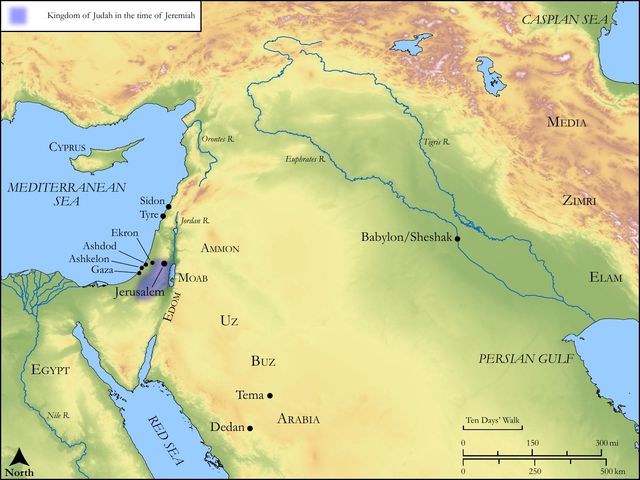
See on the biblical-era map
Study this verse
Public-domain commentary
Matthew Henry
From his Commentary on the Whole Bible. Henry comments on passages, not single verses — this entry covers Jeremiah 25:8–14. His two-level outline is real structure in the source text, so it is rendered as structure.
Here is the sentence grounded upon the foregoing charge: "Because you have not heard my words, I must take another course with you," Jer 25:8. Note, When men will not regard the judgments of God's mouth they may expect to feel the judgments of his hands, to hear the rod, since they would not hear the word; for the sinner must either be parted from his sin or perish in it. Wrath comes without remedy against those only that sin without repentance. It is not so much men's turning aside that ruins them as their not returning.
I.The ruin of the land of Judah by the king of Babylon's armies is here decreed, Jer 25:9.
God sent to them his servants the prophets, and they were not heeded, and therefore God will send for his servant the king of Babylon, whom they cannot mock, and despise, and persecute, as they did his servants the prophets. Note, The messengers of God's wrath will be sent against those that would not receive the messengers of his mercy. One way or other God will be heeded, and will make men know that he is the Lord. Nebuchadrezzar, though a stranger to the true God, the God of Israel, nay, an enemy to him and afterwards a rival with him, was yet, in the descent he made upon his country. God's servant, accomplished his purpose, was employed by him, and was an instrument in his hand for the correction of his people. He was really serving God's designs when he thought he was serving his own ends. Justly therefore does God here call himself The Lord of hosts (Jer 25:8), for here is an instance of his sovereign dominion, not only over the inhabitants, but over the armies of this earth, of which he makes what use he pleases. He has them all at his command. The most potent and absolute monarchs are his servants. Nebuchadrezzar, who is an instrument of his wrath, is as truly his servant as Cyrus, who is an instrument of his mercy. The land of Judah being to be made desolate, God here musters his army that is to make it so, gathers it together, takes all the families of the north, if there be occasion for them, leads them on as their commander-in-chief, brings them against this land, gives them success, not only against Judah and Jerusalem, but against all the nations round about, that there might be no dependence upon them as allies or assistants against that threatening force. The utter destruction of this and all the neighbouring lands is here described, Jer 25:9-11. It shall be total: The whole land shall be a desolation, not only desolate, but a desolation itself; both city and country shall be laid waste, and all the wealth of both be made a prey of. It shall be lasting, even perpetual desolations; they shall continue so long in ruins, and after long waiting there shall appear so little prospect of relief, that every one shall call it perpetual. This desolation shall be the ruin of their credit among their neighbours; it shall bury their honour in the dust, shall make them an astonishment and a hissing; every one will be amazed at them, and hiss them off the stage of action with just disgrace for deserting a God who would have been their protection for impostors who would certainly be their destruction. It will likewise be the ruin of all their comfort among themselves; it shall be a final period of all their joy: I will take from them the voice of mirth, hang their harps on the willow-trees, and put them out of tune for songs. I will take from them the voice of mirth; they shall neither have cause for it nor hearts for it. They would not hear the voice of God's word and therefore the voice of mirth shall no more be heard among them. They shall be deprived of food: The sound of the mill-stones shall not be heard; for, when the enemy has seized their stores, the sound of the grinding must needs be low, Ecc 12:4. An end shall be put to all business; there shall not be seen the light of a candle, for there shall be no work to be done worth candle-light. And, lastly, they shall be deprived of their liberty: Those nations shall serve the king of Babylon seventy years. The fixing of time during which the captivity should last would be of great use, not only for the confirmation of the prophecy, when the event (which in this particular could by no human sagacity be foreseen) should exactly answer the prediction, but for the comfort of the people of God in their calamity and the encouragement of faith and prayer. Daniel, who was himself a prophet, had an eye to it, Dan 9:2. Nay, God himself had an eye to it (Ch2 36:22); for therefore he stirred up the spirit of Cyrus, that the word spoken by the mouth of Jeremiah might be accomplished. Known unto God are all his works from the beginning of the world, which appears by this, that, when he has thought fit, some of them have been made known to his servants the prophets and by them to his church.
II.The ruin of Babylon, at last, is here likewise foretold, as it had been, long before, by Isaiah, Jer 25:12-14.
The destroyers must themselves be destroyed, and the rod thrown into the fire, when the correcting work is done with it. This shall be done when seventy years are accomplished; for the destruction of Babylon must make way for the deliverance of the captives. It is a great doubt when these seventy years commence; some date them from the captivity in the fourth year of Jehoiakim and first of Nebuchadrezzar, others from the captivity of Jehoiachin eight years after. I rather incline to the former, because then these nations began to serve the king of Babylon, and because usually God has taken the earliest time from which to reckon the accomplishment of a promise of mercy, as will appear in computing the 400 years' servitude in Egypt. And, if so, eighteen or nineteen years of the seventy had run out before Jerusalem and the temple were quite destroyed in the eleventh year of Zedekiah. However that be, when the time, the set time, to favour Zion, has come, the king of Babylon must be visited, and all the instances of his tyranny reckoned for; then that nation shall be punished for their iniquity, as the other nations have been punished for theirs. That land must then be a perpetual desolation, such as they had made other lands; for the Judge of all the earth will both do right and avenge wrong, as King of nations and King of saints. Let proud conquerors and oppressors be moderate in the use of their power and success, for it will come at last to their own turn to suffer; their day will come to fall. In this destruction of Babylon, which was to be brought about by the Medes and Persians, reference shall be had,
1.To what God had said: I will bring upon that land all my words; for all the wealth and honour of Babylon shall be sacrificed to the truth of the divine predictions, and all its power broken, rather than one iota or tittle of God's word shall fall to the ground. The same Jeremiah that prophesied the destruction of other nations by the Chaldeans foretold also the destruction of the Chaldeans themselves; and this must be brought upon them, Jer 25:13. It is with reference to this very event that God says, I will confirm the word of my servant, and perform the counsel of my messengers, Isa 44:26.
2.Two what they had done (Jer 25:14): I will recompense them according to their deeds, by which they transgressed the law of God, even then when they were made to serve his purposes. They had made many nations to serve them, and trampled upon them with the greatest insolence imaginable; but not that the measure of their iniquity is full many nations and great kings, that are in alliance with and come in to the assistance of Cyrus king of Persia, shall serve themselves of them also, shall make themselves masters of their country, enrich themselves with their spoils, and make them the footstool by which to mount the throne of universal monarchy. They shall make use of them for servants and soldiers. He that leads into captivity shall go into captivity.
Historical interpretation
Historical reception
2 surviving comments on this verse. Each one is dated, so this reads as a timeline rather than a list.
Select a marker to jump to its quote. Markers stagger vertically where authors wrote within a few decades of each other.
Israel … killed those who were sent, and not even before the Lord of the vineyard were they ashamed, but even he was slain by them. Truly, when he came and found no fruit in them, he cursed them through the fig tree, saying, “From now on, let there be no fruit from you.” The fig tree was dead and fruitless so that even the disciples wondered when it withered away. Then was fulfilled that which was spoken by the prophet: “I will take away from them the voice of joy and the voice of gladness, the voice of the bridegroom and the voice of the bride, the scent of myrrh and the light of a lamp, and the whole land shall be destroyed.” For the whole service of the law has been abolished from them, and from now on and forever they remain without a feast.
(Verse 10) And I will destroy from among them the voice of joy, and the voice of gladness; the voice of the bridegroom, and the voice of the bride; the sound of the millstone, and the light of the lamp. And the whole land shall be desolation and astonishment, and these things are proven today in the assembly of the wicked; so that their teachers do not teach the word of God, but hiss like a serpent. And the voice of joy and the voice of gladness perish in them, so that they never hear the words of the Apostle: Rejoice, again I say, rejoice (Philippians 4:4). The voice also of the bride, of the Ecclesiastical faith; and the voice of the bridegroom, of the Lord Savior: For he who has a bride, is the bridegroom (John III, 29). The voice of the mill, so that the grains are not crushed in it, and are given to the peoples for nourishment: and the light of the lamp, namely the teaching and knowledge (or, rather, the teaching and knowledge) of the Prophets. Finally, it is also said about John the Baptist: He was a shining lamp (John V, 35). And another Prophet: Your word, Lord, is a lamp to my feet, and a light to my paths (Psalm CXVIII, 105). All, he said, the land of heretics will be as a wasteland and in astonishment, when its final folly has been revealed.
Continue studying Jeremiah 25:10 across the web’s major study libraries — every link below opens this exact verse, chapter, or book on the destination site.
Read & Compare
 BibleGatewayThis verse in more than 200 translations and 70 languages.
 Bible.comThe YouVersion reader — hundreds of translations, reading plans, and highlights.
 ESV.orgCrossway's official English Standard Version reader.
 NET BibleThe NET translation with 60,000+ translators' notes on every rendering decision.
 STEP BibleTyndale House's free study tool — original text, vocabulary, and scholarly resources.
 BibliaLogos Bible Software's free web reader.
 USCCBThe New American Bible (Revised Edition) with the U.S. bishops' study notes.
Commentaries
 BibleHub CommentariesDozens of classic commentaries on this verse, gathered on one page.
 StudyLightMore than 100 commentary sets — the largest collection on the web.
 BibleRefPlain-English commentary on what this verse means, verse by verse.
 Enduring WordDavid Guzik's free commentary on this chapter, widely used by Bible teachers.
 Bible Study ToolsVerse commentary alongside Greek and Hebrew study aids.
Original Language & Research
- BibleHub InterlinearThe verse word by word — original language, transliteration, and English.
- BibleHub LexiconEvery word's original-language definition and Strong's entry.
 Blue Letter BibleDeep-study tools — Strong's numbers, concordance, and word studies.
 SefariaThe Hebrew text with Rashi and centuries of Jewish commentary.
Sermons, Hymns & Audio


TrulyRandomVerse is not affiliated with these sites and doesn’t control their content. They’re linked because they’re genuinely useful.
Summary
Jeremiah 25:10 delivers a stark and comprehensive prophecy of desolation upon Judah and Jerusalem, foretelling a future stripped of all joy, celebration, and the fundamental rhythms of daily life. Through vivid and culturally resonant imagery of silenced mirth, absent marital festivities, dormant household activities, and extinguished domestic light, the verse powerfully conveys the extent of God's impending judgment, signifying a complete societal collapse and the profound emptiness that would follow persistent rebellion against Him.
Context
ShowHideLiterary Context
Jeremiah 25:10 is an integral part of a sweeping prophecy delivered by Jeremiah in the fourth year of King Jehoiakim's reign, a pivotal moment in Judah's history (approximately 605 BC). This chapter serves as a summation of Jeremiah's prophetic ministry over 23 years, during which he consistently warned Judah of impending judgment due to their idolatry and disobedience, as detailed in Jeremiah 25:1-7. The verses immediately preceding Jeremiah 25:10 describe the Lord's long-suffering patience and His repeated sending of prophets, whom Judah stubbornly refused to hear. The subsequent verses, particularly Jeremiah 25:11, explicitly name the seventy-year Babylonian captivity as the specific consequence of this judgment, emphasizing that the desolation described in verse 10 is a direct result of this exile and the land lying waste. The verse thus functions as a chilling description of the effects of the impending seventy-year judgment.
Historical & Cultural Context
The prophecy in Jeremiah 25:10 is deeply rooted in the geopolitical realities of the late 7th century BC. Judah, under King Jehoiakim, was caught between the declining Assyrian Empire, the rising power of Babylon, and a weakened Egypt. Despite repeated warnings from Jeremiah, the nation continued in its idolatrous practices and rejected God's covenant. The imagery employed in the verse resonates profoundly with ancient Israelite daily life and cultural norms. Weddings, symbolized by the "voice of the bridegroom and the voice of the bride," were central to community life, signifying continuity, blessing, and joy, essential for the perpetuation of society. The "sound of the millstones" represented the most basic, essential daily activity for food preparation, indicating the presence of life and domesticity. The "light of the candle" (or lamp) symbolized life, warmth, and safety within the home, especially after dark. The removal of these elements would have been understood as a complete cessation of normal life, a profound silence and darkness settling over the land, indicating utter abandonment, ruin, and depopulation.
Key Themes
ShowHideJeremiah 25:10 powerfully contributes to several overarching themes within the book of Jeremiah and broader biblical theology. Firstly, it underscores the theme of Divine Judgment and the Consequences of Disobedience. God's patience has limits, and persistent rebellion inevitably leads to severe repercussions, as seen in Judah's impending exile. Secondly, it highlights the theme of Loss and Desolation, illustrating how sin strips away not only peace and security but also the fundamental joys, celebrations, and rhythms of daily life. The absence of sound and light metaphorically represents the spiritual darkness and emptiness that accompanies separation from God. This verse also implicitly touches upon the theme of Covenant Faithfulness (or lack thereof), as Judah's judgment is a direct consequence of their failure to uphold their covenant obligations, a theme reiterated throughout Jeremiah 7 and Jeremiah 11. The removal of these signs of life indicates a reversal of the blessings promised for covenant obedience (e.g., Deuteronomy 28:1-14).
Exposition and Analysis
ShowHideKey Word Analysis
ShowHideFrom an unused root meaning "to call aloud," this word (H6963) is repeated five times in the verse. It signifies not just an auditory sound but often carries the nuance of proclamation, an audible presence, or activity. Its absence, therefore, implies a profound silence, a cessation of all human activity, celebration, and the very pulse of life within the community. The repeated "voice" emphasizes the profound quietness of desolation, indicating a complete lack of human presence and vitality.
Derived from the root "śûś" meaning "to be cheerful," this term (H8342) denotes blithesomeness, glee, gladness, joy, and rejoicing, often specifically associated with festive occasions. Its removal signifies the extinguishing of all sources of happiness, celebration, and communal cheer, leaving behind only sorrow, despair, and a profound emptiness where vibrant life once thrived.
This term (H5216), also rendered as "lamp" or "light," refers to an illumination source, literally or figuratively. In ancient homes, lamps provided essential illumination after sunset, symbolizing life, warmth, domestic activity, and safety. The extinguishing of the candle represents the end of domestic life, the emptiness of homes, and a pervasive darkness, both literal and metaphorical, signifying the absence of hope, the cessation of daily routines, and the presence of death-like stillness.
Verse Breakdown
ShowHide"Moreover I will take from them"
This opening phrase immediately establishes the divine agency behind the impending judgment. It is God Himself who is actively removing these elements of life, underscoring the severity and certainty of His decree against Judah. The verb "take" is from the Hebrew ʼâbad (H6), which properly means "to wander away" or "lose oneself," but by implication, "to perish" or (causative) "to destroy." Here, it implies a complete removal, a destruction of what was, signifying God's direct intervention in bringing about this desolation.
"the voice of mirth, and the voice of gladness"
These phrases denote the cessation of all forms of public and private celebration, joy, and communal festivity. "Mirth" (sâsôwn) and "gladness" (simchâh, H8057) are often used synonymously, emphasizing the complete absence of any occasion for rejoicing, indicating a society utterly devoid of happiness.
"the voice of the bridegroom, and the voice of the bride"
This specific imagery points to the end of weddings, which were paramount celebrations of new life, family, and the continuation of society. Their silence signifies a halt to procreation, a break in the generational line, and the profound disruption of social order and hope for the future, representing the very end of communal life and continuity.
"the sound of the millstones"
Grinding grain was a daily, essential activity in every household, producing the staple food. The silence of the millstones indicates the complete absence of daily labor, sustenance, and the very presence of people in their homes, signaling widespread famine, depopulation, and the cessation of basic domestic life.
"and the light of the candle"
This final image represents the extinguishing of domestic life and warmth. Lamps provided light in homes after dark, symbolizing life, security, and the ongoing rhythm of daily existence. Its removal signifies empty houses, the end of normal domesticity, and a pervasive, literal and metaphorical, darkness, indicating the absence of hope, life, and divine presence.
Literary Devices
ShowHideJeremiah 25:10 is rich in literary devices that amplify its message of comprehensive desolation. The most prominent is Anaphora, seen in the repeated phrase "the voice of..." (Hebrew: qôwl). This repetition, occurring five times, creates a rhythmic, almost dirge-like quality, emphasizing the comprehensive nature of the silence that will fall upon the land and underscoring the multitude of joyous sounds that will cease. The verse also employs Merism, where two contrasting or complementary parts are used to represent a whole. For instance, "mirth and gladness" collectively signify the entirety of human celebration and emotional well-being. Similarly, "bridegroom and bride" encapsulate the full spectrum of social continuity and the joyous beginning of new families. The "sound of the millstones" (representing daily sustenance and labor) and the "light of the candle" (representing domestic life, warmth, and safety) together encompass the full spectrum of mundane, essential human activity. Furthermore, the entire verse functions as powerful Symbolism, where each item—the voice of mirth, the voice of the bride and bridegroom, the sound of millstones, and the light of the candle—is not merely a literal object but stands for a broader aspect of life, joy, and societal function. Their removal symbolizes the complete dismantling of Judah's society, from its grandest celebrations to its most basic necessities, leaving behind only emptiness, darkness, and the profound silence of judgment.
Theological and Thematic Connections
ShowHideJeremiah 25:10 serves as a profound theological statement on the nature of divine judgment and the consequences of sustained rebellion against God. It reveals that God's justice is not merely punitive but also corrective, aiming to bring His people to repentance, even if through severe discipline. The comprehensive nature of the desolation described underscores that sin impacts every facet of human existence—from individual joy to communal well-being and the very fabric of society. This judgment is a direct outcome of Judah's persistent idolatry and rejection of God's prophetic warnings, demonstrating that true peace and flourishing are inextricably linked to a right relationship with the Creator. The loss of joy, light, and daily rhythms signifies a spiritual darkness that accompanies separation from God, where the very blessings of life are withdrawn, illustrating the principle that disobedience leads to a forfeiture of divine favor and the blessings of covenant life.
Reflection and Application
ShowHideJeremiah 25:10 stands as a timeless and sobering reminder of the gravity of sin and the inevitable consequences of persistent disobedience to God's revealed will. It challenges us to consider what "voices" of mirth, gladness, and normal life might be silenced in our own lives or societies if we stray from God's path. The verse underscores that true and lasting joy, stability, and light are not found in material possessions or fleeting pleasures, but in a vibrant, obedient relationship with the Lord. It calls us to a posture of humility and responsiveness to God's Word, recognizing that His warnings are not arbitrary but are given for our ultimate good and flourishing. For believers today, it serves as a powerful incentive to live in faithful alignment with Christ, ensuring that the "light of the candle" of our lives continues to shine brightly, reflecting His glory rather than succumbing to spiritual darkness. It prompts us to examine our priorities, repent of any unconfessed sin, and actively pursue the "fullness of joy" found only in God's presence and obedience to His commands.
Questions for Reflection
ShowHideFAQ
ShowHideWhy is God's judgment described in such specific, everyday terms?
ShowHideGod's judgment is described in specific, everyday terms (like the voice of mirth, sound of millstones, and light of the candle) to make its impact profoundly relatable and comprehensive. For an ancient Israelite, these elements represented the very fabric of daily life, community, and domesticity. By listing them, Jeremiah emphasizes that the impending desolation would not merely be a political or military defeat, but a complete dismantling of their society from its grandest celebrations (weddings) to its most mundane, essential activities (grinding grain for food, lighting homes). This detailed imagery underscores the totality of the judgment, leaving no aspect of life untouched, making the prophecy more vivid and impactful for the original audience and for us today. It shows that God's judgment affects the entire human experience, not just abstract spiritual concepts.
Does this prophecy of desolation offer any hope?
ShowHideWhile Jeremiah 25:10 itself is a stark pronouncement of judgment and desolation, the broader context of Jeremiah's prophecy, and indeed the entire biblical narrative, does offer hope. The seventy-year Babylonian captivity, explicitly mentioned in Jeremiah 25:11, was a defined period, after which God promised restoration. In Jeremiah 29:10-14, the Lord declares His plans for Judah's future: "For I know the plans I have for you," declares the Lord, "plans to prosper you and not to harm you, plans to give you hope and a future." This demonstrates that even in judgment, God's ultimate intention is redemptive. The desolation was a disciplinary measure designed to lead His people to repentance and a renewed relationship with Him, ultimately paving the way for a future restoration of joy, community, and divine presence, culminating in the new covenant.
Christ-Centered Fulfillment
ShowHideJeremiah 25:10, with its chilling depiction of a silenced, darkened world devoid of joy and life, finds its profound Christ-centered fulfillment in the ultimate victory of Jesus over sin and death. The "voice of mirth and gladness" that was taken away from Judah is fully restored and surpassed in Christ, who brings an "inexpressible and glorious joy" to those who believe, a joy that is eternal and not dependent on earthly circumstances (1 Peter 1:8). The absence of the "voice of the bridegroom and the voice of the bride" in Jeremiah foreshadows the broken covenant relationship between God and His people, a relationship perfectly and eternally restored through Christ. He is the true and eternal Bridegroom of the Church, His redeemed people, who will one day participate in the glorious wedding feast of the Lamb, where joy will be unending and the covenant perfectly fulfilled. Furthermore, the "light of the candle" extinguished in Judah's homes points to the spiritual darkness of a world alienated from God, a darkness dispelled by Jesus, who declared, "I am the light of the world. Whoever follows me will never walk in darkness, but will have the light of life." In Him, all that was lost through sin and judgment is not only restored but transformed into an eternal, perfect reality, where there will be no more night, no need for lamp or sun, for the Lord God will give them light and His presence will be their everlasting illumination.