


Revelation 18:22
flute-players and trumpeters
will never again be heard in you.
No worker of any trade
will ever again be found in you,
the sound of a mill
will never again be heard in you,
- καὶkaiAndG2532CONJConjunction
- φωνὴphōnēsoundG5456N-NSFNoun Nominative Singular Feminine
- κιθαρῳδῶνkitharōdōnof harpistsG2790N-GPMNoun Genitive Plural Masculine
- καὶkaiandG2532CONJConjunction
- μουσικῶνmousikōnmusiciansG3451A-GPMAdjective Genitive Plural Masculine
- καὶkaiandG2532CONJConjunction
- αὐλητῶνaulētōnflute playersG834N-GPMNoun Genitive Plural Masculine
- καὶkaiandG2532CONJConjunction
- σαλπιστῶνsalpistōntrumpetersG4538N-GPMNoun Genitive Plural Masculine
- οὐoucertainlyG3756PRT-NNegative Particle Negative
- μὴmēnotG3361PRT-NNegative Particle Negative
- ἀκουσθῇakousthēamay be heardG191V-APS-3SVerb Aorist Passive Subjunctive 3rd Singular
- ἐνeninG1722PREPPreposition
- σοὶsoiyouG4771P-2DSPersonal pronoun Dative 2nd Singular
- ἔτιetiany longerG2089ADVAdverb
- καὶkaiAndG2532CONJConjunction
- πᾶςpasanyG3956A-NSMAdjective Nominative Singular Masculine
- τεχνίτηςtechnitēscraftsmenG5079N-NSMNoun Nominative Singular Masculine
- πάσηςpasēsof anyG3956A-GSFAdjective Genitive Singular Feminine
- τέχνηςtechnēscraftG5078N-GSFNoun Genitive Singular Feminine
- οὐoucertainlyG3756PRT-NNegative Particle Negative
- μὴmēnotG3361PRT-NNegative Particle Negative
- εὑρεθῇheurethēamay be foundG2147V-APS-3SVerb Aorist Passive Subjunctive 3rd Singular
- ἐνeninG1722PREPPreposition
- σοὶsoiyouG4771P-2DSPersonal pronoun Dative 2nd Singular
- ἔτιetiany longerG2089ADVAdverb
- καὶkaiandG2532CONJConjunction
- φωνὴphōnē[the] soundG5456N-NSFNoun Nominative Singular Feminine
- μύλουmulouof a millstoneG3458N-GSMNoun Genitive Singular Masculine
- οὐoucertainlyG3756PRT-NNegative Particle Negative
- μὴmēnotG3361PRT-NNegative Particle Negative
- ἀκουσθῇakousthēamay be heardG191V-APS-3SVerb Aorist Passive Subjunctive 3rd Singular
- ἐνeninG1722PREPPreposition
- σοὶsoiyouG4771P-2DSPersonal pronoun Dative 2nd Singular
- ἔτιetiany longerG2089ADVAdverb
English is a literal word-by-word gloss of the Greek, not the KJV's wording. Why?
This is the original text the KJV's translators worked from — each Greek word with its own literal English meaning in this verse, prepared by scholars at Tyndale House, Cambridge. The KJV translates whole sentences, not word by word, so its wording differs: one Greek word can become several English words, and the KJV may choose “charity” where the gloss reads “love”. Both are faithful — they answer different questions. For the KJV's own rendering, switch to the KJV text.
Details
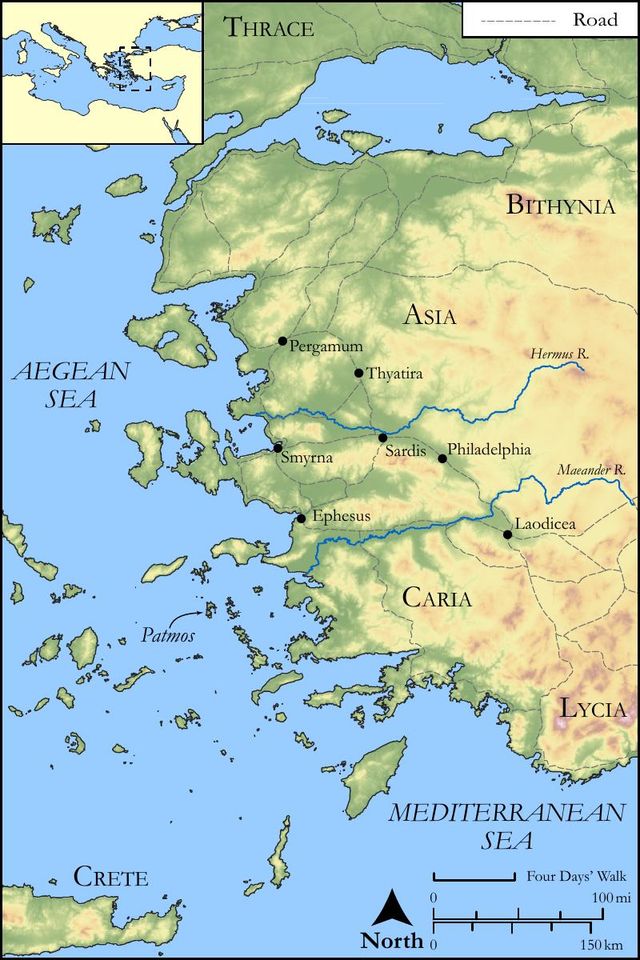
See on the biblical-era map

Study this verse
Public-domain commentary
Matthew Henry
From his Commentary on the Whole Bible. Henry comments on passages, not single verses — this entry covers Revelation 18:9–24. His three-level outline is real structure in the source text, so it is rendered as structure.
Here we have,
I.A doleful lamentation made by Babylon's friends for her fall; and here observe,
1.Who are the mourners, namely, those who had been bewitched by her fornication, those who had been sharers in her sensual pleasures, and those who had been gainers by her wealth and trade - the kings and the merchants of the earth: the kings of the earth, whom she had flattered into idolatry by allowing them to be arbitrary and tyrannical over their subjects, while they were obsequious to her; and the merchants, that is, those who trafficked with her for indulgences, pardons, dispensations, and preferments; these will mourn, because by this craft they got their wealth.
2.What was the manner of their mourning.
(1.)They stood afar off, they durst not come nigh her. Even Babylon's friends will stand at a distance from her fall. Though they had been partakers with her in her sins, and in her sinful pleasures and profits, they were not willing to bear a share in her plagues.
(2.)They made a grievous outcry: Alas! alas! that great city, Babylon, that mighty city!
(3.)They wept, and cast dust upon their heads, Rev 18:19. The pleasures of sin are but for a season, and they will end in dismal sorrow. All those who rejoice in the success of the church's enemies will share with them in their downfall; and those who have most indulged themselves in pride and pleasure are the least able to bear calamities; their sorrows will be as excessive as their pleasure and jollity were before.
3.What was the cause of their mourning; not their sin, but their punishment. They did not lament their fall into idolatry, and luxury, and persecution, but their fall into ruin - the loss of their traffic and of their wealth and power. The spirit of antichrist is a worldly spirit, and their sorrow is a mere worldly sorrow; they did not lament for the anger of God, that had now fallen upon them, but for the loss of their outward comfort. We have a large schedule and inventory of the wealth and merchandise of this city, all which was suddenly lost (Rev 18:12, Rev 18:13), and lost irrecoverably (Rev 18:14): All things which were dainty and goodly have departed from thee, and thou shalt find them no more at all. The church of God may fall for a time, but she shall rise again; but the fall of Babylon will be an utter overthrow, like that of Sodom and Gomorrah. Godly sorrow is some support under affliction, but mere worldly sorrow adds to the calamity.
II.An account of the joy and triumph there was both in heaven and earth at the irrecoverable fall of Babylon:
while her own people were bewailing her, the servants of God were called to rejoice over her, Rev 18:20. Here observe,
1.How universal this joy would be: heaven and earth, angels and saints, would join in it; that which is matter of rejoicing to the servants of God in this world is matter of rejoicing to the angels in heaven.
2.How just and reasonable; and that,
(1.)Because the fall of Babylon was an act of God's vindictive justice. God was then avenging his people's cause. They had committed their cause to him to whom vengeance belongs, and now the year of recompence had come for the controversies of Zion; and, though they did not take pleasure in the miseries of any, yet they had reason to rejoice in the discoveries of the glorious justice of God.
(2.)Because it was an irrecoverable ruin. This enemy should never molest them any more, and of this they were assured by a remarkable token (Rev 18:21): An angel from heaven took up a stone like a great millstone, and cast it into the sea, saying, "Thus shall Babylon be thrown down with violence, and be found no more at all; the place shall be no longer habitable by man, no work shall be done there, no comfort enjoyed, no light seen there, but utter darkness and desolation, as the reward of her great wickedness, first in deceiving the nations with her sorceries, and secondly in destroying and murdering those whom she could not deceive," Rev 18:24. Such abominable sins deserved so great a ruin.
Historical interpretation
Two Centuries of Reception
4 surviving comments on this verse. Each one is dated, so this reads as a timeline rather than a list.
Select a marker to jump to its quote. Markers stagger vertically where authors wrote within a few decades of each other.
Babylon is likened to a great millstone which is thrown down, for the revolving of times, as though it were a millstone, grinds down those who love the world, and it sends them in circles. Of these the Scriptures say, “The wicked walk in a circle.” … “The sound of harpers and musicians and flute players and trumpeters is no longer heard in her.” That is, the joy and happiness of the wicked passes away and is no longer to be found. And it adds the reason for this, “for your merchants were the great men of the earth,” that is, they had received good things in their lives. “The blood of the prophets and the saints was found in her and of all who have been slain by [her] upon the earth.” Did the same city kill the apostles that also killed the prophets and all of the rest of the martyrs? Rather, this is the city of all the proud and arrogant, which Cain established by the blood of his brother and which he named after the name of his son, Enoch, that is, after his posterity. For all the wicked in whom Babylon resides succeed one another and persecute the church of God until the end of the world. In the city of Cain “all the righteous blood” is poured out “from the blood of righteous Abel to the blood of Zechariah,” that is, of the people and of the priests, “between the sanctuary and the altar,” that is, between the people and the priests. This was said because not only the people but also the priests conspired in the death of Zechariah.… This is the city which killed the prophets and stoned those who were sent to it. This is that city that is built upon blood, as the Scriptures say, “Woe to him who builds a city with blood and founds a city on iniquity.”
Just as a millstone sinks with force into the sea, so also the destruction of this Babylon will be sudden, so that afterward no trace of her will be found. The absence of harpers, minstrels and the rest is an indication of this. And he gives the reason for this. [Babylon] deceived all nations with her sorcery and was the recipient of the blood of prophets and the other saints. It is possible that this passage depicts the impious Babylon among the Persians, for at various times until now she has received the blood of many saints and continually rejoices in sorceries and deceptions. And this gives us an occasion for prayer, that she receive the rewards prophesied for arrogance against Christ and his servants.
And no craftsman of any craft shall be found in you any more, etc. He says, all things that pertain to the use or pleasure of human life are taken away from the wicked. And he added the reason, saying:
The sound of harpists and musicians, etc. He had deferred the sound of those five senses, which he now says will be taken away from the world among other things. As if to say: What is beautiful to see, melodious to hear, smooth to touch, pleasant to smell, and delightful to taste will pass away from the world.
Continue studying Revelation 18:22 across the web’s major study libraries — every link below opens this exact verse, chapter, or book on the destination site.
Read & Compare
 BibleGatewayThis verse in more than 200 translations and 70 languages.
 Bible.comThe YouVersion reader — hundreds of translations, reading plans, and highlights.
 ESV.orgCrossway's official English Standard Version reader.
 NET BibleThe NET translation with 60,000+ translators' notes on every rendering decision.
 STEP BibleTyndale House's free study tool — original text, vocabulary, and scholarly resources.
 BibliaLogos Bible Software's free web reader.
 USCCBThe New American Bible (Revised Edition) with the U.S. bishops' study notes.
Commentaries
 BibleHub CommentariesDozens of classic commentaries on this verse, gathered on one page.
 StudyLightMore than 100 commentary sets — the largest collection on the web.
 BibleRefPlain-English commentary on what this verse means, verse by verse.
 Enduring WordDavid Guzik's free commentary on this chapter, widely used by Bible teachers.
 Bible Study ToolsVerse commentary alongside Greek and Hebrew study aids.
Original Language & Research
- BibleHub InterlinearThe verse word by word — original language, transliteration, and English.
- BibleHub LexiconEvery word's original-language definition and Strong's entry.
 Blue Letter BibleDeep-study tools — Strong's numbers, concordance, and word studies.
 CNTR CollationThe earliest Greek manuscripts of this verse, collated letter by letter.
Sermons, Hymns & Audio


TrulyRandomVerse is not affiliated with these sites and doesn’t control their content. They’re linked because they’re genuinely useful.
Summary
Revelation 18:22 vividly portrays the absolute and irreversible desolation of "Babylon the Great," a symbolic entity representing the world's anti-God systems of commerce, culture, and power. This verse marks the complete cessation of all sounds of joy, celebration, productivity, and daily life within it, underscoring the finality and totality of God's righteous judgment against a system that exalted itself against the divine will.
Context
ShowHideLiterary Context
Revelation 18:22 is a pivotal verse within the larger prophetic lament over the fall of Babylon the Great, which begins in Revelation 18:1. The preceding verses detail Babylon's immense wealth, its spiritual harlotry, and the immediate, overwhelming nature of its destruction, announced by a mighty angel. The kings of the earth and the merchants, who grew rich from Babylon's luxuries, are depicted mourning its demise from afar, acknowledging its sudden downfall. This specific verse, 18:22, shifts from the general lament to a granular depiction of the silence and emptiness that will pervade the fallen city, providing concrete examples of the eradicated activities—music, craftsmanship, and daily sustenance—to emphasize the utter finality of its judgment. It serves as a stark contrast to the vibrant, bustling life described earlier in the chapter, reinforcing the completeness of its ruin.
Historical & Cultural Context
The imagery used in Revelation 18 draws heavily on Old Testament prophetic pronouncements against ancient cities like Tyre and Babylon, which were renowned for their commercial prowess, luxury, and idolatry (e.g., Isaiah 23 concerning Tyre; Jeremiah 50-51 concerning Babylon). In the Roman world of John's time, major cities were centers of vibrant cultural life, economic activity, and political power. Music, craftsmanship, and the grinding of millstones (essential for daily bread) were ubiquitous sounds of a thriving metropolis. The absence of these sounds would signify not just economic collapse but the complete eradication of civic life, joy, and even the basic means of survival. The "craftsman" (Greek: technitēs) would include a wide range of skilled artisans, from builders to jewelers, representing the sophisticated economic engine of a great city. The "millstone" was a common household item, its sound indicating the preparation of food, thus its silence pointed to the absence of life itself.
Key Themes
ShowHideThis verse powerfully contributes to several overarching themes within Revelation and biblical theology. Firstly, it highlights the theme of Divine Judgment and Retribution, demonstrating God's righteous response to human rebellion and the systems that oppose Him. Babylon's destruction is not random but a just recompense for its sins, particularly its spiritual fornication and oppression of the saints, as seen in Revelation 18:6-7. Secondly, it underscores the Transience of Worldly Power and Glory. Despite its immense wealth and influence, Babylon's dominion is ephemeral, contrasting sharply with the eternal nature of God's kingdom (Daniel 2:44). Finally, the pervasive silence emphasizes the theme of Utter Desolation and Emptiness, a direct consequence of God's wrath. The absence of music, craft, and the millstone's sound symbolizes a complete void, a reversal of the creation and life that God intends, serving as a stark warning against placing trust in any earthly system apart from God.
Exposition and Analysis
ShowHideKey Word Analysis
ShowHideThis word, G5456, refers to a tone, sound, or language. In this context, it encompasses the audible expressions of human activity and joy—the sounds of harpers, musicians, pipers, and trumpeters. Its cessation signifies the complete absence of celebration, entertainment, and the vibrant cultural life characteristic of a thriving city. The silence of these "voices" is a powerful indicator of utter desolation.
A primary verb meaning "to hear" in various senses, including to perceive sound or to understand. The repeated phrase "shall be heard no more at all" emphasizes the sensory experience of absence. It's not just that these activities cease, but that their very sounds, which once filled the city, will be completely absent, reinforcing the theme of absolute emptiness and permanent silence.
This powerful double negative (G3364 and G2089, with G2089 meaning "still" or "yet") strengthens the denial, conveying an absolute and irreversible cessation. It signifies that the described activities will not merely diminish or be temporarily interrupted, but will definitively and permanently vanish. This phrase underscores the finality of God's judgment and the eternal ruin of Babylon.
Verse Breakdown
ShowHide"And the voice of harpers, and musicians, and of pipers, and trumpeters, shall be heard no more at all in thee;"
This clause describes the end of all sounds of joy, celebration, and cultural life. Harpers, musicians, pipers, and trumpeters represent various forms of entertainment and festivity, often associated with prosperity, feasts, and public gatherings. Their silence signifies the complete eradication of happiness, leisure, and the vibrant social fabric of the city. The absence of these sounds points to a place devoid of life and mirth.
"and no craftsman, of whatsoever craft [he be], shall be found any more in thee;"
This segment focuses on the cessation of economic activity and productive labor. "Craftsman" (Greek: technitēs) refers to skilled artisans of any trade, from builders to jewelers, who contribute to the city's wealth and infrastructure. Their disappearance means the end of all industry, commerce, and the very means of production that once made Babylon rich and powerful. This signifies not just economic collapse but the complete absence of human ingenuity and constructive effort.
"and the sound of a millstone shall be heard no more at all in thee;"
This final clause highlights the absence of basic daily life and sustenance. The grinding of a millstone was a common, essential sound in ancient homes and communities, indicating the preparation of flour for bread—the most fundamental necessity of life. Its silence points to the complete lack of inhabitants, the absence of daily routines, and ultimately, the impossibility of sustaining life within the city. It underscores the utter desolation to the point of being uninhabitable.
Literary Devices
ShowHideRevelation 18:22 employs several potent literary devices to convey its message of absolute destruction. Anaphora is evident in the repeated phrase "shall be heard no more at all in thee," which powerfully emphasizes the permanence and totality of Babylon's desolation. This repetition creates a rhythmic, dirge-like quality, underscoring the finality of the judgment. Synecdoche is used by listing specific examples—harpers, musicians, craftsmen, millstones—to represent the entirety of a city's vibrant life, economic activity, and daily existence. By focusing on these particular elements, the passage evokes a comprehensive sense of loss. Furthermore, the verse utilizes auditory imagery to paint a vivid picture of silence, contrasting the former sounds of a bustling city with the eerie quiet of its ruin. This sensory detail allows the reader to "hear" the absence, making the desolation palpable and profoundly impactful.
Theological and Thematic Connections
ShowHideRevelation 18:22 serves as a stark theological declaration of God's ultimate sovereignty over all earthly powers and His unwavering commitment to justice. It vividly illustrates that any system, empire, or culture that exalts itself against God, promotes idolatry, and oppresses His people will ultimately face His righteous judgment and be brought to utter ruin. This principle resonates throughout biblical history, from the destruction of Sodom and Gomorrah to the fall of ancient empires, reminding us that no human construct, however powerful or seemingly enduring, can withstand the divine will. The silence described in the verse is not merely an absence of noise but the profound spiritual emptiness that results when a society rejects its Creator and embraces self-sufficiency and moral decay. It is a powerful warning against placing ultimate trust in transient worldly comforts and achievements.
Reflection and Application
ShowHideRevelation 18:22 offers a profound opportunity for reflection on our own values and allegiances. In a world that often prioritizes material wealth, fleeting entertainment, and self-made success, this verse serves as a sobering reminder of the temporary nature of all earthly kingdoms and achievements. It challenges us to examine where our true security and joy lie. Are we investing our lives in things that will ultimately perish, or in the eternal kingdom of God? The silence of Babylon should prompt us to cultivate a life that is not dependent on the transient pleasures and systems of this world, but on the enduring truth and promises of God. It calls us to live with an eternal perspective, recognizing that true prosperity and lasting joy are found only in Christ, not in the fleeting glories of human enterprise. This passage also reinforces our hope in God's justice, knowing that all evil and oppression will ultimately be judged and eradicated, paving the way for His perfect and righteous reign.
Questions for Reflection
ShowHideFAQ
ShowHideWhat does "Babylon the Great" symbolize in Revelation 18?
ShowHide"Babylon the Great" is a complex and multifaceted symbol in Revelation, primarily representing the culmination of all human systems and powers that stand in rebellion against God. It embodies the world's corrupt economic, political, and cultural structures, characterized by idolatry, luxury, oppression, and spiritual deception. While some interpretations connect it to a literal city, its primary function in Revelation is symbolic, encompassing the globalized anti-God system that seduces humanity with its wealth and power, ultimately leading to the persecution of God's people and the rejection of divine truth. Its fall signifies the ultimate triumph of God's justice over all forms of human rebellion.
Christ-Centered Fulfillment
ShowHideRevelation 18:22, depicting the absolute desolation of Babylon, finds its Christ-centered fulfillment not in a direct prophecy of Jesus' first coming, but in the ultimate triumph of His kingdom and the establishment of the New Heavens and New Earth. The silence and emptiness that fall upon Babylon are the antithesis of the vibrant, eternal life promised in Christ. While Babylon represents the world system that rejected and crucified the Messiah, its destruction foreshadows the complete vanquishing of all evil and opposition to God's reign. Jesus, through His death and resurrection, secured victory over sin and death (Colossians 2:15). The judgment on Babylon, therefore, is a necessary precursor to the full manifestation of Christ's righteous rule, where there will be no more sorrow, pain, or ungodliness (Revelation 21:4). The silence of Babylon paves the way for the eternal praises and worship of the Lamb in the New Jerusalem, where the "voice" of God's people will resound forever in joyful communion with Him (Revelation 21:3). Thus, the desolation of Babylon underscores the ultimate and glorious reign of Christ, where all that opposes Him is silenced, and His eternal kingdom of peace and righteousness prevails.