


John 8:12
Bible text: King James Version (1769 Blayney text) · Public domain
Bible text: King James Version with Strong's numbers · Public domain
Bible text: Berean Standard Bible · Public domain
Bible text: American Standard Version (1901) · Public domain
Bible text: World English Bible, Messianic edition · Public domain
Bible text: Geneva Bible (1599) · Public domain
Bible text: Young's Literal Translation · Public domain
- ΠάλινPalinAgainG3825ADVAdverb
- οὖνounthereforeG3767CONJConjunction
- αὐτοῖςautoisto themG846P-DPMPersonal pronoun Dative Plural Masculine
- ἐλάλησενelalēsenspokeG2980V-AAI-3SVerb Aorist Active Indicative 3rd Singular
- ὁho[the]G3588T-NSMDefinite article Nominative Singular Masculine
- ἸησοῦςIēsousJesusG2424N-NSM-PNoun Nominative Singular Masculine Individual
- λέγων·legōnsayingG3004V-PAP-NSMVerb Present Active Participle Nominative Singular Masculine
- ἐγώegōI myselfG1473P-1NSPersonal pronoun Nominative 1st Singular
- εἰμιeimiamG1510V-PAI-1SVerb Present Active Indicative 1st Singular
- τὸtotheG3588T-NSNDefinite article Nominative Singular Neuter
- φῶςphōslightG5457N-NSNNoun Nominative Singular Neuter
- τοῦtouof theG3588T-GSMDefinite article Genitive Singular Masculine
- κόσμουkosmouworldG2889N-GSMNoun Genitive Singular Masculine
- ὁhothe [one]G3588T-NSMDefinite article Nominative Singular Masculine
- ἀκολουθῶνakolouthōnfollowingG190V-PAP-NSMVerb Present Active Participle Nominative Singular Masculine
- ἐμοὶemoiMe myselfG1473P-1DSPersonal pronoun Dative 1st Singular
- οὐoucertainlyG3756PRT-NNegative Particle Negative
- μὴmēnotG3361PRT-NNegative Particle Negative
- περιπατήσῃperipatēsēmay walkG4043V-AAS-3SVerb Aorist Active Subjunctive 3rd Singular
- ἐνeninG1722PREPPreposition
- τῇtēatheG3588T-DSFDefinite article Dative Singular Feminine
- σκοτίᾳskotiadarknessG4653N-DSFNoun Dative Singular Feminine
- ἀλλ᾽all᾽butG235CONJConjunction
- ἕξειhexeiwill haveG2192V-FAI-3SVerb Future Active Indicative 3rd Singular
- τὸtotheG3588T-ASNDefinite article Accusative Singular Neuter
- φῶςphōslightG5457N-ASNNoun Accusative Singular Neuter
- τῆςtēs[the]G3588T-GSFDefinite article Genitive Singular Feminine
- ζωῆςzōēsof lifeG2222N-GSFNoun Genitive Singular Feminine
English is a literal word-by-word gloss of the Greek, not the KJV's wording. Why?
This is the original text the KJV's translators worked from — each Greek word with its own literal English meaning in this verse, prepared by scholars at Tyndale House, Cambridge. The KJV translates whole sentences, not word by word, so its wording differs: one Greek word can become several English words, and the KJV may choose “charity” where the gloss reads “love”. Both are faithful — they answer different questions. For the KJV's own rendering, switch to the KJV text.
Words in [ ] are added by the English.
Details
See on the biblical-era maps
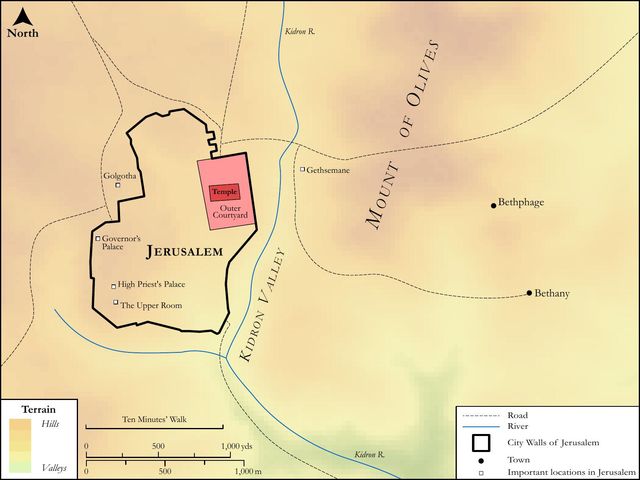
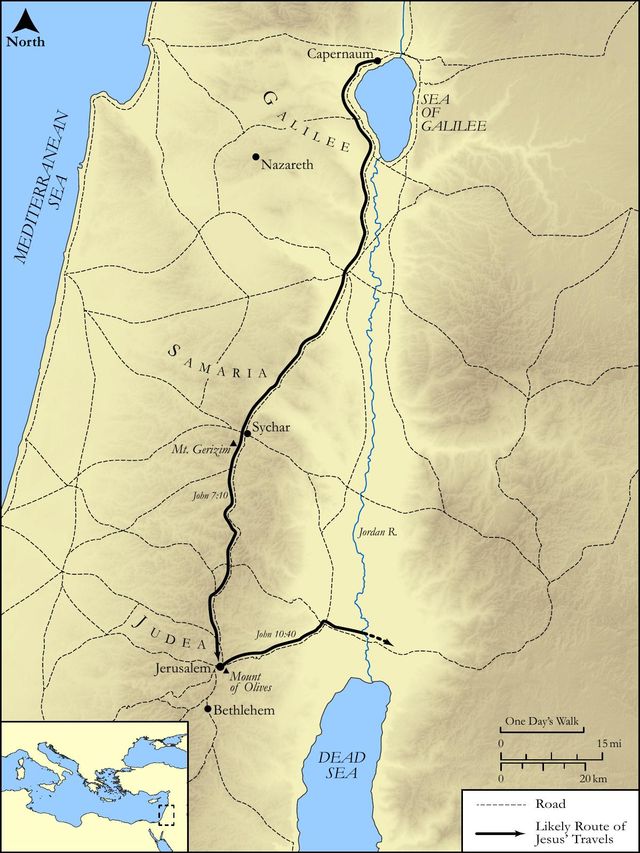
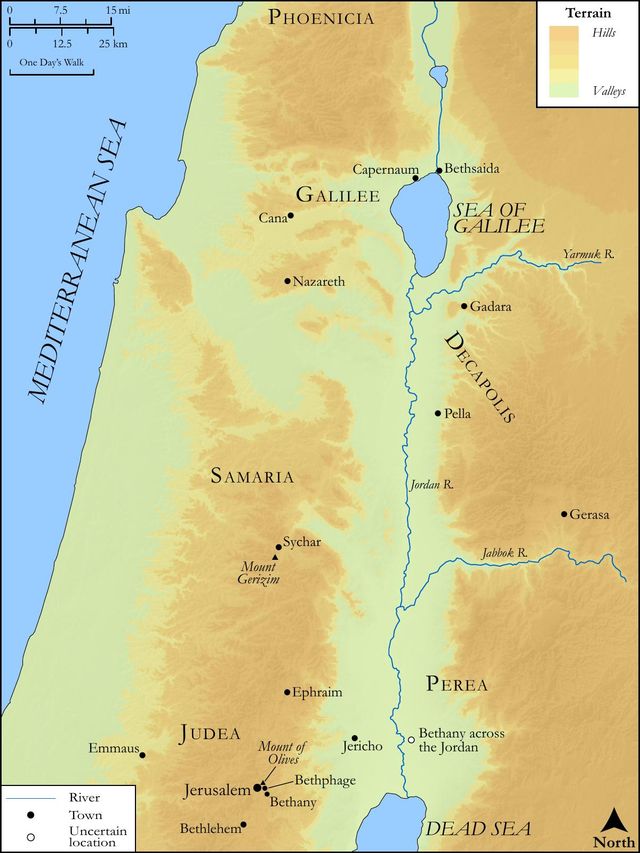
Study this verse
Public-domain commentary
Matthew Henry
From his Commentary on the Whole Bible. Henry wrote on whole passages, and this entry covers John 8:12–20. He set out his notes in a four-level outline, kept here as he numbered it.
The rest of the chapter is taken up with debates between Christ and contradicting sinners, who cavilled at the most gracious words that proceeded out of his mouth. It is not certain whether these disputes were the same day that the adulteress was discharged; it is probable they were, for the evangelist mentions no other day, and takes notice (John 8:2) how early Christ began that day's work. Though those Pharisees that accused the woman had absconded, yet there were other Pharisees (John 8:13) to confront Christ, who had brass enough in their foreheads to keep them in countenance, though some of their party were put to such a shameful retreat; nay perhaps that made them the more industrious to pick quarrels with him, to retrieve, if possible, the reputation of their baffled party. In these verses we have,
I.A great doctrine laid down, with the application of it.
1.The doctrine is, That Christ is the light of the world (John 8:12): Then spoke Jesus again unto them; though he had spoken a great deal to them to little purpose, and what he had said was opposed, yet he spoke again, for he speaketh once, yea, twice. They had turned a deaf ear to what he said, and yet he spoke again to them, saying, I am the light of the world. Note, Jesus Christ is the light of the world. One of the rabbies saith, Light is the name of the Messiah, as it is written, Daniel 2:22, And light dwelleth with him. God is light, and Christ is the image of the invisible God; God of gods, Light of lights. He was expected to be a light to enlighten the Gentiles (Luke 2:32), and so the light of the world, and not of the Jewish church only. The visible light of the world is the sun, and Christ is the Sun of righteousness. One sun enlightens the whole world, so does one Christ, and there needs no more. Christ in calling himself the light expresses,
(1.)What he is in himself - most excellent and glorious.
(2.)What he is to the world - the fountain of light, enlightening every man. What a dungeon would the world be without the sun! So would it be without Christ by whom light came into the world, John 3:19.
2.The inference from this doctrine is, He that followeth me, as a traveller follows the light in a dark night, shall not walk in darkness, but shall have the light of life. If Christ be the light, then,
(1.)It is our duty to follow him, to submit ourselves to his guidance, and in every thing take directions from him, in the way that leads to happiness. Many follow false lights - ignes fatui, that lead them to destruction; but Christ is the true light. It is not enough to look at this light, and to gaze upon it, but we must follow it, believe in it, and walk in it, for it is a light to our feet, not our eyes only.
(2.)It is the happiness of those who follow Christ that they shall not walk in darkness. They shall not be left destitute of those instructions in the way of truth which are necessary to keep them from destroying error, and those directions in the way of duty which are necessary to keep them from damning sin. They shall have the light of life, that knowledge and enjoyment of God which will be to them the light of spiritual life in this world and of everlasting life in the other world, where there will be no death nor darkness. Follow Christ, and we shall undoubtedly be happy in both worlds. Follow Christ, and we shall follow him to heaven.
II.The objection which the Pharisees made against this doctrine, and it was very trifling and frivolous:
Thou bearest record of thyself; thy record is not true, John 8:13. In this objection they went upon the suspicion which we commonly have of men's self-condemnation, which is concluded to be the native language of self-love, such as we are all ready to condemn in others, but few are willing to own in themselves. But in this case the objection was very unjust, for,
1.They made that his crime, and a diminution to the credibility of his doctrine, which in the case of one who introduced a divine revelation was necessary and unavoidable. Did not Moses and all the prophets bear witness of themselves when they avouched themselves to be God's messengers? Did not the Pharisees ask John Baptist, What sayest thou of thyself?
2.They overlooked the testimony of all the other witnesses, which corroborated the testimony he bore of himself. Had he only borne record of himself, his testimony had indeed been suspicious, and the belief of it might have been suspended; but his doctrine was attested by more than two or three credible witnesses, enough to establish every word of it.
III.Christ's reply to this objection, John 8:14.
He does not retort upon them as he might ("You profess yourselves to be devout and good men, but your witness is not true"), but plainly vindicates himself; and, though he had waived his own testimony (John 5:31), yet here he abides by it, that it did not derogate from the credibility of his other proofs, but was necessary to show the force of them. He is the light of the world, and it is the property of light to be self-evidencing. First principles prove themselves. He urges three things to prove that his testimony, though of himself, was true and cogent.
1.That he was conscious to himself of his own authority, and abundantly satisfied in himself concerning it. He did not speak as one at uncertainty, nor propose a disputable notion, about which he himself hesitated, but declared a decree, and gave such an account of himself as he would abide by: I know whence I came, and whither I go. He was fully apprised of his own undertaking from first to last; knew whose errand he went upon, and what his success would be. He knew what he was before his manifestation to the world, and what he should be after; that he came from the Father, and was going to him (John 16:28), came from glory, and was going to glory, (John 17:5). This is the satisfaction of all good Christians, that though the world know them not, as it knew him not, yet they know whence their spiritual life comes, and whither it tends, and go upon sure grounds.
2.That they are very incompetent judges of him, and of his doctrine, and not to be regarded.
(1.)Because they were ignorant, willingly and resolvedly ignorant: You cannot tell whence I came, and whither I go. To what purpose is it to talk with those who know nothing of the matter, nor desire to know? He had told them of his coming from heaven and returning to heaven, but it was foolishness to them, they received it not; it was what the brutish man knows not, Psalm 92:6. They took upon them to judge of that which they did not understand, which lay quite out of the road of their acquaintance. Those that despise Christ's dominions and dignities speak evil of what they know not, Jude, Jude 1:8, Jude 1:10.
(2.)Because they were partial (John 8:15): You judge after the flesh. When fleshly wisdom gives the rule of judgment, and outward appearances only are given in evidence, and the case decided according to them, then men judge after the flesh; and when the consideration of a secular interest turns the scale in judging of spiritual matters, when we judge in favour of that which pleases the carnal mind, and recommends us to a carnal world, we judge after the flesh; and the judgment cannot be right when the rule is wrong. The Jews judged of Christ and his gospel by outward appearances, and, because he appeared so mean, thought it impossible he should be the light of the world; as if the sun under a cloud were no sun.
(3.)Because they were unjust and unfair towards him, intimated in this: "I judge no man; I neither make nor meddle with your political affairs, nor does my doctrine or practice at all intrench upon, or interfere with, your civil rights or secular powers." He thus judged no man. Now, if he did not war after the flesh, it was very unreasonable for them to judge him after the flesh, and to treat him as an offender against the civil government. Or, "I judge no man," that is, "not now in my first coming, that is deferred till I come again," John 3:17. Prima dispensatio Christi medicinalis est, non judicialis - The first coming of Christ was for the purpose of administering, not justice, but medicine.
3.That his testimony of himself was sufficiently supported and corroborated by the testimony of his Father with him and for him (John 8:16): And yet, if I judge, my judgment is true. He did in his doctrine judge (John 9:39), though not politically. Consider him then,
(1.)As a judge, and his own judgment was valid: "If I judge, I who have authority to execute judgments, I to whom all things are delivered, I who am the Son of God, and have the Spirit of God, if I judge, my judgment is true, of incontestable rectitude and uncontrollable authority, Romans 2:2. If I should judge, my judgment must be true, and then you would be condemned; but the judgment-day is not yet come, you are not yet to be condemned, but spared, and therefore now I judge no man;" so Chrysostom. Now that which makes his judgment unexceptionable is,
[1.]His Father's concurrence with him: I am not alone, but I and the Father. He has the Father's concurring counsels to direct; as he was with the Father before the world in forming the counsels, so the Father was with him in the world in prosecuting and executing those counsels, and never left him inops consilii - without advice, Isaiah 11:2. All the counsels of peace ( and of war too) were between them both, Zechariah 6:13. He had also the Father's concurring power to authorize and confirm what he did; see Psalm 89:21, etc.; Isaiah 42:1. He did not act separately, but in his own name and his Father's, and by the authority aforesaid, John 5:17, and John 14:9, John 14:10.
[2.]His Father's commission to him: "It is the Father that sent me." Note, God will go along with those that he sends; see Exodus 3:10, Exodus 3:12 : Come, and I will send thee, and certainly I will be with thee. Now, if Christ had a commission from the Father, and the Father's presence with him in all his administrations, no doubt his judgment was true and valid; no exception lay against it, no appeal lay from it.
(2.)Look upon him as a witness, and now he appeared no otherwise (having not as yet taken the throne of judgment), and as such his testimony was true and unexceptionable; this he shows, John 8:17, John 8:18, where,
[1.]He quotes a maxim of the Jewish law, John 8:17. That the testimony of two men is true. Not as if it were always true in itself, for many a time hand has been joined in hand to bear a false testimony, 1 Kings 21:10. But it is allowed as sufficient evidence upon which to ground a verdict (verum dictum), and if nothing appear to the contrary it is taken for granted to be true. Reference is here had to that law (Deuteronomy 17:6), At the mouth of two witnesses shall he that is worthy of death be put to death. And see Deuteronomy 9:15; Numbers 35:30. It was in favour of life that in capital cases two witnesses wee required, as with us in case of treason. See Hebrews 6:18.
[2.]He applies this to the case in hand (John 8:18): I am one that bear witness of myself, and the Father that sent me bears witness of me. Behold two witnesses! Though in human courts, where two witnesses are required, the criminal or candidate is not admitted to be a witness for himself; yet in a matter purely divine, which can be proved only by a divine testimony, and God himself must be the witness, if the formality of two or three witnesses be insisted on, there can be no other than the eternal Father, the eternal Son of the Father, and the eternal Spirit. Now if the testimony of two distinct persons, that are men, and therefore may deceive or be deceived, is conclusive, much more ought the testimony of the Son of God concerning himself, backed with the testimony of his Father concerning him, to command assent; see 1 John 5:7, 1 John 5:9-11. Now this proves not only that the Father and the Son are two distinct persons (for their respective testimonies are here spoken of as the testimonies of two several persons), but that these two are one, not only one in their testimony, but equal in power and glory, and therefore the same in substance. St. Austin here takes occasion to caution his hearers against Sabellianism on the one hand, which confounded the persons in the Godhead, and Arianism on the other, which denied the Godhead of the Son and Spirit. Alius est filius, et alius pater, non tamed aliud, sed hoc ipsum est et pater, et filius, scilicet unus Deus est - The Son is one Person, and the Father is another; they do not, however, constitute two Beings, but the Father is the same Being that the Son is, that is, the only true God. Tract. 36, in Joann. Christ here speaks of himself and the Father as witnesses to the world, giving in evidence to the reason and conscience of the children of men, whom he deals with as men. And these witnesses to the world now will in the great day be witnesses against those that persist in unbelief, and their word will judge men.
This was the sum of the first conference between Christ and these carnal Jews, in the conclusion of which we are told how their tongues were let loose, and their hands tied.
First, How their tongues were let loose (such was the malice of hell) to cavil at his discourse, John 8:19. Though in what he said there appeared nothing of human policy or artifice, but a divine security, yet they set themselves to cross questions with him. None so incurably blind as those that resolve they will not see. Observe,
a.How they evaded the conviction with a cavil: Then said they unto him, Where is thy Father? They might easily have understood, by the tenour of this and his other discourses, that when he spoke of his Father he meant no other than God himself; yet they pretend to understand him of a common person, and, since he appeals to his testimony, they bid him call his witness, and challenge him, if he can, to produce him: Where is thy Father? Thus, as Christ said of them (John 8:15), they judge after the flesh. Perhaps they hereby intend a reflection upon the meanness and obscurity of his family: Where is thy Father, that he should be fit to give evidence in such a case as this? Thus they turned it off with a taunt, when they could not resist the wisdom and spirit with which he spoke.
b.How he evaded the cavil with a further conviction; he did not tell them where his Father was, but charged them with wilful ignorance: "You neither know me nor my Father. It is to no purpose to discourse to you about divine things, who talk of them as blind men do of colours. Poor creatures! you know nothing of the matter." (a.) He charges them with ignorance of God: "You know not my Father." In Judah was God known (Psalm 76:1); they had some knowledge of him as the God that made the world, but their eyes were darkened that they could not see the light of his glory shining in the face of Jesus Christ. The little children of the Christian church know the Father, know him as a Father (1 John 2:13); but these rulers of the Jews did not, because they would not so know him. (b.) He shows them the true cause of their ignorance of God: If you had known me, you would have known my Father also. The reason why men are ignorant of God is because they are unacquainted with Jesus Christ. Did we know Christ, [a.] In knowing him we should know the Father, of whose person he is the express image, John 14:9. Chrysostom proves hence the Godhead of Christ, and his equality with his Father. We cannot say, "He that knows a man knows an angel," or, "He that knows a creature knows the Creator;" but he that knows Christ knows the Father. [b.] By him we should be instructed in the knowledge of God, and introduced into an acquaintance with him. If we knew Christ better, we should know the Father better; but, where the Christian religion is slighted and opposed, natural religion will soon be lost and laid aside. Deism makes way for atheism. Those become vain in their imaginations concerning God that will not learn of Christ.
Secondly, See how their hands were tied, though their tongues were thus let loose; such was the power of Heaven to restrain the malice of hell. These words spoke Jesus, these bold words, these words of conviction and reproof, in the treasury, an apartment of the temple, where, to be sure, the chief priests, whose gain was their godliness, were mostly resident, attending the business of the revenue. Christ taught in the temple, sometimes in one part, sometimes in another, as he saw occasion. Now the priests who had so great a concern in the temple, and looked upon it as their demesne, might easily, with the assistance of the janizaries that were at their beck, either have seized him and exposed him to the rage of the mob, and that punishment which they called the beating of the rebels; or, at least, have silenced him, and stopped his mouth there, as Amos, though tolerated in the land of Judah, was forbidden to prophesy in the king's chapel, Amos 7:12, Amos 7:13. Yet even in the temple, where they had him in their reach, no man laid hands on him, for his hour was not yet come. See here, 1. The restraint laid upon his persecutors by an invisible power; none of them durst meddle with him. God can set bounds to the wrath of men, as he does to the waves of the sea. Let us not therefore fear danger in the way of duty; for God hath Satan and all his instruments in a chain. 2. The reason of this restraint: His hour was not yet come. The frequent mention of this intimates how much the time of our departure out of the world depends upon the fixed counsel and decree of God. It will come, it is coming; not yet come, but it is at hand. Our enemies cannot hasten it any sooner, nor our friends delay it any longer, than the time appointed of the Father, which is very comfortable to every good man, who can look up and say with pleasure, My times are in thy hands; and better there than in our own. His hour was not yet come, because his work was not done, nor his testimony finished. To all God's purposes there is a time.
Historical interpretation
Nine Centuries of Reception
19 surviving comments on this verse. Each one is dated, so this reads as a timeline rather than a list.
Select a marker to jump to its quote. Markers stagger vertically where authors wrote within a few decades of each other.
No one was able, either in heaven or in earth or under the earth, to open the book of the Father … so that all things … might behold their King and that the Fatherly light might meet with and rest upon the flesh of our Lord and come to us from his radiant flesh. In this way, human beings might attain to immortality, having been invested with the Fatherly light.
That Christ our God should come, the En-lightener and Saviour of the human race. In Isaiah: "Be comforted, ye weakened hands; and ye weak knees, be strengthened. Ye who are of a timorous heart, fear not. Our God will recompense judgment, He Himself will come, and will save us. Then shall be opened the eves of the blind, and the ears of the deaf shall hear. Then the lame man shall leap as a stag, and the tongue of the dumb shall be intelligible; because in the wilderness the water is broken forth, and the stream in the thirsty land." Also in that place: "Not an elder nor an angel, but the Lord Himself shall deliver them; because He shall love them, and shall spare them, and He Himself shall redeem them. Also in the same place: "I the Lord God have called Thee in righteousness, that I may hold Thine hand, and I will comfort Thee; and I have given Thee for a covenant of my people, for a light of the nations; to open the eyes of the blind, to bring forth them that are bound from chains, and those who sit in darkness from the prison-house. I am the Lord God, that is my name. I will not: give any glory to another, nor my powers to given images." Also in the twenty-fourth Psalm: "Show me Thy ways, Lord, and teach me Thy paths, and lead me unto Thy truth, and teach me; for Thou art the God of my salvation." Whence, in the Gospel according to John, the Lord says: "I am the light of the world. He that will follow me shall not walk in darkness, but shall have the light of life." Moreover, in that according to Matthew, the angel Gabriel says to Joseph: "Joseph, thou son of David, fear not to take unto thee Mary thy wife. For that which shall be born to her is of the Holy Ghost. And she shall bring forth a son, and thou shalt call His name Jesus; for He shall save His people from their sins." Also in that according to Luke: "And Zacharias was filled with the Holy Ghost, and prophesied, saying, Blessed be the Lord God of Israel, who hath foreseen redemption for His people, and hath raised up an horn of salvation for us in the house of His servant David." Also in the same. place, the angel said to the shepherds: "Fear not; for, behold, I bring you tidings that unto you is born this day in the city of David a Saviour, which is Christ Jesus."
Why do you rush into the darkness of jealousy? why do you enfold yourself in the cloud of malice? why do you quench all the light of peace and charity in the blindness of envy? why do you return to the devil, whom you had renounced? why do you stand like Cain? For that he who is jealous of his brother, and has him in hatred, is bound by the guilt of homicide, the Apostle John declares in his epistle, saying, "Whosoever hateth his brother is a murderer; and ye know that no murderer hath life abiding in him." And again: "He that saith he is in the light, and hateth his brother, is in darkness even until now, and walketh in darkness, and knoweth not whither he goeth, because that darkness hath blinded his eyes." Whosoever hates, says he, his brother, walketh in darkness, and knoweth not whither he goeth. For he goeth unconsciously to Gehenna, in ignorance and blindness; he is hurrying into punishment, departing, that is, from the light of Christ, who warns and says, "I am the light of the world. He that followeth me shall not walk in darkness, but shall have the light of life." But he follows Christ who stands in His precepts, who walks in the way of His teaching, who follows His footsteps and His ways, who imitates that which Christ both did and taught; in accordance with what Peter also exhorts and warns, saying, "Christ suffered for us, leaving you an example that ye should follow His steps."
To neglect these things any further, and to persevere in the former error, what is it else than to fall under the Lord's rebuke, who in the l psalm reproveth, and says, "What hast thou to do to declare my statutes, or that thou shouldest take my covenant into thy mouth, seeing thou hatest instruction and castest my words behind thee? When thou sawest a thief, thou consentedst with him, and hast been partaker with adulterers." For to declare the righteousness and the covenant of the Lord, and not to do the same that the Lord did, what else is it than to cast away His words and to despise the Lord's instruction, to commit not earthly, but spiritual thefts and adulteries? While any one is stealing from evangelical truth the words and doings of our Lord, he is corrupting and adulterating the divine precepts, as it is written in Jeremiah. He says, "What is the chaff to the wheat? Therefore, behold, I am against the prophets, saith the Lord, who steal my words every one froth his neighbour, and cause my people to err by their lies and by their lightness." Also in the same prophet, in another place, He says, "She committed adultery with stocks and stones, and yet for all this she turned not unto me." That this theft and adultery may not fall unto us also, we ought to be anxiously careful, and fearfully and religiously to watch. For if we are priests of God and of Christ, I do not know any one whom we ought rather to follow than God and Christ, since He Himself emphatically says in the Gospel, "I am the light of the world; he that followeth me shall not walk in darkness, but shall have the light of life." Lest therefore we should walk in darkness, we ought to follow Christ, and to observe his precepts, because He Himself told His apostles in another place, as He sent them forth, "All power is given unto me in heaven and earth. Go, therefore, and teach all nations, baptizing them in the name of the Father, and of the Son, and of the Holy Ghost: teaching them to observe all things whatsoever I have commanded you." Wherefore, if we wish to walk in the light of Christ, let us not depart from His precepts and monitions, giving thanks that, while He instructs for the future what we ought to do, He pardons for the past wherein we in our simplicity have erred. And because already His second coming draws near to us, His benign and liberal condescension is more and more illuminating our hearts with the light of truth.
He called himself “the light,” not because “the light is in me”—lest someone split the one Christ into a duality of Sons. Christ, the Son, is one, both before the flesh and after the flesh. He is in truth the one and only Son of God the Father even when he became man since he did not partially embrace the human nature. For his body is his own, and it is blasphemy to divide Christ after his incarnation into two sons or into two beings.
Listen to the voice of God, which sounds so exceedingly clear to me—I who am both disciple and master of these mysteries. This is how I hope to God it may sound to you: “I am the Light of the world.” Therefore approach him and be enlightened, and do not let your faces be ashamed, being signed with the true Light. It is a season of new birth; let us be born again. It is a time of reformation; let us receive again the first Adam. Let us not remain what we are, but let us become what we once were. The Light shines in darkness in this life and in the flesh. It is chased by the darkness but is not overtaken by it. I am referring to the power of the enemy that leaps up in its shamelessness against the visible Adam. But it encounters God and is defeated. Let us put away the darkness so that we may draw near to the Light and may then become perfect Light, the children of perfect Light.
A great thing to say, great of a truth, but it did not greatly amaze them, because He did not now make Himself equal to the Father, nor assert that He was His Son, nor that He was God, but for a while calleth Himself "a light." They indeed desired to disprove this also, and yet this was a much greater thing than to say, "He that followeth Me, shall not walk in darkness." Using the words "light" and "darkness" in a spiritual sense, and meaning thereby "abideth not in error."
(Hom. lii. 2) As they had brought Galilee as an objection against Him, and doubted His being one of the Prophets, as if that was all He claimed to be, He wished to show that He was not one of the Prophets, but the Lord of the whole earth: Then spake Jesus again unto them, saying, I am the Light of the world: not of Galilee, or of Palestine, or of Judæa.
(Hom. lii. 2) Walketh not in darkness, i. e. spiritually abideth not in error. Here He tacitly praises Nicodemus and the officers, and censures those who had plotted against Him; as being in darkness and error, and unable to come to the light.
In this place He draweth on Nicodemus, and bringeth him in as having spoken very boldly, and praiseth the servants who had also done so. For to "cry aloud," is the act of one desirous to cause that they also should hear. At the same time He hinteth at these who were secretly contriving treacheries, being both in darkness and error, but that they should not prevail over the light. And He remindeth Nicodemus of the words which He had uttered before, "Every one that doeth evil hateth the light, neither cometh to the light, lest his deeds should be reproved." (c. iii. 20.) For since they had asserted that none of the rulers had believed on Him, therefore He saith, that "he that doeth evil cometh not to the light," to show that their not having come proceedeth not from the weakness of the light, but from their own perverse will.
What then did Christ? Since they were continually dwelling upon Galilee and "The Prophet," to free all men from this erroneous suspicion, and to show that He was not one of the prophets, but the Master of the world, He said, "I am the light of the world." Not "of Galilee," not of Palestine, nor of Judaea.
Do you not recognize the words of the prophet, in the fact that the Galileans enjoy a great light? Therefore, [Jesus says], “I am that light.” And I not only provide [this light] for them but for all people. Whoever keeps close to me will not suffer; I have sufficient [light] for all people.
What we have just heard and attentively received, as the holy Gospel was being read, I doubt not that all of us have also endeavored to understand, and that each of us according to his measure apprehended what he could of so great a matter as that which has been read; and while the bread of the word is laid out, no one can complain that he has tasted nothing. But again I doubt not that there is scarcely any who has understood the whole. Nevertheless, even should there be any who may sufficiently understand the words of our Lord Jesus Christ now read out of the Gospel, let him bear with our ministry, whilst, if possible, with His assistance, we may, by treating thereof, cause that either all or many may understand that which a few are joyful of having understood for themselves.
I think that what the Lord says, "I am the light of the world," is clear to those that have eyes, by which they are made partakers of this light: but they who have not eyes except in the flesh alone, wonder at what is said by the Lord Jesus Christ, "I am the light of the world." And perhaps there may not be wanting some one too who says with himself: Whether perhaps the Lord Christ is that sun which by its rising and setting causes the day? For there have not been wanting heretics who thought this. The Manichaeans have supposed that the Lord Christ is that sun which is visible to carnal eyes, exposed and public to be seen, not only by men, but by the beasts. But the right faith of the Catholic Church rejects such a fiction, and perceives it to be a devilish doctrine: not only by believing acknowledges it to be such, but in the case of whom it can, proves it even by reasoning. Let us therefore reject this kind of error, which the Holy Church has anathematized from the beginning. Let us not suppose that the Lord Jesus Christ is this sun which we see rising from the east, setting in the west; to whose course succeeds night, whose rays are obscured by a cloud, which removes from place to place by a set motion: the Lord Christ is not such a thing as this. The Lord Christ is not the sun that was made, but He by whom the sun was made. For "all things were made by Him, and without Him was nothing made."
There is therefore a Light which made this light of the sun: let us love this Light, let us long to understand it, let us thirst for the same; that, with itself for our guide, we may at length come to it, and that we may so live in it that we may never die. This is indeed that Light of which prophecy long ago going before thus sang in the psalm: "O Lord, Thou shalt save men and beasts; even as Thy mercy is multiplied, O God." These are the words of the holy psalm: mark ye what the ancient discourse of holy men of God did premise concerning such a light. "Men," saith it, "and beasts Thou shalt save, O Lord; even as Thy mercy is multiplied, O God." For since Thou art God, and hast manifold mercy, the same multiplicity of Thy mercy reaches not only to men whom Thou hast created in Thine own image, but even to the beasts which Thou hast made subservient to men. For He who gives salvation to man, the same gives salvation also to the beast. Do not blush to think this of the Lord thy God: nay, rather believe this and trust it, and see thou think not otherwise. He that saves thee, the same saves thy horse and thy sheep; to come to the very least, also thy hen: "Salvation is of the Lord," and God saves these. Thou art uneasy, thou questionest. I wonder why thou doubtest. Shall He disdain to save who deigned to create? Of the Lord is the saving of angels, of men, and of beasts: "Salvation is of the Lord." Just as no man is from himself, so no man is saved by himself. Therefore most truly and right well doth the psalm say, "O Lord, Thou shall save men and beasts." Why? "Even as thy mercy is multiplied, O God." For Thou art God, Thou hast created, Thou savest: Thou gavest being, Thou givest to be in health.
Since, therefore, as the mercy of God is multiplied, men and beasts are saved by Him, have not men something else which God as Creator bestows on them, which He bestows not on the beasts? Is there no distinction between the living creature made after the image of God, and the living creature made subject to the image of God? Clearly there is: beyond that salvation common to us with the dumb animals, there is what God bestows on us, but not on them. What is this? Follow on in the same psalm: "But the sons of men shall hope under the covert of Thy wings." Having now a salvation in common with their cattle, "the sons of men shall hope under the covert of Thy wings." They have one salvation in fact, another in hope. This salvation which is at present is common to men and cattle; but there is another which men hope for; and which they who hope for receive, they who despair of receive not. For it saith, "The sons of men shall hope under covert of Thy wings." And they that perseveringly hope are protected by Thee, lest they be cast down from their hope by the devil: "Under covert of Thy wings they shall hope." If they shall hope, what shall they hope for, but for what the cattle shall not have? "They shall be fully drunk with the fatness of Thy house; and from the torrent of Thy pleasure Thou shalt give them drink." What sort of wine is that with which it is laudable to be drunk? What sort of wine is that which disturbs not the mind, but directs it? What sort of wine is that which makes perpetually sane, and makes not insane by drinking? "They shall be fully drunk." How? "With the fatness of Thy house; and from the torrent of Thy pleasure Thou shalt give them drink." How so? "Because with Thee is the fountain of life." The very fountain of life walked on the earth, the same who said, "Whoso thirsts, let him come unto me." Behold the fountain! But we begin to speak about the light, and to handle the question laid down from the Gospel concerning the light. For we read how the Lord said, "I am the light of the world." Thence arose a question, lest any one, carnally understanding this, should fancy this light to mean the sun: we came thence to the psalm, which having considered, we found meanwhile that the Lord is the fountain of life. Drink and live. "With Thee," it saith, "is the fountain of life;" therefore, "under the shadow of Thy wings the sons of men hope," seeking to be full drunk with this fountain. But we were speaking of the Light. Follow on, then; for the prophet, having said, "With Thee is the fountain of life," went on to add, "In Thy light shall we see light,"-God of God, Light of Light. By this Light the sun's light was made; and the Light which made the sun, under which He also made us, was made under the sun for our sake. That Light which made the sun, was made, I say, under the sun for our sake. Do not despise the cloud of the flesh; with that cloud it is covered, not to be obscured, but to be moderated.
That unfailing Light, the Light of wisdom, speaking through the cloud of the flesh, says to men, "I am the light of the world; he that followeth me shall not walk in darkness, but shall have the light of life." How He has withdrawn thee from the eyes of the flesh, and recalled thee to the eyes of the heart! For it is not enough to say, "Whoso followeth me shall not walk in darkness, but shall have light;" He added too, "of life;" even as it was there said, "For with Thee is the fountain of life." See thus, my brethren, how the words of the Lord agree with the truth of that psalm: both there, the light is put with the fountain of life, and by the Lord it is said, "light of life." But for bodily use, light and fountain are different things: our mouths seek a fountain, our eyes light; when we thirst we seek a fountain, when we are in darkness we seek light; and if we chance to thirst in the night, we kindle a light to come to a fountain. Not so with God: light and fountain are the same thing: He who shines for thee that thou mayest see, the same flows for thee that thou mayest drink.
You see, then, my brethren, you see, if you see inwardly, what kind of light this is, of which the Lord says, "He that followeth me shall not walk in darkness." Follow the sun, and let us see if thou wilt not walk in darkness. Behold, by rising it comes forth to thee; it goes by its course towards the west. Perhaps thy journey is towards the east: unless thou goest in a contrary direction to that in which it travels, thou wilt certainly err by following it, and instead of east wilt get to the west. If thou follow it by land, thou wilt go wrong; if the mariner follow it by sea, he will go wrong. Finally, it seems to thee, suppose, that thou must follow the sun, and thou also travellest thyself towards the west, whither it also travels; let us see after it has set if thou wilt not walk in darkness. See how, although thou art not willing to desert it, yet it will desert thee, to finish the day by necessity of its service. But our Lord Jesus Christ, even when He was not manifest to all through the cloud of His flesh, was yet at the same time holding all things by the power of His wisdom. Thy God is whole everywhere: if thou fall not off from Him, He will never fall away from thee.
Accordingly, "He that followeth me," saith He," shall not walk in darkness, but shall have the light of life." What He has promised, He put in a word of the future tense; for He says not has, but "shall have the light of life." Yet He does not say, He that shall follow me; but, he that does follow me. What it is our duty to do, He put in the present tense; but what He has promised to them that do it, He has indicated by a word of the future tense. "He that followeth, shall have." That followeth now, shall have hereafter: followeth now by faith, shall have hereafter by sight. For, "whilst we are in the body," saith the apostle, "we are absent from the Lord: for we walk by faith, not by sight." When shall we walk by sight? When we shall have the light of life, when we shall have come to that vision, when this night shall have passed away. Of that day, indeed, which is to arise, it is said. "In the morning I will stand near thee, and contemplate thee." What means "in the morning"? When the night of this world is over, when the terrors of temptations are over, when that lion which goeth about roaring in the night, seeking whom it may devour, is vanquished. "In the morning I will stand near thee, and contemplate." Now what do we think, brethren, to be our duty for the present time, but what is again said in the psalm, "Every night through will I wash my couch; I will moisten my bed with my tears"? Every night through, saith he, I will weep; I will burn with desire for the light. The Lord sees my desire: for another psalm says to Him, "All my desire is before Thee; and my groaning is not hid from Thee." Dost thou desire gold? Thou canst be seen; for, while seeking gold, thou wilt be manifest to men. Dost thou desire corn? Thou askest one that has it; whom also thou informest, while seeking to get at that which thou desirest. Dost thou desire God? Who sees, but God? From whom, then, dost thou seek God, as thou seekest bread, water, gold, silver, corn? From whom dost thou seek God, except from God? He is sought from Himself who has promised Himself. Let the soul extend her desire, and with more capacious bosom seek to comprehend that which "eye hath not seen, nor ear heard, nor hath entered into the heart of man." Desire it we can, long for it we can, pant after it we can; but worthily conceive it, worthily unfold it in words, we cannot.
Wherefore, my brethren, since the Lord says briefly, "I am the light of the world: he that followeth me shall not walk in darkness, but shall have the light of life;" in these words He has commanded one thing, promised another; let us do what He has commanded, that we may not with shameless face demand what He has promised; that He may not say to us in His judgment, Hast thou done what I commanded, that thou shouldest expect what I promised? What hast Thou commanded, then, O Lord our God? He says to thee, That thou shouldest follow me. Thou hast sought counsel of life? Of what life, but of that of which it is said, "With Thee is the fountain of life"? A certain man heard it said to him, "Go, sell all that thou hast, and give to the poor, and thou shalt have treasure in heaven; and come, follow me." He followed not, but went away sorrowful; he sought the "good Master," went to Him as a teacher, and despised His teaching; he went away sorrowful, tied and bound by his lusts; he went away sorrowful, having a great load of avarice on his shoulders. He toiled and fretted; and yet he thought that He, who was willing to rid him of his load, was not to be followed but forsaken. But after the Lord has, by the gospel, cried aloud, "Come unto me, all ye that labor, and are heavy laden, and I will give you rest; take my yoke upon you, and learn of me, for I am meek and lowly in heart," how many, on hearing the gospel, have done what that rich man, on hearing from His own mouth, did not do? Therefore, let us do it now, let us follow the Lord; let us loose the fetters by which we are hindered from following Him. And who is sufficient to loose such bonds, unless He help, to whom it is said, "Thou hast burst asunder my bonds"? Of whom another psalm says, "The Lord looseth them that are in bonds; the Lord raiseth up them that are crushed and oppressed."
And what do they follow, who have been loosed and raised up, but the Light from which they hear, "I am the light of the world: he that followeth me shall not walk in darkness"? For the Lord gives light to the blind. Therefore we, brethren, having the eye-salve of faith, are now enlightened. For His spittle did before mingle with the earth, by which the eyes of him who was born blind were anointed. We, too, have been born blind of Adam, and have need of Him to enlighten us. He mixed spittle with clay: "The Word was made flesh, and dwelt among us." He mixed spittle with earth; hence it was predicted, "Truth has sprung from the earth;" and He said Himself, "I am the way, the truth, and the life." When we shall see face to face, we shall have the full fruition of the truth; for this also is promised to us. For who would dare hope for what God had not deigned either to promise or to give? We shall see face to face. The apostle says, "Now I know in part, now through a glass darkly; but then, face to face." And the Apostle John says in his epistle, "Beloved, now are we the sons of God; and it has not yet appeared what we shall be: we know that, when He shall appear, we shall be like Him; for we shall see Him even as He is." This is a great promise; if thou lovest, follow. I do love, sayest thou, but by what way am I to follow? If the Lord thy God had said to thee, "I am the truth and the life," in desiring truth and longing for life, thou mightest truly ask the way by which thou mightest come to these, and mightest say to thyself: A great thing is the truth, a great thing is the life, were there only the means whereby my soul might come thereto! Dost thou ask by what way? Hear Him say at the first, "I am the way." Before He said whither, He premised by what way: "I am," saith He, "the way." The way whither? "And the truth and the life." First, He told thee the way to come; then, whither to come. I am the way, I am the truth, I am the life. Remaining with the Father, the truth and life; putting on flesh, He became the way. It is not said to thee, Labor in finding a way to come to the truth and life; this is not said to thee. Sluggard, arise: the way itself has come to thee, and roused thee from thy sleep; if, however, it has roused thee, up and walk. Perhaps thou art trying to walk, and art not able, because thy feet ache. How come thy feet to ache? Have they been running over rough places at the bidding of avarice? But the word of God has healed even the lame. Behold, thou sayest, I have my feet sound, but the way itself I see not. He has also enlightened the blind.
All this by faith, so long as we are absent from the Lord, dwelling in the body; but when we shall have traversed the way, and have reached the home itself, what shall be more joyful than we? What shall be more blessed than we? Because nothing more at peace than we; for there will be no rebelling against a man. But now, brethren, it is difficult for us to be without strife. We have indeed been called to concord, we are commanded to have peace among ourselves; to this we must give our endeavor, and strain with all our might, that we may come at last to the most perfect peace; but at present we are at strife, very often with those whose good we are seeking. There is one who goes astray, thou wishest to lead him to the way; he resists, thou strivest with him: the pagan resists thee, thou disputest against the errors of idols and devils; a heretic resists, thou disputest against other doctrines of devils; a bad catholic is not willing to live aright, thou rebukest even thy brother within; he dwells with thee in the house, and seeks the paths of ruin; thou art inflamed with eager passion to put him right, that thou mayest render to the Lord a good account of both concerning him. How many necessities of strife there are on every side! Very often one is overcome with weariness, and says to himself, "What have I to do with bearing with gainsayers, bearing with those who render evil for good? I wish to benefit them, they are willing to perish; I wear out my life in strife; I have no peace; besides, I make enemies of those whom I ought to have as friends, if they regarded the good will of him that seeks their good: what business is it of mine to endure this? Let me return to myself, I will be kept to myself, I will call upon my God. Do return to thyself, thou findest strife there. If thou hast begun to follow God, thou findest strife there. What strife, sayest thou, do I find? "The flesh lusteth against the Spirit, and the Spirit against the flesh." Behold thou art thyself, thou art alone, thou art with thyself; behold, thou art bearing with no other person, but yet thou seest another law in thy members warring against the law of thy mind, and taking thee captive in the law of sin, which is in thy members. Cry aloud, then, and cry to God, that He may give thee peace from the inner strife: "O wretched man that I am, who shall deliver me from the body of this death? The grace of God through our Lord Jesus Christ." Because, "He that followeth me," saith He, "shall not walk in darkness, but shall have the light of life." All strife ended, immortality shall follow; for "the last enemy, death, shall be destroyed." And what peace will this be? "This corruptible must put on incorruption, and this mortal must put on immortality." To which that we may come (for it will then be in reality), let us now follow in hope Him who said, "I am the light of the world: he that followeth me shall not walk in darkness, but shall have the light of life."
(Tract. xxxiii. 5, 6) There were left however two, the pitiable and the pitiful, And Jesus was left alone, and the woman standing in the midst: the woman, you may suppose, in great alarm, expecting punishment from one in whom no sin could be found. But He who had repelled her adversaries with the word of justice, lifted on her the eyes of mercy, and asked; When Jesus had lifted Himself up, and saw none but the woman, He said unto her, Woman, where are these thine accusers? hath no man condemned thee? She said, No man, Lord. We heard above the voice of justice; let us hear now that of mercy: Jesus said unto her, Neither do I condemn thee; I, who thou fearedst would condemn thee, because thou foundest no fault in me. What then, Lord? Dost Thou favour sin? No, surely. Listen to what follows, Go, and sin no more. So then our Lord condemned sin, but not the sinner. For did He favour sin, He would have said, Go, and live as thou wilt: depend on my deliverance: howsoever great thy sins be, it matters not: I will deliver thee from hell, and its tormentors. But He did not say this. Let those attend, who love the Lord's mercy, and fear His truth. Truly, Gracious and righteous is the Lord. (Ps. 35:7)
(Tract. xxxiv. 2) The Manichæans suppose the sun of the natural world to be our Lord Christ; but the Catholic Church reprobates such a notion; for our Lord Christ was not made the sun, but the sun was made by Him: inasmuch as all things were made by Him. (c. 1:3) And for our sake did He come to be under the sun, being the light which made the sun: He hid Himself under the cloud of the flesh, not to obscure, but to temper His light. Speaking then through the cloud of the flesh, the Light unfailing, the Light of wisdom says to men, I am the Light of the world.
(Tract. xxxiv. s. 5) He withdraws you however from the eyes of the flesh, to those of the heart, in that He adds, He that followeth Me shall not walk in darkness, but shall have the light of life. He thinks it not enough to say, shall have light, but adds, of life. These words of our Lord agree with those of the Psalm, In Thy light shall we see light; for with Thee is the well of life. (Ps. 35) For bodily uses, light is one thing, and a well another; and a well ministers to the mouth, light to the eyes. With God the light and the well are the same. He who shines upon thee, that thou mayest see Him, the Same flows unto thee, that thou mayest drink Him. What He promises is put in the future tense; what we ought to do in the present. He that followeth Me, He says, shall have; i. e. by faith now, in sight hereafter. The visible sun accompanieth thee, only if thou goest westward, whither it goeth also; and even if thou follow it, it will forsake thee, at its setting. Thy God is every where wholly; He will not fall from thee, if thou fall not from Him. Darkness is to be feared, not that of the eyes, but that of the mind; and if of the eyes, of the inner not the outer eyes; not those by which white and black, but those by which just and unjust, are discerned.
He that followeth Me shall not walk in darkness, but shall have the light of life.
He is again persuading them on all sides to aim at hunting after what is profitable, and to desire rather to be led by His appointments, than to choose to follow their own unlearning and bereave themselves of everlasting life. He shows how great shall be the profit to those who are obedient to Him, seeing He is by Nature Good and willeth all men to be saved and to come unto the knowledge of the truth. But since He knew as God that they would gainsay, He fashions His speech after an elder image of things and from what had befallen their ancestors He declares plainly that the desire to follow Him will be to their great profit. It was written then of them of Israel, that in the daytime also He led them with a cloud and all the night with a light of fire. For when they were crossing the wide desert, hasting unto the Land of promise, a cloud was suspended over them like a roof in the day driving off the sun's flame, by Divine Counsel that is: by night a pillar of fire contending with the darkness and marking out to the travellers their un-erring road did lead them. For just as they who at that time followed the guiding and conducting fire, escaped straying, and were borne straight forward along their right and holy ground, recking nought of night or darkness: so he that followeth Me, i. e., who goeth in the track of My teachings, shall in no wise be in the dark, but shall gain the light of life, that is, the revelation of My mysteries able to lead him by the hand unto everlasting life. The Lord being a skillful workman in His speech, in no wise provokes the Pharisees, who rage and rave not a little, by telling them more openly that they shall both abide in the dark and shall die in their unbelief: but in other guise does He tell them this, transferring unto the better the force of His speech. For whereby He here promises that he who has chosen to follow Him shall have the light of life, by this same does He show covertly, that by refusing to follow they shall have dearth of that light which availeth to recover them unto life. For is it not clear to all and unhesitatingly to be received, that to those who flee what cheers, the reverse: must needs befall? True then was the word of our Saviour and undoubted that which was contrived through His skill.
Again therefore spake Jesus unto them, saying, I am the Light of the world.
As we said that Jesus had made His Discourse in accordance with what was written of the feast, when at its last day He was standing crying, If any man thirst, let him come unto Me and drink, because the oracle of Moses had made mention of the brook: so now too does He make His explanation most seasonable, and due to the nature of things. For since He saw that the teachers were partners in folly with the multitudes and that the laughers were sick of the like with them they laughed at, drenched (so to speak) all of them in one night of unlearning and seeking to get hold of His Mystery yet finding nought at all, He brings forward the reason of tho want of understanding that is in them, crying, I am the Light of the world. Ye (He says) going through the whole holy Scripture and thinking to test the things spoken of Me through the Prophets, are far astray of the way of Life. And no marvel: for He is not in you Who revealeth mysteries and illumineth the whole world, and like a sun shineth into the hearts of them that receive Him. And needs must he who has not within him the Divine and spiritual Light surely walk in darkness and stumble on many absurdities therefrom.
But that the Only-Begotten is by Nature Light, as beaming forth from God the Father Who is by Nature Light, we have shown at great length in the first book, on the words, He was the Very Light.
But we must note again that He says that He is the Light not specially or solely of them of Israel, but of all the world. And herein He tells a thing most true: for He says that He it is Who infused into all the nature the light of understanding, and like some deposit of seed sowed the understanding befitting man in every one who is called into being, according to what is said of Him, He was the Very Light Which lighteth every man that cometh into the world. But I think, that there is something keen deep buried in the words. For if what He had said were not replete with something of this kind, He would have merely said, I am the Light. But since He hath added, Of the world, I think that now too He wills something of this sort to be hinted. God was known in Judaea alone, in Israel alone was His Name great; and all the rest of the earth a deep darkness filled, not one of those that were in the world possessing the Divine and heavenly Light, save only Israel.
But as then while all the nations in this world were together banished from the knowledge of God, and lay as it were in some rank of their own, the Lord's portion was His people, Israel the cord of His inheritance: so again when the spiritual sun was transferred unto the whole world, and the light taken away from them of Israel and removed unto the Gentiles, Israel was found to be external to all: for while they waited for light darkness came to them, as it is written, awaiting brightness, they walked in gloom. Not in vain then saith the Saviour when communing with the Pharisees, I am the Light of the world, for He threatens well that He will remove from Israel and will transfer the grace unto the whole world, and will spread forth the ray of Divine knowledge at last upon others.
But we must observe that although by His hearers He was seen as Man and with flesh, He does not say, In Me is the Light, but, I am the Light, that none divide Christ after the Economy of the Incarnation into a pair of sons: for One Lord Jesus Christ, as Paul saith, both before Flesh and with Flesh, and One and Alone in Verity Son is the Word of God the Father, even when He was made Man, not counted apart from the Temple that was taken of a woman: for His Own is the Body, and to wholly sever after the Incarnation, |564 as regards Sonship, is not free from blasphemy. But we must know that though we say that the Word of God was made Flesh, we do not say that He was clad in flesh alone, but in the word flesh we signify the whole man.
[Christ] is the brightness of souls, the one who drives away the darkness of ignorance, and the one who reveals mysteries that can be perceived only by the pure.
Where it is to be observed, He does not say, I am the light of Angels, or of heaven, but the Light of the world, i. e. of mankind who live in darkness, as we read, To give light to them that sit in darkness, and in the shadow of death. (Luke 1:79)
Having absolved the woman from her sin, lest some should doubt, seeing that He was really man, His power to forgive sins, He deigns to give further disclosure of His divine nature; Then spake Jesus again unto them, saying, I am the Light of the world.
You may bring these words against Nestorius: for our Lord does not say, In Me is the light of the world, but, I am the Light of the world: He who appeared man, was both the Son of God, and the Light of the world; not, as Nestorius fondly holds, the Son of God dwelling in a mere man.
Continue studying John 8:12 across the web’s major study libraries — every link below opens this exact verse, chapter, or book on the destination site.
Read & Compare
 BibleGatewayThis verse in more than 200 translations and 70 languages.
 Bible.comThe YouVersion reader — hundreds of translations, reading plans, and highlights.
 ESV.orgCrossway's official English Standard Version reader.
 NET BibleThe NET translation with 60,000+ translators' notes on every rendering decision.
 STEP BibleTyndale House's free study tool — original text, vocabulary, and scholarly resources.
 BibliaLogos Bible Software's free web reader.
 USCCBThe New American Bible (Revised Edition) with the U.S. bishops' study notes.
Commentaries
 BibleHub CommentariesDozens of classic commentaries on this verse, gathered on one page.
 StudyLightMore than 100 commentary sets — the largest collection on the web.
 BibleRefPlain-English commentary on what this verse means, verse by verse.
 Enduring WordDavid Guzik's free commentary on this chapter, widely used by Bible teachers.
 Bible Study ToolsVerse commentary alongside Greek and Hebrew study aids.
Original Language & Research
- BibleHub InterlinearThe verse word by word — original language, transliteration, and English.
- BibleHub LexiconEvery word's original-language definition and Strong's entry.
 Blue Letter BibleDeep-study tools — Strong's numbers, concordance, and word studies.
 CNTR CollationThe earliest Greek manuscripts of this verse, collated letter by letter.
Sermons, Hymns & Audio


TrulyRandomVerse is not affiliated with these sites and doesn’t control their content. They’re linked because they’re genuinely useful.
Written with AI assistance. Always check it against Scripture.
This verse
Jesus declares that he is the light of the world, and promises that whoever follows him will never walk in darkness but will have the light that gives life.
“Then spake Jesus again unto them, saying,”
Jesus takes up his public teaching in the temple once more, with the same hearers before him.
“I am the light of the world:”
The one light, for all people, spoken with an emphatic “I” (egō eimí).
“he that followeth me shall not walk in darkness,”
The promise belongs to the one who follows, and its “shall not” is the strongest form Greek has (ou mḗ).
“but shall have the light of life.”
The follower holds this light now, and it is the light that belongs to life with God (John 1:4).
I Am the Light of the World
John 8:12–20
Summary
Teaching in the temple, Jesus says, “I am the light of the world: he that followeth me shall not walk in darkness, but shall have the light of life.” The Pharisees object that his witness about himself is untrue. Jesus replies that his witness is true because he knows where he came from and where he is going, that they judge by outward human standards, and that the Father who sent him stands with him and bears witness of him, so he has the two witnesses their own law requires. When they ask where his Father is, he tells them that to know him is to know the Father. His words stirred his enemies, yet he went on teaching unharmed, because his hour had yet to come. In nine verses we learn who Jesus is, why his word can be trusted, and that his life was held in his Father’s hands.
Jesus is the light of the world
“Then spake Jesus again unto them” brings us back to Jesus teaching openly in the temple. The word “again”, pálin, means that he spoke to the people once more. Just before this John tells of the woman taken in adultery (John 8:1–11), where Jesus showed both his authority and his mercy. Now he moves from one act of mercy to a claim about who he is for the whole world, and it opens a long and sharp exchange with the Jewish leaders about where he came from and by whose authority he speaks (John 8:21–59).
The lamps of the feast
Jesus spoke these words at the time of the Feast of Tabernacles, one of Israel’s most joyful feasts, which recalled how God provided for his people and was present with them in the wilderness. During the feast great golden lampstands were lit at night in the temple courts, and it was said that their light reached the whole city of Jerusalem. They called to mind the pillar of fire by which the LORD led Israel by night (Exodus 13:21). With those lamps burning around him, Jesus says that he himself is the light, and his light reaches far beyond one festival and one city.
The one light, for all the world
Jesus calls himself “the light”, the one light, and “the light of the world”, for every nation as well as Israel. The word for light, phōs, covers light of every kind, the light we see by and, as here, the light that shows us the truth. In Scripture light stands for truth, purity, guidance and the presence of God. God’s first creating word was “Let there be light” (Genesis 1:3), and David sang, “The LORD is my light and my salvation” (Psalm 27:1).
John opened his Gospel by saying of the Word, “In him was life; and the life was the light of men. And the light shineth in darkness; and the darkness comprehended it not” (John 1:4–5), and he called him “the true Light, which lighteth every man that cometh into the world” (John 1:9). Isaiah had promised that “the people that walked in darkness have seen a great light” (Isaiah 9:2), and in Jesus that promise is kept. He says it again before he gives sight to a man born blind: “As long as I am in the world, I am the light of the world” (John 9:5).
This light shines brightest at the cross, where the Lamb of God, “which taketh away the sin of the world” (John 1:29), overcame the darkness of sin and death, and his resurrection showed his victory over it. At the end the holy city shines with the glory of God, “and the Lamb is the light thereof” (Revelation 21:23).
What “I am” says about Jesus
The Greek words for “I am”, egō eimí, put an emphatic “I” before the verb: it is Jesus himself who is the light. John records Jesus speaking this way again and again, as the bread of life, the good shepherd, and the way, the truth and the life. These sayings echo the name God gave Moses at the burning bush, “I AM THAT I AM” (Exodus 3:14), and with them Jesus claims to be for his people what only God can be.
Following him and the light of life
“He that followeth me” uses akolouthéō, the word for following someone along the road, which the Gospels use for following Jesus as a disciple. To follow him is to go where he goes, trusting him, obeying him and living as he taught. “Walk” is peripatéō, which means to walk about and also to live and behave, so to walk in darkness is to live in it, in ignorance of God, in blindness, in sin and apart from him. The word for darkness, skotía, means dimness or obscurity, literal or figurative, and in John it stands for all that sets itself against the light.
The promise is as strong as Greek can make it. Jesus uses the doubled negative ou mḗ, which makes a denial emphatic, “not at all” or “never”, so whoever follows him will never walk in darkness. In its place he “shall have the light of life”. The verb échō means to have, hold or possess, and the follower holds this light as his own. The word for life, zōḗ, is the everyday word for life, used of natural life and of eternal life alike, and here it is the life John spoke of in his first chapter, the life that is in the Word and is the light of men. The light of life comes from the one who is life, and it leads into life with God.
John later wrote, “God is light, and in him is no darkness at all,” and “if we walk in the light, as he is in the light, we have fellowship one with another, and the blood of Jesus Christ his Son cleanseth us from all sin” (1 John 1:5–7). Before he left his disciples, Jesus promised them the Spirit of truth, who would guide them into all truth (John 16:13).
Why the Pharisees called his witness untrue
The Pharisees answer at once: “Thou bearest record of thyself; thy record is not true.” A Pharisaîos belonged to a Jewish party known for strict keeping of the law of Moses and of the traditions handed down with it, and in the Gospels the Pharisees often stand against Jesus. “Therefore” (oûn) shows that they are replying to his claim to be the light of the world, which they heard as an empty boast.
Their objection is a legal one. “Bearest record” is martyréō, to be a witness, testify or bear record, and “record” is martyría, the witness or testimony given. Both come from mártys, a witness, and they belong to the language of the courtroom. Martyría names testimony of any kind, true or false, so whether a witness can be trusted depends on who gives it.
The law of Moses required more than one witness to settle a grave matter: “At the mouth of two witnesses, or three witnesses, shall he that is worthy of death be put to death; but at the mouth of one witness he shall not be put to death” (Deuteronomy 17:6). Again, “at the mouth of two witnesses, or at the mouth of three witnesses, shall the matter be established” (Deuteronomy 19:15), and a murderer was to be put to death only on the word of more than one witness (Numbers 35:30). The rule guarded against false accusation and kept justice fair, and Paul still uses it in the church (2 Corinthians 13:1).
When the Pharisees call his record “not true”, they mean that by their rules it is invalid, since one man is speaking for himself. Their charge concerns legal standing more than lying. They held up a human court’s rule against the Son of God, whose witness rests on who he is. The men who claimed to guard the truth called the Truth himself untrue, and the light shone before them while they stayed in the dark (John 1:5).
Did Jesus contradict what he said in John 5?
Earlier Jesus had said, “If I bear witness of myself, my witness is not true” (John 5:31), which sounds like the very charge the Pharisees now bring. He went straight on to say, “There is another that beareth witness of me; and I know that the witness which he witnesseth of me is true” (John 5:32). In John 5 he meant a witness standing by itself, which he never claimed to give. In John 8 he says the same thing from the other side: his witness is true because the Father stands with it. The two passages agree.
Jesus knows where he came from and where he goes
Jesus answers, “Though I bear record of myself, yet my record is true.” His witness is true because of who is speaking. The word alēthḗs means true in the sense of open and unconcealed, genuine and matching what is real.
His reason is “for I know whence I came, and whither I go”. “Know” is eídō, a verb whose root sense is to see, and by implication to know, and here it stands in the perfect tense. Jesus speaks of his origin with the Father and his return to him, which he later put plainly: “I came forth from the Father, and am come into the world: again, I leave the world, and go to the Father” (John 16:28). He is the only begotten Son, in the bosom of the Father, who has declared him to us (John 1:18). Where he came from speaks of the Son who “made himself of no reputation, and took upon him the form of a servant” (Philippians 2:7). Where he goes speaks of the cross, the resurrection and the ascension, when he entered “into heaven itself, now to appear in the presence of God for us” (Hebrews 9:24).
“But ye cannot tell whence I come, and whither I go.” Some in Jerusalem had said, “Howbeit we know this man whence he is: but when Christ cometh, no man knoweth whence he is” (John 7:27), because they expected the Messiah’s origin to be hidden, and they thought they knew all about the man from Nazareth. Jesus answered them then that he was from God and that God had sent him (John 7:28–29). Their trouble was unbelief, which shut their eyes to heavenly things. Jesus had told Nicodemus, “Except a man be born again, he cannot see the kingdom of God” (John 3:3).
Judging after the flesh
“Ye judge after the flesh; I judge no man.” The verb krínō, used twice here, means first to distinguish and so to decide, in the mind or in a court, and by implication to try, condemn or punish. “Flesh” is sárx, the body and, by extension, human nature with its weakness and passions. To judge “after the flesh” (katá tēn sárka) is to judge by human standards and outward appearance, by what man can see and reason out for himself. That is how the Pharisees judged Jesus, as a man from Nazareth speaking for himself.
The LORD told Samuel, “for the LORD seeth not as man seeth; for man looketh on the outward appearance, but the LORD looketh on the heart” (1 Samuel 16:7). Paul writes, “But the natural man receiveth not the things of the Spirit of God: for they are foolishness unto him: neither can he know them, because they are spiritually discerned” (1 Corinthians 2:14), and he sets those who walk after the flesh beside those who walk after the Spirit (Romans 8:4–8).
“No man” is oudeís, “not even one”, none at all.
Does “I judge no man” mean Jesus will never judge?
Jesus is speaking of why he came, which was to save the world, and these words do not mean he will never judge. “For God sent not his Son into the world to condemn the world; but that the world through him might be saved” (John 3:17). He came as the one of whom Isaiah wrote, “he hath sent me to bind up the brokenhearted” (Isaiah 61:1–3). Though he was fully able to condemn, he laid down his life as the Lamb of God, and “God commendeth his love toward us, in that, while we were yet sinners, Christ died for us” (Romans 5:8). “For he hath made him to be sin for us, who knew no sin; that we might be made the righteousness of God in him” (2 Corinthians 5:21).
Yet the Father “hath committed all judgment unto the Son” (John 5:22), and God “hath appointed a day, in the which he will judge the world in righteousness by that man whom he hath ordained” (Acts 17:31). Jesus himself shows how both are true: “for I came not to judge the world, but to save the world. He that rejecteth me, and receiveth not my words, hath one that judgeth him: the word that I have spoken, the same shall judge him in the last day” (John 12:47–48). His coming already divides those who believe from those who reject him, and his judgment at the last will be perfectly righteous, unlike the judgment of the Pharisees in this verse. The very next words are “And yet if I judge”.
The Father stands with the Son
“And yet if I judge, my judgment is true: for I am not alone, but I and the Father that sent me.” Whenever Jesus does judge, his verdict is alēthḗs, true and matching what is real. “Alone” is mónos, sole or single. The Pharisees treated him as one lone witness, and he answers that the Father is always with him. He said the same on the night before he died: “and yet I am not alone, because the Father is with me” (John 16:32). Earlier he had said, “I can of mine own self do nothing: as I hear, I judge: and my judgment is just; because I seek not mine own will, but the will of the Father which hath sent me” (John 5:30).
“I and the Father” speaks of the unity of the Father and the Son. Jesus says elsewhere, “I and my Father are one” (John 10:30), and “he that hath seen me hath seen the Father” (John 14:9). The Father and the Son are distinct persons who share one will and one purpose, and everything Jesus claims for himself rests on that unity.
“Sent” is pémpō, to send or dispatch. The Father sent his Son in love: “For God so loved the world, that he gave his only begotten Son, that whosoever believeth in him should not perish, but have everlasting life” (John 3:16). In that unity the Son did the Father’s will to the end, for Christ “through the eternal Spirit offered himself without spot to God” (Hebrews 9:14). So the one whose judgment is true is also the one in whom “There is therefore now no condemnation to them which are in Christ Jesus” (Romans 8:1).
Two witnesses, the Son and the Father
“It is also written in your law, that the testimony of two men is true.” “Written” is gráphō, the ordinary word for writing, and “it is written” is how Scripture is quoted as settled authority. “Law” is nómos, here the law of Moses. “Your law” uses hyméteros, “your”, and points the Pharisees to the very law they prided themselves on keeping. Even by its standard, his witness stands. “Testimony” is martyría again and “true” is alēthḗs.
The law speaks of two witnesses, and Jesus names the two at once: “I am one that bear witness of myself, and the Father that sent me beareth witness of me.” “Bear witness” is martyréō again, the language of the court. “Father” is patḗr, the ordinary word for a father, which Jesus uses of God as his own Father. The Father’s witness meets the law’s demand and goes far beyond it, as John says: “If we receive the witness of men, the witness of God is greater” (1 John 5:9). Jesus himself is “the faithful witness” (Revelation 1:5), “the faithful and true witness” (Revelation 3:14).
Why did Jesus give two witnesses if he is God?
His own word is true because of who he is. He met the Pharisees on their own ground, under the law they had invoked, so as to answer their charge and to show the truth to any who were open to it. He offered the Father’s witness for their sake, and in doing so he showed that his claims are attested by God himself.
How the Father bears witness to the Son
Jesus gives the witness of John the Baptist too (John 1:19–34), but the greater witness is the Father’s, and Scripture shows it in many ways.
To know the Son is to know the Father
“Then said they unto him, Where is thy Father?” The question is a challenge more than an enquiry, a demand that he produce this second witness. It may also have carried a veiled insult about his birth. Jesus answers, “Ye neither know me, nor my Father: if ye had known me, ye should have known my Father also.” “Know” is eídō again. “If”, ei, opens a condition contrary to fact, which lays bare what they lacked.
The Pharisees were devoted to the law and believed they knew God through it, yet the Son of God stood before them and they turned from him. To turn from the Son is to turn from the Father who sent him. Jesus said to them elsewhere, “And ye will not come to me, that ye might have life” (John 5:39–40), and later in this chapter he asks, “Why do ye not understand my speech? even because ye cannot hear my word” (John 8:43).
The Son makes the Father known. “If ye had known me, ye should have known my Father also: and from henceforth ye know him, and have seen him” (John 14:7). “Neither knoweth any man the Father, save the Son, and he to whomsoever the Son will reveal him” (Matthew 11:27). He is “the image of the invisible God” (Colossians 1:15), the Word who “was made flesh, and dwelt among us” (John 1:14). God, who spoke in times past by the prophets, “hath in these last days spoken unto us by his Son”, who is “the brightness of his glory, and the express image of his person” (Hebrews 1:1–3). And Jesus says, “I am the way, the truth, and the life: no man cometh unto the Father, but by me” (John 14:6).
Why no one could seize Jesus
“These words spake Jesus in the treasury, as he taught in the temple: and no man laid hands on him; for his hour was not yet come.” John closes the exchange by telling us where it happened and why it ended as it did.
The treasury in the temple
The treasury, gazophylákion, is a word made from gaza, treasure, and phylakē, a guard or keeping, so it means a treasure-house. In the temple it was the court where the collection chests stood, most likely in the Court of Women, where thirteen trumpet-shaped chests received the people’s offerings. It was a busy, public place where ordinary worshippers and religious leaders came and went. “Temple” here is hierón, the whole sacred complex, distinct from the inner sanctuary, the naos. “Taught” is didáskō, to teach, and Jesus was teaching in the open, in the heart of Israel’s worship and in full view of the men who opposed him.
His hour
The Jewish leaders wanted to silence him, and later they would arrest him and see him crucified. Here he stays untouched, and John gives the reason: “his hour was not yet come.” The word hōra means an hour, one twelfth part of the day or the night, and also a season or a set time. In John’s Gospel “his hour” is the appointed time of his suffering, death, resurrection and glory. Jesus tells his mother at Cana, “mine hour is not yet come” (John 2:4), and earlier at this same feast John says, “Then they sought to take him: but no man laid hands on him, because his hour was not yet come” (John 7:30). At last Jesus says, “The hour is come, that the Son of man should be glorified” (John 12:23), and “Jesus knew that his hour was come that he should depart out of this world unto the Father” (John 13:1).
The Father had set that hour, and until it came the anger of his enemies was powerless against him. When it came, Jesus gave himself up as the willing sacrifice: “No man taketh it from me, but I lay it down of myself” (John 10:18). Peter preached that he was “delivered by the determinate counsel and foreknowledge of God” (Acts 2:23). His arrest and death were the triumph God had ordained, the hour when the Lamb of God took away the sin of the world.
Walking in the light of the world
Jesus still says to everyone who hears him, “I am the light of the world.” If you follow him, you have his own promise, made as strongly as words allow, that you will never walk in darkness, and you hold the light of life now. Paul says to believers, “For ye were sometimes darkness, but now are ye light in the Lord: walk as children of light” (Ephesians 5:8). Those who have received his light carry it into a world that is still dark.
His witness about himself is true, and the Father stands behind it, with his voice, the works he gave the Son, the Scriptures, the Spirit and the empty tomb. Our faith rests on the word of the Son and the Father together. And when we want to know God, we look to Jesus, because whoever knows him knows the Father also.
This passage also teaches us how to judge. The Pharisees judged after the flesh, by appearances, and missed the Son of God. Jesus came to save before he comes to judge, and we who have received his mercy can meet others with the same grace and patience, looking past the surface to the heart, while still calling sin by its name.
Last of all, Jesus taught openly in the most public place in Jerusalem, among men who wanted him dead, because his life was in his Father’s hands and his hour was set by God. The same Father holds the times of his people. You can speak the truth with courage and rest in his timing, knowing that his purposes will stand.
John 8:12 This verse
“Then spake Jesus again unto them, saying,”
Jesus takes up his public teaching in the temple once more, with the same hearers before him.
“I am the light of the world:”
The one light, for all people, spoken with an emphatic “I” (egō eimí).
“he that followeth me shall not walk in darkness,”
The promise belongs to the one who follows, and its “shall not” is the strongest form Greek has (ou mḗ).
“but shall have the light of life.”
The follower holds this light now, and it is the light that belongs to life with God (John 1:4).
John 8:13
“The Pharisees therefore said unto him,”
Their reply answers the claim of verse 12 directly.
“Thou bearest record of thyself;”
One witness, they say, speaking for himself.
“thy record is not true.”
Their verdict concerns legal standing: by their rule one man’s word about himself is insufficient (Deuteronomy 19:15).
John 8:14
“Jesus answered and said unto them,”
He meets their challenge with plain authority.
“Though I bear record of myself, yet my record is true:”
He grants that he speaks of himself, and holds that his witness is true because of who he is.
“for I know whence I came, and whither I go;”
From the Father and back to the Father (John 16:28).
“but ye cannot tell whence I come, and whither I go.”
Unbelief left them in the dark about him, though they thought they knew where he was from (John 7:27).
John 8:15
“Ye judge after the flesh;”
By outward appearance and human reasoning, the way they had just judged his claim.
“I judge no man.”
In this coming he came to save (John 3:17), and the word he has spoken will judge at the last day (John 12:47–48).
John 8:16
“And yet if I judge, my judgment is true:”
When he does judge, his verdict matches what is real.
“for I am not alone,”
His answer to the charge that he is a lone witness.
“but I and the Father that sent me.”
Two persons and one judgment, the Father who sends and the Son he sent.
John 8:17
“It is also written in your law,”
He points them to the law of Moses that they honoured.
“that the testimony of two men is true.”
The rule of two witnesses, which he now applies to himself (Deuteronomy 17:6).
John 8:18
“I am one that bear witness of myself,”
He is the first witness, and he knows the truth about himself as only he can.
“and the Father that sent me beareth witness of me.”
The second witness is God himself, by his voice, the works he gave the Son, the Scriptures and the Spirit (John 5:37).
John 8:19
“Then said they unto him, Where is thy Father?”
A challenge to produce the second witness, and possibly a sneer at his birth.
“Jesus answered,”
He turns the question back on their own state.
“Ye neither know me, nor my Father:”
Their ignorance of the Son and their ignorance of the Father are one and the same.
“if ye had known me, ye should have known my Father also.”
Knowing the Son is the way to know the Father (John 14:7).
John 8:20
“These words spake Jesus in the treasury,”
At the place of the offering chests, in the busy heart of the temple.
“as he taught in the temple:”
He taught openly, in full view of his opponents.
“and no man laid hands on him;”
For all their anger, he stood unharmed.
“for his hour was not yet come.”
The Father had set the time of his death, and until it came his enemies were powerless (John 7:30).
Last revised