


Exodus 13:21
Bible text: King James Version (1769 Blayney text) · Public domain
Bible text: King James Version with Strong's numbers · Public domain
Bible text: Berean Standard Bible · Public domain
Bible text: American Standard Version (1901) · Public domain
Bible text: World English Bible, Messianic edition · Public domain
Bible text: Geneva Bible (1599) · Public domain
Bible text: Young's Literal Translation · Public domain
- וַיהוָהva·Yah·wehand YahwehH3068Conj-w ¦ N-properNoun Proper TitleוַandיהוָהYahweh
- הֹלֵךְho·leKh[was] goingH1980V-Qal-Prtcpl-msVerb Qal Participle Singular Masculine Absolute
- לִפְנֵיהֶםlif·nei·Hem<to> before themH6440Prep-l ¦ N-mpc ¦ 3mpNoun Plural Masculine Constructלִ<to>פְנֵיbeforeהֶםthem
- יוֹמָםyo·Mamby dayH3119AdvAdverb
- בְּעַמּוּדbe·'a·Mudin a pillar ofH5982Prep-b ¦ N-mscNoun Singular Masculine Constructבְּinעַמּוּדa pillar of
- עָנָן'a·NancloudH6051N-msNoun Singular Masculine Absolute
- לַנְחֹתָםlan·cho·Tamto guide themH5148Prep-l ¦ V-Hiphil-Inf ¦ 3mpVerb Hiphil Infinitive Constructלַtoנְחֹתָguideםthem
- הַדֶּרֶךְha·De·rekhthe journeyH1870Art ¦ N-csNoun Singular common gender Absoluteהַtheדֶּרֶךְjourney
- וְלַיְלָהve·Lay·lahand nightH3915Conj-w ¦ N-msNoun Singular Masculine Absoluteוְandלַיְלָהnight
- בְּעַמּוּדbe·'a·Mudin a pillar ofH5982Prep-b ¦ N-mscNoun Singular Masculine Constructבְּinעַמּוּדa pillar of
- אֵשׁ'eshfireH784N-csNoun Singular common gender Absolute
- לְהָאִירle·ha·'Irto give lightH215Prep-l ¦ V-Hiphil-InfVerb Hiphil Infinitive Constructלְtoהָאִירgive light
- לָהֶםla·Hemto themPrep-l ¦ 3mpSuffix Personal 3rd Plural Masculineלָtoהֶםthem
- לָלֶכֶתla·Le·khetto goH1980Prep-l ¦ V-Qal-InfVerb Qal Infinitive Constructלָtoלֶכֶתgo
- יוֹמָםyo·Mamby dayH3119AdvAdverb
- וָלָיְלָהva·La·ye·lahand nightH3915Conj-w ¦ N-msNoun Singular Masculine Absoluteוָandלָיְלָהnight
English is a literal word-by-word gloss of the Hebrew, not the KJV's wording. Why?
This is the original text the KJV's translators worked from — each Hebrew word with its own literal English meaning in this verse, prepared by scholars at Tyndale House, Cambridge. The KJV translates whole sentences, not word by word, so its wording differs: one Hebrew word can become several English words, and the KJV may choose “the LORD” where the gloss reads “Yahweh”. Both are faithful — they answer different questions. For the KJV's own rendering, switch to the KJV text.
Details
See on the biblical-era maps

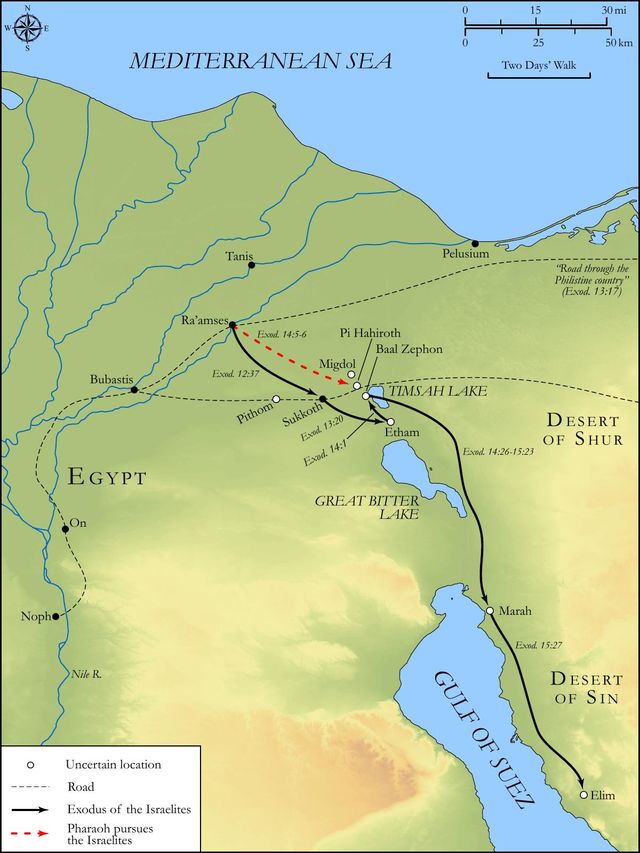
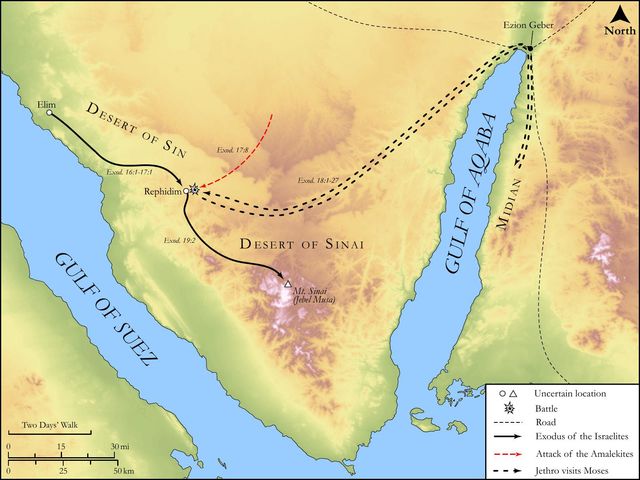
Study this verse
Public-domain commentary
Matthew Henry
From his Commentary on the Whole Bible. Henry comments on passages, not single verses — this entry covers Exodus 13:17–22. His three-level outline is real structure in the source text, so it is rendered as structure.
Here is, I. The choice God made of their way, Exo 13:17, Exo 13:18. He was their guide. Moses gave them direction but as he received it from the Lord. Note, The way of man is not in himself, Jer 10:23. He may devise his way, and design it; but, after all, it is God that directs his steps, Pro 16:9. Man proposes, but God disposes, and in his disposal we must acquiesce, and set ourselves to follow providence. There were two ways from Egypt to Canaan. One was a short cut from the north of Egypt to the south of Canaan, perhaps about four or five days' journey; the other was much further about, through the wilderness, and that was the way in which God chose to lead his people Israel, Exo 13:18. 1. There were many reasons why God led them through the way of the wilderness of the Red Sea. The Egyptians were to be drowned in the Red Sea. The Israelites were to be humbled and proved in the wilderness, Deu 8:2. God had given it to Moses for a sign (Exo 3:12), You shall serve God in this mountain. They had again and again told Pharaoh that they must go three days' journey into the wilderness to do sacrifice, and therefore it was requisite that they should bend their march that way, else they would justly have been exclaimed against as notorious dissemblers. Before they entered the lists with their enemies, matters must be settled between them and their God, laws must be given, ordinances instituted, covenants sealed, and the original contract ratified, for the doing of which it was necessary that they should retire into the solitudes of a wilderness, the only closet for such a crowd; the high road would be no proper place for these transactions. It is said (Deu 32:10), He led them about, some hundreds of miles about, and yet (Psa 107:7), He led them forth by the right way. God's way is the right way, though it seem about. If we think he leads not his people the nearest way, yet we may be sure he leads them the best way, and so it will appear when we come to our journey's end. Judge nothing before the time. 2. There was one reason why God did not lead them the nearest way, which would have brought them after a few days' march to the land of the Philistines (for it was that part of Canaan that lay next to Egypt), namely, because they were not as yet fit for war, much less for war with the Philistines, Exo 13:17. Their spirits were broken with slavery; it was not easy for them to turn their hands of a sudden from the trowel to the sword. The Philistines were formidable enemies, too fierce to be encountered by raw recruits; it was more suitable that they should begin with the Amalekites, and be prepared for the wars of Canaan by experiencing the difficulties of the wilderness. Note, God proportions his people's trials to their strength, and will not suffer them to be tempted above what they are able, Co1 10:13. That promise, if compared with the foregoing verses, will seem to refer to this event, as an instance of it. God knows our frame, and considers our weakness and faintheartedness, and by less trials will prepare us for greater. God is said to bring Israel out of Egypt as the eagle brings up her young ones (Deu 32:11), teaching them by degrees to fly. Orders being thus given which way they should go, we are told, (1.) That they went up themselves, not as a confused rout, but in good order, rank and file: they went up harnessed, Exo 13:18. They went up by five in a rank (so some), in five squadrons, so others. They marched like an army with banners, which added much to their strength and honour. (2.) That they took the bones of Joseph along with them (Exo 13:19), and probably the bones of the rest of Jacob's sons, unless (as some think) they had been privately carried to Canaan (Act 7:16), severally as they died. Joseph had particularly appointed that his bones should be carried up when God should visit the (Gen 50:25, Gen 50:26), so that their carrying up his bones was not only a performance of the oath their fathers had sworn to Joseph, but an acknowledgment of the performance of God's promise to them by Joseph that he would visit them and bring them out of the land of Egypt, and an encouragement to their faith and hope that he would fulfil the other part of the promise, which was to bring them to Canaan, in expectation of which they carried these bones with them while they wandered in the desert. They might think, "Joseph's bones must rest at last, and then we shall." Moses is said to take these bones with him. Moses was now a very great man; so had Joseph been in his day, yet he was now but a box full of dry bones; this was all that remained of him in this world, which might serve for a monitor to Moses to remember his mortality. I have said, You are gods; it was said so to Moses expressly (Exo 7:1); but you shall die like men.
II.Here is the guidance they were blessed with in the way:
The Lord went before them in a pillar, Exo 13:21, Exo 13:22. In the first two stages it was enough that God directed Moses whither to march: he knew the country and the road well enough; but now that they had come to the edge of the wilderness (Exo 13:20) they would have occasion for a guide; and a very good guide they had, one that was infinitely wise, kind, and faithful: The Lord went before them, the shechinah (or appearance of the divine Majesty, which was typical of Christ) or a previous manifestation of the eternal Word, which, in the fulness of time, was to be made flesh, and dwell among us. Christ was with the church in the wilderness, Co1 10:9. Now their King passed before them, even the Lord on the head of them, Mic 2:13. Note, Those whom God brings into a wilderness he will not leave nor lose there, but will take care to lead them through it; we may well think it was a very great satisfaction to Moses and the pious Israelites to be sure that they were under divine guidance. Those needed not to fear missing their way who were thus led, nor being lost who were thus directed; those needed not to fear being benighted who were thus illuminated, nor being robbed who were thus protected. Those who make the glory of God their end, and the word of God their rule, the Spirit of God the guide of their affections, and the providence of God the guide of their affairs, may be confident that the Lord goes before them, as truly as he went before Israel in the wilderness, though not so sensibly; we must live by faith.
1.They had sensible evidences of God's going before them. They all saw an appearance from heaven of a pillar, which in the bright day appeared cloudy, and in the dark night appeared fiery. We commonly see that that which is a flame in the night is a smoke in the day; so was this. God gave them this ocular demonstration of his presence, in compassion to the infirmity of their faith, and in compliance with that infant state of the church, which needed to be thus lisped to in their own language; but blessed are those that have not seen and yet have believed God's gracious presence with them, according to his promise.
2.They had sensible effects of God's going before them in this pillar. For,
(1.)It led the way in that vast howling wilderness, in which there was no road, no track, no way-mark, of which they had no maps, through which they had no guides. When they marched, this pillar went before them, at the rate that they could follow, and appointed the place of their encampment, as Infinite Wisdom saw fit, which both eased them from care, and secured them from danger, both in moving and in resting.
(2.)It sheltered them by day from the heat, which, at some times of the year, was extreme.
(3.)It gave them light by night when they had occasion for it, and at all times made their camp pleasant and the wilderness they were in less frightful.
III.These were constant standing miracles (Exo 13:22):
He took not away the pillar of cloud; no, not when they seemed to have less occasion for it, travelling through inhabited countries, no, not when they murmured and were provoking; it never left them, till it brought them to the borders of Canaan. It was a cloud which the wind could not scatter. This favour is acknowledged with thankfulness long afterwards, Neh 9:19; Psa 78:14. There was something spiritual in this pillar of cloud and fire.
1.The children of Israel were baptized unto Moses in this cloud, which, some think, distilled dew upon them, Co1 10:2. By coming under this cloud, they signified their putting themselves under the divine guidance and command by the ministry of Moses. Protection draws allegiance; this cloud was the badge of God's protection, and so became the bond of their allegiance. Thus they were initiated, and admitted under that government, now when they were entering upon the wilderness.
2.Some make this cloud a type f Christ. The cloud of his human nature was a veil to the light and fire of his divine nature; we find him (Rev 10:1) clothed with a cloud, and his feet as pillars of fire. Christ is our way, the light of our way and the guide of it.
3.It signified the special guidance and protection which the church of Christ is under in this world. God himself is the keeper of Israel, and he neither slumbers nor sleeps, Psa 121:4; Isa 27:3. There is a defence created, not only on Sion's assemblies, but on every dwelling-place in Sion. See Isa 4:5, Isa 4:6. Nay, every Israelite indeed is hidden under the shadow of God's wings (Psa 17:8); angels, whose ministry was made use of in this cloud, are employed for their good, and pitch their tents about them. Happy art thou, O Israel! who is like unto thee, O people?
Historical interpretation
Three Centuries of Reception
4 surviving comments on this verse. Each one is dated, so this reads as a timeline rather than a list.
Select a marker to jump to its quote. Markers stagger vertically where authors wrote within a few decades of each other.
Who can doubt that here too God appeared to the eyes of mortal men by a corporeal creature made subject to him and not by his own substance? But it is also not apparent whether it was the Father, or the Son, or the Holy Spirit, or the Trinity itself, the one God. Nor, as far as I can judge, has this distinction been made in that place where it is written: “And the glory of the Lord appeared in the cloud, and the Lord spoke to Moses saying, ‘I have heard the grumbling of the children of Israel.’ ”
At one time he appears all aglow in a bush. For you are cold with the perfidy of infidelity, and he wants to enkindle you with the heat of faith. At another time he glows like fire in a pillar extending toward heaven, that the darkness of your ignorance may be removed and that you can follow the way of saving knowledge through the wilderness of this world. At yet another time he is changed for you into a pillar of cloud, in order to restrain the burning ebullience of your passions.
It was also fitting that a pillar of fire preceded the Israelites as they progressed through the desert during the night and a pillar of a cloud during the day. There is dread in fire but a gentle soothing quality in the sight of a cloud. “Day” is understood to point toward the life of the righteous and “night” that of the sinner. Hence Paul said to sinners who had been converted, “You were once darkness but are now light in the Lord.” The pillar was revealed as a cloud during the day and as a fire during the night since almighty God will appear soothing to the righteous and dreadful to the unrighteous. When he comes at the judgment, he will reassure the former by his gentleness and mildness and cause dread in the latter by the strictness of his justice.
The freeing of the children of Israel and their being brought out into the fatherland once promised them is also linked with the mystery of our redemption. By means of it we make our way to the light of the dwelling place on high with the grace of Christ lighting our way and guiding us. That cloud and column of fire that both protected them throughout the whole of their journey from the darkness of the nights and led them by a sure path to the promised homes of the fatherland also prefigured the light of this grace.
Continue studying Exodus 13:21 across the web’s major study libraries — every link below opens this exact verse, chapter, or book on the destination site.
Read & Compare
 BibleGatewayThis verse in more than 200 translations and 70 languages.
 Bible.comThe YouVersion reader — hundreds of translations, reading plans, and highlights.
 ESV.orgCrossway's official English Standard Version reader.
 NET BibleThe NET translation with 60,000+ translators' notes on every rendering decision.
 STEP BibleTyndale House's free study tool — original text, vocabulary, and scholarly resources.
 BibliaLogos Bible Software's free web reader.
 USCCBThe New American Bible (Revised Edition) with the U.S. bishops' study notes.
Commentaries
 BibleHub CommentariesDozens of classic commentaries on this verse, gathered on one page.
 StudyLightMore than 100 commentary sets — the largest collection on the web.
 BibleRefPlain-English commentary on what this verse means, verse by verse.
 Enduring WordDavid Guzik's free commentary on this chapter, widely used by Bible teachers.
 Bible Study ToolsVerse commentary alongside Greek and Hebrew study aids.
Original Language & Research
- BibleHub InterlinearThe verse word by word — original language, transliteration, and English.
- BibleHub LexiconEvery word's original-language definition and Strong's entry.
 Blue Letter BibleDeep-study tools — Strong's numbers, concordance, and word studies.
 SefariaThe Hebrew text with Rashi and centuries of Jewish commentary.
Sermons, Hymns & Audio


TrulyRandomVerse is not affiliated with these sites and doesn’t control their content. They’re linked because they’re genuinely useful.
Summary
Exodus 13:21 powerfully illustrates God's direct, personal, and unwavering guidance of the Israelites following their liberation from Egypt. Through the miraculous manifestation of a pillar of cloud by day and a pillar of fire by night, the LORD visibly demonstrated His constant presence, leading His people through the perilous wilderness, providing essential protection, and assuring them of His perpetual watchfulness and care, enabling them to travel continuously.
Context
ShowHideLiterary Context
This pivotal verse immediately follows the momentous Exodus from Egypt and the institution of the Passover, marking the beginning of Israel's journey as a newly formed nation. Having just witnessed God's devastating tenth plague against Egypt and their subsequent release, the Israelites, a vast and vulnerable multitude, were embarking on an uncharted path into the wilderness. The preceding verses (Exodus 13:17-20) explain God's strategic decision not to lead them by the shortest route through Philistine territory, which would have exposed them to immediate warfare, but rather "by the way of the wilderness toward the Red Sea." The appearance of the pillar is thus presented as God's immediate, practical, and miraculous solution to guide them on this divinely chosen, longer route, emphasizing His direct involvement in their every step.
Historical & Cultural Context
Among the nations of that day, kings and leaders often led their armies or peoples into battle or migration, sometimes with standards or banners. This visible manifestation of God's presence as a pillar served as a tangible and unmistakable sign of His divine kingship and active leadership over Israel. For a newly freed, disoriented, and largely unorganized multitude, the wilderness presented immense dangers: extreme climate (scorching sun by day, cold nights), scarcity of water and food, and the constant threat of hostile nomadic tribes. A visible, constant guide like the pillar would have been profoundly reassuring, addressing their deep-seated fears of getting lost, facing unknown dangers, or being abandoned. It was a direct, divine response to the practical and psychological needs of a people transitioning from slavery to nationhood, demonstrating that their God was truly "with them" and actively providing for their every need.
Key Themes
ShowHideExodus 13:21 contributes significantly to several major theological and narrative themes prevalent throughout the book of Exodus and the Pentateuch. Foremost among these is God's faithfulness to His covenant promises, particularly those made to Abraham, to make his descendants a great nation and lead them to a promised land. The pillar is a tangible expression of God's immanence and active presence among His people, demonstrating that He is not a distant deity but one who intimately involves Himself in their daily lives and journey. It also highlights God's sovereignty and providential care, showing that He directs their steps, provides for their physical needs (shade, light, warmth), and protects them from harm. This divine guidance is a recurring motif, seen earlier in God's leading of Abraham and later in the detailed instructions for the Tabernacle, where God's glory would dwell among them. The pillar's role as a constant guide underscores God's commitment to His people's ultimate destination and His continuous provision for their journey, a theme that echoes throughout the wilderness narratives, such as in Numbers 9.
Exposition and Analysis
ShowHideExodus 13:21 presents a profound picture of divine immanence and guidance, meticulously detailing the nature of God's presence.
Key Word Analysis
ShowHideThis is the sacred Tetragrammaton (YHWH), God's personal, covenantal name (H3068). Its use here underscores that it was not a generic deity but the specific God who had made promises to Abraham, Isaac, and Jacob. This name emphasizes His faithfulness to His covenant and His unique, intimate relationship with Israel, signifying His self-existent and eternal nature.
This primitive root (H1980) signifies "to walk" in a great variety of applications, both literally and figuratively. Here, it emphasizes God's active, personal, and pioneering leadership. He wasn't merely observing or sending an angel; He Himself was physically leading the way, demonstrating His commitment to His people's journey and His intimate involvement in their daily lives.
This term (H5982) refers to a column or standing support. Its usage here suggests a visible, stable, and unmistakable structure. It was not an ephemeral mist or fleeting light, but a solid, reliable, and unmistakable sign of God's leadership, providing a focal point for the entire camp, a constant and tangible reminder of His presence.
Verse Breakdown
ShowHide"And the LORD went before them"
This opening clause immediately establishes God's initiative and active role. He is not a distant deity but one who personally takes the lead, indicating His sovereign control over their journey and His commitment to His covenant people.
"by day in a pillar of a cloud, to lead them the way;"
During the daytime, the pillar took the form of a cloud. This provided crucial shade from the intense desert sun, making travel more bearable and protecting them from heatstroke. More importantly, it served as their primary navigational guide, directing their path through the trackless wilderness, ensuring they followed God's chosen route.
"and by night in a pillar of fire, to give them light;"
At night, the cloud transformed into a pillar of fire. This provided essential light for their encampments, allowing them to travel even after sundown if necessary. It also offered warmth against the often-cold desert nights and served as a visible reassurance against the darkness, dangers, and fear of the unknown in the wilderness.
"to go by day and night"
This concluding phrase emphasizes the ceaseless nature of God's guidance and provision. His presence was not intermittent but continuous, ensuring that the Israelites never had to wonder if God was still with them or if they were on the right path. This perpetual presence allowed them to travel whenever needed, assuring them of His unceasing watchfulness and care.
Literary Devices
ShowHideThe dual nature of the pillar—a cloud by day and fire by night—is a powerful metaphor for God's comprehensive and adaptive care. It illustrates His ability to meet diverse needs—shade from the scorching sun, light and warmth in the darkness—all stemming from His singular, unwavering presence. The parallelism of "by day in a pillar of a cloud" and "by night in a pillar of fire" highlights the continuous and complementary aspects of His guidance, emphasizing His constant and perfect provision tailored to the specific needs of each moment. This consistent presence also functions as a powerful symbolism of God's covenant faithfulness and His immanent dwelling among His people.
Theological and Thematic Connections
ShowHideThis verse powerfully teaches several core theological truths. It reveals God's immanence—His active presence and intimate involvement in human history—and His unwavering faithfulness to His covenant promises. The pillar demonstrates God's sovereign guidance, showing that He directs the steps of His people, even through challenging and unknown environments. It underscores His providence, providing for their physical needs (shade, light, warmth) and their spiritual need for assurance and direction. This divine manifestation also foreshadows the ultimate dwelling of God with humanity, a theme that culminates in the incarnation of Christ.
This theme of God's guiding presence resonates throughout the biblical narrative. From His walking with Adam and Eve in the Garden of Eden to His dwelling among Israel in the Tabernacle and later the Temple, God consistently desires to be present with His people. The pillar of cloud and fire is a preeminent example of this divine desire for intimate communion and active leadership, a tangible sign of His commitment to His chosen nation.
Reflection and Application
ShowHideFor believers today, Exodus 13:21 serves as a profound and comforting reminder of God's continued desire to guide and protect His people. While we no longer see a literal pillar of cloud and fire, the underlying principle of God's constant presence and unfailing guidance remains true. We are now led by His inspired Word, which illuminates our path and provides wisdom, and by the indwelling Holy Spirit, who convicts, teaches, comforts, and directs us from within. This verse encourages us to cultivate a deep trust in God's presence, especially during times of uncertainty, transition, or "wilderness experiences" in our lives. It assures us that just as He faithfully led Israel through the unknown, He is always with us, leading us day and night, fulfilling His promise to never leave us nor forsake us (Hebrews 13:5). Our task is to remain attentive to His leading, whether through His Word, His Spirit, or the wise counsel of His community.
Questions for Reflection
ShowHideFAQ
ShowHideWas the pillar a literal cloud and fire, or was it symbolic?
ShowHideThe biblical text consistently describes the pillar in very literal terms, as a physical manifestation that could be seen by the entire Israelite camp and later by the Egyptians (Exodus 14:19-20). It provided tangible benefits such as shade, light, and guidance, suggesting a real, observable phenomenon rather than a mere symbolic representation. While it was undoubtedly a miraculous sign, it functioned as a concrete, physical guide for the Israelites.
Did the pillar move constantly, or only when Israel moved?
ShowHideThe pillar's movement dictated the movement of the Israelite camp. When the pillar lifted, Israel broke camp and moved; when it settled, they encamped (Numbers 9:17-23). Its continuous presence "by day and night" means it was always there, visible and present, but its movement was tied directly to God's command for Israel to travel or rest. It was their divine GPS, always on, but only moving when God intended them to.
How could such a large pillar of fire not cause issues (e.g., blinding light at night, excessive heat)?
ShowHideThe Bible describes this as a divine manifestation, a miracle that operated outside typical natural laws. While it provided light and warmth, it was clearly controlled by God in a way that served, rather than harmed, the Israelites. Its purpose was guidance and protection, not to be a source of discomfort or danger to them. God's power is such that He can manifest His presence in ways that defy natural limitations, perfectly calibrated to meet the needs of His people without adverse effects.
Christ-Centered Fulfillment
ShowHideThe pillar of cloud and fire in the Old Testament serves as a powerful and profound foreshadowing of God's ultimate dwelling among His people in the person of Jesus Christ. Just as the pillar was God's visible presence leading Israel through the wilderness, Jesus is Emmanuel, "God with us," the very embodiment of divine immanence. He is the ultimate fulfillment of God's desire to lead and be present with His people. This is evident in His Divine Presence and Guidance: The pillar was God's physical presence leading His people through a desolate land. In the New Testament, Jesus is the ultimate manifestation of God's presence, the very "image of the invisible God" (Colossians 1:15). He declares Himself to be "the way, the truth, and the life" (John 14:6), the definitive and perfect guide for humanity through the wilderness of sin and earthly life. Furthermore, He provides Light and Protection: The pillar of fire provided light and protection in the darkness of the desert nights. Jesus proclaimed, "I am the light of the world. Whoever follows me will not walk in darkness, but will have the light of life" (John 8:12). He protects His sheep from danger and guides them to spiritual nourishment and safety, embodying the role of the Good Shepherd. Finally, His Continuous Leadership mirrors the pillar's "day and night" presence, signifying uninterrupted guidance and care. After His ascension, Jesus promised His disciples the Holy Spirit, who would be their "Helper" and "Guide into all truth" (John 16:13). The Holy Spirit, sent by Christ, continues the work of divine guidance and presence within believers, fulfilling the continuous, intimate leading that the pillar symbolized. Thus, Christ, through His Spirit, remains our constant, faithful guide, just as the LORD led Israel, ensuring we are never left to navigate life's challenges alone.