


Genesis 28:15
- וְהִנֵּהve·hi·Nehand here!H2009Conj-w ¦ PrtParticle Interjectionוְandהִנֵּהhere!
- אָנֹכִי'a·no·KhiIH595Pro-1csPronoun Personal 1st Singular common gender
- עִמָּךְ'i·Makh[am] with youH5973Prep ¦ 2msPreposition Definiteעִמָּ[am] withךְyou
- וּשְׁמַרְתִּיךָu·she·mar·Ti·khaand I will protect youH8104Conj-w ¦ V-Qal-ConsecPerf-1cs ¦ 2msVerb Qal Consecutive Perfect 1st Singular common genderוּandשְׁמַרְתִּיI will protectךָyou
- בְּכֹלbe·Kholin everyH3605Prep-b ¦ N-msNoun Singular Masculine Absoluteבְּinכֹלevery
- אֲשֶׁר'a·SherwhereH834RelParticle Relative
- תֵּלֵךְte·Lekhyou will goH1980V-Qal-Imperf-2msVerb Qal Imperfect 2nd Singular Masculine
- וַהֲשִׁבֹתִיךָva·ha·Shi·vo·Ti·khaand I will bring back youH7725Conj-w ¦ V-Hiphil-ConsecPerf-1cs ¦ 2msVerb Hiphil Consecutive Perfect 1st Singular common genderוַandהֲשִׁבֹתִיI will bring backךָyou
- אֶל'eltoH413PrepPreposition
- הָאֲדָמָהha·'a·da·Mahthe landH127Art ¦ N-fsNoun Singular Feminine Absoluteהָtheאֲדָמָהland
- הַזֹּאתha·Zot<the> thisH2063Art ¦ PrtParticle Demonstrativeהַ<the>זֹּאתthis
- כִּיkiforH3588PrtParticle Conditional
- לֹאlo'notH3808NegParticle Negative
- אֶעֱזָבְךָ'e·'e·za·ve·KhaI will abandon youH5800V-Qal-Imperf-1cs ¦ 2msVerb Qal Imperfect 1st Singular common genderאֶעֱזָבְI will abandonךָyou
- עַד'aduntilH5704PrepPreposition
- אֲשֶׁר'a·SherthatH834RelParticle Relative
- אִם'im<if>H518PrtParticle Conditional
- עָשִׂיתִי'a·Si·tiI have doneH6213V-Qal-Perf-1csVerb Qal Perfect 1st Singular common gender
- אֵת'et<obj.>H853DirObjMParticle Object Indicator
- אֲשֶׁר'a·Sher[that] whichH834RelParticle Relative
- דִּבַּרְתִּיdi·Bar·tiI have spokenH1696V-Piel-Perf-1csVerb Piel Perfect 1st Singular common gender
- לָךְLakhto <the> youPrep-l ¦ 2msSuffix Personal 2nd Singular Masculineלָto <the>ךְyou
English is a literal word-by-word gloss of the Hebrew, not the KJV's wording. Why?
This is the original text the KJV's translators worked from — each Hebrew word with its own literal English meaning in this verse, prepared by scholars at Tyndale House, Cambridge. The KJV translates whole sentences, not word by word, so its wording differs: one Hebrew word can become several English words, and the KJV may choose “the LORD” where the gloss reads “Yahweh”. Both are faithful — they answer different questions. For the KJV's own rendering, switch to the KJV text.
Details
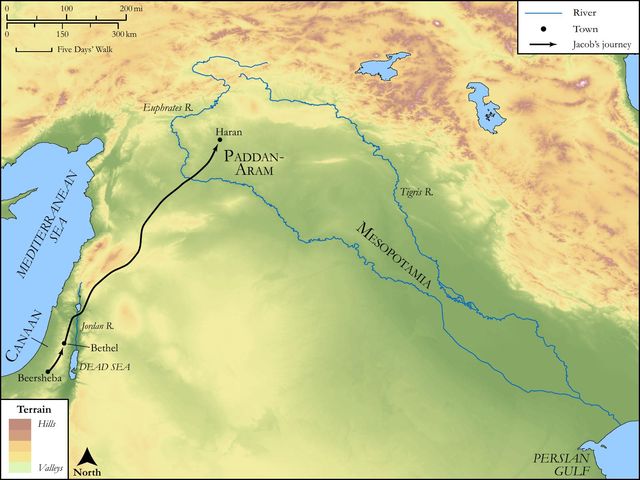
See on the biblical-era maps


Study this verse
Public-domain commentary
Matthew Henry
From his Commentary on the Whole Bible. Henry comments on passages, not single verses — this entry covers Genesis 28:10–15. His four-level outline is real structure in the source text, so it is rendered as structure.
We have here Jacob upon his journey towards Syria, in a very desolate condition, like one that was sent to seek his fortune; but we find that, though he was alone, yet he was not alone, for the Father was with him, Joh 16:32. If what is here recorded happened (as it should seem it did) the first night, he had made a long day's journey from Beersheba to Bethel, above forty miles. Providence brought him to a convenient place, probably shaded with trees, to rest himself in that night; and there he had,
I.A hard lodging (Gen 28:11), the stones for his pillows, and the heavens for his canopy and curtains.
As the usage then was, perhaps this was not so bad as it seems how to us; but we should think,
1.He lay very cold, the cold ground for his bed, and, which one would suppose made the matter worse, a cold stone for his pillow, and in the cold air.
2.Very uneasy. If his bones were sore with his day's journey, his night's rest would but make them sorer.
3.Very much exposed. He forgot that he was fleeing for his life; or had his brother, in his rage, pursued, or sent a murderer after him, here he lay ready to be sacrificed, and destitute of shelter and defence. We cannot think it was by reason of his poverty that he was so ill accommodated, but,
(1.)It was owing to the plainness and simplicity of those times, when men did not take so much state, and consult their ease so much, as in these later times of softness and effeminacy.
(2.)Jacob had been particularly used to hardships, as a plain man dwelling in tents; and, designing now to go to service, he was the more willing to inure himself to them; and, as it proved, it was well, Gen 31:40.
(3.)His comfort in the divine blessing, and his confidence in the divine protection, made him easy, even when he lay thus exposed; being sure that his God made him to dwell in safety, he could lie down and sleep upon a stone.
II.In his hard lodging he had a pleasant dream.
Any Israelite indeed would be willing to take up with Jacob's pillow, provided he might but have Jacob's dream. Then, and there, he heard the words of God, and saw the visions of the Almighty. It was the best night's sleep he ever had in his life. Note, God's time to visit his people with his comforts is when they are most destitute of other comforts, and other comforters; when afflictions in the way of duty (as these were) do abound, then shall consolations so much the more abound. Now observe here,
1.The encouraging vision Jacob saw, Gen 28:12. He saw a ladder which reached from earth to heaven, the angels ascending and descending upon it, and God himself at the head of it. Now this represents the two things that are very comfortable to good people at all times, and in all conditions: - (1.) The providence of God, by which there is a constant correspondence kept up between heaven and earth. The counsels of heaven are executed on earth, and the actions and affairs of this earth are all known in heaven are executed on earth, and the actions and affairs of this earth are all known in heaven and judged there. Providence does its work gradually, and by steps. Angels are employed as ministering spirits, to serve all the purposes and designs of Providence, and the wisdom of God is at the upper end of the ladder, directing all the motions of second causes to the glory of the first Cause. The angels are active spirits, continually ascending and descending; they rest not, day nor night, from service, according to the posts assigned them. They ascend, to give account of what they have done, and to receive orders; and then descend, to execute the orders they have received. Thus we should always abound in the work of the Lord, that we may do it as the angels do it, Psa 103:20, Psa 103:21. This vision gave very seasonable comfort to Jacob, letting him know that he had both a good guide and a good guard, in his going out and coming in, - that, though he was made to wander from his father's house, yet still he was the care of a kind Providence, and the charge of the holy angels. This is comfort enough, though we should not admit the notion which some have, that the tutelar angels of Canaan were ascending, having guarded Jacob out of their land, and the angels of Syria descending to take him into their custody. Jacob was now the type and representative of the whole church, with the guardianship of which the angels are entrusted. (2.) The mediation of Christ. He is this ladder, the foot on earth in his human nature, the top in heaven in his divine nature: or the former in his humiliation, the latter in his exaltation. All the intercourse between heaven and earth, since the fall, is by this ladder. Christ is the way; all God's favours come to us, and all our services go to him, by Christ. If God dwell with us, and we with him, it is by Christ. We have no way of getting to heaven, but by this ladder; if we climb up any other way we are thieves and robbers. To this vision our Saviour alludes when he speaks of the angels of God ascending and descending upon the son of man (Joh 1:51); for the kind offices the angels do us, and the benefits we receive by their ministration, are all owing to Christ, who has reconciled things on earth and things in heaven (Col 1:20), and made them all meet in himself, Eph 1:10.
2.The encouraging words Jacob heard. God now brought him into the wilderness, and spoke comfortably to him, spoke from the head of the ladder; for all the glad tidings we receive from heaven come through Jesus Christ.
(1.)The former promises made to his father were repeated and ratified to him, Gen 28:13, Gen 28:14. In general, God intimated to him that he would be the same to him that he had been to Abraham and Isaac. Those that tread in the steps of their godly parents are interested in their covenant and entitled to their privileges. Particularly,
[1.]The land of Canaan is settled upon him, the land whereon thou liest; as if by his lying so contentedly upon the bare ground he had taken livery and seisin of the whole land.
[2.]It is promised him that his posterity should multiply exceedingly as the dust of the earth - that, though he seemed now to be plucked off as a withered branch, yet he should become a flourishing tree, that should send out his boughs unto the sea. These were the blessings with which his father had blessed him (Gen 28:3, Gen 28:4), and God here said Amen to them, that he might have strong consolation.
[3.]It is added that the Messiah should come from his loins, in whom all the families of the earth should be blessed. Christ is the great blessing of the world. All that are blessed, whatever family they are of, are blessed in him, and none of any family are excluded from blessedness in him, but those that exclude themselves.
(2.)Fresh promises were made him, accommodated to his present condition, Gen 28:15.
[1.]Jacob was apprehensive of danger from his brother Esau; but God promises to keep him. Note, Those are safe whom god protects, whoever pursues them.
[2.]He had now a long journey before him, had to travel alone, in an unknown road, to an unknown country; but, behold, I am with thee, says God. Note, Wherever we are, we are safe, and may be easy, if we have God's favourable presence with us.
[3.]He knew not, but God foresaw, what hardships he should meet with in his uncle's service, and therefore promises to preserve him in all places. Note, God knows how to give his people graces and comforts accommodated to the events that shall be, as well as to those that are.
[4.]He was now going as an exile into a place far distant, but God promises him to bring him back again to this land. Note, He that preserves his people's going out will also take care of their coming in, Psa 121:8.
[5.]He seemed to be forsaken of all his friends, but God here gives him this assurance, I will not leave thee. Note, Whom God loves he never leaves. This promise is sure to all the seed, Heb 13:5.
[6.]Providences seemed to contradict the promises; he is therefore assured of the performance of them in their season: All shall be done that I have spoken to thee of. Note, Saying and doing are not two things with God, whatever they are with us.
Continue studying Genesis 28:15 across the web’s major study libraries — every link below opens this exact verse, chapter, or book on the destination site.
Read & Compare
 BibleGatewayThis verse in more than 200 translations and 70 languages.
 Bible.comThe YouVersion reader — hundreds of translations, reading plans, and highlights.
 ESV.orgCrossway's official English Standard Version reader.
 NET BibleThe NET translation with 60,000+ translators' notes on every rendering decision.
 STEP BibleTyndale House's free study tool — original text, vocabulary, and scholarly resources.
 BibliaLogos Bible Software's free web reader.
 USCCBThe New American Bible (Revised Edition) with the U.S. bishops' study notes.
Commentaries
 BibleHub CommentariesDozens of classic commentaries on this verse, gathered on one page.
 StudyLightMore than 100 commentary sets — the largest collection on the web.
 BibleRefPlain-English commentary on what this verse means, verse by verse.
 Enduring WordDavid Guzik's free commentary on this chapter, widely used by Bible teachers.
 Bible Study ToolsVerse commentary alongside Greek and Hebrew study aids.
Original Language & Research
- BibleHub InterlinearThe verse word by word — original language, transliteration, and English.
- BibleHub LexiconEvery word's original-language definition and Strong's entry.
 Blue Letter BibleDeep-study tools — Strong's numbers, concordance, and word studies.
 SefariaThe Hebrew text with Rashi and centuries of Jewish commentary.
Sermons, Hymns & Audio


TrulyRandomVerse is not affiliated with these sites and doesn’t control their content. They’re linked because they’re genuinely useful.
Summary
Genesis 28:15 records God's profound assurance to Jacob during his transformative vision at Bethel, promising His unwavering presence, divine protection throughout his perilous journey, and an eventual, guaranteed return to the promised land. This pivotal verse underscores God's steadfast faithfulness to His covenant, declaring with absolute certainty that He will not abandon Jacob until every promise spoken to him is fully accomplished.
Context
ShowHideLiterary Context
Genesis 28:15 stands as the climax of God's direct address to Jacob following his dream of a ladder reaching to heaven. This divine encounter, detailed in Genesis 28:10-22, occurs immediately after Jacob's flight from Beer-sheba, necessitated by his deception of Isaac and the ensuing wrath of Esau (Genesis 27:41-45). The preceding verses (Genesis 28:13-14) establish the reaffirmation of the Abrahamic covenant promises—land, descendants, and universal blessing—to Jacob personally. Verse 15 then shifts from the what of the promises to the how and who of their fulfillment, emphasizing God's personal commitment, presence, and protection as the guarantor of these promises for Jacob's immediate journey and ultimate destiny.
Historical & Cultural Context
Jacob's journey to Haran was a perilous undertaking in that day. Traveling alone through wilderness, he faced dangers from wild animals, bandits, and the harsh elements. The cultural norm of the time dictated that a man's future, including marriage and inheritance, was tied to his ancestral land and family. Jacob, stripped of his immediate family support and fleeing his homeland, was in a vulnerable and uncertain position. His dream at Bethel, a desolate place, provided not just spiritual comfort but also a divine legitimization of his lineage and a supernatural assurance of safety and return, counteracting the very real fears and dangers of his exile. This encounter also served to establish Bethel as a sacred site, a "house of God," for future generations.
Key Themes
ShowHideThis verse powerfully reinforces several overarching themes found throughout Genesis and the broader Pentateuch. It highlights God's Covenant Faithfulness, demonstrating His unwavering commitment to the promises made to Abraham and Isaac, now personally extended to Jacob, ensuring the continuity of the chosen lineage. The theme of Divine Presence and Providence is central, assuring Jacob that God is not a distant deity but an active, accompanying, and protective force in his life, orchestrating events even in his exile to fulfill His purposes. Furthermore, it speaks to Hope in Exile and Uncertainty, providing profound comfort and direction to an individual facing a daunting and uncertain future, a theme that resonates with the experiences of Israel throughout its history, from the Egyptian bondage to the Babylonian exile.
Exposition and Analysis
ShowHideKey Word Analysis
ShowHideMeaning "to hedge about (as with thorns), i.e. guard; generally, to protect, attend to, etc." In this context, God's promise to "keep" Jacob signifies His active, vigilant guardianship over him. It implies a comprehensive protection that encompasses physical safety, spiritual preservation, and the safeguarding of Jacob's life and purpose against all harm, ensuring he remains on the path to fulfill God's will.
Meaning "to loosen, i.e. relinquish, permit, etc.; commit self, fail, forsake, fortify, help, leave (destitute, off), refuse." The powerful negation "I will not leave thee" underscores God's absolute commitment and unwavering constancy. It assures Jacob that God's presence and support are not temporary or conditional, but steadfast until His divine purposes are fully realized, emphasizing an unbreakable bond and covenant fidelity.
Meaning "perhaps properly, to arrange; but used figuratively (of words), to speak; rarely (in a destructive sense) to subdue." This word highlights the authoritative and performative nature of God's word. What God "has spoken" is not merely a suggestion or a wish, but a divine decree that carries the power and certainty of its own fulfillment. It emphasizes God's integrity and His commitment to bring to pass every declaration He has made concerning Jacob and his descendants.
Verse Breakdown
ShowHide"And, behold, I [am] with thee"
This opening phrase, marked by the emphatic "behold" (וְהִנֵּה - vəhinnēh), immediately arrests Jacob's attention. The declaration "I am with thee" (אָנֹכִי עִמָּךְ - ʾānōḵî ʿimmāḵ) is a deeply personal and foundational assurance of God's intimate, active, and accompanying presence. For Jacob, a man isolated, vulnerable, and fleeing, this promise of divine companionship provides immediate comfort and profound courage, signaling that he is not alone in his exile.
"and will keep thee in all [places] whither thou goest"
God's intimate presence is immediately linked to His protective power. The promise to "keep" (שָׁמַר - shamar) implies guarding, preserving, and watching over. This comprehensive protection extends to "all places," assuring Jacob that no matter how far he travels or what dangers he encounters on his journey, God's protective hand will be upon him, covering both physical perils and spiritual challenges.
"and will bring thee again into this land"
This specific promise reiterates a core aspect of the Abrahamic covenant—the inheritance of the land of Canaan. Despite Jacob's immediate departure from the land, God guarantees his return. This demonstrates God's sovereign control over Jacob's destiny and His unwavering faithfulness to His long-term covenantal purposes, ensuring the continuity of the covenant line within the promised territory.
"for I will not leave thee, until I have done [that] which I have spoken to thee of"
This concluding clause underscores God's absolute commitment and unwavering faithfulness. The phrase "I will not leave thee" (לֹא אֶעֱזָבְךָ - loʾ ʾeʿezavəḵa) is a strong negation, emphasizing divine constancy. God's presence and protection are not conditional or temporary; they are steadfast until His entire purpose for Jacob's life, and the covenant line through him, is fully realized. This promise guarantees the fulfillment of all previous declarations, including the multiplication of his descendants and the blessing of all families of the earth through them.
Literary Devices
ShowHideThe verse employs several powerful literary devices to convey its profound message. The opening interjection, "And, behold," serves as a dramatic emphasis, drawing Jacob's (and the reader's) immediate and focused attention to the divine declaration that follows, highlighting its extraordinary significance. The entire verse functions as a direct divine assurance and promise, characteristic of covenant language, where God explicitly states His intentions and commitments. The comprehensive nature of God's promise, covering "all places" and lasting "until I have done that which I have spoken," demonstrates hyperbole or totality, emphasizing the completeness and unwavering scope of God's protective care and faithfulness. Finally, the repetition of the themes of presence, protection, and fulfillment throughout the verse, particularly the strong negative "I will not leave thee," creates a sense of reiteration and reinforcement, solidifying the certainty and unchangeable nature of God's word.
Theological and Thematic Connections
ShowHideGenesis 28:15 is a profound theological statement, revealing God's character and His method of interacting with humanity within the framework of His covenant. It powerfully illustrates God's immanence—His willingness to be intimately involved in human affairs—and His omnipresence, affirming that no place is beyond His reach or care. The verse serves as a powerful testament to God's unwavering covenant faithfulness, demonstrating His commitment to the promises made to His chosen people, ensuring the continuity of His redemptive plan through a specific lineage. Furthermore, it highlights God's active sovereignty and providence, showing His explicit control over Jacob's journey, his protection, and his guaranteed return to the land, illustrating God's orchestration of events to fulfill His predetermined purposes. This promise offers a profound theological truth: God's presence and protection are especially potent during times of fear, exile, and transition, offering comfort and assurance to those facing uncertain futures, and underscoring the unconditional nature of God's promises—they are guaranteed by His own character and power, not by human performance.
Reflection and Application
ShowHideGenesis 28:15 offers enduring comfort and strength to believers navigating life's unpredictable journeys. Like Jacob, we often find ourselves in unfamiliar or challenging circumstances, facing uncertainty, fear, or a sense of isolation. This verse reminds us that God's promise to be "with thee" is a cornerstone of our faith, assuring us of His constant presence, protective care, and faithful guidance through every season. We can confidently trust that He will never abandon us, but will faithfully work to accomplish His purposes in our lives, bringing us to our ultimate promised destination, until all His good intentions for us are fulfilled. This divine assurance calls us to live with courage, knowing that even when we feel most alone, the Creator of the heavens and the earth is intimately present, guarding our steps and guiding our path toward the fulfillment of His perfect will. Our response should be one of trust and obedience, resting in the absolute reliability of His spoken word.
Questions for Reflection
ShowHideFAQ
ShowHideWhat is the significance of the phrase "I am with thee" in this context?
ShowHideThe phrase "I am with thee" (אָנֹכִי עִמָּךְ) is a deeply personal and foundational promise of God's active, accompanying presence. In Jacob's vulnerable state, fleeing his brother and entering the unknown, this declaration signifies that he is not alone. It assures him of divine companionship, comfort, and active support, establishing a personal relationship between God and Jacob that underpins all subsequent promises. This promise is a recurring theme throughout Scripture, offering comfort to God's people in various challenging situations, as seen in Exodus 3:12 and Joshua 1:5.
Why does God specifically promise to "bring thee again into this land"?
ShowHideThis promise is crucial because it directly reiterates and reaffirms a key component of the Abrahamic covenant: the inheritance of the land of Canaan. Despite Jacob's immediate departure, God assures him of his return, demonstrating His sovereign control over Jacob's destiny and His unwavering commitment to fulfilling His long-term covenantal purposes, which included establishing a nation in that specific territory through Jacob's descendants. This particular promise ensures the continuity of the covenant lineage within the promised land, a vital element for the future unfolding of God's redemptive plan for Israel and, ultimately, for all nations.
How does God's promise "I will not leave thee, until I have done that which I have spoken to thee of" demonstrate His character?
ShowHideThis powerful statement reveals God's absolute faithfulness, unwavering commitment, and divine integrity. It emphasizes that God's promises are not conditional on human performance but are guaranteed by His own character and power. It highlights His steadfastness, ensuring that He will see His purposes through to completion, never abandoning those to whom He has made a covenant until every word spoken is fully realized. This aspect of God's character, His unchangeable faithfulness to His word, is a cornerstone of biblical theology, providing immense assurance to believers across all generations, as echoed in passages like Numbers 23:19 and Isaiah 55:11.
Christ-Centered Fulfillment
ShowHideThe divine promise of unwavering presence and ultimate fulfillment in Genesis 28:15 finds its ultimate and most profound fulfillment in Jesus Christ. While God promised to be with Jacob, in Christ, God became Immanuel—"God with us" (Matthew 1:23). Jesus's incarnation is the supreme expression of God's promise never to leave or forsake His people (Hebrews 13:5), providing not just a physical presence but a spiritual indwelling through the Holy Spirit. Through His sacrificial death and glorious resurrection, Christ secured a New Covenant, guaranteeing not merely a return to a physical land, but eternal life and entrance into the heavenly Jerusalem, the true promised land, for all who believe (Hebrews 12:22). His ascension and the sending of the Holy Spirit ensure His continued presence with believers "always, even unto the end of the world" (Matthew 28:20), fulfilling God's commitment to complete all He has spoken for His people, bringing them into their eternal inheritance in Him.