


Genesis 28:14
Bible text: King James Version (1769 Blayney text) · Public domain
Bible text: King James Version with Strong's numbers · Public domain
Bible text: Berean Standard Bible · Public domain
Bible text: American Standard Version (1901) · Public domain
Bible text: World English Bible, Messianic edition · Public domain
Bible text: Geneva Bible (1599) · Public domain
Bible text: Young's Literal Translation · Public domain
- וְהָיָהve·ha·Yahand it will beH1961Conj-w ¦ V-Qal-ConsecPerf-3msVerb Qal Consecutive Perfect 3rd Singular Masculineוְandהָיָהit will be
- זַרְעֲךָzar·'a·Khayour offspringH2233N-msc ¦ 2msNoun Singular Masculine Constructזַרְעֲoffspringךָyour
- כַּעֲפַרka·'a·Farlike [the] dust ofH6083Prep-k ¦ N-mscNoun Singular Masculine Constructכַּlikeעֲפַר[the] dust of
- הָאָרֶץha·'A·retzthe earthH776Art ¦ N-fsNoun Singular Feminine Absoluteהָtheאָרֶץearth
- וּפָרַצְתָּu·fa·ratz·Taand you will spread outH6555Conj-w ¦ V-Qal-ConsecPerf-2msVerb Qal Consecutive Perfect 2nd Singular Masculineוּandפָרַצְתָּyou will spread out
- יָמָּהYa·mahwest -wardH3220N-ms ¦ SfxNoun Singular Masculine Absoluteיָמָּwestה-ward
- וָקֵדְמָהva·Ke·de·mahand east -wardH6924Conj-w ¦ N-ms ¦ SfxNoun Singular Masculine Absoluteוָandקֵדְמָeastה-ward
- וְצָפֹנָהve·tza·Fo·nahand north -wardH6828Conj-w ¦ N-fs ¦ SfxNoun Singular Feminine Absoluteוְandצָפֹנָnorthה-ward
- וָנֶגְבָּהva·Neg·bahand south -wardH5045Conj-w ¦ N-ms ¦ SfxNoun Singular Masculine Absoluteוָandנֶגְבָּsouthה-ward
- וְנִבְרֲכוּve·niv·ra·Khuand they will be blessedH1288Conj-w ¦ V-Niphal-ConsecPerf-3cpVerb Niphal Consecutive Perfect 3rd Plural common genderוְandנִבְרֲכוּthey will be blessed
- בְךָve·Khaby <the> youPrep-b ¦ 2msSuffix Personal 2nd Singular Masculineבְby <the>ךָyou
- כָּלkolallH3605N-mscNoun Singular Masculine Construct
- מִשְׁפְּחֹתmish·pe·Chot[the] clans ofH4940N-fpcNoun Plural Feminine Construct
- הָאֲדָמָהha·'a·da·Mahthe earthH127Art ¦ N-fsNoun Singular Feminine Absoluteהָtheאֲדָמָהearth
- וּבְזַרְעֶךָu·ve·zar·'E·khaand by your offspringH2233Conj-w ¦ Prep-b ¦ N-msc ¦ 2msNoun Singular Masculine Constructוּandבְbyזַרְעֶoffspringךָyour
English is a literal word-by-word gloss of the Hebrew, not the KJV's wording. Why?
This is the original text the KJV's translators worked from — each Hebrew word with its own literal English meaning in this verse, prepared by scholars at Tyndale House, Cambridge. The KJV translates whole sentences, not word by word, so its wording differs: one Hebrew word can become several English words, and the KJV may choose “the LORD” where the gloss reads “Yahweh”. Both are faithful — they answer different questions. For the KJV's own rendering, switch to the KJV text.
Details
See on the biblical-era maps


Study this verse
Public-domain commentary
Matthew Henry
From his Commentary on the Whole Bible. Henry comments on passages, not single verses — this entry covers Genesis 28:10–15. His four-level outline is real structure in the source text, so it is rendered as structure.
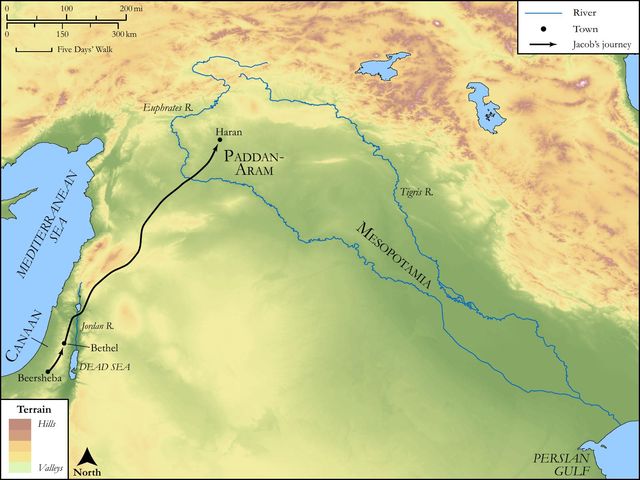
We have here Jacob upon his journey towards Syria, in a very desolate condition, like one that was sent to seek his fortune; but we find that, though he was alone, yet he was not alone, for the Father was with him, Joh 16:32. If what is here recorded happened (as it should seem it did) the first night, he had made a long day's journey from Beersheba to Bethel, above forty miles. Providence brought him to a convenient place, probably shaded with trees, to rest himself in that night; and there he had,
I.A hard lodging (Gen 28:11), the stones for his pillows, and the heavens for his canopy and curtains.
As the usage then was, perhaps this was not so bad as it seems how to us; but we should think,
1.He lay very cold, the cold ground for his bed, and, which one would suppose made the matter worse, a cold stone for his pillow, and in the cold air.
2.Very uneasy. If his bones were sore with his day's journey, his night's rest would but make them sorer.
3.Very much exposed. He forgot that he was fleeing for his life; or had his brother, in his rage, pursued, or sent a murderer after him, here he lay ready to be sacrificed, and destitute of shelter and defence. We cannot think it was by reason of his poverty that he was so ill accommodated, but,
(1.)It was owing to the plainness and simplicity of those times, when men did not take so much state, and consult their ease so much, as in these later times of softness and effeminacy.
(2.)Jacob had been particularly used to hardships, as a plain man dwelling in tents; and, designing now to go to service, he was the more willing to inure himself to them; and, as it proved, it was well, Gen 31:40.
(3.)His comfort in the divine blessing, and his confidence in the divine protection, made him easy, even when he lay thus exposed; being sure that his God made him to dwell in safety, he could lie down and sleep upon a stone.
II.In his hard lodging he had a pleasant dream.
Any Israelite indeed would be willing to take up with Jacob's pillow, provided he might but have Jacob's dream. Then, and there, he heard the words of God, and saw the visions of the Almighty. It was the best night's sleep he ever had in his life. Note, God's time to visit his people with his comforts is when they are most destitute of other comforts, and other comforters; when afflictions in the way of duty (as these were) do abound, then shall consolations so much the more abound. Now observe here,
1.The encouraging vision Jacob saw, Gen 28:12. He saw a ladder which reached from earth to heaven, the angels ascending and descending upon it, and God himself at the head of it. Now this represents the two things that are very comfortable to good people at all times, and in all conditions: - (1.) The providence of God, by which there is a constant correspondence kept up between heaven and earth. The counsels of heaven are executed on earth, and the actions and affairs of this earth are all known in heaven are executed on earth, and the actions and affairs of this earth are all known in heaven and judged there. Providence does its work gradually, and by steps. Angels are employed as ministering spirits, to serve all the purposes and designs of Providence, and the wisdom of God is at the upper end of the ladder, directing all the motions of second causes to the glory of the first Cause. The angels are active spirits, continually ascending and descending; they rest not, day nor night, from service, according to the posts assigned them. They ascend, to give account of what they have done, and to receive orders; and then descend, to execute the orders they have received. Thus we should always abound in the work of the Lord, that we may do it as the angels do it, Psa 103:20, Psa 103:21. This vision gave very seasonable comfort to Jacob, letting him know that he had both a good guide and a good guard, in his going out and coming in, - that, though he was made to wander from his father's house, yet still he was the care of a kind Providence, and the charge of the holy angels. This is comfort enough, though we should not admit the notion which some have, that the tutelar angels of Canaan were ascending, having guarded Jacob out of their land, and the angels of Syria descending to take him into their custody. Jacob was now the type and representative of the whole church, with the guardianship of which the angels are entrusted. (2.) The mediation of Christ. He is this ladder, the foot on earth in his human nature, the top in heaven in his divine nature: or the former in his humiliation, the latter in his exaltation. All the intercourse between heaven and earth, since the fall, is by this ladder. Christ is the way; all God's favours come to us, and all our services go to him, by Christ. If God dwell with us, and we with him, it is by Christ. We have no way of getting to heaven, but by this ladder; if we climb up any other way we are thieves and robbers. To this vision our Saviour alludes when he speaks of the angels of God ascending and descending upon the son of man (Joh 1:51); for the kind offices the angels do us, and the benefits we receive by their ministration, are all owing to Christ, who has reconciled things on earth and things in heaven (Col 1:20), and made them all meet in himself, Eph 1:10.
2.The encouraging words Jacob heard. God now brought him into the wilderness, and spoke comfortably to him, spoke from the head of the ladder; for all the glad tidings we receive from heaven come through Jesus Christ.
(1.)The former promises made to his father were repeated and ratified to him, Gen 28:13, Gen 28:14. In general, God intimated to him that he would be the same to him that he had been to Abraham and Isaac. Those that tread in the steps of their godly parents are interested in their covenant and entitled to their privileges. Particularly,
[1.]The land of Canaan is settled upon him, the land whereon thou liest; as if by his lying so contentedly upon the bare ground he had taken livery and seisin of the whole land.
[2.]It is promised him that his posterity should multiply exceedingly as the dust of the earth - that, though he seemed now to be plucked off as a withered branch, yet he should become a flourishing tree, that should send out his boughs unto the sea. These were the blessings with which his father had blessed him (Gen 28:3, Gen 28:4), and God here said Amen to them, that he might have strong consolation.
[3.]It is added that the Messiah should come from his loins, in whom all the families of the earth should be blessed. Christ is the great blessing of the world. All that are blessed, whatever family they are of, are blessed in him, and none of any family are excluded from blessedness in him, but those that exclude themselves.
(2.)Fresh promises were made him, accommodated to his present condition, Gen 28:15.
[1.]Jacob was apprehensive of danger from his brother Esau; but God promises to keep him. Note, Those are safe whom god protects, whoever pursues them.
[2.]He had now a long journey before him, had to travel alone, in an unknown road, to an unknown country; but, behold, I am with thee, says God. Note, Wherever we are, we are safe, and may be easy, if we have God's favourable presence with us.
[3.]He knew not, but God foresaw, what hardships he should meet with in his uncle's service, and therefore promises to preserve him in all places. Note, God knows how to give his people graces and comforts accommodated to the events that shall be, as well as to those that are.
[4.]He was now going as an exile into a place far distant, but God promises him to bring him back again to this land. Note, He that preserves his people's going out will also take care of their coming in, Psa 121:8.
[5.]He seemed to be forsaken of all his friends, but God here gives him this assurance, I will not leave thee. Note, Whom God loves he never leaves. This promise is sure to all the seed, Heb 13:5.
[6.]Providences seemed to contradict the promises; he is therefore assured of the performance of them in their season: All shall be done that I have spoken to thee of. Note, Saying and doing are not two things with God, whatever they are with us.
Historical interpretation
Historical reception
2 surviving comments on this verse. Each one is dated, so this reads as a timeline rather than a list.
Select a marker to jump to its quote. Markers stagger vertically where authors wrote within a few decades of each other.
O foolish Galatians, who hath bewitched you, that ye should not obey the truth, before whose eyes Jesus Christ hath been evidently set forth, crucified among you? This only would I learn of you, Received ye the Spirit by the works of the law, or by the hearing of faith? Are ye so foolish? having begun in the Spirit, are ye now made perfect by the flesh? Have ye suffered so many things in vain? if it be yet in vain. He therefore that ministereth to you the Spirit, and worketh miracles among you, doeth he it by the works of the law, or by the hearing of faith? Even as Abraham believed God, and it was accounted to him for righteousness. Know ye therefore that they which are of faith, the same are the children of Abraham. And the scripture, foreseeing that God would justify the heathen through faith, preached before the gospel unto Abraham, saying, In thee shall all nations be blessed. [Genesis 28:14] So then they which be of faith are blessed with faithful Abraham. For as many as are of the works of the law are under the curse: for it is written, Cursed is every one that continueth not in all things which are written in the book of the law to do them. But that no man is justified by the law in the sight of God, it is evident: for, The just shall live by faith. And the law is not of faith: but, The man that doeth them shall live in them. Christ hath redeemed us from the curse of the law, being made a curse for us: for it is written, Cursed is every one that hangeth on a tree: That the blessing of Abraham might come on the Gentiles through Jesus Christ; that we might receive the promise of the Spirit through faith.
And now, brethren, I wot that through ignorance ye did it, as did also your rulers. But those things, which God before had showed by the mouth of all his prophets, that Christ should suffer, he hath so fulfilled. Repent ye therefore, and be converted, that your sins may be blotted out, when the times of refreshing shall come from the presence of the Lord; And he shall send Jesus Christ, which before was preached unto you: Whom the heaven must receive until the times of restitution of all things, which God hath spoken by the mouth of all his holy prophets since the world began. For Moses truly said unto the fathers, A prophet shall the Lord your God raise up unto you of your brethren, like unto me; him shall ye hear in all things whatsoever he shall say unto you. And it shall come to pass, that every soul, which will not hear that prophet, shall be destroyed from among the people. Yea, and all the prophets from Samuel and those that follow after, as many as have spoken, have likewise foretold of these days. Ye are the children of the prophets, and of the covenant which God made with our fathers, saying unto Abraham, And in thy seed shall all the kindreds of the earth be blessed. [Genesis 28:14] Unto you first God, having raised up his Son Jesus, sent him to bless you, in turning away every one of you from his iniquities.
Continue studying Genesis 28:14 across the web’s major study libraries — every link below opens this exact verse, chapter, or book on the destination site.
Read & Compare
 BibleGatewayThis verse in more than 200 translations and 70 languages.
 Bible.comThe YouVersion reader — hundreds of translations, reading plans, and highlights.
 ESV.orgCrossway's official English Standard Version reader.
 NET BibleThe NET translation with 60,000+ translators' notes on every rendering decision.
 STEP BibleTyndale House's free study tool — original text, vocabulary, and scholarly resources.
 BibliaLogos Bible Software's free web reader.
 USCCBThe New American Bible (Revised Edition) with the U.S. bishops' study notes.
Commentaries
 BibleHub CommentariesDozens of classic commentaries on this verse, gathered on one page.
 StudyLightMore than 100 commentary sets — the largest collection on the web.
 BibleRefPlain-English commentary on what this verse means, verse by verse.
 Enduring WordDavid Guzik's free commentary on this chapter, widely used by Bible teachers.
 Bible Study ToolsVerse commentary alongside Greek and Hebrew study aids.
Original Language & Research
- BibleHub InterlinearThe verse word by word — original language, transliteration, and English.
- BibleHub LexiconEvery word's original-language definition and Strong's entry.
 Blue Letter BibleDeep-study tools — Strong's numbers, concordance, and word studies.
 SefariaThe Hebrew text with Rashi and centuries of Jewish commentary.
Sermons, Hymns & Audio


TrulyRandomVerse is not affiliated with these sites and doesn’t control their content. They’re linked because they’re genuinely useful.
Summary
Genesis 28:14 records God's profound reaffirmation of the Abrahamic covenant to Jacob during his revelatory dream at Bethel. This pivotal promise assures Jacob of an exceedingly numerous posterity, symbolized by the dust of the earth, and a vast territorial expansion for his descendants across all cardinal directions. Most significantly, it declares that through Jacob himself and his singular "seed," all the families of the earth would ultimately receive divine blessing, underscoring God's unwavering faithfulness, His global redemptive plan, and the ultimate Christological fulfillment of the covenant.
Context
ShowHideLiterary Context
This verse is the climactic declaration within Jacob's dream at Bethel, immediately following the vision of the ladder connecting heaven and earth with angels ascending and descending Genesis 28:12. Jacob is at a critical juncture in his life, fleeing his brother Esau after deceitfully obtaining Isaac's blessing. He is alone, vulnerable, and uncertain of his future. In this moment of profound need, God appears to him, identifying Himself as "the LORD God of Abraham thy father, and the God of Isaac" Genesis 28:13 and directly reiterates the covenant promises. This divine encounter serves to legitimate Jacob as the heir of the covenant, providing him with comfort, assurance, and a clear understanding of his pivotal role in God's unfolding redemptive narrative, despite his personal failings.
Historical & Cultural Context
Dreams were significant channels of divine communication in Genesis, as when God came to Abimelech and to Laban the Syrian in a dream by night, often conveying messages, warnings, or promises. Jacob's dream at Bethel stands among them, and its content reveals the personal and covenantal God of Israel. The concept of "seed" and "land" were fundamental to ancient identity and prosperity, making God's promises of numerous descendants and widespread territory incredibly meaningful. Furthermore, the practice of a patriarch passing on a blessing was a deeply ingrained cultural norm, and Jacob's receipt of this comprehensive divine blessing, despite his dubious actions, highlights God's sovereign choice and grace over human merit, setting the stage for the formation of the nation of Israel.
Key Themes
ShowHideGenesis 28:14 powerfully contributes to several overarching themes within Genesis and the broader biblical narrative. It reinforces the theme of Covenant Faithfulness, demonstrating God's unwavering commitment to His promises across generations, from Abraham Genesis 12:1-3 to Isaac and now to Jacob. The promise of numerous descendants and widespread territory emphasizes the theme of Divine Election and Purpose, highlighting God's sovereign choice of a specific lineage through whom to accomplish His global redemptive plan. Most profoundly, the declaration that "all the families of the earth shall be blessed" introduces or reiterates the theme of Universal Blessing and Redemption, revealing that God's ultimate plan extends beyond a single nation to encompass all humanity, a theme further developed in the New Testament concerning the gospel preached to Abraham.
Exposition and Analysis
ShowHideGenesis 28:14 unfolds a multi-faceted divine promise to Jacob, building upon the Abrahamic Covenant and detailing its implications for his lineage and the world.
Key Word Analysis
ShowHideFrom זָרַע; seed; figuratively, fruit, plant, sowing-time, posterity; [idiom] carnally, child, fruitful, seed(-time), sowing-time. This versatile Hebrew word can be singular or collective. In this context, it refers both to Jacob's countless physical descendants (the nation of Israel) and, crucially, to a singular, specific descendant—the Messiah, Jesus Christ, through whom the blessing for "all the families of the earth" would ultimately come. The dual nature of zeraʻ allows for both a national and a singular, messianic fulfillment.
From עָפַר; dust (as powdered or gray); hence, clay, earth, mud; ashes, dust, earth, ground, morter, powder, rubbish. The imagery of "dust of the earth" emphasizes an incredibly numerous posterity for Jacob, echoing earlier promises to Abraham where his descendants were likened to the dust Genesis 13:16 or the stars, signifying an uncountable multitude. This hyperbolic expression assures Jacob that despite his current solitary and vulnerable state, his lineage will flourish and become a great nation.
A primitive root; to kneel; by implication to bless God (as an act of adoration), and (vice-versa) man (as a benefit); also (by euphemism) to curse (God or the king, as treason); [idiom] abundantly, [idiom] altogether, [idiom] at all, blaspheme, bless, congratulate, curse, [idiom] greatly, [idiom] indeed, kneel (down), praise, salute, [idiom] still, thank. When God promises that "all the families of the earth shall be blessed," it speaks to the spiritual and redemptive benefits that flow from God's covenant with Abraham, Isaac, and Jacob, culminating in the saving work of Christ. This aspect highlights God's redemptive plan for all humanity, not just one nation.
Verse Breakdown
ShowHide"And thy seed shall be as the dust of the earth"
This clause initiates the promise by emphasizing the immense numerical growth of Jacob's descendants. The comparison to "dust of the earth" is a vivid hyperbole signifying an uncountable multitude, assuring Jacob that his lineage will indeed become a great nation, fulfilling the promise made to Abraham.
"and thou shalt spread abroad to the west, and to the east, and to the north, and to the south"
This phrase signifies a vast territorial inheritance and expansion for Jacob's descendants. It points to the future establishment and growth of the nation of Israel within the promised land, extending its influence and dominion in all directions. This promise reinforces the idea of a divinely ordained national identity and destiny, emphasizing the geographical scope of God's covenant.
"and in thee and in thy seed shall all the families of the earth be blessed"
This culminating promise is profoundly significant, shifting the focus from national prosperity to universal redemption. It declares that the ultimate purpose of God's covenant with Jacob's lineage is not merely for their own benefit but for the spiritual enrichment and salvation of all humanity. This points to a future, singular "seed" (the Messiah) through whom the blessings of salvation would be extended to every nation, tribe, and people group.
Literary Devices
ShowHideGenesis 28:14 employs several powerful literary devices. Hyperbole is evident in the phrase "thy seed shall be as the dust of the earth," which vividly exaggerates the number of Jacob's descendants to convey an immeasurable multitude, emphasizing the certainty and magnitude of God's promise. Symbolism is present in the "dust of the earth" itself, representing both countless numbers and the humble origins from which a great nation would arise. The directional declaration, "to the west, and to the east, and to the north, and to the south," is a form of merism, where two or more contrasting parts are used to represent a whole, indicating the comprehensive and boundless extent of the promised land and the influence of Jacob's descendants. Finally, the entire passage functions as a reiteration of the Abrahamic covenant, reinforcing its validity and continuity through Jacob, thereby providing a sense of divine faithfulness and an unbroken lineage of promise.
Theological and Thematic Connections
ShowHideGenesis 28:14 serves as a profound theological anchor, demonstrating God's unwavering commitment to His covenant promises across generations, even amidst human frailty and flight. It underscores the sovereign nature of God's election, as He chooses Jacob, a flawed individual, to be the conduit for His redemptive plan. The verse beautifully expands the scope of God's blessing from a singular family to "all the families of the earth," revealing a universal, inclusive dimension to His ultimate design for salvation. This global vision is central to biblical theology, highlighting that God's covenant with Israel was always intended to be a means of bringing light and blessing to the entire world, culminating in the person and work of Jesus Christ.
Reflection and Application
ShowHideGenesis 28:14 stands as a powerful testament to God's unwavering faithfulness to His promises, even when human circumstances seem bleak or uncertain. Jacob, a deceiver on the run, receives a profound affirmation of God's continued covenant, reminding us that God's plans are not contingent on our perfection but on His sovereign grace. This verse underscores the universal scope of God's love and salvation, extended to "all the families of the earth" through the lineage of Abraham, Isaac, and Jacob, ultimately fulfilled in Jesus Christ. For us today, it assures us that God's plans are global in reach and that through faith in Christ, we are included in this magnificent blessing, regardless of our background. It encourages us to trust in God's sovereign plan, to find comfort in His enduring promises, and to actively participate in His mission to bless the world by sharing the good news of the gospel.
Questions for Reflection
ShowHideFAQ
ShowHideWhat does "thy seed shall be as the dust of the earth" signify?
ShowHideThis phrase signifies an incredibly numerous posterity for Jacob. It is a hyperbolic expression emphasizing that his descendants would be too many to count, echoing similar promises made to Abraham regarding his offspring being like the dust of the earth or the stars of the heavens. It assures Jacob of the continuation and vast expansion of his lineage, forming a great nation.
How can "all the families of the earth be blessed" through one lineage?
ShowHideThis promise points to God's global redemptive plan. While the nation of Israel, Jacob's physical descendants, was meant to be a light to the nations and a witness to God's truth, the ultimate and spiritual fulfillment of this blessing comes through the singular "Seed" of Abraham and Jacob, who is Jesus Christ. Through Christ's atoning work, salvation and spiritual blessings are made available to people from every nation, tribe, and tongue, fulfilling God's universal intent. This is a key theme in the New Testament, particularly in Paul's letter to the Galatians.
Is the "seed" in Genesis 28:14 purely physical or spiritual?
ShowHideThe Hebrew word zeraʻ (seed) in this context carries a dual meaning, encompassing both physical and spiritual aspects. It refers to Jacob's numerous physical descendants (the nation of Israel) and, crucially, to a singular, specific descendant—the Messiah, Jesus Christ. The New Testament, particularly Paul's interpretation in Galatians 3:16, clarifies that the ultimate fulfillment of the promise of blessing for "all the families of the earth" is realized spiritually through Christ, demonstrating that the "seed" has a profound spiritual dimension beyond mere physical lineage. This duality highlights God's plan to work through a chosen people to bring salvation to all.
Christ-Centered Fulfillment
ShowHideThe profound promise in Genesis 28:14, particularly the declaration that "in thee and in thy seed shall all the families of the earth be blessed," finds its ultimate and most glorious fulfillment in the person and work of Jesus Christ. While initially pointing to the nation of Israel as the vehicle of God's blessing to the world, the New Testament clarifies that the singular "seed" through whom all nations would be blessed is Christ Himself Galatians 3:16. Through His perfect life, atoning death, and triumphant resurrection, Jesus inaugurated a new covenant that extends salvation and spiritual blessing to all humanity, transcending ethnic and national boundaries. He is the Lamb of God who takes away the sin of the world, the one through whom people from every family on earth can receive forgiveness, reconciliation with God, and eternal life. Thus, God's ancient promise to Abraham, Isaac, and Jacob, reiterated to Jacob at Bethel, culminates in the universal scope of the gospel, inviting all to partake in the blessings of Christ's redemptive work Revelation 7:9-10.