


Genesis 13:14
Bible text: King James Version (1769 Blayney text) · Public domain
Bible text: King James Version with Strong's numbers · Public domain
Bible text: Berean Standard Bible · Public domain
Bible text: American Standard Version (1901) · Public domain
Bible text: World English Bible, Messianic edition · Public domain
Bible text: Geneva Bible (1599) · Public domain
Bible text: Young's Literal Translation · Public domain
- וַיהוָהva·Yah·wehand YahwehH3068Conj-w ¦ N-properNoun Proper TitleוַandיהוָהYahweh
- אָמַר'a·Marhe saidH559V-Qal-Perf-3msVerb Qal Perfect 3rd Singular Masculine
- אֶל'eltoH413PrepPreposition
- אַבְרָם'av·RamAbramH87N-proper-mNoun Proper Masculine
- אַחֲרֵי'a·cha·ReiafterH310Adj-mpcAdjective Numerical Plural Masculine Construct
- הִפָּרֶדhi·pa·redseparatedH6504V-Niphal-InfVerb Niphal Infinitive Construct
- לוֹטLotLotH3876N-proper-mNoun Proper Masculine
- מֵעִמּוֹme·'i·Mofrom with <the> himH5973Prep-m ¦ Prep ¦ 3msPreposition Definiteמֵfromעִמּwith <the>וֹhim
- שָׂאsa'lift upH5375V-Qal-Imp-2msVerb Qal Imperative 2nd Singular Masculine
- נָאna'pleaseH4994PrtParticle Interjection
- עֵינֶיךָ'ei·Nei·khayour eyesH5869N-fdc ¦ 2msNoun Dual Feminine Constructעֵינֶיeyesךָyour
- וּרְאֵהu·re·'Ehand lookH7200Conj-w ¦ V-Qal-Imp-2msVerb Qal Imperative 2nd Singular Masculineוּandרְאֵהlook
- מִןminfromH4480PrepPreposition
- הַמָּקוֹםha·ma·Komthe placeH4725Art ¦ N-msNoun Singular Masculine Absoluteהַtheמָּקוֹםplace
- אֲשֶׁר'a·SherwhereH834RelParticle Relative
- אַתָּה'a·TahyouH859Pro-2msPronoun Personal 2nd Singular Masculine
- שָׁםSham[are] thereH8033AdvAdverb
- צָפֹנָהtza·Fo·nahnorth -wardH6828N-fs ¦ SfxNoun Singular Feminine Absoluteצָפֹנָnorthה-ward
- וָנֶגְבָּהva·Neg·bahand south -wardH5045Conj-w ¦ N-ms ¦ SfxNoun Singular Masculine Absoluteוָandנֶגְבָּsouthה-ward
- וָקֵדְמָהva·Ke·de·mahand east -wardH6924Conj-w ¦ N-ms ¦ SfxNoun Singular Masculine Absoluteוָandקֵדְמָeastה-ward
- וָיָמָּהva·Ya·mahand west -wardH3220Conj-w ¦ N-ms ¦ SfxNoun Singular Masculine Absoluteוָandיָמָּwestה-ward
English is a literal word-by-word gloss of the Hebrew, not the KJV's wording. Why?
This is the original text the KJV's translators worked from — each Hebrew word with its own literal English meaning in this verse, prepared by scholars at Tyndale House, Cambridge. The KJV translates whole sentences, not word by word, so its wording differs: one Hebrew word can become several English words, and the KJV may choose “the LORD” where the gloss reads “Yahweh”. Both are faithful — they answer different questions. For the KJV's own rendering, switch to the KJV text.
Details
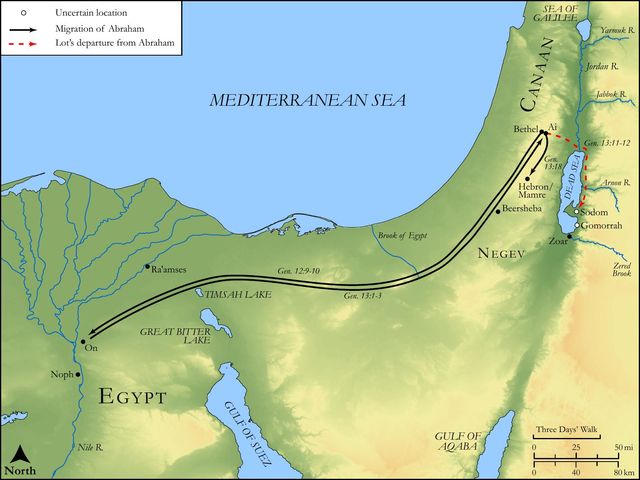
See on the biblical-era maps


Study this verse
Public-domain commentary
Matthew Henry
From his Commentary on the Whole Bible. Henry comments on passages, not single verses — this entry covers Genesis 13:14–18. His three-level outline is real structure in the source text, so it is rendered as structure.
We have here an account of a gracious visit which God paid to Abram, to confirm the promise to him and his. Observe,
I.When it was that God renewed and ratified the promise: After that Lot was separated from him, that is,
1.After the quarrel was over; for those are best prepared for the visits of divine grace whose spirits are calm and sedate, and not ruffled with any passion.
2.After Abram's humble self-denying condescensions to Lot for the preserving of peace. It was then that God came to him with this token of his favour. Note, God will abundantly make up in spiritual peace what we lose for the preservation of neighbourly peace. When Abram had willingly offered Lot one-half of his right, God came, and confirmed the whole to him.
3.After he had lost the comfortable society of his kinsman, by whose departure his hands were weakened and his heart was saddened, then God came to him with these good words and comfortable words. Note, Communion with God may, at any time, serve to make up the want of conversation with our friends; when our relations are separated from us, yet God is not.
4.After Lot had chosen that pleasant fruitful vale, and had gone to take possession of it, lest Abram should be tempted to envy him and to repent that he had given him the choice, God comes to him, and assures him that what he had should remain to him and his heirs for ever; so that, though Lot perhaps had the better land, yet Abram had the better title. Lot had the paradise, such as it was, but Abram had the promise; and the event soon made it appear that, however it seemed now, Abram had really the better part. See Job 22:20. God owned Abram after his strife with Lot, as the churches owned Paul after his strife with Barnabas, Act 15:39, Act 15:40.
II.The promises themselves with which God now comforted and enriched Abram. Two things he assures him of - a good land, and a numerous issue to enjoy it.
1.Here is the grant of a good land, a land famous above all lands, for it was to be the holy land, and Immanuel's land; this is the land here spoken of.
(1.)God here shows Abram the land, as he had promised (Gen 12:1), and afterwards he showed it to Moses from the top of Pisgah. Lot had lifted up his eyes and beheld the plain of Jordan (Gen 13:10), and he had gone to enjoy what he saw: "Come," says God to Abram, "now lift thou up thy eyes, and look, and see thy own." Note, That which God has to show us is infinitely better and more desirable than any thing that the world has to offer our view. The prospects of an eye of faith are much more rich and beautiful than those of an eye of sense. Those for whom the heavenly Canaan is designed in the other world have sometimes, by faith, a comfortable prospect of it in their present state; for we look at the things that are not seen, as real, though distant.
(2.)He secures this land to him and his seed for ever (Gen 13:15): To thee will I give it; and again (Gen 13:17) I will give it unto thee; every repetition of the promise is a ratification of it. To thee and thy seed, not to Lot and his seed; they were not to have their inheritance in this land, and therefore Providence so ordered it that Lot should be separated from Abram first, and then the grant should be confirmed to him and his seed. Thus God often brings good out of evil, and makes men's sins and follies subservient to his own wise and holy counsels. To thee and thy seed - to thee to sojourn in as a stranger, to thy seed to dwell and rule in as proprietors. To thee, that is, to thy seed. The granting of it to him and his for ever intimates that it was typical of the heavenly Canaan, which is given to the spiritual seed of Abram for ever, Heb 11:14.
(3.)He gives him livery and seisin of it, though it was a reversion: "Arise, walk through the land, Gen 13:17. Enter, and take possession, survey the parcels, and it will appear better than upon a distant prospect." Note, God is willing more abundantly to show to the heirs of promise the immutability of his covenant, and the inestimable worth of covenant blessings. Go, walk about Sion, Psa 48:12.
2.Here is the promise of a numerous issue to replenish this good land, so that it should never be lost for want of heirs (Gen 13:16): I will make thy seed as the dust of the earth, that is, "They shall increase incredibly, and, take them altogether, they shall be such a great multitude as no man can number." They were so in Solomon's time, Kg1 4:20, Judah and Israel were many as the sand which is by the sea in multitude. This God here gives him the promise of. Note, The same God that provides the inheritance provides the heirs. He that has prepared the holy land prepares the holy seed; he that gives glory gives grace to make meet for glory.
Lastly, We are told what Abram did when God had thus confirmed the promise to him, Gen 13:18. 1. He removed his tent. God bade him walk through the land, that is, "Do not think of fixing in it, but expect to be always unsettled, and walking through it to a better Canaan:" in compliance with God's will herein, he removes his tent, confirming himself to the condition of a pilgrim. 2. He built there an altar, in token of his thankfulness to God for the kind visit he had paid him. Note, When God meets us with gracious promises, he expects that we should attend him with our humble praises.
Historical interpretation
Six Centuries of Reception
5 surviving comments on this verse. Each one is dated, so this reads as a timeline rather than a list.
Select a marker to jump to its quote. Markers stagger vertically where authors wrote within a few decades of each other.
Abraham, styled "the friend," [Isaiah 41:8] was found faithful, inasmuch as he rendered obedience to the words of God. He, in the exercise of obedience, went out from his own country, and from his kindred, and from his father's house, in order that, by forsaking a small territory, and a weak family, and an insignificant house, he might inherit the promises of God. For God said to him, "Get you out from your country, and from your kindred, and from your father's house, into the land which I shall show you. And I will make you a great nation, and will bless you, and make your name great, and you shall be blessed. And I will bless them that bless you, and curse them that curse you; and in you shall all the families of the earth be blessed." [Genesis 12:1-3] And again, on his departing from Lot, God said to him, "Lift up your eyes, and look from the place where you now are, northward, and southward, and eastward, and westward; for all the land which you see, to you will I give it, and to your seed forever. And I will make your seed as the dust of the earth, [so that] if a man can number the dust of the earth, then shall your seed also be numbered." [Genesis 13:14-16] And again [the Scripture] says, "God brought forth Abram, and spoke unto him, Look up now to heaven, and count the stars if you are able to number them; so shall your seed be. And Abram believed God, and it was counted to him for righteousness." [Genesis 15:5-6] On account of his faith and hospitality, a son was given him in his old age; and in the exercise of obedience, he offered him as a sacrifice to God on one of the mountains which He showed him. [Genesis 22:9]
There follows a passage that clearly teaches us how fast the soul progresses once the excesses of the irrational parts have been eliminated and how much evil is produced by an accumulation of vices. Not without reason did Scripture put it this way: “And God said to Abraham, after Lot had separated from him: ‘Lift up your eyes and look from the place where you are, northward and southward and eastward and westward: for all the land which you see I will give to you and to your descendants for ever.’ ” This text is the source from which the Stoic philosophers drew one of their doctrinal maxims: that everything belongs to the wise man. Indeed, north, south, east and west are the parts of the universe: they encompass the entire world. And when God promises that he will give all of this to Abraham, what else is he saying than that the wise and faithful man possesses all things, lacks nothing at all? For which reason Solomon also says in Proverbs, “The whole world of riches belongs to him who is faithful.” How much earlier did Solomon live than Zeno the teacher and founder of the Stoic school itself! How much earlier was he than Plato, the very father of philosophy, or Pythagoras, who invented the term philosophy. But who is the faithful person if not one who is wise? For “the fool changes like the moon,” but the wise person remains unchanging in faith.
See the promptness of God’s providential recompense demonstrated in favor of the good man. Sacred Scripture wants to teach us the extent of the reimbursement the patriarch was accorded for such humility from the loving God. And so after saying that Lot took his leave and went off to the land he had selected on the score of its beauty, [Scripture] immediately added, “The Lord God said to Abram.” Then, for our precise realization that he said this by way of rewarding him for what had been done for Lot, it added, “God said to Abram after Lot’s parting with him,” as if to say the following words to him without demur: You ceded the beautiful region to your nephew on account of your great restraint and thus gave evidence of your eminent humility and showed such concern for peace as to put up with anything for the sake of preventing any rivalry coming between you—accept from me a generous reward.
(Verse 14 and 15.) Lift up your eyes and look from the place where you are, towards the north, south, east, and west; for all the land that you see I will give to you and to your offspring. He set the four regions of the world: east, west, north, and south. But what is read in all the Scriptures, let it suffice to say once, that the sea is always considered to be in the west: because the region of Palestine is situated in such a way that the sea is in the western part.
And the Lord said to Abram after Lot had separated from him: Lift up your eyes, and look from the place where you are northward and southward and eastward and westward: all the land that you see I will give to you and to your offspring forever. Some manuscripts have "unto the age," which both translate from the one Greek term Aeonion, αἰὼν. Therefore, if it is read as "unto eternity," it rightly raises the question of how Abraham's offspring can possess that land eternally, whereas human life in this world cannot be everlasting. But if it is read as "unto the age," and thus understood, as we faithfully hold, that the beginning of the future age will commence from the end of the present, no question will arise: because even if the Israelites were expelled from Jerusalem, they still remain in other cities of the land of Canaan, and will remain until the end, and that entire land is inhabited with Christians, and they themselves are the seed of Abraham. It can also be mystically understood to have been said to blessed Abraham, "all the land that you see I will give to you and to your offspring forever"; because the region of the heavenly homeland, which that land of promise prefigured, is thus possessed in full by all the elect, namely the seed of Abraham, so that they remain in it without end, according to what is said of the fire of the burnt offering in Exodus: This is a perpetual fire that shall never go out on the altar. For neither could that material fire, by which sacrifices were burnt in the tabernacle, be perpetual, since even the tabernacle itself, the very altar, and the priesthood have long been taken away. But the fire of love, by which the elect are inflamed to offer sacrifices of prayers or good deeds to God, never fails on the altar, that is, from their hearts which were represented by that Mosaic altar: because in this life they fervently love with divine love, and in the future, seeing God more perfectly, they love Him with all their heart, with all their soul, with all their strength. And you will find many such things in the ceremonies of the law, which although they were said to be done or to remain with perpetual right, are yet proven not to have been perpetual except when spiritually understood.
Continue studying Genesis 13:14 across the web’s major study libraries — every link below opens this exact verse, chapter, or book on the destination site.
Read & Compare
 BibleGatewayThis verse in more than 200 translations and 70 languages.
 Bible.comThe YouVersion reader — hundreds of translations, reading plans, and highlights.
 ESV.orgCrossway's official English Standard Version reader.
 NET BibleThe NET translation with 60,000+ translators' notes on every rendering decision.
 STEP BibleTyndale House's free study tool — original text, vocabulary, and scholarly resources.
 BibliaLogos Bible Software's free web reader.
 USCCBThe New American Bible (Revised Edition) with the U.S. bishops' study notes.
Commentaries
 BibleHub CommentariesDozens of classic commentaries on this verse, gathered on one page.
 StudyLightMore than 100 commentary sets — the largest collection on the web.
 BibleRefPlain-English commentary on what this verse means, verse by verse.
 Enduring WordDavid Guzik's free commentary on this chapter, widely used by Bible teachers.
 Bible Study ToolsVerse commentary alongside Greek and Hebrew study aids.
Original Language & Research
- BibleHub InterlinearThe verse word by word — original language, transliteration, and English.
- BibleHub LexiconEvery word's original-language definition and Strong's entry.
 Blue Letter BibleDeep-study tools — Strong's numbers, concordance, and word studies.
 SefariaThe Hebrew text with Rashi and centuries of Jewish commentary.
Sermons, Hymns & Audio


TrulyRandomVerse is not affiliated with these sites and doesn’t control their content. They’re linked because they’re genuinely useful.
Summary
Genesis 13:14 marks a profound moment of divine initiative where the LORD speaks directly to Abram, reaffirming and significantly expanding the covenant promises concerning the land. This pivotal address occurs immediately after the necessary separation of Abram and Lot, underscoring God's precise timing and the singular, unhindered focus of His unfolding plan for Abram and his future descendants. The command to visually survey the land in all cardinal directions serves as a tangible confirmation of the immense scope of the promised inheritance.
Context
ShowHideLiterary Context
Genesis 13:14 is strategically placed immediately following the narrative of Abram and Lot's separation. The preceding verses (Genesis 13:5-7) describe the growing tension between their herdsmen due to their immense wealth and the limited grazing land. Abram, demonstrating remarkable faith and generosity, offers Lot the first choice of land (Genesis 13:8-9). Lot, choosing by sight, selects the fertile plain of Jordan, gravitating towards the cities of Sodom and Gomorrah (Genesis 13:10-13). It is only after Lot's departure, when Abram is spiritually and physically isolated from his nephew's influence and choices, that the LORD intervenes. This divine address is not a casual remark but a deliberate reaffirmation and expansion of the covenant first initiated in Genesis 12:1-3, now focused solely on Abram's lineage.
Historical & Cultural Context
Abram was a sojourner in the land of Canaan, a region inhabited by various Canaanite tribes (Genesis 12:6). The concept of land ownership was central to the life of the patriarchs, often tied to identity, security, and prosperity. For a nomadic chieftain like Abram, lacking a permanent dwelling, the promise of an entire land was extraordinarily significant. The act of surveying the land from a high vantage point was a symbolic act of possession or claim in that day, often associated with kings or conquerors asserting their dominion. God's command to "lift up thine eyes, and look" would have resonated deeply with Abram, giving tangible expression to an otherwise abstract promise, especially in a time when divine promises were often understood through concrete, observable signs.
Key Themes
ShowHideThis verse powerfully contributes to several overarching themes in Genesis and the broader biblical narrative. It highlights God's unwavering faithfulness to His covenant promises, reaffirming them even when human circumstances shift. The theme of divine sovereignty and timing is evident, as God speaks precisely when Lot's presence no longer complicates the singular focus on Abram's lineage. The expansive nature of the promised land introduces the theme of God's boundless generosity and the vastness of His inheritance, a promise that extends beyond immediate sight. Furthermore, Abram's act of looking in all directions underscores the theme of faith and spiritual vision, emphasizing that God's promises require an active, believing response, even before their full realization. This passage also subtly introduces the theme of separation for blessing, showing how God uses difficult partings to refine and advance His purposes for His chosen ones.
Exposition and Analysis
ShowHideKey Word Analysis
ShowHideThis is the covenant name of God, H3068, emphasizing His self-existent, eternal nature. The use of "LORD" (Jehovah) here underscores that the speaker is the personal, covenant-keeping God who is actively involved in Abram's life and meticulously orchestrating His divine plan, not merely a generic deity.
Derived from H6504, meaning "to break through, spread, or separate (oneself)." This word highlights the decisive and necessary nature of the division between Abram and Lot. It implies a physical parting but also a theological severing, ensuring that God's promise to Abram would be unadulterated and focused solely on his direct lineage, distinct from Lot's chosen path.
A primitive root meaning "to see, literally or figuratively (in numerous applications)." Coupled with "lift up" (H5375, nâsâʼ), this imperative signifies a deliberate, comprehensive visual apprehension. It's not a casual glance but an intentional act of surveying, inviting Abram to internalize the vastness and reality of the promised inheritance by actively engaging his sight.
Verse Breakdown
ShowHide"And the LORD said unto Abram, after that Lot was separated from him,"
This opening clause establishes the divine initiative and perfect timing of God's communication. The phrase "after that Lot was separated from him" is crucial, indicating that Lot's departure was a prerequisite for this renewed and expanded revelation. It signifies that God's covenant promises are exclusive to Abram and his chosen seed, unhindered by Lot's presence or his worldly choices. This underscores God's sovereignty in orchestrating events to align with His purposes.
"Lift up now thine eyes, and look from the place where thou art"
This is an imperative command, not a suggestion. "Lift up now thine eyes" implies an intentional act of visual engagement, a deliberate survey rather than a passive glance. "From the place where thou art" suggests a specific, likely elevated, vantage point from which Abram could literally perceive the surrounding landscape. This physical act was intended to make the abstract promise of land tangible and concrete, embedding it deeply in Abram's mind and heart as a visual confirmation of God's word.
"northward, and southward, and eastward, and westward:"
This specifies the boundless extent of the promised land. By commanding Abram to look in all four cardinal directions, God emphasizes the comprehensive and all-encompassing nature of His gift. It symbolizes that the entire visible horizon from Abram's vantage point, and by extension the entire land of Canaan, was his promised inheritance. This expansive vision reinforces God's generosity and the magnitude of the covenant, assuring Abram that the land was not a small parcel but a vast territory.
Literary Devices
ShowHideThe verse employs several significant literary devices. Imperative Mood is prominent in "Lift up now thine eyes, and look," conveying God's direct command and the urgency for Abram to actively engage with the promise. The use of Cardinal Directions ("northward, and southward, and eastward, and westward") serves as Merism, a rhetorical device where two contrasting parts represent the whole. Here, specifying all four directions comprehensively indicates the entire, boundless extent of the land God is promising. This also functions as Symbolism, where the physical act of surveying the land symbolizes the spiritual apprehension of God's vast and encompassing promises. The Timing of God's speech, "after that Lot was separated from him," acts as a Narrative Marker, highlighting a pivotal moment of transition and divine intervention, emphasizing God's precise and purposeful orchestration of events in Abram's life.
Theological and Thematic Connections
ShowHideGod's address to Abram in Genesis 13:14 powerfully illustrates His unwavering faithfulness and the expansive nature of His covenant promises. The divine command to survey the land after Lot's departure underscores God's sovereign timing, revealing that sometimes necessary separations or losses are divinely orchestrated to clear the path for a clearer, more focused outpouring of blessing and direction. This passage teaches that God's promises are not limited by human circumstances or relationships but are rooted in His own will and purpose, inviting believers to cultivate a spiritual vision that apprehends the vastness of God's provision, even when it extends beyond immediate sight.
Reflection and Application
ShowHideGenesis 13:14 offers profound lessons for believers today, reminding us of God's unwavering faithfulness, especially during periods of transition, loss, or uncertainty. Just as Abram was invited to visually embrace the vastness of God's promise, we are called to fix our eyes on God's word and His future plans for us, cultivating a spiritual vision that transcends immediate circumstances. This verse encourages us to trust God's timing and sovereignty, recognizing that He often uses moments of separation or apparent loss to refine and advance His purposes. Our inheritance in Christ is vast and good, and like Abram, we are called to walk in faith, believing in the unseen realities of God's promises. This spiritual vision is not passive but active, requiring us to "lift up our eyes" and intentionally apprehend the scope of God's blessings, which are often far greater than we can initially perceive. The promise of the land to Abram continues to unfold in the subsequent verse, Genesis 13:15, emphasizing its eternal nature.
Questions for Reflection
ShowHideFAQ
ShowHideWhy did God wait until Lot was separated from Abram to speak this promise?
ShowHideGod's timing is perfect and purposeful. The separation of Lot from Abram was necessary to clarify the lineage through which God's covenant promises would be fulfilled. Lot's presence, with his own herds and interests, could have complicated the singular focus of God's promise to Abram and his direct descendants. By speaking "after that Lot was separated," God emphasized that the promise was exclusively for Abram and his seed, setting the stage for the unfolding of His distinct plan for the covenant people and preventing any ambiguity regarding the recipient of the land covenant. This moment highlights God's meticulous orchestration of events to ensure the purity and clarity of His redemptive plan.
What is the significance of Abram being told to "lift up thine eyes, and look" in all directions?
ShowHideThis command is highly significant and multifaceted. It was not a casual suggestion but an imperative for Abram to actively engage with the promise. By physically surveying the land from a specific vantage point "northward, and southward, and eastward, and westward," Abram was visually apprehending the immense scope and reality of the territory God was promising. This act served to embed the promise deeply in his mind and heart, making the unseen future inheritance tangible and reinforcing his faith in the vastness of God's gift. It underscores that God's promises are not limited but comprehensive, encompassing the entirety of the land he could see, symbolizing the boundless nature of God's provision and the certainty of His word.
Christ-Centered Fulfillment
ShowHideThe promise of the land to Abram and his seed, reiterated and expanded in Genesis 13:14, finds its ultimate and spiritual fulfillment in Jesus Christ. While the physical land was given to Israel as a temporal inheritance, Christ is the true "seed" of Abraham through whom all the nations of the earth are blessed, as explicitly stated in Galatians 3:16. The vastness of the promised land foreshadows the spiritual kingdom of God, which is not confined to a geographical region but encompasses believers from every tribe, tongue, people, and nation, demonstrating God's universal redemptive plan. Through Christ, believers inherit not merely a piece of earthly territory but eternal life (John 3:16) and a share in the new heavens and new earth, where righteousness dwells (2 Peter 3:13). This spiritual inheritance, far grander and more enduring than any physical land, fully realizes the expansive vision given to Abram, establishing Christ as the heir of all things and His people as co-heirs with Him (Romans 8:17).