


Genesis 13:13
Bible text: King James Version (1769 Blayney text) · Public domain
Bible text: Berean Standard Bible · Public domain
Bible text: American Standard Version (1901) · Public domain
Bible text: World English Bible, Messianic edition · Public domain
Bible text: Geneva Bible (1599) · Public domain
Bible text: Young's Literal Translation · Public domain
- וְאַנְשֵׁיve·'an·Sheiand [the] people ofH582Conj-w ¦ N-mpcNoun Plural Masculine Constructוְandאַנְשֵׁי[the] people of
- סְדֹםse·DomSodomH5467N-properNoun Proper Location
- רָעִיםra·'Im[were] wickedH7451Adj-mpAdjective Plural Masculine Absolute
- וְחַטָּאִיםve·cha·ta·'Imand sinfulH2400Conj-w ¦ Adj-mpAdjective Plural Masculine Absoluteוְandחַטָּאִיםsinful
- לַיהוָהla·Yah·wehto YahwehH3068Prep-l ¦ N-properNoun Proper TitleלַtoיהוָהYahweh
- מְאֹדme·'OdexceedinglyH3966Adj-msAdjective Numerical Singular Masculine Absolute
English is a literal word-by-word gloss of the Hebrew, not the KJV's wording. Why?
This is the original text the KJV's translators worked from — each Hebrew word with its own literal English meaning in this verse, prepared by scholars at Tyndale House, Cambridge. The KJV translates whole sentences, not word by word, so its wording differs: one Hebrew word can become several English words, and the KJV may choose “the LORD” where the gloss reads “Yahweh”. Both are faithful — they answer different questions. For the KJV's own rendering, switch to the KJV text.
Details
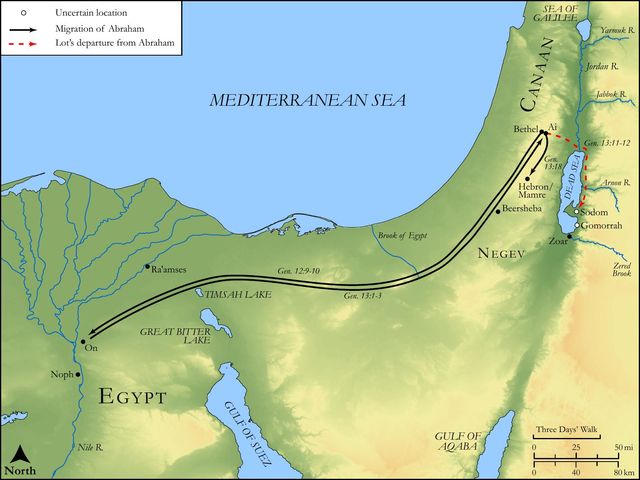
See on the biblical-era maps


Study this verse
Public-domain commentary
Matthew Henry
From his Commentary on the Whole Bible. Henry comments on passages, not single verses — this entry covers Genesis 13:10–13. His three-level outline is real structure in the source text, so it is rendered as structure.
We have here the choice that Lot made when he parted from Abram. Upon this occasion, one would have expected, 1. That he should have expressed an unwillingness to part from Abram, and that, at least, he should have done it with reluctancy. 2. That he should have been so civil as to have remitted the choice back again to Abram. But we find not any instance of deference or respect to his uncle in the whole management. Abram having offered him the choice, without compliment he accepted it, and made his election. Passion and selfishness make men rude. Now, in the choice which Lot made, we may observe,
I.How much he had an eye to the goodness of the land.
He beheld all the plan of Jordan, the flat country in which Sodom stood, that it was admirably well watered every where (and perhaps the strife had been about water, which made him particularly fond of that convenience), and so Lot chose all that plain, Gen 13:10, Gen 13:11. That valley, which was like the garden of Eden itself, now yielded him a most pleasant prospect. It was, in his eye, beautiful for situation, the joy of the whole earth; and therefore he doubted not but that it would yield him a comfortable settlement, and that in such a fruitful soil he should certainly thrive, and grow very rich: and this was all he looked at. But what came of it? Why, the next news we hear of him is that he is in the briars among them, he and his carried captive. While he lived among them, he vexed his righteous soul with their conversation, and never had a good day with them, till, at last, God fired the town over his head, and forced him to the mountain for safety who chose the plain for wealth and pleasure. Note, Sensual choices are sinful choices, and seldom speed well. Those who in choosing relations, callings, dwellings, or settlements are guided and governed by the lusts of the flesh, the lusts of the eye, or the pride of life, and consult not the interests of their souls and their religion, cannot expect God's presence with them, nor his blessing upon them, but are commonly disappointed even in that which they principally aimed at, and miss of that which they promised themselves satisfaction in. In all our choices this principle should overrule us, That that is best for us which is best for our souls.
II.How little he considered the wickedness of the inhabitants: But the men of Sodom were wicked, Gen 13:13. Note,
1.Though all are sinners, yet some are greater sinners than others. The men of Sodom were sinners of the first magnitude, sinners before the Lord, that is, impudent daring sinners; they were so to a proverb. Hence we read of those that declare their sin as Sodom, they hide it not, Isa 3:9.
2.That some sinners are the worse for living in a good land. So the Sodomites were: for this was the iniquity of Sodom, pride, fulness of bread, and abundance of idleness; and all these were supported by the great plenty their country afforded, Eze 16:49. Thus the prosperity of fools destroys them.
3.That God often gives great plenty to great sinners. Filthy Sodomites dwell in a city, in a fruitful plain, while faithful Abram and his pious family dwell in tents upon the barren mountains.
4.When wickedness has come to the height, ruin is not far off. Abounding sins are sure presages of approaching judgments. Now Lot's coming to dwell among the Sodomites may be considered,
(1.)As a great mercy to them, and a likely means of bringing them to repentance; for now they had a prophet among them and a preacher of righteousness, and, if they had hearkened to him, they might have been reformed, and the ruin prevented. Note, God sends preachers, before he sends destroyers; for he is not willing that any should perish.
(2.)As a great affliction to Lot, who was not only grieved to see their wickedness (Pe2 2:7, Pe2 2:8), but was molested and persecuted by them, because he would not do as they did. Note, It has often been the vexatious lot of good men to live among wicked neighbours, to sojourn in Mesech (Psa 120:5), and it cannot but be the more grievous, if, as Lot here, they have brought it upon themselves by an unadvised choice.
Historical interpretation
Historical reception
3 surviving comments on this verse. Each one is dated, so this reads as a timeline rather than a list.
Select a marker to jump to its quote. Markers stagger vertically where authors wrote within a few decades of each other.
But the fact that “the men of Sodom were wicked, great sinners in the sight of the Lord” is not a matter of minor importance, in terms of the way God deals with human beings. Rather, its aim is to help us understand that the harsh gravity of sin can compel a gentle God to retaliate. The reason Abraham was unable to obtain pardon for the Sodomites through his prayer is that their malice was beyond all measure. There are many people who the more wicked they are the more sheltered and secure they seem to be. They find ways of escaping human detection, where things are done without supervision or where a just person is indicted through false testimony. The just person remains just before God, even if others condemn him. God does not look at the outcome of trials or judicial actions based on unjust machinations but observes matters in their naked reality. In human trials, however, the error of false opinion often obstructs the force of truth. Susanna remained exceedingly chaste in God’s eyes, even when she was convicted of adultery, because God did not make a finding of fact based on the assertions of lying witnesses but directly examined the inner conscience of the mind.
Do you observe Lot having regard only for the nature of the land and not considering the wickedness of the inhabitants? What good, after all, is fertility of land and abundance of produce when the inhabitants are evil in their ways? By contrast, what harm could come from solitude and a simple lifestyle when the inhabitants are more restrained? The summit of blessings, you see, is the uprightness of those who dwell in a place. Lot, however, had eyes for one thing only, the richness of the countryside. Hence Scripture desires to indicate to us the wickedness of those who dwelt there in the words “Now the people of Sodom were very wicked sinners in God’s sight.” They were not merely “wicked” but also “sinners,” and not simply “sinners” but also “in God’s sight.” That is, the extent of their sins was extreme, and their wickedness superabounded—hence it added as well, “very wicked in God’s sight.” Do you see the extremity of the evil? Do you see how great an evil it is to usurp pride of place and not to consider what is for the common good? Do you see what a great thing is deference, ceding pride of place, taking second place? Take note, in fact: As the instruction develops we shall see that the one who took the pick of the best places gained no advantage from it, whereas he who chose the lesser became more resplendent day by day, and, with his wealth increasing, he became the attraction of all eyes.
(Verse 13) And the men of Sodom were wicked and sinners before God exceedingly. This addition, "before God," is superfluous in the Septuagint interpreters, since the inhabitants of Sodom were wicked and sinners among all people. However, a person is said to be a sinner before God, who can appear righteous among people, just as it is declared in the proclamation of Zachariah and Elizabeth that they were both righteous before God (Luke 1:6). And in the Psalter it is said: 'No living creature shall be justified in your sight.' (Ps. 142:2)
Continue studying Genesis 13:13 across the web’s major study libraries — every link below opens this exact verse, chapter, or book on the destination site.
Read & Compare
 BibleGatewayThis verse in more than 200 translations and 70 languages.
 Bible.comThe YouVersion reader — hundreds of translations, reading plans, and highlights.
 ESV.orgCrossway's official English Standard Version reader.
 NET BibleThe NET translation with 60,000+ translators' notes on every rendering decision.
 STEP BibleTyndale House's free study tool — original text, vocabulary, and scholarly resources.
 BibliaLogos Bible Software's free web reader.
 USCCBThe New American Bible (Revised Edition) with the U.S. bishops' study notes.
Commentaries
 BibleHub CommentariesDozens of classic commentaries on this verse, gathered on one page.
 StudyLightMore than 100 commentary sets — the largest collection on the web.
 BibleRefPlain-English commentary on what this verse means, verse by verse.
 Enduring WordDavid Guzik's free commentary on this chapter, widely used by Bible teachers.
 Bible Study ToolsVerse commentary alongside Greek and Hebrew study aids.
Original Language & Research
- BibleHub InterlinearThe verse word by word — original language, transliteration, and English.
- BibleHub LexiconEvery word's original-language definition and Strong's entry.
 Blue Letter BibleDeep-study tools — Strong's numbers, concordance, and word studies.
 SefariaThe Hebrew text with Rashi and centuries of Jewish commentary.
Sermons, Hymns & Audio


TrulyRandomVerse is not affiliated with these sites and doesn’t control their content. They’re linked because they’re genuinely useful.
Summary
Genesis 13:13 serves as a stark and crucial narrative interjection, immediately following Lot's choice to settle in the fertile plains of the Jordan. This verse functions as a divine commentary, revealing the profound and pervasive moral corruption of Sodom by explicitly stating that its inhabitants "were wicked and sinners before the LORD exceedingly." This declaration provides a critical warning to the reader, foreshadowing the inevitable divine judgment that would later befall the city and contrasting Lot's worldly ambition with the spiritual reality of his chosen environment.
Context
ShowHideLiterary Context
This verse is strategically placed immediately after the amicable separation of Abram and Lot, a necessary division due to the increasing size of their herds and the resulting conflict between their herdsmen. Lot, given the first choice of land, surveyed the well-watered Jordan plain and chose it as his dwelling, moving his tents as far as Sodom. The preceding verses (Genesis 13:10-12) describe the land's lushness, comparing it to "the garden of the LORD" and "the land of Egypt." Genesis 13:13 then acts as a jarring and immediate counterpoint to this seemingly idyllic description, injecting a crucial piece of theological information that recontextualizes Lot's choice. It transforms what appeared to be a shrewd economic decision into a perilous spiritual compromise, setting the narrative stage for the dramatic events of judgment in Genesis 18, Genesis 19.
Historical & Cultural Context
In that day, cities were often centers of trade, culture, and power, but also potential hubs of moral decay. The Jordan plain, being well-watered, was agriculturally rich and thus likely prosperous. Sodom, as a prominent city in this region, would have enjoyed significant material wealth. The phrase "before the LORD" is not merely a statement of God's omnipresence but also carries a judicial connotation, implying that their wickedness was not hidden but openly and brazenly committed in the sight of divine justice. This reflects a cultural understanding of a deity's active involvement in human affairs and moral oversight, where public transgressions were deemed particularly offensive to divine order. The extreme nature of their sin, as described, suggests a society that had completely abandoned the moral standards expected by God, leading to a state of profound moral depravity that would have been recognizable as such among the peoples round about.
Key Themes
ShowHideGenesis 13:13 contributes significantly to several overarching themes within Genesis and the broader biblical narrative. It highlights the theme of Divine Omniscience and Justice, emphasizing that God sees and knows all human actions, even those committed in private, and that His justice will ultimately prevail against pervasive wickedness. It underscores the theme of Human Depravity, showcasing the extreme depths to which human sinfulness can descend, particularly when unchecked by divine law or moral conscience, contrasting sharply with the righteousness of Abram, who chose to dwell in the land of Canaan, trusting in God's provision (see Genesis 13:14-18). The verse also introduces the theme of Consequences of Association, serving as a cautionary tale about the spiritual dangers of aligning oneself, even geographically, with unrighteousness, a warning echoed throughout wisdom literature (e.g., Proverbs 13:20). Finally, it lays the groundwork for the theme of Divine Judgment, foreshadowing the severe and just retribution that awaits unrepentant sin, a pattern seen repeatedly in God's dealings with humanity.
Exposition and Analysis
ShowHideGenesis 13:13 is a concise yet profoundly impactful statement, designed to immediately inform the reader of the true spiritual danger inherent in Lot's seemingly advantageous choice. The verse's deliberate placement after Lot's decision to settle near Sodom underscores the principle that material prosperity can often mask profound spiritual decay. The description of Sodom's inhabitants is intensified through specific Hebrew terms, painting a picture of pervasive and extreme moral depravity.
Key Word Analysis
ShowHideThis term, derived from the root meaning "to break" or "to be evil," denotes a comprehensive state of moral badness. It encompasses actions that are harmful, malicious, and fundamentally contrary to God's character and law. In this context, it describes a pervasive evil that permeated the very fabric of Sodomite society, indicating not just isolated acts but a deep-seated moral corruption.
This word, from a root meaning "to miss the mark," refers to those who transgress God's commands or deviate from His righteous path. When used intensively, as here, it signifies a criminal or one accounted guilty. The plural form emphasizes that this was not an individual failing but a characteristic of the entire populace, indicating a habitual and widespread practice of rebellion against divine standards.
This adverb serves as a powerful intensifier, stressing the extreme degree of their wickedness. It signifies "vehemence," "wholly," or "very much." Its inclusion here highlights that Sodom's sin was not casual or occasional but an overwhelming, pervasive, and deeply entrenched state of evil that permeated every aspect of their society, leaving no room for doubt about the severity of their moral condition.
Verse Breakdown
ShowHide"But the men of Sodom"
This phrase immediately shifts the focus from the pleasantness of the land to the character of its inhabitants. The contrast is stark and intentional, highlighting the spiritual danger lurking beneath the surface of material prosperity. It specifies that the problem was with the people themselves, not merely their environment.
"were wicked and sinners"
These two terms are used in conjunction to emphasize the comprehensive and pervasive nature of Sodom's corruption. "Wicked" (raʻ) points to their inherent moral depravity and evil character, while "sinners" (chaṭṭâʼ) highlights their active transgression of divine commands. Together, they paint a picture of a populace characterized by both a corrupt nature and a pattern of sinful behavior.
"before the LORD exceedingly"
This crucial phrase underscores several vital points. "Before the LORD" emphasizes God's omnipresence and perfect knowledge; their sins were not hidden but committed openly and brazenly in His sight, demonstrating a profound lack of fear or respect for divine authority. The addition of "exceedingly" (mᵉʼôd) intensifies the description, indicating that their wickedness was not merely present but extreme, overwhelming, and without measure. This phrase establishes the divine justification for the severe judgment that God would later bring upon the city, confirming that their depravity had reached its zenith.
Literary Devices
ShowHideGenesis 13:13 masterfully employs several literary devices to convey its powerful message. Juxtaposition is immediately evident, as the verse sharply contrasts the lush, "garden-like" description of the Jordan plain in Genesis 13:10 with the profound moral corruption of its inhabitants. This creates a jarring effect, highlighting the deceptive nature of outward appearances and the spiritual danger inherent in Lot's choice. The verse also functions as powerful Foreshadowing, serving as an explicit narrative warning to the reader about the impending divine judgment on Sodom and Gomorrah, which culminates dramatically in Genesis 19. The use of the intensifying adverb "exceedingly" (מְאֹד, me'od) is a form of Hyperbole or Emphasis, stressing the extreme and pervasive nature of Sodom's sin beyond mere casual transgression, ensuring the reader fully grasps the depth of their depravity. Finally, the phrase "before the LORD" employs Anthropomorphism by attributing a human-like perception (seeing) to God, thereby underscoring His active awareness and judicial oversight of human actions.
Theological and Thematic Connections
ShowHideGenesis 13:13 is a pivotal verse that profoundly shapes our understanding of divine justice, human depravity, and the consequences of moral compromise. It establishes early in the biblical narrative that God is not a distant observer but an active, righteous judge who sees all human actions, even those committed in the darkest corners of society. The extreme wickedness of Sodom serves as a stark illustration of the depth of human sinfulness and the potential for societal moral decay when unchecked by divine law or conscience. This verse, therefore, is a foundational statement about the nature of sin as a deliberate, open, and pervasive transgression against God's character and commands, inevitably leading to divine reckoning. It underscores that while God is merciful and long-suffering, there are limits to His patience, and unrepentant, extreme wickedness will ultimately incur His just wrath.
Reflection and Application
ShowHideGenesis 13:13 offers timeless lessons for believers today, reminding us that God sees and knows all things, including the hidden thoughts and actions of humanity, reinforcing the concept of divine accountability. Lot's choice to dwell near Sodom, despite its known wickedness, serves as a profound cautionary tale, underscoring the critical importance of discerning our environments and associations. The company we keep and the places we choose to inhabit can profoundly influence our spiritual and moral well-being, as the Bible often warns about the corrupting influence of bad company (e.g., 1 Corinthians 15:33). This verse challenges us to prioritize spiritual integrity over worldly gain or convenience, to be vigilant against the subtle allure of environments that may appear prosperous but harbor deep moral decay. Ultimately, the eventual fate of Sodom illustrates the severe consequences of unrepentant and pervasive sin, highlighting that while God is merciful, He is also perfectly just, and His justice will ultimately prevail against wickedness, pointing to the universal need for repentance and seeking God's righteousness in our lives and communities.
Questions for Reflection
ShowHideFAQ
ShowHideWhat specific sins were the men of Sodom committing?
ShowHideWhile Genesis 13:13 generally describes them as "wicked and sinners exceedingly," later biblical passages provide more specific details. Ezekiel 16:49-50 lists their sins as pride, fullness of bread (gluttony), abundance of idleness, and a failure to strengthen the hand of the poor and needy, in addition to committing abominations. This suggests a comprehensive moral decay, encompassing oppression, arrogance, lack of compassion, and sexual perversion (as strongly implied by Genesis 19, particularly the attempted gang rape of Lot's angelic visitors).
Why is this verse placed immediately after Lot's choice?
ShowHideThe immediate placement of this verse serves a crucial narrative and theological purpose. It acts as a divine commentary on Lot's seemingly advantageous choice, warning the reader of the inherent danger and moral compromise involved in settling near such a depraved city. It immediately establishes the spiritual reality of Sodom, contrasting it with the perceived material benefits Lot sought. This foreshadows the coming judgment and fully justifies God's later actions, highlighting the stark contrast between Lot's worldly ambition and the profound spiritual peril of his chosen environment. It also serves as a literary device to build tension and explain the future divine intervention.
Christ-Centered Fulfillment
ShowHideThe profound wickedness of Sodom, judged "before the LORD exceedingly," finds its ultimate contrast and fulfillment in the person and work of Jesus Christ. While Sodom represents the epitome of human depravity and the just wrath of God against sin, Christ embodies perfect righteousness and offers the ultimate solution to sin. He is the one who, though utterly sinless, bore the full weight of God's judgment against humanity's wickedness, including the kind of pervasive sinfulness seen in Sodom, when He was crucified (as prophesied in Isaiah 53:5-6). Through His atoning sacrifice on the cross, Christ offers deliverance from the wrath to come, providing a path to righteousness and reconciliation with God that was utterly absent in Sodom (see Romans 5:8-9). Furthermore, Christ will return as the righteous Judge, fulfilling the ultimate justice of God that was partially demonstrated in Sodom's destruction (as described in Matthew 25:31-33), calling all people to repentance and faith in Him as the only escape from eternal condemnation and the only means to inherit eternal life (as proclaimed in John 3:16-18).