


Genesis 13:5
Bible text: King James Version (1769 Blayney text) · Public domain
Bible text: Berean Standard Bible · Public domain
Bible text: American Standard Version (1901) · Public domain
Bible text: World English Bible, Messianic edition · Public domain
Bible text: Geneva Bible (1599) · Public domain
Bible text: Young's Literal Translation · Public domain
- וְגַםve·gamand alsoH1571Conj-w ¦ AdvAdverbוְandגַםalso
- לְלוֹטle·Lotto LotH3876Prep-l ¦ N-proper-mNoun Proper MasculineלְtoלוֹטLot
- הַהֹלֵךְha·ho·Lekhwho was travelingH1980Art ¦ V-Qal-Prtcpl-msVerb Qal Participle Singular Masculine Absoluteהַwhoהֹלֵךְwas traveling
- אֶת'etwithH854PrepPreposition
- אַבְרָם'av·RamAbramH87N-proper-mNoun Proper Masculine
- הָיָהha·Yahit be[longed]H1961V-Qal-Perf-3msVerb Qal Perfect 3rd Singular Masculine
- צֹאןtzonsheepH6629N-csNoun Singular common gender Absolute
- וּבָקָרu·va·Karand cattleH1241Conj-w ¦ N-csNoun Singular common gender Absoluteוּandבָקָרcattle
- וְאֹהָלִיםve·'o·ha·Limand tentsH168Conj-w ¦ N-mpNoun Plural Masculine Absoluteוְandאֹהָלִיםtents
English is a literal word-by-word gloss of the Hebrew, not the KJV's wording. Why?
This is the original text the KJV's translators worked from — each Hebrew word with its own literal English meaning in this verse, prepared by scholars at Tyndale House, Cambridge. The KJV translates whole sentences, not word by word, so its wording differs: one Hebrew word can become several English words, and the KJV may choose “the LORD” where the gloss reads “Yahweh”. Both are faithful — they answer different questions. For the KJV's own rendering, switch to the KJV text.
Details
See on the biblical-era maps


Study this verse
Public-domain commentary
Matthew Henry
From his Commentary on the Whole Bible. Henry comments on passages, not single verses — this entry covers Genesis 13:5–9. His three-level outline is real structure in the source text, so it is rendered as structure.
We have here an unhappy falling out between Abram and Lot, who had hitherto been inseparable companions (see Gen 13:1, and Gen 12:4), but now parted.
I.The occasion of their quarrel was their riches.
We read (Gen 13:2) how rich Abram was; now here we are told (Gen 13:5) that Lot, who went with Abram, was rich too; and therefore God blessed him with riches because he went with Abram. Note,
1.It is good being in good company, and going with those with whom God is, Zac 8:23.
2.Those that are partners with God's people in their obedience and sufferings shall be sharers with them in their joys and comforts, Isa 66:10. Now, they both being very rich, the land was not able to bear them, that they might dwell comfortably and peaceably together. So that their riches may be considered,
(1.)As setting them at a distance one from another. Because the place was too strait for them, and they had not room for their stock, it was necessary they should live asunder. Note, Every comfort in this world has its cross attending it. Business is a comfort; but it has this inconvenience in it, that it allows us not the society of those we love, so often, nor so long, as we could wish.
(2.)As setting them at variance one with another. Note, Riches are often an occasion of strife and contention among relations and neighbours. this is one of those foolish and hurtful lusts which those that will be rich fall into, Ti1 6:9. Riches not only afford matter for contention, and are the things most commonly striven about, but they also stir up a spirit of contention, by making people proud and covetous. Meum and tuum - Mine and thine, are the great make-bates of the world. Poverty and travail, wants and wanderings, could not separate between Abram and Lot; but riches did. Friends are soon lost; but God is a friend from whose love neither the height of prosperity nor the depth of adversity shall separate us.
II.The immediate instruments of the quarrel were their servants.
The strife began between the herdsmen of Abram's cattle and the herdsmen of Lot's cattle, Gen 13:7. They strove, it is probable, which should have the better pasture or the better water; and both interested their masters in the quarrel. Note, Bad servants often make a great deal of mischief in families, by the pride and passion, their lying slandering, and tale-bearing. It is a very wicked thing for servants to do ill offices between relations and neighbours, and to sow discord; those that do so are the devil's agents and their masters' worst enemies.
III.The aggravation of the quarrel was that the Canaanite and the Perizzite dwelt then in the land; this made the quarrel,
1.Very dangerous. If Abram and Lot cannot agree to feed their flocks together, it is well if the common enemy do not come upon them and plunder them both. Note, The division of families and churches often proves the ruin of them.
2.Very scandalous. No doubt the eyes of all the neighbours were upon them, especially because of the singularity of their religion, and the extraordinary sanctity they professed; and notice would soon be taken of this quarrel, and improvement made of it, to their reproach, by the Canaanites and Perizzites. Note, The quarrels of professors are the reproach of profession, and give occasion, as much as any thing, to the enemies of the Lord to blaspheme.
IV.The making up of this quarrel was very happy.
It is best to preserve the peace, that it be not broken; but the next best is, if differences do happen, with all speed to accommodate them, and quench the fire that has broken out. The motion for staying this strife was made by Abram, though he was the senior and superior relation, Gen 13:8.
1.His petition for peace was very affectionate: Let there be not strife, I pray thee. Abram here shows himself to be a man, (1.) of a cool spirit, that had the command of his passion, and knew how to turn away wrath with a soft answer. Those that would keep the peace must never render railing for railing. (2.) Of a condescending spirit; he was willing to beseech even his inferior to be at peace, and made the first overture of reconciliation. Conquerors reckon it their glory to give peace by power; and it is no less so to give peace by the meekness of wisdom. Note, The people of God should always approve themselves a peaceable people; whatever others are for, they must be for peace.
2.His plea for peace was very cogent. (1.) "Let there be no strife between me and thee. Let the Canaanites and Perizzites contend about trifles; but let not thee and me fall out, who know better things, and look for a better country." Note, Professors of religion should, of all others, be careful to avoid contention. You shall not be so, Luk 22:26. We have no such custom, Co1 11:16. "Let there be no strife between me and thee, who have lived together and loved one another so long." Note, The remembrance of old friendships should quickly put an end to new quarrels which at any time happen. (2.) Let it be remembered that we are brethren, Heb. we are men brethren; a double argument. [1.] We are men; and, as men, we are mortal creatures - we may die tomorrow, and are concerned to be found in peace. We are rational creatures, and should be ruled by reason. We are men, and not brutes, men, and not children; we are sociable creatures, let us be so to the uttermost. [2.] We are brethren. Men of the same nature, of the same kindred and family, of the same religion, companions in obedience, companions in patience. Note, The consideration of our relation to each other, as brethren, should always prevail to moderate our passions, and either to prevent or put an end to our contentions. Brethren should love as brethren.
3.His proposal for peace was very fair. Many who profess to be for peace yet will do nothing towards it; but Abram hereby approved himself a real friend to peace that he proposed an unexceptionable expedient for the preserving of it: Is not the whole land before thee? Gen 13:9. As if he had said, "Why should we quarrel for room, while there is room enough for us both?" (1.) He concludes that they must part, and is very desirous that they should part friends: Separate thyself, I pray thee, from me. What could be expressed more affectionately? He does not expel him, and force him away, but advises that he should separate himself. Nor does he charge him to depart, but humbly desires him to withdraw. Note, Those that have power to command, yet sometimes, for love's sake, and peace' sake, should rather beseech us, we may well afford to beseech one another, to be reconciled, Co2 5:20. (2.) He offers him a sufficient share of the land they were in. Though God had promised Abram to give this land to his seed (Gen 12:7), and it does not appear that ever any such promise was made to Lot, which Abram might have insisted on, to the total exclusion of Lot, yet he allows him to come in partner with him, and tenders an equal share to one that had not an equal right, and will not make God's promise to patronise his quarrel, nor, under the protection of that, put any hardship on his kinsman. (3.) He give him his choice, and offers to take up with his leavings: If thou wilt take the left hand, I will go to the right. There was all the reason in the world that Abram should choose first; yet he recedes from his right. Note, It is a noble conquest to be willing to yield for peace' sake; it is the conquest of ourselves, and our own pride and passion, Mat 5:39, Mat 5:40. It is not only the punctilios of honour, but even interest itself, that in many cases must be sacrificed to peace.
Historical interpretation
Three Centuries of Reception
3 surviving comments on this verse. Each one is dated, so this reads as a timeline rather than a list.
Select a marker to jump to its quote. Markers stagger vertically where authors wrote within a few decades of each other.
It remains to be seen if Lot too, his nephew, was rich as one who belonged to the same family. But Scripture says only that he had many cattle. In fact, the text reads, “Lot also, who went with Abraham, had flocks, herds and tents.” He had no silver, because he was not yet just; in fact, “the tongue of the just man is like silver purified by fire.” He had no gold, which was the possession of the one who saw the posterity of Christ, of whom it is written: “And his posterity shines like gold.” Abraham saw him, as the Lord testified when he said, “Abraham saw my day and rejoiced.” This is why he deserved to shine like gold and to have gold as his endowment.
It is impossible for me to omit here a discussion of a question that has stumped even the more learned, namely, why the text is worded this way: “Lot also, who went with Abraham,” as though we were to understand that there was another Lot who did not go with him. And many believe the problem is as yet unresolved. So to satisfy these and at the same time to abide by the rule of Scripture, we would say that there is one person who takes on two roles, that in one and the same individual two things are signified. Numerically Lot is a single individual; virtually he is two. In fact, Lot, according to the Latin interpretation, means declinatio (“a deviation”). But one can deviate either from the good or from the bad. So when Lot deviated from the bad, that is, from error, from base and criminal behavior, he was joined to his uncle. When he deviated from the good, that is, from what is just, innocent, holy and sacred, he was joined to baseness. This is why it says, “now Lot too, who accompanied Abraham,” because he had not yet chosen Sodom, and he was not dwelling among those who are authors of evil. Thereafter he did go to live in Sodom. And so it was that he became alienated from himself; he thought of himself as of another, as of one, that is, who withdraws not only from the just man but even from himself.
But Lot also, who was with Abram, had flocks of sheep, and herds, and tents; nor could the land bear them so that they might dwell together: for their substance was great, and they could not dwell together: hence there was a quarrel between the herdsmen of Abram's flocks and Lot's, and it is detailed how Lot departed from Abraham with their love preserved, preferring to separate physically from his dearest and most holy brother rather than to remain with him amidst scandals and disputes, which were troubling the weak ones; yet he in no way let his bodily separation from him separate him from the deepest love of his mind, as the following sacred history most clearly proves: where having been captured by enemies, he saved him with all his might with his men, and rightly so because Lot himself did not at all alter the course of virtue and faith, which he had been accustomed to practice with his elder brother, even living apart.
Continue studying Genesis 13:5 across the web’s major study libraries — every link below opens this exact verse, chapter, or book on the destination site.
Read & Compare
 BibleGatewayThis verse in more than 200 translations and 70 languages.
 Bible.comThe YouVersion reader — hundreds of translations, reading plans, and highlights.
 ESV.orgCrossway's official English Standard Version reader.
 NET BibleThe NET translation with 60,000+ translators' notes on every rendering decision.
 STEP BibleTyndale House's free study tool — original text, vocabulary, and scholarly resources.
 BibliaLogos Bible Software's free web reader.
 USCCBThe New American Bible (Revised Edition) with the U.S. bishops' study notes.
Commentaries
 BibleHub CommentariesDozens of classic commentaries on this verse, gathered on one page.
 StudyLightMore than 100 commentary sets — the largest collection on the web.
 BibleRefPlain-English commentary on what this verse means, verse by verse.
 Enduring WordDavid Guzik's free commentary on this chapter, widely used by Bible teachers.
 Bible Study ToolsVerse commentary alongside Greek and Hebrew study aids.
Original Language & Research
- BibleHub InterlinearThe verse word by word — original language, transliteration, and English.
- BibleHub LexiconEvery word's original-language definition and Strong's entry.
 Blue Letter BibleDeep-study tools — Strong's numbers, concordance, and word studies.
 SefariaThe Hebrew text with Rashi and centuries of Jewish commentary.
Sermons, Hymns & Audio


TrulyRandomVerse is not affiliated with these sites and doesn’t control their content. They’re linked because they’re genuinely useful.
Summary
Genesis 13:5 meticulously records Lot's significant material possessions, including extensive flocks, herds, and numerous tents, acquired during his journey alongside Abram. This verse is pivotal, underscoring the immense wealth both men had amassed, which directly sets the stage for the inevitable conflict over resources. This burgeoning prosperity ultimately necessitates their separation, a crucial event that defines their divergent paths and profoundly shapes the unfolding of God's covenant promises to Abram.
Context
ShowHideLiterary Context
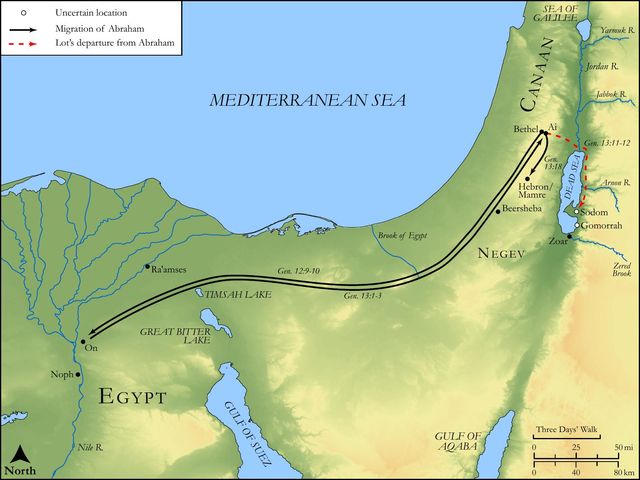
This verse is strategically placed within the narrative immediately following Abram's return from Egypt, as detailed in Genesis 13:1-4. Having sojourned in Egypt during a famine, Abram, along with Lot, returned to the Negev and then to Bethel, the place where Abram had previously built an altar and called upon the name of the Lord. The preceding verses (Genesis 13:2-4) emphasize Abram's "very great" wealth in livestock, silver, and gold. Genesis 13:5 then explicitly extends this description of prosperity to Lot, setting up the economic parity that will become the catalyst for the conflict described in Genesis 13:6-7. The specific mention of Lot's independent wealth is crucial as it highlights the scale of their combined possessions, which the land could no longer sustain.
Historical & Cultural Context
In the lands of the patriarchs, particularly among nomadic peoples like Abram and Lot, wealth was primarily measured in livestock (flocks of sheep and goats, and herds of cattle) and the number of tents, which indicated the size of one's household and dependents. Land ownership was often communal or based on grazing rights, and fertile pasturage was a highly contested resource. The presence of "the Canaanite and the Perizzite" in the land, as mentioned in Genesis 13:7, further exacerbated the issue of limited grazing land. This context illuminates why the burgeoning wealth of both Abram and Lot, while a sign of blessing, would inevitably lead to disputes over scarce resources, making their separation a practical necessity for survival and peace. Their nomadic lifestyle meant that their "tents" were not merely shelters but symbols of their mobile economy and large, self-sufficient communities.
Key Themes
ShowHideGenesis 13:5 significantly contributes to several overarching themes within the book of Genesis and the broader biblical narrative. Firstly, it highlights the theme of Divine Blessing and Provision, demonstrating God's faithfulness in prospering Abram, and by extension, those associated with him, even in a foreign land, as promised in Genesis 12:2. Secondly, it introduces the theme of Conflict Arising from Prosperity, showing that even blessings can lead to challenges that require wise discernment and resolution, foreshadowing the choices Abram and Lot must make. Thirdly, the verse subtly underscores the theme of Separation and the Refinement of the Covenant Line, as the impending division between Abram and Lot is not merely a practical solution but a divinely orchestrated step to ensure the purity and distinctness of the lineage through which God's covenant promises would be fulfilled, as seen in Genesis 13:14-17.
Exposition and Analysis
ShowHideKey Word Analysis
ShowHideThis proper noun refers to Abraham's nephew. His inclusion in this verse is significant because it establishes his independent wealth, which is crucial for the narrative's progression. The mention of Lot's prosperity alongside Abram's highlights the scale of their combined assets and the impending logistical challenges.
A primitive root meaning "to walk" or "to go" in a variety of applications, both literally and figuratively. Here, it literally describes Lot's continuous journeying and association with Abram. This word emphasizes their shared nomadic lifestyle and the fact that Lot's prosperity was directly tied to his accompaniment of Abram, who was the recipient of God's blessing.
Meaning "a tent (as clearly conspicuous from a distance)." This term signifies not just a dwelling but the mobile nature of their wealth and lifestyle. In the households of the patriarchs, the number of tents indicated the size of a household, including servants and extended family, and thus represented significant social and economic standing for nomadic pastoralists.
Verse Breakdown
ShowHide"And Lot also,"
This opening phrase immediately draws attention to Lot, signaling that his possessions are comparable to Abram's, which were detailed in the preceding verses. The word "also" emphasizes a shared, substantial prosperity between the two households, setting the stage for the conflict that arises from their combined wealth.
"which went with Abram,"
This clause highlights the close relationship between Lot and Abram, and implicitly, the source of Lot's blessing. Lot's prosperity is a direct result of his association with Abram, who is the recipient of God's covenant promises. It underscores the idea that God's blessing on Abram extended to those closely connected to him.
"had flocks, and herds, and tents."
This tripartite phrase comprehensively describes the nature of Lot's wealth. "Flocks" (sheep and goats) and "herds" (cattle) were the primary forms of capital for nomadic pastoralists, providing food, clothing, and trade goods. "Tents" represent their portable dwellings, indicative of a large, mobile household and significant social status. Together, these terms paint a vivid picture of Lot's considerable and self-sufficient prosperity, mirroring Abram's.
Literary Devices
ShowHideThe verse employs Merism by listing "flocks, and herds, and tents" to represent the entirety of Lot's considerable wealth and nomadic lifestyle. This concise enumeration effectively conveys the vastness of his possessions without needing an exhaustive inventory. Furthermore, the verse functions as Foreshadowing, subtly hinting at the impending conflict and separation between Abram and Lot. The explicit mention of Lot's independent wealth, mirroring Abram's, creates a narrative tension that will be resolved in the subsequent verses through their division of land. There is also an element of Parallelism with the description of Abram's wealth in Genesis 13:2, emphasizing the shared, yet ultimately problematic, prosperity.
Theological and Thematic Connections
ShowHideThe prosperity of both Abram and Lot, as highlighted in this verse, serves as a powerful testament to God's abundant provision and faithfulness to His covenant promises. While the immediate context is material wealth, this blessing is rooted in God's commitment to Abram, showcasing how divine favor can extend to those connected to the covenant recipient. However, this very blessing also introduces a challenge, necessitating a decision that reveals the differing priorities of Abram and Lot, and ultimately, God's sovereign hand in guiding the lineage of promise. This narrative subtly introduces the theme that even blessings can create complexities that require spiritual discernment and a willingness to prioritize peace and God's greater purposes over worldly gain.
Reflection and Application
ShowHideGenesis 13:5, though brief, offers profound lessons for contemporary believers regarding the complexities of prosperity and relationships. It reminds us that while material blessings are gifts from God, they can also become sources of contention if not managed with wisdom, humility, and a clear spiritual perspective. The burgeoning wealth of Abram and Lot, while a sign of divine favor, ultimately created an environmental strain that necessitated a difficult decision. This narrative challenges us to examine our own stewardship of resources, asking whether our possessions serve to foster peace and godly relationships, or if they inadvertently create division and draw us away from spiritual priorities. It encourages us to cultivate a heart that prioritizes harmonious relationships and God's will above personal gain, recognizing that true wealth lies not merely in what we possess, but in how we steward it for God's glory and the good of others.
Questions for Reflection
ShowHideFAQ
ShowHideWhy is Lot's wealth specifically mentioned in this verse?
ShowHideLot's wealth is specifically mentioned in Genesis 13:5 to establish the economic parity between him and Abram. This detail is crucial because it directly sets the stage for the conflict over grazing land and resources that immediately follows. It highlights that both households had grown so large and prosperous that the land could no longer sustain them together, thus necessitating their separation. This specific mention is not merely an inventory but a narrative device to explain the impending need for division.
What do "flocks, herds, and tents" signify about Lot's wealth?
ShowHide"Flocks, herds, and tents" represent the comprehensive and typical wealth of nomadic pastoralists in the lands of the patriarchs. "Flocks" (sheep and goats) and "herds" (cattle) were the primary forms of capital, providing food, clothing, milk, and goods for trade. "Tents" signify their mobile dwellings, indicating a large household, numerous dependents, and the ability to move with their vast livestock. Together, these terms paint a vivid picture of Lot's significant, self-sufficient prosperity, underscoring his considerable status and influence within their nomadic society.
Does this verse imply Lot was as blessed as Abram in terms of God's covenant?
ShowHideWhile Genesis 13:5 indicates Lot was also very wealthy, it does not imply he was blessed in the same unique covenantal sense as Abram. Lot's prosperity was largely a consequence of his association with Abram, who was the direct recipient of God's covenant promises of blessing, land, and nationhood (Genesis 12:2-3). Lot benefited from being in Abram's household and under the umbrella of God's favor on Abram. However, Lot was not the one through whom the divine promises of a great nation and the blessing of all families of the earth would be fulfilled; that distinct calling remained solely with Abram.
Christ-Centered Fulfillment
ShowHideThe seemingly mundane account of Lot's wealth in Genesis 13:5 and the subsequent separation from Abram serves a profound redemptive purpose, ultimately pointing to Christ. The division ensures that the lineage of promise, through which the Messiah would eventually come, remains distinct and uncompromised by the choices and influences of Lot. This narrative foreshadows the necessity of separation from worldly entanglements for the fulfillment of God's greater redemptive plan. In Christ, the true and eternal "flocks and herds" are not material possessions but the vast multitude of believers from every tribe and tongue, whom He gathers into His kingdom as the Good Shepherd. The "tents" of nomadic life find their ultimate fulfillment in Christ as the one in whom God's Spirit dwells, making His people the temple of the Holy Spirit and a spiritual house. Unlike the earthly wealth that led to division, Christ offers an eternal, spiritual inheritance that unites believers in Him, transcending material possessions and earthly conflicts, providing ultimate fulfillment of all divine promises and an everlasting dwelling place with God (Revelation 21:3).