


Genesis 25:27
Bible text: King James Version (1769 Blayney text) · Public domain
Bible text: Berean Standard Bible · Public domain
Bible text: American Standard Version (1901) · Public domain
Bible text: World English Bible, Messianic edition · Public domain
Bible text: Geneva Bible (1599) · Public domain
Bible text: Young's Literal Translation · Public domain
- וַיִּגְדְּלוּvai·yig·de·Luand they grew upH1431Conj-w ¦ V-Qal-ConsecImperf-3mpVerb Qal Consecutive Imperfect 3rd Plural Masculineוַandיִּגְדְּלוּthey grew up
- הַנְּעָרִיםha·ne·'a·Rimthe ladsH5288Art ¦ N-mpNoun Plural Masculine Absoluteהַtheנְּעָרִיםlads
- וַיְהִיvay·Hiand he wasH1961Conj-w ¦ V-Qal-ConsecImperf-3msVerb Qal Consecutive Imperfect 3rd Singular Masculineוַandיְהִיhe was
- עֵשָׂו'e·SavEsauH6215N-proper-mNoun Proper Masculine
- אִישׁ'isha manH376N-msNoun Singular Masculine Absolute
- יֹדֵעַyo·De·a'[who] knewH3045V-Qal-Prtcpl-msVerb Qal Participle Singular Masculine Absolute
- צַיִדTza·yidhuntingH6718N-msNoun Singular Masculine Absolute
- אִישׁ'isha man ofH376N-mscNoun Singular Masculine Construct
- שָׂדֶהsa·Deh[the] open countryH7704N-msNoun Singular Masculine Absolute
- וְיַעֲקֹבve·ya·'a·Koand JacobH3290Conj-w ¦ N-proper-mNoun Proper MasculineוְandיַעֲקֹבJacob
- אִישׁ'ish[was] a manH376N-msNoun Singular Masculine Absolute
- תָּםTamquietH8535Adj-msAdjective Singular Masculine Absolute
- יֹשֵׁבyo·Shev[who] dweltH3427V-Qal-Prtcpl-msVerb Qal Participle Singular Masculine Absolute
- אֹהָלִים'o·ha·LimtentsH168N-mpNoun Plural Masculine Absolute
English is a literal word-by-word gloss of the Hebrew, not the KJV's wording. Why?
This is the original text the KJV's translators worked from — each Hebrew word with its own literal English meaning in this verse, prepared by scholars at Tyndale House, Cambridge. The KJV translates whole sentences, not word by word, so its wording differs: one Hebrew word can become several English words, and the KJV may choose “the LORD” where the gloss reads “Yahweh”. Both are faithful — they answer different questions. For the KJV's own rendering, switch to the KJV text.
Details
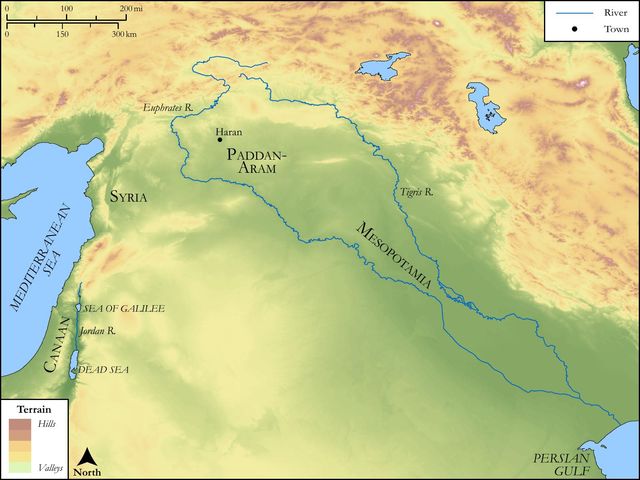
See on the biblical-era maps


Study this verse
Public-domain commentary
Matthew Henry
From his Commentary on the Whole Bible. Henry comments on passages, not single verses — this entry covers Genesis 25:19–28. His four-level outline is real structure in the source text, so it is rendered as structure.
We have here an account of the birth of Jacob and Esau, the twin sons of Isaac and Rebekah: their entrance into the world was (which is not usual) one of the most considerable parts of their story; nor is much related concerning Isaac but what had reference to his father while he lived and to his sons afterwards. For Isaac seems not to have been a man of action, nor much tried, but to have spent his days in quietness and silence. Now concerning Jacob and Esau we are here told,
I.That they were prayed for.
Their parents, after they had been long childless, obtained them by prayer, Gen 25:20, Gen 25:21. Isaac was forty years old when he was married; though he was an only son, and the person from whom the promised seed was to come, yet he made no haste to marry. He was sixty years old when his sons were born (Gen 25:26), so that, after he was married, he had no child for twenty years. Note, Though the accomplishment of God's promise is always sure, yet it is often slow, and seems to be crossed and contradicted by Providence, that the faith of believers may be tried, their patience exercised, and mercies long waited for may be the more welcome when they come. While this mercy was delayed, Isaac did not approach to a handmaid's bed, as Abraham had done, and Jacob afterwards; for he loved Rebekah, Gen 24:67. But,
1.He prayed: he entreated the Lord for his wife. Though God had promised to multiply his family, he prayed for its increase; for God's promises must not supersede, but encourage, our prayers, and be improved as the ground of our faith. Though he had prayed for this mercy very often, and had continued his supplication many years, and it was not granted, yet he did not leave off praying for it; for men ought always to pray, and not to faint (Luk 18:1), to pray without ceasing, and knock till the door be opened, He prayed for his wife; some read it with his wife. Note, Husbands and wives should pray together, which is intimated in the apostle's caution, that their prayers be not hindered, Pe1 3:7. The Jews have a tradition that Isaac, at length, took his wife with him to mount Moriah, where God had promised that he would multiply Abraham's seed (ch. 22:17), and there, in his prayer with her and for her, pleaded the promise made in that very place.
2.God heard his prayer, and was entreated of him. Note, Children are the gift of God. Those that continue instant in prayer, as Isaac did, shall find, at last, that they did not seek in vain, Isa 45:19.
II.That they were prophesied of before they were born, and great mysteries were wrapped up in the prophecies which went before of them, Gen 25:22, Gen 25:23. Long had Isaac prayed for a son; and now his wife is with child of two, to recompense him for his long waiting. Thus God often outdoes our prayers, and gives more than we are able to ask or think. Now Rebekah being with child of these two sons, observe here,
1.How she was perplexed in her mind concerning her present case: The children struggled together within her. The commotion she felt was altogether extraordinary and made her very uneasy. Whether she was apprehensive that the birth would be her death, or whether she was weary of the intestine tumult, or whether she suspected it to be an ill omen, it seems she was ready to wish that either she had not been with child or that she might die immediately, and not bring forth such a struggling brood: If it be so, or, since it is so, Why am I thus? Before, the want of children was her trouble, now, the struggle of the children is no loss so. Note,
(1.)The comforts we are most desirous of are sometimes found to bring along with them more occasion of trouble and uneasiness that we thought of; vanity being written upon all things under the sun, God thus teaches us to read it.
(2.)We are too apt to be discontented with our comforts, because of the uneasiness that attends them. We know not when we are pleased; we know neither how to want nor how to abound. This struggle between the kingdom of God and the kingdom of Satan,
[1.]In the world. The seed of the woman and the seed of the serpent have been contending ever since the enmity was put between them (Gen 3:15), and this has occasioned a constant uneasiness among men. Christ himself came to send fire on earth, and this division, Luk 12:49, Luk 12:51. But let not this be offence to us. A holy war is better than the peace of the devil's palace.
[2.]In the hearts of believers. No sooner is Christ formed in the soul than immediately there begins a conflict between the flesh and spirit, Gal 5:17. The stream is not turned without a mighty struggle, which yet ought not to discourage us. It is better to have a conflict with sin than tamely to submit to it.
2.What course she took for her relief: She went to enquire of the Lord. Some think Melchizedek was now consulted as an oracle, or perhaps some Urim or Teraphim were now used to enquire of God by, as afterwards in the breast-plate of judgment. Note, The word and prayer, by both which we now enquire of the Lord, give great relief to those that are upon any account perplexed. It is a great relief to the mind to spread our case before the Lord, and ask counsel at his mouth. Go into the sanctuary, Psa 73:17.
3.The information given her, upon her enquiry, which expounded the mystery: Two nations are in thy womb, Gen 25:23. She was now pregnant, not only with two children, but two nations, which should not only in their manners and dispositions greatly differ from each other, but in their interests clash and contend with each other; and the issue of the contest should be that the elder should serve the younger, which was fulfilled in the subjection of the Edomites, for many ages, to the house of David, till they revolted, Ch2 21:8. Observe here, (1.) God is a free agent in dispensing his grace; it is his prerogative to make a difference between those who have not as yet themselves done either good or evil. This the apostle infers hence, Rom 9:12 (2.) In the struggle between grace and corruption in the soul, grace, the younger, shall certainly get the upper hand at last.
III.That when they were born there was a great difference between them, which served to confirm what had been foretold (Gen 25:23), was presage of the accomplishment of it, and served greatly to illustrate the type.
1.There was a great difference in their bodies, Gen 25:25. Esau, when he was born, was rough and hairy, as if he had been already a grown man, whence he had his name Esau, made, reared already. This was an indication of a very strong constitution, and gave cause to expect that he would be a very robust, daring, active man. But Jacob was smooth and tender as other children. Note,
(1.)The difference of men's capacities, and consequently of their condition in the world, arises very much from the difference of their natural constitution; some are plainly designed by nature for activity and honour, others as manifestly marked for obscurity. This instance of the divine sovereignty in the kingdom of providence may perhaps help to reconcile us to the doctrine of the divine sovereignty in the kingdom of grace.
(2.)It is God's usual way to choose the weak things of the world, and to pass by the mighty, Co1 1:26, Co1 1:27.
2.There was a manifest contest in their births. Esau, the stronger, came forth first; but Jacob's hand took hold of his heel, Gen 25:26. This signified,
(1.)Jacob's pursuit of the birthright and blessing; from the first, he reached forth to catch hold of it, and, if possible, to prevent his brother.
(2.)His prevailing for it at last, that, in precess of time, he should undermine his brother, and gain his point. This passage is referred to (Hos 12:8), and hence he had his name, Jacob, a supplanter.
3.They were very unlike in the temper of their minds, and the way of living they chose, Gen 25:27. They soon appeared to be of very different dispositions.
(1.)Esau was a man for this world. He was a man addicted to his sports, for he was a hunter; and a man who knew how to live by his wits, for he was a cunning hunter. Recreation was his business; he studied the art of it, and spent all his time in it. He never loved a book, nor cared for being within doors; but he was a man of the field, like Nimrod and Ishmael, all for the game, and never well but when he was upon the stretch in pursuit of it: in short, he set up for a gentleman and a soldier.
(2.)Jacob was a man for the other world. He was not cut out for a statesman, nor did he affect to look great, but he was a plain man, dwelling in tents, an honest man that always meant well, and dealt fairly, that preferred the true delights of solitude and retirement to all the pretended pleasure of busy noisy sports: he dwelt in tents,
[1.]As a shepherd. he was attached to that safe and silent employment of keeping sheep, to which also he bred up his children, Gen 46:34. Or,
[2.]As a student. He frequented the tents of Melchizedek, or Heber, as some understand it, to be taught by them divine things. And this was that son of Isaac on whom the covenant was entailed.
4.Their interest in the affections of their parents was likewise different. They had but these two children, and, it seems, one was the father's darling and the other the mother's, Gen 25:28.
(1.)Isaac, though he was not a stirring man himself (for when he went into the fields he went to meditate and pray, not to hunt), yet loved to have his son active. Esau knew how to please him, and showed a great respect for him, by treating him often with venison, which gained him the affections of the good old man, and won upon him more than one would have thought.
(2.)Rebekah was mindful of the oracle of God, which had given the preference to Jacob, and therefore she preferred him in her love. And, if it be lawful for parents to make a difference between their children upon any account, doubtless Rebekah was in the right, that loved him whom God loved.
Continue studying Genesis 25:27 across the web’s major study libraries — every link below opens this exact verse, chapter, or book on the destination site.
Read & Compare
 BibleGatewayThis verse in more than 200 translations and 70 languages.
 Bible.comThe YouVersion reader — hundreds of translations, reading plans, and highlights.
 ESV.orgCrossway's official English Standard Version reader.
 NET BibleThe NET translation with 60,000+ translators' notes on every rendering decision.
 STEP BibleTyndale House's free study tool — original text, vocabulary, and scholarly resources.
 BibliaLogos Bible Software's free web reader.
 USCCBThe New American Bible (Revised Edition) with the U.S. bishops' study notes.
Commentaries
 BibleHub CommentariesDozens of classic commentaries on this verse, gathered on one page.
 StudyLightMore than 100 commentary sets — the largest collection on the web.
 BibleRefPlain-English commentary on what this verse means, verse by verse.
 Enduring WordDavid Guzik's free commentary on this chapter, widely used by Bible teachers.
 Bible Study ToolsVerse commentary alongside Greek and Hebrew study aids.
Original Language & Research
- BibleHub InterlinearThe verse word by word — original language, transliteration, and English.
- BibleHub LexiconEvery word's original-language definition and Strong's entry.
 Blue Letter BibleDeep-study tools — Strong's numbers, concordance, and word studies.
 SefariaThe Hebrew text with Rashi and centuries of Jewish commentary.
Sermons, Hymns & Audio


TrulyRandomVerse is not affiliated with these sites and doesn’t control their content. They’re linked because they’re genuinely useful.
Summary
Genesis 25:27 offers a pivotal glimpse into the formative years of Isaac and Rebekah's twin sons, Esau and Jacob, starkly delineating their contrasting temperaments and chosen lifestyles. It portrays Esau as a rugged, skillful hunter, deeply connected to the untamed wilderness, while Jacob is depicted as a more settled, introspective individual, content with the domesticity of tent-dwelling. This verse not only establishes their divergent paths but also subtly foreshadows the unfolding narrative of their rivalry, the divine election, and the foundational elements of the covenant lineage.
Context
ShowHideLiterary Context
This verse immediately follows the miraculous birth narrative of Esau and Jacob in Genesis 25:24-26, which itself is preceded by the crucial divine prophecy given to Rebekah in Genesis 25:23. The prophecy declared that "two nations are in thy womb, and two manner of people shall be separated from thy bowels; and the one people shall be stronger than the other people; and the elder shall serve the younger." Verse 27 serves as the initial fulfillment and vivid illustration of this prophecy, demonstrating how the inherent differences in the twins' characters and chosen vocations began to manifest, setting the stage for the subsequent narrative of Esau despising his birthright (Genesis 25:29-34) and Jacob's eventual acquisition of the blessing. It moves the narrative from their miraculous conception and birth to their developing individual identities.
Historical & Cultural Context
In the patriarchal age, lifestyle was often dictated by the environment and family tradition. Nomadic or semi-nomadic existence, characterized by dwelling in tents and moving with flocks, was common for Abraham's descendants. Hunting, while providing sustenance, was often a more solitary and less domesticated pursuit. The "field" (Hebrew: sadeh) represented the wild, untamed areas outside settled encampments, contrasting with the domestic sphere of the "tent" (ohel). The description of Esau as a "man of the field" and Jacob as "dwelling in tents" highlights a fundamental cultural and vocational divergence. It also subtly reflects the tension between the settled, covenant-keeping lifestyle of the patriarchs and the more independent, perhaps wilder, existence of those less tethered to the communal and familial traditions.
Key Themes
ShowHideGenesis 25:27 introduces and reinforces several key themes prevalent throughout the book of Genesis. Foremost is the theme of divine election and sovereignty, as the inherent differences between the brothers begin to align with the pre-ordained divine purpose declared in Genesis 25:23. It also highlights the theme of contrasting natures and destinies, where individual character traits, even from childhood, contribute to the unfolding of God's plan, often subverting human expectations (e.g., the younger being chosen over the elder). The verse further establishes the theme of inheritance and covenant fidelity, as Jacob's "tent-dwelling" subtly connects him to the nomadic, faith-driven lifestyle of Abraham (Hebrews 11:9) and Isaac, who were sojourners looking for a heavenly city, contrasting with Esau's more earthly, immediate focus which would lead him to despise his birthright (Genesis 25:34).
Exposition and Analysis
ShowHideThe precise language of Genesis 25:27 provides a foundational understanding of the diverging paths of Isaac and Rebekah's twin sons, setting the stage for the intricate family drama that follows. The verse states: "And the boys grew: and Esau was a cunning hunter, a man of the field; and Jacob [was] a plain man, dwelling in tents."
Key Word Analysis
ShowHideThis primitive root signifies to "become large" or "grow up," encompassing physical maturity but also implying development in character and capacity. The boys' growth marks their transition from infancy to adolescence, where their innate dispositions begin to concretize into distinct lifestyles and identities, making their contrasting natures more apparent and impactful on their future.
While often translated as "cunning" in the KJV, this word fundamentally means "to know" or "to be acquainted with." In this context, it suggests Esau was highly skilled, experienced, or knowledgeable in hunting. He was not merely a hunter but one who knew the art of the chase, implying expertise, shrewdness, and perhaps a deep familiarity with the wild, untamed aspects of nature. This "knowing" points to his practical, worldly wisdom rather than spiritual insight.
This term, applied to Jacob, is rich in meaning. From the root "to be complete," it denotes someone who is "complete," "perfect," "undefiled," or "upright." While "plain" might suggest simplicity, tâm often implies integrity, quietness, or wholeness of character. It contrasts sharply with Esau's wildness, portraying Jacob as settled, domestic, and perhaps more aligned with the quiet, contemplative life of the patriarchs, living in accordance with their traditions and the covenant promises.
More than just a dwelling, the "tent" in the patriarchal narrative symbolizes a nomadic, sojourning lifestyle. It represents a temporary dwelling, signifying a people who are not settled in one place but are on a journey, looking forward to a greater, permanent home. Jacob's dwelling in tents connects him directly to the lifestyle of Abraham and Isaac, emphasizing his continuity with the covenant line and their identity as strangers and pilgrims on the earth.
Verse Breakdown
ShowHide"And the boys grew"
This opening clause signifies the passage of time and the natural development of Esau and Jacob from infancy into young men. It marks a period where their innate temperaments and inclinations would begin to manifest clearly, laying the groundwork for their distinct adult identities and roles within the unfolding narrative.
"and Esau was a cunning hunter, a man of the field"
This segment vividly describes Esau's character and chosen vocation. He is portrayed as highly skilled ("cunning") in the art of hunting, indicating a mastery of outdoor pursuits. Being a "man of the field" further emphasizes his affinity for the wilderness, the untamed environment, and a lifestyle that valued immediate gratification and physical prowess over domesticity or settled life.
"and Jacob [was] a plain man, dwelling in tents"
In stark contrast, Jacob's character is presented. The term "plain man" (Hebrew: tam) suggests integrity, completeness, or quietness, depicting him as settled, domestic, and perhaps more introspective. His "dwelling in tents" directly links him to the traditional nomadic lifestyle of his patriarchal ancestors, signifying a connection to the communal, family-oriented life and, by extension, the covenant promises associated with that heritage.
Literary Devices
ShowHideThe verse employs several significant literary devices to effectively convey the contrasting natures of the twins. Juxtaposition is the most prominent, placing Esau's wild, outdoor-oriented life directly against Jacob's settled, domestic existence. This sharp contrast immediately highlights their fundamental differences in temperament and vocation. Characterization is achieved through specific descriptive phrases: "cunning hunter" and "man of the field" for Esau, and "plain man, dwelling in tents" for Jacob. These phrases are not merely descriptive but symbolic, with the "field" representing the untamed, immediate, and earthly, while "tents" symbolize the domestic, communal, and covenant-oriented life of the patriarchs. This symbolism foreshadows their future choices and destinies, suggesting that their inherent natures align with the divine prophecy of their differing paths.
Theological and Thematic Connections
ShowHideGenesis 25:27 is not merely a biographical note but a profound theological statement on divine sovereignty and human nature. The stark contrast between Esau and Jacob, evident from their youth, underscores God's pre-ordained plan, where His choice is not based on human merit or outward appearance, but on His sovereign purpose. This verse sets the stage for the unfolding of God's elective grace, demonstrating that His covenant promises are fulfilled through His chosen vessel, often subverting human expectations and highlighting the spiritual over the carnal.
Reflection and Application
ShowHideGenesis 25:27 offers a powerful lens through which to view human diversity and divine purpose. It reminds us that each individual, even within the closest familial bonds, is uniquely wired with distinct personalities, inclinations, and strengths. Instead of striving for uniformity, we are called to recognize and appreciate these God-given differences, understanding that the Lord often uses a wide array of temperaments and gifts to accomplish His sovereign will. This verse subtly challenges us to examine our own priorities: are we, like Esau, primarily driven by immediate gratification, earthly pursuits, and transient pleasures, or are we, like Jacob (despite his flaws), more inclined towards a settled, covenant-focused life, valuing spiritual inheritance and the long-term promises of God? Our choices, shaped by our deepest values and inclinations, ultimately determine the path we walk and the blessings we receive. It urges us to cultivate a heart that prioritizes eternal realities over temporal satisfactions, finding our true dwelling in God's presence and His promises.
Questions for Reflection
ShowHideFAQ
ShowHideWhat does "plain man" mean in the context of Jacob?
ShowHideThe KJV translation "plain man" for Jacob comes from the Hebrew word tam (תָּם, H8535). While "plain" might suggest simple or unrefined, tam carries a richer meaning, often implying integrity, completeness, quietness, or wholeness. It describes someone who is settled, domestic, and perhaps even wholesome in character, contrasting sharply with Esau's wild, untamed nature. It does not necessarily imply moral perfection, but rather a disposition more aligned with a settled, pastoral existence and potentially more open to the spiritual heritage than Esau's preoccupation with transient pleasures. This disposition would later prove crucial in his role as the inheritor of the covenant, despite his own moral failings.
How do Esau's and Jacob's early descriptions foreshadow their later roles?
ShowHideEsau's description as a "cunning hunter" and "man of the field" highlights his focus on immediate, earthly pursuits and physical gratification, which directly foreshadows his later decision to despise his birthright for a mere meal (Genesis 25:29-34). This illustrates a valuing of the temporal over the eternal. Jacob's characterization as a "plain man, dwelling in tents" connects him to the patriarchal lifestyle of Abraham and Isaac, who lived as sojourners, looking for a heavenly country (Hebrews 11:9). This foreshadows Jacob's role as the inheritor of the covenant promises, despite his own flaws and deceptive actions, emphasizing God's sovereign choice in establishing His lineage and demonstrating that His plan is not dependent on human perfection but on divine election.
Christ-Centered Fulfillment
ShowHideThe contrasting lives of Esau and Jacob, so vividly introduced in Genesis 25:27, serve as a profound Old Testament type pointing to the ultimate fulfillment in Christ. Esau, the firstborn, strong and outwardly impressive, represents humanity's natural inclination towards earthly pursuits and self-sufficiency, ultimately leading him to despise his spiritual inheritance for transient satisfaction (Hebrews 12:16). Jacob, the younger, the "plain man" dwelling in tents, though flawed and deceptive, was chosen by God's sovereign grace to carry the covenant line. This divine election, not based on human merit but on God's purpose, finds its ultimate expression in Jesus Christ. He is the true "plain man," not in weakness, but in His profound humility and obedience, emptying Himself and taking the form of a servant (Philippians 2:6-8). Christ embodies the true spiritual inheritance, offering it freely to all who believe, regardless of their earthly prowess or perceived worth. He is the Lamb of God, who, through His sacrifice, takes away the sin of the world (John 1:29), establishing a new covenant and welcoming all, Jew and Gentile, into His eternal kingdom, fulfilling the promise of a spiritual nation that transcends earthly lineage or human achievement (Galatians 3:28-29). He is the one through whom all the promises of God find their "Yes" and "Amen" (2 Corinthians 1:20), making us heirs according to the promise.