


Genesis 28:11
Bible text: King James Version (1769 Blayney text) · Public domain
Bible text: King James Version with Strong's numbers · Public domain
Bible text: Berean Standard Bible · Public domain
Bible text: American Standard Version (1901) · Public domain
Bible text: World English Bible, Messianic edition · Public domain
Bible text: Geneva Bible (1599) · Public domain
Bible text: Young's Literal Translation · Public domain
- וַיִּפְגַּעvai·yif·Ga'and he reachedH6293Conj-w ¦ V-Qal-ConsecImperf-3msVerb Qal Consecutive Imperfect 3rd Singular Masculineוַandיִּפְגַּעhe reached
- בַּמָּקוֹםba·ma·Kom<in> the placeH4725Prep-b ¦ N-msNoun Singular Masculine Absoluteבַּ<in> theמָּקוֹםplace
- וַיָּלֶןvai·Ya·lenand he stayed [the] nightH3885Conj-w ¦ V-Qal-ConsecImperf-3msVerb Qal Consecutive Imperfect 3rd Singular Masculineוַandיָּלֶןhe stayed [the] night
- שָׁםshamthereH8033AdvAdverb
- כִּיkiforH3588PrtParticle Conditional
- בָאva'it had goneH935V-Qal-Perf-3msVerb Qal Perfect 3rd Singular Masculine
- הַשֶּׁמֶשׁha·She·meshthe sunH8121Art ¦ N-csNoun Singular common gender Absoluteהַtheשֶּׁמֶשׁsun
- וַיִּקַּחvai·yi·Kachand he tookH3947Conj-w ¦ V-Qal-ConsecImperf-3msVerb Qal Consecutive Imperfect 3rd Singular Masculineוַandיִּקַּחhe took
- מֵאַבְנֵיme·'av·Neione of [the] stones ofH68Prep-m ¦ N-fpcNoun Plural Feminine Constructמֵone ofאַבְנֵי[the] stones of
- הַמָּקוֹםha·ma·Komthe placeH4725Art ¦ N-msNoun Singular Masculine Absoluteהַtheמָּקוֹםplace
- וַיָּשֶׂםvai·Ya·semand he put [it]H7760Conj-w ¦ V-Qal-ConsecImperf-3msVerb Qal Consecutive Imperfect 3rd Singular Masculineוַandיָּשֶׂםhe put [it]
- מְרַאֲשֹׁתָיוme·ra·'a·sho·Tav[the] his place of headH4763N-fpc ¦ 3msNoun Plural Feminine Constructמְרַאֲשֹׁתָי[the] place of headוhis
- וַיִּשְׁכַּבvai·yish·Kavand he lay downH7901Conj-w ¦ V-Qal-ConsecImperf-3msVerb Qal Consecutive Imperfect 3rd Singular Masculineוַandיִּשְׁכַּבhe lay down
- בַּמָּקוֹםba·ma·Komin the placeH4725Prep-b ¦ N-msNoun Singular Masculine Absoluteבַּin theמָּקוֹםplace
- הַהוּאha·Hu'<the> thatH1931Art ¦ Pro-3msPronoun Personal 3rd Singular Masculineהַ<the>הוּאthat
English is a literal word-by-word gloss of the Hebrew, not the KJV's wording. Why?
This is the original text the KJV's translators worked from — each Hebrew word with its own literal English meaning in this verse, prepared by scholars at Tyndale House, Cambridge. The KJV translates whole sentences, not word by word, so its wording differs: one Hebrew word can become several English words, and the KJV may choose “the LORD” where the gloss reads “Yahweh”. Both are faithful — they answer different questions. For the KJV's own rendering, switch to the KJV text.
Details
See on the biblical-era maps


Study this verse
Public-domain commentary
Matthew Henry
From his Commentary on the Whole Bible. Henry comments on passages, not single verses — this entry covers Genesis 28:10–15. His four-level outline is real structure in the source text, so it is rendered as structure.
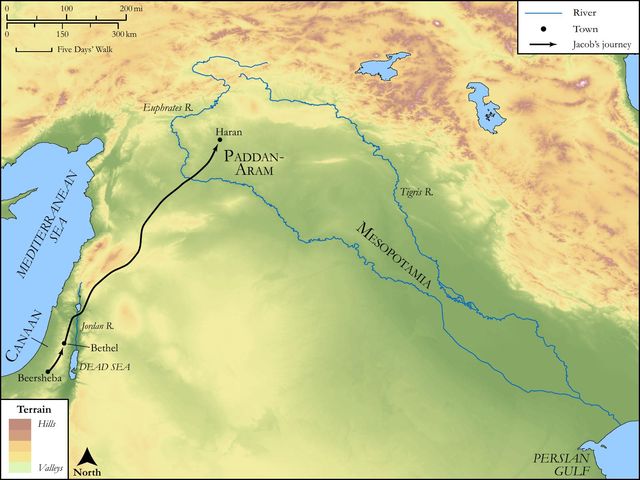
We have here Jacob upon his journey towards Syria, in a very desolate condition, like one that was sent to seek his fortune; but we find that, though he was alone, yet he was not alone, for the Father was with him, Joh 16:32. If what is here recorded happened (as it should seem it did) the first night, he had made a long day's journey from Beersheba to Bethel, above forty miles. Providence brought him to a convenient place, probably shaded with trees, to rest himself in that night; and there he had,
I.A hard lodging (Gen 28:11), the stones for his pillows, and the heavens for his canopy and curtains.
As the usage then was, perhaps this was not so bad as it seems how to us; but we should think,
1.He lay very cold, the cold ground for his bed, and, which one would suppose made the matter worse, a cold stone for his pillow, and in the cold air.
2.Very uneasy. If his bones were sore with his day's journey, his night's rest would but make them sorer.
3.Very much exposed. He forgot that he was fleeing for his life; or had his brother, in his rage, pursued, or sent a murderer after him, here he lay ready to be sacrificed, and destitute of shelter and defence. We cannot think it was by reason of his poverty that he was so ill accommodated, but,
(1.)It was owing to the plainness and simplicity of those times, when men did not take so much state, and consult their ease so much, as in these later times of softness and effeminacy.
(2.)Jacob had been particularly used to hardships, as a plain man dwelling in tents; and, designing now to go to service, he was the more willing to inure himself to them; and, as it proved, it was well, Gen 31:40.
(3.)His comfort in the divine blessing, and his confidence in the divine protection, made him easy, even when he lay thus exposed; being sure that his God made him to dwell in safety, he could lie down and sleep upon a stone.
II.In his hard lodging he had a pleasant dream.
Any Israelite indeed would be willing to take up with Jacob's pillow, provided he might but have Jacob's dream. Then, and there, he heard the words of God, and saw the visions of the Almighty. It was the best night's sleep he ever had in his life. Note, God's time to visit his people with his comforts is when they are most destitute of other comforts, and other comforters; when afflictions in the way of duty (as these were) do abound, then shall consolations so much the more abound. Now observe here,
1.The encouraging vision Jacob saw, Gen 28:12. He saw a ladder which reached from earth to heaven, the angels ascending and descending upon it, and God himself at the head of it. Now this represents the two things that are very comfortable to good people at all times, and in all conditions: - (1.) The providence of God, by which there is a constant correspondence kept up between heaven and earth. The counsels of heaven are executed on earth, and the actions and affairs of this earth are all known in heaven are executed on earth, and the actions and affairs of this earth are all known in heaven and judged there. Providence does its work gradually, and by steps. Angels are employed as ministering spirits, to serve all the purposes and designs of Providence, and the wisdom of God is at the upper end of the ladder, directing all the motions of second causes to the glory of the first Cause. The angels are active spirits, continually ascending and descending; they rest not, day nor night, from service, according to the posts assigned them. They ascend, to give account of what they have done, and to receive orders; and then descend, to execute the orders they have received. Thus we should always abound in the work of the Lord, that we may do it as the angels do it, Psa 103:20, Psa 103:21. This vision gave very seasonable comfort to Jacob, letting him know that he had both a good guide and a good guard, in his going out and coming in, - that, though he was made to wander from his father's house, yet still he was the care of a kind Providence, and the charge of the holy angels. This is comfort enough, though we should not admit the notion which some have, that the tutelar angels of Canaan were ascending, having guarded Jacob out of their land, and the angels of Syria descending to take him into their custody. Jacob was now the type and representative of the whole church, with the guardianship of which the angels are entrusted. (2.) The mediation of Christ. He is this ladder, the foot on earth in his human nature, the top in heaven in his divine nature: or the former in his humiliation, the latter in his exaltation. All the intercourse between heaven and earth, since the fall, is by this ladder. Christ is the way; all God's favours come to us, and all our services go to him, by Christ. If God dwell with us, and we with him, it is by Christ. We have no way of getting to heaven, but by this ladder; if we climb up any other way we are thieves and robbers. To this vision our Saviour alludes when he speaks of the angels of God ascending and descending upon the son of man (Joh 1:51); for the kind offices the angels do us, and the benefits we receive by their ministration, are all owing to Christ, who has reconciled things on earth and things in heaven (Col 1:20), and made them all meet in himself, Eph 1:10.
2.The encouraging words Jacob heard. God now brought him into the wilderness, and spoke comfortably to him, spoke from the head of the ladder; for all the glad tidings we receive from heaven come through Jesus Christ.
(1.)The former promises made to his father were repeated and ratified to him, Gen 28:13, Gen 28:14. In general, God intimated to him that he would be the same to him that he had been to Abraham and Isaac. Those that tread in the steps of their godly parents are interested in their covenant and entitled to their privileges. Particularly,
[1.]The land of Canaan is settled upon him, the land whereon thou liest; as if by his lying so contentedly upon the bare ground he had taken livery and seisin of the whole land.
[2.]It is promised him that his posterity should multiply exceedingly as the dust of the earth - that, though he seemed now to be plucked off as a withered branch, yet he should become a flourishing tree, that should send out his boughs unto the sea. These were the blessings with which his father had blessed him (Gen 28:3, Gen 28:4), and God here said Amen to them, that he might have strong consolation.
[3.]It is added that the Messiah should come from his loins, in whom all the families of the earth should be blessed. Christ is the great blessing of the world. All that are blessed, whatever family they are of, are blessed in him, and none of any family are excluded from blessedness in him, but those that exclude themselves.
(2.)Fresh promises were made him, accommodated to his present condition, Gen 28:15.
[1.]Jacob was apprehensive of danger from his brother Esau; but God promises to keep him. Note, Those are safe whom god protects, whoever pursues them.
[2.]He had now a long journey before him, had to travel alone, in an unknown road, to an unknown country; but, behold, I am with thee, says God. Note, Wherever we are, we are safe, and may be easy, if we have God's favourable presence with us.
[3.]He knew not, but God foresaw, what hardships he should meet with in his uncle's service, and therefore promises to preserve him in all places. Note, God knows how to give his people graces and comforts accommodated to the events that shall be, as well as to those that are.
[4.]He was now going as an exile into a place far distant, but God promises him to bring him back again to this land. Note, He that preserves his people's going out will also take care of their coming in, Psa 121:8.
[5.]He seemed to be forsaken of all his friends, but God here gives him this assurance, I will not leave thee. Note, Whom God loves he never leaves. This promise is sure to all the seed, Heb 13:5.
[6.]Providences seemed to contradict the promises; he is therefore assured of the performance of them in their season: All shall be done that I have spoken to thee of. Note, Saying and doing are not two things with God, whatever they are with us.
Historical interpretation
Historical reception
4 surviving comments on this verse. Each one is dated, so this reads as a timeline rather than a list.
Select a marker to jump to its quote. Markers stagger vertically where authors wrote within a few decades of each other.
When the sun was setting, the text tells us, he slept where the night came upon him: “He took a stone and put it under his head.” See the young fellow’s hardy spirit: He used the stone as a pillow and slept on the ground. Consequently, since he was imbued with common sense and a hardy attitude and was free of all human pretence, he was found worthy of that remarkable vision. Our Lord is like that, you see: When he sees a dutiful soul that makes no account of present realities, he demonstrates his own great care for him.
Consider our ascetic [Jacob]: he was running away from a very cruel man; he was fleeing his brother, and he found help in stone. That stone is Christ. That stone is the support of all those who suffer persecution, but to the unbelieving Jew, it is “a stone of stumbling, and a rock of scandal.” “Jacob saw there a ladder set up on the ground with its top reaching to heaven, and in heaven the Lord leaning upon it. And he saw angels ascending and descending.” Note: he saw angels ascending; he saw Paul ascending; he saw angels descending; Judas, the betrayer, was falling headlong. He saw angels ascending—holy men going from earth to heaven; he saw angels descending—the devil and his whole army cast down from heaven. It is very difficult indeed to ascend from earth into heaven. We fall more easily than we rise. We fall easily; it requires great labor, a great deal of sweat to climb upwards. If I am on the lowest step, how many more are there before I reach heaven? If I am on the second, the third, the fourth, the tenth, what benefit to me unless I reach the top? Grant with me that this ladder has fifteen rungs. I climb as high as the fourteenth, but unless I reach and hold the fifteenth, what profit to me to have mounted the fourteenth? If I should arrive at the fifteenth and then fall, the higher my ascent, the greater my fall.
When Jacob was in flight from his brother, in Mesopotamia he came to Luza, and there to rest, Scripture says, he placed a stone under his head. The stone under his head was Christ. Never before had he put a stone under his head; only at the time when he was escaping from his persecutor. When he was in his father’s house, and as long as he was in his father’s house and enjoyed the comforts of the flesh, he had no stone at his head. He departed from his home, poor and alone; he left with only a staff, and immediately that very night he found a stone and placed it at his head. Because he had a pillow of that kind upon which to rest his head, think of the vision he saw. “He dreamed that a ladder was set up on the ground with its top reaching to heaven; angels were ascending and descending on it.” He saw angels descend from heaven to earth and others ascend from earth to heaven. Would you know that the stone at Jacob’s head was Christ, the cornerstone? “The stone which the builders rejected has become the cornerstone.” That is the stone that is called Ebenezer in the Book of Samuel. That stone is Christ. The name Ebenezer, moreover, means “the Stone of Help.” “Jacob woke from his sleep,” Scripture says, and what did he say? “This is the house of God.” What did he do? “He poured oil over the stone.” Unless we penetrate the spiritual mystery of holy Scripture, what reason is there that he should anoint the stone?
We do not read of blessed Jacob that he departed with horses or asses or camels, but we read only that he carried a staff in his hand. Thus, indeed, when entreating the Lord he said, “Lord, I am not worthy of all your kindnesses. With only my staff I crossed this Jordan; behold, now I have grown into two camps.” Jacob displayed his staff to take a wife, but Christ bore the wood of the cross to redeem the church. In his sleep Jacob put a stone under his head and saw a ladder extending to heaven, while the Lord leaned upon the ladder. Consider, brothers, how many mysteries there are in this place. Jacob represented a type of the Lord our Savior; the stone that he put under his head no less prefigured Christ the Lord. Listen to the apostle telling why the stone at the head signifies Christ: “The head of man is Christ.” Finally, notice that blessed Jacob anointed the stone. Pay attention to the anointing, and you will recognize Christ: Christ is explained from an anointing, that is, from the grace of anointing.
Continue studying Genesis 28:11 across the web’s major study libraries — every link below opens this exact verse, chapter, or book on the destination site.
Read & Compare
 BibleGatewayThis verse in more than 200 translations and 70 languages.
 Bible.comThe YouVersion reader — hundreds of translations, reading plans, and highlights.
 ESV.orgCrossway's official English Standard Version reader.
 NET BibleThe NET translation with 60,000+ translators' notes on every rendering decision.
 STEP BibleTyndale House's free study tool — original text, vocabulary, and scholarly resources.
 BibliaLogos Bible Software's free web reader.
 USCCBThe New American Bible (Revised Edition) with the U.S. bishops' study notes.
Commentaries
 BibleHub CommentariesDozens of classic commentaries on this verse, gathered on one page.
 StudyLightMore than 100 commentary sets — the largest collection on the web.
 BibleRefPlain-English commentary on what this verse means, verse by verse.
 Enduring WordDavid Guzik's free commentary on this chapter, widely used by Bible teachers.
 Bible Study ToolsVerse commentary alongside Greek and Hebrew study aids.
Original Language & Research
- BibleHub InterlinearThe verse word by word — original language, transliteration, and English.
- BibleHub LexiconEvery word's original-language definition and Strong's entry.
 Blue Letter BibleDeep-study tools — Strong's numbers, concordance, and word studies.
 SefariaThe Hebrew text with Rashi and centuries of Jewish commentary.
Sermons, Hymns & Audio


TrulyRandomVerse is not affiliated with these sites and doesn’t control their content. They’re linked because they’re genuinely useful.
Summary
Genesis 28:11 vividly portrays Jacob, a fugitive fleeing his brother Esau, arriving at an anonymous, desolate location as night descends. In a state of profound vulnerability, lacking basic provisions, he uses the stones of that very place as his pillow and lies down to sleep. This seemingly ordinary and humble act of finding rest in a harsh wilderness sets the stage for one of the most pivotal divine encounters in the Old Testament, transforming a common, unnamed spot into a sacred site of revelation and covenant renewal.
Context
ShowHideLiterary Context
This verse marks a critical turning point in Jacob's life, immediately following his deceptive acquisition of Isaac's blessing and Esau's subsequent murderous rage, as detailed in Genesis 27. Jacob is now on a solitary journey from Beersheba to Haran, a journey initiated by Rebekah to protect him from Esau and to find a wife among her kin. Genesis 28:10 establishes his departure, making verse 11 the first stop on this forced exile. The events of this verse, particularly Jacob's humble resting place, directly precede the profound dream of the ladder to heaven in Genesis 28:12-15, which is a foundational moment for the patriarchal covenant. The narrative emphasizes Jacob's isolation and vulnerability, setting a stark contrast with the grand divine revelation that follows.
Historical & Cultural Context
In that age, travel was arduous and often dangerous, especially for a lone individual. Nightfall in the wilderness necessitated finding shelter, often in caves, under trees, or in designated caravanserai if available. Jacob, as a fugitive, would have been particularly vulnerable to wild animals and bandits. His use of stones for a pillow was not an uncommon practice for travelers caught unawares or lacking provisions, but for a patriarch from a wealthy family, it underscores his destitution at this moment. The journey from Beersheba to Haran was a significant distance, traversing semi-arid regions, making the need for rest imperative. The "place" (מָקוֹם, maqom) would have been an uncultivated, perhaps rocky, area typical of the wilderness between settled regions.
Key Themes
ShowHideGenesis 28:11 contributes significantly to several overarching themes in the book of Genesis and the broader biblical narrative. It highlights the theme of Divine Providence, demonstrating that God's plans unfold even in the midst of human failure and flight, guiding Jacob to a specific "place" for a divine encounter. The verse also introduces the theme of Vulnerability and Dependence, showing Jacob stripped of all comfort and relying solely on the land for rest, which often precedes profound spiritual revelation. Furthermore, it sets the stage for the theme of God's Unwavering Covenant Faithfulness, as the subsequent dream in Genesis 28:13-15 reaffirms the promises made to Abraham and Isaac, ensuring the continuation of the lineage despite Jacob's circumstances. Finally, it foreshadows the concept of Sacred Space, as this ordinary, desolate spot is transformed into "Bethel," the "House of God," a theme that resonates throughout biblical history, from the tabernacle to the temple.
Exposition and Analysis
ShowHideKey Word Analysis
ShowHideA primitive root meaning "to impinge, by accident or violence, or (figuratively) by importunity; come (betwixt), cause to entreat, fall (upon), make intercession, intercessor, intreat, lay, light (upon), meet (together), pray, reach, run." While describing Jacob's physical arrival, the verb pâgaʻ here carries a deeper theological resonance. It suggests more than a casual stumble; it implies a providential encounter, as if Jacob was divinely "caused to fall upon" this specific location, setting the stage for God's intervention.
Meaning "properly, a standing, i.e., a spot; but used widely of a locality (general or specific); also (figuratively) of a condition (of body or mind); country, [idiom] home, [idiom] open, [idiom] place, room, space, [idiom] whither(-soever)." The repeated use of "place" (four times in this verse and the next few) emphasizes its initial anonymity and lack of inherent significance. Its importance is not intrinsic but derived from the divine event that will soon occur there, transforming it from "a certain place" to "Bethel," the "House of God."
Meaning "properly, a headpiece, i.e. (plural for adverbial) at (or as) the head-rest (or pillow); bolster, head, pillow." This term specifically refers to something placed under the head for rest. The use of "stones" for mᵉraʼăshâh vividly illustrates Jacob's destitution and the harshness of his circumstances, a stark contrast to the comforts of his father's home. Yet, these very stones become consecrated objects, marking the site of divine revelation.
Verse Breakdown
ShowHide"And he lighted upon a certain place,"
This clause describes Jacob's arrival. The verb "lighted upon" (Hebrew pâgaʻ) suggests an unexpected or providential encounter rather than a planned destination. The phrase "a certain place" (Hebrew maqom) emphasizes the anonymity and lack of distinction of the location, underscoring that its significance is not inherent but will be bestowed by the divine presence.
"and tarried there all night, because the sun was set;"
This part explains the reason for Jacob's stop – the setting sun, which made further travel impractical or unsafe. The enforced halt in the wilderness, devoid of human comfort or shelter, highlights Jacob's isolation and vulnerability. The night, often a time of fear and uncertainty, becomes the backdrop for God's comforting presence and revelation.
"and he took of the stones of that place, and put [them for] his pillows,"
This detail vividly portrays Jacob's destitution. Unlike the patriarchs who often traveled with tents and servants, Jacob is alone and without even basic provisions for comfort. The use of hard, cold stones for a pillow is a tangible symbol of his hardship and vulnerability. Yet, it is precisely these ordinary, harsh elements that will be transformed into sacred objects, marking the place of divine encounter.
"and lay down in that place to sleep."
Despite the harsh conditions, Jacob finds rest. This act of lying down to sleep in such a desolate environment signifies his complete surrender to his circumstances and, implicitly, his dependence on God for protection during the night. This vulnerable position makes him receptive to the profound divine vision that follows in Genesis 28:12.
Literary Devices
ShowHideGenesis 28:11 employs several literary devices to enhance its narrative and theological impact. The most prominent is Symbolism, where the "stones" Jacob uses as pillows symbolize his hardship, vulnerability, and the harsh reality of his situation. Paradoxically, these very stones become the foundation for a sacred encounter, later transforming into a pillar of remembrance, symbolizing the transformation of the ordinary into the holy through divine presence. There is also a strong element of Irony: a desolate, unnamed "certain place" (מָקוֹם, maqom) becomes the site of one of the most significant divine revelations in the patriarchal narratives, later named Bethel, "House of God." This contrast between the humble setting and the grand divine encounter highlights God's ability to act powerfully in unexpected places and circumstances. Furthermore, the verse serves as Foreshadowing, setting the stage for the dream of the ladder connecting heaven and earth, thereby hinting at the profound spiritual significance of this otherwise mundane stop.
Theological and Thematic Connections
ShowHideGenesis 28:11 is a powerful testament to God's omnipresence and sovereign care, even in moments of human weakness and flight. Jacob, at his lowest point, a fugitive with nothing but the clothes on his back and stones for a pillow, is met by God not in a grand temple or a comfortable home, but in a desolate wilderness. This encounter demonstrates that God's presence and plans are not limited by human comfort, location, or even our failings. It underscores that God actively pursues His covenant purposes, transforming ordinary places and difficult circumstances into sites of profound spiritual revelation and renewed promise. This narrative offers immense comfort, reminding us that no place is too desolate, and no situation too dire, for God to meet us and demonstrate His unwavering faithfulness.
Reflection and Application
ShowHideGenesis 28:11 offers a profound and enduring message for believers today, particularly in moments of profound difficulty, isolation, or discomfort. Jacob's experience reminds us that our "hard places"—those seasons of vulnerability, uncertainty, or even consequence for our actions—can become the very sites where God chooses to reveal Himself most powerfully. When we feel most alone, "out of place," or stripped of our usual comforts, God is not distant but intimately present, ready to transform our wilderness experiences into sacred encounters. This narrative encourages us to embrace humility and dependence, recognizing that it is often in our weakness that God's strength is made perfect. It calls us to trust in God's sovereignty, knowing that He can use the most humble and unpromising circumstances to initiate profound spiritual growth, impart divine comfort, and reaffirm His unwavering promises, turning our "stone pillows" into altars of worship and remembrance.
Questions for Reflection
ShowHideFAQ
ShowHideWhy did Jacob use stones for his pillows?
ShowHideJacob used stones for his pillows because he was a fugitive traveling alone in the wilderness, without the usual provisions or comforts of a traveler. This detail emphasizes his destitution, vulnerability, and the harsh reality of his situation, highlighting his lack of a tent, bedding, or any other form of shelter or comfort. It underscores his complete reliance on the natural environment for his basic needs.
What is the significance of the phrase "a certain place"?
ShowHideThe phrase "a certain place" (Hebrew: maqom) initially emphasizes the anonymity and lack of distinction of the location. It signifies that this spot had no inherent sacredness or fame prior to Jacob's arrival. However, its significance is profoundly transformed by the divine encounter that occurs there. It becomes "Bethel," the "House of God" (as named in Genesis 28:19), demonstrating that God's presence can sanctify any location, turning an ordinary, desolate spot into a sacred site of revelation and covenant.
Does this verse imply Jacob was unprepared or disobedient?
ShowHideWhile Jacob's flight was a direct consequence of his deceptive actions against Esau and Isaac (see Genesis 27), the verse itself doesn't explicitly judge his preparedness or imply further disobedience. Rather, it highlights his vulnerable and desperate state as a fugitive. God, in His sovereign grace, chooses to meet Jacob precisely where he is, demonstrating His faithfulness to His covenant promises and His redemptive plan, even amidst human failings and difficult circumstances. It's a testament to God's pursuit of His chosen ones regardless of their immediate condition.
Christ-Centered Fulfillment
ShowHideGenesis 28:11, though a simple narrative of Jacob's humble rest, profoundly foreshadows the person and work of Jesus Christ. Jacob's vulnerability and the desolate "certain place" where God meets him point to Christ's profound humility and His willingness to meet humanity in its lowest state. Just as Jacob, a deceiver and fugitive, was met by God in the wilderness, so too did God, in Christ, come to a fallen and desolate humanity. The subsequent dream of a ladder connecting heaven and earth, for which this verse sets the stage, is explicitly identified by Jesus Himself as fulfilled in Him. In John 1:51, Jesus declares, "Verily, verily, I say unto you, Hereafter ye shall see heaven open, and the angels of God ascending and descending upon the Son of man." Here, Jesus proclaims Himself to be the true "ladder" or "stairway," the sole mediator and bridge through whom humanity gains access to God and divine communication. Jacob's stone pillow, transformed by God's presence, symbolizes the transformation of the ordinary into the sacred. This finds its ultimate fulfillment in Christ, whose very body became the true temple and dwelling place of God among men (John 1:14). Through His incarnation, death, and resurrection, Christ makes the ordinary sacred and provides intimate access to the divine, far surpassing Jacob's visionary experience, establishing a new and living way for all who believe (Hebrews 10:19-20).