


Genesis 28:19
Bible text: King James Version (1769 Blayney text) · Public domain
Bible text: Berean Standard Bible · Public domain
Bible text: American Standard Version (1901) · Public domain
Bible text: World English Bible, Messianic edition · Public domain
Bible text: Geneva Bible (1599) · Public domain
Bible text: Young's Literal Translation · Public domain
- וַיִּקְרָאvai·yik·Ra'and he calledH7121Conj-w ¦ V-Qal-ConsecImperf-3msVerb Qal Consecutive Imperfect 3rd Singular Masculineוַandיִּקְרָאhe called
- אֶת'et<obj.>H853DirObjMParticle Object Indicator
- שֵׁםshem[the] name ofH8034N-mscNoun Singular Masculine Construct
- הַמָּקוֹםha·ma·Komthe placeH4725Art ¦ N-msNoun Singular Masculine Absoluteהַtheמָּקוֹםplace
- הַהוּאha·Hu'<the> thatH1931Art ¦ Pro-3msPronoun Personal 3rd Singular Masculineהַ<the>הוּאthat
- בֵּיתbeitBeth-H1008N-properNoun Proper Location
- אֵל'El-elH1008N-properNoun Proper Location
- וְאוּלָםve·'u·Lamand butH199Conj-w ¦ AdvAdverbוְandאוּלָםbut
- לוּזluz[was] LuzH3870N-properNoun Proper Location
- שֵׁםshem[the] name ofH8034N-mscNoun Singular Masculine Construct
- הָעִירha·'Irthe cityH5892Art ¦ N-fsNoun Singular Feminine Absoluteהָtheעִירcity
- לָרִאשֹׁנָהla·ri·sho·Nahto the former [time]H7223Prep-l ¦ Adj-fsAdjective Numerical Position Singular Feminine Absoluteלָto theרִאשֹׁנָהformer [time]
English is a literal word-by-word gloss of the Hebrew, not the KJV's wording. Why?
This is the original text the KJV's translators worked from — each Hebrew word with its own literal English meaning in this verse, prepared by scholars at Tyndale House, Cambridge. The KJV translates whole sentences, not word by word, so its wording differs: one Hebrew word can become several English words, and the KJV may choose “the LORD” where the gloss reads “Yahweh”. Both are faithful — they answer different questions. For the KJV's own rendering, switch to the KJV text.
Details
See on the biblical-era maps


Study this verse
Public-domain commentary
Matthew Henry
From his Commentary on the Whole Bible. Henry comments on passages, not single verses — this entry covers Genesis 28:16–22. His four-level outline is real structure in the source text, so it is rendered as structure.
God manifested himself and his favour to Jacob when he was asleep and purely passive; for the spirit, like the wind, blows when and where he listeth, and God's grace, like the dew, tarrieth not for the sons of men, Mic 5:7. But Jacob applied himself to the improvement of the visit God had made him when he was awake; and we may well think he awaked, as the prophet did (Jer 31:26), and behold his sleep was sweet to him. Here is much of Jacob's devotion on this occasion.
I.He expressed a great surprise at the tokens he had of God's special presence with him in that place: Surely the Lord is in this place and I knew it not, Gen 28:16. Note,
1.God's manifestations of himself to his people carry their own evidence along with them. God can give undeniable demonstrations of his presence, such as give abundant satisfaction to the souls of the faithful that God is with them of a truth, satisfaction not communicable to others, but convincing to themselves.
2.We sometimes meet with God where we little thought of meeting with him. He is where we did not think he had been, is found where we asked not for him. No place excludes divine visits (Gen 16:13, here also); wherever we are, in the city or in the desert, in the house or in the field, in the shop or in the street, we may keep up our intercourse with Heaven if it be not our own fault.
II.It struck an awe upon him (Gen 28:17):
He was afraid; so far was he from being puffed up, and exalted above measure, with the abundance of the revelations (Co2 12:7), that he was afraid. Note, The more we see of God the more cause we see for holy trembling and blushing before him. Those to whom God is pleased to manifest himself are thereby laid, and kept, very low in their own eyes, and see cause to fear even the Lord and his goodness, Hos 3:5. He said, How dreadful is this place! that is, "The appearance of God in this place is never to be thought of, but with a holy awe and reverence. I shall have a respect for this place, and remember it by this token, as long as I live:" not that he thought the place itself any nearer the divine visions than other places; but what he saw there at this time was, as it were, the house of God, the residence of the divine Majesty, and the gate of heaven, that is, the general rendezvous of the inhabitants of the upper world, as the meetings of a city were in their gates; or the angels ascending and descending were like travellers passing and re-passing through the gates of a city. Note,
1.God is in a special manner present where his grace is revealed and where his covenants are published and sealed, as of old by the ministry of angels, so now by instituted ordinances, Mat 28:20.
2.Where God meets us with his special presence we ought to meet him with the most humble reverence, remembering his justice and holiness, and our own meanness and vileness.
III.He took care to preserve the memorial of it two ways:
1.He set up the stone for a pillar (Gen 28:18); not as if he thought the visions of his head were any way owing to the stone on which it lay, but thus he would mark the place against he came back, and erect a lasting monument of God's favour to him, and because he had not time now to build an altar here, as Abraham did in the places where God appeared to him, Gen 12:7. He therefore poured oil on the top of this stone, which probably was the ceremony then used in dedicating their altars, as an earnest of his building an altar when he should have conveniences for it, as afterwards he did, in gratitude to God for this vision, Gen 35:7. Note, Grants of mercy call for returns of duty, and the sweet communion we have with God ought ever to be remembered.
2.He gave a new name to the place, Gen 28:19. It had been called Luz, an almond-tree; but he will have it henceforward called Beth-el, the house of God. This gracious appearance of God to him put a greater honour upon it, and made it more remarkable, than all the almond-trees that flourished there. This is that Beth-el where, long after, it is said, God found Jacob, and there (in what he said to him) he spoke with us, Hos 12:4. In process of time, this Beth-el, the house of God, became Beth-aven, a house of vanity and iniquity, when Jeroboam set up one of his calves there.
IV.He made a solemn vow upon this occasion, Gen 28:20-22.
By religious vows we give glory to God, own our dependence upon him, and lay a bond upon our own souls to engage and quicken our obedience to him. Jacob was now in fear and distress; and it is seasonable to make vows in times of trouble, or when we are in pursuit of any special mercy, Jon 1:16; Psa 66:13, Psa 66:14; Sa1 1:11; Num 21:1-3. Jacob had now had a gracious visit from heaven. God had renewed his covenant with him, and the covenant is mutual. When God ratifies his promises to us, it is proper for us to repeat our promises to him. Now in this vow observe,
1.Jacob's faith. God had said (Gen 28:15), I am with thee, and will keep thee. Jacob takes hold of this, and infers, "Seeing God will be with me, and will keep me, as he hath said, and (which is implied in that promise) will provide comfortably for me, - and seeing he has promised to bring me again to this land, that is, to the house of my father, whom I hope to find alive at my return in peace" (so unlike was he to Esau who longed for the days of mourning for his father), - "I depend upon it." Note, God's promises are to be the guide and measure of our desires and expectations.
2.Jacob's modesty and great moderation in his desires. He will cheerfully content himself with bread to eat, and raiment to put on; and, though God's promise had now made him heir to a very great estate, yet he indents not for soft clothing and dainty meat. Agur's wish is his, Feed me with food convenient for me; and see Ti1 6:8. Nature is content with a little, and grace with less. Those that have most have, in effect, no more for themselves than food and raiment; of the overplus they have only either the keeping or the giving, not the enjoyment: if God give us more, we are bound to be thankful, and to use it for him; if he give us but this, we are bound to be content, and cheerfully to enjoy him in it.
3.Jacob's piety, and his regard to God, which appear here,
(1.)In what he desired, that God would be with him and keep him. Note, We need desire no more to make us easy and happy, wherever we are, than to have God's presence with us and to be under his protection. It is comfortable, in a journey, to have a guide in an unknown way, a guard in a dangerous way, to be well carried, well provided for, and to have good company in any way; and those that have God with them have all this in the best manner.
(2.)In what he designed. His resolution is,
[1.]In general, to cleave to the Lord, as his God in covenant: Then shall the Lord be my God. Not as if he would disown him and cast him off if he should want food and raiment; no, though he slay us, we must cleave to him; but "then I will rejoice in him as my God; then I will more strongly engage myself to abide with him." Note, Every mercy we receive from God should be improved as an additional obligation upon us to walk closely with him as our God.
[2.]In particular, that he would perform some special acts of devotion, in token of his gratitude. First, "This pillar shall keep possession here till I come back in peace, and then it shall be God's house," that is, "an altar shall be erected here to the honour of God." Secondly, "The house of god shall not be unfurnished, nor his altar without a sacrifice: Of all that thou shalt give me I will surely give the tenth unto thee, to be spent either upon God's altars or upon his poor," both which are his receivers in the world. Probably it was according to some general instructions received from heaven that Abraham and Jacob offered the tenth of their acquisitions to God. Note, 1. God must be honoured with our estates, and must have his dues out of them. When we receive more than ordinary mercy from God we should study to give some signal instances of gratitude to him. 2. The tenth is a very fit proportion to be devoted to God and employed for him, though, as circumstances vary, it may be more or less, as God prospers us, Co1 16:2; Co2 9:7.
Historical interpretation
Historical reception
1 surviving comment on this verse from the historical church.
(Chapter 28, verse 19) And he called the name of that place Bethel, but previously its name was Luz. From what he had said above: How awesome is this place, it is nothing but the house of God, and this is the gate of heaven: now he gives the place a name, and he calls it Bethel, which means the house of God. The place was previously called Luz, which means nut or almond. Therefore, some foolishly think that the Hebrew word Ulam is the name of a city, when Ulam actually means previously. Therefore, the order of the reading is as follows: And he called the name of that place Bethel, and before it was called Luz, a city. All the ancient scriptures are full of the word 'ulam', or 'Elam', which signifies nothing else but before, or previously, or threshold, or gateposts.
Continue studying Genesis 28:19 across the web’s major study libraries — every link below opens this exact verse, chapter, or book on the destination site.
Read & Compare
 BibleGatewayThis verse in more than 200 translations and 70 languages.
 Bible.comThe YouVersion reader — hundreds of translations, reading plans, and highlights.
 ESV.orgCrossway's official English Standard Version reader.
 NET BibleThe NET translation with 60,000+ translators' notes on every rendering decision.
 STEP BibleTyndale House's free study tool — original text, vocabulary, and scholarly resources.
 BibliaLogos Bible Software's free web reader.
 USCCBThe New American Bible (Revised Edition) with the U.S. bishops' study notes.
Commentaries
 BibleHub CommentariesDozens of classic commentaries on this verse, gathered on one page.
 StudyLightMore than 100 commentary sets — the largest collection on the web.
 BibleRefPlain-English commentary on what this verse means, verse by verse.
 Enduring WordDavid Guzik's free commentary on this chapter, widely used by Bible teachers.
 Bible Study ToolsVerse commentary alongside Greek and Hebrew study aids.
Original Language & Research
- BibleHub InterlinearThe verse word by word — original language, transliteration, and English.
- BibleHub LexiconEvery word's original-language definition and Strong's entry.
 Blue Letter BibleDeep-study tools — Strong's numbers, concordance, and word studies.
 SefariaThe Hebrew text with Rashi and centuries of Jewish commentary.
Sermons, Hymns & Audio


TrulyRandomVerse is not affiliated with these sites and doesn’t control their content. They’re linked because they’re genuinely useful.
Summary
Genesis 28:19 records Jacob's pivotal act of renaming the city of Luz to Bethel, meaning "House of God," immediately following his profound dream of a ladder connecting heaven and earth and a direct encounter with the Lord. This transformation of an ordinary location into a sacred space signifies a moment of divine revelation and covenant reaffirmation, indelibly marking the place's identity and deepening Jacob's understanding of God's omnipresence and faithfulness.
Context
ShowHideLiterary Context
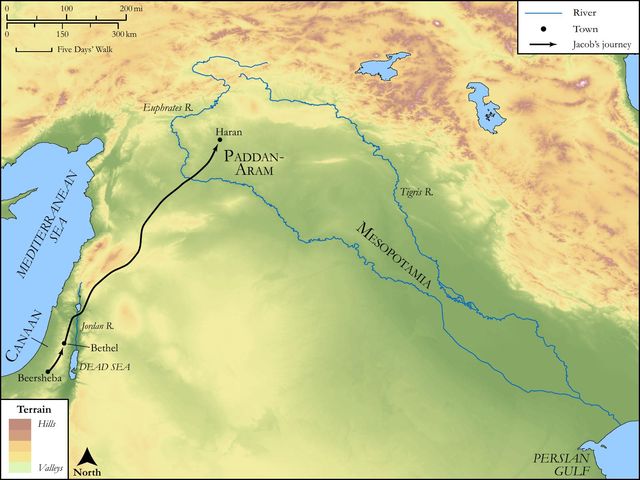
This verse serves as the culmination of Jacob's transformative encounter at a previously unremarkable location. The preceding verses detail Jacob's flight from Esau, his solitary journey, and his unexpected stop for the night. Exhausted, he uses a stone for a pillow and experiences a vivid dream of a stairway (often translated "ladder") to heaven, with angels ascending and descending, and the Lord standing above it. In this dream, God reiterates the Abrahamic covenant promises of land, numerous descendants, and divine protection, assuring Jacob of His presence and blessing (Genesis 28:13-15). Upon waking, Jacob is filled with awe and fear, realizing "Surely the Lord is in this place; and I knew it not" (Genesis 28:16). His immediate response, described in Genesis 28:18, is to set up the stone as a pillar, anoint it with oil, and then, in this verse, rename the place, solidifying its new spiritual significance.
Historical & Cultural Context
In the days of the patriarchs, the act of naming or renaming a place was often a significant act, reflecting ownership, a major event, or a change in identity. Pillars (massebot) were commonly erected as memorials, boundary markers, or cultic objects, and anointing them with oil was a customary way to consecrate them, setting them apart for sacred purposes. The concept of a "house of God" (Bethel) would have resonated with the idea of a sacred precinct or a place where divine presence was manifested, though not necessarily a constructed temple in the architectural sense at this early stage. Jacob's journey was typical of nomadic life, where travelers would stop in open country, and stones served as readily available pillows. The region of Luz/Bethel was strategically located in the central hill country of Canaan, making it a significant future landmark for Israel.
Key Themes
ShowHideThe renaming of Luz to Bethel contributes significantly to several overarching themes in Genesis and the broader biblical narrative. It underscores the theme of divine revelation, where God actively initiates contact with humanity, often in unexpected places and circumstances. It highlights God's omnipresence and accessibility, demonstrating that He is not confined to specific holy sites but can be encountered anywhere, even in the wilderness. The event also powerfully reinforces the theme of covenant faithfulness, as God personally reaffirms the promises made to Abraham and Isaac to Jacob, ensuring the continuation of the lineage through which the Messiah would come. Furthermore, it introduces the transformation of the mundane into the sacred, showing how an ordinary location can be imbued with profound spiritual meaning through a divine encounter, a concept echoed in later narratives like Moses at the burning bush in Exodus 3:5.
Exposition and Analysis
ShowHideGenesis 28:19 encapsulates the profound transformation of a geographical location through divine encounter and human response. Jacob's act of renaming is not merely a label change but a theological declaration, signifying the site's new identity as a place of God's manifest presence.
Key Word Analysis
ShowHideFrom the Hebrew words bayith (house) and El (God), meaning "house of God." This name immediately elevates the site from a common geographical point to a consecrated space, a place where the divine and human realms intersected. It reflects Jacob's realization that God was uniquely present there, making it a sacred dwelling place, not in a physical sense, but as a locus of divine revelation.
This verb means "to call out to," "address by name," "proclaim," or "name." Jacob's act of calling the name of the place Bethel is a public declaration and an act of spiritual appropriation. It signifies his recognition of God's presence and his intention to memorialize this encounter, establishing the site's new identity for future generations and within the unfolding narrative of salvation history.
This was the original name of the city, likely meaning "almond tree" or "nut tree," suggesting a mundane, botanical association. The contrast between this ordinary, natural name and the divinely inspired "Bethel" underscores the dramatic spiritual shift that occurred. Luz represents the common, unholy ground, while Bethel signifies its transformation into a site of profound sacredness due to God's direct intervention.
Verse Breakdown
ShowHide"And he called the name of that place Bethel"
This clause describes Jacob's decisive act of renaming. Following his awe-inspiring dream and his declaration that "This is none other but the house of God, and this is the gate of heaven" (Genesis 28:17), Jacob formally bestows the name "Bethel" (House of God) upon the site. This renaming is a direct response to his encounter with the Lord, consecrating the ground and establishing its spiritual significance as a place where God had revealed Himself. It transforms an anonymous wilderness spot into a landmark of divine presence.
"but the name of that city [was called] Luz at the first"
This parenthetical clause provides crucial historical context, highlighting the original, pre-encounter identity of the location. The term "city" (Hebrew ʻîyr) here might refer to a nearby settlement or an encampment, rather than a large metropolis. The original name, Luz, emphasizes the ordinary, secular nature of the place before Jacob's arrival and God's revelation. The phrase "at the first" (Hebrew riʼshôwn) underscores the temporal shift and the profound change in identity that occurred due to the divine encounter, marking a new spiritual era for this specific geographical point.
Literary Devices
ShowHideThe verse employs several significant literary devices. Juxtaposition is prominent, contrasting the former, mundane name "Luz" with the new, divinely inspired name "Bethel." This highlights the transformative power of God's presence, turning an ordinary place into a sacred one. The act of Naming/Renaming itself is a powerful literary and theological device, signifying a change in identity, purpose, or destiny, often initiated by a divine encounter. In this case, Jacob's naming of Bethel is an act of acknowledging and memorializing God's direct revelation. Furthermore, there is an element of Symbolism where "Luz" represents the common, secular world, while "Bethel" symbolizes the sanctified space where heaven and earth meet, a gateway for divine communication and blessing.
Theological and Thematic Connections
ShowHideGenesis 28:19 profoundly impacts our understanding of God's relationship with humanity and the nature of sacred space. It demonstrates that God is not confined to human-built structures or designated holy sites but can manifest His presence anywhere, transforming ordinary locations into places of profound spiritual significance through His sovereign initiative. This encounter at Bethel establishes a precedent for recognizing God's active involvement in the lives of His covenant people, even when they are vulnerable and far from home. It underscores God's unwavering faithfulness to His promises, reaffirming the Abrahamic covenant to Jacob and ensuring the continuation of the redemptive plan through his lineage.
Reflection and Application
ShowHideThe story of Jacob renaming Luz to Bethel offers profound insights for contemporary believers. It challenges us to cultivate an awareness of God's presence in every aspect of our lives, not just in designated "holy" spaces or during specific religious activities. Like Jacob, who encountered God in a desolate wilderness, we are reminded that God can meet us in our most vulnerable moments, in the midst of uncertainty, and in the seemingly mundane places of our daily existence. This verse encourages us to see our homes, workplaces, and even our struggles as potential "Bethels"—places where God reveals Himself, reaffirms His promises, and transforms our perspective. It calls us to respond to these divine encounters with worship, consecration, and a renewed commitment to living in light of His presence, recognizing that every place can become a "House of God" when we acknowledge Him as Lord.
Questions for Reflection
ShowHideFAQ
ShowHideWhat is the significance of Jacob renaming Luz to Bethel?
ShowHideThe renaming signifies a profound spiritual transformation of the place. Luz, meaning "almond tree," was a common, mundane name, reflecting its ordinary status. By renaming it Bethel, "House of God," Jacob declared it a sacred site where God had revealed Himself in a powerful dream, establishing it as a gateway between heaven and earth and a place of divine communication and covenant. This act marked the place as a memorial to God's presence and faithfulness, transforming its identity from an ordinary location to a consecrated landmark in salvation history, as highlighted by Jacob's declaration in Genesis 28:17.
Did Jacob build a physical "house" for God at Bethel?
ShowHideNo, Jacob did not build a temple or a physical "house" in the architectural sense at this time. The "house of God" (Bethel) refers to the spiritual significance of the location as a place where God's presence was powerfully manifested, making it a sacred dwelling place for divine encounter. Jacob's immediate action, described in Genesis 28:18, was to set up the stone he had used as a pillow as a pillar and pour oil on it, consecrating it as a memorial to the divine encounter. Later, a city would develop around this significant site, and it would become an important religious center in Israel's history, though not always for righteous worship (e.g., 1 Kings 12:29).
Christ-Centered Fulfillment
ShowHideThe profound encounter at Bethel, with its imagery of a "ladder" connecting heaven and earth and the declaration of the place as the "House of God," finds its ultimate and glorious fulfillment in the person and work of Jesus Christ. Jesus Himself alludes to Jacob's ladder when He tells Nathanael, "Verily, verily, I say unto you, Hereafter ye shall see heaven open, and the angels of God ascending and descending upon the Son of man" (John 1:51). Christ is the true ladder, the sole mediator and living connection between God and humanity, through whom access to the Father is granted. He is the ultimate "House of God," the dwelling place of God among humanity, as the Word made flesh who "dwelt among us" (John 1:14). In Christ, all the covenant promises made to Abraham and Jacob find their "Yea, and Amen" (2 Corinthians 1:20), for He is the Seed through whom all nations are blessed (Galatians 3:16). Thus, the spiritual reality foreshadowed at Bethel—God's presence, divine communication, and the bridging of the gap between heaven and earth—is fully realized in the person and redemptive work of Jesus Christ, making Him the true and eternal Bethel.