


1 Kings 12:29
Bible text: King James Version (1769 Blayney text) · Public domain
Bible text: Berean Standard Bible · Public domain
Bible text: American Standard Version (1901) · Public domain
Bible text: World English Bible, Messianic edition · Public domain
Bible text: Geneva Bible (1599) · Public domain
Bible text: Young's Literal Translation · Public domain
- וַיָּשֶׂםvai·Ya·semand he setH7760Conj-w ¦ V-Qal-ConsecImperf-3msVerb Qal Consecutive Imperfect 3rd Singular Masculineוַandיָּשֶׂםhe set
- אֶת'et<obj.>H853DirObjMParticle Object Indicator
- הָאֶחָדha·'e·Chadthe one [calf]H259Art ¦ N-fsNoun Singular Feminine Absoluteהָtheאֶחָדone [calf]
- בְּבֵיתbe·veitin Beth-H1008Prep-b ¦ N-properNoun Proper LocationבְּinבֵיתBeth-
- אֵל'El-elH1008N-properNoun Proper Location
- וְאֶתve·'Etand <obj.>H853Conj-w ¦ DirObjMParticle Object Indicatorוְandאֶת<obj.>
- הָאֶחָדha·'e·Chadthe one [calf]H259Art ¦ N-fsNoun Singular Feminine Absoluteהָtheאֶחָדone [calf]
- נָתַןna·Tanhe putH5414V-Qal-Perf-3msVerb Qal Perfect 3rd Singular Masculine
- בְּדָןbe·Danin DanH1835Prep-b ¦ N-properNoun Proper LocationבְּinדָןDan
English is a literal word-by-word gloss of the Hebrew, not the KJV's wording. Why?
This is the original text the KJV's translators worked from — each Hebrew word with its own literal English meaning in this verse, prepared by scholars at Tyndale House, Cambridge. The KJV translates whole sentences, not word by word, so its wording differs: one Hebrew word can become several English words, and the KJV may choose “the LORD” where the gloss reads “Yahweh”. Both are faithful — they answer different questions. For the KJV's own rendering, switch to the KJV text.
Details
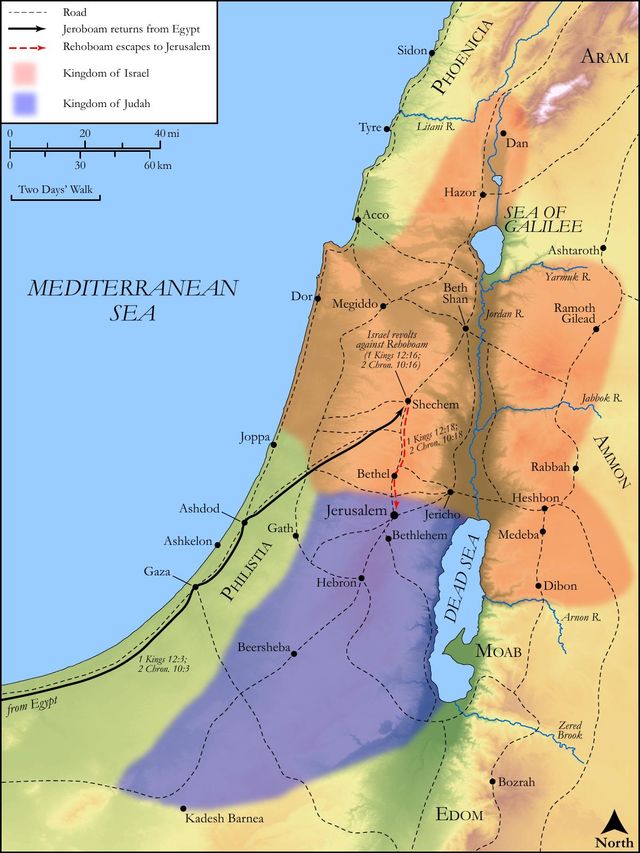
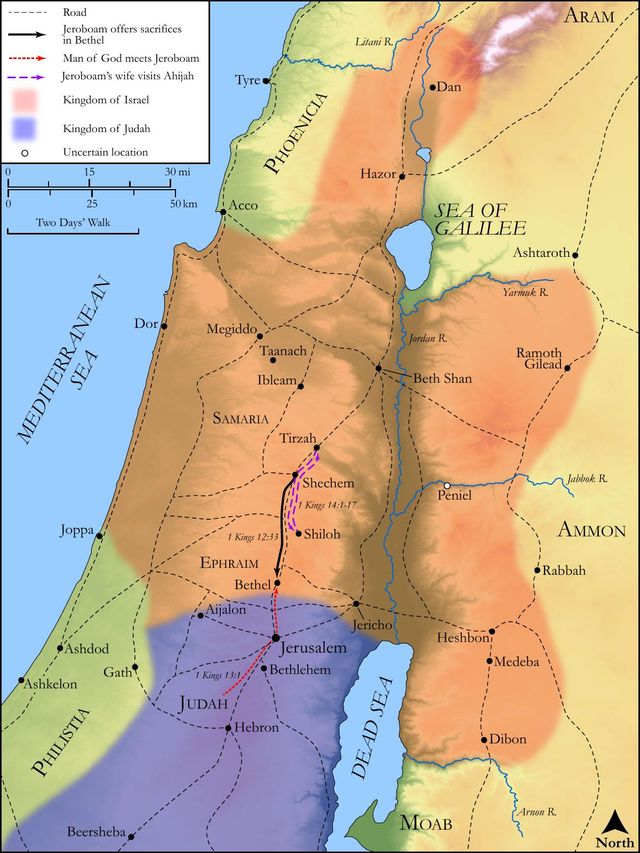
See on the biblical-era maps

Study this verse
Public-domain commentary
Matthew Henry
From his Commentary on the Whole Bible. Henry comments on passages, not single verses — this entry covers 1 Kings 12:25–33. His four-level outline is real structure in the source text, so it is rendered as structure.
We have here the beginning of the reign of Jeroboam. He built Shechem first and then Penuel - beautified and fortified them, and probably had a palace in each of them for himself (Kg1 12:25), the former in Ephraim, the latter in Gad, on the other side Jordan. This might be proper; but he formed another project for the establishing of his kingdom which was fatal to the interests of religion in it.
I.That which he designed was by some effectual means to secure those to himself who had now chosen him for their king, and to prevent their return to the house of David, Kg1 12:26, Kg1 12:27. It seems,
1.He was jealous of the people, afraid that, some time or other, they would kill him and go again to Rehoboam. Many that have been advanced in one tumult have been hurled down in another. Jeroboam could not put any confidence in the affections of his people, though now they seemed extremely fond of him; for what is got by wrong and usurpation cannot be enjoyed nor kept with any security or satisfaction.
2.He was distrustful of the promise of God, could not take his word that, if he would keep close to his duty, God would build him a sure house (Kg1 11:38); but he would contrive ways and means, and sinful ones too, for his own safety. A practical disbelief of God's all-sufficiency is at the bottom of all our treacherous departures from him.
II.The way he took to do this was by keeping the people from going up to Jerusalem to worship.
That was the place God had chosen, to put his name there. Solomon's temple was there, which God had, in the sight of all Israel, and in the memory of many now living, taken solemn possession of in a cloud of glory. At the altar there the priest of the Lord attended, there all Israel were to keep the feasts, and thither they were to bring their sacrifices. Now,
1.Jeroboam apprehended that, if the people continued to do this, they would in time return to the house of David, allured by the magnificence both of the court and of the temple. If they cleave to their old religion, they will go back to their old king. We may suppose, if he had treated with Rehoboam for the safe conduct of himself and his people to and from Jerusalem at the times appointed for their solemn feasts, it would not have been denied him; therefore he fears not their being driven back by force, but their going back voluntarily to Rehoboam.
2.He therefore dissuaded them from going up to Jerusalem, pretending to consult their ease: "It is too much for you to go so far to worship God, Kg1 12:28. It is a heavy yoke, and it is time to shake it off; you have gone long enough to Jerusalem" (so some read it); "the temple, now that you are used to it, does not appear so glorious and sacred as it did at first" (sensible glories wither by degrees in men's estimation); "you have greed yourselves from other burdens, free yourselves from this: why should we now be tied to one place any more than in Samuel's time?"
3.He provided for the assistance of their devotion at home. Upon consultation with some of his politicians, he came to this resolve, to set up two golden calves, as tokens or signs of the divine presence, and persuade the people that they might as well stay at home and offer sacrifice to those as go to Jerusalem to worship before the ark: and some are so charitable as to think they were made to represent the mercy-seat and the cherubim over the ark; but more probably he adopted the idolatry of the Egyptians, in whose land he had sojourned for some time and who worshipped their god Apis under the similitude of a bull or calf.
(1.)He would not be at the charge of building a golden temple, as Solomon had done; two golden calves are the most that he can afford.
(2.)He intended, no doubt, by these to represent, or rather make present, not any false god, as Moloch or Chemosh, but the true God only, the God of Israel, the God that brought them up out of the land of Egypt, as he declares, Kg1 12:28. So that it was no violation of the first commandment, but the second. And he chose thus to engage the people's devotion because he knew there were many among them so in love with images that for the sake of the calves they would willingly quit God's temple, where all images were forbidden.
(3.)He set up two, by degrees to break people off from the belief of the unity of the godhead, which would pave the way to the polytheism of the Pagans. He set up these two at Dan and Beth-el (one the utmost border of his country northward), the other southward, as if they were the guardians and protectors of the kingdom. Beth-el lay close to Judah. He set up one there, to tempt those of Rehoboam's subjects over to him who were inclined to image-worship, in lieu of those of his subjects that would continue to go to Jerusalem. He set up the other at Dan, for the convenience of those that lay most remote, and because Micah's images had been set up there, and great veneration paid to them for many ages, Jdg 18:30, Jdg 18:31. Beth-el signifies the house of God, which gave some colour to the superstition; but the prophet called it Beth-aven, the house of vanity, or iniquity.
4.The people complied with him herein, and were fond enough of the novelty: They went to worship before the one, even unto Dan (Kg1 12:30), to that at Dan first because it was first set up, or even to that at Dan, though it lay such a great way off. Those that thought it much to go to Jerusalem, to worship God according to his institution, made no difficulty of going twice as far, to Dan, to worship him according to their own inventions. Or they are said to go to one of the calves at Dan because Abijah, king of Judah, within twenty years, recovered Beth-el (Ch2 13:19), and it is likely removed the golden calf, or forbade the use of it, and then they had only that at Dan to go to. This became a sin; and a great sin it was, against the express letter of the second commandment. God had sometimes dispensed with the law concerning worshipping in one place, but never allowed the worship of him by images. Hereby they justified their fathers in making the calf at Horeb, though God had so fully shown his displeasure against them for it and threatened to visit for it in the day of visitation (Exo 32:34), so that it was as great a contempt of God's wrath as it was of his law; and thus they added sin to sin. Bishop Patrick quotes a saying of the Jews, That till Jeroboam's time the Israelites sucked but one calf, but from that time they sucked two.
5.Having set up the gods, he fitted up accommodations for them; and wherein he varied from the divine appointment we are here told, which intimates that in other things he imitated what was done in Judah (Kg1 12:32) as well as he could. See how one error multiplied into many.
(1.)He made a house of high-places, or of altars, one temple at Dan, we may suppose, and another at Beth-el (Kg1 12:31), and in each many altars, probably complaining of it as an inconvenience that in the temple at Jerusalem there was but one. The multiplying of altars passed with some for a piece of devotion, but God, by the prophet, puts another construction upon it, Hos 8:11. Ephraim has made many altars to sin.
(2.)He made priests of the lowest of the people; and the lowest of the people were good enough to be priests to his calves, and too good. He made priests from the extremest parts of the people, that is, some out of every corner of the country, whom he ordered to reside among their neighbours, to instruct them in his appointments and reconcile them to them. Thus were they dispersed as the Levites, but were not of the sons of Levi. But the priests of the high-laces, or altars, he ordered to reside in Beth-el, as the priests at Jerusalem (Kg1 12:32), to attend the public service.
(3.)The feast of tabernacles, which God had appointed on the fifteenth day of the seventh month, he adjourned to the fifteenth day of the eighth month (Kg1 12:32), the month which he devised of his own heart, to show his power in ecclesiastical matters, Kg1 12:33. The passover and pentecost he observed in their proper season, or did not observe them at all, or with little solemnity in comparison with this.
(4.)He himself assuming a power to make priests, no marvel if he undertook to do the priests' work with his own hands: He offered upon the altar. This is twice mentioned (Kg1 12:32, Kg1 12:33), as also that he burnt incense. This was connived at in him because it was of a piece with the rest of his irregularities; but in king Uzziah it was immediately punished with the plague of leprosy. He did it himself, to make himself look great among the people and to get the reputation of a devout man, also to grace the solemnity of his new festival, with which, it is likely, at this time he joined the feast of the dedication of his altar. And thus,
[1.]Jeroboam sinned himself, yet perhaps excused himself to the world and his own conscience with this, that he did not do so ill as Solomon did, who worshipped other gods.
[2.]He made Israel to sin, drew them off from the worship of God and entailed idolatry upon their seed. And hereby they were punished for deserting the thrones of the house of David. The learned Mr. Whiston, in his chronology, for the adjusting of the annals of the two kingdoms of Judah and Israel, supposes that Jeroboam changed the calculation of the year and made it to contain but eleven months, and that by those years the reigns of the kings of Israel are measured till Jehu's revolution and no longer, so that during this interval eleven years of the annals of Judah answer to twelve in those of Israel.
Historical interpretation
Historical reception
1 surviving comment on this verse from the historical church.
Bethel: Bethel was a city of the tribe of Ephraim in the southern part of the dominions of Jeroboam, about six leagues from Jerusalem; Dan was in the extremity of his dominions to the north in the confines of Syria.
Continue studying 1 Kings 12:29 across the web’s major study libraries — every link below opens this exact verse, chapter, or book on the destination site.
Read & Compare
 BibleGatewayThis verse in more than 200 translations and 70 languages.
 Bible.comThe YouVersion reader — hundreds of translations, reading plans, and highlights.
 ESV.orgCrossway's official English Standard Version reader.
 NET BibleThe NET translation with 60,000+ translators' notes on every rendering decision.
 STEP BibleTyndale House's free study tool — original text, vocabulary, and scholarly resources.
 BibliaLogos Bible Software's free web reader.
 USCCBThe New American Bible (Revised Edition) with the U.S. bishops' study notes.
Commentaries
 BibleHub CommentariesDozens of classic commentaries on this verse, gathered on one page.
 StudyLightMore than 100 commentary sets — the largest collection on the web.
 BibleRefPlain-English commentary on what this verse means, verse by verse.
 Enduring WordDavid Guzik's free commentary on this chapter, widely used by Bible teachers.
 Bible Study ToolsVerse commentary alongside Greek and Hebrew study aids.
Original Language & Research
- BibleHub InterlinearThe verse word by word — original language, transliteration, and English.
- BibleHub LexiconEvery word's original-language definition and Strong's entry.
 Blue Letter BibleDeep-study tools — Strong's numbers, concordance, and word studies.
 SefariaThe Hebrew text with Rashi and centuries of Jewish commentary.
Sermons, Hymns & Audio


TrulyRandomVerse is not affiliated with these sites and doesn’t control their content. They’re linked because they’re genuinely useful.
Summary
1 Kings 12:29 details King Jeroboam's decisive and religiously subversive act of establishing two golden calves as alternative objects of worship, strategically placing one in Bethel and the other in Dan. This calculated political maneuver was designed to prevent the newly formed Northern Kingdom of Israel from returning to Jerusalem for worship, thereby consolidating his own power and preventing a potential reunification with the Southern Kingdom under Rehoboam. This decision marked a catastrophic spiritual deviation for Israel, initiating a pattern of idolatry that would plague the Northern Kingdom throughout its history and ultimately contribute to its downfall and divine judgment.
Context
ShowHideLiterary Context
This verse is the culmination of Jeroboam's strategic response to the newly divided kingdom. It immediately follows his internal reasoning and public declaration in 1 Kings 12:26-28, where he expresses fear that continued pilgrimages to Jerusalem would cause his people's loyalty to revert to Rehoboam and the house of David. The broader narrative of 1 Kings 12 establishes the dramatic schism of the united monarchy after Solomon's death, a direct consequence of Rehoboam's oppressive policies and foolish rejection of the elders' counsel. Jeroboam, previously prophesied by the prophet Ahijah to rule over ten tribes (1 Kings 11:29-39), now takes steps to secure his reign, tragically choosing a path of spiritual apostasy. This act of establishing rival worship centers in Bethel and Dan sets the stage for the chronic idolatry and spiritual decline that defines the subsequent history of the Northern Kingdom of Israel, serving as the foundational "sin of Jeroboam" that later kings would perpetuate.
Historical & Cultural Context
Following the death of King Solomon around 931 BC, the united kingdom of Israel fractured into two distinct entities: the Southern Kingdom of Judah (comprising the tribes of Judah and Benjamin, with Jerusalem as its capital) and the Northern Kingdom of Israel (the ten remaining tribes). Jerusalem, housing the Temple built by Solomon, remained the divinely appointed center for Yahweh worship. For Jeroboam, allowing his subjects to continue pilgrimage to Jerusalem posed a significant political and existential threat, as it could foster loyalty to the Davidic dynasty and undermine his own rule. To counteract this, Jeroboam intentionally replicated the infamous sin of the golden calf from Exodus 32:4, crafting two golden calves and presenting them as the "gods" who brought Israel out of Egypt. He strategically placed one in Bethel, a site with deep historical and religious significance in the south of his territory, where Jacob had a vision of God and named the place "House of God" (Genesis 28:19). The other calf was placed in Dan, the northernmost city of his kingdom, completing a religious infrastructure that spanned the entire Northern Kingdom. This move effectively created alternative pilgrimage sites, severing the spiritual ties to Jerusalem and consolidating Jeroboam's political control.
Key Themes
ShowHideJeroboam's actions in 1 Kings 12:29 are foundational to several critical themes that permeate the books of Kings. First and foremost is Idolatry and Apostasy. By setting up the golden calves and declaring them gods, Jeroboam directly violated the first two commandments of the Decalogue, which prohibit worshipping other gods and making carved images (Exodus 20:3-4). This act represents a profound spiritual rebellion and a deliberate turning away from the covenant God of Israel. Secondly, the theme of Political Expediency Over Spiritual Fidelity is starkly evident. Jeroboam's decision was not born out of theological conviction but out of a pragmatic desire to secure his earthly throne, prioritizing political stability over divine obedience. This sets a dangerous precedent for future kings, illustrating the corrupting influence of power when unmoored from spiritual truth. Finally, this act becomes known as The "Sin of Jeroboam," a recurring motif throughout the books of Kings and Chronicles. It defines the spiritual trajectory of the Northern Kingdom, leading to a cycle of moral and spiritual decay that is frequently referenced as the cause of Israel's eventual destruction and exile (1 Kings 14:16).
Exposition and Analysis
ShowHideKey Word Analysis
ShowHideThe Hebrew verb שׂוּם (sûwm) is a primitive root meaning "to put, place, set, appoint." In this context, it conveys a deliberate, intentional act of placement. Jeroboam did not stumble into this idolatry; he actively and purposefully "set" the calf in Bethel. This highlights the calculated nature of his sin, emphasizing his direct agency in establishing this false worship system. It implies an act of foundation, laying the groundwork for a new, illicit religious order that would profoundly impact the nation's spiritual future.
The Hebrew verb נָתַן (nâthan) is a primitive root meaning "to give, put, make, appoint." Similar to sûwm, nâthan also denotes a volitional and decisive action. The use of two distinct but semantically overlapping verbs ("set" and "put") emphasizes the king's intentionality and thoroughness in establishing these centers of idolatry. He wasn't merely experimenting; he was firmly "putting" in place a comprehensive, kingdom-wide system of false worship, demonstrating his unwavering commitment to this rebellious path and ensuring its widespread adoption.
Verse Breakdown
ShowHide"And he set the one in Bethel"
This clause highlights Jeroboam's deliberate action ("he set") and the specific location chosen for the first golden calf. Bethel, meaning "House of God," was a site of profound historical and spiritual significance, associated with Jacob's ladder vision and God's promises to Abraham and Jacob. By placing an idol here, Jeroboam not only desecrated a holy site but also cleverly leveraged its existing religious veneration to legitimize his new form of worship, subtly replacing the true God with a golden image and twisting sacred memory for profane purposes.
"and the other put he in Dan."
This clause completes the geographical span of Jeroboam's idolatry. Dan, located at the northernmost extremity of the Northern Kingdom, served as the second pole of this new religious system. The phrase "from Dan to Beersheba" (though Beersheba was in Judah) was a common idiom for the entire breadth of Israel. By placing calves at both ends of his territory, Jeroboam ensured that his subjects had accessible, alternative places of worship, effectively preventing any need or desire to travel to Jerusalem and reinforcing his political control over their spiritual lives, thereby creating a spiritual trap for the entire kingdom.
Literary Devices
ShowHideThe verse, though brief, employs several potent literary devices that amplify its theological significance. Symbolism is paramount, as the golden calves are not merely statues but powerful symbols of apostasy, directly echoing the egregious sin at Mount Sinai and representing a fundamental rejection of Yahweh's exclusive covenant with Israel. There is profound Irony in Jeroboam's choice of Bethel, meaning "House of God," as a primary site for idolatry; a place once consecrated by divine encounter and promise is now defiled by false worship, turning a sacred space into a center of rebellion. This ironic twist underscores the depth of Israel's spiritual fall. Furthermore, the establishment of these cultic centers serves as a clear Foreshadowing of the spiritual decline and eventual judgment that would befall the Northern Kingdom. This act of Jeroboam becomes the template for the "sins of Jeroboam" that subsequent kings perpetuate, ultimately leading to the kingdom's destruction and exile, a tragic consequence repeatedly highlighted in the biblical narrative as a direct result of this initial apostasy.
Theological and Thematic Connections
ShowHide1 Kings 12:29 serves as a stark theological warning against the dangers of syncretism and political expediency overriding divine command. Jeroboam's actions represent a fundamental breach of the covenant, substituting the worship of the invisible, sovereign God with tangible, man-made idols. This act of idolatry was not merely a ritualistic deviation but a profound betrayal of Israel's unique identity as God's chosen people, called to be a light to the nations by their exclusive devotion to Yahweh. It illustrates how fear and a desire for control can lead even divinely appointed leaders to commit grievous sins that have devastating, long-term consequences for an entire nation, setting a precedent for generations of apostasy and demonstrating the destructive power of human self-reliance over divine trust.
Reflection and Application
ShowHideJeroboam's decision to establish calf worship in Bethel and Dan offers a timeless and sobering lesson for believers today. It powerfully illustrates the insidious nature of compromise when fear or personal ambition overshadows fidelity to God's clear commands. We are often tempted to create our own "convenient" forms of worship or spiritual practice that might seem pragmatic, culturally relevant, or politically astute in our contexts, but which subtly deviate from God's revealed truth. This can manifest as prioritizing worldly success over ethical integrity, seeking affirmation from people rather than God, diluting biblical truth to gain popularity, or substituting genuine spiritual discipline with superficial rituals. The "sin of Jeroboam" reminds us that true security, lasting peace, and genuine blessing come not from human ingenuity or strategic maneuvering, but from unwavering obedience and exclusive devotion to the Lord. Our ultimate allegiance must be to Christ alone, ensuring that our worship, our decisions, and our lives are truly centered on Him, rather than on any earthly gain or perceived stability.
Questions for Reflection
ShowHideFAQ
ShowHideWhy did Jeroboam choose Bethel and Dan as the locations for the golden calves?
ShowHideJeroboam's choice of Bethel and Dan was highly strategic, driven by both political and historical considerations. Bethel, located in the southern part of his kingdom, held deep historical significance as a place where Jacob had a profound encounter with God, making it a natural pilgrimage site for many Israelites. Dan, at the northern extreme of his territory, completed the geographical span, effectively covering the entire Northern Kingdom "from Dan to Beersheba." By establishing these two centers, Jeroboam aimed to provide convenient, accessible alternatives to Jerusalem, which was the capital of the rival Southern Kingdom of Judah and the divinely appointed center of worship. His primary fear, as stated in 1 Kings 12:27, was that if his people continued to go to Jerusalem for worship, their hearts would eventually turn back to Rehoboam, leading to his own overthrow. The placement of the calves was a calculated move to consolidate his political power by severing the spiritual ties that bound the northern tribes to Jerusalem and the Davidic dynasty, thereby attempting to secure his throne through religious manipulation.
Christ-Centered Fulfillment
ShowHideJeroboam's establishment of false worship centers and his leadership into idolatry stand in stark contrast to the true King and Shepherd, Jesus Christ. Jeroboam, motivated by fear and a desire to secure an earthly throne, led his people astray, creating idols that could not save or truly represent God. His actions illustrate the human tendency to seek security and worship in created things, rather than in the Creator. In profound contrast, Jesus Christ is the true and ultimate "place" of worship, declaring that true worship would no longer be confined to a specific mountain or city, but would be "in spirit and truth" (John 4:21-24). He is the ultimate High Priest and the perfect sacrifice, making access to God possible not through golden calves or man-made rituals, but through His own sinless life and atoning blood (Hebrews 9:11-14). Unlike Jeroboam, who sought to keep the people from the true temple, Christ invites all to come to Him, for He is the way, the truth, and the life, the sole path to the Father (John 14:6). His kingdom is not of this world, secured by political maneuvering or earthly power, but is a spiritual kingdom established through self-sacrificial love and perfect obedience to the Father (John 18:36). Ultimately, Jeroboam's sin highlights the desperate need for the one true Shepherd who gathers His flock and leads them in righteousness, protecting them from the idolatry of their own hearts and the false shepherds of this world, a role perfectly fulfilled in Christ (John 10:11-16).