


1 Kings 11:38
Bible text: King James Version (1769 Blayney text) · Public domain
Bible text: King James Version with Strong's numbers · Public domain
Bible text: Berean Standard Bible · Public domain
Bible text: American Standard Version (1901) · Public domain
Bible text: World English Bible, Messianic edition · Public domain
Bible text: Geneva Bible (1599) · Public domain
Bible text: Young's Literal Translation · Public domain
- וְהָיָהve·ha·Yahand it will beH1961Conj-w ¦ V-Qal-ConsecPerf-3msVerb Qal Consecutive Perfect 3rd Singular Masculineוְandהָיָהit will be
- אִם'imifH518PrtParticle Conditional
- תִּשְׁמַעtish·Ma'you will listen toH8085V-Qal-Imperf-2msVerb Qal Imperfect 2nd Singular Masculine
- אֶת'et<obj.>H853DirObjMParticle Object Indicator
- כָּלkolallH3605N-msNoun Singular Masculine Absolute
- אֲשֶׁר'a·SherthatH834RelParticle Relative
- אֲצַוֶּךָ'a·tza·ve·KhaI will command youH6680V-Piel-Imperf-1cs ¦ 2msVerb Piel Imperfect 1st Singular common genderאֲצַוֶּI will commandךָyou
- וְהָלַכְתָּve·ha·lakh·Taand you will walkH1980Conj-w ¦ V-Qal-ConsecPerf-2msVerb Qal Consecutive Perfect 2nd Singular Masculineוְandהָלַכְתָּyou will walk
- בִדְרָכַיvid·ra·Khaiin my waysH1870Prep-b ¦ N-cpc ¦ 1csNoun Plural common gender Constructבִinדְרָכַwaysיmy
- וְעָשִׂיתָve·'a·Si·taand you will doH6213Conj-w ¦ V-Qal-ConsecPerf-2msVerb Qal Consecutive Perfect 2nd Singular Masculineוְandעָשִׂיתָyou will do
- הַיָּשָׁרhai·ya·Sharthe rightH3477Art ¦ Adj-msAdjective Singular Masculine Absoluteהַtheיָּשָׁרright
- בְּעֵינַיbe·'ei·Naiin my viewH5869Prep-b ¦ N-fdc ¦ 1csNoun Dual Feminine Constructבְּinעֵינַviewיmy
- לִשְׁמוֹרlish·Morby observingH8104Prep-l ¦ V-Qal-InfVerb Qal Infinitive Constructלִbyשְׁמוֹרobserving
- חֻקּוֹתַיchu·ko·Taimy statutesH2708N-fpc ¦ 1csNoun Plural Feminine Constructחֻקּוֹתַstatutesיmy
- וּמִצְוֹתַיu·mitz·vo·Taiand my commandmentsH4687Conj-w ¦ N-fpc ¦ 1csNoun Plural Feminine Constructוּandמִצְוֹתַcommandmentsיmy
- כַּאֲשֶׁרka·'a·Sherjust asH834Prep-k ¦ RelParticle Relativeכַּjustאֲשֶׁרas
- עָשָׂה'a·Sahhe didH6213V-Qal-Perf-3msVerb Qal Perfect 3rd Singular Masculine
- דָּוִדda·VidDavidH1732N-proper-mNoun Proper Masculine
- עַבְדִּי'av·Dimy servantH5650N-msc ¦ 1csNoun Singular Masculine Constructעַבְדִּservantיmy
- וְהָיִיתִיve·ha·Yi·tiand I will beH1961Conj-w ¦ V-Qal-ConsecPerf-1csVerb Qal Consecutive Perfect 1st Singular common genderוְandהָיִיתִיI will be
- עִמָּךְ'i·Makhwith youH5973Prep ¦ 2msPrepositionעִמָּwithךְyou
- וּבָנִיתִיu·va·Ni·tiand I will buildH1129Conj-w ¦ V-Qal-ConsecPerf-1csVerb Qal Consecutive Perfect 1st Singular common genderוּandבָנִיתִיI will build
- לְךָle·Khafor youPrep-l ¦ 2msSuffix Personal 2nd Singular Masculineלְforךָyou
- בַיִתva·yita houseH1004N-msNoun Singular Masculine Absolute
- נֶאֱמָןne·'e·ManenduringH539V-Niphal-Prtcpl-msVerb Niphal Participle Singular Masculine Absolute
- כַּאֲשֶׁרka·'a·Sherjust asH834Prep-k ¦ RelParticle Relativeכַּjustאֲשֶׁרas
- בָּנִיתִיba·Ni·tiI builtH1129V-Qal-Perf-1csVerb Qal Perfect 1st Singular common gender
- לְדָוִדle·da·Vidfor DavidH1732Prep-l ¦ N-proper-mNoun Proper MasculineלְforדָוִדDavid
- וְנָתַתִּיve·na·ta·Tiand I will giveH5414Conj-w ¦ V-Qal-ConsecPerf-1csVerb Qal Consecutive Perfect 1st Singular common genderוְandנָתַתִּיI will give
- לְךָle·Khato youPrep-l ¦ 2msSuffix Personal 2nd Singular Masculineלְtoךָyou
- אֶת'et<obj.>H853DirObjMParticle Object Indicator
- יִשְׂרָאֵלYis·ra·'ElIsraelH3478N-properNoun Proper Location
English is a literal word-by-word gloss of the Hebrew, not the KJV's wording. Why?
This is the original text the KJV's translators worked from — each Hebrew word with its own literal English meaning in this verse, prepared by scholars at Tyndale House, Cambridge. The KJV translates whole sentences, not word by word, so its wording differs: one Hebrew word can become several English words, and the KJV may choose “the LORD” where the gloss reads “Yahweh”. Both are faithful — they answer different questions. For the KJV's own rendering, switch to the KJV text.
Details
See on the biblical-era maps

Study this verse
Public-domain commentary
Matthew Henry
From his Commentary on the Whole Bible. Henry comments on passages, not single verses — this entry covers 1 Kings 11:26–40. His four-level outline is real structure in the source text, so it is rendered as structure.
We have here the first mention of that infamous name Jeroboam the son of Nebat, that made Israel to sin; he is here brought upon the stage as an adversary to Solomon, whom God had expressly told (Kg1 11:11) that he would give the greatest part of his kingdom to his servant, and Jeroboam was the man. We have here an account,
I.Of his extraction, Kg1 11:26.
He was of the tribe of Ephraim, he next in honour to Judah. His mother was a widow, to whom Providence had made up the loss of a husband in a son that was active and ingenious, and (we may suppose) a great support and comfort to her.
II.Of his elevation.
It was Solomon's wisdom, when he had work to do, to employ proper persons in it. He observed Jeroboam to be a very industrious young man, one that minded his business, took a pleasure in it, and did it with all his might, and therefore he gradually advanced him, till at length he made him receiver-general for the two tribes of Ephraim and Manasseh, or perhaps put him into an office equivalent to that of lord-lieutenant of those two counties, for he was ruler of the burden, or tribute, that is, either of the taxes or of the militia of the house of Joseph. Note, Industry is the way to preferment. Seest thou a man diligent in his business, that will take care and pains, and go through with it? he shall stand before kings, and not always be on the level with mean men. Observe a difference between David, and both his predecessor and his successor: when Saul saw a valiant man he took him to himself (Sa1 14:52); when Solomon saw an industrious man he preferred him; but David's eyes were upon the faithful in the land, that they might dwell with him: if he saw a godly man, he preferred him, for he was a man after God's own heart, whose countenance beholds the upright.
III.Of his designation to the government of the ten tribes after the death of Solomon.
Some think he was himself plotting against Solomon, and contriving to rise to the throne, that he was turbulent and aspiring. The Jews say that when he was employed by Solomon in building Millo he took opportunities of reflecting upon Solomon as oppressive to his people, and suggesting that which would alienate them from his government. It is not indeed probable that he should say much to that purport, for Solomon would have got notice of it, and it would have hindered his preferment; but it is plainly intimated that he had it in his thoughts, for the prophet tells him (Kg1 11:37), Thou shalt reign according to all that thy soul desireth. But this was the cause, or rather this was the story, of the lifting up of his hand against the king: Solomon made him ruler over the tribes of Joseph, and, as he was going to take possession of his government, he was told by a prophet in God's name that he should be king, which emboldened him to aim high, and in some instances to oppose the king and give him vexation.
1.The prophet by whom this message was sent was Ahijah of Shiloh; we shall read of him again, Kg1 14:2. It seems, Shiloh was not so perfectly forsaken and forgotten of God but that, in remembrance of the former days, it was blessed with a prophet. He delivered his message to Jeroboam in the way, his servants being probably ordered to retire, as in a like case (Sa1 9:27), when Samuel delivered his message to Saul. God's word was not the less sacred and sure for being delivered to him thus obscurely, under a hedge it may be.
2.The sign by which it was represented to him was the rending of a garment into twelve pieces, and giving him ten, Kg1 11:30, Kg1 11:31. It is not certain whether the garment was Jeroboam's, as is commonly taken for granted, or Ahijah's, which is more probable: He (that is, the prophet) had clad himself with a new garment, on purpose that he might with it give him a sign. The rending of the kingdom from Saul was signified by the rending of Samuel's mantle, not Saul's, Sa1 15:27, Sa1 15:28. And it was more significant to give Jeroboam ten pieces of that which was not his own before than of that which was. The prophets, both true and false, used such signs, even in the New Testament, as Agabus, Act 21:10, Act 21:11.
3.The message itself, which is very particular,
(1.)He assures him that he shall be king over ten of the twelve tribes of Israel, Kg1 11:31. The meanness of his extraction and employment shall be no hindrance to his advancement, when the God of Israel says (by whom kings reign), I will give ten tribes unto thee.
(2.)He tells him the reason; not for his good character or deserts, but for the chastising of Solomon's apostasy: "Because he, and his family, and many of his people with him, have forsaken me, and worshipped other gods," Kg1 11:33. It was because they had done ill, not because he was likely to do much better. Thus Israel must know that it is not for their righteousness that they are made masters of Canaan, but for the wickedness of the Canaanites, Deu 9:4. Jeroboam did not deserve so good a post, but Israel deserved so bad a prince. In telling him that the reason why he rent the kingdom from the house of Solomon was because they had forsaken God, he warns him to take heed of sinning away his preferment in like manner.
(3.)He limits his expectations to the ten tribes only, and to them in reversion after the death of Solomon, lest he should aim at the whole and give immediate disturbance to Solomon's government. He is here told,
[1.]That two tribes (called here one tribe, because little Benjamin was in a manner lost in the thousands of Judah) should remain sure to the house of David, and he must never make any attempt upon them: He shall have one tribe (Kg1 11:32), and again (Kg1 11:36), That David may have a lamp, that is, a shining name and memory (Psa 132:17), and his family, as a royal family, may not be extinct. He must not think that David was rejected, as Saul was. No, God would not take his loving-kindness from him, as he did from Saul. The house of David must be supported and kept in reputation, for all this, because out of it the Messiah must arise. Destroy it not, for that blessing is in it.
[2.]That Solomon must keep possession during his life, Kg1 11:34, Kg1 11:35. Jeroboam therefore must not offer to dethrone him, but wait with patience till his day shall come to fall. Solomon shall be prince, all the days of his life, not for his own sake (he had forfeited his crown to the justice of God), but for David my servant's sake, because he kept my commandments. Children that do not tread in their parents' steps yet often fare the better in this world for their good parents' piety.
(4.)He gives him to understand that he will be upon his good behaviour. The grant of the crown must run quamdiu se bene gesserit - during good behaviour. "If thou wilt do what is right in my sight, I will build thee a sure house, and not otherwise" (Kg1 11:38), intimating that, if he forsook God, even his advancement to the throne would in time lay his family in the dust; whereas the seed of David, though afflicted, should not be afflicted for ever (Kg1 11:39), but should flourish again, as it did in many of the illustrious kings of Judah, who reigned in glory when Jeroboam's family was extirpated.
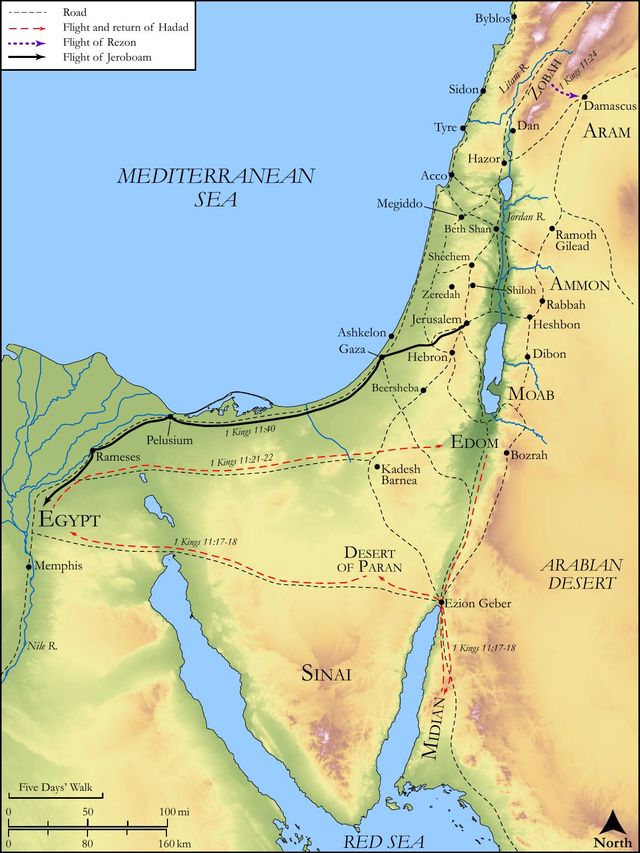
IV.Jeroboam's flight into Egypt, Kg1 11:40.
In some way or other Solomon came to know of all this, probably from Jeroboam's own talk of it; he could not conceal it as Saul did, nor keep his own counsel; if he had, he might have staid in his country, and been preparing there for his future advancement; but letting it be known,
1.Solomon foolishly sought to kill his successor. Had not he taught others that, whatever devices are in men's hearts, the counsel of the Lord shall stand? And yet does he himself think to defeat that counsel?
2.Jeroboam prudently withdrew into Egypt. Though God's promise would have secured him any where, yet he would use means for his own preservation, and was content to live in exile and obscurity for a while, being sure of a kingdom at last. And shall not we be so, who have a better kingdom in reserve?
Continue studying 1 Kings 11:38 across the web’s major study libraries — every link below opens this exact verse, chapter, or book on the destination site.
Read & Compare
 BibleGatewayThis verse in more than 200 translations and 70 languages.
 Bible.comThe YouVersion reader — hundreds of translations, reading plans, and highlights.
 ESV.orgCrossway's official English Standard Version reader.
 NET BibleThe NET translation with 60,000+ translators' notes on every rendering decision.
 STEP BibleTyndale House's free study tool — original text, vocabulary, and scholarly resources.
 BibliaLogos Bible Software's free web reader.
 USCCBThe New American Bible (Revised Edition) with the U.S. bishops' study notes.
Commentaries
 BibleHub CommentariesDozens of classic commentaries on this verse, gathered on one page.
 StudyLightMore than 100 commentary sets — the largest collection on the web.
 BibleRefPlain-English commentary on what this verse means, verse by verse.
 Enduring WordDavid Guzik's free commentary on this chapter, widely used by Bible teachers.
 Bible Study ToolsVerse commentary alongside Greek and Hebrew study aids.
Original Language & Research
- BibleHub InterlinearThe verse word by word — original language, transliteration, and English.
- BibleHub LexiconEvery word's original-language definition and Strong's entry.
 Blue Letter BibleDeep-study tools — Strong's numbers, concordance, and word studies.
 SefariaThe Hebrew text with Rashi and centuries of Jewish commentary.
Sermons, Hymns & Audio


TrulyRandomVerse is not affiliated with these sites and doesn’t control their content. They’re linked because they’re genuinely useful.
Summary
This pivotal verse in 1 Kings 11:38 conveys God's conditional promise to Jeroboam, offering him a stable and enduring dynasty over the ten northern tribes of Israel. This divine offer is explicitly contingent upon Jeroboam's complete obedience to God's commands and his commitment to walking in God's ways, mirroring the faithfulness demonstrated by King David. It highlights God's sovereignty in orchestrating the division of the kingdom as a consequence of Solomon's apostasy, while simultaneously extending a new opportunity for a righteous reign, provided Jeroboam fulfills the terms of this conditional covenant.
Context
ShowHideLiterary Context
This verse is part of a crucial prophetic oracle delivered by the prophet Ahijah of Shiloh to Jeroboam, a servant of Solomon, as recorded in 1 Kings 11:29-39. It immediately follows the divine pronouncement of judgment against King Solomon for his extensive idolatry and turning away from the Lord, specifically mentioned in 1 Kings 11:9-10. God declares His intent to tear the kingdom from Solomon's hand, leaving only one tribe (Judah) to his son for the sake of David and Jerusalem (1 Kings 11:11-13). Jeroboam is then designated to rule over the remaining ten tribes. Verse 38, therefore, presents the precise terms under which Jeroboam's reign, though divinely ordained in its inception, could become a lasting and blessed dynasty, explicitly drawing a parallel to the covenant God made with David. The subsequent narrative in 1 Kings 12 tragically reveals Jeroboam's failure to uphold these conditions, leading to the instability and eventual downfall of his own "house."
Historical & Cultural Context
The historical setting is the twilight of the united monarchy, following the glorious but ultimately flawed reign of Solomon. The concept of a "house" (Hebrew: bayit) in Israel extended beyond a physical dwelling to encompass a family, lineage, or dynasty. The promise to "build a sure house" was therefore a profound assurance of dynastic stability and longevity, a highly coveted blessing for any monarch. Kingship in Israel was ideally a covenantal office, where the king was expected to rule under God's authority, upholding the Mosaic Law. David served as the quintessential model of a king who, despite personal failings, maintained a heart generally devoted to God's ways, as seen in 1 Samuel 13:14. The division of the kingdom, though a consequence of Solomon's sin, was also a fulfillment of earlier prophecies and reflected underlying tensions between the northern tribes and the Davidic dynasty in Judah, particularly concerning taxation and forced labor.
Key Themes
ShowHideThe central theme is the Conditional Covenant, where God's blessing and the establishment of a lasting dynasty for Jeroboam are entirely dependent on his obedience to divine commands. This underscores a recurring biblical principle: while God's ultimate plan is sovereign, immediate blessings and consequences often hinge on human response and faithfulness. Another prominent theme is The Standard of David, with God repeatedly referring to "David my servant" as the model of faithfulness and obedience. David's reign, despite its imperfections, was characterized by a heart generally devoted to God's ways, setting a high benchmark for all subsequent kings of Israel. This verse also highlights Divine Sovereignty in Judgment and Promise, showing God actively orchestrating the division of the kingdom as a just consequence of Solomon's sin, yet simultaneously extending a new opportunity and promise to Jeroboam, demonstrating His control over earthly kingdoms and His justice. Finally, the promise to "build thee a sure house" signifies an Enduring Dynasty, echoing God's unconditional promise to David's lineage in 2 Samuel 7:16, but here, the promise to Jeroboam is explicitly conditional on his personal obedience, a crucial distinction.
Exposition and Analysis
ShowHideKey Word Analysis
ShowHideDerived from a primitive root, this term signifies far more than passive hearing. It implies intelligent listening, often with the strong implication of attention, comprehension, and, critically, obedient response. To "hearken" to God's commands means to internalize them, to submit to their authority, and to act in accordance with His will, forming the very foundation of covenant faithfulness and a life lived in submission to divine authority.
This primitive root, often used figuratively, describes a continuous course of life or mode of action. When applied to God's "ways" (derek), it denotes a consistent, habitual pattern of conduct that aligns with God's moral and ethical standards, rather than mere isolated acts of obedience. It encompasses the totality of one's life direction, signifying a journey of faithful adherence to God's character and revealed will.
This root word conveys the sense of being firm, faithful, reliable, and permanent. When God promises to build a "sure house," it signifies a dynasty that is firmly established, trustworthy, and enduring through generations. It contrasts sharply with the instability and short-lived reigns that would plague the Northern Kingdom, highlighting that true dynastic stability is rooted in God's faithfulness, contingent here upon human obedience.
Verse Breakdown
ShowHide"And it shall be, if thou wilt hearken unto all that I command thee"
This opening clause establishes the fundamental condition for the divine promise. God's blessings are contingent upon Jeroboam's active and obedient response to every command given by God, setting a high standard of comprehensive faithfulness. The emphasis is on a responsive and submissive heart.
"and wilt walk in my ways, and do [that is] right in my sight, to keep my statutes and my commandments"
This elaborates on the nature of the required obedience. "Walking in my ways" refers to a lifestyle of conformity to God's character and will. "Doing what is right in my sight" emphasizes the moral and ethical dimension of obedience, not merely outward compliance but an inner disposition aligned with God's perspective. "Keeping my statutes and my commandments" refers to the specific legal and moral instructions given through the Mosaic covenant, underscoring the comprehensive nature of the expected fidelity.
"as David my servant did"
This crucial phrase sets David as the exemplary standard for Jeroboam's kingship. Despite his personal failures, David's overall reign was characterized by a heart devoted to God, a commitment to God's law, and a willingness to repent when he sinned. He was a king who sought God's will and built a kingdom on the foundation of God's covenant, serving as the benchmark for all subsequent kings.
"that I will be with thee"
This is the first part of the divine promise, assuring Jeroboam of God's presence, support, and favor. God's "being with" someone signifies divine assistance, protection, and empowerment for the task at hand, a vital assurance for a newly appointed king.
"and build thee a sure house, as I built for David"
This is the core dynastic promise. God pledges to establish a stable and enduring dynasty for Jeroboam, mirroring the secure and lasting "house" He built for David. This promise of a "sure house" is the ultimate blessing for a king, ensuring the continuation of his lineage and rule, a sign of divine favor and legitimacy.
"and will give Israel unto thee"
This final clause confirms Jeroboam's dominion over the ten northern tribes, reiterating the divine appointment of his kingship over the majority of Israel, a direct consequence of Solomon's sin and God's sovereign judgment, and a clear mandate of authority.
Literary Devices
ShowHideThe verse prominently employs a Conditional Clause ("if... then..."), clearly delineating the cause-and-effect relationship between Jeroboam's obedience and God's promised blessings. This structure is characteristic of covenant theology throughout the Old Testament, emphasizing human responsibility within the divine-human relationship. A significant Simile or Analogy is used in the repeated phrase "as David my servant did" and "as I built for David." This establishes David as the benchmark for righteous kingship and the model for the promised dynastic stability, highlighting God's consistent principles across generations and setting a high standard for Jeroboam. The language itself is rich in Covenant Language, using terms like "command," "walk in my ways," "statutes," "commandments," and "build a sure house," all of which resonate with the established covenant framework between God and His people, particularly the Abrahamic and Mosaic covenants. The verse also demonstrates Divine Promise, where God, as the sovereign Lord, pledges specific blessings contingent on human faithfulness, showcasing His justice, mercy, and faithfulness to His own character.
Theological and Thematic Connections
ShowHideThis verse is a profound theological statement on the nature of divine blessing and human responsibility within a covenantal framework. It underscores that while God's sovereign plan will unfold (the division of the kingdom), the quality and duration of human participation in that plan are directly tied to obedience. It highlights God's justice in judging sin (Solomon's idolatry) and His grace in offering a new opportunity (to Jeroboam), yet always within the boundaries of His moral law. The "sure house" promise echoes the unconditional Davidic covenant, but its application to Jeroboam is starkly conditional, revealing that even divinely appointed leadership requires ongoing faithfulness to maintain God's favor and presence. This principle transcends the monarchy, speaking to the enduring truth that God desires a people who "walk in His ways" and that true stability, whether for an individual, a family, or a nation, is found in faithful adherence to His word.
Reflection and Application
ShowHide1 Kings 11:38 serves as a timeless reminder that divine favor and lasting blessing are intrinsically linked to obedience and a lifestyle of walking in God's ways. For Jeroboam, this meant the stability of his dynasty; for us, it speaks to the stability and fruitfulness of our lives, families, and ministries. God's promise to "be with thee" is a powerful assurance of His presence and empowering grace for those who genuinely seek to follow Him. This verse challenges us to examine our own lives: are we merely hearing God's commands, or are we actively hearkening to them, allowing them to shape our daily conduct and decisions? The standard of David, a man after God's own heart, calls us to a wholehearted devotion, acknowledging that while perfection is unattainable, a sincere desire to please God and a commitment to repentance when we fall short are paramount. Our legacy, both spiritual and temporal, is deeply impacted by our faithfulness to the Lord, and true security is found not in human schemes but in divine alignment.
Questions for Reflection
ShowHideFAQ
ShowHideWhy was Solomon punished, leading to the division of the kingdom?
ShowHideSolomon's punishment, leading to the division of the kingdom, was primarily due to his widespread idolatry and turning away from the Lord in his later years. Despite his wisdom and the magnificent temple he built, Solomon allowed his numerous foreign wives to introduce and practice their pagan religions, even building high places for their gods in Jerusalem. This directly violated God's commands against idolatry and intermarriage with foreign women who would lead Israel astray, as detailed in 1 Kings 11:1-8. God's anger was kindled because Solomon's heart was not fully devoted to the Lord, unlike that of his father, David.
What does "build thee a sure house" mean in this context?
ShowHideIn this context, "build thee a sure house" is a promise of an enduring and stable dynasty. The term "house" (Hebrew: bayit) refers to a royal lineage or family, not a physical building. "Sure" (Hebrew: ʼâman) implies reliability, faithfulness, and permanence. Therefore, God was promising Jeroboam that if he remained obedient, his line of descendants would continue to rule over the northern kingdom, providing dynastic stability similar to the secure, lasting "house" God had promised to David. Unfortunately, Jeroboam's subsequent disobedience led to the rapid instability and eventual end of his own "house," as seen in 1 Kings 14:10.
Did Jeroboam keep his end of the covenant, and what were the consequences?
ShowHideTragically, Jeroboam did not keep his end of the covenant. Despite God's clear instructions and the promise of a "sure house," Jeroboam quickly succumbed to fear and political expediency. To prevent the northern tribes from returning to Jerusalem for worship, which he feared would shift their allegiance back to the Davidic king, he established new centers of worship at Dan and Bethel, setting up golden calves for the people to worship. This act of idolatry, described in 1 Kings 12:26-33, became the "sin of Jeroboam" that plagued the Northern Kingdom throughout its history. As a consequence of his disobedience, God raised up prophets to pronounce judgment against Jeroboam's house, and his dynasty was indeed short-lived and violently overthrown, failing to become the "sure house" God had offered.
Christ-Centered Fulfillment
ShowHide1 Kings 11:38, with its conditional promise to Jeroboam, powerfully foreshadows the ultimate "sure house" and perfect obedience found in Jesus Christ. While Jeroboam failed to "hearken" and "walk in God's ways," leading to the instability of his earthly dynasty, Jesus perfectly fulfilled every command of God. He is the true "David my servant," not merely a model, but the very Son of David, whose obedience was absolute and unwavering, even to the point of death on a cross (Philippians 2:8). Unlike the conditional promise to Jeroboam, God's covenant with Christ is eternally sure and unconditional, establishing a kingdom that will never end (Luke 1:33). Jesus is the one in whom God is always "with thee," for He is Emmanuel, God with us (Matthew 1:23). Through His perfect life, atoning death, and glorious resurrection, Christ has built not merely a physical dynasty, but a spiritual "sure house" for all who believe—the Church, His body (Ephesians 2:19-22). In Him, the promises of God find their "Yes" and "Amen" (2 Corinthians 1:20), offering an eternal, unshakable kingdom and an everlasting presence for those who are "in Christ," a stability that no human king, including Jeroboam, could ever provide.